Quantum simulations of Green's functions for small superfluid systems
Pith reviewed 2026-05-18 20:05 UTC · model grok-4.3
The pith
A hybrid quantum-classical strategy computes accurate one-body Green's functions for small superfluid systems across the normal-to-superfluid transition.
A machine-rendered reading of the paper's core claim, the machinery that carries it, and where it could break.
Core claim
By accessing the N-body ground state through variational techniques and constructing the (N±1)-body eigenstates and energies with the quantum subspace expansion method, the spectral representation produces one-body Green's functions that accurately approximate the exact ones for the pairing model, including in the superfluid regime. As a result, odd systems are also well described when the even system is accurately captured.
What carries the argument
The spectral representation of the Green's function, which requires the ground state of the N-body system plus eigenstates and energies of the (N±1)-body neighbors, realized through a combination of variational ansatzes and quantum subspace expansion.
If this is right
- The computed Green's functions remain accurate across the normal-to-superfluid transition.
- A good description of odd systems follows whenever the even-N ground state is well reproduced by the variational ansatz.
- Different ansatzes, whether classical or quantum, can be substituted and directly compared to exact results.
Where Pith is reading between the lines
- The same hybrid workflow could be tested on other solvable nuclear models to check whether accuracy persists when the interaction changes.
- Success for small systems suggests the method could serve as a benchmark for future quantum hardware applied to larger pairing-like Hamiltonians.
- The ability to handle the phase transition hints that response functions or other spectral quantities might be accessible with modest extensions of the subspace expansion.
Load-bearing premise
The variational ansatz for the even-N ground state must be sufficiently accurate and the quantum subspace expansion must span the relevant eigenstates of the (N±1) systems.
What would settle it
Direct comparison of the computed Green's functions against exact diagonalization for interaction strengths or particle numbers where the chosen variational ansatz visibly deviates from the true ground state.
Figures



read the original abstract
An end-to-end strategy for hybrid quantum-classical computations of Green's functions in many-body systems is presented and applied to the pairing model. The scheme makes explicit use of the spectral representation of the Green's function, which entails the calculation of the $N$-body ground state as well as eigenstates and associated energies of the $(N\pm1)$-body neighbors. While the former is accessed via variational techniques, the latter are constructed by means of the quantum subspace expansion method. Different ansatzes for the ground-state wave function, originating from either classical or quantum approaches, are tested and compared to exact calculations. The resulting one-body Green's functions prove to be accurate approximations of the exact one for a large range of parameters, including across the normal-to-superfluid transition. As a byproduct, this approach yields a good description of odd systems provided that the starting even system is well reproduced by the variational ansatz.
Editorial analysis
A structured set of objections, weighed in public.
Referee Report
Summary. The manuscript presents a hybrid quantum-classical strategy for computing one-body Green's functions in small superfluid systems via the pairing model. It reconstructs G(ω) from its spectral representation by obtaining the even-N ground state variationally and the (N±1) eigenstates via quantum subspace expansion (QSE), testing classical and quantum ansatzes against exact results. The central claim is that the resulting Green's functions remain accurate approximations to the exact ones over a wide parameter range, including across the normal-to-superfluid transition, with the additional benefit of describing odd systems when the even reference is well reproduced.
Significance. If the accuracy claims hold with quantitative support, the work offers a concrete route to Green's function calculations on near-term quantum devices for nuclear many-body problems involving pairing, where exact methods scale poorly. The explicit use of the spectral representation and the byproduct for odd-A systems are strengths that could inform extensions to more realistic nuclear Hamiltonians.
major comments (2)
- [Results on the pairing model and variational ansatz comparisons] The central claim of accuracy across the normal-to-superfluid transition (abstract and results) depends on the variational even-N ansatz retaining high fidelity with the exact ground state, particularly its pairing correlations, as the wavefunction character changes when g crosses the critical value set by level spacing. No quantitative fidelity or overlap data versus g are supplied near this point, which is load-bearing for the reconstruction of G(ω).
- [Quantum subspace expansion method and spectral reconstruction] The QSE construction for the (N±1) eigenstates must capture all states with appreciable spectral weight in the sum for G(ω). Near the transition the (N±1) spectrum densifies; without explicit truncation-error estimates, subspace-size convergence checks, or weight-distribution plots, it is unclear whether the reconstructed spectral function remains faithful.
minor comments (2)
- [Abstract] The abstract asserts accuracy 'for a large range of parameters' without quoting any error metrics, RMS deviations, or specific g values; cross-references to quantitative tables or figures should be added.
- [Methods] Notation for the full spectral representation of G(ω), including both particle and hole contributions, would benefit from an explicit equation early in the methods section for clarity.
Simulated Author's Rebuttal
We thank the referee for the careful reading of our manuscript and the constructive comments. We address each major comment below and indicate the revisions we will make to strengthen the presentation.
read point-by-point responses
-
Referee: [Results on the pairing model and variational ansatz comparisons] The central claim of accuracy across the normal-to-superfluid transition (abstract and results) depends on the variational even-N ansatz retaining high fidelity with the exact ground state, particularly its pairing correlations, as the wavefunction character changes when g crosses the critical value set by level spacing. No quantitative fidelity or overlap data versus g are supplied near this point, which is load-bearing for the reconstruction of G(ω).
Authors: We agree that explicit quantitative fidelity data would strengthen the manuscript. Although the accuracy of the reconstructed Green's functions is demonstrated by direct comparison to exact results across the transition (which requires the variational state to capture the relevant pairing correlations), we will add in the revision a plot of the overlap between each variational ansatz and the exact ground state as a function of g, with emphasis on the region near the critical value. This will make the load-bearing assumption fully transparent. revision: yes
-
Referee: [Quantum subspace expansion method and spectral reconstruction] The QSE construction for the (N±1) eigenstates must capture all states with appreciable spectral weight in the sum for G(ω). Near the transition the (N±1) spectrum densifies; without explicit truncation-error estimates, subspace-size convergence checks, or weight-distribution plots, it is unclear whether the reconstructed spectral function remains faithful.
Authors: We acknowledge the value of explicit truncation diagnostics. The manuscript already shows close agreement with exact Green's functions for the subspace sizes employed, indicating that the dominant spectral weight is captured. In the revision we will add (i) a brief estimate of the truncation error by bounding the contribution of omitted states, (ii) subspace-size convergence results for representative values of g near the transition, and (iii) a short discussion of the spectral-weight distribution. These additions will confirm the faithfulness of the reconstruction. revision: yes
Circularity Check
No significant circularity; computational procedure validated against external exact benchmarks
full rationale
The paper outlines a hybrid quantum-classical workflow: variational ansatz for the even-N ground state, quantum subspace expansion to obtain (N±1) eigenstates and energies, followed by direct construction of the one-body Green's function from its spectral representation. These outputs are then compared to exact diagonalization results for the pairing model over a range of parameters. No equation, ansatz, or claim reduces by construction to a fitted input, self-referential definition, or load-bearing self-citation chain; the accuracy statements rest on independent numerical verification rather than internal equivalence.
Axiom & Free-Parameter Ledger
axioms (1)
- domain assumption The spectral representation expresses the Green's function exactly in terms of eigenstates and energies of the N and N±1 systems.
Forward citations
Cited by 1 Pith paper
-
Improved quasiparticle nuclear Hamiltonians for quantum computing
Brillouin-Wigner perturbation theory plus Hartree-Fock mean-field approximation upgrades quasiparticle nuclear Hamiltonians, yielding <0.2% and ~2% ground-state energy errors versus exact shell-model results in the sd...
Reference graph
Works this paper leans on
-
[1]
This approximate ground state is denoted by |eΨN 0 ⟩ be- low
Given a parametrized circuit as the wave-function ansatz, the variational quantum eigensolver (VQE) hybrid method is used to obtain an approximation of the N-particle ground-state wave-function. This approximate ground state is denoted by |eΨN 0 ⟩ be- low. Note that only ansatzes possessing the correct particle number are considered here
-
[2]
To construct states with N ± 1 particles, two pools of operators {A+ α }α=1,··· ,Ω and {A− α }α=1,··· ,Ω are chosen. Each operator in the former (latter) has the effect of increasing (reducing) particle number by one unit when applied to the reference state |eΨN 0 ⟩, which results in two new sets of (eventually non- orthogonal) states |ϕN+1 1 ⟩, · · · , |...
-
[3]
(7) is distributed between the Quantum processor unit (QPU) and the classical one (CPU), as follows
Approximate eigenstates of the Hamiltonian for N ± 1 particles |eΨN ±1 k ⟩ = X α cN ±1 α (k)|ϕN ±1 α ⟩ , (6) 3 together with their corresponding eigenvalues eEN ±1 k , can be obtained by solving a generalized eigenvalue problem in the two reduced subspaces defined above, which is written as X β cN ±1 α (k)HN ±1 βα = eEN ±1 k X β cN ±1 α (k)ON ±1 βα , (7) ...
-
[4]
(9) The spectroscopic amplitudes appearing in the nu- merators in Eq
Finally, an approximate Green’s function is built using these eigenelements as Gij(ω) = X k ⟨eΨN 0 |ai|eΨN+1 k ⟩⟨eΨN+1 k |a† j|eΨN 0 ⟩ ω − (eEN+1 k − eEN 0 ) + iη + X k′ ⟨eΨN 0 |a† j|eΨN −1 k′ ⟩⟨eΨN −1 k′ |ai|eΨN 0 ⟩ ω − (eEN 0 − eEN −1 k′ ) − iη . (9) The spectroscopic amplitudes appearing in the nu- merators in Eq. (9) can be obtained by combin- ing exp...
-
[5]
Particle-number projected BCS state Let us consider the BCS state |Φ⟩ ≡ q−1Y i=0 ui + via† i a† ¯i |−⟩ , (19) 6 where |−⟩ is the particle vacuum. The real parame- ters ( ui, vi) determine the Bogolyubov transformation linking the single-particle and BCS quasiparticle cre- ation/annihilation operators [60]. It is easy to see that the state (19) has compone...
-
[6]
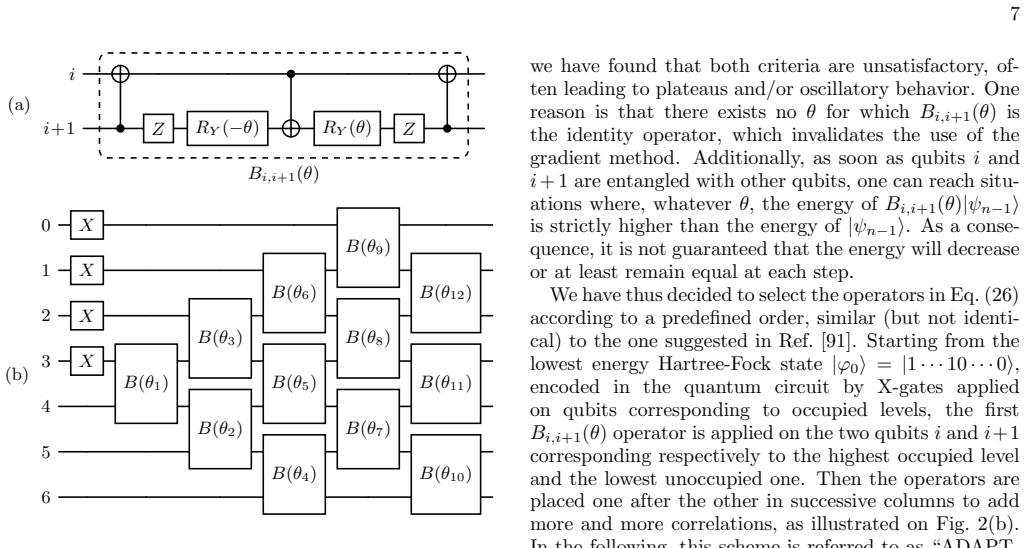
Particle-number conserving ADAPT-VQE state We now present an alternative set of quantum com- puting ansatzes for the preparation of the pairing Hamiltonian ground state. These ansatzes are based on or inspired by the adaptive derivative-assembled pseudo-Trotter ansatz variational quantum eigensolver (ADAPT-VQE) approach [77]. In Ref. [70], it was shown th...
-
[7]
|φ0⟩ is a chosen state that serves as a seed to ini- tiate the iterative process. Here we use the simple state where only the lowest energy levels are oc- cupied, which in term of qubits reads as |φ0⟩ = |1 · · ·10 · · ·0⟩
-
[8]
A new trial state is then built fol- lowing Eq
At each iteration n ≥ 1, an operator is selected under the criterion that the energy gradient ∂En ∂θn θn=0 = i⟨φn−1| [H, Gαn] |φn−1⟩ , (22) with En ≡ ⟨φn|H|φn⟩ , (23) is extremized. A new trial state is then built fol- lowing Eq. (21). Finally, in order to speed up the convergence, the full set of parameters ( θ1, · · · , θn) is re-optimized by minimizing...
-
[9]
The iterative procedure is stopped when the gain in energy between two steps is below a given thresh- old. Several different choices can be made for the set of operators {Gα}. Following Ref. [70], we first tested the so-called single qubit excitation-based pool (QEB-Pool) proposed in Ref. [80]. This set has the advantage of per- forming unitary operations...
-
[10]
Calculations have been performed using the quantum emulation soft- ware QISKIT [92]
Results We have tested these adaptive methods in the context of the pairing model for different particle numbers N, en- ergy levels D, and interaction strengths g. Calculations have been performed using the quantum emulation soft- ware QISKIT [92]. Figure 3 shows the resulting ground- state energies for the case N = D = 8 (i.e., half filling) and for thre...
-
[11]
Scaling of QPU computations Starting from the ground-state approximation |eΨN 0 ⟩, one needs to evaluate the 4Ω 2 expectation values in- troduced in Eqs. (8). The current choice for opera- 9 14 16 18 20 Energy / E (a) Exact PAV-BCS VAP-BCS Adapt-St Adapt-Min Adapt-Fix 10 6 10 4 10 2 100 Relative error (b) 0.2 0.4 0.6 0.8 1.0 g/ E 10 8 10 6 10 4 10 2 1 - F...
-
[12]
Odd systems An interesting byproduct of the use of the QSE ap- proach is that one has access to approximate eigenener- gies of the neighboring odd systems with N ±1 particles. In this section we analyze the quality of the description of these odd systems for the different approaches con- sidered in this study. Figure 5 shows the approximate correlation en...
-
[13]
Results for Green’s functions We now turn to the main objective of the article, i.e., the evaluation of one-body Green’s functions for small superfluid systems following the strategy highlighted in Sec. II B. Results based on the PAV, VAP, and ADAPT- Min approximations of the ground state are shown in Fig. 6 and compared with exact calculations. The same ...
work page 2030
- [14]
-
[15]
Som` a, Self-consistent Green’s function theory for atomic nuclei, Front
V. Som` a, Self-consistent Green’s function theory for atomic nuclei, Front. Phys. 8, 340 (2020)
work page 2020
-
[16]
Rios, Green’s Function Techniques for Infinite Nuclear Systems, Front
A. Rios, Green’s Function Techniques for Infinite Nuclear Systems, Front. Phys. 8, 387 (2020)
work page 2020
- [17]
-
[18]
M. Vorabbi, C. Barbieri, V. Som` a, P. Finelli, and C. Giusti, Microscopic optical potentials for medium-mass isotopes derived at the first order of Watson multiple- scattering theory, Phys. Rev. C 109, 034613 (2024)
work page 2024
-
[19]
Schirmer, May-Body Methods for Atoms, Molecules and Clusters, Lecture Notes in Chemistry 94 1 (2018)
J. Schirmer, May-Body Methods for Atoms, Molecules and Clusters, Lecture Notes in Chemistry 94 1 (2018)
work page 2018
-
[20]
C. Barbieri and A. Carbone, Self-Consistent Green’s Function Approaches, Lecture Notes in Physics 936 571 (2017)
work page 2017
- [21]
- [22]
-
[23]
S. McArdle, S. Endo, A. Aspuru-Guzik, S. C. Benjamin, and X. Yuan, Quantum computational chemistry , Rev. Mod. Phys., 92, 015003, (2020)
work page 2020
-
[24]
M. Motta and J. E. Rice, Emerging quantum comput- ing algorithms for quantum chemistry , WIREs Compu- tational Molecular Science, 12, e1580, (2022)
work page 2022
- [25]
-
[26]
B. Fauseweh, Quantum many-body simulations on digi- tal quantum computers: State-of-the-art and future chal- lenges, Nat. Commun., 15, 2123, (2024)
work page 2024
-
[27]
D. Wu, R. Rossi, F. Vicentini, N. Astrakhantsev, F. Becca, X. Cao, J. Carrasquilla, F. Ferrari, A. Georges, M. Hibat-Allah, et al., Variational benchmarks for quan- tum many-body problems, Science, 386, 296, (2024)
work page 2024
-
[28]
E. A. Ruiz Guzman and D. Lacroix, Accessing ground- state and excited-state energies in a many-body system after symmetry restoration using quantum computers , Phys. Rev. C 105, 024324 (2022)
work page 2022
-
[29]
D. Lacroix, E. A. Ruiz Guzman, and P. Siwach, Symme- try breaking/symmetry preserving circuits and symmetry restoration on quantum computers , Eur. Phys. J. A 59, 3 (2023). 14
work page 2023
-
[30]
E. A. Ruiz Guzman and D. Lacroix, Restoring broken symmetries using quantum search “oracles” , Phys. Rev. C 107, 034310 (2023)
work page 2023
-
[31]
E. A. Ruiz Guzman and D. Lacroix, Restoring sym- metries in quantum computing using Classical Shadows , Eur. Phys. J. A 60, 112 (2024)
work page 2024
-
[32]
Srivastava, Prediction of the neutron drip line in oxygen isotopes using quantum computation , Phys
Chandan Sarma, Olivia Di Matteo, Abhishek Abhishek, and Praveen C. Srivastava, Prediction of the neutron drip line in oxygen isotopes using quantum computation , Phys. Rev. C, 108, 064305, (2023)
work page 2023
-
[33]
A. P´ erez-Obiol, A. M. Romero, J. Men´ endez, A. Rios, A. Garc´ ıa-S´ aez, and B. Juli´ a-D´ ıaz,Nuclear shell-model simulation in digital quantum computers , Sci. Rep., 13, 12291, (2023)
work page 2023
- [34]
-
[35]
S. Yoshida, T. Sato, T. Ogata, T. Naito, and M. Kimura, Accurate and precise quantum computation of valence two-neutron systems, Phys. Rev. C, 109, 064305, (2024)
work page 2024
-
[36]
B. Bhoy and P. Stevenson, Shell-model study of 58Ni us- ing quantum computing algorithm , New J. Phys. A 26, 075001 (2024)
work page 2024
-
[37]
Y. Yang, R. Yang, and X. Xu, Quantum-enhanced Green’s function Monte Carlo algorithm for excited states of the nuclear shell model , Phys. Rev. A, 110, 042623, (2024)
work page 2024
- [38]
- [39]
- [40]
-
[41]
E. F. Dumitrescu, A. J. McCaskey, G. Hagen, G. R. Jansen, T. D. Morris, T. Papenbrock, R. C. Pooser, D. J. Dean, and P. Lougovski, Cloud Quantum Computing of an Atomic Nucleus , Phys. Rev. Lett., 120, 210501, (2018)
work page 2018
-
[42]
O. Kiss, M. Grossi, P. Lougovski, F. Sanchez, S. Val- lecorsa, and T. Papenbrock, Quantum computing of the Li6 nucleus via ordered unitary coupled clusters , Phys. Rev. C, 106, 034325, (2022)
work page 2022
-
[43]
M. Carrasco-Codina, E. Costa, A. M´ arquez Romero, J. Men´ endez and A. Rios, Comparison of variational quantum eigensolvers in light nuclei , arXiv:2507.13819 (2025)
-
[44]
S. Endo, I. Kurata and Y. O. Nakagawa, Calculation of the Green’s function on near-term quantum computers , Phys. Rev. Research 2, 033281 (2020)
work page 2020
-
[45]
R. Sakurai, W. Mizukami and H. Shinaoka, Hybrid quantum-classical algorithm for computing imaginary- time correlation functions , Phys. Rev. Research 4, 023219 (2022)
work page 2022
- [46]
- [47]
-
[48]
A circuit-differentiation framework for Green's functions on quantum computers
S. Piccinelli, F. Tacchino, I. Tavernelli, G. Carleo, Efficient calculation of Green’s functions on quan- tum computers via simultaneous circuit perturbation , arXiv:2505.05563 (2025)
work page internal anchor Pith review Pith/arXiv arXiv 2025
-
[49]
T. E. Baker, Lanczos recursion on a quantum computer for the Green’s function and ground state , Phys. Rev. A 103, 032404 (2021)
work page 2021
-
[50]
G. Greene-Diniz, D. Z. Manrique, K. Yamamoto, E. Plekhanov, N. Fitzpatrick, M. Krompiec, R. Sakuma, D. Mu˜ noz Ramo,Quantum Computed Green’s Functions us- ing a Cumulant Expansion of the Lanczos Method, Quan- tum 8, 1383 (2024)
work page 2024
-
[51]
S. Kanasugi, S. Tsutsui, Y. O. Nakagawa, K. Maruyama, H. Oshima and S. Sato, Computation of Green’s function by local variational quantum compilation, Phys. Rev. Re- search 5, 033070 (2023)
work page 2023
- [52]
-
[53]
R. W. Richardson and N. Sherman, Exact eigenstates of the pairing-force Hamiltonian , Nucl. Phys. 52, 221 (1964)
work page 1964
-
[54]
R. W. Richardson, Numerical Study of the 8-32-Particle Eigenstates of the Pairing Hamiltonian , Phys. Rev. 141, 949 (1966)
work page 1966
-
[55]
J. Dukelsky, S. Pittel, and G. Sierra, Exactly solvable Richardson-Gaudin models for many-body quantum sys- tems, Rev. Mod. Phys. 76, 643 (2004)
work page 2004
-
[56]
A. L. Fetter and J. D. Walecka, Quantum Theory of Many-Particle Systems (McGraw-Hill, New York, 1971)
work page 1971
-
[57]
V. M. Galitskii and A. B. Migdal, Application of quantum field theory methods to the many-body problem , Z. Eksp. Teor. Fiz. 34, 139 (1958)
work page 1958
-
[58]
D. S. Koltun, Total Binding Energies of Nuclei and Particle-Removal Experiments, Phys. Rev. Lett. 28, 182 (1972)
work page 1972
-
[59]
H. F. Trotter, On the product of semi-groups of operators, Proc. Am. Math. Soc. 10, 545 (1959)
work page 1959
-
[60]
S. McArdle, S. Endo, A. Aspuru-Guzik, S. C. Benjamin and X. Yuan, Quantum computational chemistry , Rev. Mod. Phys. 92, 015003 (2020)
work page 2020
-
[61]
H. Lehmann, ¨Uber Eigenschaften von Ausbreitungs- funktionen und Renormierungskonstanten quantisierter Felder, Nuovo Cim. 11, 342 (1954)
work page 1954
- [62]
- [63]
-
[64]
J. R. McClean, M. E. Kimchi-Schwartz, J. Carter, and W. A. de Jong, Hybrid quantum-classical hierarchy for mitigation of decoherence and determination of excited states, Phys. Rev. A 95, 042308 (2017)
work page 2017
-
[65]
J. R. McClean, Z. Jiang, N. C. Rubin, R. Babbush, and H. Neven, Decoding quantum errors with subspace expan- sions, Nat. Commun. 11, 636 (2020)
work page 2020
-
[66]
T. Takeshita, N. C. Rubin, Z. Jiang, E. Lee, R. Bab- bush, and J. R. McClean, Increasing the Representation Accuracy of Quantum Simulations of Chemistry With- out Extra Quantum Resources, Phys. Rev. X 10, 011004 15 (2020)
work page 2020
-
[67]
N. Yoshioka, T. Sato, Y. O. Nakagawa, Y. Ohnishi, and W. Mizukami, Variational quantum simulation for peri- odic materials, Phys. Rev. Research 4, 013052 (2022)
work page 2022
- [68]
- [69]
-
[70]
B. Gauthier, P. Rosenberg, A. Foley and M. Charlebois, An occupation number quantum subspace expansion ap- proach to compute the single-particle Green function: an opportunity for noise filtering, Phys. Rev. A 110, 032624 (2024)
work page 2024
-
[71]
J. von Delft and D. C. Ralf, Spectroscopy of discrete en- ergy levels in ultrasmall metallic grains , Phys. Rep. 345, 61 (2001)
work page 2001
-
[72]
V. Zelevinsky and A. Volya, Nuclear pairing New per- spectives, Phys. of Atomic Nuclei 66, 1781 (2003)
work page 2003
-
[73]
D. M. Brink and R. A. Broglia, Nuclear Superfluidity: Pairing in Finite Systems (Cambridge University Press, Cambridge, UK, 2005)
work page 2005
-
[74]
P. Ring and P. Schuck, The Nuclear Many-Body Problem (Springer-Verlag, New-York, 1980)
work page 1980
-
[75]
J. P. Blaizot and G. Ripka, Quantum Theory of Finite Systems (MIT Press, Cambridge, 1986)
work page 1986
-
[76]
M. Bender, P.-H. Heenen, and P.-G. Reinhard, Self- consistent mean-field models for nuclear structure , Rev. Mod. Phys. 75, 121 (2003)
work page 2003
-
[77]
Lacroix, Symmetry-Assisted Preparation of Entangled Many-Body States on a Quantum Computer , Phys
D. Lacroix, Symmetry-Assisted Preparation of Entangled Many-Body States on a Quantum Computer , Phys. Rev. Lett. 125, 230502 (2020)
work page 2020
-
[78]
A. Khamoshi, T. Henderson, and G. Scuseria, Correlat- ing AGP on a quantum computer , Quant. Sci. Technol. 6, 014004 (2021)
work page 2021
- [79]
-
[80]
Ovrum, Quantum computing and many-body physics , Master’s thesis, University of Oslo, (2003)
E. Ovrum, Quantum computing and many-body physics , Master’s thesis, University of Oslo, (2003)
work page 2003
discussion (0)
Sign in with ORCID, Apple, or X to comment. Anyone can read and Pith papers without signing in.