REVIEW 2 major objections 4 minor 2 cited by
The incidence of magnetism in blue and yellow straggler stars
T0 review · 2 major / 4 minor · reviewed 2026-08-15 · deepseek-v4-flash
Pith's one-line read This paper reports the first observational evidence that blue and yellow straggler stars possess magnetic fields of the order of a hundred to a few hundred Gauss, measured with HARPSpol spectropolarimetry and least-squares deconvolution.
desk verdict First magnetic field detections in blue and yellow stragglers are credible, but weak membership for half the sample makes the abstract's broad claim overreach. read the letter →
The pith
A machine-rendered reading of the paper's core claim, the machinery that carries it, and where it could break.
The reading
What carries the argument
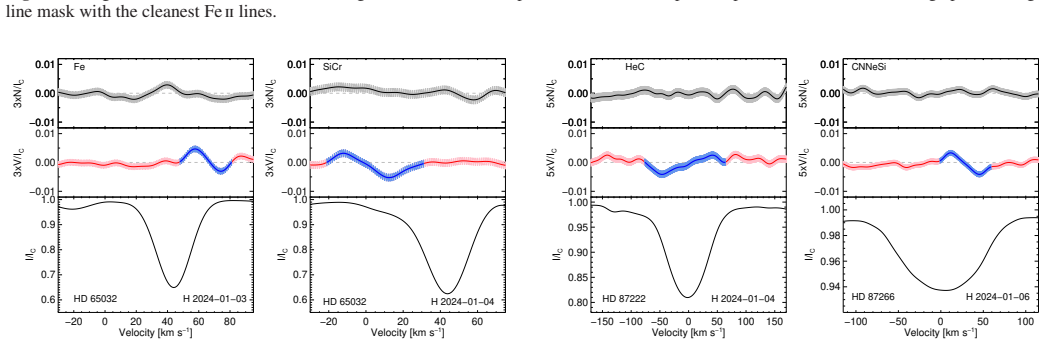
The central technique is least-squares deconvolution (LSD), which combines the information from thousands of individual metal and helium lines in HARPSpol spectra into a single mean profile, greatly increasing the sensitivity to the circularly polarized Zeeman signature from which the mean longitudinal magnetic field ⟨Bz⟩ is measured. Detection significance is set by the false alarm probability (FAP) criterion of Donati et al. (1992): FAP ≤ 10⁻⁵ is a definite detection, 10⁻⁵ < FAP ≤ 10⁻³ is marginal, and larger values are non-detections. The sample is drawn from the Gaia DR2-based catalogue of blue stragglers in open clusters, selecting stars in clusters of different ages and metallicities so that any dependence of magnetism on the cluster environment can be tested.
What would settle it
Check the cluster membership of the eight targets with Gaia DR3 astrometry and radial velocities; if any star with a definite magnetic detection, especially HD 62329 (membership probability 0.5) or HD 101545 (not in the Rain catalogue), turns out to be a field star unassociated with its assigned cluster, then the measured fields belong to ordinary stars and the claim that stragglers host these fields is not supported.
Extended reading notes
Core claim
The central claim is that blue straggler and yellow straggler stars host magnetic fields with strengths of roughly one hundred to a few hundred Gauss, comparable to the fields of ordinary magnetic OBA stars. Using the least-squares deconvolution technique on HARPSpol spectra, the authors achieve definite detections of a longitudinal field in four blue stragglers and three yellow stragglers, with a marginal detection in one further blue straggler; measured values include ⟨Bz⟩ = 156±46 G and −582±86 G across different nights. Because blue and yellow stragglers are theorized to be merger products or rejuvenated stars in mass-transfer binaries, the detection of magnetic fields in them is taken as observational support for the idea that strong binary interactions generate or preserve such fields. The paper also reports the first definite magnetic-field detection in a Be-shell star (HD 61954), and notes that two yellow stragglers and one blue straggler in the sample appear to be binary or triple systems.
Load-bearing premise
The central claim rests on all eight measured stars really being blue or yellow stragglers that belong to their assigned open clusters, yet membership probabilities for some targets are as low as 0.5, one star is reclassified as a yellow straggler only from its Gaia colour, and one is absent from the Gaia-based catalogue entirely.
Editorial extensions
If this is right
- If true, these detections show that binary mass transfer or stellar mergers produce observable magnetic fields in intermediate-mass stars with radiative envelopes, supporting the merger scenario for magnetic field origin.
- The absence of any detected correlation between field strength or incidence and cluster age or metallicity suggests the magnetic field generation in stragglers is set by the binaries' internal evolution rather than by the cluster environment.
- Newly discovered binarity and multiplicity among the magnetized targets strengthens the case that stragglers are the missing short-period binaries of magnetic Ap/Bp stars.
- The first definite magnetic detection in a Be-shell star implies that magnetic fields can also be present in at least some Be-shell objects, with potential consequences for the physics of their circumstellar disks.
- The paper motivates a wider spectropolarimetric survey of the remaining bright blue and yellow stragglers in the Gaia-based catalogue to measure the true incidence of magnetism in these stars.
Reading between the lines
- A detection in seven of eight targets, if it holds in a larger sample, would imply that magnetism is far more common among stragglers than among ordinary OBA stars, where the incidence is about 10–15%; the present sample is too small to establish this, but it suggests stragglers could be a magnetically over-represented population.
- Because the measured field is the rotation-modulated longitudinal component, the spread between the two epochs for individual stars (e.g., HD 61954, HD 62329) is consistent with oblique rotators like Ap/Bp stars; phase-resolved monitoring could test whether the field geometry is dipolar or more complex, as expected shortly after a merger.
- A testable extension: search for the same Nd iii and Pr iii rare-earth spot signatures in a larger sample of stragglers; if they appear preferentially in the magnetic targets, it would indicate that the fields are strong enough to drive the chemical spot formation seen in Ap/Bp stars.
- If the magnetic incidence among stragglers truly exceeds that of normal OBA stars, then the straggler channel could be an important missing piece in explaining the fossil-field fraction in intermediate-mass and massive stars.
Signed reviews
Editorial analysis
A structured set of objections, weighed in public.
Referee Report
Summary. The paper presents HARPSpol spectropolarimetric observations of eight blue and yellow straggler candidates in five open clusters (NGC 2437, NGC 2447, Trumpler 9, NGC 3114, IC 2944). Using least-squares deconvolution with element-specific line masks, the authors measure mean longitudinal magnetic fields and report definite detections in four blue stragglers and three yellow stragglers, with field strengths of tens to a few hundred Gauss, including the first definite detection in the Be-shell star HD 61954. They further identify several targets as binary or triple systems and find weak Nd III lines in two yellow stragglers. The paper concludes that these observations provide the first evidence that blue and yellow straggler stars can host magnetic fields, supporting merger and mass-transfer origin scenarios.
Significance. The observational methodology is a clear strength: the LSD analysis follows established procedures, null spectra are checked for all measurements, and multiple epochs for some targets (HD 61954, HD 62329, HD 62775, HD 65032) show independent detections. If the target classifications are correct, the result is significant because it connects the straggler phenomenon to magnetic field generation, offering a direct test of fossil-field versus binary-interaction dynamo theories. However, the significance is tempered by the small sample size (eight stars) and, more critically, by the uncertain straggler status of four of the eight targets; the paper would be substantially strengthened by a robustness analysis that restricts the sample to secure cluster members or by a more measured statement of the conclusions.
major comments (2)
- [Section 2, Table 2] The central claim that blue and yellow straggler stars possess magnetic fields rests entirely on the eight targets being genuine stragglers of their assigned clusters. Four of the eight have weak or indirect membership/classification: HD 61954 (Rain et al. 2021 membership probability 0.8), HD 62329 (probability 0.5), HD 65032 (reclassified as a YSS from Gaia colors, with the caveat in Sect. 3.3 that the effect of a magnetic field on Gaia colors is unexplored), and HD 101545 (absent from the Rain catalog, membership from Baumgardt et al. 2000 with p=0.83, and a spectral type O9.5Ib that is not a classical blue straggler). The paper acknowledges these limitations but does not show that the headline conclusion survives when only the secure stragglers (e.g., p≥0.9 or independently confirmed membership) are retained. Please provide such a robustness analysis or temper the abstract's claim to reflect the uncertainty in the target identifications.
- [Table 2 and Section 3.1] The definite detection for HD 62000 with the Fe mask is listed as ⟨Bz⟩ = -4±29 G, which is consistent with zero field; the only non-zero measurement is a marginal detection from the Ti mask (-111±43 G). As presented, this target does not support the statement that yellow stragglers possess fields of the order of a hundred Gauss, and it is unclear on what basis it is counted among the definite detections. Please clarify whether the Zeeman signature is robust and whether the summary counts should include this target; if the detection is real but the longitudinal field cancels due to geometry or line-blending, that should be explained explicitly.
minor comments (4)
- [Title] The title contains a typo: 'straggler star s' should read 'straggler stars'.
- [Section 2 and Table 2] Section 2 describes the sample as six BSSs and two YSSs, but after the reclassification of HD 65032 as a YSS (Sect. 3.3) the sample becomes five BSSs and three YSSs; the text should be internally consistent about this reclassification.
- [Table 2 and Section 3.3] The FAP value for HD 65032 on the first epoch is listed as 0.5×10^-5 and flagged as 'MD', but 0.5×10^-5 = 5×10^-6 is below the 10^-5 threshold for a definite detection defined in Section 3. Please correct this inconsistency or explain the labeling; the same issue appears in the text where this measurement is described as marginal.
- [Abstract and Section 4] The statement that no relationship is found between the presence or strength of the magnetic field and cluster characteristics is based on only eight stars with heterogeneous sampling (different line masks, single versus multiple epochs). This null result should be explicitly described as preliminary, as the authors themselves note later in Section 4, rather than stated without qualification in the abstract.
Circularity Check
No significant circularity: the paper is an observational spectropolarimetric survey with externally benchmarked reduction and detection criteria; its central claim does not reduce to its inputs by construction.
full rationale
The paper's central claim is an empirical detection claim, not a derivation: mean longitudinal magnetic fields are measured from HARPSpol Stokes V spectra via the LSD technique following Donati et al. (1997), with line data from VALD3 and fixed FAP thresholds from Donati et al. (1992). The target selection is independent of the measured quantity: BSS/YSS status comes from the Gaia DR2-based catalogue of Rain et al. (2021) or from earlier external catalogues (Ahumada & Lapasset 2007; Baumgardt et al. 2000), and the magnetic-field measurements use spectral masks and polarimetric signals that do not enter the straggler classification. No parameter is fitted to a subset and then renamed as a prediction, and no target quantity is defined in terms of the result. The paper's own caveats about weak cluster membership or the reclassification of HD 65032 as a YSS from Gaia colours affect the robustness of the astrophysical interpretation, not the logical independence of the measurement from the conclusion. Self-citations to Hubrig et al. (2013, 2023) concern reduction procedures and comparative statements about magnetic binaries; they are methodological or contextual, not load-bearing uniqueness claims, and the main interpretive framework also rests on independent theoretical work (e.g., Schneider et al. 2019; Tout et al. 2008; Ferrario et al. 2009). Consequently, no circularity step can be exhibited with the required specificity, and the appropriate score is 0.
Assumptions & free parameters
free parameters (1)
- LSD line mask selection =
Multiple element masks per star (Fe, Ti, Si, HeCSi, FeTi, SiCr, HeC, CNNeSi, HeNOSi, He), chosen post hoc
assumptions (4)
- domain assumption The LSD technique with VALD3 line masks recovers the mean longitudinal magnetic field under the weak-field approximation.
- domain assumption The targets are genuine blue or yellow stragglers belonging to the stated open clusters.
- domain assumption Observed Stokes V signatures are stellar in origin rather than artifacts of unresolved binarity, pulsation, or instrument.
- domain assumption The quoted FAP values and Bz error bars are mutually consistent and correctly computed.
Cite this review
Pith. "Pith review of The incidence of magnetism in blue and yellow straggler stars." pith.science (2026). https://pith.science/paper/XO2LJIVI
@misc{pith2026250902304,
  author       = {Pith},
  title        = {Pith review of: The incidence of magnetism in blue and yellow straggler stars},
  year         = {2026},
  howpublished = {\url{https://pith.science/paper/XO2LJIVI}},
  note         = {Machine review of arXiv:2509.02304}
}
read the original abstract
Our understanding of the generation of magnetic fields in intermediate-mass and massive OBA stars remains limited. Some theories have proposed that their magnetic fields could be a result of strong binary interactions, including stellar mergers. Blue stragglers, which lie well beyond the main sequence turn-off point on the colour-magnitude diagram of stellar clusters, are widely theorised to be merger products or interacting binaries and therefore can be considered excellent test targets to get insights into the origin of magnetic fields in stars with radiative envelopes. We search for the presence of magnetic fields in a sample of blue and yellow stragglers listed in the Gaia DR2-based catalogue of blue stragglers in open clusters. We measured the mean longitudinal magnetic field from HARPSpol spectra of five blue stragglers and three yellow stragglers using the least-squares deconvolution technique. We present the first observational evidence that blue and yellow stragglers possess magnetic fields of the order of a hundred to a few hundred Gauss. The targets in our sample belong to open clusters of very different ages and metallicities, but we do not detect any relationship between the presence or strength of the detected magnetic field and the cluster characteristics. For the first time, using high-resolution spectropolarimetric observations, a definite detection of a magnetic field is achieved in a Be-shell star, HD61954. The two yellow stragglers, HD62329 and HD65032, appear to be members in binary systems, whereas the blue straggler HD62775 is possibly a triple system. HD62329 and HD65032 exhibit in their spectra weak Nd III 6145 lines, which are usually prominent in magnetic Ap and Bp stars.
Figures


Figures from the paper (4 more)



Forward citations
Cited by 2 Pith papers
-
Something new under the Sun: A magnetically driven CH/CN anti-correlation
The solar magnetic cycle produces a CH/CN anti-correlation in the integrated solar spectrum, which the authors scale up to argue that surface magnetism could mimic globular cluster multi-population signatures.
-
Examining the stellar-merger origin of the blue main sequence in the open cluster NGC\,3532 with N-body simulations
N-body models of NGC 3532 produce only 0-8 stellar mergers, too few to explain the cluster's ~37% blue main-sequence population, disfavoring the merger origin for its slow rotators.
Reference graph
Works this paper leans on
-
[1]
Abt, H. A. 1985, ApJ, 294, L103
work page 1985
- [2]
-
[3]
Ahumada, J. A. & Lapasset, E. 2007, A&A, 463, 789
work page 2007
-
[4]
Aidelman, Y ., Cidale, L. S., Zorec, J., & Panei, J. A. 2015, A& A, 577, A45
work page 2015
-
[5]
Bagnulo, S., Landstreet, J. D., Mason, E., et al. 2006, A&A, 4 50, 777
work page 2006
- [6]
-
[7]
Baume, G., Rodríguez, M. J., Corti, M. A., Carraro, G., & Pane i, J. A. 2014, MNRAS, 443, 411
work page 2014
-
[8]
Baumgardt, H., Dettbarn, C., & Wielen, R. 2000, A&AS, 146, 25 1
work page 2000
Show all 55 references
-
[9]
Cannon, A. J. & Pickering, E. C. 1993
1993
-
[10]
2002, A&A, 394, 1 51
Carrier, F., North, P ., Udry, S., & Babel, J. 2002, A&A, 394, 1 51
2002
-
[11]
& Divan, L
Chalonge, D. & Divan, L. 1952, Annales d’Astrophysique, 15, 201
1952
-
[12]
S., Monteiro, H., Moitinho, A., et al
Dias, W. S., Monteiro, H., Moitinho, A., et al. 2021, MNRAS, 5 04, 356
2021
-
[13]
F., Semel, M., Carter, B
Donati, J. F., Semel, M., Carter, B. D., Rees, D. E., & Collier Cameron, A. 1997, MNRAS, 291, 658
1997
-
[14]
F., Semel, M., & Rees, D
Donati, J. F., Semel, M., & Rees, D. E. 1992, A&A, 265, 669
1992
-
[15]
E., Tout, C
Ferrario, L., Pringle, J. E., Tout, C. A., & Wickramasinghe, D. T. 2009, MNRAS, 400, L71
2009
-
[16]
J., Sana, H., Mahy, L., et al
Frost, A. J., Sana, H., Mahy, L., et al. 2024, Science, 384, 21 4 Gaia Collaboration. 2022
2024
-
[17]
Ghazaryan, S., Alecian, G., & Hakobyan, A. A. 2019, MNRAS, 48 7, 5922 González, J. F. & Lapasset, E. 2001, AJ, 121, 2657
2019
-
[18]
2009, Astronomische Nachrichten, 330, 317
Hubrig, S., Briquet, M., De Cat, P ., et al. 2009, Astronomische Nachrichten, 330, 317
2009
-
[19]
2008, A&A, 488, 287
Hubrig, S., Briquet, M., Morel, T., et al. 2008, A&A, 488, 287
2008
-
[20]
F., Ilyin, I., et al
Hubrig, S., González, J. F., Ilyin, I., et al. 2012, A&A, 547, A90
2012
-
[21]
2013, Astr onomische Nachrichten, 334, 1093
Hubrig, S., Ilyin, I., Schöller, M., & Lo Curto, G. 2013, Astr onomische Nachrichten, 334, 1093
2013
-
[22]
P ., Ilyin, I., & Schöller, M
Hubrig, S., Järvinen, S. P ., Ilyin, I., & Schöller, M. 2022, A pJ, 933, 27
2022
-
[23]
P ., Ilyin, I., Schöller, M., & Jayar aman, R
Hubrig, S., Järvinen, S. P ., Ilyin, I., Schöller, M., & Jayar aman, R. 2023, MN- RAS, 521, 6228
2023
-
[24]
P ., Madej, J., et al
Hubrig, S., Järvinen, S. P ., Madej, J., et al. 2018, MNRAS, 47 7, 3791
2018
-
[25]
& Mathys, G
Hubrig, S. & Mathys, G. 1995, Comments on Astrophysics, 18, 1 67
1995
-
[26]
P ., et al
Hubrig, S., Schöller, M., Järvinen, S. P ., et al. 2024, A&A, 6 86, L4
2024
-
[27]
V ., Pogodin, M., Schöller, M., & Peters , G
Hubrig, S., Y udin, R. V ., Pogodin, M., Schöller, M., & Peters , G. J. 2007, As- tronomische Nachrichten, 328, 1133
2007
-
[28]
Jadhav, V . V . & Subramaniam, A. 2021, MNRAS, 507, 1699 Järvinen, S. P ., Hubrig, S., Mathys, G., et al. 2020, MNRAS, 4 99, 2734
2021
-
[29]
V ., Piskunov, A
Kharchenko, N. V ., Piskunov, A. E., Hubrig, S., & Schöller, M . 2022, MNRAS, 515, 3094
2022
-
[30]
& Kondo, M
Kitamura, M. & Kondo, M. 1978, Ap&SS, 56, 341 Article number, page 8 of 9 S. Hubrig et al.: Magnetic blue and yellow stragglers
1978
-
[31]
L., & V AMDC Collaboration
Kupka, F., Dubernet, M. L., & V AMDC Collaboration. 2011, Baltic Astronomy, 20, 503
2011
-
[32]
& Malaroda, S
Levato, H. & Malaroda, S. 1975, AJ, 80, 807
1975
-
[33]
Lloyd, C., Stickland, D., & Walborn, N. R. 1995, PASP , 107, 1030
1995
-
[34]
M., Seggewiss, W., & Tueg, H
Maitzen, H. M., Seggewiss, W., & Tueg, H. 1981, A&A, 96, 174
1981
-
[35]
1988, The Messenger, 53, 39
Mathys, G. 1988, The Messenger, 53, 39
1988
-
[36]
2017, A&A, 601, A14
Mathys, G. 2017, A&A, 601, A14
2017
-
[37]
McCrea, W. H. 1964, MNRAS, 128, 147
1964
-
[38]
& Fabrycky, D
Naoz, S. & Fabrycky, D. C. 2014, ApJ, 793, 137
2014
-
[39]
Negueruela, I., Simón-Díaz, S., de Burgos, A., Casasbuenas , A., & Beck, P . G. 2024, A&A, 690, A176
2024
-
[40]
& Przybilla, N
Nieva, M.-F. & Przybilla, N. 2014, A&A, 566, A7
2014
-
[41]
M., et al
Paunzen, E., Netopil, M., Maitzen, H. M., et al. 2014, A&A, 56 4, A42
2014
-
[42]
Pendl, E. S. & Seggewiss, W. 1976, in IAU Colloq. 32: Physics o f Ap Stars, ed. W. W. Weiss, H. Jenkner, & H. J. Wood, 357
1976
-
[43]
J., Ahumada, J
Rain, M. J., Ahumada, J. A., & Carraro, G. 2021, A&A, 650, A67
2021
-
[44]
& Manfroid, J
Renson, P . & Manfroid, J. 2009, A&A, 498, 961
2009
-
[45]
B., Wehlau, W
Rice, J. B., Wehlau, W. H., & Holmgren, D. E. 1997, A&A, 326, 98 8
1997
-
[46]
2006, A&A, 459, 137
Rivinius, T., Štefl, S., & Baade, D. 2006, A&A, 459, 137
2006
-
[47]
2011, MNRAS, 416, 817
Sana, H., James, G., & Gosset, E. 2011, MNRAS, 416, 817
2011
-
[48]
B., Lacour, S., et al
Sana, H., Le Bouquin, J. B., Lacour, S., et al. 2014, ApJS, 215 , 15
2014
-
[49]
Schneider, F. R. N., Ohlmann, S. T., Podsiadlowski, P ., et al . 2019, Nature, 574, 211
2019
-
[50]
A., Wickramasinghe, D
Tout, C. A., Wickramasinghe, D. T., Liebert, J., Ferrario, L ., & Pringle, J. E. 2008, MNRAS, 387, 897
2008
-
[51]
Tutukov, A. V . & Fedorova, A. V . 2010, Astronomy Reports, 54,156
2010
-
[52]
Walborn, N. R. 1979, PASP , 91, 442
1979
-
[53]
2020, ApJ, 88 8, L12
Wang, C., Langer, N., Schootemeijer, A., et al. 2020, ApJ, 88 8, L12
2020
- [54]
-
[55]
T., Tout, C
Wickramasinghe, D. T., Tout, C. A., & Ferrario, L. 2014, MNRA S, 437, 675 Article number, page 9 of 9
2014
Reviewed August 15, 2026 · model on record in the stance chip above.
Discussion (0). Continue with ORCID to comment.