REVIEW 4 major objections 5 minor 103 references
TeRA: Rethinking Text-guided Realistic 3D Avatar Generation
T0 review · 4 major / 5 minor · reviewed 2026-08-05 · deepseek-v4-flash
Pith's one-line read TeRA makes text-guided 3D avatars a single 12-second latent diffusion pass, with quality and alignment it claims beat score-distillation methods that take hours.
desk verdict A plausible feedforward alternative to SDS-based avatar generation with a real speed win, but the 'first latent diffusion model' and 'proven superiority' claims outrun the evidence since the closest latent-diffusion baseline is cited and never compared. read the letter →
The pith
A machine-rendered reading of the paper's core claim, the machinery that carries it, and where it could break.
The reading
What carries the argument
The load-bearing object is the 256×256 structured latent map distilled from the 1536×1536 UV feature space of a large pre-trained single-image human reconstruction model. A compact convolutional decoder upsamples it back to a 1024×1024 UV code, then two convolutional heads decode geometry and texture into 3D Gaussian attributes on the SMPL-X UV map. Because the latent is UV-aligned, the diffusion model learns a structured distribution rather than an unstructured 3D field, and semantic regions such as clothing can be edited independently. The diffusion model itself uses x0-prediction with classifier-free guidance, making the text-conditioned denoising process the generator that replaces itera
What would settle it
Run the distilled decoder on held-out identities from the training source: encode a front view with the reconstruction model, downsample to the 256×256 latent, decode and render four orthogonal views, and compare against ground-truth images using pixel and perceptual losses. If the reconstruction error approaches the visible artifacts of the SDS baselines, the claim that TeRA's realism comes from learning the real human distribution would collapse.
Extended reading notes
Core claim
The paper's central claim is that TeRA is the first latent diffusion model designed specifically for text-guided 3D avatar generation. Instead of distilling images from a pretrained 2D diffusion model for every new prompt, TeRA learns the distribution of real human bodies directly: a distilled decoder maps a 256×256 structured latent into 3D Gaussian attributes arranged on the SMPL-X UV map, and a text-conditioned latent diffusion model generates those latents from noise. With classifier-free guidance and a CLIP text encoder, the diffusion model produces latents that decode into photorealistic avatars, and the structured UV layout allows partial customization by inpainting the latent region
Load-bearing premise
The load-bearing premise is that the 256×256 distilled latent, obtained by downsampling a reconstruction model's 1536×1536 UV features and decoding them with a small convolutional network, preserves enough fine geometry and appearance that the diffusion model's output quality is not capped by the decoder; the paper supports this only with qualitative ablations, without a quantitative reconstruction-fidelity measure.
Editorial extensions
If this is right
- Generation becomes a one-shot feedforward prediction: one text prompt yields a textured, animatable 3D avatar in about 12 seconds on an RTX 3090, versus 1–4 hours for SDS-based baselines.
- Because output Gaussians live on SMPL-X UV attribute maps, generated avatars can be reposed directly with SMPL-X pose sequences without extra post-processing.
- Clothing can be replaced by inpainting the structured latent region corresponding to the garment, enabling text-driven virtual try-on from the same model.
- Shape and texture become separately editable through SMPL-X parameters and color maps, since the Gaussian attributes are stored in a structured UV space.
- The two-stage recipe shows that a large reconstruction model can supply a generative latent space, avoiding the instability and cost of training a 3D VAE from scratch.
Reading between the lines
- The same distillation recipe likely transfers to other structured domains—heads, hands, or any object with a canonical UV or atlas—wherever a pretrained reconstruction model exposes a feature map; the paper does not test this transfer.
- The reported 12-second runtime uses 100 DDPM denoising steps; fewer steps or a distilled sampler could push toward real-time interactive avatar generation, but the paper reports no such experiment.
- Whether the 256×256 latent is the true quality ceiling is testable: a quantitative reconstruction-fidelity comparison between the distilled decoder and the original UV decoder on held-out identities would separate compression error from diffusion error, while the paper currently gives only qualitative ablations.
- The paper's stated limitations—static training data and reliance on the SMPL-X body prior—imply the model will struggle with loose garments and motion-induced wrinkles; virtual try-on on dresses or flowing clothing is an open stress test.
Editorial analysis
A structured set of objections, weighed in public.
Referee Report
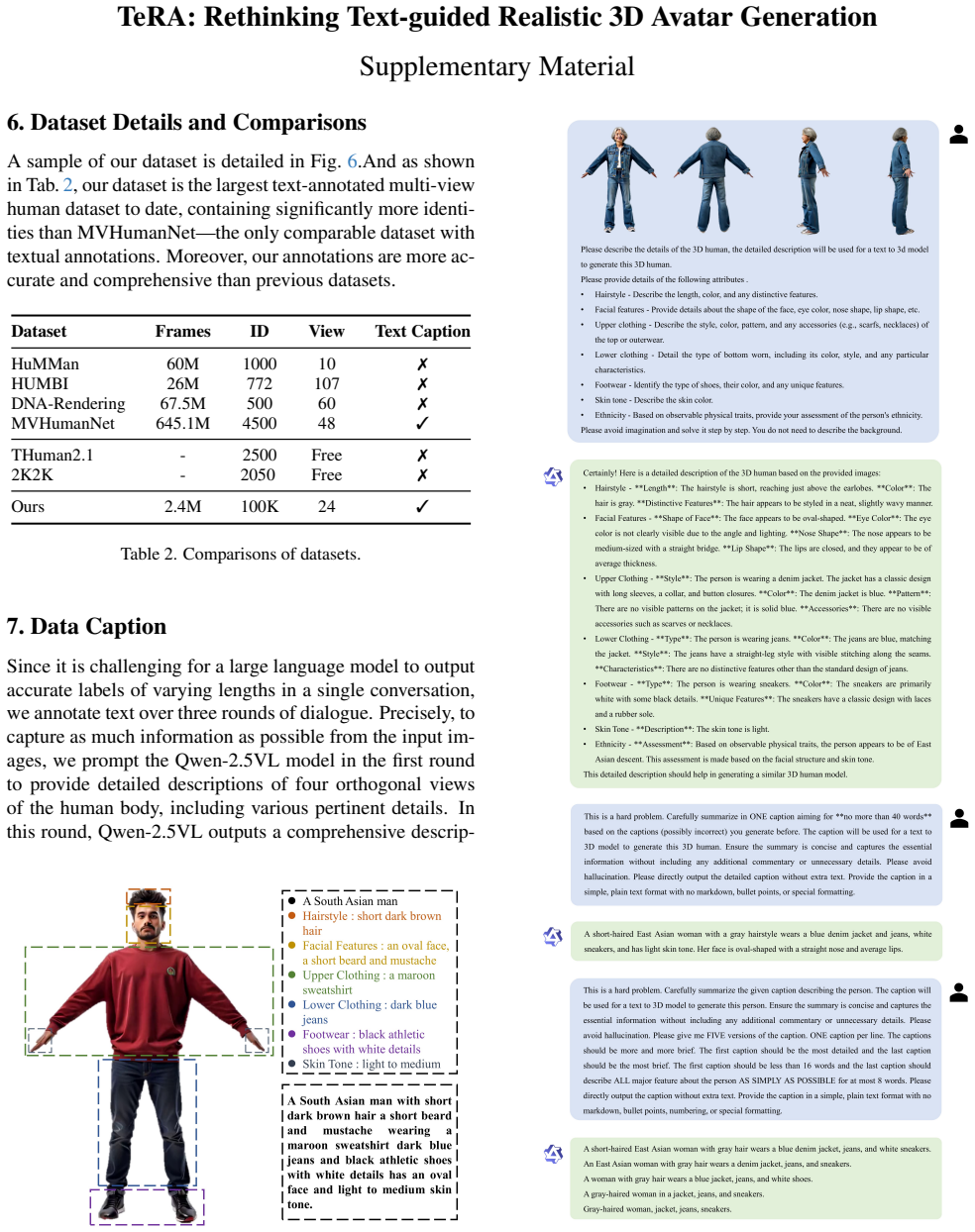
Summary. The paper proposes TeRA, a feedforward text-to-3D avatar generation method. It first annotates the HuGe100K dataset with text captions using Qwen2.5-VL and Qwen2.5, represents humans as UV-structured Gaussians aligned with SMPL-X, distills a compact 256x256 latent space from IDOL's high-resolution UV features (Sec. 3.3), and trains a text-conditioned latent diffusion model in this latent space (Sec. 3.4). Inference takes 12 seconds. The paper also presents a latent-space inpainting method for structure-aware virtual try-on (Sec. 3.5). Experiments compare TeRA to four SDS-based baselines (TADA, X-Oscar, HumanGaussian, HumanNorm) using CLIP Score, VQA Score, and a user study, with additional qualitative comparisons in the supplementary material.
Significance. Feedforward latent diffusion for 3D avatars is a meaningful direction, and the two-stage strategy of distilling a compact latent from a pretrained reconstruction model is a sensible way to avoid training a 3D VAE from scratch. The 12s inference speed and the structure-aware editing capability are practically attractive. If validated, TeRA would be a strong alternative to SDS-based per-scene optimization. The method is clearly formulated, the dataset annotation pipeline is described in detail, and the ablation of latent resolution is useful. However, the paper's headline claims—being the first latent diffusion model for text-guided 3D avatar generation and demonstrating superiority over prior avatar generators—are not currently supported by the evidence: the closest latent-diffusion baseline is cited but not evaluated, the objective metrics are mixed, and the reconstruction fidelity of the distilled latent is not quantitatively verified.
major comments (4)
- [Sec. 3.3 / Sec. 4.2 / Supplementary Sec. 9] The abstract and Figure 1 claim that TeRA is 'the first latent diffusion model specifically designed for text-guided 3D avatar generation.' However, Sec. 3.3 cites StructLDM [34] as a recent work validating LDM on 3D generative tasks, and StructLDM is a text-conditioned structured latent diffusion model for 3D human generation. The main experiments in Sec. 4.2 compare only SDS-based methods (TADA, X-Oscar, HumanGaussian, HumanNorm), omitting this directly relevant latent-diffusion competitor. This is internally inconsistent with the Supplementary Sec. 9 statement that 'SDS-based models are the only available text-to-3D-avatar methods.' The novelty and superiority claims are load-bearing; please add a comparison to StructLDM (and, if applicable, other cited feedforward avatar methods such as E3Gen [88]) or substantially qualify the claims.
- [Table 1 / Abstract] The abstract states that experiments have 'proven our approach's superiority over previous text-to-avatar generative models in subjective and objective evaluation.' Table 1 shows TeRA is second on CLIP Score (30.17 vs. X-Oscar's 32.46) and tied with HumanGaussian on VQA Score (0.82). Only the user study is clearly favorable. Since no error bars or statistical significance tests are reported, the broad superiority claim is not supported by the objective metrics as presented. Please either temper the wording to 'competitive' or add additional objective evidence and statistical validation.
- [Sec. 3.3 / Fig. 4(a)] The load-bearing assumption is that the 256x256 distilled latent retains enough structure and appearance to support photorealistic generation. The paper provides only a qualitative ablation (Fig. 4a) and no quantitative reconstruction fidelity on held-out data (e.g., PSNR/SSIM against ground-truth renderings or against the full-resolution IDOL features). Additionally, the claims that 'directly training a VAE for complex 3D human models is prone to instability' and that direct encoder-to-diffusion connection leads to 'posterior collapse' are asserted without supporting experiments or ablations. Please provide quantitative reconstruction metrics and an ablation of the distillation module versus a directly trained VAE.
- [Sec. 4.2 / Supplementary Fig. 8] The abstract also claims superiority over 'general large 3D generative models,' but the main quantitative comparison includes only SDS-based avatar methods. The comparison to general 3D methods (LGM, GVGen, DiffSplat) is relegated to a small qualitative figure in the supplementary material with no metrics. Either add quantitative results for these general 3D baselines or narrow the claim to SDS-based methods.
minor comments (5)
- [Table 1] Typo: 'HumanGaussiann' should be 'HumanGaussian.' Also, the caption says 'The best and second-best scores are marked,' but no bold/underline styling is visible in the text version; please clarify.
- [Sec. 2.1] Typo: 'bilions' should be 'billions.'
- [Sec. 3.3] Inconsistent spacing: 'V AE' should be 'VAE.'
- [Supplementary Sec. 9] The statement 'As far as we know, SDS-based models are the only available text-to-3D-avatar methods' contradicts the citation of StructLDM in Sec. 3.3 and the paper's own 'first LDM' claim. Please correct this inconsistency.
- [General] No code release or public dataset link is mentioned; providing these would improve reproducibility. Also, Figure 1 contains 'FINAL VERSION – 2023/3/6,' which appears to be a stale draft artifact and should be removed.
Circularity Check
No circular reduction found. The 'first LDM for text-to-avatar' claim conflicts with the paper's own citation of StructLDM, but that is a positioning/completeness gap, not a circularity.
full rationale
The derivation chain is self-contained and not circular in the sense of fitted parameters renamed as predictions or equations reducing to inputs. Stage one (Sec. 3.3) trains a distillation decoder with an image reconstruction loss (Eq. 7) from IDOL's UV features; stage two (Sec. 3.4) trains a text-conditioned latent diffusion model with an MSE loss (Eq. 9) on those latents. The generated avatar is decoded by the stage-one decoder, and the evaluation uses CLIP Score, VQA Score, and user studies. None of these evaluation quantities appear as training targets or as fitted constants, so the central generation result is not forced by construction. The main lineage concern is that the latent space derives from IDOL [98], a prior work with overlapping authors; however, IDOL is used as a fixed external reconstruction model with independent published results, so this is a self-citation but not a load-bearing circular premise. A mild coupling exists in that Qwen was used both to generate the training captions (Sec. 3.1) and to compute the VQA evaluation score (Sec. 4.2), which could bias the alignment metric, but the VQA score is not part of the training loss and the paper also reports CLIP Score and user study. The paper's claim of being 'the first LDM for text-to-3D avatar generation' (Sec. 3.3) is contradicted by its own citation of StructLDM [34], a structured latent diffusion model for 3D human generation, and Sec. 9 of the supplementary states 'SDS-based models are the only available text-to-3D-avatar methods' without comparing against StructLDM. This is a significant correctness/completeness issue for the novelty and superiority claims, but it is not a circular derivation: no equation, fitted parameter, or self-citation chain makes the output equivalent to the input. The score of 1 reflects only the minor self-citation lineage and the Qwen-based evaluation coupling, not circular reasoning.
Assumptions & free parameters
free parameters (6)
- lambda_L2 =
20
- lambda_vgg =
20
- lambda_offset =
1
- latent_resolution =
256x256
- inference_denoising_steps =
100
- guidance_weight_w =
not specified
assumptions (7)
- domain assumption SMPL-X is an adequate parametric human body model for representing a wide range of human avatars
- domain assumption UV-structured 3D Gaussians can faithfully represent clothed humans
- domain assumption IDOL's autoencoder features provide a suitable base latent space for generative modeling
- domain assumption Qwen2.5-VL and Qwen2.5 produce text captions accurately describing human appearance
- domain assumption The 70k-identity subset of HuGe100K is diverse and representative enough for generalization
- standard math Latent diffusion can learn the distribution of the distilled 256x256 latents
- domain assumption CLIP text embeddings are a sufficient text condition for avatar appearance
Cite this review
Pith. "Pith review of TeRA: Rethinking Text-guided Realistic 3D Avatar Generation." pith.science (2026). https://pith.science/paper/A66RZ2TC
@misc{pith2026250902466,
  author       = {Pith},
  title        = {Pith review of: TeRA: Rethinking Text-guided Realistic 3D Avatar Generation},
  year         = {2026},
  howpublished = {\url{https://pith.science/paper/A66RZ2TC}},
  note         = {Machine review of arXiv:2509.02466}
}
read the original abstract
In this paper, we rethink text-to-avatar generative models by proposing TeRA, a more efficient and effective framework than the previous SDS-based models and general large 3D generative models. Our approach employs a two-stage training strategy for learning a native 3D avatar generative model. Initially, we distill a decoder to derive a structured latent space from a large human reconstruction model. Subsequently, a text-controlled latent diffusion model is trained to generate photorealistic 3D human avatars within this latent space. TeRA enhances the model performance by eliminating slow iterative optimization and enables text-based partial customization through a structured 3D human representation. Experiments have proven our approach's superiority over previous text-to-avatar generative models in subjective and objective evaluation.
Figures


Figures from the paper (7 more)




Reference graph
Works this paper leans on
-
[34]
Structldm: Struc- tured latent diffusion for 3d human generation
Tao Hu, Fangzhou Hong, and Ziwei Liu. Structldm: Struc- tured latent diffusion for 3d human generation. In European Conference on Computer Vision , pages 363–381. Springer,
-
[88]
E3gen: Efficient, expressive and ed- itable avatars generation
Weitian Zhang, Yichao Yan, Yunhui Liu, Xingdong Sheng, and Xiaokang Yang. E3gen: Efficient, expressive and ed- itable avatars generation. In Proceedings of the 32nd ACM International Conference on Multimedia, pages 6860–6869,
-
[1]
Josh Achiam, Steven Adler, Sandhini Agarwal, Lama Ah- mad, Ilge Akkaya, Florencia Leoni Aleman, Diogo Almeida, Janko Altenschmidt, Sam Altman, Shyamal Anadkat, et al. Gpt-4 technical report. arXiv preprint arXiv:2303.08774 ,
-
[2]
Learning representations and generative models for 3d point clouds
Panos Achlioptas, Olga Diamanti, Ioannis Mitliagkas, and Leonidas Guibas. Learning representations and generative models for 3d point clouds. In International conference on machine learning, pages 40–49. PMLR, 2018. 2
2018
-
[3]
The digital emily project: Achieving a photorealistic digital actor
Oleg Alexander, Mike Rogers, William Lambeth, Jen-Yuan Chiang, Wan-Chun Ma, Chuan-Chang Wang, and Paul De- bevec. The digital emily project: Achieving a photorealistic digital actor. IEEE Computer Graphics and Applications, 30 (4):20–31, 2010. 1
2010
-
[4]
imghum: Implicit generative models of 3d human shape and articulated pose
Thiemo Alldieck, Hongyi Xu, and Cristian Sminchisescu. imghum: Implicit generative models of 3d human shape and articulated pose. In ICCV, 2021. 3
2021
-
[5]
Panohead: Geometry-aware 3d full- head synthesis in 360deg
Sizhe An, Hongyi Xu, Yichun Shi, Guoxian Song, Umit Y Ogras, and Linjie Luo. Panohead: Geometry-aware 3d full- head synthesis in 360deg. In Proceedings of the IEEE/CVF conference on computer vision and pattern recognition , pages 20950–20959, 2023. 2
2023
-
[6]
Controlled diffusion models for optimal dividend pay-out
Søren Asmussen and Michael Taksar. Controlled diffusion models for optimal dividend pay-out. Insurance: Mathemat- ics and Economics, 20(1):1–15, 1997. 2
1997
Show all 103 references
-
[7]
Blended latent diffusion
Omri Avrahami, Ohad Fried, and Dani Lischinski. Blended latent diffusion. ACM transactions on graphics (TOG) , 42 (4):1–11, 2023. 6
2023
-
[8]
Shuai Bai, Keqin Chen, Xuejing Liu, Jialin Wang, Wenbin Ge, Sibo Song, Kai Dang, Peng Wang, Shijie Wang, Jun Tang, et al. Qwen2. 5-vl technical report. arXiv preprint arXiv:2502.13923, 2025. 3
2025 arXiv
-
[9]
ediffi: Text-to-image diffusion models with an ensemble of expert denoisers.arXiv preprint arXiv:2211.01324, 2022
Yogesh Balaji, Seungjun Nah, Xun Huang, Arash Vahdat, Jiaming Song, Karsten Kreis, Miika Aittala, Timo Aila, Samuli Laine, Bryan Catanzaro, et al. ediffi: Text-to-image diffusion models with an ensemble of expert denoisers.arXiv preprint arXiv:2211.01324, 2022. 2
2022 arXiv
-
[10]
Universal guidance for diffusion models
Arpit Bansal, Hong-Min Chu, Avi Schwarzschild, Soumyadip Sengupta, Micah Goldblum, Jonas Geip- ing, and Tom Goldstein. Universal guidance for diffusion models. In Proceedings of the IEEE/CVF Conference on Computer Vision and Pattern Recognition , pages 843–852,
-
[11]
Stable video diffusion: Scaling latent video diffusion models to large datasets
Andreas Blattmann, Tim Dockhorn, Sumith Kulal, Daniel Mendelevitch, Maciej Kilian, Dominik Lorenz, Yam Levi, Zion English, Vikram V oleti, Adam Letts, et al. Stable video diffusion: Scaling latent video diffusion models to large datasets. arXiv preprint arXiv:2311.15127, 2023. 2
2023 arXiv
-
[12]
Dreamavatar: Text-and-shape guided 3d hu- man avatar generation via diffusion models
Yukang Cao, Yan-Pei Cao, Kai Han, Ying Shan, and Kwan- Yee K Wong. Dreamavatar: Text-and-shape guided 3d hu- man avatar generation via diffusion models. In Proceedings of the IEEE/CVF conference on computer vision and pattern recognition, pages 958–968, 2024. 3
2024
-
[13]
Efficient geometry-aware 3d generative adversarial networks
Eric R Chan, Connor Z Lin, Matthew A Chan, Koki Nagano, Boxiao Pan, Shalini De Mello, Orazio Gallo, Leonidas J Guibas, Jonathan Tremblay, Sameh Khamis, et al. Efficient geometry-aware 3d generative adversarial networks. In Pro- ceedings of the IEEE/CVF Conference on Computer V...
2022
-
[14]
Text2shape: Generating shapes from natural language by learning joint embeddings
Kevin Chen, Christopher B Choy, Manolis Savva, An- gel X Chang, Thomas Funkhouser, and Silvio Savarese. Text2shape: Generating shapes from natural language by learning joint embeddings. InComputer Vision–ACCV 2018: 14th Asian Conference on Computer Vision, Perth, Australia, De...
2018
-
[15]
Fan- tasia3d: Disentangling geometry and appearance for high- quality text-to-3d content creation
Rui Chen, Yongwei Chen, Ningxin Jiao, and Kui Jia. Fan- tasia3d: Disentangling geometry and appearance for high- quality text-to-3d content creation. In Proceedings of the IEEE/CVF international conference on computer vision , pages 22246–22256, 2023. 2
2023
-
[16]
Text-to-3d using gaussian splatting
Zilong Chen, Feng Wang, Yikai Wang, and Huaping Liu. Text-to-3d using gaussian splatting. In Proceedings of the IEEE/CVF conference on computer vision and pattern recognition, pages 21401–21412, 2024. 2
2024
-
[17]
Meshgan: Non-linear 3d morphable models of faces
Shiyang Cheng, Michael Bronstein, Yuxiang Zhou, Irene Kotsia, Maja Pantic, and Stefanos Zafeiriou. Meshgan: Non-linear 3d morphable models of faces. arXiv preprint arXiv:1903.10384, 2019. 2
1903 arXiv
-
[18]
Progressive3d: Progres- sively local editing for text-to-3d content creation with com- plex semantic prompts
Xinhua Cheng, Tianyu Yang, Jianan Wang, Yu Li, Lei Zhang, Jian Zhang, and Li Yuan. Progressive3d: Progres- sively local editing for text-to-3d content creation with com- plex semantic prompts. In The Twelfth International Confer- ence on Learning Representations. 7
-
[19]
Boosting camera mo- tion control for video diffusion transformers
Soon Yau Cheong, Duygu Ceylan, Armin Mustafa, Andrew Gilbert, and Chun-Hao Paul Huang. Boosting camera mo- tion control for video diffusion transformers. arXiv preprint arXiv:2410.10802, 2024. 2
2024 arXiv
-
[20]
The light stages and their applications to pho- toreal digital actors
Paul Debevec. The light stages and their applications to pho- toreal digital actors. SIGGRAPH Asia, 2(4):1–6, 2012. 1
2012
-
[21]
Textdeformer: Geometry manipu- lation using text guidance
William Gao, Noam Aigerman, Thibault Groueix, V ova Kim, and Rana Hanocka. Textdeformer: Geometry manipu- lation using text guidance. In ACM SIGGRAPH 2023 Con- ference Proceedings, pages 1–11, 2023. 3
2023
-
[22]
Visual fact checker: En- abling high-fidelity detailed caption generation
Yunhao Ge, Xiaohui Zeng, Jacob Samuel Huffman, Tsung- Yi Lin, Ming-Yu Liu, and Yin Cui. Visual fact checker: En- abling high-fidelity detailed caption generation. In Proceed- ings of the IEEE/CVF Conference on Computer Vision and Pattern Recognition, pages 14033–14042, 2024. 3
2024
-
[23]
Densepose: Dense human pose estimation in the wild
Rıza Alp G ¨uler, Natalia Neverova, and Iasonas Kokkinos. Densepose: Dense human pose estimation in the wild. In Proceedings of the IEEE conference on computer vision and pattern recognition, pages 7297–7306, 2018. 3
2018
-
[24]
The re- lightables: V olumetric performance capture of humans with realistic relighting
Kaiwen Guo, Peter Lincoln, Philip Davidson, Jay Busch, Xueming Yu, Matt Whalen, Geoff Harvey, Sergio Orts- Escolano, Rohit Pandey, Jason Dourgarian, et al. The re- lightables: V olumetric performance capture of humans with realistic relighting. ACM Transactions on Graphics (To...
2019
-
[25]
I2v-adapter: A general image-to-video adapter for diffusion models
Xun Guo, Mingwu Zheng, Liang Hou, Yuan Gao, Yufan Deng, Pengfei Wan, Di Zhang, Yufan Liu, Weiming Hu, Zhengjun Zha, et al. I2v-adapter: A general image-to-video adapter for diffusion models. In ACM SIGGRAPH 2024 Conference Papers, pages 1–12, 2024. 2
2024
-
[26]
Cameractrl: Enabling camera control for text-to-video generation
Hao He, Yinghao Xu, Yuwei Guo, Gordon Wetzstein, Bo Dai, Hongsheng Li, and Ceyuan Yang. Cameractrl: Enabling camera control for text-to-video generation. arXiv preprint arXiv:2404.02101, 2024. 2
2024 arXiv
-
[27]
Head360: Learning a parametric 3d full-head for free-view synthesis in 360◦
Yuxiao He, Yiyu Zhuang, Yanwen Wang, Yao Yao, Siyu Zhu, Xiaoyu Li, Qi Zhang, Xun Cao, and Hao Zhu. Head360: Learning a parametric 3d full-head for free-view synthesis in 360◦. In European Conference on Computer Vision , pages 254–272. Springer, 2024. 2
2024
-
[28]
Clipscore: A reference-free evaluation met- ric for image captioning
Jack Hessel, Ari Holtzman, Maxwell Forbes, Ronan Le Bras, and Yejin Choi. Clipscore: A reference-free evaluation met- ric for image captioning. In Proceedings of the 2021 Confer- ence on Empirical Methods in Natural Language Processing, pages 7514–7528, 2021. 7
2021
-
[29]
Classifier-free diffusion guidance
Jonathan Ho and Tim Salimans. Classifier-free diffusion guidance. In NeurIPS 2021 Workshop on Deep Generative Models and Downstream Applications. 5
2021
-
[30]
Denoising dif- fusion probabilistic models
Jonathan Ho, Ajay Jain, and Pieter Abbeel. Denoising dif- fusion probabilistic models. In Advances in Neural Informa- tion Processing Systems, 2020. 2
2020
-
[31]
Eva3d: Compositional 3d human generation from 2d image collections
Fangzhou Hong, Zhaoxi Chen, Yushi Lan, Liang Pan, and Ziwei Liu. Eva3d: Compositional 3d human generation from 2d image collections. arXiv preprint arXiv:2210.04888 ,
-
[32]
Avatarclip: Zero-shot text- driven generation and animation of 3d avatars
Fangzhou Hong, Mingyuan Zhang, Liang Pan, Zhongang Cai, Lei Yang, and Ziwei Liu. Avatarclip: Zero-shot text- driven generation and animation of 3d avatars. ACM Trans- actions on Graphics, 2022. 3
2022
-
[33]
Training-free camera control for video generation
Chen Hou, Guoqiang Wei, Yan Zeng, and Zhibo Chen. Training-free camera control for video generation. arXiv preprint arXiv:2406.10126, 2024. 2
2024 arXiv
-
[35]
Humannorm: Learning normal diffusion model for high-quality and realistic 3d hu- man generation
Xin Huang, Ruizhi Shao, Qi Zhang, Hongwen Zhang, Ying Feng, Yebin Liu, and Qing Wang. Humannorm: Learning normal diffusion model for high-quality and realistic 3d hu- man generation. In CVPR, 2024. 3, 6, 8
2024
-
[36]
Dreamwaltz: Make a scene with complex 3d animatable avatars.Advances in Neural Information Processing Systems , 36:4566–4584,
Yukun Huang, Jianan Wang, Ailing Zeng, He Cao, Xianbiao Qi, Yukai Shi, Zheng-Jun Zha, and Lei Zhang. Dreamwaltz: Make a scene with complex 3d animatable avatars.Advances in Neural Information Processing Systems , 36:4566–4584,
-
[37]
Zero-shot text-guided object genera- tion with dream fields
Ajay Jain, Ben Mildenhall, Jonathan T Barron, Pieter Abbeel, and Ben Poole. Zero-shot text-guided object genera- tion with dream fields. In Proceedings of the IEEE/CVF con- ference on computer vision and pattern recognition , pages 867–876, 2022. 2
2022
-
[38]
Avatar- craft: Transforming text into neural human avatars with pa- rameterized shape and pose control
Ruixiang Jiang, Can Wang, Jingbo Zhang, Menglei Chai, Mingming He, Dongdong Chen, and Jing Liao. Avatar- craft: Transforming text into neural human avatars with pa- rameterized shape and pose control. In Proceedings of the IEEE/CVF International Conference on Computer Vision ,...
2023
-
[39]
Flovd: Optical flow meets video diffusion model for enhanced camera-controlled video synthesis
Wonjoon Jin, Qi Dai, Chong Luo, Seung-Hwan Baek, and Sunghyun Cho. Flovd: Optical flow meets video diffusion model for enhanced camera-controlled video synthesis. In Proceedings of the Computer Vision and Pattern Recognition Conference, pages 2040–2049, 2025. 2
-
[40]
3d gaussian splatting for real-time radiance field rendering
Bernhard Kerbl, Georgios Kopanas, Thomas Leimk ¨uhler, and George Drettakis. 3d gaussian splatting for real-time radiance field rendering. ACM Transactions on Graphics, 42 (4), 2023. 2, 3
2023
-
[41]
Gghead: Fast and generalizable 3d gaussian heads
Tobias Kirschstein, Simon Giebenhain, Jiapeng Tang, Markos Georgopoulos, and Matthias Nießner. Gghead: Fast and generalizable 3d gaussian heads. In SIGGRAPH Asia 2024 Conference Papers, pages 1–11, 2024. 2
2024
-
[42]
Dreamhuman: Animatable 3d avatars from text
Nikos Kolotouros, Thiemo Alldieck, Andrei Zanfir, Ed- uard Bazavan, Mihai Fieraru, and Cristian Sminchisescu. Dreamhuman: Animatable 3d avatars from text. Advances in neural information processing systems, 36:10516–10529,
-
[43]
Ln3diff: Scalable latent neural fields diffusion for speedy 3d generation
Yushi Lan, Fangzhou Hong, Shuai Yang, Shangchen Zhou, Xuyi Meng, Bo Dai, Xingang Pan, and Chen Change Loy. Ln3diff: Scalable latent neural fields diffusion for speedy 3d generation. In European Conference on Computer Vision , pages 112–130. Springer, 2024. 4
2024
-
[44]
Blip: Bootstrapping language-image pre-training for unified vision-language understanding and generation
Junnan Li, Dongxu Li, Caiming Xiong, and Steven Hoi. Blip: Bootstrapping language-image pre-training for unified vision-language understanding and generation. In Interna- tional conference on machine learning, pages 12888–12900. PMLR, 2022. 3
2022
-
[45]
Tada! text to animatable digital avatars
Tingting Liao, Hongwei Yi, Yuliang Xiu, Jiaxiang Tang, Yangyi Huang, Justus Thies, and Michael J Black. Tada! text to animatable digital avatars. In 2024 International Confer- ence on 3D Vision (3DV), pages 1508–1519. IEEE, 2024. 3, 6, 8
2024
-
[46]
Flow matching for generative mod- eling
Yaron Lipman, Ricky TQ Chen, Heli Ben-Hamu, Maximil- ian Nickel, and Matt Le. Flow matching for generative mod- eling. In 11th International Conference on Learning Repre- sentations, ICLR 2023, 2023. 2
2023
-
[47]
Humangaus- sian: Text-driven 3d human generation with gaussian splat- ting
Xian Liu, Xiaohang Zhan, Jiaxiang Tang, Ying Shan, Gang Zeng, Dahua Lin, Xihui Liu, and Ziwei Liu. Humangaus- sian: Text-driven 3d human generation with gaussian splat- ting. In Proceedings of the IEEE/CVF Conference on Com- puter Vision and Pattern Recognition , pages 6646–6657,
-
[48]
Sora: A review on background, technology, limitations, and opportunities of large vision models
Yixin Liu, Kai Zhang, Yuan Li, Zhiling Yan, Chujie Gao, Ruoxi Chen, Zhengqing Yuan, Yue Huang, Hanchi Sun, Jian- feng Gao, et al. Sora: A review on background, technology, limitations, and opportunities of large vision models. arXiv preprint arXiv:2402.17177, 2024. 2
2024 arXiv
-
[49]
To- wards implicit text-guided 3d shape generation
Zhengzhe Liu, Yi Wang, Xiaojuan Qi, and Chi-Wing Fu. To- wards implicit text-guided 3d shape generation. In Proceed- ings of the IEEE/CVF Conference on Computer Vision and Pattern Recognition, pages 17896–17906, 2022. 2
2022
-
[50]
Matthew Loper, Naureen Mahmood, Javier Romero, Gerard Pons-Moll, and Michael J. Black. SMPL: A skinned multi- person linear model. ACM Transactions on Graphics, 2015. 3
2015
-
[51]
Latte: Latent diffusion transformer for video generation
Xin Ma, Yaohui Wang, Gengyun Jia, Xinyuan Chen, Zi- wei Liu, Yuan-Fang Li, Cunjian Chen, and Yu Qiao. Latte: Latent diffusion transformer for video generation. arXiv preprint arXiv:2401.03048, 2024. 2
2024 arXiv
-
[52]
X-oscar: a progressive framework for high- quality text-guided 3d animatable avatar generation
Yiwei Ma, Zhekai Lin, Jiayi Ji, Yijun Fan, Xiaoshuai Sun, and Rongrong Ji. X-oscar: a progressive framework for high- quality text-guided 3d animatable avatar generation. In Pro- ceedings of the 41st International Conference on Machine Learning, pages 33826–33838, 2024. 6, 8
2024
-
[53]
Latent-nerf for shape-guided generation of 3d shapes and textures
Gal Metzer, Elad Richardson, Or Patashnik, Raja Giryes, and Daniel Cohen-Or. Latent-nerf for shape-guided generation of 3d shapes and textures. In Proceedings of the IEEE/CVF Conference on Computer Vision and Pattern Recognition , pages 12663–12673, 2023. 2
2023
-
[54]
Text2mesh: Text-driven neural stylization for meshes
Oscar Michel, Roi Bar-On, Richard Liu, Sagie Benaim, and Rana Hanocka. Text2mesh: Text-driven neural stylization for meshes. In Proceedings of the IEEE/CVF Conference on Computer Vision and Pattern Recognition, pages 13492– 13502, 2022. 2
2022
-
[55]
Clip-mesh: Generating textured meshes from text using pretrained image-text models
Nasir Mohammad Khalid, Tianhao Xie, Eugene Belilovsky, and Tiberiu Popa. Clip-mesh: Generating textured meshes from text using pretrained image-text models. InSIGGRAPH Asia 2022 conference papers, pages 1–8, 2022. 2
2022
-
[56]
Expressive body capture: 3d hands, face, and body from a single image
Georgios Pavlakos, Vasileios Choutas, Nima Ghorbani, Timo Bolkart, Ahmed AA Osman, Dimitrios Tzionas, and Michael J Black. Expressive body capture: 3d hands, face, and body from a single image. In Proceedings of the IEEE/CVF conference on computer vision and pattern recognitio...
2019
-
[57]
Barron, and Ben Milden- hall
Ben Poole, Ajay Jain, Jonathan T. Barron, and Ben Milden- hall. Dreamfusion: Text-to-3d using 2d diffusion. In ICLR,
-
[58]
Learning transferable visual models from natural language supervi- sion
Alec Radford, Jong Wook Kim, Chris Hallacy, Aditya Ramesh, Gabriel Goh, Sandhini Agarwal, Girish Sastry, Amanda Askell, Pamela Mishkin, Jack Clark, et al. Learning transferable visual models from natural language supervi- sion. In International conference on machine learning, ...
2021
-
[59]
Hierarchical text-conditional image gen- eration with clip latents
Aditya Ramesh, Prafulla Dhariwal, Alex Nichol, Casey Chu, and Mark Chen. Hierarchical text-conditional image gen- eration with clip latents. arXiv preprint arXiv:2204.06125,
-
[60]
High-resolution image synthesis with latent diffusion models
Robin Rombach, Andreas Blattmann, Dominik Lorenz, Patrick Esser, and Bj ¨orn Ommer. High-resolution image synthesis with latent diffusion models. In Proceedings of the IEEE/CVF conference on computer vision and pattern recognition, pages 10684–10695, 2022. 2, 4
2022
-
[61]
High-resolution image synthesis with latent diffusion models
Robin Rombach, Andreas Blattmann, Dominik Lorenz, Patrick Esser, and Bj ¨orn Ommer. High-resolution image synthesis with latent diffusion models. In Proceedings of the IEEE/CVF conference on computer vision and pattern recognition, pages 10684–10695, 2022. 2
2022
-
[62]
High-resolution image syn- thesis with latent diffusion models
Robin Rombach, Andreas Blattmann, Dominik Lorenz, Patrick Esser, and Bj¨orn Ommer. High-resolution image syn- thesis with latent diffusion models. In IEEE Conference on Computer Vision and Pattern Recognition, 2022. 2
2022
-
[63]
Photorealistic text-to-image diffusion models with deep language understanding
Chitwan Saharia, William Chan, Saurabh Saxena, Lala Li, Jay Whang, Emily L Denton, Kamyar Ghasemipour, Raphael Gontijo Lopes, Burcu Karagol Ayan, Tim Salimans, et al. Photorealistic text-to-image diffusion models with deep language understanding. Advances in neural information...
2022
-
[64]
Pifu: Pixel-aligned implicit function for high-resolution clothed human digitiza- tion
Shunsuke Saito, Zeng Huang, Ryota Natsume, Shigeo Mor- ishima, Angjoo Kanazawa, and Hao Li. Pifu: Pixel-aligned implicit function for high-resolution clothed human digitiza- tion. In Proceedings of the IEEE/CVF international confer- ence on computer vision, pages 2304–2314, 2019. 1
2019
-
[65]
3d point cloud generative adversarial network based on tree structured graph convolutions
Dong Wook Shu, Sung Woo Park, and Junseok Kwon. 3d point cloud generative adversarial network based on tree structured graph convolutions. In Proceedings of the IEEE/CVF international conference on computer vision , pages 3859–3868, 2019. 2
2019
-
[66]
Dreamgaussian: Generative gaussian splatting for ef- ficient 3d content creation
Jiaxiang Tang, Jiawei Ren, Hang Zhou, Ziwei Liu, and Gang Zeng. Dreamgaussian: Generative gaussian splatting for ef- ficient 3d content creation. In ICLR, 2024. 2
2024
-
[67]
Shapescaffolder: Structure-aware 3d shape generation from text
Xi Tian, Yong-Liang Yang, and Qi Wu. Shapescaffolder: Structure-aware 3d shape generation from text. In Proceed- ings of the IEEE/CVF International Conference on Com- puter Vision, pages 2715–2724, 2023. 2
2023
-
[68]
Triposr: Fast 3d object reconstruction from a single image
Dmitry Tochilkin, David Pankratz, Zexiang Liu, Zixuan Huang, , Adam Letts, Yangguang Li, Ding Liang, Christian Laforte, Varun Jampani, and Yan-Pei Cao. Triposr: Fast 3d object reconstruction from a single image. arXiv preprint arXiv:2403.02151, 2024. 2
2024 arXiv
-
[69]
Clip-nerf: Text-and-image driven manip- ulation of neural radiance fields
Can Wang, Menglei Chai, Mingming He, Dongdong Chen, and Jing Liao. Clip-nerf: Text-and-image driven manip- ulation of neural radiance fields. In Proceedings of the IEEE/CVF Conference on Computer Vision and Pattern Recognition, pages 3835–3844, 2022. 2
2022
-
[70]
Score jacobian chaining: Lifting pretrained 2d diffusion models for 3d generation
Haochen Wang, Xiaodan Du, Jiahao Li, Raymond A Yeh, and Greg Shakhnarovich. Score jacobian chaining: Lifting pretrained 2d diffusion models for 3d generation. In Pro- ceedings of the IEEE/CVF Conference on Computer Vision and Pattern Recognition, pages 12619–12629, 2023. 2
2023
-
[71]
Disentangled clothed avatar generation from text descriptions
Jionghao Wang, Yuan Liu, Zhiyang Dou, Zhengming Yu, Yongqing Liang, Cheng Lin, Rong Xie, Li Song, Xin Li, and Wenping Wang. Disentangled clothed avatar generation from text descriptions. In European Conference on Com- puter Vision, pages 381–401, 2024. 3
2024
-
[72]
Prolificdreamer: High-fidelity and diverse text-to-3d generation with variational score distilla- tion
Zhengyi Wang, Cheng Lu, Yikai Wang, Fan Bao, Chongxuan Li, Hang Su, and Jun Zhu. Prolificdreamer: High-fidelity and diverse text-to-3d generation with variational score distilla- tion. Advances in neural information processing systems, 36: 8406–8441, 2023. 2
2023
-
[73]
Taps3d: Text-guided 3d textured shape generation from pseudo supervision
Jiacheng Wei, Hao Wang, Jiashi Feng, Guosheng Lin, and Kim-Hui Yap. Taps3d: Text-guided 3d textured shape generation from pseudo supervision. In Proceedings of the IEEE/CVF conference on computer vision and pattern recognition, pages 16805–16815, 2023. 2
2023
-
[74]
Learning a probabilistic latent space of object shapes via 3d generative-adversarial modeling
Jiajun Wu, Chengkai Zhang, Tianfan Xue, Bill Freeman, and Josh Tenenbaum. Learning a probabilistic latent space of object shapes via 3d generative-adversarial modeling. Ad- vances in neural information processing systems , 29, 2016. 2
2016
-
[75]
Direct3d: Scal- able image-to-3d generation via 3d latent diffusion trans- former
Shuang Wu, Youtian Lin, Feihu Zhang, Yifei Zeng, Jingxi Xu, Philip Torr, Xun Cao, and Yao Yao. Direct3d: Scal- able image-to-3d generation via 3d latent diffusion trans- former. Advances in Neural Information Processing Systems, 37:121859–121881, 2024. 1, 2, 4
2024
-
[76]
Structured 3d latents for scalable and versatile 3d gen- eration
Jianfeng Xiang, Zelong Lv, Sicheng Xu, Yu Deng, Ruicheng Wang, Bowen Zhang, Dong Chen, Xin Tong, and Jiaolong Yang. Structured 3d latents for scalable and versatile 3d gen- eration. In Proceedings of the Computer Vision and Pattern Recognition Conference, pages 21469–21480, 20...
2025
-
[77]
Econ: Explicit clothed humans optimized via normal integration
Yuliang Xiu, Jinlong Yang, Xu Cao, Dimitrios Tzionas, and Michael J Black. Econ: Explicit clothed humans optimized via normal integration. InProceedings of the IEEE/CVF con- ference on computer vision and pattern recognition , pages 512–523, 2023. 1
2023
-
[78]
An Yang, Baosong Yang, Beichen Zhang, Binyuan Hui, Bo Zheng, Bowen Yu, Chengyuan Li, Dayiheng Liu, Fei Huang, Haoran Wei, et al. Qwen2. 5 technical report. arXiv preprint arXiv:2412.15115, 2024. 3
2024 arXiv
-
[79]
Gaussian- dreamer: Fast generation from text to 3d gaussian splatting with point cloud priors
Taoran Yi, Jiemin Fang, Guanjun Wu, Lingxi Xie, Xiaopeng Zhang, Wenyu Liu, Qi Tian, and Xinggang Wang. Gaussian- dreamer: Fast generation from text to 3d gaussian splatting with point cloud priors. arXiv preprint arXiv:2310.08529 ,
-
[80]
Doublefu- sion: Real-time capture of human performances with inner body shapes from a single depth sensor
Tao Yu, Zerong Zheng, Kaiwen Guo, Jianhui Zhao, Qionghai Dai, Hao Li, Gerard Pons-Moll, and Yebin Liu. Doublefu- sion: Real-time capture of human performances with inner body shapes from a single depth sensor. In Proceedings of the IEEE conference on computer vision and patter...
2018
-
[81]
Function4d: Real-time human vol- umetric capture from very sparse consumer rgbd sensors
Tao Yu, Zerong Zheng, Kaiwen Guo, Pengpeng Liu, Qiong- hai Dai, and Yebin Liu. Function4d: Real-time human vol- umetric capture from very sparse consumer rgbd sensors. In Proceedings of the IEEE/CVF conference on computer vi- sion and pattern recognition, pages 5746–5756, 2021. 1
2021
-
[82]
Avatarbooth: High-quality and customizable 3d human avatar generation
Yifei Zeng, Yuanxun Lu, Xinya Ji, Yao Yao, Hao Zhu, and Xun Cao. Avatarbooth: High-quality and customizable 3d human avatar generation. arXiv preprint arXiv:2306.09864,
-
[83]
Text-guided generation and editing of compositional 3d avatars
Hao Zhang, Yao Feng, Peter Kulits, Yandong Wen, Jus- tus Thies, and Michael J Black. Text-guided generation and editing of compositional 3d avatars. arXiv preprint arXiv:2309.07125, 2023. 3
2023 arXiv
-
[84]
Avatarverse: High-quality & stable 3d avatar creation from text and pose
Huichao Zhang, Bowen Chen, Hao Yang, Liao Qu, Xu Wang, Li Chen, Chao Long, Feida Zhu, Daniel Du, and Min Zheng. Avatarverse: High-quality & stable 3d avatar creation from text and pose. In Proceedings of the AAAI Conference on Artificial Intelligence, pages 7124–7132, 2024. 3
2024
-
[85]
Fate: Full- head gaussian avatar with textural editing from monocular video
Jiawei Zhang, Zijian Wu, Zhiyang Liang, Yicheng Gong, Dongfang Hu, Yao Yao, Xun Cao, and Hao Zhu. Fate: Full- head gaussian avatar with textural editing from monocular video. 2025. 3
2025
-
[86]
Adding conditional control to text-to-image diffusion models
Lvmin Zhang, Anyi Rao, and Maneesh Agrawala. Adding conditional control to text-to-image diffusion models. In Proceedings of the IEEE/CVF international conference on computer vision, pages 3836–3847, 2023. 2, 3
2023
-
[87]
Clay: A controllable large-scale generative model for creat- ing high-quality 3d assets
Longwen Zhang, Ziyu Wang, Qixuan Zhang, Qiwei Qiu, Anqi Pang, Haoran Jiang, Wei Yang, Lan Xu, and Jingyi Yu. Clay: A controllable large-scale generative model for creat- ing high-quality 3d assets. ACM Transactions on Graphics,
-
[89]
Zero-shot text-to-parameter translation for game character auto-creation
Rui Zhao, Wei Li, Zhipeng Hu, Lincheng Li, Zhengxia Zou, Zhenwei Shi, and Changjie Fan. Zero-shot text-to-parameter translation for game character auto-creation. In Proceedings of the IEEE/CVF Conference on Computer Vision and Pat- tern Recognition, pages 21013–21023, 2023. 3
2023
-
[90]
Uni-controlnet: All-in-one control to text-to-image diffusion models
Shihao Zhao, Dongdong Chen, Yen-Chun Chen, Jianmin Bao, Shaozhe Hao, Lu Yuan, and Kwan-Yee K Wong. Uni-controlnet: All-in-one control to text-to-image diffusion models. Advances in Neural Information Processing Sys- tems, 36:11127–11150, 2023. 2
2023
-
[91]
Cami2v: Camera-controlled image-to-video dif- fusion model
Guangcong Zheng, Teng Li, Rui Jiang, Yehao Lu, Tao Wu, and Xi Li. Cami2v: Camera-controlled image-to-video dif- fusion model. arXiv preprint arXiv:2410.15957, 2024. 2
2024 arXiv
-
[92]
Pamir: Parametric model-conditioned implicit representa- tion for image-based human reconstruction
Zerong Zheng, Tao Yu, Yebin Liu, and Qionghai Dai. Pamir: Parametric model-conditioned implicit representa- tion for image-based human reconstruction. IEEE transac- tions on pattern analysis and machine intelligence , 44(6): 3170–3184, 2021. 1
2021
-
[93]
Detailed avatar recovery from single im- age
Hao Zhu, Xinxin Zuo, Haotian Yang, Sen Wang, Xun Cao, and Ruigang Yang. Detailed avatar recovery from single im- age. IEEE Transactions on Pattern Analysis and Machine Intelligence, 44(11):7363–7379, 2021. 1
2021
-
[94]
Champ: Controllable and consistent human image an- imation with 3d parametric guidance
Shenhao Zhu, Junming Leo Chen, Zuozhuo Dai, Zilong Dong, Yinghui Xu, Xun Cao, Yao Yao, Hao Zhu, and Siyu Zhu. Champ: Controllable and consistent human image an- imation with 3d parametric guidance. In European Confer- ence on Computer Vision , pages 145–162. Springer, 2024. 2
2024
-
[95]
Dagsm: Disentangled avatar generation with gs-enhanced mesh
Jingyu Zhuang, Di Kang, Linchao Bao, Liang Lin, and Guanbin Li. Dagsm: Disentangled avatar generation with gs-enhanced mesh. In Proceedings of the Computer Vision and Pattern Recognition Conference, pages 292–303, 2025. 3
2025
-
[96]
Mofanerf: Morphable facial neural radiance field
Yiyu Zhuang, Hao Zhu, Xusen Sun, and Xun Cao. Mofanerf: Morphable facial neural radiance field. In European confer- ence on computer vision, pages 268–285. Springer, 2022. 2
2022
-
[97]
To- wards native generative model for 3d head avatar
Yiyu Zhuang, Yuxiao He, Jiawei Zhang, Yanwen Wang, Ji- ahe Zhu, Yao Yao, Siyu Zhu, Xun Cao, and Hao Zhu. To- wards native generative model for 3d head avatar. arXiv preprint arXiv:2410.01226, 2024. 2
2024 arXiv
-
[98]
Idol: Instant photorealistic 3d human creation from a sin- gle image
Yiyu Zhuang, Jiaxi Lv, Hao Wen, Qing Shuai, Ailing Zeng, Hao Zhu, Shifeng Chen, Yujiu Yang, Xun Cao, and Wei Liu. Idol: Instant photorealistic 3d human creation from a sin- gle image. In Proceedings of the IEEE/CVF Conference on Computer Vision and Pattern Recognition, 2025. 2...
2025
-
[99]
6.And as shown in Tab
Dataset Details and Comparisons A sample of our dataset is detailed in Fig. 6.And as shown in Tab. 2, our dataset is the largest text-annotated multi-view human dataset to date, containing significantly more identi- ties than MVHumanNet—the only comparable dataset with textual...
-
[100]
Data Caption Since it is challenging for a large language model to output accurate labels of varying lengths in a single conversation, we annotate text over three rounds of dialogue. Precisely, to capture as much information as possible from the input im- ages, we prompt the Q...
-
[101]
Architecture of Distillation Decoder The distillation decoder consists of a UV code decoder and a Gaussian attribute decoding head. The UV code decoder includes two transposed convolution layers and two convo- lution layers, with an input feature size of 256 × 256 × 32 and an ...
-
[102]
More Comparisons As far as we know, SDS-based models are the only avail- able text-to-3D-avatar methods. We have evaluated addi- tional baselines of general 3D reconstruction methods, in- cluding LGM (text → multi-view → 3DGS), GVGen (di- rect 3D), and DiffSplat (2D-diffusion ...
-
[103]
9 and Fig
More Results We show more renderings of our generated models with in- put text description in Fig. 9 and Fig. 10. Figure 9. More results of text-guided generation Figure 10. More results of text-guided generation Figure 11. More results of text-guided virtual try-on
Reviewed August 5, 2026 · model on record in the stance chip above.
Discussion (0). Continue with ORCID to comment.