REVIEW 4 major objections 5 minor 1 cited by
Unifi3D: A Study on 3D Representations for Generation and Reconstruction in a Common Framework
T0 review · 4 major / 5 minor · reviewed 2026-08-05 · deepseek-v4-flash
Pith's one-line read A unified 3D generation pipeline shows reconstruction fidelity, not the generative model, sets the quality ceiling, with compression errors alone accounting for 39.3% of generation error.
desk verdict Useful open-source 3D representation benchmark, but the headline error-decomposition numbers (12.9%/39.3%) don't survive scrutiny against the paper's own tables. read the letter →
The pith
A machine-rendered reading of the paper's core claim, the machinery that carries it, and where it could break.
The reading
What carries the argument
The central object is the standardized four-stage pipeline: mesh conversion into a representation, autoencoder compression into a latent, latent diffusion (DiT or U-Net), and mesh reconstruction—with every representation forced through the same data split, training budget, and metric set. The load-bearing comparison device is the error decomposition: the generation MMD is set against the per-sample Chamfer distance of mesh-to-mesh reconstruction and of encode-decode reconstruction, which lower-bounds what a generator can achieve. Around this, a flood-fill preprocessing step defines inside/outside without thickening thin structures, and a Bradley-Terry user study converts 575 pairwise prefere
What would settle it
Retrain all six representations in the same harness with one shared diffusion backbone (one DiT for everything) and one shared tokenization, then check whether SDF still reconstructs best and DualOctree still generates best, and whether compression still accounts for 39.3% of the MMD; if swapping the backbone reorders the winners, the representation ranking is confounded by implementation.
Extended reading notes
Core claim
Unifi3D claims that the performance of latent-diffusion 3D generation is substantially bounded by how well the chosen representation survives the round trip through an encoder and decoder. On a controlled ShapeNet training setup, the SDF grid with a plain autoencoder gives the best reconstruction (F-score 88.4), but the dual octree with a variational autoencoder and U-Net diffusion gives the best unconditional generation on Chamfer-based metrics (1-NNA 0.824 vs 0.860 for SDF). A second dataset (Objaverse) reproduces the main rankings. The decomposition of the generation MMD shows reconstruction errors make up 12.9% and compression errors 39.3% of the total, so the authors conclude that repor
Load-bearing premise
The comparison is fair only if the observed differences come from the representation itself; but the paper uses a different encoder and diffusion backbone for each representation, and the NeRF results are explicitly affected by changes made to fit the common framework.
Editorial extensions
If this is right
- The SDF-grid autoencoder is the safest default when reconstruction fidelity matters, e.g., for CAD-style or quality-critical applications.
- The dual octree's top automatic generation score with a small latent marks it as a promising direction for memory-limited and detail-hungry generation, since its spatial adaptivity packs more information per latent element.
- Because compression alone eats 39.3% of the generation MMD, improving autoencoders—not just diffusion backbones—is a direct lever on generation quality.
- Evaluation of unconditional 3D generation needs at least 200 samples; smaller sets inflate spread and make literature numbers incomparable.
- Preprocessing matters: the flood-fill conversion avoids the surface-thickening bias of standard manifoldization, which distorts meshes and adds representation-independent error.
Reading between the lines
- If reconstruction error is a hard ceiling on generation, then the field's emphasis on ever-larger diffusion models may be mis-aimed: equally large gains could come from decoders tailored to each representation, or from fine-tuned reconstruction objectives.
- The rankings pair representations with specific generators (DiT for SDF, U-Net for octree); a natural testable extension is to decouple the two and report a matrix of representation × generator results, since the paper's own ablations show DiT vs U-Net flips the winner for some representations.
- The OOD gap (NeRF and DualOctree drop hardest when trained on chairs and tested on airplanes) suggests compact latents and MLP decoders overfit category-specific geometry; increasing latent capacity or adding regularization should be testable against the paper's benchmark.
- The framework quantifies dataset quality via round-trip conversion error—a reusable diagnostic beyond this paper's ranking, e.g., for deciding whether a new 3D dataset is clean enough for generative training.
Editorial analysis
A structured set of objections, weighed in public.
Referee Report
Summary. The paper proposes Unifi3D, a unified pipeline for benchmarking 3D representations (voxel grids, SDF grids, 3DShape2VecSet, Dual Octrees, triplanes, and NeRFs) across representation conversion, compression with autoencoders, latent diffusion generation, and mesh reconstruction. Reconstruction quality is measured with Chamfer distance, F-score, and normal consistency on ShapeNet and Objaverse; unconditional generation is measured with COV, MMD, and 1-NNA, complemented by a user study. The central claims are that SDF AE gives the best reconstruction (F-score 88.4), DualOctree VAE UNet gives the best generation on automatic metrics (1-NNA 0.824), and that reconstruction/compression errors account for 12.9% and 39.3%, respectively, of the generation MMD, motivating joint evaluation of reconstruction and generation.
Significance. The paper provides a useful open-source benchmark and a broad empirical comparison of six representations under a common pipeline. Strengths include the modular codebase, the novel DualOctree generative baseline, the Objaverse replication, the preprocessing study, and the analysis of metric stability with respect to sample size. If the central attribution claims are correct, the paper would be an important reference for practitioners choosing 3D representations. However, the load-bearing quantitative decomposition in Fig. 6 is not reproducible from the reported tables, and the fairness assumption that observed differences are inherent to the representation is weakened by representation-specific encoders and diffusion backbones. These issues need to be resolved before the main conclusions can be relied upon.
major comments (4)
- [§4.5, Fig. 6] The 39.3% compression share of MMD cannot be reproduced from Tables 2 and 3. Table 3 reports the average CD for DualOctree, SDF, Shape2VecSet, Triplane, and Voxel as 0.020, 0.012, 0.023, 0.028, and 0.016. If these are actual CD values, their mean (0.0198) divided by the mean Table 2 MMD (0.0344) is ~58%, not 39.3%. If the Table 3 header '(*1e-4)' means the values are scaled by 1e-4, the ratio is below 1%. The 39.3% figure matches a chair-only computation using Table 6 and Table 7, but §4.5 states 'averaging over all representations' and Fig. 6 does not indicate chair-only scope. The 12.9% reconstruction share is attributed to Fig. 7b, which plots F-score, not Chamfer distance, so it cannot be recomputed from the cited evidence. Please clarify the units, the exact per-sample computation, and the scope (all categories vs chair-only), and make the decomposition reproducible from the tables
- [§4.5, Fig. 6] The error decomposition double-counts the mesh→representation→mesh conversion error. The compression errors taken from Table 3 are full-pipeline errors (mesh→representation→latent→representation→mesh), which already include the conversion error used for the 'reconstruction' share. Presenting 12.9% and 39.3% as two stacked components of the MMD therefore conflates overlapping error sources. The caveat 'these errors are not simply additive' does not resolve this structural double counting; the paper should either decompose the stages sequentially (e.g., conversion error first, then incremental compression error) or present the percentages as shares of a non-additive upper bound with a clear statement of what is included in each term.
- [§2, §2.2, §4.2] The central attribution claim—that the standardized pipeline ensures 'any observed performance differences are inherent to the representations themselves'—is not supported because the encoder and diffusion architectures are not held constant. SDF and Shape2VecSet use DiT; DualOctree uses a two-layer 3D U-Net; Triplane uses a U-Net with 3D-aware convolutions; NeRF uses a modified Shap-E encoder. Section 4.2 explicitly says NeRF performs worst 'probably due to modifications in our implementation for the sake of comparability.' With different backbones per representation, the observed generation rankings (Table 2) and even reconstruction rankings could be driven by implementation choices rather than the representation. Either add controlled comparisons that vary only the representation, or explicitly reframe the conclusions as comparisons of the authors' best pipeline instantiation per repr
- [§4.1, Table 2] The generation metric table reports no confidence intervals or multiple-seed variance. The differences between adjacent methods (MMD 0.031 vs 0.032 vs 0.033; 1-NNA 0.824 vs 0.860) are small relative to the spread shown in Fig. 2 for set sizes around 400, where the paper itself demonstrates that MMD and 1-NNA have substantial sampling variability. Without repeated runs or bootstrap confidence intervals, the ranking of DualOctree over SDF and Shape2VecSet is not statistically established. Please report variance or otherwise quantify the uncertainty of the headline generation rankings.
minor comments (5)
- [Table 3] The header 'CD (*1e-4)' is ambiguous. If the values are actual Chamfer distances (~0.012), the notation is wrong; if they are scaled by 1e-4, the table should show appropriate decimal notation. This ambiguity propagates to the error-decomposition discussion in §4.5.
- [Abstract / Contributions] The introduction states 'Reconstruction errors are as high as 20% of the generation error,' while §4.5 reports 12.9% and 39.3%. These numbers should be reconciled or the contribution statement should match the final quantitative claim.
- [Appendix C] Typo: 'Iversion bracket' should be 'Iverson bracket'.
- [Table 4] The Objaverse CD values include standard deviations such as '0.016 ± 10.51' and '0.009 ± 4.948', which appear to have inconsistent scaling relative to the mean. Check whether these are percentage-scaled or absolute deviations.
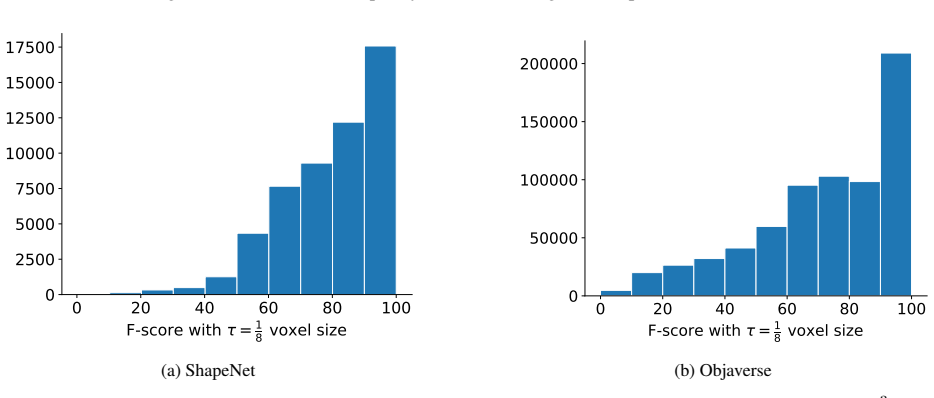
- [§4.5] The phrase 'reconstruction errors are taken from the analysis in Figure 7b' is confusing because Fig. 7b reports F-score for SDF grid conversion under different preprocessing methods, not per-representation reconstruction errors. Clarify what data were actually used to compute the 12.9% share.
Circularity Check
No significant circularity: the benchmark is externally anchored; the only self-citation is not load-bearing.
full rationale
This paper is an empirical benchmark rather than a derivation. Its central claims—representation rankings for reconstruction/generation and the reported fractions of generation MMD attributable to reconstruction/compression errors—are computed from measured errors on external datasets (ShapeNet, Objaverse) and a user study, not derived from the definitions of the representations themselves. The autoencoders are trained for reconstruction and then evaluated with geometry metrics, but the paper does not specify that the training losses are identical to the CD/F-score/NC evaluation metrics, so the ranking is not a fitted parameter renamed as a prediction. The only self-citation (Leboutet et al. 2024, in the Outlook section) is not load-bearing. The error-decomposition percentages in Fig. 6 are not straightforwardly reproducible from Tables 2 and 3 and may double-count conversion error, but that is a correctness/reproducibility concern rather than circularity: the claimed shares are ratios of independent measurements, and the paper explicitly notes the errors are "not simply additive." No step reduces to its own input by construction, and no author-imposed uniqueness theorem is invoked to force a choice. Therefore, no significant circularity is present.
Assumptions & free parameters
free parameters (6)
- Grid resolution 64^3 for voxel/SDF =
64^3
- SDF truncation cutoff =
0.2
- Octree depth =
6
- Latent patch size for transformer tokenization =
4^3
- Evaluation set size for generation metrics =
400 (ShapeNet), 183 (Objaverse)
- Learning rates and schedules per model =
not listed in main text
assumptions (4)
- domain assumption Meshes are the ground truth for evaluating 3D representation quality.
- domain assumption Latent diffusion is representative enough that conclusions generalize to other generators (GANs, autoregressive).
- ad hoc to paper Standardized pipeline isolates the representation as the source of performance differences.
- domain assumption Chamfer Distance, F-score, Normal Consistency, COV/MMD/1-NNA capture meaningful shape quality.
Cite this review
Pith. "Pith review of Unifi3D: A Study on 3D Representations for Generation and Reconstruction in a Common Framework." pith.science (2026). https://pith.science/paper/77HDYR5D
@misc{pith2026250902474,
  author       = {Pith},
  title        = {Pith review of: Unifi3D: A Study on 3D Representations for Generation and Reconstruction in a Common Framework},
  year         = {2026},
  howpublished = {\url{https://pith.science/paper/77HDYR5D}},
  note         = {Machine review of arXiv:2509.02474}
}
read the original abstract
Following rapid advancements in text and image generation, research has increasingly shifted towards 3D generation. Unlike the well-established pixel-based representation in images, 3D representations remain diverse and fragmented, encompassing a wide variety of approaches such as voxel grids, neural radiance fields, signed distance functions, point clouds, or octrees, each offering distinct advantages and limitations. In this work, we present a unified evaluation framework designed to assess the performance of 3D representations in reconstruction and generation. We compare these representations based on multiple criteria: quality, computational efficiency, and generalization performance. Beyond standard model benchmarking, our experiments aim to derive best practices over all steps involved in the 3D generation pipeline, including preprocessing, mesh reconstruction, compression with autoencoders, and generation. Our findings highlight that reconstruction errors significantly impact overall performance, underscoring the need to evaluate generation and reconstruction jointly. We provide insights that can inform the selection of suitable 3D models for various applications, facilitating the development of more robust and application-specific solutions in 3D generation. The code for our framework is available at https://github.com/isl-org/unifi3d.
Figures


Figures from the paper (13 more)




Forward citations
Cited by 1 Pith paper
-
A Cross-Model VLM-Judge Protocol for Single-Image 3D Mesh Quality (and Why Cheap Proxies Fall Short)
A reproducible VLM-judge protocol with position-bias correction is validated as superior to CLIP similarity and geometry-validity proxies for assessing single-image 3D mesh quality.
Reference graph
Works this paper leans on
-
[1]
Learning representations and generative models for 3d point clouds
Panos Achlioptas, Olga Diamanti, Ioannis Mitliagkas, and Leonidas Guibas. Learning representations and generative models for 3d point clouds. In International conference on machine learning, pages 40--49. PMLR, 2018
2018
-
[2]
Sal: Sign agnostic learning of shapes from raw data
Matan Atzmon and Yaron Lipman. Sal: Sign agnostic learning of shapes from raw data. In Proceedings of the IEEE/CVF conference on computer vision and pattern recognition, pages 2565--2574, 2020
2020
-
[3]
Rank analysis of incomplete block designs: I
Ralph Allan Bradley and Milton E Terry. Rank analysis of incomplete block designs: I. the method of paired comparisons. Biometrika, 39 0 (3/4): 0 324--345, 1952
1952
-
[4]
Generative and discriminative voxel modeling with convolutional neural networks
Andrew Brock, Theodore Lim, James M Ritchie, and Nick Weston. Generative and discriminative voxel modeling with convolutional neural networks. arXiv preprint arXiv:1608.04236, 2016
arXiv 2016
-
[5]
Learning gradient fields for shape generation
Ruojin Cai, Guandao Yang, Hadar Averbuch-Elor, Zekun Hao, Serge Belongie, Noah Snavely, and Bharath Hariharan. Learning gradient fields for shape generation. In Computer Vision--ECCV 2020: 16th European Conference, Glasgow, UK, August 23--28, 2020, Proceedings, Part III 16, pages 364--381. Springer, 2020
2020
-
[6]
A survey on generative diffusion models
Hanqun Cao, Cheng Tan, Zhangyang Gao, Yilun Xu, Guangyong Chen, Pheng-Ann Heng, and Stan Z Li. A survey on generative diffusion models. IEEE transactions on knowledge and data engineering, 36 0 (7): 0 2814--2830, 2024
2024
-
[7]
Efficient geometry-aware 3d generative adversarial networks
Eric R Chan, Connor Z Lin, Matthew A Chan, Koki Nagano, Boxiao Pan, Shalini De Mello, Orazio Gallo, Leonidas J Guibas, Jonathan Tremblay, Sameh Khamis, et al. Efficient geometry-aware 3d generative adversarial networks. In Proceedings of the IEEE/CVF conference on computer vision and pattern recognition, pages 16123--16133, 2022
2022
-
[8]
Shapenet: An information-rich 3d model repository
Angel X Chang, Thomas Funkhouser, Leonidas Guibas, Pat Hanrahan, Qixing Huang, Zimo Li, Silvio Savarese, Manolis Savva, Shuran Song, Hao Su, et al. Shapenet: An information-rich 3d model repository. arXiv preprint arXiv:1512.03012, 2015
arXiv 2015
Show all 108 references
-
[9]
Single-stage diffusion nerf: A unified approach to 3d generation and reconstruction
Hansheng Chen, Jiatao Gu, Anpei Chen, Wei Tian, Zhuowen Tu, Lingjie Liu, and Hao Su. Single-stage diffusion nerf: A unified approach to 3d generation and reconstruction. In Proceedings of the IEEE/CVF international conference on computer vision, pages 2416--2425, 2023 a
2023
-
[10]
Fantasia3d: Disentangling geometry and appearance for high-quality text-to-3d content creation
Rui Chen, Yongwei Chen, Ningxin Jiao, and Kui Jia. Fantasia3d: Disentangling geometry and appearance for high-quality text-to-3d content creation. In Proceedings of the IEEE/CVF international conference on computer vision, pages 22246--22256, 2023 b
2023
-
[11]
Dora: Sampling and benchmarking for 3d shape variational auto-encoders
Rui Chen, Jianfeng Zhang, Yixun Liang, Guan Luo, Weiyu Li, Jiarui Liu, Xiu Li, Xiaoxiao Long, Jiashi Feng, and Ping Tan. Dora: Sampling and benchmarking for 3d shape variational auto-encoders. arXiv preprint arXiv:2412.17808, 2024 a
2024 arXiv
-
[12]
Meshxl: Neural coordinate field for generative 3d foundation models
Sijin Chen, Xin Chen, Anqi Pang, Xianfang Zeng, Wei Cheng, Yijun Fu, Fukun Yin, Billzb Wang, Jingyi Yu, Gang Yu, Bin Fu, and Tao Chen. Meshxl: Neural coordinate field for generative 3d foundation models. In NeurIPS, 2024 b
2024
-
[13]
gdna: Towards generative detailed neural avatars
Xu Chen, Tianjian Jiang, Jie Song, Jinlong Yang, Michael J Black, Andreas Geiger, and Otmar Hilliges. gdna: Towards generative detailed neural avatars. In Proceedings of the IEEE/CVF Conference on Computer Vision and Pattern Recognition, pages 20427--20437, 2022
2022
-
[14]
Autoregressive 3d shape generation via canonical mapping
An-Chieh Cheng, Xueting Li, Sifei Liu, Min Sun, and Ming-Hsuan Yang. Autoregressive 3d shape generation via canonical mapping. In European Conference on Computer Vision, pages 89--104. Springer, 2022
2022
-
[15]
SDFusion : Multimodal 3d shape completion, reconstruction, and generation
Yen-Chi Cheng, Hsin-Ying Lee, Sergey Tulyakov, Alexander G Schwing, and Liang-Yan Gui. SDFusion : Multimodal 3d shape completion, reconstruction, and generation. In Proceedings of the IEEE/CVF Conference on Computer Vision and Pattern Recognition, pages 4456--4465, 2023
2023
-
[16]
3d-r2n2: A unified approach for single and multi-view 3d object reconstruction
Christopher B Choy, Danfei Xu, JunYoung Gwak, Kevin Chen, and Silvio Savarese. 3d-r2n2: A unified approach for single and multi-view 3d object reconstruction. In Computer Vision--ECCV 2016: 14th European Conference, Amsterdam, The Netherlands, October 11-14, 2016, Proceedings,...
2016
-
[17]
Scalable high-resolution pixel-space image synthesis with hourglass diffusion transformers
Katherine Crowson, Stefan Andreas Baumann, Alex Birch, Tanishq Mathew Abraham, Daniel Z Kaplan, and Enrico Shippole. Scalable high-resolution pixel-space image synthesis with hourglass diffusion transformers. In Forty-first International Conference on Machine Learning, 2024
2024
-
[18]
Scancomplete: Large-scale scene completion and semantic segmentation for 3d scans
Angela Dai, Daniel Ritchie, Martin Bokeloh, Scott Reed, J \"u rgen Sturm, and Matthias Nie ner. Scancomplete: Large-scale scene completion and semantic segmentation for 3d scans. In Proceedings of the IEEE Conference on Computer Vision and Pattern Recognition, pages 4578--4587, 2018
2018
-
[19]
Objaverse: A universe of annotated 3d objects
Matt Deitke, Dustin Schwenk, Jordi Salvador, Luca Weihs, Oscar Michel, Eli VanderBilt, Ludwig Schmidt, Kiana Ehsani, Aniruddha Kembhavi, and Ali Farhadi. Objaverse: A universe of annotated 3d objects. In Proceedings of the IEEE/CVF Conference on Computer Vision and Pattern Rec...
2023
-
[20]
Objaverse-xl: A universe of 10m+ 3d objects
Matt Deitke, Ruoshi Liu, Matthew Wallingford, Huong Ngo, Oscar Michel, Aditya Kusupati, Alan Fan, Christian Laforte, Vikram Voleti, Samir Yitzhak Gadre, et al. Objaverse-xl: A universe of 10m+ 3d objects. Advances in Neural Information Processing Systems, 36, 2024
2024
-
[21]
Boost your nerf: A model-agnostic mixture of experts framework for high quality and efficient rendering
Francesco Di Sario, Riccardo Renzulli, Enzo Tartaglione, and Marco Grangetto. Boost your nerf: A model-agnostic mixture of experts framework for high quality and efficient rendering. In European Conference on Computer Vision, pages 176--192. Springer, 2024
2024
-
[22]
Plenoxels: Radiance fields without neural networks
Sara Fridovich-Keil, Alex Yu, Matthew Tancik, Qinhong Chen, Benjamin Recht, and Angjoo Kanazawa. Plenoxels: Radiance fields without neural networks. In Proceedings of the IEEE/CVF conference on computer vision and pattern recognition, pages 5501--5510, 2022
2022
-
[23]
Representing scenes as compositional generative neural feature fields based on giraffe for 3d reconstruction of classroom scenes
Tianlin Fu, Renyu Deng, Yue Gao, and Fuquan Zhang. Representing scenes as compositional generative neural feature fields based on giraffe for 3d reconstruction of classroom scenes. In International Conference on Intelligent Information Hiding and Multimedia Signal Processing, ...
2022
-
[24]
Get3d: A generative model of high quality 3d textured shapes learned from images
Jun Gao, Tianchang Shen, Zian Wang, Wenzheng Chen, Kangxue Yin, Daiqing Li, Or Litany, Zan Gojcic, and Sanja Fidler. Get3d: A generative model of high quality 3d textured shapes learned from images. Advances In Neural Information Processing Systems, 35: 0 31841--31854, 2022
2022
-
[25]
Sdm-net: Deep generative network for structured deformable mesh
Lin Gao, Jie Yang, Tong Wu, Yu-Jie Yuan, Hongbo Fu, Yu-Kun Lai, and Hao Zhang. Sdm-net: Deep generative network for structured deformable mesh. ACM Transactions on Graphics (TOG), 38 0 (6): 0 1--15, 2019
2019
-
[26]
A review on deep learning approaches for 3d data representations in retrieval and classifications
Abubakar Sulaiman Gezawa, Yan Zhang, Qicong Wang, and Lei Yunqi. A review on deep learning approaches for 3d data representations in retrieval and classifications. IEEE access, 8: 0 57566--57593, 2020
2020
-
[27]
3dgen: Triplane latent diffusion for textured mesh generation
Anchit Gupta, Wenhan Xiong, Yixin Nie, Ian Jones, and Barlas O g uz. 3dgen: Triplane latent diffusion for textured mesh generation. arXiv preprint arXiv:2303.05371, 2023
2023 arXiv
-
[28]
Sparseflex: High-resolution and arbitrary-topology 3d shape modeling
Xianglong He, Zi-Xin Zou, Chia-Hao Chen, Yuan-Chen Guo, Ding Liang, Chun Yuan, Wanli Ouyang, Yan-Pei Cao, and Yangguang Li. Sparseflex: High-resolution and arbitrary-topology 3d shape modeling. arXiv preprint arXiv:2503.21732, 2025
2025 arXiv
-
[29]
Clip goes 3d: Leveraging prompt tuning for language grounded 3d recognition
Deepti Hegde, Jeya Maria Jose Valanarasu, and Vishal Patel. Clip goes 3d: Leveraging prompt tuning for language grounded 3d recognition. In Proceedings of the IEEE/CVF International Conference on Computer Vision, pages 2028--2038, 2023
-
[30]
Denoising diffusion probabilistic models
Jonathan Ho, Ajay Jain, and Pieter Abbeel. Denoising diffusion probabilistic models. Advances in neural information processing systems, 33: 0 6840--6851, 2020
2020
-
[31]
Robust watertight manifold surface generation method for shapenet models
Jingwei Huang, Hao Su, and Leonidas Guibas. Robust watertight manifold surface generation method for shapenet models. arXiv preprint arXiv:1802.01698, 2018
2018 arXiv
-
[32]
Manifoldplus: A robust and scalable watertight manifold surface generation method for triangle soups
Jingwei Huang, Yichao Zhou, and Leonidas Guibas. Manifoldplus: A robust and scalable watertight manifold surface generation method for triangle soups. arXiv preprint arXiv:2005.11621, 2020
2005 arXiv
-
[33]
Make-a-shape: a ten-million-scale 3d shape model
Ka-Hei Hui, Aditya Sanghi, Arianna Rampini, Kamal Rahimi Malekshan, Zhengzhe Liu, Hooman Shayani, and Chi-Wing Fu. Make-a-shape: a ten-million-scale 3d shape model. In Forty-first International Conference on Machine Learning, 2024
2024
-
[34]
A survey on text-to-3d contents generation in the wild
Chenhan Jiang. A survey on text-to-3d contents generation in the wild. arXiv preprint arXiv:2405.09431, 2024
2024 arXiv
-
[35]
Shap-e: Generating conditional 3d implicit functions
Heewoo Jun and Alex Nichol. Shap-e: Generating conditional 3d implicit functions. arXiv preprint arXiv:2305.02463, 2023
2023 arXiv
-
[36]
Holodiffusion: Training a 3d diffusion model using 2d images
Animesh Karnewar, Andrea Vedaldi, David Novotny, and Niloy J Mitra. Holodiffusion: Training a 3d diffusion model using 2d images. In Proceedings of the IEEE/CVF conference on computer vision and pattern recognition, pages 18423--18433, 2023
2023
-
[37]
3d gaussian splatting for real-time radiance field rendering
Bernhard Kerbl, Georgios Kopanas, Thomas Leimk \"u hler, and George Drettakis. 3d gaussian splatting for real-time radiance field rendering. ACM Trans. Graph., 42 0 (4): 0 139--1, 2023
2023
-
[38]
Softflow: Probabilistic framework for normalizing flow on manifolds
Hyeongju Kim, Hyeonseung Lee, Woo Hyun Kang, Joun Yeop Lee, and Nam Soo Kim. Softflow: Probabilistic framework for normalizing flow on manifolds. Advances in Neural Information Processing Systems, 33: 0 16388--16397, 2020
2020
-
[39]
Neuralfield-ldm: Scene generation with hierarchical latent diffusion models
Seung Wook Kim, Bradley Brown, Kangxue Yin, Karsten Kreis, Katja Schwarz, Daiqing Li, Robin Rombach, Antonio Torralba, and Sanja Fidler. Neuralfield-ldm: Scene generation with hierarchical latent diffusion models. In Proceedings of the IEEE/CVF conference on computer vision an...
2023
-
[40]
Discrete point flow networks for efficient point cloud generation
Roman Klokov, Edmond Boyer, and Jakob Verbeek. Discrete point flow networks for efficient point cloud generation. In European Conference on Computer Vision, pages 694--710. Springer, 2020
2020
-
[41]
Gaussiananything: Interactive point cloud flow matching for 3d object generation
Yushi Lan, Shangchen Zhou, Zhaoyang Lyu, Fangzhou Hong, Shuai Yang, Bo Dai, Xingang Pan, and Chen Change Loy. Gaussiananything: Interactive point cloud flow matching for 3d object generation. arXiv preprint arXiv:2411.08033, 2024
2024 arXiv
-
[42]
Midgard: Modular interpretable diffusion over graphs for articulated designs
Quentin Leboutet, Nina Wiedemann, Zhipeng Cai, Michael Paulitsch, and Kai Yuan. Midgard: Modular interpretable diffusion over graphs for articulated designs. In Advances in Neural Information Processing Systems, 2024
2024
-
[43]
Nap: Neural 3d articulated object prior
Jiahui Lei, Congyue Deng, William B Shen, Leonidas J Guibas, and Kostas Daniilidis. Nap: Neural 3d articulated object prior. Advances in Neural Information Processing Systems, 36: 0 31878--31894, 2023
2023
-
[44]
Diffusion-sdf: Text-to-shape via voxelized diffusion
Muheng Li, Yueqi Duan, Jie Zhou, and Jiwen Lu. Diffusion-sdf: Text-to-shape via voxelized diffusion. In Proceedings of the IEEE/CVF conference on computer vision and pattern recognition, pages 12642--12651, 2023
2023
-
[45]
Advances in 3d generation: A survey
Xiaoyu Li, Qi Zhang, Di Kang, Weihao Cheng, Yiming Gao, Jingbo Zhang, Zhihao Liang, Jing Liao, Yan-Pei Cao, and Ying Shan. Advances in 3d generation: A survey. arXiv preprint arXiv:2401.17807, 2024
2024 arXiv
-
[46]
Triposg: High-fidelity 3d shape synthesis using large-scale rectified flow models
Yangguang Li, Zi-Xin Zou, Zexiang Liu, Dehu Wang, Yuan Liang, Zhipeng Yu, Xingchao Liu, Yuan-Chen Guo, Ding Liang, Wanli Ouyang, et al. Triposg: High-fidelity 3d shape synthesis using large-scale rectified flow models. arXiv preprint arXiv:2502.06608, 2025
2025 arXiv
-
[47]
Magic3d: High-resolution text-to-3d content creation
Chen-Hsuan Lin, Jun Gao, Luming Tang, Towaki Takikawa, Xiaohui Zeng, Xun Huang, Karsten Kreis, Sanja Fidler, Ming-Yu Liu, and Tsung-Yi Lin. Magic3d: High-resolution text-to-3d content creation. In Proceedings of the IEEE/CVF Conference on Computer Vision and Pattern Recognitio...
2023
-
[48]
A comprehensive survey on 3d content generation
Jian Liu, Xiaoshui Huang, Tianyu Huang, Lu Chen, Yuenan Hou, Shixiang Tang, Ziwei Liu, Wanli Ouyang, Wangmeng Zuo, Junjun Jiang, et al. A comprehensive survey on 3d content generation. arXiv preprint arXiv:2402.01166, 2024 a
2024 arXiv
-
[49]
Cage: Controllable articulation generation
Jiayi Liu, Hou In Ivan Tam, Ali Mahdavi-Amiri, and Manolis Savva. Cage: Controllable articulation generation. In Proceedings of the IEEE/CVF Conference on Computer Vision and Pattern Recognition, pages 17880--17889, 2024 b
2024
-
[50]
Neural sparse voxel fields
Lingjie Liu, Jiatao Gu, Kyaw Zaw Lin, Tat-Seng Chua, and Christian Theobalt. Neural sparse voxel fields. Advances in Neural Information Processing Systems, 33: 0 15651--15663, 2020
2020
-
[51]
One-2-3-45++: Fast single image to 3d objects with consistent multi-view generation and 3d diffusion
Minghua Liu, Ruoxi Shi, Linghao Chen, Zhuoyang Zhang, Chao Xu, Xinyue Wei, Hansheng Chen, Chong Zeng, Jiayuan Gu, and Hao Su. One-2-3-45++: Fast single image to 3d objects with consistent multi-view generation and 3d diffusion. arXiv preprint arXiv:2311.07885, 2023 a
2023 arXiv
-
[52]
One-2-3-45: Any single image to 3d mesh in 45 seconds without per-shape optimization
Minghua Liu, Chao Xu, Haian Jin, Linghao Chen, Mukund Varma T, Zexiang Xu, and Hao Su. One-2-3-45: Any single image to 3d mesh in 45 seconds without per-shape optimization. Advances in Neural Information Processing Systems, 36, 2024 c
2024
-
[53]
Zero-1-to-3: Zero-shot one image to 3d object
Ruoshi Liu, Rundi Wu, Basile Van Hoorick, Pavel Tokmakov, Sergey Zakharov, and Carl Vondrick. Zero-1-to-3: Zero-shot one image to 3d object. In Proceedings of the IEEE/CVF international conference on computer vision, pages 9298--9309, 2023 b
2023
-
[54]
Wonder3d: Single image to 3d using cross-domain diffusion
Xiaoxiao Long, Yuan - Chen Guo, Cheng Lin, Yuan Liu, Zhiyang Dou, Lingjie Liu, Yuexin Ma, Song - Hai Zhang, Marc Habermann, Christian Theobalt, and Wenping Wang. Wonder3d: Single image to 3d using cross-domain diffusion. In CVPR , pages 9970--9980. IEEE , 2024
2024
-
[55]
Lorensen and Harvey E
William E. Lorensen and Harvey E. Cline. Marching cubes: A high resolution 3d surface construction algorithm. In SIGGRAPH , pages 163--169. ACM , 1987
1987
-
[56]
Surfgen: Adversarial 3d shape synthesis with explicit surface discriminators
Andrew Luo, Tianqin Li, Wen-Hao Zhang, and Tai Sing Lee. Surfgen: Adversarial 3d shape synthesis with explicit surface discriminators. In Proceedings of the IEEE/CVF International Conference on Computer Vision, pages 16238--16248, 2021
2021
-
[57]
Diffusion probabilistic models for 3d point cloud generation
Shitong Luo and Wei Hu. Diffusion probabilistic models for 3d point cloud generation. In Proceedings of the IEEE/CVF Conference on Computer Vision and Pattern Recognition, pages 2837--2845, 2021
2021
-
[58]
A conditional point diffusion-refinement paradigm for 3d point cloud completion
Zhaoyang Lyu, Zhifeng Kong, Xudong Xu, Liang Pan, and Dahua Lin. A conditional point diffusion-refinement paradigm for 3d point cloud completion. arXiv preprint arXiv:2112.03530, 2021
2021 arXiv
-
[59]
Voxnet: A 3d convolutional neural network for real-time object recognition
Daniel Maturana and Sebastian Scherer. Voxnet: A 3d convolutional neural network for real-time object recognition. In 2015 IEEE/RSJ international conference on intelligent robots and systems (IROS), pages 922--928. IEEE, 2015
2015
-
[60]
Occupancy networks: Learning 3d reconstruction in function space
Lars Mescheder, Michael Oechsle, Michael Niemeyer, Sebastian Nowozin, and Andreas Geiger. Occupancy networks: Learning 3d reconstruction in function space. In Proceedings of the IEEE/CVF conference on computer vision and pattern recognition, pages 4460--4470, 2019
2019
-
[61]
Nerf: Representing scenes as neural radiance fields for view synthesis
Ben Mildenhall, Pratul P Srinivasan, Matthew Tancik, Jonathan T Barron, Ravi Ramamoorthi, and Ren Ng. Nerf: Representing scenes as neural radiance fields for view synthesis. Communications of the ACM, 65 0 (1): 0 99--106, 2021
2021
-
[62]
Autosdf: Shape priors for 3d completion, reconstruction and generation
Paritosh Mittal, Yen-Chi Cheng, Maneesh Singh, and Shubham Tulsiani. Autosdf: Shape priors for 3d completion, reconstruction and generation. In Proceedings of the IEEE/CVF Conference on Computer Vision and Pattern Recognition, pages 306--315, 2022
2022
-
[63]
Instant neural graphics primitives with a multiresolution hash encoding
Thomas M \"u ller, Alex Evans, Christoph Schied, and Alexander Keller. Instant neural graphics primitives with a multiresolution hash encoding. ACM transactions on graphics (TOG), 41 0 (4): 0 1--15, 2022
2022
-
[64]
3d-ldm: Neural implicit 3d shape generation with latent diffusion models
Gimin Nam, Mariem Khlifi, Andrew Rodriguez, Alberto Tono, Linqi Zhou, and Paul Guerrero. 3d-ldm: Neural implicit 3d shape generation with latent diffusion models. arXiv preprint arXiv:2212.00842, 2022
2022 arXiv
-
[65]
Polygen: An autoregressive generative model of 3d meshes
Charlie Nash, Yaroslav Ganin, SM Ali Eslami, and Peter Battaglia. Polygen: An autoregressive generative model of 3d meshes. In International conference on machine learning, pages 7220--7229. PMLR, 2020
2020
-
[66]
Blockgan: Learning 3d object-aware scene representations from unlabelled images
Thu H Nguyen-Phuoc, Christian Richardt, Long Mai, Yongliang Yang, and Niloy Mitra. Blockgan: Learning 3d object-aware scene representations from unlabelled images. Advances in neural information processing systems, 33: 0 6767--6778, 2020
2020
-
[67]
Point-e: A system for generating 3d point clouds from complex prompts
Alex Nichol, Heewoo Jun, Prafulla Dhariwal, Pamela Mishkin, and Mark Chen. Point-e: A system for generating 3d point clouds from complex prompts. arXiv preprint arXiv:2212.08751, 2022
2022 arXiv
-
[68]
Deepsdf: Learning continuous signed distance functions for shape representation
Jeong Joon Park, Peter Florence, Julian Straub, Richard Newcombe, and Steven Lovegrove. Deepsdf: Learning continuous signed distance functions for shape representation. In Proceedings of the IEEE/CVF conference on computer vision and pattern recognition, pages 165--174, 2019
2019
-
[69]
Scalable diffusion models with transformers
William Peebles and Saining Xie. Scalable diffusion models with transformers. In Proceedings of the IEEE/CVF International Conference on Computer Vision, pages 4195--4205, 2023
2023
-
[70]
Convolutional occupancy networks
Songyou Peng, Michael Niemeyer, Lars Mescheder, Marc Pollefeys, and Andreas Geiger. Convolutional occupancy networks. In Computer Vision--ECCV 2020: 16th European Conference, Glasgow, UK, August 23--28, 2020, Proceedings, Part III 16, pages 523--540. Springer, 2020
2020
-
[71]
State of the art on diffusion models for visual computing
Ryan Po, Wang Yifan, Vladislav Golyanik, Kfir Aberman, Jonathan T Barron, Amit Bermano, Eric Chan, Tali Dekel, Aleksander Holynski, Angjoo Kanazawa, et al. State of the art on diffusion models for visual computing. In Computer graphics forum, volume 43, page e15063. Wiley Onli...
2024
-
[72]
Dreamfusion: Text-to-3d using 2d diffusion
Ben Poole, Ajay Jain, Jonathan T Barron, and Ben Mildenhall. Dreamfusion: Text-to-3d using 2d diffusion. arXiv preprint arXiv:2209.14988, 2022
2022 arXiv
-
[73]
Xcube: Large-scale 3d generative modeling using sparse voxel hierarchies
Xuanchi Ren, Jiahui Huang, Xiaohui Zeng, Ken Museth, Sanja Fidler, and Francis Williams. Xcube: Large-scale 3d generative modeling using sparse voxel hierarchies. In Proceedings of the IEEE/CVF Conference on Computer Vision and Pattern Recognition, pages 4209--4219, 2024
2024
-
[74]
High-resolution image synthesis with latent diffusion models
Robin Rombach, Andreas Blattmann, Dominik Lorenz, Patrick Esser, and Bj \"o rn Ommer. High-resolution image synthesis with latent diffusion models. In Proceedings of the IEEE/CVF conference on computer vision and pattern recognition, pages 10684--10695, 2022
2022
-
[75]
Zero123++: a single image to consistent multi-view diffusion base model
Ruoxi Shi, Hansheng Chen, Zhuoyang Zhang, Minghua Liu, Chao Xu, Xinyue Wei, Linghao Chen, Chong Zeng, and Hao Su. Zero123++: a single image to consistent multi-view diffusion base model. arXiv preprint arXiv:2310.15110, 2023 a
2023 arXiv
-
[76]
Mvdream: Multi-view diffusion for 3d generation
Yichun Shi, Peng Wang, Jianglong Ye, Mai Long, Kejie Li, and Xiao Yang. Mvdream: Multi-view diffusion for 3d generation. arXiv preprint arXiv:2308.16512, 2023 b
2023 arXiv
-
[77]
3d point cloud generative adversarial network based on tree structured graph convolutions
Dong Wook Shu, Sung Woo Park, and Junseok Kwon. 3d point cloud generative adversarial network based on tree structured graph convolutions. In Proceedings of the IEEE/CVF international conference on computer vision, pages 3859--3868, 2019
2019
-
[78]
Meshgpt: Generating triangle meshes with decoder-only transformers
Yawar Siddiqui, Antonio Alliegro, Alexey Artemov, Tatiana Tommasi, Daniele Sirigatti, Vladislav Rosov, Angela Dai, and Matthias Nie ner. Meshgpt: Generating triangle meshes with decoder-only transformers. arXiv preprint arXiv:2311.15475, 2023
2023 arXiv
-
[79]
Deep unsupervised learning using nonequilibrium thermodynamics
Jascha Sohl-Dickstein, Eric Weiss, Niru Maheswaranathan, and Surya Ganguli. Deep unsupervised learning using nonequilibrium thermodynamics. In International conference on machine learning, pages 2256--2265. PMLR, 2015
2015
-
[80]
Direct voxel grid optimization: Super-fast convergence for radiance fields reconstruction
Cheng Sun, Min Sun, and Hwann-Tzong Chen. Direct voxel grid optimization: Super-fast convergence for radiance fields reconstruction. In Proceedings of the IEEE/CVF conference on computer vision and pattern recognition, pages 5459--5469, 2022
2022
-
[81]
Dreamcraft3d: Hierarchical 3d generation with bootstrapped diffusion prior
Jingxiang Sun, Bo Zhang, Ruizhi Shao, Lizhen Wang, Wen Liu, Zhenda Xie, and Yebin Liu. Dreamcraft3d: Hierarchical 3d generation with bootstrapped diffusion prior. arXiv preprint arXiv:2310.16818, 2023
2023 arXiv
-
[82]
Pointgrow: Autoregressively learned point cloud generation with self-attention
Yongbin Sun, Yue Wang, Ziwei Liu, Joshua Siegel, and Sanjay Sarma. Pointgrow: Autoregressively learned point cloud generation with self-attention. In Proceedings of the IEEE/CVF Winter Conference on Applications of Computer Vision, pages 61--70, 2020
2020
-
[83]
Dreamgaussian: Generative gaussian splatting for efficient 3d content creation
Jiaxiang Tang, Jiawei Ren, Hang Zhou, Ziwei Liu, and Gang Zeng. Dreamgaussian: Generative gaussian splatting for efficient 3d content creation. arXiv preprint arXiv:2309.16653, 2023
2023 arXiv
-
[84]
Diffusion models for 3d generation: A survey
Chen Wang, Hao-Yang Peng, Ying-Tian Liu, Jiatao Gu, and Shi-Min Hu. Diffusion models for 3d generation: A survey. arXiv, 2024 a
2024
-
[85]
Dual octree graph networks for learning adaptive volumetric shape representations
Peng-Shuai Wang, Yang Liu, and Xin Tong. Dual octree graph networks for learning adaptive volumetric shape representations. ACM SIGGRAPH 2022 Conference Papers, 2022 a
2022
-
[86]
Dual octree graph networks for learning adaptive volumetric shape representations
Peng-Shuai Wang, Yang Liu, and Xin Tong. Dual octree graph networks for learning adaptive volumetric shape representations. ACM Transactions on Graphics (TOG), 41 0 (4): 0 1--15, 2022 b
2022
-
[87]
Rodin: A generative model for sculpting 3d digital avatars using diffusion
Tengfei Wang, Bo Zhang, Ting Zhang, Shuyang Gu, Jianmin Bao, Tadas Baltrusaitis, Jingjing Shen, Dong Chen, Fang Wen, Qifeng Chen, et al. Rodin: A generative model for sculpting 3d digital avatars using diffusion. In Proceedings of the IEEE/CVF conference on computer vision and...
2023
-
[88]
Prolificdreamer: High-fidelity and diverse text-to-3d generation with variational score distillation
Zhengyi Wang, Cheng Lu, Yikai Wang, Fan Bao, Chongxuan Li, Hang Su, and Jun Zhu. Prolificdreamer: High-fidelity and diverse text-to-3d generation with variational score distillation. Advances in Neural Information Processing Systems, 36, 2024 b
2024
-
[89]
Taming feed-forward reconstruction models as latent encoders for 3d generative models
Suttisak Wizadwongsa, Jinfan Zhou, Edward Li, and Jeong Joon Park. Taming feed-forward reconstruction models as latent encoders for 3d generative models. arXiv preprint arXiv:2501.00651, 2024
2024 arXiv
-
[90]
Learning a probabilistic latent space of object shapes via 3d generative-adversarial modeling
Jiajun Wu, Chengkai Zhang, Tianfan Xue, Bill Freeman, and Josh Tenenbaum. Learning a probabilistic latent space of object shapes via 3d generative-adversarial modeling. Advances in neural information processing systems, 29, 2016
2016
-
[91]
Pq-net: A generative part seq2seq network for 3d shapes
Rundi Wu, Yixin Zhuang, Kai Xu, Hao Zhang, and Baoquan Chen. Pq-net: A generative part seq2seq network for 3d shapes. In Proceedings of the IEEE/CVF Conference on Computer Vision and Pattern Recognition, pages 829--838, 2020
2020
-
[92]
Direct3d: Scalable image-to-3d generation via 3d latent diffusion transformer
Shuang Wu, Youtian Lin, Feihu Zhang, Yifei Zeng, Jingxi Xu, Philip Torr, Xun Cao, and Yao Yao. Direct3d: Scalable image-to-3d generation via 3d latent diffusion transformer. arXiv preprint arXiv:2405.14832, 2024 a
2024 arXiv
-
[93]
Blockfusion: Expandable 3d scene generation using latent tri-plane extrapolation
Zhennan Wu, Yang Li, Han Yan, Taizhang Shang, Weixuan Sun, Senbo Wang, Ruikai Cui, Weizhe Liu, Hiroyuki Sato, Hongdong Li, et al. Blockfusion: Expandable 3d scene generation using latent tri-plane extrapolation. ACM Transactions on Graphics (TOG), 43 0 (4): 0 1--17, 2024 b
2024
-
[94]
3d shapenets: A deep representation for volumetric shapes
Zhirong Wu, Shuran Song, Aditya Khosla, Fisher Yu, Linguang Zhang, Xiaoou Tang, and Jianxiong Xiao. 3d shapenets: A deep representation for volumetric shapes. In Proceedings of the IEEE conference on computer vision and pattern recognition, pages 1912--1920, 2015
1912
-
[95]
Structured 3d latents for scalable and versatile 3d generation
Jianfeng Xiang, Zelong Lv, Sicheng Xu, Yu Deng, Ruicheng Wang, Bowen Zhang, Dong Chen, Xin Tong, and Jiaolong Yang. Structured 3d latents for scalable and versatile 3d generation. arXiv preprint arXiv:2412.01506, 2024
2024 arXiv
-
[96]
Ldm: Large tensorial sdf model for textured mesh generation
Rengan Xie, Wenting Zheng, Kai Huang, Yizheng Chen, Qi Wang, Qi Ye, Wei Chen, and Yuchi Huo. Ldm: Large tensorial sdf model for textured mesh generation. arXiv preprint arXiv:2405.14580, 2024
2024 arXiv
-
[97]
Disn: Deep implicit surface network for high-quality single-view 3d reconstruction
Qiangeng Xu, Weiyue Wang, Duygu Ceylan, Radomir Mech, and Ulrich Neumann. Disn: Deep implicit surface network for high-quality single-view 3d reconstruction. Advances in neural information processing systems, 32, 2019
2019
-
[98]
Shapeformer: Transformer-based shape completion via sparse representation
Xingguang Yan, Liqiang Lin, Niloy J Mitra, Dani Lischinski, Daniel Cohen-Or, and Hui Huang. Shapeformer: Transformer-based shape completion via sparse representation. In Proceedings of the IEEE/CVF Conference on Computer Vision and Pattern Recognition, pages 6239--6249, 2022
2022
-
[99]
Pointflow: 3d point cloud generation with continuous normalizing flows
Guandao Yang, Xun Huang, Zekun Hao, Ming-Yu Liu, Serge Belongie, and Bharath Hariharan. Pointflow: 3d point cloud generation with continuous normalizing flows. In Proceedings of the IEEE/CVF international conference on computer vision, pages 4541--4550, 2019
2019
-
[100]
Hunyuan3d-1.0: A unified framework for text-to-3d and image-to-3d generation
Xianghui Yang, Huiwen Shi, Bowen Zhang, Fan Yang, Jiacheng Wang, Hongxu Zhao, Xinhai Liu, Xinzhou Wang, Qingxiang Lin, Jiaao Yu, et al. Hunyuan3d-1.0: A unified framework for text-to-3d and image-to-3d generation. arXiv preprint arXiv:2411.02293, 2024
2024 arXiv
-
[101]
Adversarial autoencoders for compact representations of 3d point clouds
Maciej Zamorski, Maciej Zikeba, Piotr Klukowski, Rafa Nowak, Karol Kurach, Wojciech Stokowiec, and Tomasz Trzci \'n ski. Adversarial autoencoders for compact representations of 3d point clouds. Computer Vision and Image Understanding, 193: 0 102921, 2020
2020
-
[102]
3dshape2vecset: A 3d shape representation for neural fields and generative diffusion models
Biao Zhang, Jiapeng Tang, Matthias Niessner, and Peter Wonka. 3dshape2vecset: A 3d shape representation for neural fields and generative diffusion models. ACM Transactions on Graphics (TOG), 42 0 (4): 0 1--16, 2023
2023
-
[103]
Clay: A controllable large-scale generative model for creating high-quality 3d assets
Longwen Zhang, Ziyu Wang, Qixuan Zhang, Qiwei Qiu, Anqi Pang, Haoran Jiang, Wei Yang, Lan Xu, and Jingyi Yu. Clay: A controllable large-scale generative model for creating high-quality 3d assets. arXiv preprint arXiv:2406.13897, 2024
2024 arXiv
-
[104]
Challenges and opportunities in 3d content generation
Ke Zhao and Andreas Larsen. Challenges and opportunities in 3d content generation. arXiv preprint arXiv:2405.15335, 2024
2024 arXiv
-
[105]
Michelangelo: Conditional 3d shape generation based on shape-image-text aligned latent representation
Zibo Zhao, Wen Liu, Xin Chen, Xianfang Zeng, Rui Wang, Pei Cheng, Bin Fu, Tao Chen, Gang Yu, and Shenghua Gao. Michelangelo: Conditional 3d shape generation based on shape-image-text aligned latent representation. In NeurIPS, 2023
2023
-
[106]
Locally attentional sdf diffusion for controllable 3d shape generation
Xin-Yang Zheng, Hao Pan, Peng-Shuai Wang, Xin Tong, Yang Liu, and Heung-Yeung Shum. Locally attentional sdf diffusion for controllable 3d shape generation. arXiv preprint arXiv:2305.04461, 2023
2023 arXiv
-
[107]
Uni3d: Exploring unified 3d representation at scale
Junsheng Zhou, Jinsheng Wang, Baorui Ma, Yu-Shen Liu, Tiejun Huang, and Xinlong Wang. Uni3d: Exploring unified 3d representation at scale. arXiv preprint arXiv:2310.06773, 2023
2023 arXiv
-
[108]
3d shape generation and completion through point-voxel diffusion
Linqi Zhou, Yilun Du, and Jiajun Wu. 3d shape generation and completion through point-voxel diffusion. In Proceedings of the IEEE/CVF International Conference on Computer Vision, pages 5826--5835, 2021
2021
Reviewed August 5, 2026 · model on record in the stance chip above.
Discussion (0). Sign in to comment.