REVIEW 2 major objections 4 minor 32 references
RNN Generalization to Omega-Regular Languages
T0 review · 2 major / 4 minor · reviewed 2026-08-15 · deepseek-v4-flash
Pith's one-line read A recurrent network trained on finite prefixes from a deterministic Büchi automaton can recognize the omega-regular language on sequences up to eight times the training length.
desk verdict First solid feasibility study on RNN recognition of omega-regular languages via ultimately periodic encodings, with a real soft spot in the single-seed and biased test generation. read the letter →
The pith
A machine-rendered reading of the paper's core claim, the machinery that carries it, and where it could break.
The reading
What carries the argument
The load-bearing object is the encoding of an ultimately periodic omega-word $uv^\omega$ as the finite word $u$v$, which a known result shows forms a regular language in bijection with the original omega-regular language — so an RNN trained to classify these strings is, in principle, learning a canonical finite projection of the Büchi automaton from which the automaton can be reconstructed. The second component is the data-generation pipeline: sample $u$ and $v$ as uniform paths through the DBA, apply targeted rebalancing to counteract accepting and rejecting sink states, and label exactly by simulating the DBA, computing the transition matrix of $v$ and exponentiating it to check reachability of an accepting cycle. Together these pieces make infinite acceptance conditions finite and balanced enough for gradient training.
What would settle it
Train the same model on one small DBA, then test it on an exhaustive enumeration of all distinct ultimately periodic words up to length 512 rather than on a sample of 512 sequences; if exhaustive accuracy falls far below the sampled accuracy, the sampling distribution, not the network, would be doing the work.
Extended reading notes
Core claim
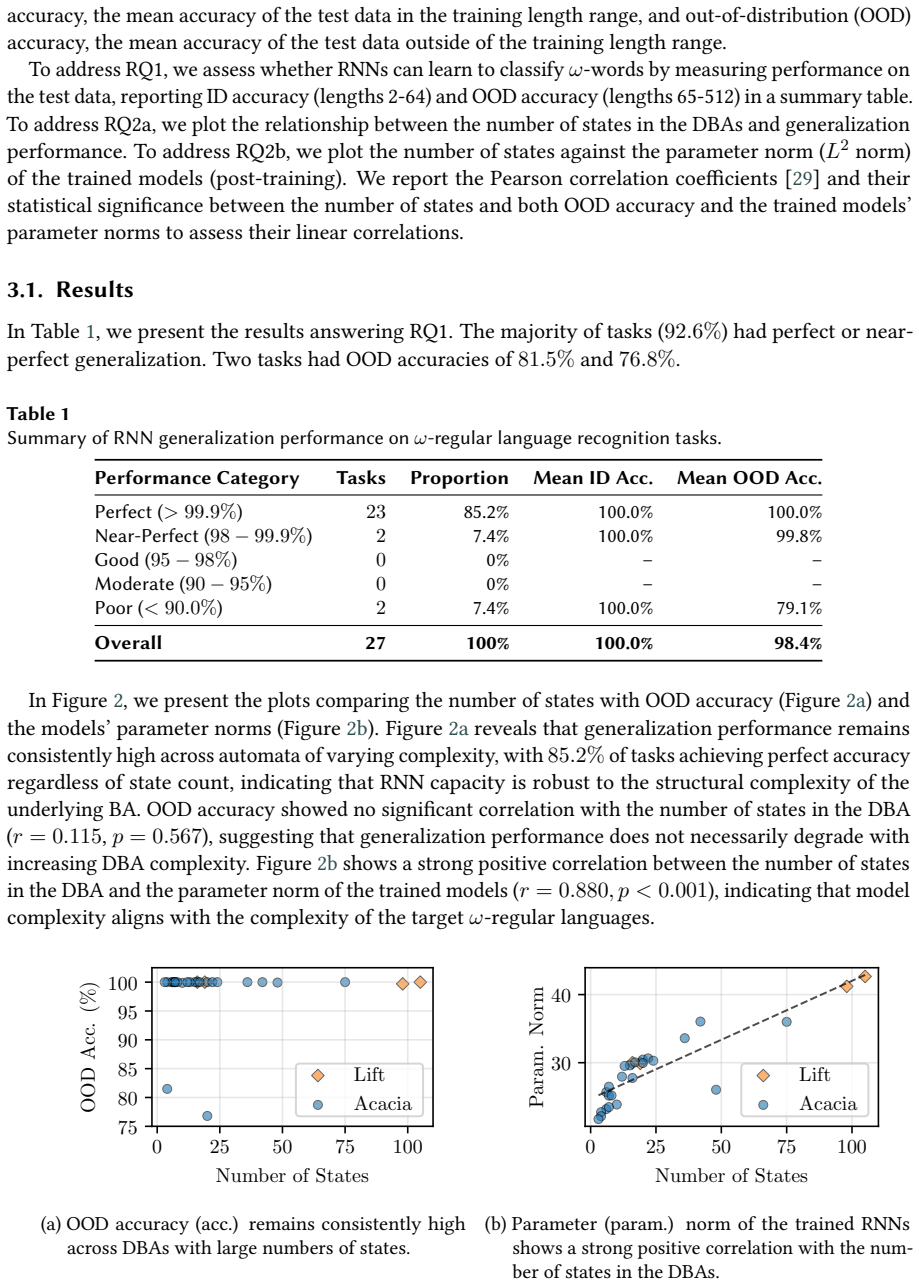
The central discovery is that the acceptance behavior of a deterministic Büchi automaton can be learned by a vanilla RNN from finite encodings of infinite words. The paper represents an omega-word $uv^\omega$ as the finite string $u$v$, relying on the fact that ultimately periodic words uniquely characterize an omega-regular language and stand in bijection with a derived regular language. Simulating DBA runs with matrix exponentiation supplies exact labels during data generation, and balanced path-based sampling prevents acceptance biases from dominating the dataset. Under this protocol, the trained networks reach 100% in-distribution accuracy on all 27 tasks and 100% out-of-distribution accuracy on 23 tasks, with an overall out-of-distribution mean of 98.4%. The paper further reports that the trained models' parameter norms correlate strongly with DBA state count ($r = 0.880$), which it reads as evidence that the networks internalize something like the automaton's structural complexity rather than merely memorizing the training set.
Load-bearing premise
The claim rests on the assumption that the balanced, path-based sampling of sequences produces a test distribution that fairly represents the full omega-regular language, so that high accuracy on the sample really means generalization to the language itself rather than only to the sampled paths.
Editorial extensions
If this is right
- If the central claim holds, recurrent networks trained on $u$v$ encodings can be reused as approximate recognizers for their target omega-regular language in the tested length range, without maintaining the explicit Büchi automaton during inference.
- The strong correlation between DBA state count and model parameter norm suggests that a model's learned complexity tracks the specification's structural complexity, which could help diagnose under- or over-parameterization in verification tasks.
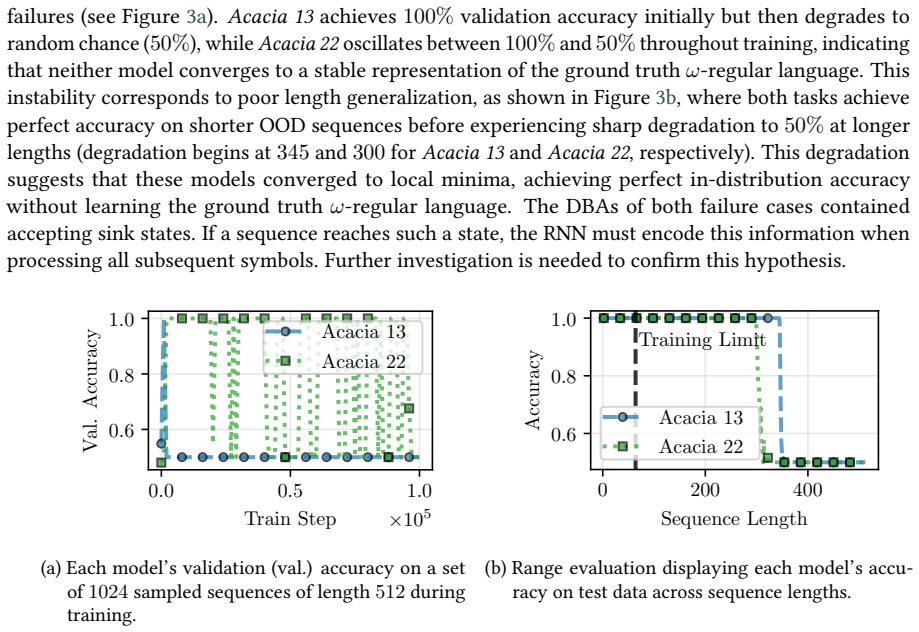
- The two failure cases show that perfect in-distribution accuracy does not guarantee length generalization; unstable validation accuracy during training is an early warning signal, and accepting sink states are a suspected source of difficulty.
- Because the method is restricted to deterministic Büchi automata, the demonstrated capability covers recurrence properties but leaves persistence properties and non-deterministic Büchi automata open for future work.
- The finite encoding preserves enough information to reconstruct the original DBA, so a learned recognizer of this kind could in principle be combined with automata-extraction or formal-verification routines to check what the network actually learned.
Reading between the lines
- A testable extension: the $u$v$ encoding and exact labeling procedure are architecture-agnostic, so the same data generator could train transformers or state-space models, making the paper's protocol a reusable benchmark for length generalization on omega-regular languages.
- The failure cases suggest a targeted intervention: train on sequences whose suffixes must remain in accepting sink states for long stretches, which would directly test whether the hypothesized sink-state memory limitation explains the observed performance collapse.
- If the parameter-norm correlation with DBA state count is genuine, one could predict which specifications need larger or smaller networks before training, using only the automaton's structure.
- The paper does not establish that the trained RNN actually implements a Büchi acceptance condition; extracting an automaton from the trained network and comparing it with the original DBA would settle whether the network approximates the language or merely fits the sampled distribution.
Signed reviews
Editorial analysis
A structured set of objections, weighed in public.
Referee Report
Summary. The paper trains single-layer vanilla RNNs to classify ultimately periodic omega-words u v^omega encoded as u$v, where the target language is the omega-regular language of a deterministic Büchi automaton (DBA) constructed by Spot from LTL formulas. Training sequences have lengths 2-64; test sequences have lengths 2-512, with out-of-distribution (OOD) defined as lengths 65-512. Across 27 LTL benchmarks (alaska_lift and acacia_example), the authors report mean OOD accuracy of 98.4%, with 92.6% of tasks achieving perfect or near-perfect accuracy, and they observe a strong positive correlation between DBA state count and the L2 norm of trained RNN parameters. The paper concludes that RNNs can generalize to omega-regular languages up to 8x the training length.
Significance. If the reported results are robust, this is a useful and original empirical contribution: it is the first study to show length generalization for RNNs on the ultimately periodic encoding of omega-regular languages, it covers non-toy DBAs up to 105 states, and the code is released. The paper is commendable for using Spot-derived DBAs as ground truth (avoiding circularity), for explicitly considering the bijection between UP-words and the derived regular language, and for diagnosing two failure cases. However, the significance is conditional on the evaluation being representative of the target language; the sampling bias described below currently undermines the central claim.
major comments (2)
- [2, 'Sampling' and 3, 'Experiments'] The rejection sampling in Section 2 (item (3)) removes, from the rejected sequences, all suffix strings v that contain a transition into an accepting state. This deletes exactly the hard negative cases in which v visits an accepting state but the limit cycle of v^omega does not contain an accepting state, i.e., the cases that require the full Büchi cycle condition instead of a simple reachability check. Since the test data in Section 3 is generated with the same pipeline, the OOD accuracy reported in Table 1 cannot currently distinguish genuine recognition of the omega-regular language from learning the simpler regular property 'the suffix never enters an accepting state.' The authors should either re-evaluate on an unbiased or independently generated test set (for instance, sampling DBA paths uniformly without the filtering constraint, or explicitly including hard negatives where v enters an accepting state but the eventual cycle is non-accepting), or provide a formal argument that the excluded sequences have negligible impact on language-level accuracy. As written, the central claim is not established.
- [3.1, Table 1] All reported accuracies are point estimates from a single training seed, and no error bars or confidence intervals are provided. Given that two of the 27 tasks exhibit validation collapse during training (Figure 3), the claim that 92.6% of tasks reach perfect or near-perfect generalization is not robustly supported; the percentage could shift substantially under different initializations. The authors should run multiple seeds at least on the tasks with apparent instability, or clearly frame the results as single-run evidence rather than a stable estimate.
minor comments (4)
- [2, near the alphabet definition] The sentence 'The alphabet size of a DBA is 2|P| + 1' should be typeset as 2^{|P|} + 1; the exponent notation is missing and the current rendering is ambiguous.
- [Figure 1] The transition label '¬ba∧ ¬b' appears malformed; please check the LaTeX and render it correctly, likely as '¬b ∧ a ∧ ¬b' or a similarly intended conjunction.
- [2, 'Sampling'] The sentence 'It is still possible to sample equivalent rejected sequences as this constraint is not applied to u' is unclear; consider rephrasing to explain what 'equivalent' means here, for example that the rejection constraint is only enforced on the v part while u may still pass through accepting states.
- [3, 'Experiments'] The sentence 'The test data was balanced for the lift formulas and for 20 of the acacia_example formulas. However, the training data was not balanced for the lift formulas and the 3 acacia_example formulas with unbalanced test data' is confusing; clarify which formulas have unbalanced test data and why the training data for them is also unbalanced.
Circularity Check
No significant circularity: target labels are external DBA ground truth, and OOD accuracy is a measured quantity rather than a fitted or self-referential prediction.
full rationale
This paper is an empirical study rather than a derivation, and its central claim is a measured generalization accuracy. Ground-truth labels are computed by simulating the Spot-constructed DBA on the u$v encoding, using matrix exponentiation to check reachability of a cycle containing an accepting state (Section 2). The RNN is trained to reproduce this externally defined target function, and test sequences are evaluated against the same independent DBA ground truth. Nothing is fitted to the OOD test results, and no predicted quantity reduces by construction to a training input. The u$v encoding and its bijection with ultimately periodic words are cited to the external, parameter-free result of Calbrix et al. [13], not to the authors' own work; self-citations play no load-bearing role. One validity caveat should be noted even though it is not circularity: Section 2's sampling rule for rejected sequences excludes suffixes v that transition to accepting states, and the test data is described as produced by the same balancing pipeline, so high OOD accuracy may reflect a shortcut on a constrained distribution rather than full language-level generalization. That is a distribution-coverage or shortcut concern, not a case where the derivation is equivalent to its own inputs. Accordingly, the circularity score is 0.
Assumptions & free parameters
free parameters (1)
- Training hyperparameters (hidden size 256, batch size 256, steps 1e5, warmup schedule, L2 weight 5e-4) =
chosen by hand, not tuned per task
assumptions (4)
- standard math Every omega-regular language is uniquely characterized by the set of ultimately periodic words it contains (Calbrix et al. [13]).
- domain assumption Spot's DBA construction and acceptance simulation are correct for the LTL formulas used.
- ad hoc to paper Uniform random path sampling of DBA paths, with the described balancing filters, yields a representative distribution over the target language.
- domain assumption A single-layer vanilla RNN with 256 hidden units can represent each target language sufficiently for the length range tested.
Cite this review
Pith. "Pith review of RNN Generalization to Omega-Regular Languages." pith.science (2026). https://pith.science/paper/VLG6YYXU
@misc{pith2026250902491,
  author       = {Pith},
  title        = {Pith review of: RNN Generalization to Omega-Regular Languages},
  year         = {2026},
  howpublished = {\url{https://pith.science/paper/VLG6YYXU}},
  note         = {Machine review of arXiv:2509.02491}
}
abstract
B\"uchi automata (BAs) recognize $\omega$-regular languages defined by formal specifications like linear temporal logic (LTL) and are commonly used in the verification of reactive systems. However, BAs face scalability challenges when handling and manipulating complex system behaviors. As neural networks are increasingly used to address these scalability challenges in areas like model checking, investigating their ability to generalize beyond training data becomes necessary. This work presents the first study investigating whether recurrent neural networks (RNNs) can generalize to $\omega$-regular languages derived from LTL formulas. We train RNNs on ultimately periodic $\omega$-word sequences to replicate target BA behavior and evaluate how well they generalize to out-of-distribution sequences. Through experiments on LTL formulas corresponding to deterministic automata of varying structural complexity, from 3 to over 100 states, we show that RNNs achieve high accuracy on their target $\omega$-regular languages when evaluated on sequences up to $8 \times$ longer than training examples, with $92.6\%$ of tasks achieving perfect or near-perfect generalization. These results establish the feasibility of neural approaches for learning complex $\omega$-regular languages, suggesting their potential as components in neurosymbolic verification methods.
Figures

Reference graph
Works this paper leans on
-
[1]
A. Pnueli, The Temporal Logic of Programs, in: 18th Annual Symposium on Foundations of Computer Science (sfcs 1977), 1977, pp. 46–57. doi:10.1109/SFCS.1977.32
-
[2]
J. R. Büchi, On a Decision Method in Restricted Second Order Arithmetic, 1990, pp. 425–435. doi:10.1007/978-1-4613-8928-6\_23
-
[3]
Baier, Christel and Katoen, Joost-Pieter, Principles of Model Checking, 2008. URL: https://mitpress. mit.edu/9780262026499/principles-of-model-checking/
arXiv 2008
-
[4]
Mirco Giacobbe and Daniel Kroening and Abhinandan Pal and Michael Tautschnig, Neural Model Checking, in: The Thirty-eighth Annual Conference on Neural Information Processing Systems,
-
[5]
Alexandra Butoi and Ghazal Khalighinejad and Anej Svete and Josef Valvoda and Ryan Cotterell and Brian DuSell, Training Neural Networks as Recognizers of Formal Languages, in: The Thirteenth International Conference on Learning Representations, 2025. URL: https://openreview. net/forum?id=aWLQTbfFgV
work page 2025
-
[6]
G. Delétang, A. Ruoss, J. Grau-Moya, T. Genewein, L. K. Wenliang, E. Catt, C. Cundy, M. Hutter, S. Legg, J. Veness, P. A. Ortega, Neural Networks and the Chomsky Hierarchy, in: 11th International Conference on Learning Representations, 2023
work page 2023
-
[7]
Svete, Anej and Chan, Robin and Cotterell, Ryan, On Efficiently Representing Regular Languages as RNNs, in: Findings of the Association for Computational Linguistics: ACL 2024, Association for Computational Linguistics, 2024, pp. 4118–4135. URL: https://aclanthology.org/2024.findings-acl. 244/. doi:10.18653/v1/2024.findings-acl.244
-
[8]
Merrill, William and Weiss, Gail and Goldberg, Yoav and Schwartz, Roy and Smith, Noah A. and Yahav, Eran, A Formal Hierarchy of RNN Architectures, in: Proceedings of the 58th Annual Meeting of the Association for Computational Linguistics, Association for Computational Linguis- tics, 2020, pp. 443–459. URL: https://aclanthology.org/2020.acl-main.43/. doi:...
doi:10.18653/v1/2020 2020
Show all 32 references
-
[9]
Stammet, Christophe and Dotti, Prisca and Ultes-Nitsche, Ulrich and Fischer, Andreas, Analyzing Büchi Automata with Graph Neural Networks, arXiv preprint arXiv:2206.09619 (2022)
2022 arXiv
-
[10]
Stammet, Christophe and Ultes-Nitsche, Ulrich and Fischer, Andreas, Universality of Büchi Automata: Analysis with Graph Neural Networks, IEEE Access 11 (2023)
2023
-
[11]
C. Hahn, F. Schmitt, J. U. Kreber, M. N. Rabe, B. Finkbeiner, Teaching Temporal Logics to Neural Networks, in: International Conference on Learning Representations, 2021. URL: https://openreview.net/forum?id=dOcQK-f4byz
2021
-
[12]
Vaswani, N
A. Vaswani, N. Shazeer, N. Parmar, J. Uszkoreit, L. Jones, A. N. Gomez, L. u. Kaiser, I. Polosukhin, Attention Is All You Need, in: Advances in Neural Information Process- ing Systems, volume 30, 2017. URL: https://proceedings.neurips.cc/paper_files/paper/2017/file/ 3f5ee24354...
2017
-
[13]
Calbrix, Hugues and Nivat, Maurice and Podelski, Andreas, Ultimately Periodic Words of Rational 𝜔-Languages, in: Mathematical Foundations of Programming Semantics, 1994, pp. 554–566
1994
-
[14]
Duret-Lutz, E
A. Duret-Lutz, E. Renault, M. Colange, F. Renkin, A. G. Aisse, P. Schlehuber-Caissier, T. Medioni, A. Martin, J. Dubois, C. Gillard, H. Lauko, From Spot 2.0 to Spot 2.10: What’s New?, in: Proceedings of the 34th International Conference on Computer Aided Verification (CAV’22),...
2022 doi
-
[15]
Manna, A
Z. Manna, A. Pnueli, A Hierarchy of Temporal Properties (invited paper, 1989), in: Proceedings of the Ninth Annual ACM Symposium on Principles of Distributed Computing, PODC ’90, 1990, p. 377–410. doi:10.1145/93385.93442
1989
-
[16]
Schmitt, C
F. Schmitt, C. Hahn, M. N. Rabe, B. Finkbeiner, Neural Circuit Synthesis from Specification Patterns, in: Advances in Neural Information Processing Systems, vol- ume 34, 2021, pp. 15408–15420. URL: https://proceedings.neurips.cc/paper_files/paper/2021/file/ 8230bea7d54bcdf99cd...
2021
-
[17]
De Giacomo, M
G. De Giacomo, M. Y. Vardi, Linear Temporal Logic and Linear Dynamic Logic on Finite Traces, in: Proceedings of the Twenty-Third International Joint Conference on Artificial Intelligence, IJCAI ’13, 2013, p. 854–860
2013
-
[18]
ACM Softw
Luo, Weilin and Han, Tingchen and Qiu, Junming and Wan, Hai and Du, Jianfeng and Peng, Bo and Xiao, Guohui and Liu, Yanan, NADA: Neural Acceptance-Driven Approximate Specification Mining, Proc. ACM Softw. Eng. 2 (2025). URL: https://doi.org/10.1145/3728956. doi:10.1145/3728956
2025 doi
-
[19]
H. Wan, P. Liang, J. Du, W. Luo, R. Ye, B. Peng, End-to-End Learning of LTLf Formulae by Faithful LTLf Encoding, Proceedings of the AAAI Conference on Artificial Intelligence 38 (2024). URL: https://ojs.aaai.org/index.php/AAAI/article/view/28757. doi:10.1609/aaai.v38i8.28757
2024 doi
-
[20]
W. Luo, P. Liang, J. Du, H. Wan, B. Peng, D. Zhang, Bridging LTLf Inference to GNN Inference for Learning LTLf Formulae, Proceedings of the AAAI Conference on Artificial Intelligence 36 (2022). URL: https://ojs.aaai.org/index.php/AAAI/article/view/21221. doi:10.1609/aaai.v36i9. 21221
2022 doi
-
[21]
Walke, D
H. Walke, D. Ritter, C. Trimbach, M. Littman, Learning Finite Linear Temporal Logic Specifications with a Specialized Neural Operator, arXiv preprint arXiv:2111.04147 (2021)
2021 arXiv
-
[22]
M. D. Wulf, L. Doyen, N. Maquet, J. Raskin, Antichains: Alternative Algorithms for LTL Sat- isfiability and Model-Checking, in: Tools and Algorithms for the Construction and Analysis of Systems, volume 4963 of Lecture Notes in Computer Science , 2008, pp. 63–77. doi: 10.1007/ ...
2008
-
[23]
Schuppan, Towards a Notion of Unsatisfiable and Unrealizable Cores for LTL, Science of Computer Programming - SCP 77 (2012)
V. Schuppan, Towards a Notion of Unsatisfiable and Unrealizable Cores for LTL, Science of Computer Programming - SCP 77 (2012). doi:10.1016/j.scico.2010.11.004
2012 doi
-
[24]
Filiot, Emmanuel and Jin, Naiyong and Raskin, Jean-François, An Antichain Algorithm for LTL Realizability, in: Proceedings of the 21st International Conference on Computer Aided Verification, CAV ’09, 2009, p. 263–277. doi:10.1007/978-3-642-02658-4_22
2009 doi
-
[25]
Schuppan, Viktor and Darmawan, Luthfi, Evaluating LTL Satisfiability Solvers, in: Automated Technology for Verification and Analysis, 2011, pp. 397–413
2011
-
[26]
J. L. Elman, Finding Structure in Time, Cognitive Science 14 (1990) 179–211. doi: https://doi. org/10.1207/s15516709cog1402\_1
1990 doi
-
[27]
D. S. Kalra, M. Barkeshli, Why Warmup the Learning Rate? Underlying Mecha- nisms and Improvements, in: Advances in Neural Information Processing Systems, vol- ume 37, 2024, pp. 111760–111801. URL: https://proceedings.neurips.cc/paper_files/paper/2024/file/ ca98452d4e9ecbc18c40...
2024
-
[28]
S. J. Reddi, S. Kale, S. Kumar, On the Convergence of Adam and Beyond, in: International Conference on Learning Representations, 2018. URL: https://openreview.net/forum?id=ryQu7f-RZ
2018
-
[29]
Freedman, R
D. Freedman, R. Pisani, R. Purves, Statistics, 4th ed., 2007. URL: https://wwnorton.co.uk/books/ 9780393930436-statistics
2007
-
[30]
Merrill, N
W. Merrill, N. Tsilivis, Extracting Finite Automata from RNNs Using State Merging, CoRR abs/2201.12451 (2022). URL: https://arxiv.org/abs/2201.12451
2022 arXiv
-
[31]
5247–5256
Weiss, Gail and Goldberg, Yoav and Yahav, Eran, Extracting Automata from Recurrent Neural Networks Using Queries and Counterexamples, in: Proceedings of the 35th International Confer- ence on Machine Learning, PMLR, 2018, pp. 5247–5256. URL: https://proceedings.mlr.press/v80/ ...
2018
-
[2024]
URL: https://openreview.net/forum?id=dJ9KzkQ0oH
Reviewed August 15, 2026 · model on record in the stance chip above.
Discussion (0). Continue with ORCID to comment.