REVIEW 3 major objections 6 minor 149 references
The ODYSSEUS Survey. Using accretion and stellar rotation to reveal the star-disk connection in T Tauri stars
T0 review · 3 major / 6 minor · reviewed 2026-08-05 · deepseek-v4-flash
Pith's one-line read The paper claims that most classical T Tauri stars are not in rotational equilibrium with their disks: the median fastness parameter is 0.34, squarely in the unstable ordered accretion regime, and the applied torque relation puts most syste
desk verdict Solid first systematic Ri-Rco comparison for ULLYSES; the central non-equilibrium result holds up, but the day-timescale variability claim overreaches. read the letter →
The pith
A machine-rendered reading of the paper's core claim, the machinery that carries it, and where it could break.
The reading
What carries the argument
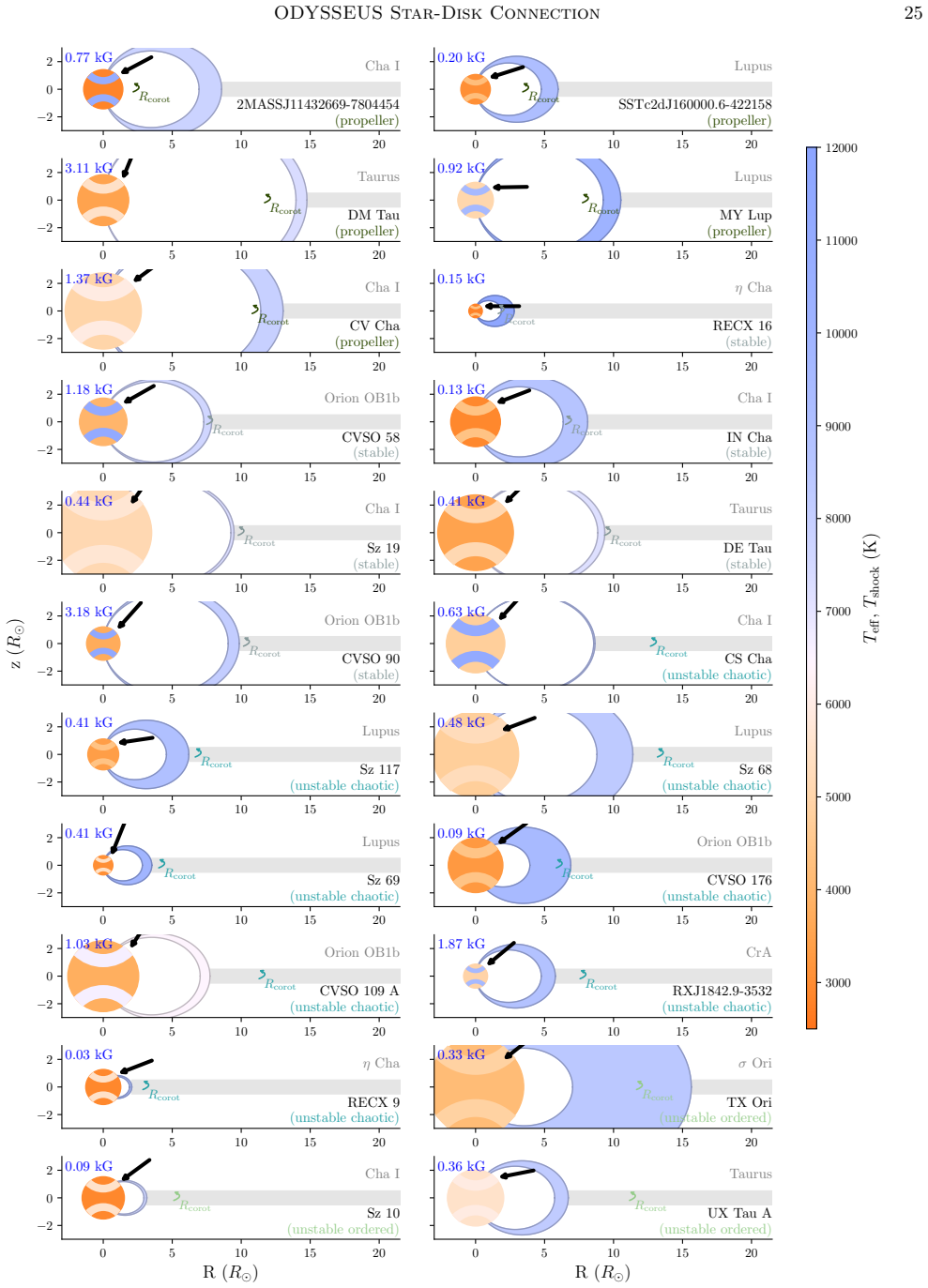
The fastness parameter ωs = (Ri/Rco)^(3/2) — the ratio of the star's angular velocity to the Keplerian angular velocity at the inner disk edge — is the organizing quantity. It assigns each system to one of four accretion regimes (propeller, stable, unstable chaotic, unstable ordered) and, via the torque relation J̇⋆ = (0.83 − 2.68ωs⁴) × Ṁ√(GM⋆Ri), converts the two measured radii into a predicted spin-up or spin-down. The empirical inputs are Ri, from axisymmetric Hα profile modeling, and Rco, from TESS rotation periods; the torque formula is what turns their ratio into a statement about angular-momentum evolution.
What would settle it
Compare TESS-derived rotation periods against an independent rotation measure for the low-ωs systems — longer-baseline K2 or multi-year ground-based spot-modulation periods, or ν sin i with known stellar radii. If a substantial fraction of unstable-ordered stars have true stellar periods longer than the TESS value, the derived ωs values and the spin-up conclusion would be systematically biased. For stars with existing Zeeman-Doppler maps, verifying that spot-modulation rotation matches the TESS period would settle the point directly.
Extended reading notes
Core claim
The paper's central claim is that the star-disk connection in classical T Tauri stars does not drive them to spin equilibrium. Combining corotation radii from TESS rotation periods with truncation radii from Hα accretion-flow modeling for 47 CTTS, it classifies each system by the fastness parameter ωs = (Ri/Rco)^(3/2). The median, 0.34 ± 0.19, places 28 of 47 stars in the unstable ordered regime, with only 6 stable and 5 propeller. With Zhu (2025)'s torque relation — whose zero-torque point is ωs ≈ 0.75 — most systems are spinning up, not in equilibrium. Correlated signatures (blueshifted wind absorption at higher ωs, a magnetospheric expansion event in CS Cha, consistency with accretion-pow
Load-bearing premise
The load-bearing premise is that the TESS light-curve period is the star's true rotation period for all 47 systems, including the 28 in the unstable ordered regime where the inner disk's Keplerian period can be shorter than the stellar period; if disk-dominated periodicity were common there, the derived corotation radii, fastness parameters, and the spin-up conclusion would shift.
Editorial extensions
If this is right
- Disk locking is effectively ruled out: if the disk locked the star's spin, systems would congregate near the equilibrium at ωs ≈ 0.75, but almost none do.
- Efficient angular-momentum-loss processes must operate in most systems — magnetospheric outflows, episodic accretion, and accretion-powered stellar winds — and the paper finds observational signatures consistent with all three.
- Accretion stability regimes are transient: Ri varies on day timescales (median 0.06 dex over roughly 2 days), so individual systems cross regime boundaries, as CS Cha does into the propeller regime.
- Dipper light curves appear at every value of ωs, so occulting disk warps or dusty magnetospheres do not require proximity to the propeller regime.
- Measured truncation radii (median 0.016 au) coincide with the semi-major axes of ultra-short-period planets, offering a formation channel that does not require billions of years of tidal decay — provided USPs are as tidally stable as some observations suggest.
Reading between the lines
- If the spin-up imbalance is generic, the slow observed rotation of T Tauri stars must be maintained dynamically by outflows whose strength tracks ωs; the paper's wind-absorption trend (median ωs 0.45 with wind vs 0.22 without) is a first sign of that coupling and could be confirmed with a larger sample.
- The apparent floor at ωs ≈ 0.04, if real, suggests a self-regulating state: very slow rotators accrete so efficiently that spin-up accelerates, preventing arbitrarily low fastness values — a feedback worth testing in population models.
- The Ri–USP alignment implies a testable demographic prediction: USPs formed by this channel should preferentially orbit stars whose disks dispersed with small truncation radii, and their orbital periods should cluster near the inner edge of the disk at dispersal.
- Because the regime classification assumes the TESS period is the stellar period, independent rotation checks — long-baseline photometry or spot-modulation periods from magnetic-field maps — for a subset of low-ωs systems would settle whether any unstable-ordered classifications are artifacts of disk-dominated periodicity.
Editorial analysis
A structured set of objections, weighed in public.
Referee Report
Summary. The paper combines TESS light curves with previously measured magnetospheric truncation radii for 47 classical T Tauri stars in the ULLYSES sample. It derives stellar rotation periods, corotation radii, and fastness parameters ωs = (Ri/Rco)^(3/2), then classifies the systems into the accretion stability regimes of Blinova et al. (2016). The central claim is that most CTTS are not in rotational equilibrium: the median ωs is 0.34 ± 0.19, in the unstable ordered regime, and application of the Zhu (2025) torque formula places most of the sample in the spin-up regime. The paper also reports day-timescale Ri variability, evidence for magnetospheric outflows and episodic accretion in CS Cha, consistency with accretion-powered stellar winds, light-curve morphology trends, and a correspondence between measured Ri values and the semimajor axes of ultra-short-period planets.
Significance. If the result holds, the paper challenges the common assumption of rotational equilibrium in CTTS angular momentum evolution and provides rare empirical constraints on fastness parameters and torque prescriptions. The period pipeline is a genuine strength: Lomb-Scargle with bootstrapping, PDM, window-function checks, structure-function validation, and cross-checks with ASAS-SN/WISE/Gaia are all used before a period is accepted. Uncertainties in Prot and M★ are propagated into Rco, and the authors explicitly discuss the limitations of the axisymmetric accretion-flow model. The CS Cha multi-epoch case is a compelling, well-documented example of a possible low-level episodic accretion/wind event. The main weaknesses are that the central spin-state distribution rests on the assumption that TESS periods are stellar rotation periods for all 47 systems, and that the day-timescale Ri variability claim is made at the edge of the measurement precision.
major comments (3)
- [§2.1.1, Table 1] The assumption that every measured TESS period is the stellar rotation period is the most load-bearing premise. For the 28/47 objects with ωs < 0.45 (the unstable ordered regime), the paper itself notes that the inner-disk Keplerian period can be shorter than P★ and can dominate light-curve periodicity at low magnetic obliquity. The cited Blinova et al. (2016) Fourier analysis is a simulation result for 10–20° obliquities, not a measurement of these stars' obliquities. The good news is that if P_disk < P★, the true ωs is even smaller than reported, so the headline 'most systems are not in equilibrium' is directionally robust; however, the quantitative median, regime counts, and individual Rco values are not protected. I recommend adding an independent v sin i check, or at least a literature-period comparison, and explicitly stating that the non-equilibrium conclusion is robust to this sy
- [§3.3] The claim that Ri varies on day timescales is not yet supported at the stated precision. The median pairwise ΔRi is 0.06 dex, which exactly equals the model grid spacing, and the typical single-measurement standard deviation is 0.04 dex. The total range (Ri,max − Ri,min) has a median of 0.13 dex, but no uncertainty is attached to that range. As written, the observed pairwise differences are indistinguishable from grid/measurement noise, so the sentence 'This likely comes from real temporal variability' is not quantitatively justified. Please propagate the measurement uncertainties into the pairwise differences and the min–max ranges, and report how many of the ΔRi values exceed the noise at, say, 2σ. Until then, the abstract's 'confirm predictions' should be softened to 'are consistent with'.
- [§2.3, Figure 4, Table 1] The regime counts (5 propeller, 6 stable, 8 unstable chaotic, 28 unstable ordered) are presented without formal classification uncertainties. Given the typical Ri measurement uncertainty of 0.04 dex and grid spacing of 0.06 dex, objects sitting near the ωs = 0.45, 0.6, or 1.0 boundaries can shift categories with a one-grid-step change in Ri. The vertical arrows in Figure 4 show the temporal range of Ri but do not distinguish temporal variability from measurement error. A Monte Carlo propagation of Ri and Rco uncertainties into ωs would establish whether the 28-object unstable-ordered pile-up is robust, and would make the distributional claims in §3.1 quantitatively reliable.
minor comments (6)
- [§2.1] The sentence 'we choose the period that is present across multiple sectors' is not defined quantitatively. What counts as 'present' — a period within 1σ? 10%? Please specify the matching criterion.
- [§2.4] For the six CTTS without clear period detections, the Q metric is computed by assuming a period that yields a quasi-periodic classification in at least one sector. This procedure can bias the morphology classification, since Q depends on the assumed period. These objects are gray 'x' markers in Figure 5, but the text should state explicitly that their Q values are upper limits or provisional, not measured properties.
- [§2.2] The Q boundaries 0.11 and 0.85 are chosen by visual inspection, as in previous work. This is acceptable, but the sensitivity of the morphological fractions to these boundaries should be stated, especially because the reader is told that different surveys require different boundaries.
- [§3.1.1] The statement that 'imag and ωs show no correlation' appears without a correlation coefficient or figure. Given that the paper reports Pearson r values for several QM correlations, adding this value would make the claim checkable.
- [§3.1.3] The approximation 'Decreasing Mdot by 30% in Equation 1 can approximately incorporate the effect of an APSW' assumes the torque scales linearly with Mdot. Since Equation 1 is linear in Mdot, this is true, but the sentence could be clearer that this is an order-of-magnitude estimate, not a detailed wind model.
- [§3.5] The USP comparison is interesting but remains a correlation. The text carefully inserts the tidal-stability caveat, but the abstract's phrase 'provides a plausible USP formation channel' overstates what a median-overlap comparison can establish. A sentence in §3.5 noting that no migration/stalling model is tested would help calibrate the claim.
Circularity Check
No significant circularity: ω_s is computed from independent TESS rotation periods and Hα-modeled truncation radii, then compared to external MHD regime and torque predictions.
full rationale
The paper's central claim—median ω_s = 0.34, so most CTTS are in the spin-up regime—rests on two independent measurements: R_i from Hα profile modeling (Pittman et al. 2025) and P_rot from TESS light curves. R_co is obtained from Kepler's law using M_★ and P_rot, and ω_s = (R_i/R_co)^(3/2) is a standard definition, not a fit. No parameter is fitted to the quantity being predicted. The torque formula (Eq. 1) and the regime boundaries come from external 3D MHD simulations (Zhu 2025; Blinova et al. 2016); the paper applies these predictions to the measured ω_s distribution rather than deriving them from the data. The dependence on prior work by the same authors (Pittman et al. 2025 for R_i) is a measurement dependency, not a circular justification; the R_i values are not defined in terms of the paper's conclusions. The only significant assumption—that the TESS period equals P_★, especially for ω_s < 0.45—is explicitly acknowledged in Section 2.1.1 and defended using independent simulation results (Blinova et al. 2016; Boyle et al. 2025). The paper even states that if P_disk contaminated the period, the classification into the unstable ordered regime would remain unchanged, making this a robustness caveat rather than a circular step. No self-definitional identity, fitted-input-as-prediction, or imported-uniqueness pattern is present.
Assumptions & free parameters
free parameters (2)
- Q metric periodicity boundaries =
0.11 (periodic/quasi-periodic), 0.85 (quasi-periodic/stochastic)
- Tentative periods for 6 CTTS without confident period detections =
Listed in Table 1 (parentheses)
assumptions (5)
- domain assumption The TESS photometric period equals the stellar rotation period for all systems, except possibly low-obliquity low-omega_s systems.
- domain assumption The Blinova et al. (2016) accretion stability regime boundaries (omega_s = 1, 0.6, 0.45) apply to T Tauri stars.
- domain assumption The Zhu (2025) torque formula (Eq. 1) accurately describes the net star-disk torque.
- domain assumption The axisymmetric accretion flow model of Hartmann et al. (1994) and Muzerolle et al. (1998, 2001) yields unbiased Ri values.
- domain assumption Stellar masses from Manara et al. (2021) and radius of gyration k^2 = 0.2 are accurate.
Cite this review
Pith. "Pith review of The ODYSSEUS Survey. Using accretion and stellar rotation to reveal the star-disk connection in T Tauri stars." pith.science (2026). https://pith.science/paper/IQJDXOHO
@misc{pith2026250903767,
  author       = {Pith},
  title        = {Pith review of: The ODYSSEUS Survey. Using accretion and stellar rotation to reveal the star-disk connection in T Tauri stars},
  year         = {2026},
  howpublished = {\url{https://pith.science/paper/IQJDXOHO}},
  note         = {Machine review of arXiv:2509.03767}
}
abstract
Classical T Tauri stars (CTTS) exhibit strong variability over timescales of minutes to decades. However, much theoretical work assumes that CTTS are in stable spin states. Here, we test expectations for CTTS angular momentum regulation by comparing star and disk rotation. We measure stellar rotation periods and disk corotation radii ($R_{\rm co}$) for 47 CTTS from the HST ULLYSES sample. We compare $R_{\rm co}$ to the magnetospheric truncation radii ($R_{\rm i}$) and show that most CTTS are in the spin-up regime based on model predictions, which may indicate efficient angular momentum loss processes. We find evidence of magnetospheric outflows and episodic accretion, and our observations are consistent with the presence of accretion-powered stellar winds. We confirm predictions that $R_{\rm i}$ is variable over timescales of days, causing some CTTS to cross accretion stability regime boundaries. We characterize light curve morphologies and confirm that our inclined CTTS with $R_{\rm i}\sim R_{\rm co}$ show dipper light curves, consistent with expectations from disk warp models. However, dippers occur at all values of $R_{\rm i}/R_{\rm co}$, suggesting that they do not need to be near the propeller regime. Finally, we show that our measured $R_{\rm i}$ locations are consistent with observed ultra-short-period planet (USP) semi-major axes. If USPs are stable against tidal dissipation, as has been suggested in the literature, then our work provides a plausible USP formation channel. These results show that the star-disk connection produces a large variety of accretion and stellar spin configurations, most of which are likely not in equilibrium.
Figures


Figures from the paper (12 more)




Reference graph
Works this paper leans on
-
[1]
, " * write output.state after.block = add.period write newline
ENTRY address archivePrefix author booktitle chapter doi edition editor eprint howpublished institution journal key month number organization pages publisher school series title misctitle type volume year version url label extra.label sort.label short.list INTEGERS output.state before.all mid.sentence after.sentence after.block FUNCTION init.state.consts ...
-
[2]
write newline
" write newline "" before.all 'output.state := FUNCTION format.url url empty "" new.block "" url * "" * if FUNCTION format.eprint eprint empty "" archivePrefix empty "" archivePrefix "arXiv" = new.block " " eprint * " " * new.block " " eprint * " " * if if if FUNCTION format.doi doi empty "" " " doi * " " * if FUNCTION format.pid doi empty eprint empty ur...
-
[3]
thebibliography [1] 20pt to REFERENCES 6pt =0pt \@twocolumntrue 12pt -12pt 10pt plus 3pt =0pt =0pt =1pt plus 1pt =0pt =0pt -12pt =13pt plus 1pt =20pt =13pt plus 1pt \@M =10000 =-1.0em =0pt =0pt 0pt =0pt =1.0em @enumiv\@empty 10000 10000 `\.\@m \@noitemerr \@latex@warning Empty `thebibliography' environment \@ifnextchar \@reference \@latexerr Missing key o...
arXiv 2017
-
[4]
Agapitou , V., & Papaloizou , J. C. B. 2000, , 317, 273, 10.1046/j.1365-8711.2000.03541.x
arXiv 2000
-
[5]
Alencar , S. H. P., Teixeira , P. S., Guimar \ a es , M. M., et al. 2010, , 519, A88, 10.1051/0004-6361/201014184
-
[6]
2020, , 492, 572, 10.1093/mnras/stz3361
Ansdell , M., Gaidos , E., Hedges , C., et al. 2020, , 492, 572, 10.1093/mnras/stz3361
-
[7]
2015, , 574, A41, 10.1051/0004-6361/201424520
Anthonioz , F., M \'e nard , F., Pinte , C., et al. 2015, , 574, A41, 10.1051/0004-6361/201424520
-
[8]
2024, , 690, A225, 10.1051/0004-6361/202451065
Armeni , A., Stelzer , B., Frasca , A., et al. 2024, , 690, A225, 10.1051/0004-6361/202451065
Show all 149 references
-
[9]
J., & Clarke , C
Armitage , P. J., & Clarke , C. J. 1996, , 280, 458, 10.1093/mnras/280.2.458
1996 doi
-
[10]
P., Tollerud , E
Astropy Collaboration , Robitaille , T. P., Tollerud , E. J., et al. 2013, , 558, A33, 10.1051/0004-6361/201322068
2013 doi
-
[11]
M., Sip o cz , B
Astropy Collaboration , Price-Whelan , A. M., Sip o cz , B. M., et al. 2018, , 156, 123, 10.3847/1538-3881/aabc4f
2018 doi
-
[12]
M., Lim , P
Astropy Collaboration , Price-Whelan , A. M., Lim , P. L., et al. 2022, , 935, 167, 10.3847/1538-4357/ac7c74
2022 doi
-
[13]
M., et al
Audard , M., \'A brah \'a m , P., Dunham , M. M., et al. 2014, in Protostars and Planets VI, ed. H. Beuther , R. S. Klessen , C. P. Dullemond , & T. Henning , 387--410, 10.2458/azu_uapress_9780816531240-ch017
2014 doi
- [14]
-
[15]
C., Quast , G
Batalha , C. C., Quast , G. R., Torres , C. A. O., et al. 1998, , 128, 561, 10.1051/aas:1998163
1998 doi
-
[16]
C., & Becker , J
Batygin , K., Adams , F. C., & Becker , J. 2023, , 951, L19, 10.3847/2041-8213/acdb5d
2023 doi
-
[17]
C., Batygin , K., & Adams , F
Becker , J. C., Batygin , K., & Adams , F. C. 2021, , 919, 76, 10.3847/1538-4357/ac111e
2021 doi
-
[18]
2008, , 478, 155, 10.1051/0004-6361:20078328
Bessolaz , N., Zanni , C., Ferreira , J., Keppens , R., & Bouvier , J. 2008, , 478, 155, 10.1051/0004-6361:20078328
2008 doi
-
[19]
A., Romanova , M
Blinova , A. A., Romanova , M. M., & Lovelace , R. V. E. 2016, , 459, 2354, 10.1093/mnras/stw786
2016 doi
-
[20]
Bodman , E. H. L., Quillen , A. C., Ansdell , M., et al. 2017, , 470, 202, 10.1093/mnras/stx1034
2017 doi
-
[21]
2017, in Astronomical Society of the Pacific Conference Series, Vol
Bouvier , J. 2017, in Astronomical Society of the Pacific Conference Series, Vol. 511, Non-Stable Universe: Energetic Resources, Activity Phenomena, and Evolutionary Processes, ed. A. M. Mickaelian , H. A. Harutyunian , & E. H. Nikoghosyan , 28
2017
-
[22]
1986, , 165, 110
Bouvier , J., Bertout , C., Benz , W., & Mayor , M. 1986, , 165, 110
1986
-
[23]
L., & Matthews , J
Bouvier , J., Cabrit , S., Fernandez , M., Martin , E. L., & Matthews , J. M. 1993, , 272, 176
1993
-
[24]
E., Bouy , H., & Barrado , D
Bouvier , J., Grankin , K., Ellerbroek , L. E., Bouy , H., & Barrado , D. 2013, , 557, A77, 10.1051/0004-6361/201321389
2013 doi
-
[25]
P., Mohanty , S., et al
Bouvier , J., Matt , S. P., Mohanty , S., et al. 2014, in Protostars and Planets VI, ed. H. Beuther , R. S. Klessen , C. P. Dullemond , & T. Henning , 433--450, 10.2458/azu_uapress_9780816531240-ch019
2014 doi
-
[26]
1999, , 349, 619
Bouvier , J., Chelli , A., Allain , S., et al. 1999, , 349, 619
1999
-
[27]
Bouvier , J., Alencar , S. H. P., Boutelier , T., et al. 2007, , 463, 1017, 10.1051/0004-6361:20066021
2007 doi
-
[28]
2023, , 672, A5, 10.1051/0004-6361/202245342
Bouvier , J., Sousa , A., Pouilly , K., et al. 2023, , 672, A5, 10.1051/0004-6361/202245342
2023 doi
-
[29]
W., Mann , A
Boyle , A. W., Mann , A. W., & Bush , J. 2025, , 985, 233, 10.3847/1538-4357/adcecc
2025 doi
-
[30]
E., Phillip , C., Fleming , S
Brasseur , C. E., Phillip , C., Fleming , S. W., Mullally , S. E., & White , R. L. 2019, Astrocut: Tools for creating cutouts of TESS images , Astrophysics Source Code Library, record ascl:1905.007
2019
-
[31]
W., Shappee , B
Bredall , J. W., Shappee , B. J., Gaidos , E., et al. 2020, , 496, 3257, 10.1093/mnras/staa1588
2020 doi
- [32]
-
[33]
M., & Hillenbrand , L
Cody , A. M., & Hillenbrand , L. A. 2010, , 191, 389, 10.1088/0067-0049/191/2/389
2010 doi
- [34]
-
[35]
M., Hillenbrand , L
Cody , A. M., Hillenbrand , L. A., & Rebull , L. M. 2022, , 163, 212, 10.3847/1538-3881/ac5b73
2022 doi
-
[36]
M., Stauffer , J., Baglin , A., et al
Cody , A. M., Stauffer , J., Baglin , A., et al. 2014, , 147, 82, 10.1088/0004-6256/147/4/82
2014 doi
-
[37]
2023, , 678, A88, 10.1051/0004-6361/202347063
Cruz-S \'a enz de Miera , F., K \'o sp \'a l , \'A ., Abrah \'a m , P., et al. 2023, , 678, A88, 10.1051/0004-6361/202347063
2023 doi
-
[40]
D., Rees, D
Donati, J.-F., Semel, M., Carter, B. D., Rees, D. E., & Cameron, A. C. 1997, Monthly Notices of the Royal Astronomical Society, 291, 658, 10.1093/mnras/291.4.658
1997 doi
-
[41]
F., Skelly , M
Donati , J. F., Skelly , M. B., Bouvier , J., et al. 2010, , 409, 1347, 10.1111/j.1365-2966.2010.17409.x
2010
-
[42]
F., Gregory , S
Donati , J. F., Gregory , S. G., Alencar , S. H. P., et al. 2012, , 425, 2948, 10.1111/j.1365-2966.2012.21482.x
2012
- [43]
-
[44]
F., Cristofari , P
Donati , J. F., Cristofari , P. I., Lehmann , L. T., et al. 2024, , 531, 3256, 10.1093/mnras/stae1227
2024 doi
-
[45]
A., Hillenbrand , L
Eisner , J. A., Hillenbrand , L. A., White , R. J., Akeson , R. L., & Sargent , A. I. 2005, , 623, 952, 10.1086/428828
2005 doi
-
[46]
C., Herczeg, G
Espaillat, C. C., Herczeg, G. J., Thanathibodee, T., et al. 2022, The ODYSSEUS Survey. Motivation and First Results: Accretion, Ejection, and Disk Irradiation of CVSO 109. 2201.06502
2022 arXiv
-
[47]
F., Cristofari , P
Finociety , B., Donati , J. F., Cristofari , P. I., et al. 2023, , 526, 4627, 10.1093/mnras/stad3012
2023 doi
- [48]
-
[49]
2024, , 966, 167, 10.3847/1538-4357/ad3447
Gaidos , E., Thanathibodee , T., Hoffman , A., et al. 2024, , 966, 167, 10.3847/1538-4357/ad3447
2024 doi
-
[50]
M., & Turner , N
Gehrig , L., Gaidos , E., Venuti , L., Cody , A. M., & Turner , N. J. 2025, , 696, L18, 10.1051/0004-6361/202553730
2025 doi
-
[51]
2007, Rotation and Accretion Powered Pulsars , Vol
Ghosh , P. 2007, Rotation and Accretion Powered Pulsars , Vol. 10 (World Scientific Publishing Co., Pte. Ltd.), 10.1142/4806
2007 doi
-
[52]
Ghosh , P., & Lamb , F. K. 1979 a , , 232, 259, 10.1086/157285
1979 doi
- [53]
-
[54]
2024, , 685, A52, 10.1051/0004-6361/202244005
Ginski , C., Garufi , A., Benisty , M., et al. 2024, , 685, A52, 10.1051/0004-6361/202244005
2024 doi
- [55]
-
[56]
2021, Acta Astrophysica Taurica, 2, 9, 10.31059/aat.vol2.iss1.pp9-20
Grankin , K. 2021, Acta Astrophysica Taurica, 2, 9, 10.31059/aat.vol2.iss1.pp9-20
2021 doi
-
[57]
N., Melnikov , S
Grankin , K. N., Melnikov , S. Y., Bouvier , J., Herbst , W., & Shevchenko , V. S. 2007, , 461, 183, 10.1051/0004-6361:20065489
2007 doi
-
[58]
W., Esposito , M., Mundt , R., et al
Guenther , E. W., Esposito , M., Mundt , R., et al. 2007, , 467, 1147, 10.1051/0004-6361:20065686
2007 doi
-
[59]
H., & Schlaufman , K
Hamer , J. H., & Schlaufman , K. C. 2020, , 160, 138, 10.3847/1538-3881/aba74f
2020 doi
-
[60]
2021, Astronomische Nachrichten, 342, 578, 10.1002/asna.202113868
Harre , J.-V., & Heller , R. 2021, Astronomische Nachrichten, 342, 578, 10.1002/asna.202113868
2021 doi
-
[61]
2016, , 54, 135, 10.1146/annurev-astro-081915-023347
Hartmann , L., Herczeg , G., & Calvet , N. 2016, , 54, 135, 10.1146/annurev-astro-081915-023347
2016 doi
-
[62]
1994, , 426, 669, 10.1086/174104
Hartmann , L., Hewett , R., & Calvet , N. 1994, , 426, 669, 10.1086/174104
1994 doi
-
[63]
W., et al
Hattori , S., Foreman-Mackey , D., Hogg , D. W., et al. 2022, , 163, 284, 10.3847/1538-3881/ac625a
2022 doi
-
[64]
Herbst , W., Bailer-Jones , C. A. L., & Mundt , R. 2001, , 554, L197, 10.1086/321706
2001 doi
- [65]
-
[66]
K., Grossman , E
Herbst , W., Herbst , D. K., Grossman , E. J., & Weinstein , D. 1994, , 108, 1906, 10.1086/117204
1994 doi
-
[67]
A., Kiker , T
Hillenbrand , L. A., Kiker , T. J., Gee , M., et al. 2022, , 163, 263, 10.3847/1538-3881/ac62d8
2022 doi
-
[68]
1965, Veroeffentlichungen der Sternwarte Sonneberg, 6, 97
Hoffmeister , C. 1965, Veroeffentlichungen der Sternwarte Sonneberg, 6, 97
1965
-
[69]
G., Matt , S
Ireland , L. G., Matt , S. P., & Zanni , C. 2022, , 929, 65, 10.3847/1538-4357/ac59b2
2022 doi
-
[70]
G., Zanni , C., Matt , S
Ireland , L. G., Zanni , C., Matt , S. P., & Pantolmos , G. 2021, , 906, 4, 10.3847/1538-4357/abc828
2021 doi
-
[71]
2009, in IAU Symposium, Vol
Irwin , J., & Bouvier , J. 2009, in IAU Symposium, Vol. 258, The Ages of Stars, ed. E. E. Mamajek , D. R. Soderblom , & R. F. G. Wyse , 363--374, 10.1017/S1743921309032025
2009 doi
-
[72]
P., Jardine , M., Gregory , S
Johnstone , C. P., Jardine , M., Gregory , S. G., Donati , J. F., & Hussain , G. 2014, , 437, 3202, 10.1093/mnras/stt2107
2014 doi
-
[73]
Kipping , D. M. 2013, , 434, L51, 10.1093/mnrasl/slt075
2013 doi
-
[74]
K., & Romanova , M
Kulkarni , A. K., & Romanova , M. M. 2013, , 433, 3048, 10.1093/mnras/stt945
2013 doi
-
[75]
J., & Symington , N
Kurosawa , R., Harries , T. J., & Symington , N. H. 2006, , 370, 580, 10.1111/j.1365-2966.2006.10527.x
2006
-
[76]
Kurosawa , R., & Romanova , M. M. 2013, , 431, 2673, 10.1093/mnras/stt365
2013 doi
-
[77]
M., & Harries , T
Kurosawa , R., Romanova , M. M., & Harries , T. J. 2011, , 416, 2623, 10.1111/j.1365-2966.2011.19216.x
2011
- [78]
-
[79]
S., Romanova , M
Lii , P. S., Romanova , M. M., Ustyugova , G. V., Koldoba , A. V., & Lovelace , R. V. E. 2014, , 441, 86, 10.1093/mnras/stu495
2014 doi
-
[80]
2023, , 166, 82, 10.3847/1538-3881/ace322
Lin , C.-L., Ip , W.-H., Hsiao , Y., et al. 2023, , 166, 82, 10.3847/1538-3881/ace322
2023 doi
-
[81]
Lomb , N. R. 1976, , 39, 447, 10.1007/BF00648343
1976 doi
-
[82]
F., Frasca, A
Manara , C. F., Frasca, A. , Venuti, L. , et al. 2021, A&A, 650, A196, 10.1051/0004-6361/202140639
2021 doi
-
[83]
S., Morbidelli , A., Crida , A., & Ferreira , J
Masset , F. S., Morbidelli , A., Crida , A., & Ferreira , J. 2006, , 642, 478, 10.1086/500967
2006 doi
-
[84]
Matt , S., & Pudritz , R. E. 2005, , 632, L135, 10.1086/498066
2005 doi
- [85]
- [86]
-
[87]
2020, Monthly Notices of the Royal Astronomical Society, 497, 2142, 10.1093/mnras/staa2041
McGinnis, P., Bouvier, J., & Gallet, F. 2020, Monthly Notices of the Royal Astronomical Society, 497, 2142, 10.1093/mnras/staa2041
2020 doi
-
[88]
T., Alencar , S
McGinnis , P. T., Alencar , S. H. P., Guimar \ a es , M. M., et al. 2015, , 577, A11, 10.1051/0004-6361/201425475
2015 doi
-
[89]
N., Mamajek , E
Mellon , S. N., Mamajek , E. E., Oberst , T. E., & Pecaut , M. J. 2017, , 844, 66, 10.3847/1538-4357/aa77fb
2017 doi
-
[90]
2024, , 686, L1, 10.1051/0004-6361/202449368
Mendigut \' a , I., Lillo-Box , J., Vioque , M., et al. 2024, , 686, L1, 10.1051/0004-6361/202449368
2024 doi
-
[91]
Michel , A., van der Marel , N., & Matthews , B. C. 2021, , 921, 72, 10.3847/1538-4357/ac1bbb
2021 doi
-
[92]
D., Pascucci , I., & Apai , D
Mulders , G. D., Pascucci , I., & Apai , D. 2015, , 798, 112, 10.1088/0004-637X/798/2/112
2015 doi
-
[93]
D., Pascucci , I., Apai , D., & Ciesla , F
Mulders , G. D., Pascucci , I., Apai , D., & Ciesla , F. J. 2018, , 156, 24, 10.3847/1538-3881/aac5ea
2018 doi
-
[94]
1998, , 492, 743, 10.1086/305069
Muzerolle , J., Calvet , N., & Hartmann , L. 1998, , 492, 743, 10.1086/305069
1998 doi
- [95]
-
[96]
2003, , 597, L149, 10.1086/379921
Muzerolle , J., Calvet , N., Hartmann , L., & D'Alessio , P. 2003, , 597, L149, 10.1086/379921
2003 doi
-
[97]
2019, , 625, A45, 10.1051/0004-6361/201833979
Nagel , E., & Bouvier , J. 2019, , 625, A45, 10.1051/0004-6361/201833979
2019 doi
-
[98]
2020, , 643, A157, 10.1051/0004-6361/202038594
---. 2020, , 643, A157, 10.1051/0004-6361/202038594
2020 doi
-
[99]
2025, , 696, A46, 10.1051/0004-6361/202453365
---. 2025, , 696, A46, 10.1051/0004-6361/202453365
2025 doi
-
[100]
Nagel , E., Bouvier , J., & Duarte , A. E. 2024, , 688, A61, 10.1051/0004-6361/202450085
2024 doi
-
[101]
2023 a , , 677, A64, 10.1051/0004-6361/202347231
Nelissen , M., Natta , A., McGinnis , P., et al. 2023 a , , 677, A64, 10.1051/0004-6361/202347231
2023 doi
-
[102]
P., et al
Nelissen , M., McGinnis , P., Folsom , C. P., et al. 2023 b , , 670, A165, 10.1051/0004-6361/202245194
2023 doi
-
[103]
Ogilvie , G. I. 2014, , 52, 171, 10.1146/annurev-astro-081913-035941
2014 doi
-
[104]
2011, Journal of Machine Learning Research, 12, 2825
Pedregosa, F., Varoquaux, G., Gramfort, A., et al. 2011, Journal of Machine Learning Research, 12, 2825
2011
-
[105]
R., Grynko , S., Seneviratne , R., & Herbst , W
Percy , J. R., Grynko , S., Seneviratne , R., & Herbst , W. 2010, , 122, 753, 10.1086/654826
2010 doi
-
[106]
V., Espaillat , C
Pittman , C. V., Espaillat , C. C., Robinson , C. E., et al. 2022, , 164, 201, 10.3847/1538-3881/ac898d
2022 doi
-
[107]
2025, arXiv e-prints, arXiv:2507.01162
---. 2025, arXiv e-prints, arXiv:2507.01162. 2507.01162
2025 arXiv
-
[108]
2024, , 691, A18, 10.1051/0004-6361/202451527
Pouilly , K., Audard , M., K \'o sp \'a l , \'A ., & Lavail , A. 2024, , 691, A18, 10.1051/0004-6361/202451527
2024 doi
-
[109]
M., Stauffer , J
Rebull , L. M., Stauffer , J. R., Cody , A. M., et al. 2018, , 155, 196, 10.3847/1538-3881/aab605
2018 doi
-
[110]
Reipurth , B., Pedrosa , A., & Lago , M. T. V. T. 1996, , 120, 229
1996
-
[111]
E., & Espaillat , C
Robinson , C. E., & Espaillat , C. C. 2019, , 874, 129, 10.3847/1538-4357/ab0d8d
2019 doi
-
[112]
E., Espaillat , C
Robinson , C. E., Espaillat , C. C., & Owen , J. E. 2021, , 908, 16, 10.3847/1538-4357/abd410
2021 doi
-
[113]
M., Blinova , A
Romanova , M. M., Blinova , A. A., Ustyugova , G. V., Koldoba , A. V., & Lovelace , R. V. E. 2018, , 62, 94, 10.1016/j.newast.2018.01.011
2018 doi
-
[114]
M., Ustyugova , G
Romanova , M. M., Ustyugova , G. V., Koldoba , A. V., & Lovelace , R. V. E. 2004, , 616, L151, 10.1086/426586
2004 doi
-
[115]
2009, , 399, 1802, 10.1111/j.1365-2966.2009.15413.x
---. 2009, , 399, 1802, 10.1111/j.1365-2966.2009.15413.x
2009
- [116]
-
[117]
C., Casertano , S., Bond , H
Sahu , K. C., Casertano , S., Bond , H. E., et al. 2006, , 443, 534, 10.1038/nature05158
2006 doi
-
[118]
N., et al
Sanchis-Ojeda , R., Rappaport , S., Winn , J. N., et al. 2014, , 787, 47, 10.1088/0004-637X/787/1/47
2014 doi
-
[119]
Scargle , J. D. 1982, , 263, 835, 10.1086/160554
1982 doi
-
[120]
P., Schlaufman , K
Schmidt , S. P., Schlaufman , K. C., & Hamer , J. H. 2024, , 168, 109, 10.3847/1538-3881/ad5d76
2024 doi
-
[121]
2021, The Astrophysical Journal, 923, 177, 10.3847/1538-4357/ac300a
Serna, J., Hernandez, J., Kounkel, M., et al. 2021, The Astrophysical Journal, 923, 177, 10.3847/1538-4357/ac300a
2021 doi
-
[122]
2024, , 968, 68, 10.3847/1538-4357/ad3a6b
Serna , J., Pinz \'o n , G., Hern \'a ndez , J., et al. 2024, , 968, 68, 10.3847/1538-4357/ad3a6b
2024 doi
-
[123]
H., Najita , J
Shu , F. H., Najita , J. R., Shang , H., & Li , Z. Y. 2000, in Protostars and Planets IV, ed. V. Mannings , A. P. Boss , & S. S. Russell , 789--814
2000
-
[124]
H., Cordes , J
Simonetti , J. H., Cordes , J. M., & Heeschen , D. S. 1985, , 296, 46, 10.1086/163418
1985 doi
-
[125]
Siwak , M., Ogloza , W., Moffat , A. F. J., et al. 2018, , 478, 758, 10.1093/mnras/sty1220
2018 doi
-
[126]
D., Gillen , E., Hodgkin , S
Smith , G. D., Gillen , E., Hodgkin , S. T., et al. 2023, , 523, 169, 10.1093/mnras/stad1435
2023 doi
-
[127]
P., Alencar , S
Sousa , A. P., Alencar , S. H. P., Bouvier , J., et al. 2016, , 586, A47, 10.1051/0004-6361/201526599
2016 doi
-
[128]
P., Bouvier , J., Alencar , S
Sousa , A. P., Bouvier , J., Alencar , S. H. P., et al. 2021, , 649, A68, 10.1051/0004-6361/202140346
2021 doi
-
[129]
F., et al
Sperling , T., Eisl \"o ffel , J., Manara , C. F., et al. 2024, , 687, A54, 10.1051/0004-6361/202450031
2024 doi
- [130]
-
[131]
M., Baglin , A., et al
Stauffer , J., Cody , A. M., Baglin , A., et al. 2014, , 147, 83, 10.1088/0004-6256/147/4/83
2014 doi
-
[132]
2025, , 699, A333, 10.1051/0004-6361/202553671
Sun , M.-F., Xie , J.-W., Zhou , J.-L., et al. 2025, , 699, A333, 10.1051/0004-6361/202553671
2025 doi
-
[133]
K., Iwasaki , K., & Tomida , K
Takasao , S., Kunitomo , M., Suzuki , T. K., Iwasaki , K., & Tomida , K. 2025, , 980, 111, 10.3847/1538-4357/ada364
2025 doi
-
[134]
Takasao , S., Tomida , K., Iwasaki , K., & Suzuki , T. K. 2022, , 941, 73, 10.3847/1538-4357/ac9eb1
2022 doi
-
[135]
2023, , 944, 90, 10.3847/1538-4357/acac84
Thanathibodee , T., Molina , B., Serna , J., et al. 2023, , 944, 90, 10.3847/1538-4357/acac84
2023 doi
-
[136]
2025, Nature Astronomy, 10.1038/s41550-025-02539-1
Tu , P.-W., Xie , J.-W., Chen , D.-C., & Zhou , J.-L. 2025, Nature Astronomy, 10.1038/s41550-025-02539-1
2025 doi
-
[137]
V., Koldoba , A
Ustyugova , G. V., Koldoba , A. V., Romanova , M. M., & Lovelace , R. V. E. 2006, , 646, 304, 10.1086/503379
2006 doi
-
[138]
A., K \"o nigl , A., & Litwin , C
Uzdensky , D. A., K \"o nigl , A., & Litwin , C. 2002, , 565, 1191, 10.1086/324720
2002 doi
-
[139]
M., et al
Venuti , L., Bouvier , J., Cody , A. M., et al. 2017, , 599, A23, 10.1051/0004-6361/201629537
2017 doi
-
[140]
J., Liu , H.-G., et al
Wang , M.-T., Herczeg , G. J., Liu , H.-G., et al. 2023, , 957, 113, 10.3847/1538-4357/acf2f4
2023 doi
-
[141]
Ward , W. R. 1997, , 126, 261, 10.1006/icar.1996.5647
1997
-
[142]
C., Thanathibodee , T., et al
Wendeborn , J., Espaillat , C. C., Thanathibodee , T., et al. 2024 a , , 972, 100, 10.3847/1538-4357/ad65ed
2024 doi
-
[143]
2024 b , , 971, 96, 10.3847/1538-4357/ad543d
---. 2024 b , , 971, 96, 10.3847/1538-4357/ad543d
2024 doi
-
[144]
N., Sanchis-Ojeda , R., & Rappaport , S
Winn , J. N., Sanchis-Ojeda , R., & Rappaport , S. 2018, , 83, 37, 10.1016/j.newar.2019.03.006
2018 doi
-
[145]
N., Sanchis-Ojeda , R., Rogers , L., et al
Winn , J. N., Sanchis-Ojeda , R., Rogers , L., et al. 2017, , 154, 60, 10.3847/1538-3881/aa7b7c
2017 doi
-
[146]
Youdin , A. N. 2011, , 742, 38, 10.1088/0004-637X/742/1/38
2011 doi
-
[147]
2009, , 508, 1117, 10.1051/0004-6361/200912879
Zanni , C., & Ferreira , J. 2009, , 508, 1117, 10.1051/0004-6361/200912879
2009 doi
-
[148]
2011, , 727, L22, 10.1088/2041-8205/727/1/L22
---. 2011, , 727, L22, 10.1088/2041-8205/727/1/L22
2011 doi
-
[149]
2013, , 550, A99, 10.1051/0004-6361/201220168
---. 2013, , 550, A99, 10.1051/0004-6361/201220168
2013 doi
- [150]
-
[151]
M., & Calvet , N
Zhu , Z., Stone , J. M., & Calvet , N. 2024, , 528, 2883, 10.1093/mnras/stad3712
2024 doi
Reviewed August 5, 2026 · model on record in the stance chip above.
Discussion (0). Sign in to comment.