REVIEW 3 major objections 6 minor 28 references
SLENet: A Guidance-Enhanced Network for Underwater Camouflaged Object Detection
T0 review · 3 major / 6 minor · reviewed 2026-08-05 · deepseek-v4-flash
Pith's one-line read This paper defines underwater camouflaged object detection, releases the DeepCamo benchmark, and claims SLENet beats ten state-of-the-art COD methods on it and three general benchmarks.
desk verdict DeepCamo is a genuinely useful new benchmark, but the paper's SOTA claim on it rests on an apples-to-oranges comparison and a false 'all metrics' statement. read the letter →
The pith
A machine-rendered reading of the paper's core claim, the machinery that carries it, and where it could break.
The reading
What carries the argument
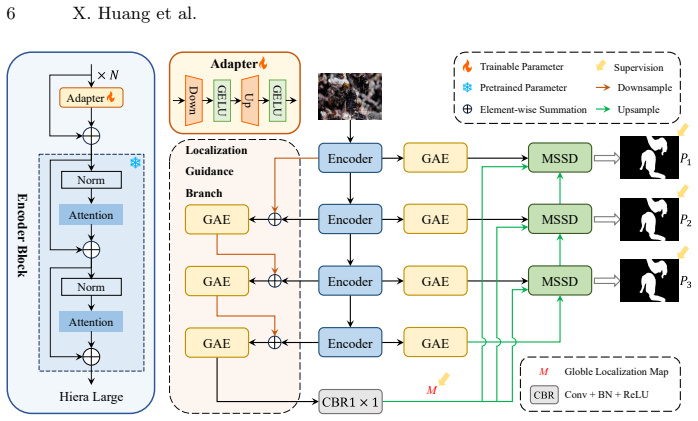
The central machinery is a three-part guidance loop around a frozen SAM2 encoder. Gamma-Asymmetric Enhancement (GAE) is a cascaded module where each branch combines 1x1 convolutions, asymmetric convolutions, max-pooling, and rate-2 dilated convolutions; later branches receive earlier branches' outputs, letting the receptive field grow while high-resolution details are carried forward. The Localization Guidance Branch (LGB) fuses GAE-enhanced multi-scale features bottom-up into a low-resolution global localization map M. The Multi-Scale Supervised Decoder (MSSD) uses M to compute per-pixel scale and shift factors applied after batch normalization, then adds spatial attention and residual conn
What would settle it
Fine-tune each of the ten baselines on DeepCamo-train under the same schedule, image size, and loss setup, then re-run Table 2 on DeepCamo-Test; if one or more baselines match or exceed SLENet, the central performance claim collapses. Independently, verify that no DeepCamo-full image overlaps any COD10K training image, since the benchmark is explicitly defined by that exclusion.
Extended reading notes
Core claim
SLENet treats underwater camouflage as a failure of two abilities: preserving fine details across scales and knowing where the object is before refining its boundary. The network therefore freezes SAM2's Hiera-L encoder, inserts lightweight Adapters for parameter-efficient domain tuning, and feeds each of the four feature levels into a Gamma-Asymmetric Enhancement (GAE) module whose cascaded branches use asymmetric convolutions, max-pooling, and rate-2 dilated convolutions to widen receptive fields without discarding high-resolution cues. A Localization Guidance Branch (LGB) then fuses the enhanced features bottom-up into a coarse global localization map, which the Multi-Scale Supervised Dec
Load-bearing premise
The central performance claim assumes that comparing pretrained baselines against SLENet trained on DeepCamo-train is a fair protocol; if the baselines were fine-tuned on the same training split, the reported margins could shrink or reverse.
Editorial extensions
If this is right
- DeepCamo can serve as a standard test for underwater camouflaged object detection, with the Table 1 numbers quantifying how far general COD models are from handling underwater scenes.
- SLENet's recipe—frozen SAM2 encoder, lightweight adapters, a localization map, and a multi-scale decoder—can be applied to other fine-grained segmentation tasks where small, multiple, or boundary-complex objects are frequently missed.
- The linear decay of localization-map supervision implies a training curriculum in which global location is learned early and fine details are refined later; this schedule could transfer to other guidance-based decoders.
- If the reported margins survive a protocol in which baselines are fine-tuned on DeepCamo-train, SLENet would be a strong general-purpose COD method, not just an underwater specialist.
Reading between the lines
- The paper's headline margin on DeepCamo partly reflects an asymmetric comparison: baselines are evaluated with pretrained weights while SLENet is trained on DeepCamo-train. Fine-tuning the baselines on the same split is a direct, untested way to check whether the benchmark claim is robust.
- DeepCamo's combination of camouflage difficulty with optical distortion could be reused to isolate the effect of image enhancement or restoration modules: the same detector can be run on raw and enhanced versions of the same images.
- Because SLENet's largest gains are on DeepCamo and COD10K, the mechanism may be more about robust multi-scale decoding under degraded inputs than about underwater-specific priors; testing on artificially degraded general COD images would separate these factors.
- The localization-map-with-decay design suggests that a standalone lightweight localization branch could be plugged into other frozen foundation-model encoders as a parameter-efficient way to improve small-object segmentation.
Editorial analysis
A structured set of objections, weighed in public.
Referee Report
Summary. The manuscript defines underwater camouflaged object detection (UCOD), introduces the DeepCamo dataset (2,493 images, 16 marine species), and proposes SLENet, which combines a frozen SAM2 Hiera-L encoder with adapters, a Gamma-Asymmetric Enhancement (GAE) module, a Localization Guidance Branch (LGB), and a Multi-Scale Supervised Decoder (MSSD). The loss is a weighted BCE+IoU together with a separately supervised localization map whose weight decays linearly. The paper benchmarks 10 COD methods on DeepCamo and three public COD datasets and claims that SLENet consistently outperforms all competitors on all metrics.
Significance. If the results are supported, DeepCamo fills an actual gap in camouflaged object detection, and SLENet offers a plausible strong baseline for the UCOD setting. The paper has concrete strengths: it introduces a new benchmark with explicit attention to multi-object scenes and underwater degradation, evaluates on four datasets, uses multiple standard metrics, and reports module-wise ablations including sensitivity to the loss weight μ. The main weakness is that the headline SOTA claim is contradicted by the paper's own Table 2 in several cells, and the DeepCamo comparison is not transparently head-to-head because baselines are evaluated with pretrained weights while SLENet is trained on DeepCamo-train. These issues are correctable but currently load-bearing for the central claim.
major comments (3)
- [Sec. 5.2, Table 2] The sentence 'SLENet consistently outperforms all competing CNN-based and Transformer-based methods across all evaluation metrics' is contradicted by Table 2. On CAMO-Test, FSNet and SAM2-UNet achieve Fwβ=0.861 while SLENet achieves 0.860. On CHAMELEON, HitNet achieves Fwβ=0.903 while SLENet achieves 0.896. The claim should be restricted to 'most metrics' or supported with paired significance tests and error bars.
- [Sec. 3.3, Sec. 5.1, Table 2] The DeepCamo comparison in Table 2 is not shown to be a like-for-like training comparison. Sec. 3.3 states that baselines are evaluated with 'publicly available pretrained weights' on DeepCamo-full; for Table 2's DeepCamo-Test column the paper does not state whether the same baselines were fine-tuned on DeepCamo-train, whereas SLENet is explicitly trained on DeepCamo-train for 100 epochs. If the baselines are zero-shot, the reported margins on DeepCamo-Test conflate domain-transfer with architectural superiority, and the SOTA claim on the new dataset is not established. The paper should either fine-tune all baselines on DeepCamo-train under comparable schedules or clearly mark the DeepCamo numbers as zero-shot transfer and rephrase the claims.
- [Sec. 3.2-3.3, Tables 1 and 2] The relationship between DeepCamo-full (1,907 images), DeepCamo-train (1,931), and DeepCamo-test (562) is unspecified, and this creates an apparent internal inconsistency. For the same baseline methods, Table 1 and Table 2 report very different numbers: SINet Sα=0.665 on DeepCamo-full versus 0.745 on DeepCamo-Test; SAM2-UNet Sα=0.741 versus 0.859. If both columns use pretrained weights, the DeepCamo-Test split appears substantially easier, which undermines the claim that the new benchmark is uniformly challenging. If fine-tuning was applied for Table 2, that protocol must be disclosed. The authors should clarify how DeepCamo-full relates to the train/test split and reconcile the two tables.
minor comments (6)
- [Abstract; Sec. 5.2] The wording 'superior performance over SOTA methods' and 'consistently outperforms' should be softened to match the quantitative evidence, particularly after the Table 2 issues above are resolved.
- [Eq. (13), Sec. 4.5] The notation μ, epoch, and epochs is used without precise definition; state that μ is the initial localization-map loss weight and clarify the floor value 0.1 in the linear decay.
- [Sec. 4.5] The 'weighted BCE' loss is said to use weights based on pixel contrast, but no formula or precise weighting rule is given. Please provide the exact definition so the loss is reproducible.
- [Fig. 2, Fig. 3] The architecture figures are dense and some arrows are hard to read at normal print size; consider enlarging the figures or adding a table of module configurations.
- [Sec. 5.3, Table 3b] The text states that μ=0 leads to a 'significant performance drop', but the corresponding row is omitted from Table 3b. Since the table otherwise reports μ values, including μ=0 would make the claim checkable.
- [General] The paper does not state whether the DeepCamo dataset and code will be released. For a benchmark contribution, dataset accessibility is important and should be addressed.
Circularity Check
No circularity: SLENet's performance claims are empirical and benchmarked against independent external datasets; the flagged issues are evaluation-protocol and reporting concerns, not reductions of outputs to inputs.
full rationale
The paper proposes a new dataset and architecture and evaluates empirically. No claim is derived from its own output by definition. The localization map M is an independent supervision target (Eqs. 13–14) with its own BCE loss; it is not a restatement of the final decoder outputs. The hyperparameter μ is selected via an ablation study (Table 3b) and reported as the method's setting; this is conventional model selection, not a fitted parameter disguised as a prediction. No load-bearing self-citation is present: the references to adapter practice ([15,16]) and SPADE ([28]) are standard external work, and none of the paper's own modules or dataset construction is justified solely by a citation to the same authors. The benchmark asymmetry noted for Table 2 (baselines with pretrained weights rather than fine-tuned on DeepCamo-train) is a legitimate concern about comparability, but it is an evaluation-protocol issue, not a circular derivation. The statement 'SLENet consistently outperforms all competing CNN-based and Transformer-based methods across all evaluation metrics' is contradicted on CAMO-Test by Fwβ=0.860 vs 0.861 for FSNet/HitNet/SAM2-UNet; that is a factual overstatement, not circularity. The paper's omission of the μ=0 ablation row is a reporting gap; it does not make any result equivalent to its inputs. Since the main SOTA claims are backed by independent test sets (COD10K, CAMO, CHAMELEON) where the training protocol is standard, the circularity score is 0.
Assumptions & free parameters
free parameters (4)
- mu (initial weight of localization-map loss) =
0.6
- learnable scaling factor gamma in GAE =
learned
- base learning rate =
5e-4
- input resolution =
352x352
assumptions (4)
- domain assumption DeepCamo's annotations are accurate, and the filtering of ambiguous labels yields camouflage-only ground truth that is unbiased.
- domain assumption A frozen SAM2 Hiera-L encoder with inserted adapters captures enough UCOD-specific semantics to be the backbone of a state-of-the-art system.
- domain assumption The published numbers for the ten baselines on CAMO, CHAMELEON, and COD10K are directly comparable to the authors' runs even where training protocols differ.
- standard math The evaluation metrics (S-measure, E-measure, weighted F-measure, MAE) are accepted and sufficient for this task.
Cite this review
Pith. "Pith review of SLENet: A Guidance-Enhanced Network for Underwater Camouflaged Object Detection." pith.science (2026). https://pith.science/paper/B3DDZX23
@misc{pith2026250903786,
  author       = {Pith},
  title        = {Pith review of: SLENet: A Guidance-Enhanced Network for Underwater Camouflaged Object Detection},
  year         = {2026},
  howpublished = {\url{https://pith.science/paper/B3DDZX23}},
  note         = {Machine review of arXiv:2509.03786}
}
read the original abstract
Underwater Camouflaged Object Detection (UCOD) aims to identify objects that blend seamlessly into underwater environments. This task is critically important to marine ecology. However, it remains largely underexplored and accurate identification is severely hindered by optical distortions, water turbidity, and the complex traits of marine organisms. To address these challenges, we introduce the UCOD task and present DeepCamo, a benchmark dataset designed for this domain. We also propose Semantic Localization and Enhancement Network (SLENet), a novel framework for UCOD. We first benchmark state-of-the-art COD models on DeepCamo to reveal key issues, upon which SLENet is built. In particular, we incorporate Gamma-Asymmetric Enhancement (GAE) module and a Localization Guidance Branch (LGB) to enhance multi-scale feature representation while generating a location map enriched with global semantic information. This map guides the Multi-Scale Supervised Decoder (MSSD) to produce more accurate predictions. Experiments on our DeepCamo dataset and three benchmark COD datasets confirm SLENet's superior performance over SOTA methods, and underscore its high generality for the broader COD task.
Figures


Figures from the paper (2 more)


Reference graph
Works this paper leans on
-
[1]
In: Proceedings of the IEEE/CVF conference on computer vision and pattern recognition
Fan, D.P., Ji, G.P., Sun, G., Cheng, M.M., Shen, J., Shao, L.: Camouflaged object detection. In: Proceedings of the IEEE/CVF conference on computer vision and pattern recognition. pp. 2777–2787 (2020)
2020
-
[2]
In: Proceedings of the IEEE/CVF conference on computer vision and pattern recognition
Mei, H., Ji, G.P., Wei, Z., Yang, X., Wei, X., Fan, D.P.: Camouflaged object seg- mentation with distraction mining. In: Proceedings of the IEEE/CVF conference on computer vision and pattern recognition. pp. 8772–8781 (2021)
work page 2021
-
[3]
In: Pro- ceedings of the AAAI Conference on Artificial Intelligence
Hu, X., Wang, S., Qin, X., Dai, H., Ren, W., Luo, D., Tai, Y., Shao, L.: High- resolution iterative feedback network for camouflaged object detection. In: Pro- ceedings of the AAAI Conference on Artificial Intelligence. vol. 37, pp. 881–889 (2023)
work page 2023
-
[4]
In: Proceedings of the IEEE/CVF conference on computer vision and pattern recognition
He, C., Li, K., Zhang, Y., Tang, L., Zhang, Y., Guo, Z., Li, X.: Camouflaged object detection with feature decomposition and edge reconstruction. In: Proceedings of the IEEE/CVF conference on computer vision and pattern recognition. pp. 22046– 22055 (2023)
work page 2023
-
[5]
IEEE Transactions on Image Processing 32, 2267–2278 (2023)
Song, Z., Kang, X., Wei, X., Liu, H., Dian, R., Li, S.: Fsnet: Focus scanning network for camouflaged object detection. IEEE Transactions on Image Processing 32, 2267–2278 (2023)
work page 2023
-
[6]
Neural Computing and Applications 35(20), 15075–15093 (2023)
Xiao, J., Chen, T., Hu, X., Zhang, G., Wang, S.: Boundary-guided context-aware network for camouflaged object detection. Neural Computing and Applications 35(20), 15075–15093 (2023)
work page 2023
-
[7]
IEEE transactions on pattern analysis and machine intelligence44(10), 6024–6042 (2021)
Fan, D.P., Ji, G.P., Cheng, M.M., Shao, L.: Concealed object detection. IEEE transactions on pattern analysis and machine intelligence44(10), 6024–6042 (2021)
work page 2021
-
[8]
arXiv preprint arXiv:2408.08870 (2024)
Xiong, X., Wu, Z., Tan, S., Li, W., Tang, F., Chen, Y., Li, S., Ma, J., Li, G.: Sam2-unet: Segment anything 2 makes strong encoder for natural and medical image segmentation. arXiv preprint arXiv:2408.08870 (2024)
arXiv 2024
Show all 28 references
-
[9]
In: Proceedings of the IEEE/CVF international conference on computer vision
Kirillov, A., Mintun, E., Ravi, N., Mao, H., Rolland, C., Gustafson, L., Xiao, T., Whitehead, S., Berg, A.C., Lo, W.Y., et al.: Segment anything. In: Proceedings of the IEEE/CVF international conference on computer vision. pp. 4015–4026 (2023)
2023
-
[10]
arXiv preprint arXiv:2408.00714 (2024)
Ravi, N., Gabeur, V., Hu, Y.T., Hu, R., Ryali, C., Ma, T., Khedr, H., R¨ adle, R., Rolland, C., Gustafson, L., et al.: Sam 2: Segment anything in images and videos. arXiv preprint arXiv:2408.00714 (2024)
2024 arXiv
-
[11]
Computer vision and image understanding 184, 45–56 (2019)
Le, T.N., Nguyen, T.V., Nie, Z., Tran, M.T., Sugimoto, A.: Anabranch network for camouflaged object segmentation. Computer vision and image understanding 184, 45–56 (2019)
2019
-
[12]
Unpublished manuscript2(6), 7 (2018)
Skurowski, P., Abdulameer, H., B laszczyk, J., Depta, T., Kornacki, A., Kozie l, P.: Animal camouflage analysis: Chameleon database. Unpublished manuscript2(6), 7 (2018)
2018
-
[13]
arXiv preprint arXiv:2010.11929 (2020) 14 X
Dosovitskiy, A., Beyer, L., Kolesnikov, A., Weissenborn, D., Zhai, X., Unterthiner, T., Dehghani, M., Minderer, M., Heigold, G., Gelly, S., et al.: An image is worth 16x16 words: Transformers for image recognition at scale. arXiv preprint arXiv:2010.11929 (2020) 14 X. Huang et al
2010 arXiv
-
[14]
In: Proceedings of the IEEE/CVF conference on computer vision and pattern recog- nition
Huang, Z., Dai, H., Xiang, T.Z., Wang, S., Chen, H.X., Qin, J., Xiong, H.: Fea- ture shrinkage pyramid for camouflaged object detection with transformers. In: Proceedings of the IEEE/CVF conference on computer vision and pattern recog- nition. pp. 5557–5566 (2023)
2023
-
[15]
In: International conference on machine learning
Houlsby, N., Giurgiu, A., Jastrzebski, S., Morrone, B., De Laroussilhe, Q., Ges- mundo, A., Attariyan, M., Gelly, S.: Parameter-efficient transfer learning for nlp. In: International conference on machine learning. pp. 2790–2799. PMLR (2019)
2019
-
[16]
arXiv preprint arXiv:2304.13425 (2023)
Qiu, Z., Hu, Y., Li, H., Liu, J.: Learnable ophthalmology sam. arXiv preprint arXiv:2304.13425 (2023)
2023 arXiv
-
[17]
In: Proceedings of the IEEE/CVF conference on computer vision and pattern recognition
Hu, H., Bai, S., Li, A., Cui, J., Wang, L.: Dense relation distillation with context- aware aggregation for few-shot object detection. In: Proceedings of the IEEE/CVF conference on computer vision and pattern recognition. pp. 10185–10194 (2021)
2021
-
[18]
In: Proceedings of the IEEE/CVF conference on computer vision and pattern recognition
Liu, J.J., Hou, Q., Cheng, M.M., Feng, J., Jiang, J.: A simple pooling-based design for real-time salient object detection. In: Proceedings of the IEEE/CVF conference on computer vision and pattern recognition. pp. 3917–3926 (2019)
2019
-
[19]
IEEE transactions on pattern analysis and machine intelli- gence40(4), 834–848 (2017)
Chen, L.C., Papandreou, G., Kokkinos, I., Murphy, K., Yuille, A.L.: Deeplab: Se- mantic image segmentation with deep convolutional nets, atrous convolution, and fully connected crfs. IEEE transactions on pattern analysis and machine intelli- gence40(4), 834–848 (2017)
2017
-
[20]
In: Proceedings of the IEEE/CVF conference on computer vision and pattern recognition
Wu, Z., Su, L., Huang, Q.: Cascaded partial decoder for fast and accurate salient object detection. In: Proceedings of the IEEE/CVF conference on computer vision and pattern recognition. pp. 3907–3916 (2019)
2019
-
[21]
In: International Symposium on Benchmarking, Measuring and Optimization
Li, L., Rigall, E., Dong, J., Chen, G.: Mas3k: An open dataset for marine ani- mal segmentation. In: International Symposium on Benchmarking, Measuring and Optimization. pp. 194–212. Springer (2020)
2020
-
[22]
IEEE Journal of Oceanic Engineering (2023)
Fu, Z., Chen, R., Huang, Y., Cheng, E., Ding, X., Ma, K.K.: Masnet: A robust deep marine animal segmentation network. IEEE Journal of Oceanic Engineering (2023)
2023
-
[23]
arXiv preprint arXiv:2002.01155 (2020)
Islam, M.J., Luo, P., Sattar, J.: Simultaneous enhancement and super- resolution of underwater imagery for improved visual perception. arXiv preprint arXiv:2002.01155 (2020)
2002 arXiv
-
[24]
In: Proceedings of the 30th ACM international conference on multimedia
Zhang, M., Xu, S., Piao, Y., Shi, D., Lin, S., Lu, H.: Preynet: Preying on cam- ouflaged objects. In: Proceedings of the 30th ACM international conference on multimedia. pp. 5323–5332 (2022)
2022
-
[25]
IEEE Transactions on Image Processing 32, 3580–3591 (2023)
Zhang, Y., Zhang, J., Hamidouche, W., Deforges, O.: Predictive uncertainty esti- mation for camouflaged object detection. IEEE Transactions on Image Processing 32, 3580–3591 (2023)
2023
-
[26]
In: Proceedings of the IEEE/CVF Conference on Computer Vision and Pattern Recognition
Zhang, P., Yan, T., Liu, Y., Lu, H.: Fantastic animals and where to find them: Segment any marine animal with dual sam. In: Proceedings of the IEEE/CVF Conference on Computer Vision and Pattern Recognition. pp. 2578–2587 (2024)
2024
-
[27]
Information Fusion117, 102871 (2025)
Wang, T., Yu, Z., Fang, J., Xie, J., Yang, F., Zhang, H., Zhang, L., Du, M., Li, L., Ning, X.: Multidimensional fusion of frequency and spatial domain information for enhanced camouflaged object detection. Information Fusion117, 102871 (2025)
2025
-
[28]
In: Proceedings of the IEEE/CVF conference on computer vision and pattern recognition
Park, T., Liu, M.Y., Wang, T.C., Zhu, J.Y.: Semantic image synthesis with spatially-adaptive normalization. In: Proceedings of the IEEE/CVF conference on computer vision and pattern recognition. pp. 2337–2346 (2019)
2019
Reviewed August 5, 2026 · model on record in the stance chip above.
Discussion (0). Continue with ORCID to comment.