REVIEW 4 major objections 6 minor 6 cited by
Identifying Microlensing by Compact Dark Matter through Diffraction Patterns in Gravitational Waves with Machine Learning
T0 review · 4 major / 6 minor · reviewed 2026-08-05 · deepseek-v4-flash
Pith's one-line read This paper claims a wavelet-convolutional network can identify gravitational waves diffracted by compact dark-matter lenses at 92.2% accuracy, with no retraining across lens masses from 1 to 1000 solar masses.
desk verdict A promising ML approach to wave-optics lensing, but the evaluation is confounded and internally inconsistent; worth refereeing, not believing yet. read the letter →
The pith
A machine-rendered reading of the paper's core claim, the machinery that carries it, and where it could break.
The reading
What carries the argument
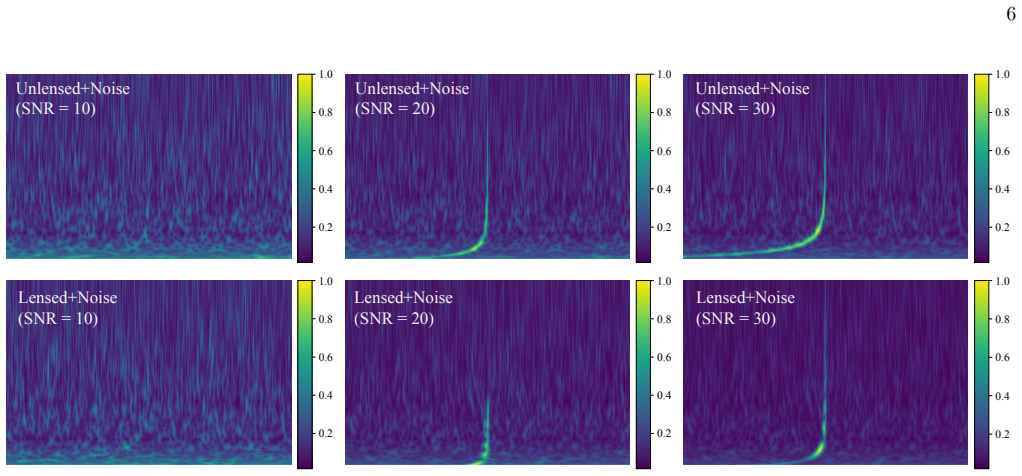
The argument is carried by two pieces working together. Physically, the point-mass lens amplification factor F(f) — the analytical solution of the diffraction integral in the wave-optics regime, where the dimensionless frequency w = 8πMLz f controls whether diffraction is significant — maps the unlensed spectrum to the lensed one via h̃L(f) = F(f)h̃(f). Observationally, the WCD classifies whitened, Q-transformed spectrograms; its WTConv layer decomposes feature maps into four wavelet sub-bands (LL, LH, HL, HH), processes them with a depthwise convolution and channel-wise scaling, and reconstructs through an inverse wavelet transform, achieving a 6×6 receptive field from 3×3 kernels while pre
What would settle it
The decisive test is out-of-distribution: run the trained WCD on lensed waveforms generated by an independent pipeline — a non-point-mass lens profile, a log-uniform instead of uniform lens-mass distribution, or the same signals embedded in a different detector's noise with glitches — and check whether the AUC holds. The complementary audit counts false positives: how often the network flags known-unlensed events that carry other time-frequency anomalies such as eccentric orbits, calibration lines, or noise glitches.
Extended reading notes
Core claim
Gravitational waves lensed by a point-mass compact object are modulated in the wave-optics regime by an analytic amplification factor F(f) — the standard diffraction-integral solution for a point-mass lens — and the paper's central claim is that the resulting frequency-dependent ripples are detectable by a machine-learning classifier even though their amplitude modulation is only a few percent. The WCD learns this from whitened Q-transform spectrograms: wavelet-transform convolutions inside residual blocks give the network a wider effective receptive field and separate low-frequency structure from high-frequency transients, matching the morphology of diffraction fringes. The paper reports 92
Load-bearing premise
Everything is tested on data generated by the paper's own simulation — point-mass lenses, uniform 1–1000 solar-mass lens masses, impact parameters cut at y0 = 3, and Gaussian noise shaped by the Einstein Telescope spectrum — so if real compact-dark-matter lensing or real detector noise differs from these choices, the reported 92% accuracy could be a property of the simulation rather than of the universe.
Editorial extensions
If this is right
- Third-generation lensing searches could screen the projected 10^10–10^12 pairwise comparisons with a single trained network, reserving Bayesian parameter estimation for the few flagged candidates.
- A model that generalizes over the full 1–1000 solar-mass lens range acts as an untargeted microlensing search, needing no template bank over lens mass or impact parameter.
- The stratification results imply that the events found first will be the high-mass, small-impact-parameter ones — exactly the configuration where diffraction is strongest.
- If the real event rate matches the assumed lensing fraction, the population of flagged events can be used to infer the compact-dark-matter fraction fCO, whose numerical value the simulation itself never fixes.
- The reported runtime advantage over Bayesian inference is what makes the search scalable rather than merely accurate.
- The same wavelet-enhanced architecture transfers to other wave-optics problems — extended halo lensing, primordial-black-hole populations, or diffraction by intervening substructure — by retraining on the corresponding transfer functions.
Reading between the lines
- My reading: the honest benchmark for this claim is out-of-distribution, not in-distribution — the decisive test would be feeding the trained WCD lensed waveforms from an independent code with a different lens model (extended mass profile, log-uniform mass function) and watching whether the AUC holds.
- The paper leaves fCO numerically unspecified; a natural extension is to scan fCO as a free parameter and turn the classifier's event-rate predictions into an actual constraint on the compact-dark-matter fraction.
- An editorial flag required by the manuscript's own text: in the y-stratified ROC discussion (Section V.C), the prose reports AUC 0.88 for low-y and 0.97 for high-y subsets, while the accompanying figure reports the opposite ordering (0.975 low-y, 0.963 high-y); the figure matches the stated physical trend, but the two sets of numbers cannot both be right and should be reconciled before the stratif
- A glitch-sensitivity audit would settle how much of the performance is diffraction-specific: if unlensed signals carrying other time-frequency anomalies (eccentricity, calibration lines, detector glitches) are flagged as lensed at elevated rates, part of the 92% would be generic anomaly detection rather than lensing detection.
Editorial analysis
A structured set of objections, weighed in public.
Referee Report
Summary. The paper proposes a wavelet-enhanced convolutional network, the Wavelet Convolution Detector (WCD), to classify simulated gravitational-wave signals as lensed or unlensed by compact dark matter under the wave-optics (point-mass lens) regime. Lensed waveforms are produced by applying the analytic point-mass amplification factor F(f) of Eq. (5) to IMRPhenomPv2 binary-black-hole signals, adding ET-like noise, whitening, and forming Q-transform spectrograms. The training set uses physically motivated source redshift, lens redshift, impact-parameter, and lens-mass distributions described in Section III, with 5000 lensed and 5000 unlensed examples. The paper reports validation accuracy 92.2%, full-dataset accuracy 98.24%, ROC AUC 0.965 on test data, and claims that performance improves at high SNR, low impact parameter, and high lens mass, concluding that the WCD is the first ML approach to identify wave-optics diffraction signatures in lensed gravitational waves.
Significance. If the reported performance were shown to isolate genuine wave-optics diffraction signatures, the WCD architecture and the data-generation pipeline would be a useful contribution for third-generation detectors: the wavelet multi-scale mechanism is a reasonable inductive bias for time-frequency diffraction features, and the use of optical-depth-weighted lens parameters is more astrophysically motivated than uniform sampling. The paper also specifies hyperparameters and training details, which supports reproducibility. However, the central claim is currently supported only by a closed simulation loop: the classifier is trained and tested on data generated by the same pipeline, and there are unresolved confounds from unmatched SNR and source-selection distributions, an internal contradiction in the impact-parameter dependence, and inconsistent reporting of accuracy on different data splits. The physical interpretation therefore needs substantial additional work before the accuracy/AUC numbers can be attributed to diffraction-pattern recognition.
major comments (4)
- [Section IV.B, Eq. (1), Eq. (11)] The manuscript never specifies the SNR distribution of the unlensed signals. Section IV.B states only that "the lensed GW signals are embedded within the noisy background with a SNR ∈ [10, 50]". Since the point-mass amplification factor F(f) in Eq. (1) changes the signal amplitude, if lensed and unlensed injections are not explicitly renormalized to the same SNR distribution, the classifier can trivially separate the classes by overall loudness. In addition, lensed events are selected according to PL(zs) in Eq. (11), so their source redshift distribution differs from that of unlensed events, changing observed masses, frequencies, and luminosity distances. The paper needs to state the unlensed SNR generation, show that the two classes have matched SNR and matched source-parameter distributions, and ideally present a control experiment (e.g., lensed vs. unlensed with identical source param
- [Section V.C, Figure 5(b)] There is a direct internal contradiction in the impact-parameter analysis. The text first says AUC "increases systematically as y decreases" and then states "the AUC drops to 0.88 for low y subsets (vs. 0.97 for high y subsets)", whereas the caption of Figure 5(b) reports Low y AUC = 0.975 and High y AUC = 0.963. These statements are opposite in sign and the numbers do not match. Since the abstract and conclusion explicitly claim superior performance in the low-impact-parameter regime, this inconsistency is load-bearing. The authors should correct the text, recompute the ROC curves, and state the actual subset sizes and thresholds used.
- [Section V.B, Figure 4, Abstract] The accuracy metrics are reported on inconsistent data splits. The validation confusion matrix sums to 1000 samples, the full-dataset confusion matrix sums to 10000, and the stated split is 8:1:1. Thus the "full dataset" accuracy of 98.24% includes the training set and is not an unbiased performance measure. The abstract's 92.2% accuracy is the validation accuracy, while the AUC of 0.965 appears to come from the test ROC; these are not from the same split. The paper should report a single held-out test-set confusion matrix with accuracy, precision, recall, and AUC, and should not quote metrics computed on training data as evidence of generalization.
- [Section III.A, Eq. (13), Section I] Several load-bearing elements of the physical interpretation are missing. First, the compact-DM fraction fCO in Eq. (13) is never numerically specified, so the reader cannot assess the assumed lensing rate; because the training set is artificially balanced 5000/5000, fCO cancels from the conditional lens parameter distributions, and therefore the reported accuracy says nothing about the detectability of a realistic DM population. Second, the Introduction promises "a domain adaptation strategy to ensure model robustness on unseen real data," but no domain adaptation method or experiment appears in Sections IV--VI. Third, all validation is on the same simulation pipeline; the classifier may be exploiting simulation-specific artifacts. The authors should either add out-of-distribution tests (different waveform approximant, different lens model, non-Gaussian or real noise, different mass fun
minor comments (6)
- [Section V.A, Table III] The training narrative says the learning rate was reduced following "an exponential decay schedule," but Table III specifies a cosine-annealing scheduler. Please align these statements.
- [Section V.B, Figure 4] The sentence "as reflected in right panel of Figure 4 left" is garbled. The figure actually has validation on the left and full dataset on the right; please rephrase.
- [Abstract] The claim of being "the first machine learning-based approach capable of identifying such wave-optics signatures" is broader than what is demonstrated, especially given previous wave-optics lensing studies cited in the text. Please qualify the novelty statement.
- [Section III.A, Eq. (14)] The display of Eq. (14) is malformed in the manuscript text, and the denominator notation is unclear. Please rewrite the probability expression with explicit limits and normalization.
- [Throughout] There are numerous typographical and grammatical errors, e.g., "comving volume," "we presents," "not enhances," and "the lensing probability distribution zl an be obtained." A careful editing pass is needed.
- [Section V.C] The statement that for y > 2 the waveform has "about 5% change in peak amplitude" is not derived or referenced. If this number is used to support the interpretation, please provide a quantitative basis or remove it.
Circularity Check
Classification benchmark is a legitimate supervised-learning result, but the paper's validation that the model 'decodes genuine diffraction' is circular because the lensed class is generated by the same F(f) whose y/mlen dependence is then read off as a physical confirmation.
-
self definitional
[Section V.C (ROC curves, lens-mass dependence); with Eq. (1) and Eq. (5) in Sec. II.A]
"This trend aligns with wave-optics theory (diffraction prominence requires RE ∼ λGW), validating the model decodes genuine diffraction-induced lensing imprints rather than spurious correlations."
The lensed training/test signals are generated as ehL(f)=F(f)eh(f) (Eq. 1), where F(f) is given by Eq. (5) and depends on w=8πMLz f (hence mlen) and y. Thus the simulated lensed class contains larger F(f)-induced distortions exactly for high mlen and low y. The observed AUC stratification (high-m AUC=0.995, low-m AUC=0.944; low-y AUC=0.975, high-y AUC=0.963) is therefore a direct consequence of the data-generation construction. Using this trend to 'validate' that the network has learned genuine diffraction rather than spurious correlations restates the input model; it is a self-consistency check, not an independent confirmation.
full rationale
No load-bearing self-citation or uniqueness-import circularity was found: the wave-optics transfer function is cited to Takahashi & Nakamura, and the astrophysical distributions (Eqs. 6-15) rest on external population-synthesis references. The 92.2% accuracy and AUC=0.965 are obtained on held-out data from the same simulation pipeline; this is a standard supervised-learning evaluation and is not itself circular. The main circular element is the interpretive claim in Sec. V.C that the model's performance trend with y and mlen independently validates diffraction learning, when that trend is engineered into the training data by Eq. (1)/(5). A separate non-circularity concern: the lensed set's SNR is specified ([10,50]) while the unlensed set's SNR is not, so loudness/source-parameter imbalance is a confounding risk for real-data claims; this is an external-validity limitation, not a circular reduction. Overall, partial circularity in the physical-interpretation validation, but the core classification benchmark retains independent content.
Assumptions & free parameters
free parameters (4)
- Lens mass range =
1 to 1000 M_sun
- Impact parameter cutoff y0 =
3
- SNR range =
10 to 50
- fCO (compact DM fraction) =
not specified
assumptions (5)
- domain assumption Point-mass lens model with analytical diffraction amplification factor F(f) (Eq. 5)
- domain assumption Compact DM distributed uniformly in comoving volume; optical depth formula (Eqs. 11-13)
- domain assumption IMRPhenomPv2 accurately models BBH waveforms
- domain assumption Gaussian noise with Einstein Telescope PSD
- ad hoc to paper Uniform lens mass distribution in [1, 1000] M_sun
Cite this review
Pith. "Pith review of Identifying Microlensing by Compact Dark Matter through Diffraction Patterns in Gravitational Waves with Machine Learning." pith.science (2026). https://pith.science/paper/6O43N2MY
@misc{pith2026250904538,
  author       = {Pith},
  title        = {Pith review of: Identifying Microlensing by Compact Dark Matter through Diffraction Patterns in Gravitational Waves with Machine Learning},
  year         = {2026},
  howpublished = {\url{https://pith.science/paper/6O43N2MY}},
  note         = {Machine review of arXiv:2509.04538}
}
abstract
Gravitational wave lensing, particularly microlensing by compact dark matter (DM), offers a unique avenue to probe the nature of dark matter. However, conventional detection methods are often computationally expensive, inefficient, and sensitive to waveform systematics. In this work, we introduce the Wavelet Convolution Detector (WCD), a deep learning framework specifically designed to identify wave-optics diffraction patterns imprinted in gravitationally lensed signals. The WCD integrates multi-scale wavelet analysis within residual convolutional blocks to efficiently extract time-frequency interference structures, and is trained on a realistically generated dataset incorporating compact DM mass functions and astrophysical lensing probabilities. This work is the first machine learning-based approach capable of identifying such wave-optics signatures in lensed gravitational waves. Tested on simulated binary black hole events, the model achieves 92.2\% accuracy (AUC=0.965), with performance rising to AUC$\sim$0.99 at high SNR. Crucially, it maintains high discriminative power across a wide range of lens masses without retraining, demonstrating particular strength in the low-impact-parameter and high-lens-mass regimes where wave-optics effects are most pronounced. Compared to Bayesian inference, the WCD provides orders-of-magnitude faster inference, making it a scalable and efficient tool for discovering compact DM through lensed gravitational waves in the era of third-generation detectors.
Figures


Figures from the paper (2 more)


Forward citations
Cited by 6 Pith papers
-
Wave Optics Effects from Gravitational Wave Propagation Through Dark Matter Halos
Numerical simulations of plane gravitational waves through Gaussian, NFW and Burkert potentials show non-geodesic propagation for Gaussian profiles and wave convexity reversal for Burkert in strong gravity, with order...
-
Identifying lensed gravitational waves with physics-informed posterior learning
Fusing a simulation-trained common-source mass posterior with waveform features raises lensed-event detection efficiency from 20.8% to 35.2% at 1% false-positive rate and lowers the SNR for 50% efficiency from 45.3 to 33.5.
-
Mock Catalogs of Strongly Lensed Gravitational Waves via A Halo Model Approach with Ground-based Detectors
Composite-halo mock catalogs forecast ~400 doublets + 36 quadruplets (plus ~107 subhalo and ~20 central-image systems) of lensed GWs per year for ET+CE and release the GW-LMC catalog.
-
Finite-Core Signatures in LISA-Band Wave-Optics Lensing by Low-Mass Dark Matter Halos
Finite cores in low-mass dark matter halos produce distinct complex residuals in LISA-band wave-optics amplification that cannot be fully mimicked by lower-concentration NFW profiles and peak at rc/rs ≃ 0.25-0.3.
-
Detection of Lensed Gravitational Waves in the Millihertz Band Using Frequency-Domain Lensing Feature Extraction Network
DCL-xLSTM neural network detects lensed GW events with AUC over 0.99 using training on PM and SIS lens models in the millihertz band.
-
Detection of Multiband Lensed Gravitational Waves from Dark Matter Halos with Deep Learning
A dual-branch neural network fusing simulated DECIGO and ET data classifies SIS, CIS, and NFW lensed binary-neutron-star signals with 97% accuracy, far above single-detector performance.
Reference graph
Works this paper leans on
-
[1]
Architecture Overview The network input consists of spectrograms generated by applying noise whitening (based on the PSD) and a Q-transform to the raw gravitational-wave (GW) signals. The proposed network adopts a ResNet backbone with five hierarchical stages, where conventional bottleneck blocks are augmented with Wavelet Transform Convo- lution (WTConv)...
-
[2]
WTConv Operational Details The WTConv module implements frequency-adaptive processing through dual-path computation: H(X) = Convk×k(X), Ω(X) = W −1 (K ⊛ W(X)) , (22) WTConv(X) = H(X) + Ω(X). The wavelet transformW decomposes features into four sub-bands: W(X) = Z = [LL,LH,HL,HH] ∈ RC×4×H/2×W/2, (23) where Z denotes the concatenated low–pass (LL) and three...
-
[3]
Parameter efficiency through depthwise wavelet pro- cessing, offering marked reductions in parameter count compared to conventional convolutions with equivalent spatial coverage. These properties make WTConv par- ticularly suitable for gravitational-wave analysis, where signal morphology manifests as localized time-frequency patterns embedded in non-stati...
work page 2000
-
[4]
E. Berti, J. Gair, and A. Sesana, Phys. Rev. D 84, 101501 (2011), 1107.3528
work page Pith review arXiv 2011
-
[5]
B. P. Abbott, R. Abbott, T. D. Abbott, M. R. Aber- nathy, F. Acernese, K. Ackley, C. Adams, T. Adams, P. Addesso, R. X. Adhikari, et al., Phys. Rev. Lett.116, 061102 (2016), 1602.03837
arXiv 2016
-
[6]
B. P. Abbott, R. Abbott, T. D. Abbott, M. R. Aber- nathy, F. Acernese, K. Ackley, C. Adams, T. Adams, P. Addesso, R. X. Adhikari, et al., Astrophys. J., Suppl. Ser. 225, 8 (2016), 1604.07864
work page Pith review arXiv 2016
-
[7]
B. P. Abbott, R. Abbott, T. D. Abbott, S. Abraham, F. Acernese, K. Ackley, C. Adams, R. X. Adhikari, V. B. Adya, C. Affeldt, et al., Phys. Rev. D 100, 104036 (2019), 1903.04467
arXiv 2019
-
[8]
B. P. Abbott, R. Abbott, T. D. Abbott, F. Acernese, K. Ackley, C. Adams, T. Adams, P. Addesso, R. X. Ad- hikari, V. B. Adya, et al., Phys. Rev. Lett.119, 161101 (2017), 1710.05832
arXiv 2017
Show all 74 references
-
[9]
Acernese, M
F. Acernese, M. Agathos, K. Agatsuma, D. Aisa, N. Alle- mandou, A. Allocca, J. Amarni, P. Astone, G. Balestri, G. Ballardin, et al., Classical and Quantum Gravity32, 024001 (2015), 1408.3978
2015 arXiv
-
[10]
Akutsu, M
T. Akutsu, M. Ando, K. Arai, Y. Arai, S. Araki, A. Araya, N. Aritomi, Y. Aso, S. Bae, Y. Bae, et al., Progress of Theoretical and Experimental Physics2021, 05A101 (2021), 2005.05574
2021
-
[11]
B. P. Abbott, R. Abbott, T. D. Abbott, S. Abraham, F. Acernese, K. Ackley, C. Adams, R. X. Adhikari, V. B. Adya, C. Affeldt, et al., Astrophys. J. Lett. 882, L24 (2019), 1811.12940
2019 arXiv
-
[12]
B. P. Abbott, R. Abbott, T. D. Abbott, F. Acernese, K. Ackley, C. Adams, T. Adams, P. Addesso, R. X. Ad- hikari, V. B. Adya, et al., Nature (London) 551, 85 (2017), 1710.05835
2017 arXiv
-
[13]
B. P. Abbott, R. Abbott, T. D. Abbott, F. Acernese, K. Ackley, C. Adams, T. Adams, P. Addesso, R. X. Ad- hikari, V. B. Adya, et al., Astrophys. J. Lett.848, L12 (2017), 1710.05833
2017 arXiv
-
[14]
Barack, V
L. Barack, V. Cardoso, S. Nissanke, T. P. Sotiriou, A. Askar, C. Belczynski, G. Bertone, E. Bon, D. Blas, R. Brito, et al., Classical and Quantum Gravity 36, 143001 (2019), 1806.05195
2019 arXiv
-
[15]
Berti, E
E. Berti, E. Barausse, V. Cardoso, L. Gualtieri, P. Pani, U. Sperhake, L. C. Stein, N. Wex, K. Yagi, T. Baker, et al., Classical and Quantum Gravity32, 243001 (2015), 1501.07274
2015 arXiv
-
[16]
Oguri, Reports on Progress in Physics 82, 126901 (2019), 1907.06830
M. Oguri, Reports on Progress in Physics 82, 126901 (2019), 1907.06830
2019 arXiv
- [17]
-
[18]
Annala, T
E. Annala, T. Gorda, A. Kurkela, J. Nättilä, and A. Vuorinen, Nature Physics16, 907 (2020), 1903.09121
2020 arXiv
-
[19]
A. R. A. C. Wierda, E. Wempe, O. A. Hannuksela, L. V. E. Koopmans, and C. Van Den Broeck, Astrophys. J. 921, 154 (2021), 2106.06303
2021 arXiv
- [20]
-
[21]
K. Liao, M. Biesiada, and Z.-H. Zhu, Chinese Physics Letters 39, 119801 (2022), 2207.13489
2022 arXiv
-
[22]
Vegetti and L
S. Vegetti and L. V. E. Koopmans, Mon. Not. Roy. As- tron. Soc. 400, 1583 (2009), 0903.4752
2009 arXiv
-
[23]
Y. D. Hezaveh, L. Perreault Levasseur, and P. J. Mar- shall, Nature (London) 548, 555 (2017), 1708.08842
2017 arXiv
-
[24]
Liao, X.-L
K. Liao, X.-L. Fan, X. Ding, M. Biesiada, and Z.-H. Zhu, Nature Communications 8, 1148 (2017), 1703.04151
2017 arXiv
-
[25]
Takahashi and T
R. Takahashi and T. Nakamura, Astrophys. J.595, 1039 (2003), astro-ph/0305055
2003 arXiv
-
[26]
Dai, S.-S
L. Dai, S.-S. Li, B. Zackay, S. Mao, and Y. Lu, Phys. Rev. D 98, 104029 (2018), 1810.00003
2018 arXiv
-
[27]
M.-R. Wu, J. Barnes, G. Martínez-Pinedo, and B. D. Metzger, Phys. Rev. Lett. 122, 062701 (2019), 1808.10459. 12
2019 arXiv
-
[28]
N. J. Cornish and T. B. Littenberg, Classical and Quan- tum Gravity 32, 135012 (2015), 1410.3835
2015 arXiv
-
[29]
Birrer, M
S. Birrer, M. Millon, D. Sluse, A. J. Shajib, F. Courbin, S. Erickson, L. V. E. Koopmans, S. H. Suyu, and T. Treu, ssr 220, 48 (2024), 2210.10833
2024 arXiv
-
[30]
S. Cao, J. Qi, Z. Cao, M. Biesiada, W. Cheng, and Z.-H. Zhu, Astron. Astrophys.659, L5 (2022), 2202.08714
2022 arXiv
-
[31]
B. J. Owen and B. S. Sathyaprakash, Phys. Rev. D60, 022002 (1999), gr-qc/9808076
1999 arXiv
-
[32]
Çalışkan, J
M. Çalışkan, J. M. Ezquiaga, O. A. Hannuksela, and D. E. Holz, Phys. Rev. D 107, 063023 (2023), 2201.04619
2023 arXiv
-
[33]
Veitch, V
J. Veitch, V. Raymond, B. Farr, W. Farr, P. Graff, S. Vi- tale, B. Aylott, K. Blackburn, N. Christensen, M. Cough- lin, et al., Phys. Rev. D91, 042003 (2015), 1409.7215
2015 arXiv
-
[34]
Janquart, T
J. Janquart, T. Baka, A. Samajdar, T. Dietrich, and C. Van Den Broeck, Mon. Not. Roy. Astron. Soc.523, 1699 (2023), 2211.01304
2023 arXiv
-
[35]
R. W. Kiendrebeogo, A. M. Farah, E. M. Foley, A. Gray, N. Kunert, A. Puecher, A. Toivonen, R. O. VandenBerg, S. Anand, T. Ahumada, et al., Astrophys. J.958, 158 (2023), 2306.09234
2023 arXiv
-
[36]
Z. Gao, K. Liao, L. Yang, and Z.-H. Zhu, Mon. Not. Roy. Astron. Soc. 526, 682 (2023), 2304.13967
2023 arXiv
-
[37]
Gabbard, M
H. Gabbard, M. Williams, F. Hayes, and C. Messenger, Phys. Rev. Lett. 120, 141103 (2018), 1712.06041
2018 arXiv
-
[38]
S. R. Green and J. Gair, arXiv e-prints arXiv:2008.03312 (2020), 2008.03312
2008 arXiv
-
[39]
A. J. K. Chua and M. Vallisneri, Phys. Rev. Lett.124, 041102 (2020), 1909.05966
2020 arXiv
-
[40]
K. Kim, J. Lee, R. S. H. Yuen, O. Akseli Hannuksela, and T. G. F. Li, arXiv e-prints arXiv:2010.12093 (2020), 2010.12093
2010 arXiv
-
[41]
T. E. Collett, Astrophys. J.811, 20 (2015), 1507.02657
2015 arXiv
-
[42]
Magare, A
S. Magare, A. More, and S. Choudhary, Mon. Not. Roy. Astron. Soc. 535, 990 (2024), 2403.02994
2024 arXiv
-
[43]
and other machine learning methods [44, 45] to the problem of lens identification. Although existing studies have made progress in lensed/unlensed classification, most approaches remain confined to the geometric-optics approximation, lack targeted modeling of wave-optical effe...
-
[44]
Goyal, D
S. Goyal, D. Harikrishnan, S. J. Kapadia, and P. Ajith, Phys. Rev. D 104, 124057 (2021), 2106.12466
2021 arXiv
-
[45]
Lin, J.-d
X.-y. Lin, J.-d. Zhang, L. Dai, S.-J. Huang, and J. Mei, Phys. Rev. D 108, 064020 (2023), 2304.04800
2023 arXiv
-
[46]
Pagano, O
G. Pagano, O. A. Hannuksela, and T. G. F. Li, Astron. Astrophys. 643, A167 (2020), 2006.12879
2020 arXiv
-
[47]
Sheng, K
S. Sheng, K. V. G. C, C. P. Choi, J. Sharpnack, and T. Jones, arXiv e-prints arXiv:2210.11681 (2022), 2210.11681
2022 arXiv
-
[48]
G. C. Keerthi Vasan, S. Sheng, T. Jones, C. P. Choi, and J. Sharpnack, Mon. Not. Roy. Astron. Soc. 524, 5368 (2023), 2211.00047
2023 arXiv
-
[49]
Chakraborty and S
A. Chakraborty and S. Mukherjee, Mon. Not. Roy. As- tron. Soc. 532, 4842 (2024), 2403.03982
2024 arXiv
-
[50]
M. H. Y. Cheung, J. Gais, O. A. Hannuksela, and T. G. F. Li, Mon. Not. Roy. Astron. Soc. 503, 3326 (2021), 2012.07800
2021 arXiv
-
[51]
S. E. Finder, R. Amoyal, E. Treister, and O. Freifeld, in European Conference on Computer Vision (2024), 2407.05848
2024 arXiv
-
[52]
K. He, X. Zhang, S. Ren, and J. Sun, in 2016 IEEE Conference on Computer Vision and Pattern Recognition (CVPR (2016), p. 1, 1512.03385
2016 arXiv
-
[53]
Grespan and M
M. Grespan and M. Biesiada, Universe9, 200 (2023)
2023
-
[54]
A. K. Meena and J. S. Bagla, Mon. Not. Roy. Astron. Soc. 492, 1127 (2020), 1903.11809
2020 arXiv
-
[55]
S. Sun, C. Shi, J.-d. Zhang, and J. Mei, Phys. Rev. D 107, 044023 (2023), 2207.13009
2023 arXiv
-
[56]
Urrutia and V
J. Urrutia and V. Vaskonen, Mon. Not. Roy. Astron. Soc. 509, 1358 (2022), 2109.03213
2022 arXiv
-
[57]
Mukherjee, T
S. Mukherjee, T. Broadhurst, J. M. Diego, J. Silk, and G. F. Smoot, Mon. Not. Roy. Astron. Soc. 506, 3751 (2021), 2106.00392
2021 arXiv
- [58]
-
[59]
K. Liao, S. Tian, and X. Ding, Mon. Not. Roy. Astron. Soc. 495, 2002 (2020), 2001.07891
2002 arXiv
-
[60]
Basak, A
S. Basak, A. Ganguly, K. Haris, S. Kapadia, A. K. Mehta, and P. Ajith, Astrophys. J. Lett.926, L28 (2022), 2109.06456
2022 arXiv
-
[61]
H. Zhou, Z. Li, K. Liao, and Z. Huang, Mon. Not. Roy. Astron. Soc. 518, 149 (2023), 2206.13128
2023 arXiv
-
[62]
X. Shan, B. Hu, X. Chen, and R.-G. Cai, Nature Astron- omy 9, 916 (2025), 2301.06117
2025 arXiv
-
[63]
Lin, X.-J
X.-Y. Lin, X.-J. Wang, H. Zhou, Z. Li, K. Liao, and Z.-H. Zhu, arXiv e-prints arXiv:2508.13577 (2025), 2508.13577
2025
-
[64]
Suyamprakasam, S
S. Suyamprakasam, S. Harikumar, P. Ciecielág, P. Figura, M. Bejger, and M. Biesiada, arXiv e-prints arXiv:2503.21845 (2025), 2503.21845
2025
-
[65]
K. Liao, M. Biesiada, and X.-L. Fan, Astrophys. J.875, 139 (2019), 1903.06612
2019 arXiv
-
[66]
LeCun, Y
Y. LeCun, Y. Bengio, and G. Hinton, Nature521, 436 (2015)
2015
-
[67]
Krizhevsky, I
A. Krizhevsky, I. Sutskever, and G. E. Hinton, inAd- vances in Neural Information Processing Systems(2012), pp. 1097–1105
2012
-
[68]
C. Dong, C. C. Loy, K. He, and X. Tang, inProceedings of the IEEE Conference on Computer Vision and Pattern Recognition(2015), pp. 166–174
2015
-
[69]
Szegedy, W
C. Szegedy, W. Liu, Y. Jia, P. Sermanet, S. Reed, D. Anguelov, D. Erhan, V. Vanhoucke, and A. Rabi- novich, inProceedings of the IEEE Conference on Com- puter Vision and Pattern Recognition(2015), pp. 1–9, 1409.4842
2015 arXiv
-
[70]
Dosovitskiy, L
A. Dosovitskiy, L. Beyer, A. Kolesnikov, D. Weissenborn, X. Zhai, T. Unterthiner, M. Dehghani, M. Minderer, G. Heigold, S. Gelly, et al., inInternational Conference on Learning Representations(2021), 2010.11929
2021 arXiv
-
[71]
A. Nitz, I. Harry, D. Brown, C. M. Biwer, J. Willis, T. D. Canton, C. Capano, T. Dent, L. Pekowsky, G. S. C. Davies, et al., gwastro/pycbc: v2.3.3 release of pycbc (2024)
2024
-
[72]
D. P. Kingma and J. Ba, CoRRabs/1412.6980 (2014)
2014 arXiv
- [73]
-
[74]
Fawcett, Pattern Recognition Letters27, 861 (2006)
T. Fawcett, Pattern Recognition Letters27, 861 (2006)
2006
Reviewed August 5, 2026 · model on record in the stance chip above.
Discussion (0). Sign in to comment.