Finite-Core Signatures in LISA-Band Wave-Optics Lensing by Low-Mass Dark Matter Halos
Pith reviewed 2026-06-26 16:25 UTC · model grok-4.3
The pith
Finite cores in low-mass dark matter halos leave structured residuals in LISA-band wave-optics lensing that NFW templates cannot fully replicate.
A machine-rendered reading of the paper's core claim, the machinery that carries it, and where it could break.
Core claim
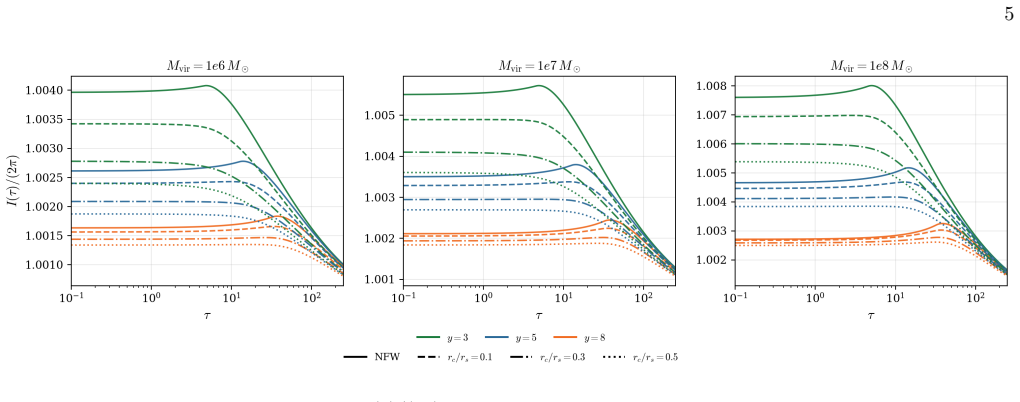
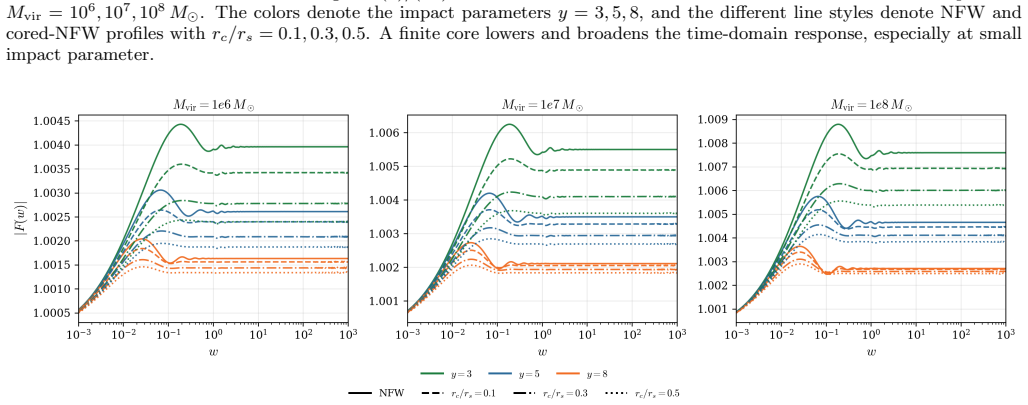
By propagating fixed-mass NFW and cored-NFW density profiles through the wave-optics formalism, the authors find that finite cores smooth the time-delay response and reshape the diffraction peak in the complex amplification factor. An NFW template with lower concentration mimics part of the effect, yet structured complex residuals persist after time and phase alignment, reaching a maximum for core-to-scale radius ratios of approximately 0.25 to 0.3. An SIDM-inspired isothermal-core profile produces the same qualitative behavior, establishing that the finite-core signature is not an artifact of parameterization. For a fiducial LISA source an appreciable mismatch requires favorable near alignm
What carries the argument
The complex wave-optics amplification factor obtained by comparing fixed-mass NFW and cored-NFW lenses.
If this is right
- Structured complex residuals remain after time and phase alignment with an NFW template.
- Residual amplitude peaks at core-to-scale-radius ratios of 0.25 to 0.3.
- An SIDM-inspired isothermal core yields the same qualitative response.
- Detectable mismatch needs near alignment and virial mass above 10 million solar masses for LISA sources.
Where Pith is reading between the lines
- This distinction could allow LISA data to test whether low-mass halos have cores, offering a probe of dark matter self-interactions.
- The method may be applied to subhalos affecting strongly lensed gravitational wave images.
- Template libraries for wave-optics lensing may need to include core parameters to avoid systematic biases in halo mass estimates.
Load-bearing premise
An appreciable mismatch requires favorable near alignment and virial mass above roughly 10 million solar masses for a typical LISA source.
What would settle it
LISA observations of waves lensed by halos above 10^7 solar masses that show no excess complex residuals after best-fit NFW subtraction would falsify the presence of detectable finite-core signatures.
Figures




read the original abstract
LISA-band gravitational waves from massive binary black holes can be diffractively lensed by low-mass dark matter halos and subhalos, so their frequency-dependent amplification can probe the inner density profile. We isolate the generic finite-core part of this signal by comparing fixed-mass Navarro-Frenk-White (NFW) and cored-NFW lenses and propagating both profiles to the complex wave-optics amplification factor. A finite core smooths the time-delay response and reshapes the diffraction peak; an NFW template with a lower concentration can mimic part of the effect, but structured complex residuals remain after time and phase alignment. The residual peaks for intermediate cores, $r_c/r_s\simeq0.25$--$0.3$. An SIDM-inspired isothermal-core profile gives the same qualitative response, showing that the signal is not an artifact of one cored parameterization. For a fiducial LISA source, an appreciable mismatch requires favorable near alignment and $M_{\rm vir}\gtrsim 10^7M_\odot$. The result is a finite-core baseline for isolated line-of-sight halos and for subhalos perturbing strongly lensed macro-images.
Editorial analysis
A structured set of objections, weighed in public.
Referee Report
Summary. The manuscript claims that finite cores in low-mass dark matter halos produce detectable signatures in the wave-optics amplification factor for LISA-band gravitational waves from massive black hole binaries. By propagating fixed-mass NFW and cored-NFW (plus isothermal) density profiles through the complex amplification factor, the authors show that a finite core smooths the time-delay response and reshapes the diffraction peak; an NFW template with reduced concentration can absorb part but not all of the effect, leaving structured complex residuals that peak at rc/rs ≃ 0.25–0.3. Detectability for a fiducial LISA source requires favorable near-alignment and M_vir ≳ 10^7 M_⊙. The result supplies a baseline template for isolated line-of-sight halos and subhalos perturbing macro-images.
Significance. If the numerical comparison holds, the work supplies a concrete, profile-specific template for searching finite-core signatures in future LISA data, directly addressing the inner structure of low-mass halos that is otherwise inaccessible. The controlled isolation of the core effect (rather than a global fit) and the cross-check with an SIDM-inspired isothermal profile are strengths that make the claim falsifiable with actual LISA waveforms.
minor comments (3)
- The abstract states that residuals remain after time and phase alignment, but the manuscript should explicitly define the alignment procedure (e.g., which time/phase parameters are varied and over what range) in §3 or §4 to allow reproduction.
- Figure captions and axis labels for the residual plots should state the exact source redshift, lens redshift, and impact parameter used for the fiducial LISA source; these values are referenced in the final paragraph but not quantified in the text.
- The claim that the signal is 'not an artifact of one cored parameterization' would be strengthened by a brief statement in §5 on how the isothermal core radius is mapped to the NFW scale radius rs.
Simulated Author's Rebuttal
We thank the referee for their positive summary, recognition of the work's significance in supplying a falsifiable template for finite-core effects, and recommendation of minor revision. No major comments were provided in the report.
Circularity Check
No significant circularity
full rationale
The paper conducts a direct numerical comparison of the wave-optics amplification factor for fixed-mass NFW versus cored-NFW (and isothermal) density profiles. Residuals are obtained after explicit time and phase alignment of the computed signals; they are not defined in terms of any fitted parameters drawn from the same data, nor do they reduce to the input profiles by construction. No load-bearing self-citations, uniqueness theorems, or ansatzes imported from prior author work appear in the abstract or stated claims. The central result (structured residuals peaking at rc/rs ≃ 0.25–0.3) follows from propagating the two profiles through the same lensing integral and is therefore independent of its inputs.
Axiom & Free-Parameter Ledger
axioms (2)
- domain assumption Navarro-Frenk-White (NFW) density profile is the baseline for dark matter halos
- standard math Wave-optics treatment is required for LISA-band gravitational lensing
Reference graph
Works this paper leans on
-
[1]
J. F. Navarro, C. S. Frenk, and S. D. M. White, Astro- phys. J.490, 493 (1997), astro-ph/9611107
Pith/arXiv arXiv 1997
- [2]
-
[3]
S.-H. Oh, C. Brook, F. Governato, E. Brinks, L. Mayer, W. J. G. de Blok, A. Brooks, and F. Walter, Astron. J. 142, 24 (2011), 1011.2777
Pith/arXiv arXiv 2011
-
[4]
D. H. Weinberg, J. S. Bullock, F. Governato, R. Kuzio de Naray, and A. H. G. Peter, Proceedings of the National Academy of Science112, 12249 (2015), 1306.0913
Pith/arXiv arXiv 2015
-
[5]
J. S. Bullock and M. Boylan-Kolchin, Ann. Rev. Astron. Astrophys.55, 343 (2017), 1707.04256
arXiv 2017
-
[6]
D. N. Spergel and P. J. Steinhardt, Phys. Rev. Lett.84, 3760 (2000), astro-ph/9909386
Pith/arXiv arXiv 2000
-
[7]
M. Rocha, A. H. G. Peter, J. S. Bullock, M. Kaplinghat, S. Garrison-Kimmel, J. O˜ norbe, and L. A. Moustakas, Mon. Not. Roy. Astron. Soc.430, 81 (2013), 1208.3025
Pith/arXiv arXiv 2013
- [8]
-
[9]
S. Adhikari, A. Banerjee, K. K. Boddy, F.-Y. Cyr- Racine, H. Desmond, C. Dvorkin, B. Jain, F. Kahlhoefer, M. Kaplinghat, A. Nierenberg, et al., Reviews of Modern Physics97, 045004 (2025), 2207.10638
arXiv 2025
-
[10]
W. Hu, R. Barkana, and A. Gruzinov, Phys. Rev. Lett. 85, 1158 (2000), astro-ph/0003365
Pith/arXiv arXiv 2000
-
[11]
H.-Y. Schive, T. Chiueh, and T. Broadhurst, Nature Physics10, 496 (2014), 1406.6586
Pith/arXiv arXiv 2014
-
[12]
L. Hui, J. P. Ostriker, S. Tremaine, and E. Witten, Phys. Rev. D95, 043541 (2017), 1610.08297
Pith/arXiv arXiv 2017
-
[13]
D. J. E. Marsh, Phys. Rept.643, 1 (2016), 1510.07633
Pith/arXiv arXiv 2016
-
[14]
J. C. Niemeyer, Progress in Particle and Nuclear Physics 113, 103787 (2020), 1912.07064
arXiv 2020
-
[15]
H. C. Ohanian, International Journal of Theoretical Physics9, 425 (1974)
1974
-
[16]
T. T. Nakamura and S. Deguchi, Progress of Theoretical Physics Supplement133, 137 (1999)
1999
-
[17]
R. Takahashi and T. Nakamura, Astrophys. J.595, 1039 (2003), astro-ph/0305055
Pith/arXiv arXiv 2003
-
[18]
P. Amaro-Seoane, J. Andrews, M. Arca Sedda, A. Askar, Q. Baghi, R. Balasov, I. Bartos, S. S. Bavera, J. Bellovary, C. P. L. Berry, et al., Living Reviews in Relativity26, 2 (2023), 2203.06016
Pith/arXiv arXiv 2023
-
[19]
Z. Gao, X. Chen, Y.-M. Hu, J.-D. Zhang, and S.-J. Huang, Mon. Not. Roy. Astron. Soc.512, 1 (2022), 2102.10295
arXiv 2022
-
[20]
M. C ¸ alı¸ skan, L. Ji, R. Cotesta, E. Berti, M. Kamionkowski, and S. Marsat, Phys. Rev. D 107, 043029 (2023), 2206.02803
arXiv 2023
-
[21]
M. C ¸ alı¸ skan, N. A. Kumar, L. Ji, J. M. Ezquiaga, R. Cotesta, E. Berti, and M. Kamionkowski, Phys. Rev. D108, 123543 (2023), 2307.06990
arXiv 2023
-
[22]
G. Tambalo, M. Zumalac´ arregui, L. Dai, and M. H.-Y. Cheung, Phys. Rev. D108, 103529 (2023), 2212.11960
arXiv 2023
- [23]
- [24]
- [25]
-
[26]
A. Liu, T. Liu, D. Li, C. Wen, J. Wang, K. Liao, J. Cui, and H. Zhou, arXiv e-prints arXiv:2509.04538 (2025), 2509.04538
arXiv 2025
-
[27]
D. Li, T. Liu, A. Liu, C. Wen, J. Wang, K. Liao, and J. Cui, Astrophys. J., Suppl. Ser.283, 31 (2026), 2508.19311
arXiv 2026
- [28]
-
[29]
Y. Li, K. Liao, M. Sun, L. Yang, X. Ding, M. Biesiada, and T. Liu, Astrophys. J., Suppl. Ser.284, 56 (2026), 2603.09289
Pith/arXiv arXiv 2026
-
[30]
M. Sun, K. Liao, Y. Li, T. Liu, H. Wu, S. Hou, T. Yang, X. Fan, and M. Biesiada, arXiv e-prints arXiv:2606.08899 (2026), 2606.08899
Pith/arXiv arXiv 2026
-
[31]
H. Wu, T. Liu, and K. Liao, arXiv e-prints arXiv:2606.12792 (2026), 2606.12792
Pith/arXiv arXiv 2026
-
[32]
K. E. Andrade, J. Fuson, S. Gad-Nasr, D. Kong, Q. Mi- nor, M. G. Roberts, and M. Kaplinghat, Mon. Not. Roy. Astron. Soc.510, 54 (2022), 2012.06611
arXiv 2022
-
[33]
M. Bartelmann, Astron. Astrophys.313, 697 (1996), astro-ph/9602053
Pith/arXiv arXiv 1996
-
[34]
C. O. Wright and T. G. Brainerd, Astrophys. J.534, 34 (2000)
2000
-
[35]
A. R. Duffy, J. Schaye, S. T. Kay, and C. Dalla Vecchia, Mon. Not. Roy. Astron. Soc.390, L64 (2008), 0804.2486
Pith/arXiv arXiv 2008
-
[36]
M. Vogelsberger, J. Zavala, and A. Loeb, Mon. Not. Roy. Astron. Soc.423, 3740 (2012), 1201.5892
Pith/arXiv arXiv 2012
-
[37]
J. Koda and P. R. Shapiro, Mon. Not. Roy. Astron. Soc. 415, 1125 (2011), 1101.3097
Pith/arXiv arXiv 2011
-
[38]
A. H. G. Peter, M. Rocha, J. S. Bullock, and M. Kapling- hat, Mon. Not. Roy. Astron. Soc.430, 105 (2013), 1208.3026
Pith/arXiv arXiv 2013
-
[39]
M. Kaplinghat, S. Tulin, and H.-B. Yu, Phys. Rev. Lett. 116, 041302 (2016), 1508.03339
Pith/arXiv arXiv 2016
-
[40]
J. Veitch, V. Raymond, B. Farr, W. Farr, P. Graff, S. Vi- tale, B. Aylott, K. Blackburn, N. Christensen, M. Cough- lin, et al., Phys. Rev. D91, 042003 (2015), 1409.7215
Pith/arXiv arXiv 2015
-
[41]
Z. Gao, K. Liao, L. Yang, and Z.-H. Zhu, Mon. Not. Roy. Astron. Soc.526, 682 (2023), 2304.13967
arXiv 2023
-
[42]
A. A. Dutton and A. V. Macci` o, Mon. Not. Roy. Astron. Soc.441, 3359 (2014), 1402.7073
Pith/arXiv arXiv 2014
-
[43]
A. D. Ludlow, S. Bose, R. E. Angulo, L. Wang, W. A. Hellwing, J. F. Navarro, S. Cole, and C. S. Frenk, Mon. Not. Roy. Astron. Soc.460, 1214 (2016), 1601.02624
Pith/arXiv arXiv 2016
-
[44]
T. Robson, N. J. Cornish, and C. Liu, Classical and Quantum Gravity36, 105011 (2019), 1803.01944
Pith/arXiv arXiv 2019
-
[45]
C. Garc´ ıa-Quir´ os, M. Colleoni, S. Husa, H. Estell´ es, G. Pratten, A. Ramos-Buades, M. Mateu-Lucena, and R. Jaume, Phys. Rev. D102, 064002 (2020), 2001.10914
arXiv 2020
discussion (0)
Sign in with ORCID, Apple, or X to comment. Anyone can read and Pith papers without signing in.