REVIEW 4 major objections 4 minor 92 references
MVRS: The Multimodal Virtual Reality Stimuli-based Emotion Recognition Dataset
T0 review · 4 major / 4 minor · reviewed 2026-08-05 · deepseek-v4-flash
Pith's one-line read The paper introduces MVRS, a multimodal emotion-recognition dataset built by showing 13 people aged 12 to 60 short VR videos intended to evoke relaxation, fear, stress, sadness, and joy while recording four synchronized streams: one-eye vid
desk verdict Genuinely new but tiny VR multimodal dataset; the reported 99% accuracies are likely participant-leakage artifacts and the dataset-quality claim needs re-evaluation. read the letter →
The pith
A machine-rendered reading of the paper's core claim, the machinery that carries it, and where it could break.
The reading
What carries the argument
The load-bearing mechanism is timestamp synchronization across three separate capture systems: a webcam-in-headset eye tracker, a Kinect v2 skeletal tracker, and an Arduino reading EMG and GSR analog pins. Each row in each modality is labeled from the stimulus timeline, so the intended emotion during a clip becomes the ground-truth label. The evaluation hinges on early fusion (concatenating selected features or an autoencoder's learned embedding) versus late fusion (majority voting per modality), with XGBoost as the strongest classifier on the fused feature spaces.
What would settle it
A concrete test: hold out entire participants, not random rows, and retrain. If accuracy drops sharply, the separability is driven by participant-specific patterns rather than emotion. A second test: collect self-reported felt emotion per clip; if a substantial fraction of reports disagree with the assigned labels, the ground truth is stimulus intent rather than felt emotion.
Extended reading notes
Core claim
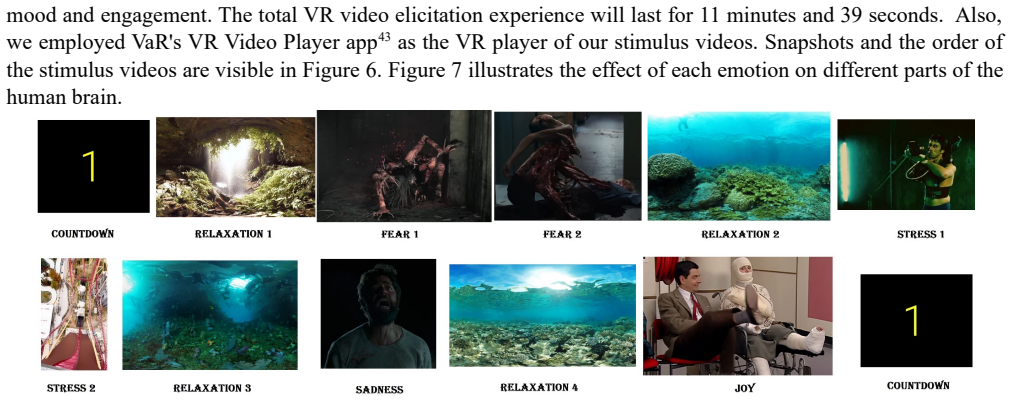
MVRS's central claim is that synchronized multimodal recording under VR emotional videos yields an emotion-recognition dataset with clear class structure. Thirteen participants watched a fixed 11-minute 39-second sequence of VR clips (relaxation bookends, fear scenes from a horror game and film, stress scenes from Saw and a roller coaster, sadness from A Quiet Place, joy from Mr. Bean), while a low-cost webcam in the headset recorded the right eye, a Kinect v2 recorded skeletal joints, and an Arduino recorded forearm EMG and GSR, all timestamp-aligned. Feature extraction produced statistical, kinematic, spectral, and gaze descriptors; early fusion by feature selection or autoencoder and late
Load-bearing premise
The whole evaluation assumes that each participant actually felt the emotion the video was chosen to elicit, and that the timestamps from the two laptops and Arduino line up well enough that labels apply to all modalities; neither assumption is directly measured in the paper.
Editorial extensions
If this is right
- Early fusion of body motion, physiological, and eye-tracking features consistently outperforms any single modality, so MVRS supports models that exploit cross-modal emotion cues.
- Body motion is the strongest single channel (97.66 percent accuracy with XGBoost), suggesting skeletal tracking alone carries much of the emotion signal in VR settings.
- Stress and fear are the most separable classes while relaxation is the hardest, so downstream users should expect class imbalance and use balancing strategies.
- The timestamp-aligned, multi-format release (MP4, XEF, CSV/TXT/JSON) is designed for reproducibility of multimodal fusion pipelines.
Reading between the lines
- The reported near-99 percent figures come from five-fold cross-validation on rows, and the paper removes participant identity before splitting; the same participant's segments may appear in both training and test folds. Leave-one-participant-out evaluation is the natural follow-up and may yield lower, more honest accuracy.
- The low-cost webcam-in-headset modification (one eye tracked through a commercial HMD) could lower the barrier for VR emotion datasets, but gaze features may be sensitive to headset slippage and right-eye-only geometry; tests comparing headset-aligned frames against per-frame iris registration would clarify this.
- The 12-year-old participant watching horror and torture clips raises consent and distress considerations the paper touches only lightly; a future extension could add post-session emotional state checks or age-segmented stimuli.
- Because labels come from the stimulus timeline rather than participant self-report, the dataset is best read as 'responses to intended emotion induction' rather than 'felt emotions'; this distinction matters for clinical or diagnostic uses.
Editorial analysis
A structured set of objections, weighed in public.
Referee Report
Summary. The paper introduces MVRS, a multimodal VR-based emotion recognition dataset recorded from 13 participants (ages 12–60) under five emotion-eliciting VR video conditions: relaxation, fear, stress, sadness, and joy. Data consist of eye tracking from a webcam mounted inside a modified VR HMD, body motion from Kinect v2, and EMG/GSR from an Arduino-based setup. Features are extracted per modality, fused using two early-fusion schemes and one late-fusion scheme, and evaluated with Random Forest, Decision Tree, and XGBoost classifiers under 5-fold cross-validation. The paper reports very high classification accuracies, up to 99.38%, and concludes that the dataset is a reliable, comprehensive, and high-quality resource for the community.
Significance. If the dataset is delivered as described and if the classification results are valid, MVRS would fill a genuine gap: few publicly available datasets combine body motion, physiological signals, and eye tracking under immersive VR elicitation. The authors provide public code and dataset links on Kaggle, Zenodo, Figshare, and IEEE Data Port, and the protocol is described in unusual detail. However, the central quality claim rests on classification results that currently appear to be inflated by participant-level data leakage. The evaluation protocol does not separate participants between training and test folds, and synchronization accuracy is acknowledged as a challenge but never measured. The dataset may still be a useful contribution after a corrected evaluation, but the present results do not establish emotion separability or 'dataset quality' as claimed.
major comments (4)
- [Data Processing / Classification and Metrics] The evaluation protocol is not participant-independent. The Data Processing section states that 'all participants' data' are stacked into a single file per modality, and the Classification section says the pipeline 'remove[s] the emotion and participant columns' before 5-fold cross-validation with 80/20 splits. With only 13 participants, random sample-level splits will place the same participant's temporally contiguous, sensor-specific samples in both training and test folds. The model can therefore exploit participant-identity signatures rather than emotion-specific patterns. The reported accuracies in Tables 1–6, including the 99.38% headline in Table 5, cannot be interpreted as evidence of emotion separability. Please re-run the evaluation with participant-blocked cross-validation (e.g., leave-one-participant-out or grouped folds) and report per-participant results; if the dataset con
- [Construction / Challenges and Multimodal Fusion] The central multimodal claim depends on accurate timestamp synchronization across two separate laptops, one for eye tracking and one for Kinect plus Arduino. The Challenges section explicitly admits 'synchronization issues, especially with ensuring consistent timestamps across devices,' but the paper provides no measurement of alignment error, no offset statistics, and no validation using a known event (e.g., the countdown beep). Without an alignment-error analysis, the statement that all modalities are 'timestamp aligned' is unsupported. Please include a quantitative synchronization check and describe how residual misalignment was handled before feature extraction and fusion.
- [Data Collection Protocol and Labeling] Labels are assigned automatically from stimulus timestamps: 'we labeled the data for each row of modalities' raw data accordingly.' The questionnaires are mentioned as validating ground truth, but no self-report or post-stimulus emotion ratings are reported or used. A stimulus label is not necessarily the emotion the participant felt; this is particularly important because the paper's own acknowledgments note that responses depend on participant state, age, gender, culture, and other factors. Please either report the questionnaire results against the stimulus labels or explicitly restrict the dataset claim to 'stimulus-elicited conditions' rather than 'felt emotions.'
- [Classification and Metrics / Figure 21] The experimental reporting is internally inconsistent and insufficient for reproducibility. The text says '5-fold cross-validation' with '80 percent train and 20 percent test,' but Figure 21 is described as showing 'classification metrics across 30 folds.' It is not clear whether the tables report the aggregate of five folds, repeated five times, or something else. In addition, the paper does not report the number of feature vectors per participant/class, class sizes after stacking, or confidence intervals. Please clarify the exact splitting protocol and provide sample counts and per-fold variability for all tables.
minor comments (4)
- [References] Reference [69] is cited as 'Retracted: Human emotion recognition based on galvanic skin response signal feature selection and svm.' Citing a retracted paper as support for a feature set is problematic; please cite the original peer-reviewed version or replace the reference.
- [Introduction / VR HMD Setup] Typo: 'VaR's VR Video Player app' should likely be 'Var's VR Video Player' or the correct app name. Please verify.
- [Data Analysis] The text refers to 'relaxation and neutral states' when discussing eye-tracking classification, but the dataset has no neutral class. Please correct the wording.
- [Dataset Details] The demographic description says '13 subjects or participant stimuli' and gives only an age range; no table reports sex, age distribution, or per-participant session details. Adding such a table would improve usability.
Circularity Check
Emotion labels are assigned from timestamps while the same timestamps (window_start/window_end) are used as dominant input features, so the reported classification accuracies partly reduce to reading the label off the input by construction.
-
self definitional
[Data Processing (Section 4.1) and Data Analysis / Figure 15 discussion; used in Classification and Metrics]
"The second step is labeling based on the time stamps. As we have the exact duration of each stimulus and also the exact duration of each participant’s experiment, we labeled the data for each row of modalities' raw data accordingly. ... For body motion, temporal markers ( window_start and window_end) dominate, followed by kinematic features such as positional and spectral energy measures from the hands, ankles, and spine, indicating that temporal alignment and limb dynamics play key roles in differentiating emotional states."
The ground-truth emotion label for every row is generated by mapping timestamps to the fixed stimulus schedule. The body-motion feature set then includes the same timestamps as features (window_start and window_end), and the paper's own feature-importance analysis reports that these temporal markers dominate the classifier. Consequently, a model can achieve high 'emotion recognition' accuracy by learning the deterministic timestamp-to-stimulus mapping, without relying on genuine emotion-dependent signals from body motion, physiology, or gaze. The claimed confirmation of 'dataset quality and emotion separability' (e.g., up to 99.38% accuracy) is therefore partly forced by construction: the target label is a function of an input feature. This is a self-definitional shortcut, not independent
full rationale
The paper's central claim that MVRS is a reliable, high-quality resource rests primarily on the classification results in Tables 1-6. The evaluation chain is: timestamps -> emotion labels; timestamps -> window_start/window_end features; features -> classifier accuracy -> 'quality and emotion separability'. Because the label assignment and a dominant input feature both derive from the same timestamps, the high accuracies are in part an artifact of the experimental protocol being encoded as a feature. This is a concrete circular reduction that the paper itself exposes when it reports that temporal markers dominate feature importance. I also note two non-circular validity risks: (1) random 5-fold CV after stacking all participants can leak participant identity across folds, inflating scores; (2) the paper acknowledges cross-device timestamp synchronization issues but provides no alignment-error measurement. These are correctness concerns, not circularity. Self-citations appear frequently but are not load-bearing for the dataset-quality conclusion. Overall, the central claimed evidence is partially circular, so the score is 6 rather than 0-2.
Assumptions & free parameters
free parameters (2)
- PCA components cap =
60 or min(training samples, features)
- Autoencoder latent dimension =
up to 100
assumptions (4)
- domain assumption Participants experienced the intended emotions during VR stimuli.
- domain assumption Timestamp synchronization across devices is accurate.
- domain assumption Webcam-based eye tracking in a modified VR headset provides valid gaze and pupil features.
- domain assumption Kinect v2 skeletal tracking is reliable for seated participants wearing a VR headset.
Cite this review
Pith. "Pith review of MVRS: The Multimodal Virtual Reality Stimuli-based Emotion Recognition Dataset." pith.science (2026). https://pith.science/paper/7G45VMM7
@misc{pith2026250905330,
  author       = {Pith},
  title        = {Pith review of: MVRS: The Multimodal Virtual Reality Stimuli-based Emotion Recognition Dataset},
  year         = {2026},
  howpublished = {\url{https://pith.science/paper/7G45VMM7}},
  note         = {Machine review of arXiv:2509.05330}
}
read the original abstract
Automatic emotion recognition has become increasingly important with the rise of AI, especially in fields like healthcare, education, and automotive systems. However, there is a lack of multimodal datasets, particularly involving body motion and physiological signals, which limits progress in the field. To address this, the MVRS dataset is introduced, featuring synchronized recordings from 13 participants aged 12 to 60 exposed to VR based emotional stimuli (relaxation, fear, stress, sadness, joy). Data were collected using eye tracking (via webcam in a VR headset), body motion (Kinect v2), and EMG and GSR signals (Arduino UNO), all timestamp aligned. Participants followed a unified protocol with consent and questionnaires. Features from each modality were extracted, fused using early and late fusion techniques, and evaluated with classifiers to confirm the datasets quality and emotion separability, making MVRS a valuable contribution to multimodal affective computing.
Figures


Figures from the paper (17 more)




Reference graph
Works this paper leans on
-
[1]
A review of affective computing: From unimodal analysis to multimodal fusion
Poria, Soujanya, et al. "A review of affective computing: From unimodal analysis to multimodal fusion." Information fusion 37 (2017): 98-125
2017
-
[2]
Deap: A database for emotion analysis; using physiological signals
Koelstra, Sander, et al. "Deap: A database for emotion analysis; using physiological signals." IEEE transactions on affective computing 3.1 (2011): 18-31
2011
-
[3]
Vreed: Virtual reality emotion recognition dataset using eye tracking & physiological measures
Tabbaa, Luma, et al. "Vreed: Virtual reality emotion recognition dataset using eye tracking & physiological measures." Proceedings of the ACM on interactive, mobile, wearable and ubiquitous technologies 5.4 (2021): 1-20
2021
-
[4]
Real-time Automatic Emotion Recognition from Body Gestures
Piana, Stefano, et al. "Real-time automatic emotion recognition from body gestures." arXiv preprint arXiv:1402.5047 (2014)
work page Pith review arXiv 2014
-
[5]
A systematic review on affective computing: Emotion models, databases, and recent advances
Wang, Yan, et al. "A systematic review on affective computing: Emotion models, databases, and recent advances." Information Fusion 83 (2022): 19-52
2022
-
[6]
EEVR: A Dataset of Paired Physiological Signals and Textual Descriptions for Joint Emotion Representation Learning
Singh, Pragya, et al. "EEVR: A Dataset of Paired Physiological Signals and Textual Descriptions for Joint Emotion Representation Learning." Advances in Neural Information Processing Systems 37 (2024): 15765-15778
2024
-
[7]
Emotion classification with multi‐modal physiological signals using multi‐attention‐based neural network
Zou, Chengsheng, et al. "Emotion classification with multi‐modal physiological signals using multi‐attention‐based neural network." Cognitive Computation and Systems 6.1-3 (2024): 1-11
2024
-
[8]
Emotion recognition based on multi-modal physiological signals and transfer learning
Fu, Zhongzheng, et al. "Emotion recognition based on multi-modal physiological signals and transfer learning." Frontiers in Neuroscience 16 (2022): 1000716
2022
Show all 92 references
-
[9]
Advancing emotion recognition with Virtual Reality: A multimodal approach using physiological signals and machine learning
Polo, Edoardo Maria, et al. "Advancing emotion recognition with Virtual Reality: A multimodal approach using physiological signals and machine learning." Computers in Biology and Medicine 193 (2025): 110310
2025
-
[10]
Multimodal Emotion Recognition using visual, vocal and Physiological Signals: a review
Udahemuka, Gustave, Karim Djouani, and Anish M. Kurien. "Multimodal Emotion Recognition using visual, vocal and Physiological Signals: a review." Applied Sciences 14.17 (2024): 8071
2024
-
[11]
Emotion recognition with multi-modal peripheral physiological signals
Gohumpu, Jennifer, Mengru Xue, and Yanchi Bao. "Emotion recognition with multi-modal peripheral physiological signals." Frontiers in Computer Science 5 (2023): 1264713
2023
-
[12]
Virtual reality for emotion elicitation–a review
Somarathna, Rukshani, Tomasz Bednarz, and Gelareh Mohammadi. "Virtual reality for emotion elicitation–a review." IEEE Transactions on Affective Computing 14.4 (2022): 2626-2645
2022
-
[13]
Virtual reality technology
Burdea, Grigore C., and Philippe Coiffet. Virtual reality technology. John Wiley & Sons, 2003
2003
-
[14]
Is clinical virtual reality ready for primetime?
Rizzo, Albert, and Sebastian Thomas Koenig. "Is clinical virtual reality ready for primetime?." Neuropsychology 31.8 (2017): 877
2017
-
[15]
A systematic review of immersive virtual reality applications for higher education: Design elements, lessons learned, and research agenda
Radianti, Jaziar, et al. "A systematic review of immersive virtual reality applications for higher education: Design elements, lessons learned, and research agenda." Computers & education 147 (2020): 103778
2020
-
[16]
Affective computing in virtual reality: emotion recognition from brain and heartbeat dynamics using wearable sensors
Marín-Morales, Javier, et al. "Affective computing in virtual reality: emotion recognition from brain and heartbeat dynamics using wearable sensors." Scientific reports 8.1 (2018): 13657
2018
-
[17]
Virtual reality in the assessment, understanding, and treatment of mental health disorders
Freeman, Daniel, et al. "Virtual reality in the assessment, understanding, and treatment of mental health disorders." Psychological medicine 47.14 (2017): 2393-2400
2017
-
[18]
A discussion of cybersickness in virtual environments
LaViola Jr, Joseph J. "A discussion of cybersickness in virtual environments." ACM Sigchi Bulletin 32.1 (2000): 47-56
2000
-
[19]
Multimodal machine learning: A survey and taxonomy
Baltrušaitis, Tadas, Chaitanya Ahuja, and Louis-Philippe Morency. "Multimodal machine learning: A survey and taxonomy." IEEE transactions on pattern analysis and machine intelligence 41.2 (2018): 423-443
2018
-
[20]
Multimodal emotion recognition: A comprehensive review, trends, and challenges
Ramaswamy, Manju Priya Arthanarisamy, and Suja Palaniswamy. "Multimodal emotion recognition: A comprehensive review, trends, and challenges." Wiley Interdisciplinary Reviews: Data Mining and Knowledge Discovery 14.6 (2024): e1563
2024
-
[21]
A survey of affect recognition methods: audio, visual and spontaneous expressions
Zeng, Zhihong, et al. "A survey of affect recognition methods: audio, visual and spontaneous expressions." Proceedings of the 9th international conference on Multimodal interfaces. 2007
2007
-
[22]
Affect detection: An interdisciplinary review of models, methods, and their applications
Calvo, Rafael A., and Sidney D'Mello. "Affect detection: An interdisciplinary review of models, methods, and their applications." IEEE Transactions on affective computing 1.1 (2010): 18-37
2010
-
[23]
The Magic XRoom: A Flexible VR Platform for Controlled Emotion Elicitation and Recognition
Mousavi, Seyed Muhammad Hossein, et al. "The Magic XRoom: A Flexible VR Platform for Controlled Emotion Elicitation and Recognition." Proceedings of the 25th International Conference on Mobile Human-Computer Interaction. 2023
2023
-
[24]
Seyed Muhammad Hossein Mousavi. (2025). Synthetic Data Generation of Body Motion Data by Neural Gas Network for Emotion Recognition. Qeios. doi:10.32388/H3YWEX.2
2025 doi
-
[25]
Synthetic Data Generation by Supervised Neural Gas Network for Physiological Emotion Recognition Data
Mousavi, S. "Synthetic Data Generation by Supervised Neural Gas Network for Physiological Emotion Recognition Data." arXiv preprint arXiv:2501.16353 (2025)
2025 arXiv
-
[26]
Introduction to Facial Micro Expressions Analysis Using Color and Depth Images: A Matlab Coding Approach (2023)
Mousavi, Seyed Muhammad Hossein. "Introduction to Facial Micro Expressions Analysis Using Color and Depth Images: A Matlab Coding Approach (2023)." arXiv preprint arXiv:2307.06396 (2023)
2023 arXiv
-
[27]
Emotion Recognition in Adaptive Virtual Reality Settings: Challenges and Opportunities
Mousavi, Seyed Muhammad Hossein, et al. "Emotion Recognition in Adaptive Virtual Reality Settings: Challenges and Opportunities." WAMWB@ MobileHCI (2023): 1-20
2023
-
[28]
Bees Local Phase Quantisation Feature Selection for RGB-D Facial Expression Recognition
Mousavi, Seyed Muhammad Hossein, and Atiye Ilanloo. "Bees Local Phase Quantisation Feature Selection for RGB-D Facial Expression Recognition." Intelligent Engineering Optimisation with the Bees Algorithm. Cham: Springer Nature Switzerland,
-
[29]
Pupil size variation as an indication of affective processing
Partala, Timo, and Veikko Surakka. "Pupil size variation as an indication of affective processing." International journal of human- computer studies 59.1-2 (2003): 185-198
2003
-
[30]
Affective body expression perception and recognition: A survey
Kleinsmith, Andrea, and Nadia Bianchi-Berthouze. "Affective body expression perception and recognition: A survey." IEEE Transactions on Affective Computing 4.1 (2012): 15-33. 32
2012
-
[31]
Mousavi, S. M. H. (2025). Graph-Based Parallel Multi-Objective Optimization of Skeletal Body Motion Data for Emotion Recognition with Knowledge-Distilled Classifier (https://github.com/SeyedMuhammadHosseinMousavi/Graph-Based-Parallel- Multi-Objective-Optimization-of-Skeletal-B...
2025 doi
-
[32]
Toward machine emotional intelligence: Analysis of affective physiological state
Picard, Rosalind W., Elias Vyzas, and Jennifer Healey. "Toward machine emotional intelligence: Analysis of affective physiological state." IEEE transactions on pattern analysis and machine intelligence 23.10 (2001): 1175-1191
2001
-
[33]
Emotion assessment: Arousal evaluation using EEG’s and peripheral physiological signals
Chanel, Guillaume, et al. "Emotion assessment: Arousal evaluation using EEG’s and peripheral physiological signals." International workshop on multimedia content representation, classification and security. Berlin, Heidelberg: Springer Berlin Heidelberg, 2006
2006
-
[34]
Challenges in representation learning: A report on three machine learning contests
Goodfellow, Ian J., et al. "Challenges in representation learning: A report on three machine learning contests." Neural information processing: 20th international conference, ICONIP 2013, daegu, korea, november 3-7, 2013. Proceedings, Part III 20. Springer berlin heidelberg, 2013
2013
-
[35]
Affectnet: A database for facial expression, valence, and arousal computing in the wild
Mollahosseini, Ali, Behzad Hasani, and Mohammad H. Mahoor. "Affectnet: A database for facial expression, valence, and arousal computing in the wild." IEEE Transactions on Affective Computing 10.1 (2017): 18-31
2017
-
[36]
Dynamic texture recognition using local binary patterns with an application to facial expressions
Zhao, Guoying, and Matti Pietikainen. "Dynamic texture recognition using local binary patterns with an application to facial expressions." IEEE transactions on pattern analysis and machine intelligence 29.6 (2007): 915-928
2007
-
[37]
A 3D facial expression database for facial behavior research
Yin, Lijun, et al. "A 3D facial expression database for facial behavior research." 7th international conference on automatic face and gesture recognition (FGR06). IEEE, 2006
2006
-
[38]
Iranian kinect face database (IKFDB): a color-depth based face database collected by kinect v. 2 sensor
Mousavi, Seyed Muhammad Hossein, and S. Younes Mirinezhad. "Iranian kinect face database (IKFDB): a color-depth based face database collected by kinect v. 2 sensor." SN Applied Sciences 3.1 (2021): 19
2021
-
[39]
DREAMER: A database for emotion recognition through EEG and ECG signals from wireless low-cost off-the-shelf devices
Katsigiannis, Stamos, and Naeem Ramzan. "DREAMER: A database for emotion recognition through EEG and ECG signals from wireless low-cost off-the-shelf devices." IEEE journal of biomedical and health informatics 22.1 (2017): 98-107
2017
-
[40]
A multimodal database for affect recognition and implicit tagging
Soleymani, Mohammad, et al. "A multimodal database for affect recognition and implicit tagging." IEEE transactions on affective computing 3.1 (2011): 42-55
2011
-
[41]
The biovid heat pain database data for the advancement and systematic validation of an automated pain recognition system
Walter, Steffen, et al. "The biovid heat pain database data for the advancement and systematic validation of an automated pain recognition system." 2013 IEEE international conference on cybernetics (CYBCO). IEEE, 2013
2013
-
[42]
Introducing wesad, a multimodal dataset for wearable stress and affect detection
Schmidt, Philip, et al. "Introducing wesad, a multimodal dataset for wearable stress and affect detection." Proceedings of the 20th ACM international conference on multimodal interaction. 2018
2018
-
[43]
Avdos-vr: Affective video database with physiological signals and continuous ratings collected remotely in vr
Gnacek, Michal, et al. "Avdos-vr: Affective video database with physiological signals and continuous ratings collected remotely in vr." Scientific Data 11.1 (2024): 132
2024
-
[44]
eSEE-d: Emotional state estimation based on eye-tracking dataset
Skaramagkas, Vasileios, et al. "eSEE-d: Emotional state estimation based on eye-tracking dataset." Brain Sciences 13.4 (2023): 589
2023
-
[45]
EyeT4Empathy: Dataset of foraging for visual information, gaze typing and empathy assessment
Lencastre, Pedro, et al. "EyeT4Empathy: Dataset of foraging for visual information, gaze typing and empathy assessment." Scientific Data 9.1 (2022): 752
2022
-
[46]
A database of German emotional speech
Burkhardt, Felix, et al. "A database of German emotional speech." Interspeech. V ol. 5. 2005
2005
-
[47]
Surrey audio-visual expressed emotion (savee) database
Jackson, Philip, and SJUoSG Haq. "Surrey audio-visual expressed emotion (savee) database." University of Surrey: Guildford, UK (2014)
2014
-
[48]
Crema-d: Crowd-sourced emotional multimodal actors dataset
Cao, Houwei, et al. "Crema-d: Crowd-sourced emotional multimodal actors dataset." IEEE transactions on affective computing 5.4 (2014): 377-390
2014
-
[49]
The Ryerson Audio-Visual Database of Emotional Speech and Song (RA VDESS): A dynamic, multimodal set of facial and vocal expressions in North American English
Livingstone, Steven R., and Frank A. Russo. "The Ryerson Audio-Visual Database of Emotional Speech and Song (RA VDESS): A dynamic, multimodal set of facial and vocal expressions in North American English." PloS one 13.5 (2018): e0196391
2018
-
[50]
IEMOCAP: Interactive emotional dyadic motion capture database
Busso, Carlos, et al. "IEMOCAP: Interactive emotional dyadic motion capture database." Language resources and evaluation 42 (2008): 335-359
2008
-
[51]
GoEmotions: A dataset of fine-grained emotions
Demszky, Dorottya, et al. "GoEmotions: A dataset of fine-grained emotions." arXiv preprint arXiv:2005.00547 (2020)
2005 arXiv
-
[52]
Semeval-2007 task 14: Affective text
Strapparava, Carlo, and Rada Mihalcea. "Semeval-2007 task 14: Affective text." Proceedings of the fourth international workshop on semantic evaluations (SemEval-2007). 2007
2007
-
[53]
Emobank: Studying the impact of annotation perspective and representation format on dimensional emotion analysis
Buechel, Sven, and Udo Hahn. "Emobank: Studying the impact of annotation perspective and representation format on dimensional emotion analysis." arXiv preprint arXiv:2205.01996 (2022)
2022 arXiv
-
[54]
Dailydialog: A manually labelled multi-turn dialogue dataset
Li, Yanran, et al. "Dailydialog: A manually labelled multi-turn dialogue dataset." arXiv preprint arXiv:1710.03957 (2017)
2017 arXiv
-
[55]
Emotionlines: An emotion corpus of multi-party conversations. arXiv 2018
Chen, S. Y ., et al. "Emotionlines: An emotion corpus of multi-party conversations. arXiv 2018." arXiv preprint arXiv:1802.08379
2018 arXiv
-
[56]
The MPI emotional body expressions database for narrative scenarios
V olkova, Ekaterina, et al. "The MPI emotional body expressions database for narrative scenarios." PloS one 9.12 (2014): e113647
2014
-
[57]
Guide to the carnegie mellon university multimodal activity (cmu-mmac) database
De la Torre, Fernando, et al. "Guide to the carnegie mellon university multimodal activity (cmu-mmac) database." (2009)
2009
-
[58]
Real-time style modelling of human locomotion via feature-wise transformations and local motion phases
Mason, Ian, Sebastian Starke, and Taku Komura. "Real-time style modelling of human locomotion via feature-wise transformations and local motion phases." Proceedings of the ACM on Computer Graphics and Interactive Techniques 5.1 (2022): 1-18
2022
-
[59]
Kinematic dataset of actors expressing emotions
Zhang, Mingming, et al. "Kinematic dataset of actors expressing emotions." Scientific data 7.1 (2020): 292
2020
-
[60]
A motion capture library for the study of identity, gender, and emotion perception from biological motion
Ma, Yingliang, Helena M. Paterson, and Frank E. Pollick. "A motion capture library for the study of identity, gender, and emotion perception from biological motion." Behavior research methods 38.1 (2006): 134-141
2006
-
[61]
AMASS: Archive of motion capture as surface shapes
Mahmood, Naureen, et al. "AMASS: Archive of motion capture as surface shapes." Proceedings of the IEEE/CVF international conference on computer vision. 2019
2019
-
[62]
Motion capture dataset for practical use of AI-based motion editing and stylization
Kobayashi, Makito, et al. "Motion capture dataset for practical use of AI-based motion editing and stylization." arXiv preprint arXiv:2306.08861 (2023)
2023 arXiv
-
[63]
Emotion Detection on TV Show Transcripts with Sequence-Based Convolutional Neural Networks
Zahiri, Sayyed M., and Jinho D. Choi. "Emotion Detection on TV Show Transcripts with Sequence-Based Convolutional Neural Networks." AAAI Workshops. V ol. 18. 2018. 33
2018
-
[64]
A circumplex model of affect
Russell, James A. "A circumplex model of affect." Journal of personality and social psychology 39.6 (1980): 1161
1980
-
[65]
Neurophysiological and subjective responses to a virtual downhill cycling exercise
Behava, Mélina, et al. "Neurophysiological and subjective responses to a virtual downhill cycling exercise." Virtual Reality 29.2 (2025): 1-14
2025
-
[66]
Recognising human emotions from body movement and gesture dynamics
Castellano, Ginevra, Santiago D. Villalba, and Antonio Camurri. "Recognising human emotions from body movement and gesture dynamics." International conference on affective computing and intelligent interaction. Berlin, Heidelberg: Springer Berlin Heidelberg, 2007
2007
-
[67]
Emotion detection from natural walking
Cui, Liqing, Shun Li, and Tingshao Zhu. "Emotion detection from natural walking." International Conference on Human Centered Computing. Cham: Springer International Publishing, 2016
2016
-
[68]
Optimal processing of surface facial EMG to identify emotional expressions: A data-driven approach
Rutkowska, Joanna M., et al. "Optimal processing of surface facial EMG to identify emotional expressions: A data-driven approach." Behavior Research Methods 56.7 (2024): 7331-7344
2024
-
[69]
Retracted: Human emotion recognition based on galvanic skin response signal feature selection and svm
Liu, Mingyang, et al. "Retracted: Human emotion recognition based on galvanic skin response signal feature selection and svm." 2016 international conference on smart city and systems engineering (ICSCSE). IEEE, 2016
2016
-
[70]
Decoding emotional experiences through physiological signal processing
Perez-Rosero, Maria S., et al. "Decoding emotional experiences through physiological signal processing." 2017 IEEE International Conference on Acoustics, Speech and Signal Processing (ICASSP). IEEE, 2017
2017
-
[71]
Pupil dilation reflects the time course of emotion recognition in human vocalizations
Oliva, Manuel, and Andrey Anikin. "Pupil dilation reflects the time course of emotion recognition in human vocalizations." Scientific reports 8.1 (2018): 4871
2018
-
[72]
Eye‐tracking analysis for emotion recognition
Tarnowski, Paweł, et al. "Eye‐tracking analysis for emotion recognition." Computational intelligence and neuroscience 2020.1 (2020): 2909267
2020
-
[73]
Emotion recognition using eye-tracking: taxonomy, review and current challenges
Lim, Jia Zheng, James Mountstephens, and Jason Teo. "Emotion recognition using eye-tracking: taxonomy, review and current challenges." Sensors 20.8 (2020): 2384
2020
-
[74]
Multimodal fusion with deep neural networks for audio-video emotion recognition
Ortega, Juan DS, et al. "Multimodal fusion with deep neural networks for audio-video emotion recognition." arXiv preprint arXiv:1907.03196 (2019)
1907 arXiv
-
[75]
M3er: Multiplicative multimodal emotion recognition using facial, textual, and speech cues
Mittal, Trisha, et al. "M3er: Multiplicative multimodal emotion recognition using facial, textual, and speech cues." Proceedings of the AAAI conference on artificial intelligence. V ol. 34. No. 02. 2020
2020
-
[76]
Multimodal alignment and fusion: A survey
Li, Songtao, and Hao Tang. "Multimodal alignment and fusion: A survey." arXiv preprint arXiv:2411.17040 (2024)
2024
-
[77]
Advances in feature selection with mutual information
Verleysen, Michel, Fabrice Rossi, and Damien François. "Advances in feature selection with mutual information." Similarity- based clustering: recent developments and biomedical applications. Berlin, Heidelberg: Springer Berlin Heidelberg, 2009. 52- 69
2009
-
[78]
A novel feature selection based on one-way anova f-test for e-mail spam classification
Elssied, Nadir Omer Fadl, Othman Ibrahim, and Ahmed Hamza Osman. "A novel feature selection based on one-way anova f-test for e-mail spam classification." Research Journal of Applied Sciences, Engineering and Technology 7.3 (2014): 625-638
2014
-
[79]
Benchmark of filter methods for feature selection in high-dimensional gene expression survival data
Bommert, Andrea, et al. "Benchmark of filter methods for feature selection in high-dimensional gene expression survival data." Briefings in Bioinformatics 23.1 (2022)
2022
-
[80]
Autoassociative neural networks
Kramer, Mark A. "Autoassociative neural networks." Computers & chemical engineering 16.4 (1992): 313-328
1992
-
[81]
A multi-stage dynamical fusion network for multimodal emotion recognition
Chen, Sihan, et al. "A multi-stage dynamical fusion network for multimodal emotion recognition." Cognitive Neurodynamics 17.3 (2023): 671-680
2023
-
[82]
A Comprehensive Survey on Deep Learning Multi-Modal Fusion: Methods, Technologies and Applications
Jiao, Tianzhe, et al. "A Comprehensive Survey on Deep Learning Multi-Modal Fusion: Methods, Technologies and Applications." Computers, Materials & Continua 80.1 (2024)
2024
-
[83]
Emotion Recognition Using a Siamese Model and a Late Fusion-Based Multimodal Method in the WESAD Dataset with Hardware Accelerators
Choi, Hyun-Sik. "Emotion Recognition Using a Siamese Model and a Late Fusion-Based Multimodal Method in the WESAD Dataset with Hardware Accelerators." Electronics 14.4 (2025): 723
2025
-
[84]
The elements of statistical learning: data mining, inference, and prediction
Hastie, Trevor. "The elements of statistical learning: data mining, inference, and prediction." (2009)
2009
-
[85]
Evaluation: from precision, recall and F-measure to ROC, informedness, markedness and correlation
Powers, David MW. "Evaluation: from precision, recall and F-measure to ROC, informedness, markedness and correlation." arXiv preprint arXiv:2010.16061 (2020)
2010 arXiv
-
[86]
A systematic analysis of performance measures for classification tasks
Sokolova, Marina, and Guy Lapalme. "A systematic analysis of performance measures for classification tasks." Information processing & management 45.4 (2009): 427-437
2009
-
[87]
Assessing feature importance in eye-tracking data within virtual reality using explainable artificial intelligence techniques
Bekler, Meryem, Murat Yilmaz, and Hüseyin Emre Ilgın. "Assessing feature importance in eye-tracking data within virtual reality using explainable artificial intelligence techniques." Applied Sciences 14.14 (2024): 6042
2024
-
[88]
Similarity judgment within and across categories: A comprehensive model comparison
Richie, Russell, and Sudeep Bhatia. "Similarity judgment within and across categories: A comprehensive model comparison." Cognitive science 45.8 (2021): e13030
2021
-
[89]
A Review of t-SNE
Jung, Sangwon, et al. "A Review of t-SNE." Image Processing On Line 14 (2024): 250-270
2024
-
[90]
Umap: Uniform manifold approximation and projection for dimension reduction
McInnes, Leland, John Healy, and James Melville. "Umap: Uniform manifold approximation and projection for dimension reduction." arXiv preprint arXiv:1802.03426 (2018)
2018 arXiv
-
[91]
Examining convolutional feature extraction using Maximum Entropy (ME) and Signal-to-Noise Ratio (SNR) for image classification
Gowdra, Nidhi, Roopak Sinha, and Stephen MacDonell. "Examining convolutional feature extraction using Maximum Entropy (ME) and Signal-to-Noise Ratio (SNR) for image classification." IECON 2020 The 46th Annual Conference of the IEEE Industrial Electronics Society. IEEE, 2020
2020
-
[92]
Violin plots: a box plot-density trace synergism
Hintze, Jerry L., and Ray D. Nelson. "Violin plots: a box plot-density trace synergism." The American Statistician 52.2 (1998): 181-184
1998
Reviewed August 5, 2026 · model on record in the stance chip above.
Discussion (0). Sign in to comment.