REVIEW 4 major objections 6 minor 34 references
Knowledge-Augmented Relation Learning for Complementary Recommendation with Large Language Models
T0 review · 4 major / 6 minor · reviewed 2026-08-15 · deepseek-v4-flash
Pith's one-line read An LLM-labeling active-learning loop lifts out-of-distribution complementary-recommendation accuracy by up to 37 percent.
desk verdict The 37% OOD gain is likely inflated because test pairs are not shown to be excluded from the unlabeled pool P_U; the framework is sensible, but the central claim needs a deduplication guarantee. read the letter →
The pith
A machine-rendered reading of the paper's core claim, the machinery that carries it, and where it could break.
The reading
What carries the argument
The machinery is KARL's four-step loop. Starting from a logistic-regression classifier trained on human function-based labels, the loop (1) samples candidate item pairs from a large unlabeled pool with category-stratified two-stage sampling; (2) scores each candidate pair by uncertainty, using either uniform random scores, query-by-committee variance across ten bagged classifiers, or the margin between the top two predicted classes, and selects the most uncertain pair per fine-grained category; (3) asks a large language model to classify each selected pair into the nine function-based categories, accepts the pair only if three independent LLM runs agree, and maps the nine categories to the three classes complementary, substitute, and unrelated; and (4) retrains the bagged logistic-regression ensemble on the human labels plus all accepted LLM labels. The explanatory metric is training-data diversity, defined as one minus the mean absolute Pearson correlation between the feature vectors of training pairs, which the paper plots against accuracy gain to make the ID/OOD contrast visible.
What would settle it
Take the item pairs KARL selected and LLM-labeled during all 20 rounds, intersect them with the 2,790 out-of-distribution test pairs, and rerun the OOD evaluation with any overlapping pairs removed from the training labels. The 37 percent improvement should survive that removal; if it shrinks substantially, the reported gain is partly label leakage.
Extended reading notes
Core claim
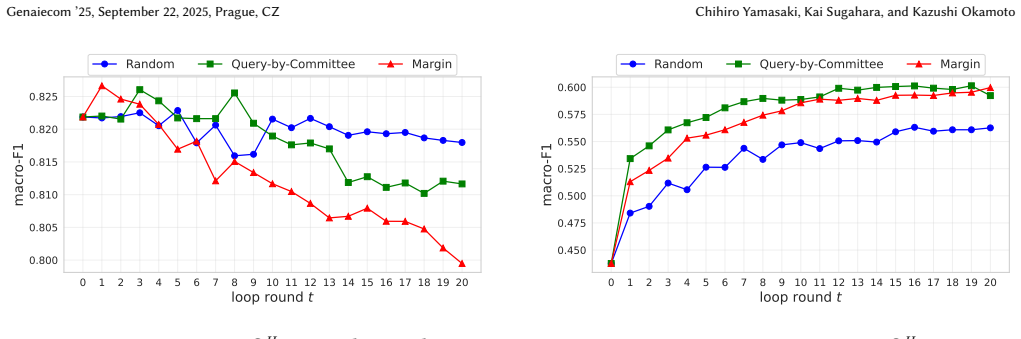
KARL's central empirical claim is that the value of LLM-expanded training data depends on whether the model already knows the item feature space. In the out-of-distribution setting, KARL's uncertainty-based variants improved macro-F1 by up to 37 percent over the baseline, reached a given accuracy in fewer rounds than random sampling, and peaked 6.6 percent higher than random sampling. In the in-distribution setting, the same procedure improved accuracy by at most 0.5 percent and then degraded it, with the degradation most severe for the uncertainty-based samplers. The paper shows a consistent positive correlation between the diversity of the training pairs and accuracy gain in the out-of-distribution case, and a flat or negative relationship in the in-distribution case, and concludes that diversity is a knowledge-expansion mechanism in unexplored feature spaces and a distribution-disruption mechanism in learned ones.
Load-bearing premise
The 37 percent OOD gain assumes that the LLM-labeled training pairs never include an out-of-distribution test pair; the paper does not state that its candidate pool excluded the 2,790 test pairs.
Editorial extensions
If this is right
- Out-of-distribution generalization of a complementary-recommendation classifier can be improved by up to 37 percent without new expert annotation, by adding LLM labels for the pairs the current model finds least certain.
- Uncertainty sampling is more cost-efficient than random sampling in unexplored item spaces: it reaches a given accuracy in fewer LLM-annotation rounds and ends at a higher peak accuracy.
- Running the same expansion loop on an already well-covered item space is counterproductive, so a deployment should stop adding LLM-labeled pairs once in-distribution accuracy peaks.
- The positive diversity–accuracy correlation in the OOD setting indicates that data diversity itself, not simply more data, carries the generalization gain.
- The baseline classifier's 0.44 OOD macro-F1 shows that a model trained on one curated category set cannot be assumed to transfer to new item features without knowledge augmentation.
Reading between the lines
- A dual-mode policy could automate the ID/OOD distinction: estimate distribution shift from classifier confidence or feature-space distance and invoke the LLM expansion loop only outside the learned region, the adaptive strategy the paper sketches as future work.
- Because diversity, not uncertainty, was the measured driver of OOD gains, an explicit diversity-maximizing sampler such as farthest-point selection in feature space is a natural alternative to uncertainty sampling that could be tested on the same two datasets.
- The three-consistency label gate could be supplemented with a small human audit on newly added categories, turning the LLM's self-agreement into measured agreement against expert labels.
- Before the 37 percent figure is adopted as a benchmark, a split audit should verify that no LLM-labeled training pair coincides with an out-of-distribution test pair; the paper does not report that exclusion.
Signed reviews
Editorial analysis
A structured set of objections, weighed in public.
Referee Report
Summary. The paper proposes KARL, a framework that iteratively expands a small human-annotated function-based-label (FBL) dataset by selecting uncertain item pairs via active learning, labeling them with GPT-4o-mini under a three-way consistency protocol, and retraining a bagged logistic-regression classifier on the augmented data. The authors evaluate KARL on two real-world e-commerce datasets: in-distribution (ID) accuracy via nested cross-validation on the human-annotated set D_H_id, and out-of-distribution (OOD) accuracy by training on D_H_id and testing on D_H_ood. They report marginal ID gains (below 0.5% macro-F1) with eventual degradation, and OOD gains of up to 37% macro-F1, with uncertainty-based sampling (QBC, Margin) outperforming random sampling. They attribute the contrast to training-data diversity, analyzed via scatter plots of diversity gain versus accuracy gain.
Significance. If the empirical claims are sound, the paper makes a useful practical contribution: it shows a relatively cheap LLM-based active-learning loop can substantially improve complementary-relation classification in an unfamiliar item feature space, while also documenting an important failure mode in ID settings. The public FBL datasets and the comparison of three sampling strategies are strengths, and the OOD/ID contrast is a falsifiable and interesting finding. However, the central OOD claim rests on data-hygiene assumptions that are not verified, and the supporting analyses lack statistical safeguards. The significance is therefore conditional on a clean re-evaluation.
major comments (4)
- [Section 3, Step 1; Section 4.1] The OOD evaluation is not shown to be leak-free, and this is load-bearing for the 37% improvement claim. Section 3 defines P_U as all possible unlabeled item pairs within the same categories, and Section 4.1 states that P_U consists of item pairs from the same e-commerce source as the FBL datasets. D_H_ood was built by sampling one query item per fine-grained category and pairing it with another item based on BBLs, which is exactly the kind of category-bounded pairing used to construct the candidate pool in Step 1. The paper never states that the 2,790 D_H_ood pairs are removed from P_U before uncertainty sampling. If any LLM-labeled pair coincides with a test pair, the OOD macro-F1 gain is inflated by direct label leakage. The same concern applies to the ID nested-cross-validation folds: P_U could contain D_H_id test-fold pairs, although the observed ID degradation makes large-scale contamination there less plausible. The authors must explicitly state and enforce disjointness of P_U from all test pairs, and rerun the experiments if the exclusion was not already in place.
- [Section 3, Step 3; Section 4.1] The quality of LLM labels on the actively selected uncertain pairs is not validated against human ground truth. Step 3 adopts only pairs for which three independent LLM labels agree; this is a self-consistency check, not a correctness check. The prior validation of GPT-4o-mini as an FBL annotator cited from [32] was performed on a different sample and does not cover the low-confidence, decision-boundary pairs that KARL actively selects. Because these are precisely the pairs on which the classifier is most uncertain, the LLM may be least reliable there. The paper should report agreement between LLM labels and human labels on a held-out subset of the actively selected pairs, or otherwise quantify the label-error rate. Without this, the claim that KARL 'augments knowledge' rather than injecting biased labels is not fully supported.
- [Section 4.4, Figures 4 and 5] The diversity-accuracy analysis does not provide the statistical support needed for the paper's causal narrative. The text states that OOD diversity gain exhibits a 'strong and consistent positive correlation' and that ID diversity is 'counterproductive', but no correlation coefficients, confidence intervals, or significance tests are reported. Moreover, the 200 points in each panel are not independent: they arise from five outer folds, twenty loop rounds, and ten bagging models, so a naive Pearson correlation over all points would overstate evidence. A hierarchical or blocked analysis is needed to account for this dependence. The authors should report effect sizes with intervals and, ideally, a test of whether the ID and OOD slopes differ.
- [Figures 2 and 3; Section 4.2-4.3] The main experimental figures report single averaged curves without error bars or repeated-run variance. Random sampling and bagging with random undersampling are stochastic, and the claimed 'up to 37%' improvement and the relative ordering of QBC/Margin versus Random could change across seeds. The paper should report means and standard deviations over multiple independent runs, or at least include confidence bands for the macro-F1 curves. This is particularly important because the central message is the size of the OOD gain and the ID degradation, not just the sign of the effect.
minor comments (6)
- [Abstract] The phrase 'with prolonged learning could degrade accuracy' is grammatically incomplete; it should be rephrased, for example as 'and prolonged learning degraded accuracy'.
- [Section 4.2] The sentence 'ambiguous samples from uncertainty sampling acted as “noise” that disrupted the model’s stable distribution of the model' contains a duplicated phrase; remove 'of the model'.
- [Section 4.3] The comparison 'final accuracy achieved by the uncertainty-based methods was up to 6.6% higher than that of Random' should state whether this is an absolute or relative difference in macro-F1.
- [Section 4.4] The text says the diversity gain produces an improvement 'of up to approximately 50%', while the abstract reports up to 37% in OOD macro-F1. These numbers should be reconciled or the different metrics explicitly distinguished.
- [Section 3, Step 1] The number of pairs added per active-learning round is not stated precisely; Step 2 selects one pair per fine-grained category, but the actual number of categories with available candidates is not reported. This makes the total annotation cost difficult to assess.
- [Section 4.1] The notation for the diversity metric writes rho as R^d x R^d -> [-1,1], but the formula applies rho to pairs of feature vectors within the sample; the domain/signature should be clarified.
Circularity Check
No circular derivation: KARL's accuracy claims are anchored to human-annotated held-out test sets, while the unstated OOD-test/P_U disjointness is a leakage risk rather than a circular step.
full rationale
The paper is an empirical active-learning study; there is no derivation chain in which a predicted quantity is defined from a fitted quantity. The classifier is trained on human-annotated FBL pairs (D_H_id, D_H_ood) plus LLM-annotated pairs from P_U, and accuracy is measured on held-out human labels using nested 5-fold cross-validation for ID and a separate human-annotated OOD set. These are external ground truths, not re-statements of the model's own scores. The self-cited prior works [24,32] supply the FBL taxonomy, datasets, and LLM prompt; the prompt is reused as a procedure, and the dataset labels are human annotations, so under the external-evidence rule these citations are real support and do not make the central OOD/ID comparison circular. The only substantive threat is data hygiene: Section 4.1 defines P_U as item pairs from the same categories and source as the FBL datasets and never states that the 2,790 OOD test pairs are excluded from P_U, so uncertainty sampling could in principle select a test pair for LLM labeling and leak it into training. That is a leakage/correctness risk to quantify, not a circularity of the kind where Eq. X reduces to Eq. Y or a fitted parameter is renamed a prediction. No circular step meeting the evidentiary bar was found.
Assumptions & free parameters
free parameters (3)
- active learning rounds =
20
- pairs labeled per round =
up to 1 per fine-grained category per round
- LLM agreement threshold =
3 identical independent labels
assumptions (4)
- domain assumption Human-annotated FBLs (D_H_id, D_H_ood) are accurate ground truth.
- domain assumption GPT-4o-mini labels are reliable for the expanded pairs under the three-way agreement protocol.
- domain assumption The 424-dimensional content-based feature vector captures relationship-relevant information across ID and OOD items.
- domain assumption The unlabeled pair pool P_U is representative of the OOD feature space and disjoint from the test set.
Cite this review
Pith. "Pith review of Knowledge-Augmented Relation Learning for Complementary Recommendation with Large Language Models." pith.science (2026). https://pith.science/paper/ACU5F6PG
@misc{pith2026250905564,
  author       = {Pith},
  title        = {Pith review of: Knowledge-Augmented Relation Learning for Complementary Recommendation with Large Language Models},
  year         = {2026},
  howpublished = {\url{https://pith.science/paper/ACU5F6PG}},
  note         = {Machine review of arXiv:2509.05564}
}
read the original abstract
Complementary recommendations play a crucial role in e-commerce by enhancing user experience through suggestions of compatible items. Accurate classification of complementary item relationships requires reliable labels, but their creation presents a dilemma. Behavior-based labels are widely used because they can be easily generated from interaction logs; however, they often contain significant noise and lack reliability. While function-based labels (FBLs) provide high-quality definitions of complementary relationships by carefully articulating them based on item functions, their reliance on costly manual annotation severely limits a model's ability to generalize to diverse items. To resolve this trade-off, we propose Knowledge-Augmented Relation Learning (KARL), a framework that strategically fuses active learning with large language models (LLMs). KARL efficiently expands a high-quality FBL dataset at a low cost by selectively sampling data points that the classifier finds the most difficult and uses the label extension of the LLM. Our experiments showed that in out-of-distribution (OOD) settings, an unexplored item feature space, KARL improved the baseline accuracy by up to 37%. In contrast, in in-distribution (ID) settings, the learned item feature space, the improvement was less than 0.5%, with prolonged learning could degrade accuracy. These contrasting results are due to the data diversity driven by KARL's knowledge expansion, suggesting the need for a dynamic sampling strategy that adjusts diversity based on the prediction context (ID or OOD).
Figures


Figures from the paper (1 more)

Reference graph
Works this paper leans on
-
[32]
C. Yamasaki, K. Sugahara, Y. Nagi, and K. Okamoto. 2025. Function-based Labels for Complementary Recommendation: Definition, Annotation, and LLM-as-a- Judge. arXiv:2507.03945 [cs.IR]
- [1]
- [2]
-
[3]
L. Breiman. 1996. Bagging Predictors.Mach. Learn.24 (1996), 123–140. doi:10. 1007/BF00058655
work page 1996
-
[4]
K. Brinker. 2003. Incorporating Diversity in Active Learning with Support Vector Machines. InProc. 20th Int. Conf. Int. Conf. Mach. Learn.59–66
work page 2003
-
[5]
H. Chen, J. He, W. Xu, T. Feng, M. Liu, T. Song, R. Yao, and Y. Qiao. 2023. Enhanced Multi-Relationships Integration Graph Convolutional Network for Inferring Substitutable and Complementary Items.Proc. AAAI Conf. Artif. Intell.37, 4 (2023), 4157–4165. doi:10.1609/aaai.v37i4.25532
-
[6]
Y. Cui, F. Liu, P. Wang, B. Wang, H. Tang, Y. Wan, J. Wang, and J. Chen. 2024. Distillation Matters: Empowering Sequential Recommenders to Match the Perfor- mance of Large Language Models. InProc. 18th ACM Conf. Recommender Systems. 507–517. doi:10.1145/3640457.3688118
arXiv 2024
-
[8]
P. Filzmoser, B. Liebmann, and K. Varmuza. 2009. Repeated Double Cross Valida- tion.J. Chemom.23, 160–171. Issue 4
work page 2009
Show all 34 references
-
[9]
J. Hao, T. Zhao, J. Li, X. L. Dong, C. Faloutsos, Y. Sun, and W. Wang. 2020. P- Companion: A Principled Framework for Diversified Complementary Product Recommendation. InProc. 29th ACM Int. Conf. Inf. Knowl. Manag.2517–2524. doi:10.1145/3340531.3412732
2020
-
[10]
A. Hein, S. Röhrl, T. Grobel, M. Lengl, N. Hafez, M. Knopp, C. Klenk, D. Heim, O. Hayden, and K. Diepold. 2022. A Comparison of Uncertainty Quantification Methods for Active Learning in Image Classification. InProc. 2022 Int. Jt. Conf. Neural Netw.1–8. doi:10.1109/IJCNN55064.2...
2022
-
[11]
Kholodna, S
N. Kholodna, S. Julka, M. Khodadadi, M. N. Gumus, and M. Granitzer. 2024. LLMs in the Loop: Leveraging Large Language Model Annotations for Active Learning in Low-Resource Languages. InProc. Mach. Learn. Knowl Discov. Databases Appl. Data Sci. Track: Eur. Conf., ECML PKDD 2024...
2024 doi
-
[12]
Li and Z
L. Li and Z. Du. 2024. Complementary Recommendation in E-commerce: Defini- tion, Approaches, and Future Directions. arXiv:2403.16135 [cs.IR]
2024 arXiv
-
[13]
Z. Li, Y. Liang, M. Wang, S. Yoon, J. Shi, X. Shen, X. He, C. Zhang, W. Wu, H. Wang, J. Li, J. Chan, and Y. Zhang. 2024. ECCR: Explainable and Coherent Complement Recommendation Based on Large Language Models. InProc. KDD 2024 Workshop Gener. AI Recomm. Syst. Pers
2024
-
[14]
H. Luo, X. Meng, S. Wang, H. Cao, W. Zhang, Y. Wang, and Y. Zhang. 2024. Spectral-Based Graph Neural Networks for Complementary Item Recommenda- tion. arXiv:2401.02130 [cs.IR]
2024 arXiv
-
[15]
L. Ma, J. Xu, J. H.D. Cho, E. Korpeoglu, S. Kumar, and K. Achan. 2021. NEAT: A Label Noise-resistant Complementary Item Recommender System with Trust- worthy Evaluation. InProc. 2021 IEEE Int. Conf. Big Data. 469–479. doi:10.1109/ BigData52589.2021.9671870
2021
-
[16]
McAuley, R
J. McAuley, R. Pandey, and J. Leskovec. 2015. Inferring Networks of Substitutable and Complementary Products. InProc. 21th ACM SIGKDD Int. Conf. Knowl. Discov. Data Min.785–794. doi:10.1145/2783258.2783381
2015
-
[17]
Mosqueira-Rey, E
E. Mosqueira-Rey, E. Hernández-Pereira, D. Alonso-Ríos, J. Bobes-Bascarán, and Á. Fernández-Leal. 2023. Human-in-the-loop Machine Learning: a State of the Art.Artif. Intell. Rev.56 (2023), 3005–3054
2023
-
[18]
Hurst, A
OpenAI, A. Hurst, A. Lerer, A. P. Goucher, A. Perelman, A. Ramesh, A. Clark, A. Ostrow, A. Welihinda, A. Hayes, et al . 2024. GPT-4o System Card. arXiv:2410.21276 [cs.CL]
2024 arXiv
-
[19]
Pangakis, S
N. Pangakis, S. Wolken, and N. Fasching. 2023. Automated Annotation with Generative AI Requires Validation. arXiv:2306.00176 [cs.IR]
2023 arXiv
-
[20]
R. Papso. 2023. Complementary Product Recommendation for Long-tail Products. InProc. 17th ACM Conf. Recomm. Syst.1305–1311. doi:10.1145/3604915.3608864
2023
-
[21]
Scheffer, C
T. Scheffer, C. Decomain, and S Wrobel. 2001. Active Hidden Markov Models for Information Extraction.Adv. Intell. Data Anal.(2001), 309–318. doi:10.1007/3- 540-44816-0_31
2001 doi
-
[22]
2009.Active Learning Literature Survey
Burr Settles. 2009.Active Learning Literature Survey. Technical Report. University of Wisconsin-Madison
2009
-
[23]
H. S. Seung, M. Opper, and H. Sompolinsky. 1992. Query by committee. InProc. 5th Annu. Workshop Comput. Learn. Theory. 287–294. doi:10.1145/130385.130417
1992
-
[24]
Sugahara, C
K. Sugahara, C. Yamasaki, and K. Okamoto. 2024. Is It Really Complementary? Revisiting Behavior-based Labels for Complementary Recommendation. InProc. 18th ACM Conf. Recomm. Syst.1091–1095. doi:10.1145/3640457.3691705
2024
-
[25]
Tharwat and W
A. Tharwat and W. Schenck. 2023. A Survey on Active Learning: State-of- the-Art, Practical Challenges and Research Directions.Math.11, 4 (2023), 820. doi:10.3390/math11040820
2023 doi
-
[26]
Tong and D
S. Tong and D. Koller. 2002. Support vector machine active learning with appli- cations to text classification.J. Mach. Learn. Res.2 (2002), 45–66. doi:10.1162/ 153244302760185243
2002
-
[27]
Tseng, J
C. Tseng, J. Song, Z. Bi, T. Wang, C. X. Liang, and M. Liu. 2025. Active Learning Methods for Efficient Data Utilization and Model Performance Enhancement. arXiv:2504.16136 [cs.LG]
2025
-
[28]
Z. Wang, Z. Jiang, Z. Ren, J. Tang, and D. Yin. 2018. A Path-Constrained Framework for Discriminating Substitutable and Complementary Products in E-Commerce. InProc. 11th ACM Int. Conf. Web Search Data Min.619–627. doi:10.1145/3159652.3159710
2018
-
[29]
Y. Xia, S. Mukherjee, Z. Xie, J. Wu, X. Li, R. Aponte, H. Lyu, J. Barrow, H. Chen, F. Dernoncourt, et al. 2025. From Selection to Generation: A Survey of LLM-based Active Learning. arXiv:2502.11767 [cs.LG]
2025 arXiv
-
[30]
R. Xiao, Y. Dong, J. Zhao, R. Wu, M. Lin, G. Chen, and H. Wang. 2023. FreeAL: Towards Human-Free Active Learning in the Era of Large Language Models. In Proc. 2023 Conf. Empir. Method. Nat. Lang. Process.14520–14535. doi:10.18653/v1/ 2023.emnlp-main.896
2023 doi
-
[31]
D. Xu, C. Ruan, J. Cho, E. Korpeoglu, S. Kumar, and K. Achan. 2020. Knowledge- Aware Complementary Product Representation Learning. InProc. 13th Int. Conf. Web Search Data Min.681–689. doi:10.1145/3336191.3371854
2020
-
[33]
Zhang, Y
R. Zhang, Y. Li, Y. Ma, M. Zhou, and L. Zou. 2023. LLMaAA: Making Large Language Models as Active Annotators. InProc. 2023 Conf. Empir. Method. Nat. Lang. Process.13088–13103. doi:10.18653/v1/2023.findings-emnlp.872
2023 doi
-
[34]
Zhang, H
Y. Zhang, H. Lu, W. Niu, and J. Caverlee. 2018. Quality-aware Neural Comple- mentary Item Recommendation. InProc. 12th ACM Conf. Recomm. Syst.77–85. doi:10.1145/3240323.3240368
2018
-
[2023]
doi:10.1145/3543507.3583462
1804–1812. doi:10.1145/3543507.3583462
Reviewed August 15, 2026 · model on record in the stance chip above.
Discussion (0). Continue with ORCID to comment.