REVIEW 4 major objections 4 minor 75 references
A set of distinctive properties ruling the prompt emission of GRB 230307A and other long {\gamma}-ray bursts from compact object mergers
T0 review · 4 major / 4 minor · reviewed 2026-08-15 · deepseek-v4-flash
Pith's one-line read GRB 230307A's gamma-ray pulses follow a four-way exponential clock that identifies compact-object mergers.
desk verdict A genuinely novel multi-property pulse-train analysis of GRB 230307A, but the waiting-time and FWHM trends need a detection-completeness check before the merger-fingerprint claim is secure. read the letter →
The pith
A machine-rendered reading of the paper's core claim, the machinery that carries it, and where it could break.
The reading
What carries the argument
The load-bearing machinery is, first, the mepsa peak-search algorithm, which detects about one hundred pulses in a 5 ms-binned light curve at signal-to-noise ratio at least 5 and returns peak times, amplitudes, and FWHMs; second, the four exponential fits (Eqs. 1–4) that unify peak rate, waiting time, duration, and spectral energy under one clock; third, a toy model in which $N_0\simeq1000$ independently decaying energy bunches with a common mean lifetime $\tau$ produce an exponentially decaying rate of pulses and, through the relation $\langle\Delta t\rangle=\tau e^{t/\tau}/N_0$, the growing waiting times; and fourth, two kinematic shell-collision models in which fast shells hit a slower target shell at radius $R_{c,i}$, so that observed waiting times inherit the exponential emission-time distribution while pulse widths grow linearly or more strongly, with the collision kinematics of Eqs. (8)–(13) governing the transformation. A genetic algorithm optimizes the free parameters against four loss functions that compare simulated and observed envelopes, peak-time distributions, peak counts, and FWHM distributions.
What would settle it
Run the same mepsa pipeline on synthetic light curves built from a stationary Poisson process with constant waiting times and constant pulse widths, scaled to match GRB 230307A's declining peak rates; if the recovered waiting times and FWHMs then grow exponentially with time, the reported trends are an artifact of faint-pulse incompleteness rather than an intrinsic property. Alternatively, re-fit the trends using only pulses with S/N≥10 and check whether the exponential growth in $\Delta t$ and FWHM persists.
Extended reading notes
Core claim
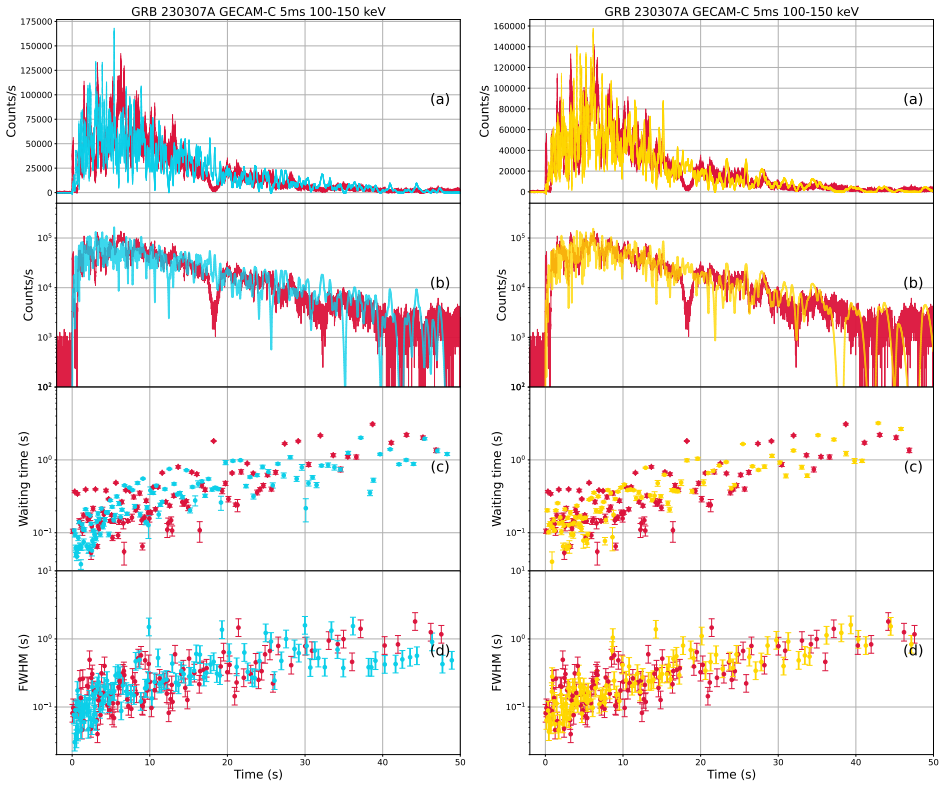
The paper's central discovery is that the roughly one hundred resolved pulses in the GECAM 100–150 keV light curve of GRB 230307A are not arranged at random: from about 10 seconds onward the peak count rate follows $P(t)=P_0 e^{-t/\tau_p}$ with $\tau_p=10.7\pm0.4$ s; adjacent-pulse waiting times grow as $\Delta t=0.14\ e^{t/15.8}$ s; pulse FWHMs grow as $0.12\ e^{t/18.6}$ s, with an exponential fit preferred over a linear one; and the $\nu F_\nu$ spectral peak energy falls as $E_p\simeq 1940\ e^{-t/16.2}$ keV. These four trends are reproduced in GRB 211211A on timescales near 20 seconds and, more loosely, in GRB 060614, while none of the six supernova-associated long GRBs examined, nor GRB 221009A, shows the joint pattern. The authors read the pattern as evidence that the dissipation happens in a succession of shocks at increasing radii, as a train of fast shells collides with a slower, expanding target shell, possibly merger dynamical ejecta, rather than at random locations within the jet, and they show that simple constant- and declining-Lorentz-factor shell models plus the energy-bunch toy model can reproduce the light curve's envelope, peak times, peak counts, and FWHM distribution.
Load-bearing premise
The reported growth of waiting times and pulse widths assumes the peak-finding routine detects faint late pulses as reliably as bright early ones; missing late pulses would by itself create an apparent exponential growth even in a burst whose underlying pulse clock never changes.
Editorial extensions
If this is right
- Long GRBs of merger origin can in principle be classified from their prompt gamma-ray light curves alone, without waiting for kilonova or supernova detections.
- A joint exponential evolution of waiting time, pulse width, peak rate, and spectral energy becomes a discriminator to apply to ambiguous events such as GRB 200826A.
- In these bursts, emission must come from collisions at progressively larger radii, so the standard internal-shock prediction of no systematic timescale evolution is violated for this class.
- The toy model implies each visible pulse is a blend of about ten fainter underlying shots, so apparent pulse counts under-resolve the engine's true activity by about an order of magnitude.
- A slow, more massive target shell, possibly dynamical merger ejecta, can produce collisions above the photosphere and avoid the compactness problem for the fitted parameters.
Reading between the lines
- The trends as measured could be partly a selection effect: since late pulses are fainter, mepsa's S/N≥5 threshold may miss a growing fraction of them, lengthening apparent waiting times and broadening measured pulses; the paper does not quantify detection completeness versus time, so an injection-recovery test on synthetic light curves is the natural next check.
- If the pattern is robust, a direct extension is to search for the same exponential clock in the extended emission of short GRBs with extended emission and in merger X-ray flares, which would test whether the target-shell interpretation holds beyond prompt gamma-rays.
- The declining-Lorentz-factor model predicts that pulse broadening and spectral softening share a single cause; time-resolved spectroscopy of individual late pulses in future bright merger bursts could test whether the per-pulse hardness tracks the $\Gamma(t)$ decay.
- A population-level consequence: if Type IL bursts are a genuine class, their occurrence rate among long GRBs could be estimated by scanning archived Fermi/GBM and Swift/BAT light curves for the same joint exponential signature.
Signed reviews
Editorial analysis
A structured set of objections, weighed in public.
Referee Report
Summary. The paper analyzes GECAM observations of GRB 230307A and reports that the sequence of gamma-ray pulses follows simultaneous exponential trends: peak rates decay as P(t) ~ P0 exp(-t/tau_p) (Eq. 1), waiting times grow as Delta t ~ Delta t0 exp(t/tau_Delta t) (Eq. 2), pulse FWHMs grow as FWHM(t) ~ FWHM0 exp(t/tau_F) (Eq. 3), and the spectral peak energy decays as Ep(t) ~ 1940 keV exp(-t/tau_E) (Eq. 4). It further claims that similar trends appear in other long compact-object-merger candidates (GRB 211211A, GRB 060614) and are absent in a small sample of supernova-associated long GRBs, suggesting that these properties are distinctive merger indicators. The authors propose a toy model and two physical shell-collision models, optimized with a genetic algorithm, to reproduce the observed light curve and its temporal properties.
Significance. If the reported exponential trends are intrinsic, this would be a valuable and observationally distinctive signature for identifying long gamma-ray bursts of compact-object-merger origin, and it would challenge the standard internal-shock interpretation for this class. The paper benefits from a rare, high-quality single-burst dataset with about 100 detected peaks, a clearly stated detection pipeline, and an explicit comparison against supernova-associated bursts. The toy and physical models make falsifiable predictions about light-curve structure and spectral evolution. However, the significance is currently conditional on demonstrating that the trends are not artifacts of time-dependent detection completeness and on providing independent validation of the model assumptions.
major comments (4)
- [Section 3, Eqs. (1)-(3); Section 2] The exponential growth of waiting times and FWHMs may be largely a detection-threshold artifact. Equation (1) shows that peak rates decay by roughly a factor of 100 by t = 50 s, while the S/N >= 5 threshold of mepsa corresponds to an approximately constant absolute amplitude. Late, faint pulses are therefore increasingly missed; a missed pulse merges two adjacent waiting times into one artificially long interval, and the surviving detected pulses are biased toward the broadest and brightest ones. The paper's own toy model requires N0 ~ 862 intrinsic peaks versus ~103 detected peaks (Section 3.4.1 and Table 1), i.e., roughly 88% incompleteness, but the genetic-algorithm loss functions in Appendix A fit the observed, selection-biased distributions. No injection-recovery completeness function and no null simulation with constant intrinsic rate and constant widths under the same mepsa threshold are presented. Without such a control, the fitted exponential trends in Eqs. (2) and (3) cannot be distinguished from completeness effects, which directly undermines the central empirical claim.
- [Section 3.1 and Appendix A] The toy model's ability to reproduce the observed light curve is not an independent validation of the exponential trends, because those trends are put into the model by construction. The peak times are sampled from an exponential distribution, the FWHMs are forced to follow Eq. (3), and the peak rates are computed from Eq. (7) using the same FWHM evolution. The GA loss functions then compare the simulated peak-time distribution, FWHM distribution, and number of peaks with the observed ones. The agreement shown in Figures 3 and A.9 therefore follows directly from the model assumptions and cannot be used as evidence that the trends are intrinsic. A null model comparison, for example a stationary Poisson process with constant widths and no trend, analyzed with the identical pipeline, is required before the toy model can be said to support the empirical claim.
- [Section 3.6 and Appendices B, C] The comparison between the merger candidates and the supernova-associated bursts is not controlled for detection completeness or matched in statistical power. The WT exponential timescale for GRB 060614, tau = 125(+291,-56) s in Table B.4, is essentially unconstrained, and the SN-GRB sample has only six bursts, several with Np = 11-16 detected peaks (Table C.5). The absence of a trend in these bursts may reflect smaller peak numbers or different S/N distributions rather than a genuinely different physical mechanism. A completeness-corrected, matched comparison in terms of peak count, S/N threshold, and burst duration is needed to support the proposed discriminant.
- [Section 3, Eq. (4); Figure 1(e)] The peak-energy trend is fit only for t > 10 s and uses Ep values taken from Moradi et al. (2024), a different spectral analysis, rather than from the same GECAM data used for the temporal properties. The dashed extension of the exponential fit to earlier times in Figure 1(e) is therefore an extrapolation whose validity is not demonstrated. The paper should clarify whether the Ep evolution is robust within the same time window used for the other trends and whether the choice of the t > 10 s window is motivated by data quality rather than by the desired fit result.
minor comments (4)
- [Section 3.4.1 and Table 1] The text states that the intrinsic number of energy bunches is 'about ten times higher than the number of mepsa-detected peaks (1000 vs 100)', but Table 1 reports N0 = 862(+1,-25). Please make the reported value consistent with the table.
- [Figure 1 and other figures] Several axis labels appear as '10 1' where '10^{-1}' is presumably intended (e.g., panels (c)-(e) of Figure 1 and similar panels in later figures). Please check the typesetting of all logarithmic axis labels.
- [Section 3 and Figure 2] The comparison between the exponential and linear FWHM fits reports chi2 values of 99.6 and 134 for the same number of degrees of freedom, but the fitted intrinsic scatter is treated differently in the two models. A quantitative model-selection criterion such as AIC or a likelihood-ratio test would make the preference for the exponential model more transparent.
- [Table B.4] The quoted uncertainty 'tau_F = 18.6+3.2+2.5 s' appears to be a typographical error; it should presumably read '+3.2/-2.5 s' or '+2.5/-3.2 s' as appropriate.
Circularity Check
Toy-model reproduction of the exponential WT/FWHM/peak-rate trends is built into its input assumptions, making the agreement in Figs. 3-4 a consistency check rather than validation; the central empirical claim rests on mepsa detections with unquantified time-dependent completeness.
-
fitted input called prediction
[Section 3.1 (Eqs. 3, 6, 7) and Appendix A loss functions]
"“N0 peak times are sampled from an exponential distribution with e-folding time τ, in agreement with Eq. (5); pulse FWHMs are calculated assuming Eq. (3), where FWHM0 and τF are treated as free parameters” (Sec. 3.1); “the peak rate P of a given pulse is calculated by dividing the counts by the corresponding FWHM: this choice is corroborated by the fact that τp of Eq. (1) is not wildly different from τF of Eq. (3).”"
The toy model is constructed from the very trends it then displays: exponential peak-time sampling gives the exponential waiting-time law ⟨Δt⟩=τ/N0 e^{t/τ} (Eq. 6); FWHM(t) is imposed via Eq. (3); Eq. (7) makes P(tp)∝exp(-tp/τF). The GA loss in Appendix A explicitly fits the simulated peak-time and FWHM distributions to the mepsa-detected observed ones. The agreement shown in Figs. 3(c)-(d) and 4 therefore verifies consistency of inputs, not an independent derivation of Eqs. (2)-(3). The fitted distributions also inherit the S/N≥5 selection bias (the paper states N0≈862 vs ~103 detected peaks), so the model cannot distinguish intrinsic exponential trends from threshold-induced apparent ones.
full rationale
The empirical discovery (Eqs. 1-4) is a direct fit to GECAM data and is not, by itself, circular: the exponential forms are fitted to measured peak rates, waiting times, FWHMs, and Ep. The circularity enters when the Section 3.1 toy model, whose assumptions already include an exponential peak-time distribution and an exponential FWHM law, is presented as 'faithfully reproducing' the observed WT and FWHM evolution; that reproduction is by construction (Eqs. 3, 6, 7). The paper is appropriately tentative about the toy and physical models, but the validation language overstates what the model can show. Self-citations (mepsa/Guidorzi 2015, Camisasca et al. 2023a, Moradi et al. 2024, Wang et al. 2025, Tan et al. 2025) are used as tools or prior data and are not the load-bearing derivation of the main trends, so they do not add circularity. A separate, non-circular but serious risk is that the fixed S/N≥5 detection threshold on a burst whose peak rates decay by ~100 over 50 s may progressively miss faint peaks, artificially lengthening measured waiting times and biasing FWHMs upward; the paper reports no time-dependent completeness correction or null simulation. This risk is a correctness concern rather than a demonstrated circularity, but it compounds the toy-model issue because the GA fits the same selection-biased distributions. Overall, partial circularity in the model-validation step, while the central empirical claim retains independent content.
Assumptions & free parameters
free parameters (7)
- P0 and tau_p (peak-rate exponential fit) =
P0 = (1.64 +/- 0.12) x 1e5 cts/s, tau_p = 10.7 +/- 0.4 s
- Delta t0 and tau_Delta t (waiting-time exponential fit) =
Delta t0 = 0.14 +/- 0.02 s, tau_Delta t ~ 15.8 s
- FWHM0 and tau_F (FWHM exponential fit) =
FWHM0 = 0.12 +/- 0.01 s, tau_F = 18.6 +/- 1.7 s (also linear fit: slope 0.010 +/- 0.001)
- Ep normalization and tau_E (peak-energy exponential fit) =
1940 +/- 150 keV, tau_E = 16.2 +/- 0.9 s
- N0, tau, FWHM0, tau_F, tau_r, Ncts (toy model) =
N0 = 862, tau = 10.9 s, FWHM0 = 0.05 s, tau_F = 14.0 s, tau_r = 2.5 s, Ncts = 1449
- R0, Gamma, Gamma_s (physical model 1, constant Gamma) =
R0 = 9.1 x 1e10 cm, Gamma = 94, Gamma_s = 8.6
- R0, Gamma0, Gamma_s, tau_Gamma (physical model 2, declining Gamma) =
R0 = 1.4 x 1e11 cm, Gamma0 = 339, Gamma_s = 26.2, tau_Gamma = 96 s
assumptions (5)
- domain assumption The analytical fits (Eqs. 1-4) use a D'Agostini likelihood with an extra dispersion term sigma for WT and FWHM fits.
- domain assumption mepsa peak detection with S/N >= 5 identifies essentially all physical pulses and does not preferentially miss faint late pulses.
- domain assumption The merger-origin classification of GRB 211211A and GRB 060614 is accepted from cited literature.
- domain assumption The Ep time series from Moradi et al. 2024 is consistent with the GECAM 100-150 keV pulse analysis used for the other three properties.
- ad hoc to paper Dynamical ejecta from a neutron star merger can form a target shell moving relativistically enough to produce the proposed collision sequence.
invented entities (1)
-
Slowly expanding relativistic target shell (the collision partner for the fast shells)
Cite this review
Pith. "Pith review of A set of distinctive properties ruling the prompt emission of GRB 230307A and other long {\gamma}-ray bursts from compact object mergers." pith.science (2026). https://pith.science/paper/ML4RDALC
@misc{pith2026250905628,
  author       = {Pith},
  title        = {Pith review of: A set of distinctive properties ruling the prompt emission of GRB 230307A and other long \gamma-ray bursts from compact object mergers},
  year         = {2026},
  howpublished = {\url{https://pith.science/paper/ML4RDALC}},
  note         = {Machine review of arXiv:2509.05628}
}
read the original abstract
Short gamma-ray bursts (SGRBs), occasionally followed by a long and spectrally soft extended emission, are associated with compact object mergers (COMs). Yet, a few recent long GRBs (LGRBs) show compelling evidence for a COM origin, in contrast with the massive-star core-collapse origin of most LGRBs. While possible COM indicators were found, such as the minimum variability timescale (MVT), a detailed and unique characterisation of their gamma-ray prompt emission that may help identify and explain their deceptively long profile is yet to be found. Here we report the discovery of a set of distinctive properties that rule the temporal and spectral evolution of GRB 230307A, a LGRB with evidence for a COM origin. Specifically, the sequence of pulses that make up its profile is characterised by an exponential evolution of (i) flux intensities, (ii) waiting times between adjacent pulses, (iii) pulse durations, and (iv) spectral peak energy. Analogous patterns are observed in the prompt emission of other long COM candidates. The observed evolution of gamma-ray pulses would imply that a relativistic jet is colliding with more slowly expanding material. This contrasts with the standard internal shock model for typical LGRBs, in which dissipation occurs at random locations within the jet itself. We tentatively propose a few simple toy models that may explain these properties and are able to reproduce the overall time profile.
Figures


Figures from the paper (4 more)


Reference graph
Works this paper leans on
-
[1]
write newline
" write newline "" before.all 'output.state := FUNCTION n.dashify 't := "" t empty not t #1 #1 substring "-" = t #1 #2 substring "--" = not "--" * t #2 global.max substring 't := t #1 #1 substring "-" = "-" * t #2 global.max substring 't := while if t #1 #1 substring * t #2 global.max substring 't := if while FUNCTION word.in bbl.in ":" * " " * FUNCTION f...
-
[2]
, author Singer , L.P
author Ahumada , T. , author Singer , L.P. , author Anand , S. , author Coughlin , M.W. , author Kasliwal , M.M. , author Ryan , G. , author Andreoni , I. , author Cenko , S.B. , author Fremling , C. , author Kumar , H. , author Pang , P.T.H. , author Burns , E. , author Cunningham , V. , author Dichiara , S. , author Dietrich , T. , author Svinkin , D.S....
2021
-
[3]
author Amati , L. , year 2006 . title The E _ p,i -E _ iso correlation in gamma-ray bursts: updated observational status, re-analysis and main implications . journal MNRAS volume 372 , pages 233--245 . :10.1111/j.1365-2966.2006.10840.x, http://arxiv.org/abs/arXiv:astro-ph/0601553 arXiv:arXiv:astro-ph/0601553
arXiv 2006
-
[4]
author Amati , L. , author Frontera , F. , author Tavani , M. , author in't Zand , J.J.M. , author Antonelli , A. , author Costa , E. , author Feroci , M. , author Guidorzi , C. , author Heise , J. , author Masetti , N. , author Montanari , E. , author Nicastro , L. , author Palazzi , E. , author Pian , E. , author Piro , L. , author Soffitta , P. , year ...
arXiv 2002
-
[5]
author Atteia , J.L. , author Cordier , B. , author Wei , J. , year 2022 . title The SVOM mission . journal International Journal of Modern Physics D volume 31 , pages 2230008 . :10.1142/S0218271822300087, http://arxiv.org/abs/2203.10962 arXiv:2203.10962
arXiv 2022
-
[6]
Long gamma-ray burst light curves as the result of a common stochastic pulse-avalanche process
author Bazzanini , L. , author Ferro , L. , author Guidorzi , C. , author Angora , G. , author Amati , L. , author Brescia , M. , author Bulla , M. , author Frontera , F. , author Maccary , R. , author Maistrello , M. , author Rosati , P. , author Tsvetkova , A. , year 2024 . title Long gamma-ray burst light curves as the result of a common stochastic pul...
work page Pith review arXiv 2024
-
[7]
author Bo s njak , Z . , author Daigne , F. , year 2014 . title Spectral evolution in gamma-ray bursts: Predictions of the internal shock model and comparison to observations . journal A&A volume 568 , pages A45 . :10.1051/0004-6361/201322341, http://arxiv.org/abs/1404.4577 arXiv:1404.4577
arXiv 2014
-
[8]
author Camisasca , A.E. , author Guidorzi , C. , author Amati , L. , author Frontera , F. , author Song , X.Y. , author Xiao , S. , author Xiong , S.L. , author Zhang , S.N. , author Margutti , R. , author Kobayashi , S. , author Mundell , C.G. , author Ge , M.Y. , author Gomboc , A. , author Jia , S.M. , author Jordana-Mitjans , N. , author Li , C.K. , a...
work page Pith review arXiv 2023
Show all 75 references
-
[9]
, author Guidorzi , C
author Camisasca , A.E. , author Guidorzi , C. , author Bulla , M. , author Amati , L. , author Rossi , A. , author Stratta , G. , author Singh , P. , year 2023 b. title GRB 230307A: short mininum variability timescale compatible with a merger origin . journal GRB Coordinates ...
2023
-
[10]
, year 2005
author D'Agostini , G. , year 2005 . title Fits, and especially linear fits, with errors on both axes, extra variance of the data points and other complications . journal ArXiv Physics e-prints http://arxiv.org/abs/physics/0511182 arXiv:physics/0511182
2005 arXiv
-
[11]
, author Guo , C.L
author Dai , C.Y. , author Guo , C.L. , author Zhang , H.M. , author Liu , R.Y. , author Wang , X.Y. , year 2024 . title Evidence for a Compact Stellar Merger Origin for GRB 230307A From Fermi-LAT and Multiwavelength Afterglow Observations . journal volume 962 , pages L37 . :1...
2024 arXiv
-
[12]
, author Mochkovitch , R
author Daigne , F. , author Mochkovitch , R. , year 1998 . title Gamma-ray bursts from internal shocks in a relativistic wind: temporal and spectral properties . journal MNRAS volume 296 , pages 275--286 . :10.1046/j.1365-8711.1998.01305.x, http://arxiv.org/abs/astro-ph/980124...
1998
-
[13]
, author Mochkovitch , R
author Daigne , F. , author Mochkovitch , R. , year 2002 . title The expected thermal precursors of gamma-ray bursts in the internal shock model . journal volume 336 , pages 1271--1280 . :10.1046/j.1365-8711.2002.05875.x, http://arxiv.org/abs/astro-ph/0207456 arXiv:astro-ph/0207456
2002
-
[14]
, author Chincarini , G
author Della Valle , M. , author Chincarini , G. , author Panagia , N. , author Tagliaferri , G. , author Malesani , D. , author Testa , V. , author Fugazza , D. , author Campana , S. , author Covino , S. , author Mangano , V. , author Antonelli , L.A. , author D'Avanzo , P. ,...
2006 arXiv
-
[15]
, year 2008
author Dermer , C.D. , year 2008 . title Nonthermal Synchrotron Radiation from Gamma-Ray Burst External Shocks and the X-Ray Flares Observed with Swift . journal volume 684 , pages 430--448 . :10.1086/589730, http://arxiv.org/abs/astro-ph/0703223 arXiv:astro-ph/0703223
2008 arXiv
-
[16]
, author B \"o ttcher , M
author Dermer , C.D. , author B \"o ttcher , M. , author Chiang , J. , year 1999 . title The External Shock Model of Gamma-Ray Bursts: Three Predictions and a Paradox Resolved . journal ApJ volume 515 , pages L49--L52 . :10.1086/311972, http://arxiv.org/abs/astro-ph/9902306 ar...
1999 arXiv
-
[17]
, author Tsang , D
author Dichiara , S. , author Tsang , D. , author Troja , E. , author Neill , D. , author Norris , J.P. , author Yang , Y.H. , year 2023 . title A Luminous Precursor in the Extremely Bright GRB 230307A . journal volume 954 , pages L29 . :10.3847/2041-8213/acf21d, http://arxiv....
2023 arXiv
-
[18]
, author Ujevic , M
author Dietrich , T. , author Ujevic , M. , year 2017 . title Modeling dynamical ejecta from binary neutron star mergers and implications for electromagnetic counterparts . journal Classical and Quantum Gravity volume 34 , pages 105014 . :10.1088/1361-6382/aa6bb0, http://arxiv...
2017 arXiv
-
[19]
, author L \"u , H
author Du , Z.W. , author L \"u , H. , author Liu , X. , author Liang , E. , year 2024 . title The jet composition of GRB 230307A: Poynting-flux-dominated outflow? journal volume 529 , pages L67--L72 . :10.1093/mnrasl/slad203, http://arxiv.org/abs/2401.05002 arXiv:2401.05002
2024 arXiv
-
[20]
, author Livio , M
author Eichler , D. , author Livio , M. , author Piran , T. , author Schramm , D.N. , year 1989 . title Nucleosynthesis, neutrino bursts and -rays from coalescing neutron stars . journal volume 340 , pages 126--128 . :10.1038/340126a0
1989 doi
-
[21]
, author Madras , C.D
author Fenimore , E.E. , author Madras , C.D. , author Nayakshin , S. , year 1996 . title Expanding Relativistic Shells and Gamma-Ray Burst Temporal Structure . journal volume 473 , pages 998 . :10.1086/178210, http://arxiv.org/abs/astro-ph/9607163 arXiv:astro-ph/9607163
1996 arXiv
-
[22]
, author Ramirez-Ruiz , E
author Fenimore , E.E. , author Ramirez-Ruiz , E. , author Wu , B. , year 1999 . title GRB 990123: Evidence that the Gamma Rays Come from a Central Engine . journal ApJ volume 518 , pages L73--L76 . :10.1086/312075, http://arxiv.org/abs/astro-ph/9902007 arXiv:astro-ph/9902007
1999 arXiv
-
[23]
, author Watson , D
author Fynbo , J.P.U. , author Watson , D. , author Th \"o ne , C.C. , author Sollerman , J. , author Bloom , J.S. , author Davis , T.M. , author Hjorth , J. , author Jakobsson , P. , author J rgensen , U.G. , author Graham , J.F. , author Fruchter , A.S. , author Bersier , D....
2006 arXiv
-
[24]
, author Smartt , S.J
author Gillanders , J.H. , author Smartt , S.J. , year 2025 . title Analysis of the JWST spectra of the kilonova AT 2023vfi accompanying GRB 230307A . journal volume 538 , pages 1663--1689 . :10.1093/mnras/staf287, http://arxiv.org/abs/2408.11093 arXiv:2408.11093
2025 arXiv
-
[25]
, author Ravasio , M.E
author Gompertz , B.P. , author Ravasio , M.E. , author Nicholl , M. , author Levan , A.J. , author Metzger , B.D. , author Oates , S.R. , author Lamb , G.P. , author Fong , W.f. , author Malesani , D.B. , author Rastinejad , J.C. , author Tanvir , N.R. , author Evans , P.A. ,...
2023 arXiv
-
[26]
, year 2015
author Guidorzi , C. , year 2015 . title MEPSA: a flexible peak search algorithm designed for uniformly spaced time series . journal Astronomy and Computing volume 10 , pages 54--60 . http://www.sciencedirect.com/science/article/pii/S2213133715000025, :10.1016/j.ascom.2015.01.001
2015 doi
-
[27]
, author Dichiara , S
author Guidorzi , C. , author Dichiara , S. , author Frontera , F. , author Margutti , R. , author Baldeschi , A. , author Amati , L. , year 2015 . title A Common Stochastic Process Rules Gamma-Ray Burst Prompt Emission and X-Ray Flares . journal ApJ volume 801 , pages 57 . :1...
2015 arXiv
-
[28]
, author Sartori , M
author Guidorzi , C. , author Sartori , M. , author Maccary , R. , author Tsvetkova , A. , author Amati , L. , author Bazzanini , L. , author Bulla , M. , author Camisasca , A.E. , author Ferro , L. , author Frontera , F. , author Li , C.K. , author Xiong , S.L. , author Zhang...
2024 arXiv
-
[29]
, author Li , X
author Jin , Z.P. , author Li , X. , author Cano , Z. , author Covino , S. , author Fan , Y.Z. , author Wei , D.M. , year 2015 . title The Light Curve of the Macronova Associated with the Long--Short Burst GRB 060614 . journal ApJ volume 811 , pages L22 . :10.1088/2041-8205/81...
2015 arXiv
-
[30]
, author Piran , T
author Kobayashi , S. , author Piran , T. , author Sari , R. , year 1997 . title Can Internal Shocks Produce the Variability in Gamma-Ray Bursts? journal ApJ volume 490 , pages 92 . :10.1086/512791, http://arxiv.org/abs/arXiv:astro-ph/9705013 arXiv:arXiv:astro-ph/9705013
1997 arXiv
-
[31]
, author Ryde , F
author Kobayashi , S. , author Ryde , F. , author MacFadyen , A. , year 2002 . title Luminosity and Variability of Collimated Gamma-Ray Bursts . journal ApJ volume 577 , pages 302--310 . :10.1086/342123, http://arxiv.org/abs/astro-ph/0110080 arXiv:astro-ph/0110080
2002 arXiv
-
[32]
, author Gompertz , B.P
author Levan , A.J. , author Gompertz , B.P. , author Salafia , O.S. , author Bulla , M. , author Burns , E. , author Hotokezaka , K. , author Izzo , L. , author Lamb , G.P. , author Malesani , D.B. , author Oates , S.R. , author Ravasio , M.E. , author Rouco Escorial , A. , a...
2024 arXiv
-
[33]
, author Malesani , D.B
author Levan , A.J. , author Malesani , D.B. , author Gompertz , B.P. , author Nugent , A.E. , author Nicholl , M. , author Oates , S.R. , author Perley , D.A. , author Rastinejad , J. , author Metzger , B.D. , author Schulze , S. , author Stanway , E.R. , author Inkenhaag , A...
2023 arXiv
-
[34]
, author Wang , X.G
author Li , L. , author Wang , X.G. , author Zheng , W. , author Pozanenko , A.S. , author Filippenko , A.V. , author Qin , S. , author Wang , S.Q. , author Jiang , L.Y. , author Li , J. , author Lin , D.B. , author Liang , E.W. , author Volnova , A.A. , author Elenin , L. , a...
2020 arXiv
-
[35]
, author Woosley , S.E
author MacFadyen , A.I. , author Woosley , S.E. , year 1999 . title Collapsars: Gamma-Ray Bursts and Explosions in ``Failed Supernovae'' . journal ApJ volume 524 , pages 262--289 . :10.1086/307790, http://arxiv.org/abs/arXiv:astro-ph/9810274 arXiv:arXiv:astro-ph/9810274
1999 arXiv
-
[36]
, author Ferro , L
author Maistrello , M. , author Ferro , L. , author Bazzanini , L. , author Maccary , R. , author Guidorzi , C. , year 2025 . title An advanced pulse-avalanche stochastic model of long gamma-ray burst light curves . journal volume 697 , pages A76 . :10.1051/0004-6361/202553821
2025 doi
-
[37]
, year 2020
author Metzger , B.D. , year 2020 . title Kilonovae . journal Living Reviews in Relativity volume 23 , pages 1 . :10.1007/s41114-019-0024-0
2020 doi
-
[38]
, author Wang , C.W
author Moradi , R. , author Wang , C.W. , author Zhang , B. , author Wang , Y. , author Xiong , S.L. , author Yi , S.X. , author Tan , W.J. , author Karlica , M. , author Zhang , S.N. , year 2024 . title Temporal and Spectral Analysis of the Unique and Second-brightest Gamma-R...
2024 arXiv
-
[39]
, author Paczynski , B
author Narayan , R. , author Paczynski , B. , author Piran , T. , year 1992 . title Gamma-ray bursts as the death throes of massive binary stars . journal ApJ volume 395 , pages L83--L86 . :10.1086/186493, http://arxiv.org/abs/arXiv:astro-ph/9204001 arXiv:arXiv:astro-ph/9204001
1992 arXiv
-
[40]
, author Bonnell , J.T
author Norris , J.P. , author Bonnell , J.T. , year 2006 . title Short Gamma-Ray Bursts with Extended Emission . journal ApJ volume 643 , pages 266--275 . :10.1086/502796, http://arxiv.org/abs/arXiv:astro-ph/0601190 arXiv:arXiv:astro-ph/0601190
2006 arXiv
-
[41]
, author Nemiroff , R.J
author Norris , J.P. , author Nemiroff , R.J. , author Bonnell , J.T. , author Scargle , J.D. , author Kouveliotou , C. , author Paciesas , W.S. , author Meegan , C.A. , author Fishman , G.J. , year 1996 . title Attributes of Pulses in Long Bright Gamma-Ray Bursts . journal Ap...
1996 doi
-
[42]
, year 1991
author Paczynski , B. , year 1991 . title Cosmological gamma-ray bursts. journal volume 41 , pages 257--267
1991
-
[43]
, year 1998
author Paczy \'n ski , B. , year 1998 . title Are Gamma-Ray Bursts in Star-Forming Regions? journal volume 494 , pages L45--L48 . :10.1086/311148, http://arxiv.org/abs/astro-ph/9710086 arXiv:astro-ph/9710086
1998 arXiv
-
[44]
, author Chen , J.M
author Peng , Z.Y. , author Chen , J.M. , author Mao , J. , year 2024 . title A Comparative Analysis of Two Peculiar Gamma-Ray Bursts: GRB 230307A and GRB 211211A . journal volume 969 , pages 26 . :10.3847/1538-4357/ad45fc, http://arxiv.org/abs/2404.17913 arXiv:2404.17913
2024 arXiv
-
[45]
, year 2004
author Piran , T. , year 2004 . title The physics of gamma-ray bursts . journal Reviews of Modern Physics volume 76 , pages 1143--1210 . :10.1103/RevModPhys.76.1143, http://arxiv.org/abs/astro-ph/0405503 arXiv:astro-ph/0405503
2004 arXiv
-
[46]
, author Akrami , Y
author Planck Collaboration , author Aghanim , N. , author Akrami , Y. , author Ashdown , M. , author Aumont , J. , author Baccigalupi , C. , author Ballardini , M. , author Banday , A.J. , author Barreiro , R.B. , author Bartolo , N. , author Basak , S. , author Battye , R. ,...
2020 arXiv
-
[47]
, author Karpov , S.V
author Racusin , J.L. , author Karpov , S.V. , author Sokolowski , M. , author Granot , J. , author Wu , X.F. , author Pal'Shin , V. , author Covino , S. , author van der Horst , A.J. , author Oates , S.R. , author Schady , P. , author Smith , R.J. , author Cummings , J. , aut...
2008 arXiv
-
[48]
, author Perego , A
author Radice , D. , author Perego , A. , author Hotokezaka , K. , author Fromm , S.A. , author Bernuzzi , S. , author Roberts , L.F. , year 2018 . title Binary Neutron Star Mergers: Mass Ejection, Electromagnetic Counterparts, and Nucleosynthesis . journal volume 869 , pages ...
2018 arXiv
-
[49]
, author Gompertz , B.P
author Rastinejad , J.C. , author Gompertz , B.P. , author Levan , A.J. , author Fong , W.f. , author Nicholl , M. , author Lamb , G.P. , author Malesani , D.B. , author Nugent , A.E. , author Oates , S.R. , author Tanvir , N.R. , author de Ugarte Postigo , A. , author Kilpatr...
2022 arXiv
-
[50]
, author Meszaros , P
author Rees , M.J. , author Meszaros , P. , year 1994 . title Unsteady outflow models for cosmological gamma-ray bursts . journal ApJ volume 430 , pages L93--L96 . :10.1086/187446, http://arxiv.org/abs/arXiv:astro-ph/9404038 arXiv:arXiv:astro-ph/9404038
1994 arXiv
-
[51]
, author Meszaros , P
author Rees , M.J. , author Meszaros , P. , year 1998 . title Refreshed Shocks and Afterglow Longevity in Gamma-Ray Bursts . journal ApJ volume 496 , pages L1 . :10.1086/311244, http://arxiv.org/abs/arXiv:astro-ph/9712252 arXiv:arXiv:astro-ph/9712252
1998 arXiv
-
[52]
, author Rothberg , B
author Rossi , A. , author Rothberg , B. , author Palazzi , E. , author Kann , D.A. , author D'Avanzo , P. , author Amati , L. , author Klose , S. , author Perego , A. , author Pian , E. , author Guidorzi , C. , author Pozanenko , A.S. , author Savaglio , S. , author Stratta ,...
2022 arXiv
-
[53]
, author Sarin , N
author Rosswog , S. , author Sarin , N. , author Nakar , E. , author Diener , P. , year 2025 . title Fast dynamic ejecta in neutron star mergers . journal volume 538 , pages 907--924 . :10.1093/mnras/staf324, http://arxiv.org/abs/2411.18813 arXiv:2411.18813
2025 arXiv
-
[54]
, author Hotokezaka , K
author Shibata , M. , author Hotokezaka , K. , year 2019 . title Merger and Mass Ejection of Neutron Star Binaries . journal Annual Review of Nuclear and Particle Science volume 69 , pages 41--64 . :10.1146/annurev-nucl-101918-023625, http://arxiv.org/abs/1908.02350 arXiv:1908.02350
2019 arXiv
-
[55]
, author Nicuesa Guelbenzu , A.M
author Stratta , G. , author Nicuesa Guelbenzu , A.M. , author Klose , S. , author Rossi , A. , author Singh , P. , author Palazzi , E. , author Guidorzi , C. , author Camisasca , A. , author Bernuzzi , S. , author Rau , A. , author Bulla , M. , author Ragosta , F. , author Ma...
2025 arXiv
-
[56]
, author Wang , C.W
author Sun , H. , author Wang , C.W. , author Yang , J. , author Zhang , B.B. , author Xiong , S.L. , author Yin , Y.H.I. , author Liu , Y. , author Li , Y. , author Xue , W.C. , author Yan , Z. , author Zhang , C. , author Tan , W.J. , author Pan , H.W. , author Liu , J.C. , ...
2025
-
[57]
, author Frederiks , D
author Svinkin , D. , author Frederiks , D. , author Ridnaia , A. , author Tsvetkova , A. , author Lysenko , A. , author Konus-Wind Team , year 2023 . title GRB 230307A: further analysis of the Konus-Wind detection and rest-frame energetics . journal GRB Coordinates Network vo...
2023
-
[58]
, author Wang , C.W
author Tan , W.J. , author Wang , C.W. , author Zhang , P. , author Xiong , S.L. , author Wu , B.b. , author Liu , J.C. , author Wang , Y. , author Xie , S.L. , author Xue , W.C. , author Yu , Z.H. , author Zhang , J.P. , author Zhang , W.L. , author Zhang , Y.Q. , author Zhen...
-
[59]
, author Fryer , C.L
author Troja , E. , author Fryer , C.L. , author O'Connor , B. , author Ryan , G. , author Dichiara , S. , author Kumar , A. , author Ito , N. , author Gupta , R. , author Wollaeger , R. , author Norris , J.P. , author Kawai , N. , author Butler , N. , author Aryan , A. , auth...
2022
-
[60]
, author Tan , W.J
author Wang , C.W. , author Tan , W.J. , author Xiong , S.L. , author Yi , S.X. , author Moradi , R. , author Li , B. , author Zhang , Z. , author Wang , Y. , author Meng , Y.Z. , author Wu , B.B. , author Liu , J.C. , author Wang , Y. , author Xie , S.L. , author Xue , W.C. ,...
2025 arXiv
-
[61]
, author Yu , Y.W
author Wang , X.I. , author Yu , Y.W. , author Ren , J. , author Yang , J. , author Zou , Z.C. , author Zhu , J.P. , year 2024 . title What Powered the Kilonova-like Emission after GRB 230307A in the Framework of a Neutron Star White Dwarf Merger? journal volume 964 , pages L9...
2024 arXiv
-
[62]
, year 1993
author Woosley , S.E. , year 1993 . title Gamma-ray bursts from stellar mass accretion disks around black holes . journal ApJ volume 405 , pages 273--277 . :10.1086/172359
1993 doi
-
[63]
, author Peng , W.X
author Xiao , S. , author Peng , W.X. , author Zhang , S.N. , author Xiong , S.L. , author Li , X.B. , author Tuo , Y.L. , author Gao , H. , author Wang , Y. , author Xue , W.C. , author Zheng , C. , author Zhang , Y.Q. , author Liu , J.C. , author Li , C.K. , author Yi , S.X....
2022 arXiv
-
[64]
, author Wang , C
author Xiong , S. , author Wang , C. , author Huang , Y. , author Gecam Team , year 2023 . title GRB 230307A: GECAM detection of an extremely bright burst . journal GRB Coordinates Network volume 33406 , pages 1
2023
-
[65]
, author Ai , S
author Yang , J. , author Ai , S. , author Zhang , B.B. , author Zhang , B.K. , author Liu , Z.K. , author Wang , X.I. , author Yang , Y.H. , author Yin , Y.H. , author Li , Y. , author L \"u , H.J. , year 2022 . title A long-duration gamma-ray burst with a peculiar origin . j...
2022 doi
-
[66]
, author Wang , C.W
author Yi , S.X. , author Wang , C.W. , author Shao , X. , author Moradi , R. , author Gao , H. , author Zhang , B. , author Xiong , S.L. , author Zhang , S.N. , author Tan , W.J. , author Liu , J.C. , author Xue , W.C. , author Zhang , Y.Q. , author Zheng , C. , author Wang ,...
2025
-
[67]
, author Yorgancioglu , E.S
author Yi , S.X. , author Yorgancioglu , E.S. , author Xiong , S.L. , author Zhang , S.N. , year 2025 b. title Long pulse by short central engine: Prompt emission from expanding dissipation rings in the jet front of gamma-ray bursts . journal Journal of High Energy Astrophysic...
2025
-
[68]
, author Murakami , T
author Yonetoku , D. , author Murakami , T. , author Nakamura , T. , author Yamazaki , R. , author Inoue , A.K. , author Ioka , K. , year 2004 . title Gamma-Ray Burst Formation Rate Inferred from the Spectral Peak Energy-Peak Luminosity Relation . journal ApJ volume 609 , page...
2004 arXiv
-
[69]
, author Zhang , C
author Yuan , W. , author Zhang , C. , author Chen , Y. , author Ling , Z. , year 2022 . title The Einstein Probe Mission , in: editor Bambi , C. , editor Sangangelo , A. (Eds.), booktitle Handbook of X-ray and Gamma-ray Astrophysics , p. pages 86 . :10.1007/978-981-16-4544-0_151-1
2022 doi
-
[70]
, author Yan , H
author Zhang , B. , author Yan , H. , year 2011 . title The Internal-collision-induced Magnetic Reconnection and Turbulence (ICMART) Model of Gamma-ray Bursts . journal ApJ volume 726 , pages 90 . :10.1088/0004-637X/726/2/90, http://arxiv.org/abs/1011.1197 arXiv:1011.1197
2011 arXiv
-
[71]
, author Zhang , B.B
author Zhang , B. , author Zhang , B.B. , author Virgili , F.J. , author Liang , E.W. , author Kann , D.A. , author Wu , X.F. , author Proga , D. , author Lv , H.J. , author Toma , K. , author M \'e sz \'a ros , P. , author Burrows , D.N. , author Roming , P.W.A. , author Gehr...
2009 arXiv
-
[72]
, author Liu , Z.K
author Zhang , B.B. , author Liu , Z.K. , author Peng , Z.K. , author Li , Y. , author L \"u , H.J. , author Yang , J. , author Yang , Y.S. , author Yang , Y.H. , author Meng , Y.Z. , author Zou , J.H. , author Ye , H.Y. , author Wang , X.G. , author Mao , J.R. , author Zhao ,...
2021 arXiv
-
[73]
, author Ling , Z.X
author Zhang , C. , author Ling , Z.X. , author Sun , X.J. , author Sun , S.L. , author Liu , Y. , author Li , Z.D. , author Xue , Y.L. , author Chen , Y.F. , author Dai , Y.F. , author Jia , Z.Q. , author Liu , H.Y. , author Zhang , X.F. , author Zhang , Y.H. , author Zhang ,...
2022 arXiv
-
[74]
, author Xue , W.C
author Zhang , W.L. , author Xue , W.C. , author Li , C.K. , author Xiong , S.L. , author Li , G. , author Chen , Y. , author Cui , W.W. , author Li , X.B. , author Liu , C.Z. , author Ge , M.Y. , author Tan , W.J. , author Liu , J.C. , author Wang , C.W. , author Zheng , C. ,...
2025 arXiv
-
[75]
2015, , 579, A101
Aladro, R., Martín, S., Riquelme, D., et al. 2015, , 579, A101
2015
Reviewed August 15, 2026 · model on record in the stance chip above.
Discussion (0). Continue with ORCID to comment.