Quantum-Gravitational Backreaction in the BTZ Background from Curved Momentum Space
Pith reviewed 2026-05-18 17:57 UTC · model grok-4.3
The pith
Curved momentum space renormalizes BTZ black hole mass while leaving geometry and thermodynamics intact
A machine-rendered reading of the paper's core claim, the machinery that carries it, and where it could break.
Core claim
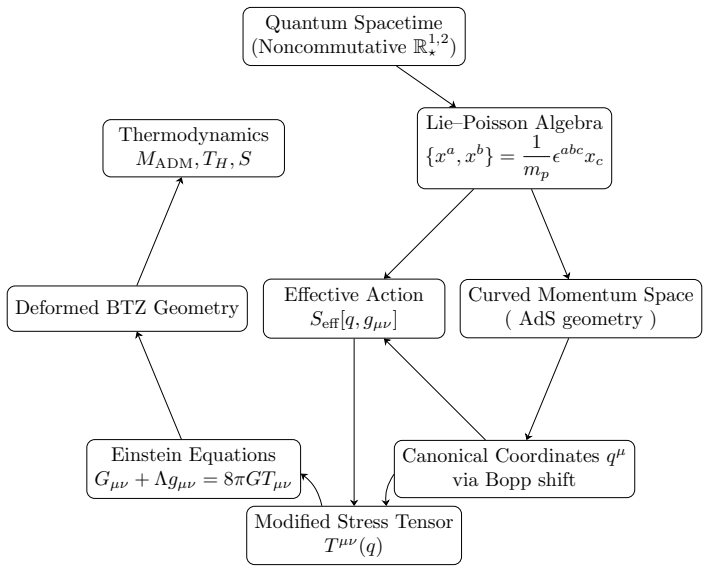
Coupling this modified matter sector to Einstein gravity, we obtain a deformed BTZ black hole solution. Remarkably, the local geometric structure and thermodynamic relations retain their standard form, while all quantum-gravity effects are encoded in a nonlinear mapping between the microscopic mass parameter and the ADM mass. This induces a renormalization of the horizon radius and thermodynamic quantities without altering their functional dependence.
What carries the argument
The nonlinear mapping between the microscopic mass parameter and the ADM mass, which isolates every quantum-gravity correction from curved momentum space while permitting unmodified geodesic motion and standard gravitational coupling.
Load-bearing premise
The first-order action for the curved-momentum-space particle produces an effective description in which trajectories remain geodesics that couple directly to ordinary Einstein gravity, with all modifications confined to the mass mapping.
What would settle it
A direct computation or observation of the return time for massless probes along null geodesics from the horizon to the AdS3 boundary that fails to match the specific shift predicted by the nonlinear mass mapping.
Figures

read the original abstract
We explore how quantum properties of spacetime, specifically the curvature of momentum space, can backreact on classical gravity within a tractable semiclassical (2+1)-dimensional framework with a negative cosmological constant. Motivated by quantum-gravity scenarios, we investigate how Planck-scale modifications of particle kinematics influence both dynamics and gravitational solutions. Starting from a first-order action, we derive an effective configuration-space description and show that particle trajectories remain geodesic, preserving the weak equivalence principle despite the underlying deformation. Coupling this modified matter sector to Einstein gravity, we obtain a deformed BTZ black hole solution. Remarkably, the local geometric structure and thermodynamic relations retain their standard form, while all quantum-gravity effects are encoded in a nonlinear mapping between the microscopic mass parameter and the ADM mass. This induces a renormalization of the horizon radius and thermodynamic quantities without altering their functional dependence. As a concrete observable consequence, we compute corrections to the return time of massless probes traveling along null geodesics between the horizon and the AdS3 boundary. Our results demonstrate that Planck-scale kinematic effects can leave controlled and potentially measurable imprints on classical geometry, providing a clear and consistent bridge between quantum-gravity ideas and semiclassical observables.
Editorial analysis
A structured set of objections, weighed in public.
Referee Report
Summary. The paper examines quantum-gravitational backreaction in the BTZ black hole within (2+1)-dimensional gravity with negative cosmological constant, induced by curvature in momentum space. Starting from a first-order action for a particle with Planck-scale modified kinematics, an effective configuration-space description is derived in which trajectories remain geodesics, preserving the weak equivalence principle. This modified matter sector is coupled to standard Einstein gravity, producing a deformed BTZ solution whose local geometry and thermodynamic relations retain their classical functional form; all quantum effects are isolated in a nonlinear mapping from the microscopic mass parameter to the ADM mass, which renormalizes the horizon radius and thermodynamic quantities. Corrections to the return time of massless probes along null geodesics are computed as a concrete observable.
Significance. If the derivation of the effective action and the isolation of effects in the mass mapping are rigorous, the result offers a controlled semiclassical bridge between curved-momentum-space kinematics and classical black-hole observables, with the return-time corrections providing a potentially measurable signature. The preservation of geodesic motion and standard thermodynamic structure despite the deformation is a notable feature. The work is strengthened by its focus on explicit, falsifiable predictions rather than abstract modifications.
major comments (2)
- [Coupling of the modified matter sector to Einstein gravity] The central claim that the effective stress-energy tensor sources unmodified Einstein equations with only a renormalized mass (yielding standard BTZ geometry) is load-bearing. Explicit computation of T_μν from the effective configuration-space action is needed to confirm the absence of additional terms, non-standard conservation laws, or curvature couplings that would alter the metric ansatz beyond the mass map.
- [Derivation of the deformed BTZ solution and mass mapping] The nonlinear mapping between the microscopic mass parameter and the ADM mass is presented as encoding all quantum-gravity effects and inducing renormalization without changing functional dependence. A concrete derivation or explicit functional form of this map (e.g., from the first-order action or dispersion relation) should be provided to demonstrate it is independently obtained rather than chosen to preserve the BTZ form.
minor comments (2)
- [Abstract and Introduction] The abstract and introduction would benefit from a brief statement of the explicit form of the first-order action or the curved-momentum-space dispersion relation to orient readers before the effective-action derivation.
- [Section on the mass mapping] Notation for the microscopic mass parameter versus ADM mass should be introduced consistently with a clear symbol distinction when first defined.
Simulated Author's Rebuttal
We thank the referee for the careful and constructive report, which correctly identifies the load-bearing aspects of our derivation. We address each major comment below and will incorporate the requested explicit details in a revised manuscript to strengthen the presentation.
read point-by-point responses
-
Referee: [Coupling of the modified matter sector to Einstein gravity] The central claim that the effective stress-energy tensor sources unmodified Einstein equations with only a renormalized mass (yielding standard BTZ geometry) is load-bearing. Explicit computation of T_μν from the effective configuration-space action is needed to confirm the absence of additional terms, non-standard conservation laws, or curvature couplings that would alter the metric ansatz beyond the mass map.
Authors: We agree that an explicit verification of the stress-energy tensor is essential for rigor. The effective configuration-space action is obtained in Section 3 by integrating out the momentum variables from the first-order action with the curved-momentum-space dispersion relation; the resulting Lagrangian yields geodesic motion with a modified mass parameter. Varying this action with respect to the metric produces a stress-energy tensor whose only non-vanishing component is the energy density associated with the microscopic mass m. Direct computation shows that ∇^μ T_μν = 0 holds identically (as a consequence of the geodesic equation) and that no curvature-dependent or higher-derivative couplings appear. Consequently, the Einstein equations remain unmodified except for the replacement of the bare mass by the ADM mass M related to m through the nonlinear map. In the revision we will insert this explicit T_μν calculation (including coordinate components in the BTZ ansatz) immediately after the derivation of the effective action. revision: yes
-
Referee: [Derivation of the deformed BTZ solution and mass mapping] The nonlinear mapping between the microscopic mass parameter and the ADM mass is presented as encoding all quantum-gravity effects and inducing renormalization without changing functional dependence. A concrete derivation or explicit functional form of this map (e.g., from the first-order action or dispersion relation) should be provided to demonstrate it is independently obtained rather than chosen to preserve the BTZ form.
Authors: The nonlinear map is not chosen by hand but follows from asymptotic matching. Starting from the first-order action with the Planck-scale deformed Hamiltonian H(p) = √(p² + m² + ℓ_p corrections from the momentum-space curvature), the on-shell energy for a static source is computed. Inserting this source into the Einstein equations and imposing the standard BTZ fall-off at infinity fixes the relation between the microscopic parameter m and the ADM mass M that appears in the metric. The resulting functional form M = m + ℓ_p² f(m, Λ) + … is obtained by solving the integrated constraint equation; it is independent of the metric ansatz and is fixed solely by the dispersion relation. In the revision we will add a dedicated subsection deriving this map step by step from the first-order action, including the explicit expression and the intermediate algebraic steps. revision: yes
Circularity Check
No significant circularity in the derivation chain.
full rationale
The paper begins from an explicit first-order action incorporating curved momentum space, derives an effective configuration-space action, demonstrates that trajectories remain geodesic (preserving weak equivalence), and then couples the resulting stress-energy tensor to the standard Einstein equations in 2+1 dimensions with negative cosmological constant. The deformed BTZ solution with a nonlinear microscopic-to-ADM mass mapping is obtained as an output of solving those equations rather than being imposed by definition or by a self-citation chain. No load-bearing step reduces by construction to a fitted parameter, an ansatz smuggled via prior work, or a uniqueness theorem imported from the same authors. The isolation of quantum-gravity effects inside the mass map is a derived feature of the solution, not an input that forces the reported renormalization of horizon radius and thermodynamics. The derivation is therefore self-contained against the paper's stated assumptions and external benchmarks.
Axiom & Free-Parameter Ledger
free parameters (1)
- microscopic mass parameter
axioms (2)
- domain assumption Particle trajectories remain geodesic in the effective configuration-space description derived from the first-order action
- domain assumption The modified matter sector couples to unmodified Einstein gravity in (2+1) dimensions with negative cosmological constant
invented entities (1)
-
curved momentum space
no independent evidence
Lean theorems connected to this paper
-
IndisputableMonolith/Cost/FunctionalEquation.leanwashburn_uniqueness_aczel unclear?
unclearRelation between the paper passage and the cited Recognition theorem.
Starting from a first-order action, we derive an effective configuration-space description... all quantum-gravity effects are encoded in a nonlinear mapping between the microscopic mass parameter and the ADM mass.
-
IndisputableMonolith/Foundation/AlexanderDuality.leanalexander_duality_circle_linking unclear?
unclearRelation between the paper passage and the cited Recognition theorem.
the metric g_μν(p) ... corresponds to the AdS metric ... R = -6/m_p²
What do these tags mean?
- matches
- The paper's claim is directly supported by a theorem in the formal canon.
- supports
- The theorem supports part of the paper's argument, but the paper may add assumptions or extra steps.
- extends
- The paper goes beyond the formal theorem; the theorem is a base layer rather than the whole result.
- uses
- The paper appears to rely on the theorem as machinery.
- contradicts
- The paper's claim conflicts with a theorem or certificate in the canon.
- unclear
- Pith found a possible connection, but the passage is too broad, indirect, or ambiguous to say the theorem truly supports the claim.
Reference graph
Works this paper leans on
-
[1]
The principle of relative locality
G. Amelino-Camelia, L. Freidel, J. Kowalski-Glikman and L. Smolin,The Principle of Relative Locality, Phys. Rev. D84, 084010 (2011) [arXiv:1101.0931 [hep-th]]
work page internal anchor Pith review Pith/arXiv arXiv 2011
-
[2]
Living in Curved Momentum Space
J. Kowalski-Glikman, “Living in Curved Momentum Space,”Int. J. Mod. Phys. A 28, 1330014 (2013), doi:10.1142/S0217751X13300147, [arXiv:1303.0195 [hep-th]]
work page internal anchor Pith review Pith/arXiv arXiv doi:10.1142/s0217751x13300147 2013
-
[3]
C. Rovelli,Loop quantum gravity, Living Rev. Rel.1, 1 (1998) [arXiv:gr-qc/9710008]
work page internal anchor Pith review Pith/arXiv arXiv 1998
-
[4]
Quantum Gravity: a Progress Report
S. Carlip,Quantum Gravity: A Progress Report, Rept. Prog. Phys.64, 885–942 (2001) [arXiv:gr-qc/0108040]
work page internal anchor Pith review Pith/arXiv arXiv 2001
-
[5]
R. P. Woodard,How Far Are We from the Quantum Theory of Gravity?, Rept. Prog. Phys.72, 126002 (2009) [arXiv:0907.4238 [gr-qc]]
work page internal anchor Pith review Pith/arXiv arXiv 2009
-
[6]
R. M. Wald,General Relativity, University of Chicago Press (1984)
work page 1984
-
[7]
Weinberg,The Quantum Theory of Fields, Vol
S. Weinberg,The Quantum Theory of Fields, Vol. 1: Foundations, Cambridge Uni- versity Press (1995)
work page 1995
-
[8]
S. Doplicher, K. Fredenhagen, and J. E. Roberts,Spacetime Quantization Induced by Classical Gravity, Phys. Lett. B331(1994) 39
work page 1994
-
[9]
Introduction to Doubly Special Relativity
J. Kowalski-Glikman,Introduction to Doubly Special Relativity, Lect. Notes Phys. 669, 131–159 (2005) [arXiv:hep-th/0405273]
work page internal anchor Pith review Pith/arXiv arXiv 2005
-
[10]
Three-dimensional cosmological gravity: Dynamics of constant curvature,
S. Deser and R. Jackiw, “Three-dimensional cosmological gravity: Dynamics of constant curvature,”Annals Phys.153(1984), 405–416, doi:10.1016/0003- 4916(84)90025-3
-
[11]
On spin and (quantum) gravity in (2+1)-dimensions,
P. de Sousa Gerbert, “On spin and (quantum) gravity in (2+1)-dimensions,” Nucl. Phys. B346, 440-472 (1990). doi:10.1016/0550-3213(90)90288-O
-
[12]
Quantization of Point Particles in 2+1 Dimensional Gravity and Space-Time Discreteness
G. ’t Hooft, “Quantization of point particles in (2+1)-dimensional gravity and space- time discreteness,” Class. Quant. Grav.13, 1023–1040 (1996) [arXiv:gr-qc/9601014]
work page internal anchor Pith review Pith/arXiv arXiv 1996
-
[13]
The Black Hole in Three Dimensional Space Time
M. Ba˜ nados, C. Teitelboim and J. Zanelli,The Black hole in three-dimensional space- time, Phys. Rev. Lett.69, 1849–1851 (1992) [arXiv:hep-th/9204099]
work page internal anchor Pith review Pith/arXiv arXiv 1992
-
[14]
Carlip,The (2+1)D Black Hole, Class
S. Carlip,The (2+1)D Black Hole, Class. Quant. Grav. 12 (1995) 2853–2879
work page 1995
-
[15]
Witten,(2+1)-Dimensional Gravity as an Exactly Soluble System, Nucl
E. Witten,(2+1)-Dimensional Gravity as an Exactly Soluble System, Nucl. Phys. B 311, 46 (1988). 32
work page 1988
-
[16]
Bound state energies and phase shifts of a non-commutative well
J. D. Thom and F. G. Scholtz, “Bound state energies and phase shifts of a non- commutative well,” J. Phys. A42, 445301 (2009) [arXiv:1012.0699 [quant-ph]]
work page internal anchor Pith review Pith/arXiv arXiv 2009
- [17]
- [18]
-
[19]
E. W. Mielke and P. Baekler,Topological Gauge Model of Gravity with Torsion, Phys. Lett. A156, 399–403 (1991)
work page 1991
-
[20]
Three lectures on Poincare gauge theory
M. Blagojevi´ c and B. Cvetkovi´ c,Canonical Structure of 3D Gravity with Torsion, Lect. Notes Phys.633, 103–113 (2004) [arXiv:gr-qc/0302040]
work page internal anchor Pith review Pith/arXiv arXiv 2004
-
[21]
Relativistic extended uncertainty principle from spacetime curva- ture,
F. Wagner, “Relativistic extended uncertainty principle from spacetime curva- ture,”Phys. Rev. D105, no.2, 025005 (2022) doi:10.1103/PhysRevD.105.025005 [arXiv:2111.15583 [gr-qc]]
-
[22]
Generalized uncertainty principle or curved momentum space?
F. Wagner, “Generalized uncertainty principle or curved momentum space?”, Phys. Rev. D104, no.12, 126010 (2021), doi:10.1103/PhysRevD.104.126010 [arXiv:2110.11067 [gr-qc]]
-
[23]
Born,A Suggestion for Unifying Quantum Theory and Relativity, Proc
M. Born,A Suggestion for Unifying Quantum Theory and Relativity, Proc. R. Soc. Lond. A165(1938) 291–303
work page 1938
-
[24]
The hidden Lorentz covariance of quantum mechanics,
P. Nandi and F. G. Scholtz, “The hidden Lorentz covariance of quantum mechanics,” Annals Phys.464, 169643 (2024) [arXiv:2312.15750 [hep-th]]
-
[25]
P. Finsler, ¨Uber Kurven und Fl¨ achen in allgemeinen R¨ aumen, Inaugural- Dissertation, Universit¨ at G¨ ottingen (1918)
work page 1918
-
[26]
´E. Cartan,Les espaces de Finsler, Actualit´ es Scientifiques et Industrielles, Hermann, Paris (1934),https://books.google.de/books?id=rE7vAAAAMAAJ
work page 1934
-
[27]
On the introduction of an ‘elementary length’ in the relativistic theory of elementary particles,
Yu. A. Golfand, “On the introduction of an ‘elementary length’ in the relativistic theory of elementary particles,”Zh. Eksp. Teor. Fiz.37, 504 (1959)
work page 1959
-
[28]
Quantum field theory in constant curvature p-space,
Yu. A. Golfand, “Quantum field theory in constant curvature p-space,”Zh. Eksp. Teor. Fiz.43, 256 (1962)
work page 1962
-
[29]
On the properties of displacements in p-space of constant curva- ture,
Yu. A. Gol’fand, “On the properties of displacements in p-space of constant curva- ture,”Zh. Eksp. Teor. Fiz.44, 1248 (1963)
work page 1963
-
[30]
I. E. Tamm, “On curved momentum space,” inProceedings of the International Conference on Elementary Particles, Kyoto University (1965), p. 314
work page 1965
-
[31]
On the use of curved momentum space in constructing nonlocal quan- tum field theory,
I. E. Tamm, “On the use of curved momentum space in constructing nonlocal quan- tum field theory,”Tr. Fiz. Inst. Akad. Nauk SSSR57, 5 (1972)
work page 1972
-
[32]
The momentum spaces ofκ- Minkowski noncommutative spacetime,
F. Lizzi, M. Manfredonia, and F. Mercati, “The momentum spaces ofκ- Minkowski noncommutative spacetime,”Nucl. Phys. B958, 115117 (2020), doi:10.1016/j.nuclphysb.2020.115117 [arXiv:2001.08756 [hep-th]]. 33
-
[33]
A unique connection for Born geometry,
L. Freidel, F. J. Rudolph, and D. Svoboda, “A unique connection for Born geometry,” Commun. Math. Phys.372, 119 (2019)
work page 2019
-
[34]
S. Majid,Algebraic Approach to Quantum Gravity I: Relative Realism, inRoad to Reality with Roger Penrose, eds. J. Ladyman, S. Presnell, G. McCabe, M. Eckstein, and S. J. Szybka, Krak´ ow: Copernicus Center Press (2015)
work page 2015
-
[35]
The beauty of curved momen- tum space,
S. Franchino-Vi˜ nas, S. Mignemi, and J. J. Relancio, “The beauty of curved momen- tum space,” PoSCORFU2022, 340 (2023) [arXiv:2303.08220 [hep-th]]
-
[36]
M. Roy and M. Balasundaram, “On the non-flatness nature of noncommutative Minkowski spacetime and the singular behavior of probes,” Mod. Phys. Lett. A39 (2024) no.31n32, 2450150, doi:10.1142/S0217732324501505 [arXiv:2205.02479 [hep- th]]
- [37]
-
[38]
S. Carlip and C. Teitelboim,Aspects of Black Hole Quantum Mechanics and Ther- modynamics in 2+1 Dimensions, Phys. Rev. D51, 622 (1995)
work page 1995
-
[39]
L. Faddeev and R. Jackiw,Hamiltonian Reduction of Unconstrained and Constrained Systems, Phys. Rev. Lett.60, 1692 (1988)
work page 1988
-
[40]
Deformed Special Relativity as an effective flat limit of quantum gravity
F. Girelli, E. R. Livine, and D. Oriti, “Deformed special relativity as an ef- fective flat limit of quantum gravity,”Nucl. Phys. B708(2005), 411–433, doi:10.1016/j.nuclphysb.2004.11.026 [arXiv:gr-qc/0406100]
work page internal anchor Pith review Pith/arXiv arXiv doi:10.1016/j.nuclphysb.2004.11.026 2005
-
[41]
Quantum symmetry, the cosmological constant, and Planck scale phenomenology,
G. Amelino-Camelia, L. Smolin, and A. Starodubtsev, “Quantum symmetry, the cosmological constant, and Planck scale phenomenology,”Class. Quant. Grav.21, 3095 (2004), doi:10.1088/0264-9381/21/13/002
-
[42]
A. H. Chamseddine and A. Connes, “Universal formula for noncommutative geom- etry actions: Unification of gravity and the standard model,”Phys. Rev. Lett.77 (1996), 4868–4871, doi:10.1103/PhysRevLett.77.4868 [arXiv:hep-th/9606056]
work page internal anchor Pith review Pith/arXiv arXiv doi:10.1103/physrevlett.77.4868 1996
-
[43]
T. Sch¨ ucker, “Forces from Connes’ geometry,” inProceedings of the 37th Winter School on Theoretical Physics: New Developments in Fundamental Interaction The- ories, edited by E. Bick and F. D. Steffen, Lect. Notes Phys.659(2005), 285–350 [arXiv:hep-th/0111236]. doi:10.1007/978-3-540-31532-2 6
work page internal anchor Pith review Pith/arXiv arXiv doi:10.1007/978-3-540-31532-2 2005
-
[44]
3D Quantum Gravity and Effective Non- commutative Quantum Field Theory,
L. Freidel and E. R. Livine, “3D Quantum Gravity and Effective Non- commutative Quantum Field Theory,”Phys. Rev. Lett.96(2006), 221301, doi:10.1103/PhysRevLett.96.221301
-
[45]
Construction of $\theta$-Poincar\'e Algebras and their Invariants on $\mathcal{M}_\theta$
F. Koch and E. Tsouchnika, “Construction of theta-Poincar´ e alge- bras and their invariants onM θ,”Nucl. Phys. B717(2005), 387–403, doi:10.1016/j.nuclphysb.2005.04.019 [arXiv:hep-th/0409012]
work page internal anchor Pith review Pith/arXiv arXiv doi:10.1016/j.nuclphysb.2005.04.019 2005
-
[46]
How anti-de Sitter black holes reach thermal equi- librium,
R. Ling, H. Xu and Y. C. Ong, “How anti-de Sitter black holes reach thermal equi- librium,”Phys. Lett. B826(2022), 136896, doi:10.1016/j.physletb.2022.136896. 34
-
[47]
Anti-de Sitter momentum space in 3D and 4D quantum gravity,
G. Amelino-Camelia, I. P. Lobo, and G. Palmisano, “Anti-de Sitter momentum space in 3D and 4D quantum gravity,” Class. Quant. Grav.41, no.8, 085006 (2024), doi:10.1088/1361-6382/ad3163, arXiv:2403.16721 [gr-qc]
-
[48]
2+1 gravity and Doubly Special Relativity
L. Freidel, J. Kowalski-Glikman, and L. Smolin, “2+1 gravity and dou- bly special relativity,” Phys. Rev. D69, 044001 (2004), arXiv:hep-th/0307085, doi:10.1103/PhysRevD.69.044001
work page internal anchor Pith review Pith/arXiv arXiv doi:10.1103/physrevd.69.044001 2004
-
[49]
Hawking Radiation as Tunneling
M. K. Parikh and F. Wilczek, “Hawking radiation as tunneling,”Phys. Rev. Lett. 85, 5042 (2000) [arXiv:hep-th/9907001]
work page internal anchor Pith review Pith/arXiv arXiv 2000
-
[50]
Quantum Tunneling and Back Reaction
R. Banerjee and B. R. Majhi, “Quantum Tunneling and Back Reaction,” Phys. Lett. B662, 62–65 (2008) [arXiv:0801.0200 [hep-th]]
work page internal anchor Pith review Pith/arXiv arXiv 2008
-
[51]
Quantum Tunneling Beyond Semiclassical Approximation
R. Banerjee and B. R. Majhi, “Quantum Tunneling Beyond Semiclassical Approxi- mation,” JHEP06, 095 (2008) [arXiv:0805.2220 [hep-th]]
work page internal anchor Pith review Pith/arXiv arXiv 2008
-
[52]
Connecting anomaly and tunneling methods for Hawking effect through chirality
R. Banerjee and B. R. Majhi, “Connecting anomaly and tunneling methods for Hawking effect through chirality,” Phys. Rev. D79, 064024 (2009) [arXiv:0812.0497 [hep-th]]
work page internal anchor Pith review Pith/arXiv arXiv 2009
-
[53]
The Spectral action principle,
A. H. Chamseddine and A. Connes, “The Spectral action principle,” Phys. Rev. Lett.77, 4868 (1996)
work page 1996
-
[54]
Asymptotically safe gravity-matter sys- tems,
N. Alkofer, F. Saueressig, and O. Zanusso, “Asymptotically safe gravity-matter sys- tems,” Phys. Rev. D91, 025025 (2015)
work page 2015
-
[55]
Quantum gravity sig- natures in the Unruh effect,
N. Alkofer, G. D’Odorico, F. Saueressig, and F. Versteegen, “Quantum gravity sig- natures in the Unruh effect,” Phys. Rev. D94, 104055 (2016). 35
work page 2016
discussion (0)
Sign in with ORCID, Apple, or X to comment. Anyone can read and Pith papers without signing in.