Recursive algorithm for constructing antisymmetric fermionic states in first quantization mapping
Pith reviewed 2026-05-18 17:20 UTC · model grok-4.3
The pith
A recursive quantum algorithm prepares antisymmetric fermionic states by initializing each particle independently and achieves O(η² √N) T-gate cost.
A machine-rendered reading of the paper's core claim, the machinery that carries it, and where it could break.
Core claim
The central discovery is a recursive construction that maps independently prepared single-particle states into a fully antisymmetric many-particle state without requiring pre-sorted inputs. For systems of η particles in N orbitals, this yields an antisymmetrized state at a cost of O(η² √N) T-gates using O(√N) ancillary qubits, with further optimizations possible when the orbitals are known in advance.
What carries the argument
The recursive antisymmetrization circuit that builds the Slater determinant-like state by successive applications of exchange operations and projections.
If this is right
- The algorithm outperforms sorting-based methods specifically when η is less than or approximately equal to sqrt(N).
- Knowledge of the single-particle states can be used to reduce the circuit complexity further.
- A measurement-based variant achieves roughly half the gate cost of the unitary version.
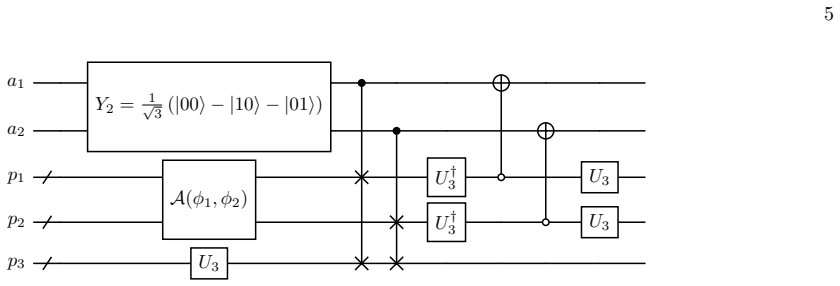
- Explicit circuits for two- and three-particle cases demonstrate the construction, and noise effects are analyzed for the three-particle example.
Where Pith is reading between the lines
- This approach could be integrated into variational quantum algorithms for molecular ground states where Hartree-Fock orbitals are precomputed.
- The scaling suggests a resource advantage in regimes typical for small-molecule simulations on near-term devices.
- Extending the recursion to include spin degrees of freedom or more complex orbital sets might preserve the efficiency gains.
Load-bearing premise
The single-particle orbitals are known in advance and can be prepared independently on each particle register without additional dominant costs or requiring ordered inputs.
What would settle it
A direct implementation or simulation showing that the T-gate count for preparing a three-particle antisymmetric state exceeds O(η² √N) or that the output state is not invariant under particle exchanges would falsify the efficiency and correctness claims.
Figures




read the original abstract
We devise a deterministic quantum algorithm to produce antisymmetric states of single-particle orbitals in the first quantization mapping. Unlike sorting-based antisymmetrization algorithms, which require ordered input states and high Clifford-gate overhead, our approach initializes the state of each particle independently. For a system of $\eta$ particles and $N$ single-particle states, our algorithm prepares antisymmetrized states of non-trivial localized (e.g., Hartree-Fock) orbitals using $O(\eta^2\sqrt{N})$ $T$-gates, outperforming alternative algorithms when $\eta\lesssim \sqrt{N}$. To achieve such scaling, we require $O(\sqrt{N})$ dirty ancilla qubits for intermediate calculations. Knowledge of the single-particle states to be antisymmetrized can be leveraged to further improve the efficiency of the circuit, and a measurement-based variant reduces gate cost by roughly a factor of two. We show example circuits for two- and three-particle systems and discuss the generalization to an arbitrary number of particles. For a specific three-particle example, we decompose the circuit into Clifford$+T$ gates and study the impact of noise on the prepared state.
Editorial analysis
A structured set of objections, weighed in public.
Referee Report
Summary. The paper presents a recursive deterministic quantum algorithm for preparing antisymmetric fermionic states in the first-quantization mapping. It initializes each of the η particles independently with known single-particle orbitals (e.g., Hartree-Fock) and uses recursion to enforce antisymmetry, achieving O(η² √N) T-gates and O(√N) dirty ancilla qubits. The method is claimed to outperform sorting-based alternatives when η ≲ √N. Explicit circuits are provided for two- and three-particle cases, a measurement-based variant is introduced that halves the gate cost, and a noise study is performed for a specific three-particle example. Generalization to arbitrary η is discussed.
Significance. If the scaling holds with preparation costs subdominant, the algorithm would offer a resource-efficient route to fermionic state preparation for quantum chemistry simulations in the first-quantized representation, particularly advantageous for moderate particle numbers relative to basis size. The recursive structure, dirty-ancilla usage, and measurement-based optimization are constructive contributions that could inform future circuit designs for indistinguishable particles.
major comments (2)
- [Resource analysis section] Resource analysis (around the T-gate counting for the full procedure): The claimed O(η² √N) T-gate bound for preparing the antisymmetrized state treats the independent preparation of each localized orbital as either external or negligible. If each orbital preparation requires Ω(√N) T-gates (plausible for general non-trivial orbitals), the total cost becomes O(η √N) or larger, which would exceed the stated bound and weaken the outperformance claim in the η ≲ √N regime. An explicit bound or assumption on preparation cost is required to support the central scaling result.
- [Generalization discussion] Generalization to arbitrary η (in the section discussing extension beyond small-particle examples): Correctness is verified explicitly for two- and three-particle systems with full Clifford+T decompositions, but the manuscript provides only a discussion rather than a formal inductive proof or complete circuit construction for general η. Since the central claim applies to arbitrary particle number, this gap is load-bearing and should be addressed with a rigorous argument.
minor comments (2)
- [Abstract] The abstract states that a three-particle noise study is performed but supplies no quantitative metrics (e.g., fidelity or error-rate values); adding a one-sentence summary of the observed impact would aid readability.
- [Circuit diagrams and ancilla discussion] Notation for ancilla usage and gate counts should be cross-checked for consistency between the main text and any supplementary circuit diagrams.
Simulated Author's Rebuttal
We thank the referee for their thorough review and valuable comments on our manuscript. We address each of the major comments in detail below. We have revised the manuscript to incorporate clarifications and additional arguments as suggested.
read point-by-point responses
-
Referee: [Resource analysis section] Resource analysis (around the T-gate counting for the full procedure): The claimed O(η² √N) T-gate bound for preparing the antisymmetrized state treats the independent preparation of each localized orbital as either external or negligible. If each orbital preparation requires Ω(√N) T-gates (plausible for general non-trivial orbitals), the total cost becomes O(η √N) or larger, which would exceed the stated bound and weaken the outperformance claim in the η ≲ √N regime. An explicit bound or assumption on preparation cost is required to support the central scaling result.
Authors: We clarify that the O(η² √N) T-gate complexity refers to the cost of the recursive antisymmetrization procedure itself, which assumes that the initial single-particle orbital states have already been prepared independently for each particle. This is consistent with the problem setup where the single-particle states (e.g., Hartree-Fock orbitals) are known and can be prepared separately. If each orbital preparation requires O(√N) T-gates, the additional cost would be O(η √N). Since η ≲ √N in the regime of interest, O(η √N) is O(N) or less, while O(η² √N) is up to O(N^{3/2}), so the antisymmetrization cost dominates and the overall scaling remains O(η² √N). We will add an explicit statement in the revised manuscript clarifying this assumption and bounding the preparation cost to support the claim. The outperformance over sorting methods holds for the antisymmetrization step, which is the focus of the comparison. revision: yes
-
Referee: [Generalization discussion] Generalization to arbitrary η (in the section discussing extension beyond small-particle examples): Correctness is verified explicitly for two- and three-particle systems with full Clifford+T decompositions, but the manuscript provides only a discussion rather than a formal inductive proof or complete circuit construction for general η. Since the central claim applies to arbitrary particle number, this gap is load-bearing and should be addressed with a rigorous argument.
Authors: We agree that a more rigorous treatment of the generalization is beneficial. The algorithm is defined recursively, with the η-particle antisymmetrizer constructed from the (η-1)-particle case by applying appropriate controlled operations and permutations to enforce the antisymmetry. In the revised version, we will include a formal inductive proof of correctness: The base case for η=1 is the identity operation, which is trivially correct. Assuming correctness for η-1, the recursive step applies the antisymmetrizer for η-1 to the first η-1 particles and then uses a series of controlled swaps and phase gates (as detailed in the two- and three-particle examples) to antisymmetrize with the η-th particle. This ensures the full state is antisymmetric under any particle exchange. We will also provide a high-level circuit diagram for the general case to complement the discussion. revision: yes
Circularity Check
No significant circularity; derivation is self-contained algorithmic construction
full rationale
The paper presents an explicit recursive construction for antisymmetrization whose T-gate scaling is derived step-by-step from the algorithm's structure and the assumed independent preparation of single-particle orbitals. No load-bearing step reduces by definition or self-citation to the target result itself; gate counts follow from standard Clifford+T decompositions and recursion depth rather than fitted parameters or renamed inputs. The treatment of orbital preparation as external input is consistent with the stated problem and does not create a self-referential loop.
Axiom & Free-Parameter Ledger
axioms (2)
- standard math Standard quantum circuit model with Clifford+T gates and dirty ancilla qubits is available.
- domain assumption Single-particle orbitals can be prepared independently on separate registers.
Reference graph
Works this paper leans on
-
[1]
To correct this, we apply to particlep1 the operatorU † 2, followed by a multi-controlledZopera- tion to restore the antisymmetry, and finallyU2 to restore the stateϕ 2, as shown in Fig. 4(b). The ancilla can then be reset and reused, if desired. As discussed earlier, one can leverage information about the single-particle state to reduce the number of gat...
-
[2]
The Ross-Selinger algorithm was used to generate discrete approximations of aZ-axis rotation with the same angle, which was then basis-transformed into aY-axis rotation. The approximation can be im- proved to arbitrary accuracyε— defined as the oper- ator norm of the difference between the exact and ap- proximate rotation operators — at the cost of additi...
-
[3]
in Clifford+Tgates to various accuracies using the Ross-Selinger algorithm. The stated er- ror (ε) represents the operator norm of the difference between the exact and approximate rotation operators. The state infi- delity resulting from rotation synthesis is roughly the square of the difference operator norm. ErrorT-gate count Total gate count 1×10 −1 8 ...
work page 2024
-
[4]
12 |0⟩ G ( 1 6 ) Z |0⟩ G ( 1 5 ) Z |0⟩ G ( 1 4 ) Z |0⟩ G ( 1 3 ) Z |0⟩ G ( 1 2 ) Z FIG
The base case is ˜Y1 =H|0⟩. 12 |0⟩ G ( 1 6 ) Z |0⟩ G ( 1 5 ) Z |0⟩ G ( 1 4 ) Z |0⟩ G ( 1 3 ) Z |0⟩ G ( 1 2 ) Z FIG. 8. Quantum circuit that prepares the stateY 5. . . . . . . . . . . . . . . . . . . . . . . . . . . . . . . . . . . . . ... ... ... . . . . . . . . . . . . . . . . . . . . . . . . . . . . . . ... . . . . . . a H H q1 ˜Yk ... qk qk+1 H qk+2 .....
-
[5]
operation, this gate can be decomposed into a controlled-Hgate followed by acnotgate, enabling an exact expression in terms of the native gate-set. The controlled-Hcan in turn be represented with 1cnot gate surrounded by oneTand oneT † gate and a basis- transformation on the target qubit that applies the fol- lowing map to the Pauli gate-set:{σ (x) →σ (z)...
-
[6]
K. W. Ford and J. A. Wheeler, Semiclassical description of scattering, Annals of Physics7, 259 (1959)
work page 1959
-
[7]
M. Brack and R. Bhaduri,Semiclassical Physics, Fron- tiers in Physics (Avalon Publishing, 2003)
work page 2003
-
[8]
Brink,Semi-classical methods for nucleus-nucleus scattering(Cambridge University Press., 2025)
D. Brink,Semi-classical methods for nucleus-nucleus scattering(Cambridge University Press., 2025)
work page 2025
-
[9]
A. D. Laurent and D. Jacquemin, TD-DFT benchmarks: A review, International Journal of Quantum Chemistry 113, 2019–2039 (2013)
work page 2019
- [10]
-
[11]
D. Chemla and J. Shah, Many-body and correlation ef- fects in semiconductors, Nature411, 549 (2001)
work page 2001
-
[12]
A. D. Klemm and R. G. Storer, The structure of quantum fluids: helium and neon, Australian Journal of Physics 26, 43 (1973)
work page 1973
-
[13]
M. Piarulli and I. Tews, Local Nucleon-Nucleon and Three-Nucleon Interactions Within Chiral Effective Field Theory, Front. in Phys.7, 245 (2020), arXiv:2002.00032 [nucl-th]
-
[14]
D. S. Abrams and S. Lloyd, Simulation of Many-Body Fermi Systems on a Universal Quantum Computer, Phys. Rev. Lett.79, 2586 (1997)
work page 1997
- [15]
-
[16]
A. Aspuru-Guzik, A. D. Dutoi, P. J. Love, and M. Head- Gordon, Simulated Quantum Computation of Molec- ular Energies, Science309, 1704 (2005), arXiv:quant- ph/0604193 [quant-ph]
-
[17]
Lloyd, Universal Quantum Simulators, Science273, 1073 (1996)
S. Lloyd, Universal Quantum Simulators, Science273, 1073 (1996)
work page 1996
-
[18]
Efficient Simulation of Quantum Systems by Quantum Computers
C. Zalka, Simulating quantum systems on a quantum computer, Proceedings of the Royal Society of Lon- don Series A454, 313 (1998), arXiv:quant-ph/9603026 [quant-ph]
work page internal anchor Pith review Pith/arXiv arXiv 1998
-
[19]
M. A. Nielsen and I. L. Chuang,Quantum computation and quantum information(2000)
work page 2000
- [20]
-
[21]
Y. Shee, P.-K. Tsai, C.-L. Hong, H.-C. Cheng, and H.- S. Goan, Qubit-efficient encoding scheme for quantum simulations of electronic structure, Phys. Rev. Res.4, 023154 (2022). ≡ |0⟩ FIG. 12. Decomposition of the multi-controlled X gate into native members of the Clifford+Tgate-set that provides a method of implementing an arbitrary number of control qubi...
work page 2022
-
[22]
R. Babbush, N. Wiebe, J. McClean, J. McClain, H. Neven, and G. K.-L. Chan, Low-depth quantum sim- ulation of materials, Phys. Rev. X8, 011044 (2018)
work page 2018
-
[23]
A. Li, A. Baroni, I. Stetcu, and T. S. Humble, Deep quan- tum circuit simulations of low-energy nuclear states, The European Physical Journal A60, 106 (2024)
work page 2024
-
[24]
D. W. Berry, M. Kieferov´ a, A. Scherer, Y. R. Sanders, G. H. Low, N. Wiebe, C. Gidney, and R. Babbush, Im- proved techniques for preparing eigenstates of fermionic Hamiltonians, npj Quantum Information4, 22 (2018)
work page 2018
-
[25]
A. Delgado, P. A. M. Casares, R. dos Reis, M. S. Zini, R. Campos, N. Cruz-Hern´ andez, A.-C. Voigt, A. Lowe, S. Jahangiri, M. A. Martin-Delgado, J. E. Mueller, and J. M. Arrazola, Simulating key properties of lithium-ion batteries with a fault-tolerant quantum computer, Phys. Rev. A106, 032428 (2022)
work page 2022
-
[26]
R. Babbush, W. J. Huggins, D. W. Berry, S. F. Ung, A. Zhao, D. R. Reichman, H. Neven, A. D. Baczewski, and J. Lee, Quantum simulation of exact electron dynam- ics can be more efficient than classical mean-field meth- ods, Nature Commun.14, 4058 (2023), arXiv:2301.01203 [quant-ph]
-
[27]
W. J. Huggins, O. Leimkuhler, T. F. Stetina, and K. B. Whaley, Efficient state preparation for the quantum sim- ulation of molecules in first quantization, PRX Quantum 6, 020319 (2025)
work page 2025
- [28]
-
[29]
M. S. Paterson, Improved sorting networks with O(logN) depth, Algorithmica5, 75–92 (1990)
work page 1990
-
[30]
M. T. Goodrich, Zig-zag sort: a simple deterministic data-oblivious sorting algorithm running in o(n log n) time, inProceedings of the Forty-Sixth Annual ACM Symposium on Theory of Computing, STOC ’14 (Asso- ciation for Computing Machinery, New York, NY, USA,
-
[31]
K. E. Batcher, Sorting networks and their applications, inProceedings of the April 30–May 2, 1968, Spring Joint Computer Conference, AFIPS ’68 (Spring) (Association for Computing Machinery, New York, NY, USA, 1968) p. 307–314
work page 1968
-
[32]
Selinger, Quantum circuits oft-depth one, Phys
P. Selinger, Quantum circuits oft-depth one, Phys. Rev. A87, 042302 (2013)
work page 2013
-
[33]
Jones, Low-overhead constructions for the fault- tolerant toffoli gate, Phys
C. Jones, Low-overhead constructions for the fault- tolerant toffoli gate, Phys. Rev. A87, 022328 (2013)
work page 2013
-
[34]
G. H. Low, V. Kliuchnikov, and L. Schaeffer, Trading T gates for dirty qubits in state preparation and unitary synthesis, Quantum8, 1375 (2024)
work page 2024
- [35]
- [36]
-
[37]
K. Mayer, C. Ryan-Anderson, N. Brown, E. Durso- Sabina, C. H. Baldwin, D. Hayes, J. M. Dreiling, C. Foltz, J. P. Gaebler, T. M. Gatterman,et al., Benchmarking logical three-qubit quantum fourier trans- form encoded in the steane code on a trapped-ion quantum computer, arXiv preprint arXiv:2404.08616 10.48550/arXiv.2303.17380 (2024)
- [38]
-
[39]
Z.-C. He and Z.-Y. Xue, High-fidelity initialization of a logical qubit with multiple injections, Phys. Rev. A111, 052419 (2025)
work page 2025
-
[40]
S. Sethi and J. M. Baker, Rescq: Realtime scheduling for continuous angle quantum error correction architec- tures, inProceedings of the 30th ACM International Con- ference on Architectural Support for Programming Lan- guages and Operating Systems, Volume 2, ASPLOS ’25 (Association for Computing Machinery, New York, NY, USA, 2025) p. 1028–1043
work page 2025
-
[41]
N. J. Ross and P. Selinger, Optimal ancilla-free Clif- ford+T approximation of z-rotations, Quantum Info. Comput.16, 901–953 (2016), arXiv:1403.2975
work page internal anchor Pith review Pith/arXiv arXiv 2016
-
[42]
A. Javadi-Abhariet al., Quantum computing with Qiskit, (2024), arXiv:2405.08810 [quant-ph]
work page internal anchor Pith review Pith/arXiv arXiv 2024
-
[43]
Demonstration of logical qubits and repeated error correction with better-than-physical error rates
A. Paetznick, M. P. da Silva, C. Ryan-Anderson, J. M. Bello-Rivas, J. P. Campora, III, A. Chernoguzov, J. M. Dreiling, C. Foltz, F. Frachon, J. P. Gaebler, T. M. Gatterman, L. Grans-Samuelsson, D. Gresh, D. Hayes, N. Hewitt, C. Holliman, C. V. Horst, J. Johansen, D. Lucchetti, Y. Matsuoka, M. Mills, S. A. Moses, B. Neyenhuis, A. Paz, J. Pino, P. Siegfried...
work page internal anchor Pith review Pith/arXiv arXiv 2024
-
[44]
D. Bluvstein, S. J. Evered, A. A. Geim, S. H. Li, H. Zhou, T. Manovitz, S. Ebadi, M. Cain, M. Kalinowski, D. Hangleiter,et al., Logical quantum processor based on reconfigurable atom arrays, Nature626, 58 (2024)
work page 2024
-
[45]
L. Egan, D. M. Debroy, C. Noel, A. Risinger, D. Zhu, D. Biswas, M. Newman, M. Li, K. R. Brown, M. Cetina, and C. Monroe, Fault-tolerant control of an error- corrected qubit, Nature598, 281 (2021)
work page 2021
-
[46]
L. Daguerre, R. Blume-Kohout, N. C. Brown, D. Hayes, and I. H. Kim, Experimental demonstration of high-fidelity logical magic states from code switch- ing, arXiv e-prints 10.48550/arXiv.2506.14169 (2025), arXiv:2506.14169 [quant-ph]
-
[47]
P. Sales Rodriguez, J. M. Robinson, P. N. Jepsen, Z. He, C. Duckering, C. Zhao, K.-H. Wu, J. Campo, K. Bagnall, M. Kwon,et al., Experimental demonstration of logical magic state distillation, Nature , 1 (2025)
work page 2025
-
[48]
Jozsa, Fidelity for mixed quantum states, Journal of Modern Optics41, 2315 (1994)
R. Jozsa, Fidelity for mixed quantum states, Journal of Modern Optics41, 2315 (1994)
work page 1994
- [49]
-
[50]
W. Dur, G. Vidal, and J. I. Cirac, Three qubits can be entangled in two inequivalent ways, Phys. Rev. A62, 062314 (2000), arXiv:quant-ph/0005115
work page internal anchor Pith review Pith/arXiv arXiv 2000
-
[51]
D. Cruz, R. Fournier, F. Gremion, A. Jeannerot, K. Komagata, T. Tosic, J. Thiesbrummel, C. L. Chan, N. Macris, M.-A. Dupertuis, and C. Javerzac-Galy, Effi- cient quantum algorithms for ghz and w states, and im- plementation on the ibm quantum computer, Advanced Quantum Technologies2, 1900015 (2019)
work page 2019
-
[52]
M. Amy, D. Maslov, M. Mosca, and M. Roetteler, A meet-in-the-middle algorithm for fast synthesis of depth-optimal quantum circuits, IEEE Transactions on Computer-Aided Design of Integrated Circuits and Sys- tems32, 818 (2013)
work page 2013
discussion (0)
Sign in with ORCID, Apple, or X to comment. Anyone can read and Pith papers without signing in.