REVIEW 3 major objections 3 minor 47 references
Leveraging Predictions in Power System Voltage Control: An Adaptive Approach
T0 review · 3 major / 3 minor · reviewed 2026-08-04 · deepseek-v4-flash
Pith's one-line read Embedding load forecasts in adaptive local voltage controllers keeps distribution grids stable under rapid net-load changes.
desk verdict A promising adaptive voltage-control idea with a real gap in the main stability theorem; worth refereeing but not citable as is. read the letter →
The pith
A machine-rendered reading of the paper's core claim, the machinery that carries it, and where it could break.
The reading
What carries the argument
The central mechanism is the modular control law $u_i(t)=k_i \tilde{v}_i(t)+\phi_i(t)^\top \tilde{a}_i(t)$: a standard linear voltage controller augmented by an adaptation term that multiplies the local prediction features $\phi_i(t)$ by online-tuned coefficients $\tilde{a}_i(t)$. A coefficient update law $\tilde{a}_i(t+1)=\alpha \tilde{a}_i(t)+\tilde{v}_i(t) A_i \phi_i(t)$ estimates the unknown load coefficients. Substituting into the LinDistFlow voltage model produces a linear time-varying system in the deviations from a slowly moving equilibrium; input-to-state stability follows if the transition matrix $M(t)$ has eigenvalues bounded away from 1, which Theorem 2 guarantees via three explicit gain c
What would settle it
Simulate the closed loop on a small network using the voltage update $v(t+1)=Rp(t)+X(q(t)-u(t))+1$ (the stated model) instead of $v(t+1)=Rp(t+1)+X(\cdots)$ and check whether the state still converges to the claimed equilibrium; if the cancellation breaks, the input-to-state stability proof does not apply. Alternatively, directly compute the eigenvalues of $M(t)$ for a network where $X$ has a large condition number and verify whether condition (c) in Theorem 2 can be satisfied with the recommended $\alpha=0.99$.
Extended reading notes
Core claim
The paper's central claim is that the closed-loop system formed by the voltage dynamics and the proposed adaptive controller is input-to-state stable. This means that the voltage deviation from its reference value remains bounded by a constant times the worst-case prediction error, and that the bound decays exponentially from the initial condition. The key is writing net-load changes as a linear combination of local basis functions (the predictions), then using an adaptation law to estimate the coefficients; at equilibrium, the controller cancels the predicted part of the load, and the residual error drives a small steady-state voltage offset that can be made arbitrarily small by choosing th
Load-bearing premise
The derivation assumes that the voltage at step $t+1$ depends on the active power at that same step $t+1$, not on the previous step's active power; if the actual model uses $p(t)$ in the voltage update, the load-prediction cancellation that the controller's stability proof relies on disappears.
Editorial extensions
If this is right
- Operators can use load forecasts without fully trusting them: even poor predictions only degrade voltage proportionally, never causing divergence.
- The stability conditions are decentralized, so no runtime communication network is needed; only offline tuning uses the network matrices.
- Choosing the adaptation gain alpha close to one pushes the equilibrium voltage error toward zero, making prediction error the main limiting factor.
- The architecture wraps around existing IEEE 1547-style linear controllers, requiring only an extra local adaptive term.
- The stability guarantee is independent of the training algorithm, so any optimizer can tune the gains while the boundedness remains intact.
Reading between the lines
- If the time-varying load contains a component not spanned by the chosen basis functions, the voltage bound grows linearly with that residual; this suggests including diverse features (weather, PV, EV) to shrink the residual and thus the voltage offset.
- The stability proof relies on a time-varying equilibrium that moves with the load; a natural extension is to learn the basis functions themselves online, potentially preserving guarantees under model drift.
- The same adaptive-prediction mechanism could apply to other grid quantities (feeder head power, microgrid frequency) wherever disturbances are partially predictable and control updates are successive.
- An experimental check of the model mismatch highlighted by the derivation would be to simulate with the original voltage update and verify whether the cancellation still holds; a negative result would require an alternative stability proof.
Editorial analysis
A structured set of objections, weighed in public.
Referee Report
Summary. The paper proposes an adaptive, decentralized voltage control scheme for distribution networks with time-varying net load. It models predictable load increments with local basis functions, augments a standard linear voltage controller with an adaptation law for the unknown coefficients, and claims that the closed-loop system is input-to-state stable whenever the eigenvalues of a time-varying transition matrix are bounded away from 1. Case studies on sinusoidal and real-world load data compare the adaptive controller against a linear baseline and report reduced voltage deviations. The main theoretical contribution is Theorem 1, stated in Section IV.D, together with sufficient eigenvalue conditions in Theorem 2 and a decentralized corollary.
Significance. If the stability result were correct, the framework would be valuable: it is decentralized, minimally modifies existing local voltage controllers, gives an explicit ISS-style bound, and the RL-based parameter tuning plus real-data case study are concrete. The paper also states assumptions and limitations clearly. However, the central theorem is not supported by the provided proof, and a time-index inconsistency affects the derivation of the control law. These are load-bearing issues: the claimed guarantee is the main contribution, and the empirical results do not by themselves establish it. The paper is therefore not acceptable in its present form.
major comments (3)
- [Section IV.D, Eqs. (20)-(21)] The proof of Theorem 1 bounds the product of transition matrices by (1-epsilon)^{t-k} solely from max_j |lambda_j(M(j))| <= 1-epsilon. For a time-varying, non-normal M(t) this implication is false: the spectral radius is not submultiplicative, and the product norm can grow even if every factor has spectral radius less than 1. The matrix M(t) in Eq. (16) is not symmetric, so eigenvalue conditions do not give a uniform norm contraction. A common Lyapunov function or an explicit norm bound on the product is needed. Also, the geometric sum in Eq. (21) is miscomputed: the denominator should be epsilon, not 1-epsilon, and the numerator should be 1-(1-epsilon)^t. The claimed ISS bound therefore does not follow from the stated hypotheses.
- [Section II.B vs. Section III.B, Eqs. (2b), (3c), (6)-(7)] The system model (2b) sets v(t+1)=Rp(t)+X(q(t)-u(t))+1, while the optimization constraint (3c) and the derivation of Eq. (6) use v(t+1)=Rp(t+1)+X(q(t)-u(t))+1. If (2b) is the intended discrete-time model, then the p(t+1)-p(t) term in Eq. (7) is unjustified and the cancellation leading to Eq. (10) is invalid. If (3c) is the intended model, then Eq. (2b) must be corrected. The time index of p must be fixed before the adaptive law can be claimed to cancel predictable load changes.
- [Lemma 1 vs. Corollary 1, Section IV.B and IV.D] Lemma 1 concludes that v*(t) -> 0 as alpha -> 1 by treating phi^T A phi / (1-alpha) as tending to infinity for fixed A. But Corollary 1(c) imposes phi_i^T A_i phi_i <= (1-epsilon)(1-alpha)/lambda_max(X). Under that sufficient condition the relevant ratio is bounded by (1-epsilon)/lambda_max(X), so the limit argument is unavailable for parameters that satisfy the paper's own decentralized stability condition. Since Section IV.E sets alpha=1-epsilon, the claim that alpha close to 1 makes v* near zero is not supported by the paper's sufficient conditions.
minor comments (3)
- [Section II.A] The notation section defines diag(A) both as the diagonal part and as the off-diagonal part; the wording is confusing and there is a typo 'diagnal'. The block-diagonal construction of phi-hat in Section III.B should be defined more carefully since phi_i(t) is a vector of basis functions.
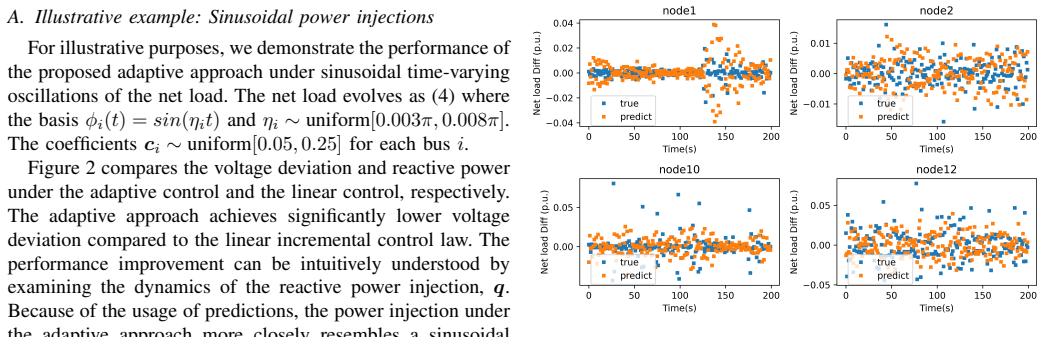
- [Section V.B, Fig. 5] The text states that the adaptive approach in Fig. 5(a) outperforms the linear controller in Fig. 5(b), but the caption labels (a) as Linear and (b) as Adaptive. This mismatch should be corrected.
- [Algorithm 1 and Eq. (31)] The loss expression in Eq. (31) is missing parentheses around the sum of C_q and C_v. In addition, Algorithm 1 uses alpha both as the learning rate and as the adaptation forgetting factor of Eq. (11b); the notation should be disambiguated.
Circularity Check
No significant circularity: the adaptive derivation is self-contained; the main proof gaps are correctness issues, not input-output circularity.
full rationale
The paper's central derivation (Sections III-B through IV-D) constructs a closed-loop model (10)-(11) from the LinDistFlow relation, a basis-function model of net-load increments (4), and an adaptive controller (11). Lemma 1's equilibrium expression and Theorem 2's eigenvalue conditions are derived algebraically from these definitions and do not fit any target quantity to data. The ISS claim in Theorem 1 has a genuine proof gap—the bound on the product of the M(j) matrices does not follow from a pointwise spectral-radius bound for non-normal/time-varying matrices—and Eq. (2b) vs (3c) has a time-index inconsistency; both are mathematical correctness concerns, not circularity. The self-citations ([11], [22], [46]) are for external data, an RL training procedure, and prior stability conditions, and they are not load-bearing for the main theorem. The equilibrium claim v*→0 as alpha→1 is an algebraic consequence of the adaptive-law definition, not a fitted prediction, so no circular step is established.
Assumptions & free parameters
free parameters (5)
- alpha (adaptation forgetting factor) =
0.99 in experiments
- epsilon (stability margin) =
0.01 in experiments
- A_i (adaptation gain matrices) =
tuned via RL in Algorithm 1
- k_i (base control gains) =
tuned via RL
- basis functions phi_i(t) =
chosen by user, sinusoidal in illustrative test, unspecified for real data
assumptions (6)
- domain assumption LinDistFlow model v = R p + X q + 1 holds with positive definite X and R
- ad hoc to paper Net load increments follow p_i(t+1)-p_i(t) = c_i^T phi_i(t) + Delta p_i(t) with constant coefficients c_i
- ad hoc to paper Non-local load variations can be represented through local basis functions as (D_o c^T phi)_i = theta_i^cor phi_i + Delta_i^phi
- domain assumption The network matrix X is known exactly
- domain assumption The prediction and model residual delta_v(t) is bounded
- ad hoc to paper Time-varying transition matrices M(t) act as contractions based only on their eigenvalue bounds
Cite this review
Pith. "Pith review of Leveraging Predictions in Power System Voltage Control: An Adaptive Approach." pith.science (2026). https://pith.science/paper/MHVFH3IC
@misc{pith2026250909937,
  author       = {Pith},
  title        = {Pith review of: Leveraging Predictions in Power System Voltage Control: An Adaptive Approach},
  year         = {2026},
  howpublished = {\url{https://pith.science/paper/MHVFH3IC}},
  note         = {Machine review of arXiv:2509.09937}
}
read the original abstract
High variability of solar PV and sudden changes in load (e.g., electric vehicles and storage) can lead to large voltage fluctuations in the distribution system. In recent years, a number of controllers have been designed to optimize voltage control. These controllers, however, almost always assume that the net load in the system remains constant over a sufficiently long time, such that the control actions converge before the load changes again. Given the intermittent and uncertain nature of renewable resources, it is becoming important to explicitly consider net load that is time-varying. This paper proposes an adaptive approach to voltage control in power systems with significant time-varying net load. We leverage advances in short-term load forecasting, where the net load in the system can be partially predicted using local measurements. We integrate these predictions into the design of adaptive controllers, and prove that the overall control architecture achieves input-to-state stability in a decentralized manner. We optimize the control policy through reinforcement learning. Case studies are conducted using time-varying load data from a real-world distribution system.
Figures


Figures from the paper (2 more)


Reference graph
Works this paper leans on
-
[1]
Learning provably stable local volt/var controllers for efficient network operation,
Z. Yuan, G. Cavraro, M. K. Singh, and J. Cort ´es, “Learning provably stable local volt/var controllers for efficient network operation,”IEEE Transactions on Power Systems, vol. 39, no. 1, pp. 2066–2079, 2023
-
[2]
Options for control of reactive power by distributed photovoltaic generators,
K. Turitsyn, P. Sulc, S. Backhaus, and M. Chertkov, “Options for control of reactive power by distributed photovoltaic generators,”Proceedings of the IEEE, vol. 99, no. 6, pp. 1063–1073, 2011
2011
-
[3]
A distributed control strategy for reactive power compensation in smart microgrids,
S. Bolognani and S. Zampieri, “A distributed control strategy for reactive power compensation in smart microgrids,”IEEE Transactions on Automatic Control, vol. 58, no. 11, pp. 2818–2833, 2013
2013
-
[4]
Adaptive var control for distribution circuits with photovoltaic generators,
H.-G. Yeh, D. F. Gayme, and S. H. Low, “Adaptive var control for distribution circuits with photovoltaic generators,”IEEE Transactions on Power Systems, vol. 27, no. 3, pp. 1656–1663, 2012
2012
-
[5]
An optimal and distributed method for voltage regulation in power distribution systems,
B. Zhang, A. Y . Lam, A. D. Dom´ınguez-Garc´ıa, and D. Tse, “An optimal and distributed method for voltage regulation in power distribution systems,”IEEE Transactions on Power Systems, vol. 30, no. 4, pp. 1714– 1726, 2014
2014
-
[6]
Real-time decentralized voltage control in distribution networks,
N. Li, G. Qu, and M. Dahleh, “Real-time decentralized voltage control in distribution networks,” in2014 52nd Annual Allerton Conference on Communication, Control, and Computing (Allerton). IEEE, 2014, pp. 582–588
2014
-
[7]
Fast local voltage control under limited reactive power: Optimality and stability analysis,
H. Zhu and H. J. Liu, “Fast local voltage control under limited reactive power: Optimality and stability analysis,”IEEE Transactions on Power Systems, vol. 31, no. 5, pp. 3794–3803, 2015
2015
-
[8]
Active load control in islanded microgrids based on the grid voltage,
T. L. Vandoorn, B. Renders, L. Degroote, B. Meersman, and L. Van- develde, “Active load control in islanded microgrids based on the grid voltage,”IEEE Transactions on Smart Grid, vol. 2, no. 1, pp. 139–151, 2010
2010
Show all 47 references
-
[9]
Local voltage control in distribution systems: An incremental control algorithm,
M. Farivar, X. Zho, and L. Chen, “Local voltage control in distribution systems: An incremental control algorithm,” in2015 IEEE international conference on smart grid communications (SmartGridComm). IEEE, 2015, pp. 732–737
2015
-
[10]
Optimal distributed feedback voltage control under limited reactive power,
G. Qu and N. Li, “Optimal distributed feedback voltage control under limited reactive power,”IEEE Transactions on Power Systems, vol. 35, no. 1, pp. 315–331, 2019
2019
-
[11]
Decentralized safe reinforcement learning for inverter-based voltage control,
W. Cui, J. Li, and B. Zhang, “Decentralized safe reinforcement learning for inverter-based voltage control,”Electric Power Systems Research, vol. 211, p. 108609, 2022
2022
-
[12]
Stability constrained reinforcement learning for decentralized real-time voltage control,
J. Feng, Y . Shi, G. Qu, S. H. Low, A. Anandkumar, and A. Wierman, “Stability constrained reinforcement learning for decentralized real-time voltage control,”IEEE Transactions on Control of Network Systems, vol. 11, no. 3, pp. 1370–1381, 2023
2023
-
[13]
Bridging transient and steady- state performance in voltage control: A reinforcement learning approach with safe gradient flow,
J. Feng, W. Cui, J. Cort ´es, and Y . Shi, “Bridging transient and steady- state performance in voltage control: A reinforcement learning approach with safe gradient flow,”IEEE Control Systems Letters, vol. 7, pp. 2845– 2850, 2023
2023
-
[14]
Robust volt/var control with photovoltaics,
R. A. Jabr, “Robust volt/var control with photovoltaics,”IEEE Transac- tions on Power Systems, vol. 34, no. 3, pp. 2401–2408, 2019
2019
-
[15]
Robust con- strained model predictive voltage control in active distribution net- works,
S. Maharjan, A. M. Khambadkone, and J. C.-H. Peng, “Robust con- strained model predictive voltage control in active distribution net- works,”IEEE Transactions on Sustainable Energy, vol. 12, no. 1, pp. 400–411, 2020
2020
-
[16]
Robust online voltage control with an unknown grid topology,
C. Yeh, J. Yu, Y . Shi, and A. Wierman, “Robust online voltage control with an unknown grid topology,” inProceedings of the Thirteenth ACM international conference on future energy systems, 2022, pp. 240–250
2022
-
[17]
V oltage control in active distribution networks under uncertainty in the system model: A robust optimization approach,
K. Christakou, M. Paolone, and A. Abur, “V oltage control in active distribution networks under uncertainty in the system model: A robust optimization approach,”IEEE Transactions on Smart Grid, vol. 9, no. 6, pp. 5631–5642, 2017
2017
-
[18]
Distributed voltage control in distribution networks: Online and robust implementations,
H. J. Liu, W. Shi, and H. Zhu, “Distributed voltage control in distribution networks: Online and robust implementations,”IEEE Transactions on Smart Grid, vol. 9, no. 6, pp. 6106–6117, 2017
2017
-
[19]
Data- driven affinely adjustable robust volt/var control,
N. Shi, R. Cheng, L. Liu, Z. Wang, Q. Zhang, and M. J. Reno, “Data- driven affinely adjustable robust volt/var control,”IEEE Transactions on Smart Grid, vol. 15, no. 1, pp. 247–259, 2023
2023
-
[20]
A stacked gru-rnn-based approach for predicting renewable energy and electricity load for smart grid operation,
M. Xia, H. Shao, X. Ma, and C. W. De Silva, “A stacked gru-rnn-based approach for predicting renewable energy and electricity load for smart grid operation,”IEEE Transactions on Industrial Informatics, vol. 17, no. 10, pp. 7050–7059, 2021
2021
-
[21]
Data- driven probabilistic net load forecasting with high penetration of behind- the-meter pv,
Y . Wang, N. Zhang, Q. Chen, D. S. Kirschen, P. Li, and Q. Xia, “Data- driven probabilistic net load forecasting with high penetration of behind- the-meter pv,”IEEE Transactions on Power Systems, vol. 33, no. 3, pp. 3255–3264, 2017
2017
-
[22]
A digital twin of an electrical distribution grid: Socal 28-bus dataset,
Y . Xie, L. Werner, K. Chen, T.-L. Le, C. Ortega, and S. Low, “A digital twin of an electrical distribution grid: Socal 28-bus dataset,”arXiv preprint arXiv:2504.06588, 2025
2025 arXiv
-
[23]
N. E. M. Associationet al.,American National Standard for Electric Power Systems and Equipment-Voltage Ratings (60 Hertz). National Electrical Manufacturers Association, 1996
1996
-
[24]
Convex relaxation of optimal power flow—part i: For- mulations and equivalence,
S. H. Low, “Convex relaxation of optimal power flow—part i: For- mulations and equivalence,”IEEE Transactions on Control of Network Systems, vol. 1, no. 1, pp. 15–27, 2014
2014
-
[25]
Optimal sizing of capacitors placed on a radial distribution system,
M. Baran and F. F. Wu, “Optimal sizing of capacitors placed on a radial distribution system,”IEEE Transactions on power Delivery, vol. 4, no. 1, pp. 735–743, 2002
2002
-
[26]
A note on branch flow models with line shunts,
F. Zhou and S. H. Low, “A note on branch flow models with line shunts,” IEEE Transactions on Power Systems, vol. 36, no. 1, pp. 537–540, 2020
2020
-
[27]
A generalized lindistflow model for power flow analysis,
J. Huang, B. Cui, X. Zhou, and A. Bernstein, “A generalized lindistflow model for power flow analysis,” in2021 60th IEEE Conference on Decision and Control (CDC). IEEE, 2021, pp. 3493–3500
2021
-
[28]
Equilibrium and dynamics of local voltage control in distribution systems,
M. Farivar, L. Chen, and S. Low, “Equilibrium and dynamics of local voltage control in distribution systems,” in52nd IEEE Conference on Decision and Control. IEEE, 2013, pp. 4329–4334
2013
-
[29]
A decentralized and cooper- ative architecture for optimal voltage regulation in smart grids,
A. Vaccaro, G. Velotto, and A. F. Zobaa, “A decentralized and cooper- ative architecture for optimal voltage regulation in smart grids,”IEEE Transactions on Industrial Electronics, vol. 58, no. 10, pp. 4593–4602, 2011
2011
-
[30]
Optimal smart inverters volt-var curve selection with a multi-objective volt-var optimization using evolutionary algorithm approach,
M. Jafari, T. O. Olowu, and A. I. Sarwat, “Optimal smart inverters volt-var curve selection with a multi-objective volt-var optimization using evolutionary algorithm approach,” in2018 North American Power Symposium (NAPS). IEEE, 2018, pp. 1–6
2018
-
[31]
Design and stability of load- side primary frequency control in power systems,
C. Zhao, U. Topcu, N. Li, and S. Low, “Design and stability of load- side primary frequency control in power systems,”IEEE Transactions on Automatic Control, vol. 59, no. 5, pp. 1177–1189, 2014
2014
-
[32]
Optimal load-side control for frequency regulation in smart grids,
E. Mallada, C. Zhao, and S. Low, “Optimal load-side control for frequency regulation in smart grids,”IEEE Transactions on Automatic Control, vol. 62, no. 12, pp. 6294–6309, Dec. 2017
2017
-
[33]
Using battery storage for peak shaving and frequency regulation: Joint optimization for superlinear gains,
Y . Shi, B. Xu, D. Wang, and B. Zhang, “Using battery storage for peak shaving and frequency regulation: Joint optimization for superlinear gains,”IEEE Transactions on Power Systems, vol. 33, no. 3, pp. 2882– 2894, 2017
2017
-
[34]
Energy forecasting: A review and outlook,
T. Hong, P. Pinson, Y . Wang, R. Weron, D. Yang, and H. Zareipour, “Energy forecasting: A review and outlook,”IEEE Open Access Journal of Power and Energy, vol. 7, pp. 376–388, 2020
2020
-
[35]
Multiple kernel learning- based transfer regression for electric load forecasting,
D. Wu, B. Wang, D. Precup, and B. Boulet, “Multiple kernel learning- based transfer regression for electric load forecasting,”IEEE Transac- tions on Smart Grid, vol. 11, no. 2, pp. 1183–1192, 2019
2019
-
[36]
Electric load forecasting using multiple output gaussian processes and multiple kernel learning,
A. Ghasempour and M. Mart ´ınez-Ram´on, “Electric load forecasting using multiple output gaussian processes and multiple kernel learning,” in2023 IEEE Symposium on Industrial Electronics & Applications (ISIEA). IEEE, 2023, pp. 1–6
2023
-
[37]
J.-J. E. Slotine, W. Liet al.,Applied nonlinear control. Prentice hall Englewood Cliffs, NJ, 1991, vol. 199, no. 1
1991
-
[38]
Neural-fly enables rapid learning for agile flight in strong winds,
M. O’Connell, G. Shi, X. Shi, K. Azizzadenesheli, A. Anandkumar, Y . Yue, and S.-J. Chung, “Neural-fly enables rapid learning for agile flight in strong winds,”Science Robotics, vol. 7, no. 66, p. eabm6597, 2022
2022
-
[39]
Meta-adaptive nonlinear control: Theory and algorithms,
G. Shi, K. Azizzadenesheli, M. O’Connell, S.-J. Chung, and Y . Yue, “Meta-adaptive nonlinear control: Theory and algorithms,”Advances in Neural Information Processing Systems, vol. 34, pp. 10 013–10 025, 2021
2021
-
[40]
Ieee standard for interconnection and interoperability of distributed energy resources with associated electric power systems interfaces,
D. G. Photovoltaics and E. Storage, “Ieee standard for interconnection and interoperability of distributed energy resources with associated electric power systems interfaces,”IEEE std, vol. 1547, no. 1547, p. 2018, 2018
2018
-
[41]
Input-to-state stability for discrete-time nonlinear systems,
Z.-P. Jiang and Y . Wang, “Input-to-state stability for discrete-time nonlinear systems,”Automatica, vol. 37, no. 6, pp. 857–869, 2001
2001
-
[42]
Patopaem: A data-driven parameter and topology joint estimation framework for time-varying system in distribution grids,
J. Yu, Y . Weng, and R. Rajagopal, “Patopaem: A data-driven parameter and topology joint estimation framework for time-varying system in distribution grids,”IEEE Transactions on Power Systems, vol. 34, no. 3, pp. 1682–1692, 2018
2018
-
[43]
Topology identification and line parameter estimation for non-pmu distribution network: A numerical method,
J. Zhang, Y . Wang, Y . Weng, and N. Zhang, “Topology identification and line parameter estimation for non-pmu distribution network: A numerical method,”IEEE Transactions on Smart Grid, vol. 11, no. 5, pp. 4440– 4453, 2020
2020
-
[44]
Data-driven modeling for distribution grids under partial observability,
S. Lin and H. Zhu, “Data-driven modeling for distribution grids under partial observability,”arXiv preprint arXiv:2108.08350, 2021
2021 arXiv
-
[45]
Characterization of radiofrequency emissions from two mod- els of wireless smartmeters,
R. Kavet, “Characterization of radiofrequency emissions from two mod- els of wireless smartmeters,”Project Manager Electric Power Research Institute, EPRI, 2011
2011
-
[46]
Reinforcement learning for optimal frequency control: A lyapunov approach,
W. Cui and B. Zhang, “Reinforcement learning for optimal frequency control: A lyapunov approach,”arXiv preprint arXiv:2009.05654, 2020
2009 arXiv
-
[47]
Network reconfiguration in distribution systems for loss reduction and load balancing,
M. E. Baran and F. F. Wu, “Network reconfiguration in distribution systems for loss reduction and load balancing,”IEEE Power Engineering Review, vol. 9, no. 4, pp. 101–102, 1989
1989
Reviewed August 4, 2026 · model on record in the stance chip above.
Discussion (0). Continue with ORCID to comment.