REVIEW 3 major objections 4 minor 40 references
Multi-Objective Optimizations of High Gradient C-band Photoinjector for High Bunch Charge Applications
T0 review · 3 major / 4 minor · reviewed 2026-08-04 · deepseek-v4-flash
Pith's one-line read Sacrificial-charge aperture more than halves emittance for high-charge C-band photoinjector bunches
desk verdict Solid simulation design study with an honest MTE re-evaluation, but the headline emittances are an idealized aperture envelope, and the state-of-the-art claim is not quantified. read the letter →
The pith
A machine-rendered reading of the paper's core claim, the machinery that carries it, and where it could break.
The reading
What carries the argument
The sacrificial-charge scheme: the beam is non-laminarly focused by one or two solenoids so that space-charge forces from the beam periphery (the sacrificial particles) linearize the slice phase space of a dense central core, which is then selected by an aperture at each evaluation point. The optimization is carried out with a Multi-Objective Genetic Algorithm (MOGA) that varies initial beam parameters (charge, transverse and longitudinal profiles, laser pulse shape, gun phase, solenoid strengths and positions) to minimize emittance and bunch length, yielding Pareto fronts. A symmetrized photoinjector cell cross-section is introduced to remove field asymmetries that distorted the beam.
What would settle it
Build or simulate the proposed 240 MV/m C-band photoinjector with a physical single aperture placed at the optimum location, using a real photocathode with MTE of at least 35 meV, and measure the transverse emittance of the transmitted 250 pC bunch; if the emittance exceeds about 100 nm at 1.6 ps bunch length, the ideal-aperture claim fails.
Extended reading notes
Core claim
The central discovery is that deliberately discarding a fraction of the beam charge—the 'sacrificial charge'—can reverse nonlinear space-charge effects and dramatically reduce the emittance of the remaining 250 pC core. In multi-objective optimizations, at a root-mean-square bunch length of 1.6 ps, inserting an aperture that selects the bright core reduces the normalized transverse emittance from 120 nm to 58 nm (and as low as 54 nm in the best cases), assuming an initial mean transverse energy of 3-5 meV. The removed periphery applies an impulse that linearizes the radial slice phase space of the core during non-laminar focusing, an effect the paper demonstrates by showing that propagating
Load-bearing premise
The headline emittance values rest on the assumption that the photocathode can be initialized with negligible intrinsic emittance (MTE of 3-5 meV) and ideal truncated-Gaussian/supergaussian profiles, and that the aperture acts as a perfect radial selection with no wakefields or scattering.
Editorial extensions
If this is right
- If correct, a 240 MV/m C-band photoinjector with sacrificial charge can produce 250 pC bunches with emittance below 60 nm, more than doubling the 5D brightness compared to the no-aperture case.
- Re-evaluating the optimized settings with realistic photocathode mean transverse energies (35 meV for NaKSb near threshold, 130 meV for 515 nm illumination, 500 meV for Cu) yields emittances of roughly 100-180 nm, still competitive with or better than the current experimental state of the art.
- The symmetrized photoinjector cross-section alone improves emittance by up to 25% (without sacrificial charge) and reduces emittance by up to 45% with sacrificial charge, translating to a more than factor-of-three improvement in 5D brightness.
- The maximum 5D brightness obtained with sacrificial charge is about 6.5 × 10^16 A/m², achieved at bunch lengths around 0.6 ps (single solenoid) or 1.2 ps (two solenoids).
- The optimizer consistently favors longitudinally uniform (supergaussian power >20) and nearly transversely uniform initial distributions, indicating these profiles are essential to realizing the quoted emittances.
Reading between the lines
- The aperture is modeled as an ideal radial selection applied at every position along the beamline, but a physical aperture is a single-position device that will also introduce wakefields and scattering; the 54-58 nm values should be treated as upper-bound performance until a single fixed aperture is simulated with realistic aperture physics.
- The negligible intrinsic emittance assumption (MTE 3-5 meV) is not achievable with standard copper or alkali photocathodes at room temperature; the paper's own re-evaluation at MTE of 35 meV gives ~100 nm, suggesting the practical gain from sacrificial charge at 250 pC may be smaller than factor of two for real cathodes.
- The linearization mechanism likely generalizes beyond C-band and 250 pC: any photoinjector that can non-laminarly focus a beam with a shaped periphery could use sacrificial charge to reduce emittance of a high-charge core, making the technique a candidate for other frequencies and charge ranges.
- A testable extension would be to scan the aperture radius and longitudinal position as explicit optimization variables rather than selecting the 250 pC core at each location; if a single position works across the Pareto front, the practical feasibility is much higher.
Editorial analysis
A structured set of objections, weighed in public.
Referee Report
Summary. The manuscript reports multi-objective genetic-algorithm optimizations of a 1.6-cell C-band photoinjector operating at 240 MV/m, delivering 250 pC bunches. Three beamline configurations are compared: a baseline single-solenoid setup, a 'sacrificial charge' scheme with one solenoid, and a sacrificial-charge scheme with two solenoids. In the sacrificial-charge cases, particles outside a radial core are discarded before emittance evaluation, and the survivor emittance is minimized. The authors report a reduction from 127 nm emittance (no aperture) to 54–58 nm with the aperture, a maximum 5D brightness of roughly 6.5e16 A/m^2, and a significant benefit from a symmetrized gun cross-section. They conclude that the results surpass the experimental state of the art for similar bunch charge.
Significance. The study uses standard, well-documented simulation tools (GPT with space charge, CST-computed RF fields, Xopt MOGA) and presents a useful design exploration for a high-gradient C-band injector. The with/without sacrificial-charge comparison in Fig. 10 provides direct evidence that the sacrificial-charge mechanism linearizes the survivor phase space, which is a concrete and falsifiable simulation result. The MTE sensitivity study and the comparison of asymmetric versus symmetrized gun cross-sections are also valuable. However, the headline emittance values rest on an idealized post-hoc radial selection procedure and on an assumed negligible intrinsic emittance; the 'surpassing experimental state-of-the-art' claim is not backed by quantitative comparison. If the idealized-aperture issue is addressed and the claims are recalibrated, this would be a solid contribution to photoinjector optimization literature.
major comments (3)
- [Section IV, paragraph beginning 'In these optimizations...'] The aperture is implemented as a radial selection of particles at each evaluation location, not as a physical aperture element in GPT. There are no wakefields, edge scattering, or momentum kicks from aperture interception, and the aperture location z* is chosen after minimization over a set of locations (Section III) rather than being an optimization variable in Table I. Thus the 54–58 nm values are an idealized 'core-emittance envelope' that assumes a perfect aperture at the optimal position. Since the factor-of-two improvement over the no-aperture case depends entirely on this selection, the claim as stated is not yet tied to a physically realizable aperture. Please either include a simulated aperture with parasitic effects in the model or clearly relabel the result as an idealized bound and adjust the abstract/conclusion accordingly.
- [Section VI and Abstract] The statement that the results 'surpass the experimental state-of-the-art for beamlines with similar bunch charge' is not supported by any quantitative comparison to experimental measurements. The quoted values are obtained under the assumptions of negligible intrinsic emittance (MTE 3–5 meV) and ideal truncated-Gaussian/supergaussian initial distributions. When the optimized settings are re-evaluated at more realistic MTEs (Section V, Fig. 11), emittances increase to roughly 100–180 nm. Without a concrete table or references giving measured emittances/brightness from comparable 250 pC injectors, the 'surpass' claim is overreaching. Please add a quantitative benchmark or remove/soften the claim.
- [Section V, MTE re-evaluation] The re-evaluation at MTE = 35, 130, and 500 meV is performed using the settings optimized with MTE = 3 meV; it is not a re-optimization. At higher intrinsic emittance, different initial beam sizes, bunch lengths, or solenoid strengths could yield better final emittance than the non-re-optimized evaluation shows. The Conclusion's statement that 'emittances as low as 100 nm were obtained when re-evaluating ... typical from semiconductor photocathodes' should therefore be labeled as a lower-bound estimate from a non-optimized evaluation, not as an optimized design result.
minor comments (4)
- [Section VI] Typos: 'Additionaly' should be 'Additionally', 'founf' should be 'found', and 'The electron bunch is is accelerated' has a duplicated 'is'.
- [Section V, Fig. 13] The text says 'For the case with sacrificial charge, shown in 13a', but Fig. 13 panel (a) is the no-sacrificial-charge case; this should be Fig. 13(b).
- [Acknowledgments] Typo: 'Deportment of Energy' should be 'Department of Energy'.
- [Equations (1) and (2)] The brightness definition in Eq. (1) uses ϵn,4D while Eq. (2) defines ϵn as the fourth-root quantity. Please clarify explicitly that ϵn,4D in Eq. (1) is the per-plane normalized emittance defined by Eq. (2), to avoid ambiguity about 4D versus 2D emittance.
Circularity Check
No significant circularity: the Pareto fronts and emittance values are genuine MOGA simulation outputs, and the sacrificial-charge mechanism is independently demonstrated inside the paper.
full rationale
The paper's derivation chain is self-contained rather than circular. The central results are emittances and Pareto fronts produced by a Multi-Objective Genetic Algorithm (MOGA) that minimizes 4D emittance and bunch length over the explicit variable ranges in Table I; these are outcomes of simulation, not quantities imposed to equal the conclusions. The sacrificial-charge concept is taken from prior work [28], which includes overlapping authors, but the paper does not merely cite it: Fig. 10 propagates survivor particles without the sacrificial charge and directly shows that the phase space is not linearized ('we see the phase spaces after propagating without the sacrificial charge are not linearized as they are when propagated with sacrificial charge'), so the load-bearing physical mechanism is checked within the present simulations. The aperture is implemented as a post-hoc radial selection of particles to obtain 250 pC, which is an idealized representation of an aperture rather than a GPT-modeled aperture with wakefields and scattering; however, this is a modeling idealization and not circular, because the emittance of the selected core is not set to a target value but is computed from the tracked particle distribution. Similarly, the MTE dependence in Sec. V is explicitly presented as a re-evaluation of previously optimized settings, with the text noting 'these are not results from optimizations performed with different MTE values,' so no fitted input is relabeled as a prediction. No equation is defined in terms of the claimed result, no fitted parameter is renamed as a prediction, and no uniqueness theorem or ansatz is smuggled in via citation. The paper's external-benchmark and applicability concerns are correctness risks, not circularity.
Assumptions & free parameters
free parameters (7)
- Initial bunch charge Q (pC) =
Near-optimal 475-575 pC (cases 2/3), range 250-1000
- Initial transverse RMS size sigma_x,y (mm) =
Near-optimal 0.15-0.35 mm
- Truncation factor n_c =
0.10-0.26 (case 2), 0.72-0.89 (case 3)
- Initial RMS bunch length sigma_L (ps) =
Near-optimal 1.2-2.9 ps
- Supergaussian power p =
>=20 (near-optimal)
- Gun phase (deg) =
Near-optimal -3.4 to 0.6
- Solenoid strengths Bsol1/Bmax, Bsol2/Bmax =
Bsol1/Bmax 0.97-1.07, Bsol2/Bmax 0.97-0.98
assumptions (5)
- domain assumption The GPT space-charge tracking model is accurate for high-gradient, high-charge photoinjector dynamics (Section III, 'well benchmarked against experiments', cited only to the GPT website [34]).
- domain assumption The initial photoelectron bunch has negligible intrinsic emittance (MTE 3-5 meV) and can be shaped as a truncated radial Gaussian and supergaussian temporal profile (Section III; abstract qualifier).
- domain assumption The aperture is modeled as an ideal radial selection of the innermost 250 pC at each longitudinal evaluation location, with no wakefields, scattering, or fixed-aperture-position constraint (Section IV).
- domain assumption The CST-computed RF fields loaded into GPT faithfully represent the physical 1.6-cell distributed-coupling cavity (Section II).
- domain assumption The sacrificial-charge linearization mechanism from [28] transfers to this C-band, 240 MV/m, 250 pC beamline (Sections I and IV).
Cite this review
Pith. "Pith review of Multi-Objective Optimizations of High Gradient C-band Photoinjector for High Bunch Charge Applications." pith.science (2026). https://pith.science/paper/O3CKA2MH
@misc{pith2026250911014,
  author       = {Pith},
  title        = {Pith review of: Multi-Objective Optimizations of High Gradient C-band Photoinjector for High Bunch Charge Applications},
  year         = {2026},
  howpublished = {\url{https://pith.science/paper/O3CKA2MH}},
  note         = {Machine review of arXiv:2509.11014}
}
read the original abstract
The high gradients potentially achievable in distributed-coupling C-band photoinjectors make them attractive for many high brightness applications. Here we discuss optimization results for a 1.6 cell C-band photoinjector with a 240 MV/m peak field at the cathode that delivers a 250 pC electron bunch charge. We use a Multi-Objective Genetic Algorithm (MOGA), obtaining a Pareto front of emittance vs. bunch length. We also perform MOGA optimizations including an aperture to retain only a bright beam core. We find this reduces the emittance of the final beam by more than factor of 2 in some cases. For example, we find that at a root mean square bunch length of 1.6 ps, the use of an aperture improves the transverse emittance from 120 nm to 58 nm assuming negligible photocathode intrinsic emittance. The sacrificial charge at the periphery of the electron beam removed by the aperture linearizes the final slice phase space inside of the remaining beam core. The results obtained surpass the experimental state-of-the-art for beamlines with similar bunch charge.
Figures


Figures from the paper (8 more)




Reference graph
Works this paper leans on
-
[1]
S. Chen, N. D. Powers, I. Ghebregziabher, C. M. Mahar- jan, C. Liu, G. Golovin, S. Banerjee, J. Zhang, N. Cun- ningham, A. Moorti, S. Clarke, S. Pozzi, and D. P. Um- stadter, Mev-energy x rays from inverse compton scatter- ing with laser-wakefield accelerated electrons, Phys. Rev. Lett.110, 155003 (2013)
2013
-
[2]
W. S. Graves, J. Bessuille, P. Brown, S. Carbajo, V. Dol- gashev, K.-H. Hong, E. Ihloff, B. Khaykovich, H. Lin, K. Murari, E. A. Nanni, G. Resta, S. Tantawi, L. E. Zapata, F. X. K¨ artner, and D. E. Moncton, Compact x- ray source based on burst-mode inverse compton scatter- ing at 100 khz, Phys. Rev. ST Accel. Beams17, 120701 (2014)
2014
-
[3]
Pellegrini, A
C. Pellegrini, A. Marinelli, and S. Reiche, The physics of x-ray free-electron lasers, Rev. Mod. Phys.88, 015006 (2016)
2016
-
[4]
P. Emma, R. Akre, J. Arthur, R. Bionta, C. Bost- edt, J. Bozek, A. Brachmann, P. Bucksbaum, R. Cof- fee, F.-J. Decker, Y. Ding, D. Dowell, S. Edstrom, A. Fisher, J. Frisch, S. Gilevich, J. Hastings, G. Hays, P. Hering, Z. Huang, R. Iverson, H. Loos, M. Messer- schmidt, A. Miahnahri, S. Moeller, H.-D. Nuhn, G. Pile, D. Ratner, J. Rzepiela, D. Schultz, T. S...
2010
-
[5]
M. Altarelli, The european x-ray free-electron laser fa- cility in hamburg, Nuclear Instruments and Methods in Physics Research Section B: Beam Interactions with Ma- terials and Atoms269, 2845 (2011), proceedings of the 10th European Conference on Accelerators in Applied Research and Technology (ECAART10)
2011
-
[6]
J. B. Rosenzweig, N. Majernik, R. R. Robles, G. Ando- nian, O. Camacho, A. Fukasawa, A. Kogar, G. Lawler, J. Miao, P. Musumeci, B. Naranjo, Y. Sakai, R. Can- dler, B. Pound, C. Pellegrini, C. Emma, A. Halavanau, J. Hastings, Z. Li, M. Nasr, S. Tantawi, P. Anisi- mov, B. Carlsten, F. Krawczyk, E. Simakov, L. Fail- lace, M. Ferrario, B. Spataro, S. Karkare,...
2020
-
[7]
E. C. Schreiber, R. S. Canon, B. T. Crowley, C. R. Howell, J. H. Kelley, V. N. Litvinenko, S. O. Nelson, S. H. Park, I. V. Pinayev, R. M. Prior, K. Sabourov, M. Spraker, W. Tornow, Y. Wu, E. A. Wulf, and H. R. Weller, First measurement of the near-threshold 2H( → γ , n)panalyzing power using a free-electron laser based γ-ray source, Phys. Rev. C61, 061604 (2000)
2000
-
[8]
H. N. Chapman, A. Barty, M. J. Bogan, S. Boutet, M. Frank, S. P. Hau-Riege, S. Marchesini, B. W. Woods, S. Bajt, W. H. Benner, R. A. London, E. Pl¨ onjes, M. Kuhlmann, R. Treusch, S. D¨ usterer, T. Tschentscher, J. R. Schneider, E. Spiller, T. M¨ oller, C. Bostedt, M. Hoener, D. A. Shapiro, K. O. Hodgson, D. van der Spoel, F. Burmeister, M. Bergh, C. Cale...
2006
Show all 40 references
-
[9]
H. N. Chapman, S. P. Hau-Riege, M. J. Bogan, S. Bajt, A. Barty, S. Boutet, S. Marchesini, M. Frank, B. W. Woods, W. H. Benner, R. A. London, U. Rohner, A. Sz¨ oke, E. Spiller, T. M¨ oller, C. Bostedt, D. A. Shapiro, M. Kuhlmann, R. Treusch, E. Pl¨ onjes, F. Burmeister, M. Berg...
2007
-
[10]
F. E. Carroll, Tunable monochromatic x rays: A new paradigm in medicine, American Journal of Roentgenol- ogy179, 583 (2002), pMID: 12185024
2002
-
[11]
K. J. Weeks, V. N. Litvinenko, and J. M. J. Madey, The compton backscattering process and radiotherapy, Med- ical Physics24, 417 (1997)
1997
-
[12]
E. R. Hosler, O. R. W. II, and W. A. Barletta, Free- electron laser emission architecture impact on extreme ul- traviolet lithography, Journal of Micro/Nanolithography, MEMS, and MOEMS16, 041009 (2017)
2017
-
[13]
I. V. Bazarov, B. M. Dunham, and C. K. Sinclair, Max- imum achievable beam brightness from photoinjectors, Phys. Rev. Lett.102, 104801 (2009)
2009
-
[14]
Karkare, G
S. Karkare, G. Adhikari, W. A. Schroeder, J. K. Nan- goi, T. Arias, J. Maxson, and H. Padmore, Ultracold electrons via near-threshold photoemission from single- crystal cu(100), Phys. Rev. Lett.125, 054801 (2020)
2020
-
[15]
Cultrera, E
L. Cultrera, E. Rocco, F. Shahedipour-Sandvik, L. D. Bell, J. K. Bae, I. V. Bazarov, P. Saha, S. Karkare, and A. Arjunan, Photoemission characterization of N- polar III-nitride photocathodes as candidate bright elec- tron beam sources for accelerator applications, Journal of A...
2022
-
[16]
S. K. Mohanty, M. Krasilnikov, A. Oppelt, F. Stephan, D. Sertore, L. Monaco, C. Pagani, and W. Hillert, Devel- opment and characterization of multi-alkali antimonide photocathodes for high-brightness rf photoinjectors, Mi- cromachines14, 10.3390/mi14061182 (2023)
2023 doi
-
[17]
Martinez-Calderon, E
M. Martinez-Calderon, E. Chevallay, R. E. Rossel, L. B. Jones, G. Zevi Della Porta, B. Marsh, and E. Granados, Fabrication and rejuvenation of high quantum efficiency caesium telluride photocathodes for high brightness and high average current photoinjectors, Phys. Rev. Accel....
2024
-
[18]
C. T. Parzyck, C. A. Pennington, W. J. I. DeBenedetti, J. Balajka, E. M. Echeverria, H. Paik, L. Moreschini, B. D. Faeth, C. Hu, J. K. Nangoi, V. Anil, T. A. Arias, M. A. Hines, D. G. Schlom, A. Galdi, K. M. Shen, and J. M. Maxson, Atomically smooth films of CsSb: A chem- 10 i...
2023
-
[19]
Musumeci, J
P. Musumeci, J. Giner Navarro, J. Rosenzweig, L. Cultr- era, I. Bazarov, J. Maxson, S. Karkare, and H. Padmore, Advances in bright electron sources, Nuclear Instruments and Methods in Physics Research Section A: Acceler- ators, Spectrometers, Detectors and Associated Equip- me...
2018
-
[20]
Filippetto, P
D. Filippetto, P. Musumeci, M. Zolotorev, and G. Stu- pakov, Maximum current density and beam brightness achievable by laser-driven electron sources, Phys. Rev. ST Accel. Beams17, 024201 (2014)
2014
-
[21]
A. D. Cahill, J. B. Rosenzweig, V. A. Dolgashev, S. G. Tantawi, and S. Weathersby, High gradient experiments withx-band cryogenic copper accelerating cavities, Phys. Rev. Accel. Beams21, 102002 (2018)
2018
-
[22]
J. B. Rosenzweig, A. Cahill, V. Dolgashev, C. Emma, A. Fukasawa, R. Li, C. Limborg, J. Maxson, P. Musumeci, A. Nause, R. Pakter, R. Pompili, R. Rous- sel, B. Spataro, and S. Tantawi, Next generation high brightness electron beams from ultrahigh field cryogenic rf photocathode ...
2019
-
[23]
Rosenzweig, A
J. Rosenzweig, A. Cahill, B. Carlsten, G. Castorina, M. Croia, C. Emma, A. Fukusawa, B. Spataro, D. Alesini, V. Dolgashev, M. Ferrario, G. Lawler, R. Li, C. Lim- borg, J. Maxson, P. Musumeci, R. Pompili, S. Tantawi, and O. Williams, Ultra-high brightness electron beams from ve...
2018
-
[24]
Schneider, V
M. Schneider, V. Dolgashev, J. W. Lewellen, S. G. Tantawi, E. A. Nanni, M. Zuboraj, R. Fleming, D. Gorelov, M. Middendorf, and E. I. Simakov, High gra- dient off-axis coupled C-band Cu and CuAg accelerating structures, Applied Physics Letters121, 254101 (2022)
2022
-
[25]
M. Bai, T. Barklow, R. Bartoldus, M. Breidenbach, P. Grenier, Z. Huang, M. Kagan, J. Lewellen, Z. Li, T. W. Markiewicz, E. A. Nanni, M. Nasr, C.-K. Ng, M. Oriunno, M. E. Peskin, T. G. Rizzo, J. Rosenzweig, A. G. Schwartzman, V. Shiltsev, E. Simakov, B. Spataro, D. Su, S. Tanta...
2021 arXiv
-
[26]
E. I. Simakov, A. M. Alexander, P. M. Anisimov, W. C. Barkley, W. B. Haynes, E. Henestroza, S. S. Kuren- noy, D. Rai, T. Tajima, H. Xu, M. R. A. Zuboraj, and J. Upadhyay, Lanl’s carie mev photoinjector test facility (2023)
2023
-
[27]
E. I. Simakovet al., Update on the status of the c- band high gradient program at lanl, inProc. IPAC’23, IPAC’23 - 14th International Particle Accelerator Confer- ence No. 14 (JACoW Publishing, Geneva, Switzerland,
-
[28]
survivors
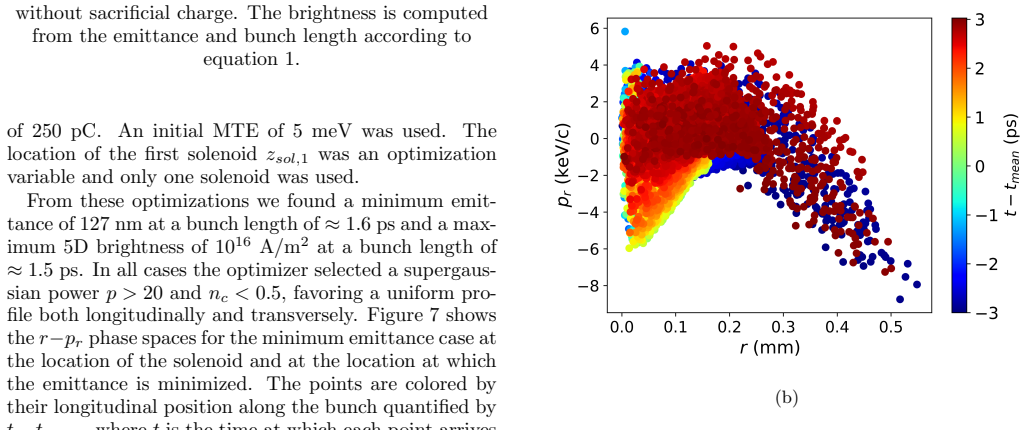
to our beamline and desired bunch charge. In these optimizations, the initial bunch charge is a variable parameter to be optimized. Prior to comput- ing the transverse emittance, at each location along the beamline, the particles within some radius are selected. This radius is...
-
[29]
W. H. Li, A. C. Bartnik, A. Fukasawa, M. Kaemingk, G. Lawler, N. Majernik, J. B. Rosenzweig, and J. M. Maxson, Compensating slice emittance growth in high brightness photoinjectors using sacrificial charge, Phys. Rev. Accel. Beams27, 084401 (2024)
2024
-
[30]
R. R. Robles, O. Camacho, A. Fukasawa, N. Majernik, and J. B. Rosenzweig, Versatile, high brightness, cryo- genic photoinjector electron source, Phys. Rev. Accel. Beams24, 063401 (2021)
2021
-
[31]
Schneideret al., High gradient c-band cryogenic cop- per silver structures, inProc
M. Schneideret al., High gradient c-band cryogenic cop- per silver structures, inProc. IPAC’24, IPAC’24 - 15th International Particle Accelerator Conference No. 15 (JACoW Publishing, Geneva, Switzerland, 2024) pp. 519–522
2024
-
[32]
Xuet al., C-band photoinjector radiofrequency cavity design for enhanced beam generation, inProc
H. Xuet al., C-band photoinjector radiofrequency cavity design for enhanced beam generation, inProc. IPAC’23, IPAC’23 - 14th International Particle Accelerator Confer- ence No. 14 (JACoW Publishing, Geneva, Switzerland,
-
[33]
Xuet al., Rf and multipactor analysis for the carie rf photoinjector with a photocathode insert, inProc
H. Xuet al., Rf and multipactor analysis for the carie rf photoinjector with a photocathode insert, inProc. IPAC’24, IPAC’24 - 15th International Particle Accel- erator Conference No. 15 (JACoW Publishing, Geneva, Switzerland, 2024) pp. 3251–3253
2024
-
[34]
Alexanderet al., High gradient rf photoinjector at lanl, inProc
A. Alexanderet al., High gradient rf photoinjector at lanl, inProc. IPAC’24, IPAC’24 - 15th International Par- ticle Accelerator Conference No. 15 (JACoW Publishing, Geneva, Switzerland, 2024) pp. 2916–2921
2024
-
[35]
Pulsar website for gpt,http://www.pulsar.nl/gpt/ (2011)
2011
-
[36]
Rousselet al., Xopt: A simplified framework for op- timization of accelerator problems using advanced algo- rithms, inProc
R. Rousselet al., Xopt: A simplified framework for op- timization of accelerator problems using advanced algo- rithms, inProc. 14th International Particle Accelerator Conference, IPAC’23 - 14th International Particle Accel- erator Conference No. 14 (JACoW Publishing, Geneva, S...
2023
-
[37]
I. V. Bazarov, B. M. Dunham, Y. Li, X. Liu, D. G. Ouzounov, C. K. Sinclair, F. Hannon, and T. Miyajima, Thermal emittance and response time measurements of negative electron affinity photocathodes, Journal of Ap- plied Physics103, 054901 (2008)
2008
-
[38]
H. Lee, S. Karkare, L. Cultrera, A. Kim, and I. V. Bazarov, Review and demonstration of ultra-low- emittance photocathode measurements, Review of Sci- entific Instruments86, 073309 (2015)
2015
-
[40]
Serafini and J
L. Serafini and J. B. Rosenzweig, Envelope analysis of intense relativistic quasilaminar beams in rf photoinjec- tors:ma theory of emittance compensation, Phys. Rev. E 55, 7565 (1997)
1997
-
[41]
Maxson, L
J. Maxson, L. Cultrera, C. Gulliford, and I. Bazarov, Measurement of the tradeoff between intrinsic emittance and quantum efficiency from a NaKSb photocathode near threshold, Applied Physics Letters106, 234102 (2015)
2015
Reviewed August 4, 2026 · model on record in the stance chip above.
Discussion (0). Continue with ORCID to comment.