Overcoming limitations on gate fidelity in noisy static exchange-coupled surface qubits
Pith reviewed 2026-05-18 15:07 UTC · model grok-4.3
The pith
Quantum optimal control pulses can reach gate fidelities above 0.9 in static exchange-coupled surface qubits by adapting to noise, outperforming standard Rabi driving.
A machine-rendered reading of the paper's core claim, the machinery that carries it, and where it could break.
Core claim
In open-system simulations of exchange-coupled surface qubits, the Krotov quantum optimal control method produces gate operations with fidelity F ≳ 0.9 when noise spectra, lifetimes, and initial-state polarization are accounted for; the resulting pulses outperform conventional Rabi driving and point to redesigned experimental setups that maximize fidelity.
What carries the argument
Krotov iterative optimal-control algorithm applied to the Lindblad master equation of the exchange-coupled spin system.
If this is right
- Gate fidelities of 0.9 or higher become attainable once control pulses are optimized for the measured noise and coupling strengths.
- Krotov pulses systematically outperform fixed-frequency Rabi driving for the same platform parameters.
- Modest changes to the original experimental geometry and pulse shaping can push achievable fidelity higher.
Where Pith is reading between the lines
- The same optimal-control strategy could be applied to other atom-on-surface or fixed-coupling qubit arrays where conventional driving is constrained.
- Multi-qubit entangling gates in this platform would likely require similar pulse optimization rather than simple extensions of single-qubit Rabi drives.
- If the simulated fidelity gains hold in experiment, surface-atom arrays could become a viable route to small-scale quantum processors without needing tunable couplers.
Load-bearing premise
The open quantum system model used in the simulations accurately captures the dominant noise sources, lifetime limits, and initial-state polarization present in the actual experimental surface-qubit platform.
What would settle it
Implement the Krotov-derived pulses on the same surface-atom hardware used in the original experiments and measure the resulting two-qubit gate fidelity; a value well below 0.9 while the measured noise and lifetime parameters remain close to the simulated values would falsify the claim.
Figures




read the original abstract
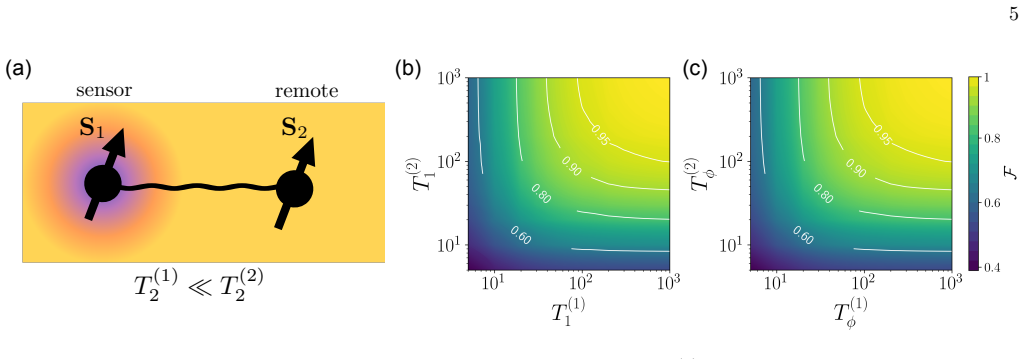
Recent experiments demonstrated that the spin state of individual atoms on surfaces can be quantum-coherently controlled through all-electric electron spin resonance. By constructing interacting arrays of atoms this results in an atomic-scale qubit platform. However, the static exchange coupling between qubits, limited lifetime and polarization of the initial state, impose significant limits on high-fidelity quantum control. We address this issue using open quantum systems simulation and quantum optimal control theory. We demonstrate the conditions under which high-fidelity operations ($\mathcal{F} \gtrsim 0.9$) are feasible in this qubit platform, and show how the Krotov method of quantum optimal control theory adapts to specific noise sources to outperform the conventional Rabi drivings. Finally, we re-examine the experimental setup used in the initial demonstration of this qubit platform and propose optimized experimental designs to maximize gate fidelity in this platform.
Editorial analysis
A structured set of objections, weighed in public.
Referee Report
Summary. The paper uses open-quantum-system master-equation simulations of surface-atom qubits with static exchange coupling, finite lifetime, and partial initial-state polarization. It applies the Krotov optimal-control algorithm to design driving pulses that achieve gate fidelities F ≳ 0.9 and shows these pulses outperform conventional Rabi driving; the work concludes by proposing concrete modifications to the experimental geometry and pulse parameters of the original surface-qubit demonstration.
Significance. If the noise model is representative, the results supply a practical route to usable two-qubit gates in an atomic-scale platform whose main decoherence channels are already identified. The explicit comparison of Krotov versus Rabi under the same Lindblad operators, together with the re-optimization of the existing experimental layout, constitutes a concrete, falsifiable prediction that experimental groups can test directly.
major comments (1)
- [Simulation section (model definition and parameter table)] The central fidelity threshold F ≳ 0.9 and the claimed superiority of Krotov control rest entirely on the open-system model (Lindblad operators, decoherence rates, and initial polarization). No section compares these rates or the resulting T1, T2 values to the experimental numbers reported in the referenced surface-qubit demonstration; without this anchoring the predicted feasibility window remains unverified.
minor comments (2)
- [Figures 3 and 4] Figure captions should state the precise pulse bandwidth and the number of Krotov iterations used to reach the reported fidelities.
- [Abstract] The abstract states that the Krotov method 'adapts to specific noise sources'; a one-sentence summary of which noise operators are actively compensated would help readers immediately see the mechanism.
Simulated Author's Rebuttal
We thank the referee for the detailed and constructive report. The suggestion to explicitly anchor the noise model to experimental data is well taken and will improve the clarity of the work. We address the major comment below.
read point-by-point responses
-
Referee: [Simulation section (model definition and parameter table)] The central fidelity threshold F ≳ 0.9 and the claimed superiority of Krotov control rest entirely on the open-system model (Lindblad operators, decoherence rates, and initial polarization). No section compares these rates or the resulting T1, T2 values to the experimental numbers reported in the referenced surface-qubit demonstration; without this anchoring the predicted feasibility window remains unverified.
Authors: We agree that an explicit comparison is necessary to verify the model. The Lindblad rates and initial polarization in our simulations are taken directly from the experimental parameters of the referenced surface-qubit demonstration (finite lifetime and partial polarization). However, the manuscript does not contain a dedicated comparison of the resulting T1 and T2 times. In the revised version we will add a new paragraph and table in the Simulation section that (i) lists the experimental T1/T2 values from the reference, (ii) shows the mapping to our chosen decoherence rates, and (iii) discusses any approximations involved. This addition will make the feasibility window directly falsifiable against the cited experiment. revision: yes
Circularity Check
No circularity: numerical predictions from explicit open-system model
full rationale
The paper applies standard Lindblad master equations and Krotov optimal control numerics to a parameterized model of static exchange coupling, lifetime, and initial polarization. The reported fidelities (F ≳ 0.9) and claimed advantage over Rabi driving are direct outputs of these simulations under the stated assumptions; they do not reduce by construction to any fitted parameter or self-citation that encodes the target result. The derivation chain is therefore self-contained and externally falsifiable against future experiments on the physical platform.
Axiom & Free-Parameter Ledger
axioms (1)
- domain assumption The dynamics of the surface qubits are well-described by a Lindblad master equation with Markovian noise.
Lean theorems connected to this paper
-
IndisputableMonolith/Cost/FunctionalEquation.leanwashburn_uniqueness_aczel unclear?
unclearRelation between the paper passage and the cited Recognition theorem.
The total Hamiltonian reads H(t) = −∑ωi Szi + ∑Jij Si·Sj + ∑Ωk cos(ωRFk τk + ϕk) σxi (Eq. 1); dynamics via GKSL master equation with collapse operators for energy relaxation and pure dephasing (Methods).
-
IndisputableMonolith/Foundation/AlphaCoordinateFixation.leanJ_uniquely_calibrated_via_higher_derivative unclear?
unclearRelation between the paper passage and the cited Recognition theorem.
Krotov method … adapts to specific noise sources to outperform the conventional Rabi drivings … average fidelities of 0.989 for the NOT gate and 0.887 for the CNOT gate
What do these tags mean?
- matches
- The paper's claim is directly supported by a theorem in the formal canon.
- supports
- The theorem supports part of the paper's argument, but the paper may add assumptions or extra steps.
- extends
- The paper goes beyond the formal theorem; the theorem is a base layer rather than the whole result.
- uses
- The paper appears to rely on the theorem as machinery.
- contradicts
- The paper's claim conflicts with a theorem or certificate in the canon.
- unclear
- Pith found a possible connection, but the passage is too broad, indirect, or ambiguous to say the theorem truly supports the claim.
Reference graph
Works this paper leans on
-
[1]
In addition to the fidelity between Bell state and the final state (obtained via Krotov method), we use concurrence Cof the final state as an additional metric. Concurrence quantifies entanglement of two qubits: concurrence of fully separated states is zero and concurrence of maximally entangled states such as Bell states is one. Figures 4(a) and (b) pres...
-
[2]
Y. Wang, Y. Chen, H. T. Bui, C. Wolf, M. Haze, C. Mier, J. Kim, D.-J. Choi, C. P. Lutz, Y. Bae, S. hyon Phark, and A. J. Heinrich, An atomic-scale multi-qubit platform, Science382, 87 (2023)
work page 2023
-
[3]
C. Wolf, A. J. Heinrich, and S.-h. Phark, On-surface atomic scale qubit platform, ACS nano18, 28469 (2024)
work page 2024
-
[4]
Y. Chen, Y. Bae, and A. J. Heinrich, Harnessing the quantum behavior of spins on surfaces, Advanced Mate- rials35, 2107534 (2023)
work page 2023
-
[5]
S. Baumann, W. Paul, T. Choi, C. P. Lutz, A. Ardavan, and A. J. Heinrich, Electron paramagnetic resonance of individual atoms on a surface, Science350, 417 (2015)
work page 2015
-
[6]
T. S. Seifert, S. Kovarik, D. M. Juraschek, N. A. Spaldin, P. Gambardella, and S. Stepanow, Longitudinal and transverse electron paramagnetic resonance in a scan- ning tunneling microscope, Science advances6, eabc5511 (2020)
work page 2020
-
[7]
K. Yang, W. Paul, S.-H. Phark, P. Willke, Y. Bae, T. Choi, T. Esat, A. Ardavan, A. J. Heinrich, and C. P. Lutz, Coherent spin manipulation of individual atoms on a surface, Science366, 509 (2019)
work page 2019
- [8]
-
[9]
Y. Wang, M. Haze, H. T. Bui, W.-h. Soe, H. Aubin, A. Ardavan, A. J. Heinrich, and S.-h. Phark, Universal quantum control of an atomic spin qubit on a surface, npj Quantum Information9, 48 (2023)
work page 2023
- [10]
- [11]
-
[12]
H. T. Bui, C. Wolf, Y. Wang, M. Haze, A. Ardavan, A. J. Heinrich, and S.-h. Phark, All-electrical driving and probing of dressed states in a single spin, ACS Nano18, 12187 (2024)
work page 2024
-
[13]
D.-J. Choi, S.-h. Phark, A. J. Heinrich, and N. Lorente, Electron spin resonance with scanning tunneling mi- croscopy: a tool for an on-surface quantum platform of identical qubits, arXiv preprint arXiv:2505.10079 10.48550/arXiv.2505.10079 (2025)
-
[14]
C. Rigetti and M. Devoret, Fully microwave-tunable uni- versal gates in superconducting qubits with linear cou- plings and fixed transition frequencies, Phys. Rev. B81, 134507 (2010)
work page 2010
- [15]
-
[16]
I. Heinz and G. Burkard, Crosstalk analysis for single- qubit and two-qubit gates in spin qubit arrays, Phys. Rev. B104, 045420 (2021)
work page 2021
-
[17]
L. M. K. Vandersypen and I. L. Chuang, Nmr techniques for quantum control and computation, Rev. Mod. Phys. 76, 1037 (2005)
work page 2005
- [18]
-
[20]
H.-P. Breuer and F. Petruccione,The Theory of Open Quantum Systems(Oxford University Press, 2007)
work page 2007
- [21]
-
[22]
Zhao, Mitigation of quantum crosstalk in cross- resonance-based qubit architectures, Phys
P. Zhao, Mitigation of quantum crosstalk in cross- resonance-based qubit architectures, Phys. Rev. Appl. 20, 054033 (2023)
work page 2023
-
[23]
I. Heinz and G. Burkard, High-fidelity cnot gate for spin qubits with asymmetric driving using virtual gates, Phys. Rev. B105, L121402 (2022)
work page 2022
-
[24]
D. A. Lidar, I. L. Chuang, and K. B. Whaley, Decoherence-free subspaces for quantum computation, Phys. Rev. Lett.81, 2594 (1998)
work page 1998
-
[25]
Y. Bae, K. Yang, P. Willke, T. Choi, A. J. Heinrich, and C. P. Lutz, Enhanced quantum coherence in exchange coupled spins via singlet-triplet transitions, Science Ad- vances4, eaau4159 (2018)
work page 2018
- [26]
- [27]
-
[28]
J. Clausen, G. Bensky, and G. Kurizki, Bath-optimized minimal-energy protection of quantum operations from decoherence, Phys. Rev. Lett.104, 040401 (2010)
work page 2010
-
[29]
C. Brif, R. Chakrabarti, and H. Rabitz, Control of quan- tum phenomena: past, present and future, New Journal of Physics12, 075008 (2010)
work page 2010
-
[30]
S. J. Glaser, U. Boscain, T. Calarco, C. P. Koch, W. K¨ ockenberger, R. Kosloff, I. Kuprov, B. Luy, S. Schirmer, T. Schulte-Herbr¨ uggen,et al., Training schr¨ odinger’s cat: Quantum optimal control: Strategic report on current status, visions and goals for research in europe, The European Physical Journal D69, 1 (2015)
work page 2015
-
[31]
J. P. Palao and R. Kosloff, Quantum computing by an optimal control algorithm for unitary transformations, Phys. Rev. Lett.89, 188301 (2002)
work page 2002
-
[32]
J. P. Palao and R. Kosloff, Optimal control theory for unitary transformations, Phys. Rev. A68, 062308 (2003)
work page 2003
-
[33]
N. Khaneja, T. Reiss, C. Kehlet, T. Schulte-Herbr¨ uggen, and S. J. Glaser, Optimal control of coupled spin dy- namics: design of nmr pulse sequences by gradient as- cent algorithms, Journal of Magnetic Resonance172, 296 (2005)
work page 2005
-
[34]
T. E. Skinner, T. O. Reiss, B. Luy, N. Khaneja, and S. J. Glaser, Application of optimal control theory to the design of broadband excitation pulses for high-resolution nmr, Journal of Magnetic Resonance163, 8 (2003)
work page 2003
- [35]
-
[36]
V. F. Krotov and I. Feldman, An iterative method for solving optimal control problems, Eng. Cybern21, 123 (1983)
work page 1983
-
[37]
J. Soml´ oi, V. A. Kazakov, and D. J. Tannor, Controlled dissociation of i2 via optical transitions between the x and b electronic states, Chemical Physics172, 85 (1993)
work page 1993
-
[38]
D. M. Reich, M. Ndong, and C. P. Koch, Monotoni- cally convergent optimization in quantum control using krotov’s method, The Journal of chemical physics136, doi:10.1063/1.3691827 (2012)
-
[39]
X.-L. He, J. Q. You, Y.-x. Liu, L. F. Wei, and F. Nori, Switchable coupling between charge and flux qubits, Phys. Rev. B76, 024517 (2007)
work page 2007
-
[40]
G. Burkard, T. D. Ladd, A. Pan, J. M. Nichol, and J. R. Petta, Semiconductor spin qubits, Rev. Mod. Phys.95, 025003 (2023)
work page 2023
-
[41]
M. Russ, D. M. Zajac, A. J. Sigillito, F. Borjans, J. M. Taylor, J. R. Petta, and G. Burkard, High-fidelity quan- tum gates in si/sige double quantum dots, Phys. Rev. B 97, 085421 (2018)
work page 2018
-
[42]
F. Nosrati, A. Castellini, G. Compagno, and R. Lo Franco, Robust entanglement preparation against noise by controlling spatial indistinguishability, npj Quantum Information6, 39 (2020)
work page 2020
-
[43]
H. Yu, Z. Wang, and J.-H. Wu, Entanglement prepa- ration and nonreciprocal excitation evolution in giant atoms by controllable dissipation and coupling, Phys. Rev. A104, 013720 (2021)
work page 2021
-
[44]
M. A. Nielsen and I. L. Chuang,Quantum computation and quantum information(Cambridge University Press, 2010)
work page 2010
-
[45]
F. Verstraete and H. Verschelde, Fidelity of mixed states of two qubits, Phys. Rev. A66, 022307 (2002)
work page 2002
-
[46]
M. H. Goerz, D. M. Reich, and C. P. Koch, Optimal control theory for a unitary operation under dissipative evolution, New Journal of Physics16, 055012 (2014)
work page 2014
-
[47]
D. Jankovi´ c, J.-G. Hartmann, M. Ruben, and P.-A. Hervieux, Noisy qudit vs multiple qubits: conditions on gate efficiency for enhancing fidelity, npj Quantum Infor- mation10, 10.1038/s41534-024-00829-6 (2024). 13
-
[48]
J.-G. Hartmann, D. Jankovi´ c, R. Pasquier, M. Ruben, and P.-A. Hervieux, Nonlinearity of the fidelity in open qudit systems: Gate and noise dependence in high- dimensional quantum computing, Quantum9, 1690 (2025)
work page 2025
-
[49]
I. I. Sobel’Man, L. A. Vainshtein, and E. A. Yukov,Exci- tation of atoms and broadening of spectral lines, Vol. 15 (Springer Science & Business Media, 2012)
work page 2012
-
[50]
S. hyon Phark, H. T. Bui, W. hyo Seo, Y. Liu, V. Sheina, C. Lee, C. Wolf, A. J. Heinrich, R. Rob- les, and N. Lorente, Spin-state engineering of single ti- tanium adsorbates on ultrathin magnesium oxide (2025), arXiv:2507.23299 [cond-mat.mes-hall]
-
[51]
W. Paul, K. Yang, S. Baumann, N. Romming, T. Choi, C. P. Lutz, and A. J. Heinrich, Control of the millisec- ond spin lifetime of an electrically probed atom, Nature Physics13, 403 (2017)
work page 2017
-
[52]
R. Broekhoven, C. Lee, S.-h. Phark, S. Otte, and C. Wolf, Protocol for certifying entanglement in surface spin sys- tems using a scanning tunneling microscope, npj Quan- tum Information10, 92 (2024)
work page 2024
-
[53]
L. H. Pedersen, N. M. Møller, and K. Mølmer, Fidelity of quantum operations, Physics Letters A367, 47 (2007)
work page 2007
-
[54]
J. Johansson, P. Nation, and F. Nori, Qutip: An open- source python framework for the dynamics of open quan- tum systems, Computer Physics Communications183, 1760 (2012)
work page 2012
-
[55]
M. H. Goerz, D. Basilewitsch, F. Gago-Encinas, M. G. Krauss, K. P. Horn, D. M. Reich, and C. P. Koch, Kro- tov: A Python implementation of Krotov’s method for quantum optimal control, SciPost Phys.7, 80 (2019)
work page 2019
-
[56]
M. A. Nielsen, A simple formula for the average gate fi- delity of a quantum dynamical operation, Physics Letters A303, 249 (2002)
work page 2002
-
[57]
W. K. Wootters, Entanglement of formation of an ar- bitrary state of two qubits, Phys. Rev. Lett.80, 2245 (1998). 14 Supplemental Material Overcoming limitations on gate fidelity in noisy static exchange-coupled surface qubits For most of the simulations we used a drift Hamiltonian withω 1 = 20πGHz, ω 2 = 14πGHz, J= 5 GHz. This Hamiltonian is partially op...
work page 1998
discussion (0)
Sign in with ORCID, Apple, or X to comment. Anyone can read and Pith papers without signing in.