Measurement of the W to μ ν_μ cross-sections as a function of the muon transverse momentum in pp collisions at 5.02 TeV
Pith reviewed 2026-05-18 14:50 UTC · model grok-4.3
The pith
LHCb measures W to muon neutrino cross sections differentially at 5.02 TeV and extracts the W mass from the shape of those distributions.
A machine-rendered reading of the paper's core claim, the machinery that carries it, and where it could break.
Core claim
The integrated cross-sections are σ(W+ → μ+ νμ) = 300.9 ± 2.4 ± 3.8 ± 6.0 pb and σ(W- → μ- ν̄μ) = 236.9 ± 2.1 ± 2.7 ± 4.7 pb, consistent with theory. A new method on detector-corrected differential cross-sections yields mW = 80369 ± 130 ± 33 MeV, where the first uncertainty is experimental and the second is theoretical.
What carries the argument
New method that determines the W-boson mass by comparing the shape of the measured differential cross section versus muon transverse momentum to theoretical templates that vary with the assumed W mass value.
If this is right
- The measured integrated cross sections agree with standard model predictions within the quoted uncertainties.
- The twelve-bin differential distributions provide detailed kinematic information for testing W production calculations.
- The new mass-extraction technique demonstrates that differential cross-section shapes can be used to constrain the W mass.
- Larger datasets would allow this method to reach higher statistical precision on mW.
Where Pith is reading between the lines
- The approach could be applied at other collision energies to provide independent checks on existing W-mass results.
- Reducing theoretical uncertainties on the predicted shapes would directly improve the precision of any future mass extraction using this technique.
- Combining the differential shape information with traditional transverse-mass fits might reduce certain systematic uncertainties in precision electroweak measurements.
Load-bearing premise
The W-mass extraction assumes that theoretical calculations accurately describe how the shape of the differential cross section depends on the W mass and that unfolding for detector effects does not introduce significant bias in the fit.
What would settle it
A statistically significant difference between the extracted mW and the world average when the same analysis is repeated on an independent dataset or with much higher integrated luminosity would indicate that the method or its assumptions require revision.
Figures




read the original abstract
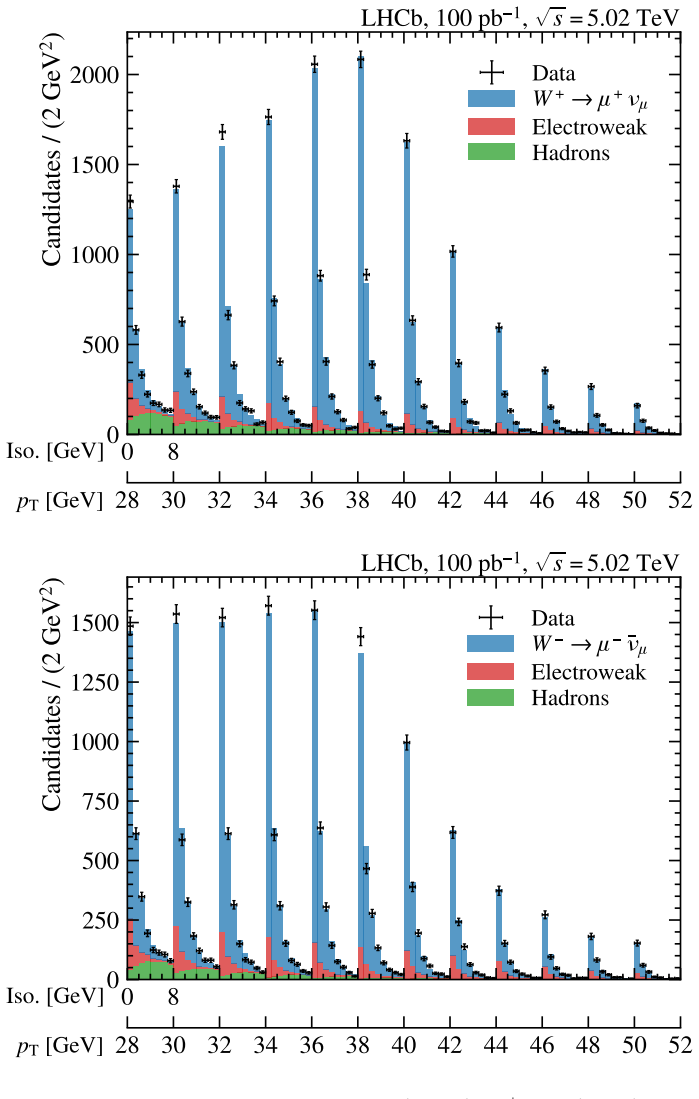
The $pp \to W^{\pm} (\to \mu^{\pm} \nu_{\mu}) X$ cross-sections are measured at a proton-proton centre-of-mass energy $\sqrt{s} = 5.02$ TeV using a dataset corresponding to an integrated luminosity of 100 pb$^{-1}$ recorded by the LHCb experiment. Considering muons in the pseudorapidity range $2.2 < \eta < 4.4$, the cross-sections are measured differentially in twelve intervals of muon transverse momentum between $28 < p_\mathrm{T} < 52$ GeV. Integrated over $p_\mathrm{T}$, the measured cross-sections are \begin{align*} \sigma_{W^+ \to \mu^+ \nu_\mu} &= 300.9 \pm 2.4 \pm 3.8 \pm 6.0~\text{pb}, \\ \sigma_{W^- \to \mu^- \bar{\nu}_\mu} &= 236.9 \pm 2.1 \pm 2.7 \pm 4.7~\text{pb}, \end{align*} where the first uncertainties are statistical, the second are systematic, and the third are associated with the luminosity calibration. These integrated results are consistent with theoretical predictions. This analysis introduces a new method to determine the $W$-boson mass using the measured differential cross-sections corrected for detector effects. The measurement is performed on this statistically limited dataset as a proof of principle and yields \begin{align*} m_W = 80369 \pm 130 \pm 33~\text{MeV}, \end{align*} where the first uncertainty is experimental and the second is theoretical.
Editorial analysis
A structured set of objections, weighed in public.
Referee Report
Summary. The manuscript reports measurements of the W± → μ±νμ cross-sections in pp collisions at √s = 5.02 TeV with the LHCb detector using 100 pb⁻¹ of data. Differential cross-sections are presented in twelve bins of muon pT (28–52 GeV) for 2.2 < η < 4.4. Integrated cross-sections are σ(W+ → μ+νμ) = 300.9 ± 2.4 ± 3.8 ± 6.0 pb and σ(W- → μ-ν̄μ) = 236.9 ± 2.1 ± 2.7 ± 4.7 pb, stated to be consistent with theoretical predictions. A new method extracts mW from detector-corrected differential cross-sections, giving mW = 80369 ± 130 ± 33 MeV (experimental and theoretical uncertainties) as a proof-of-principle on this statistically limited sample.
Significance. If the results hold, the integrated and differential cross-section measurements supply useful forward-region data at low LHC energy for PDF studies and theory validation. The introduction of a detector-corrected pT-based method for mW extraction is a positive technical development that could complement traditional approaches, and the paper appropriately labels it a proof-of-principle given the 100 pb⁻¹ luminosity. The quoted consistency of cross-sections with theory is a clear strength.
major comments (2)
- The section on the W-mass extraction (around the description of the template fit to unfolded pT distributions) does not provide sufficient detail on the unfolding procedure, including how the response matrix or correction factors are derived and validated. Explicit closure tests or pseudo-experiment studies demonstrating that unfolding introduces no pT-dependent shape bias at the level affecting the 130 MeV experimental uncertainty are needed, as this directly impacts the central claim of the new method.
- In the theoretical modeling and fit description, the paper states that mW variations dominate the pT shape changes within the 28–52 GeV window while other effects (PDFs, higher-order QCD, QED radiation, parton shower) are sub-dominant or parameterized. No quantitative sensitivity studies or alternative template variations are shown to bound the impact of these assumptions on the fitted mass; with only 100 pb⁻¹ this is load-bearing for the reliability of the 130 MeV uncertainty.
Simulated Author's Rebuttal
We thank the referee for their positive evaluation of the significance of our results and for the detailed and constructive major comments. We address each point below and have revised the manuscript to incorporate additional details and studies as appropriate.
read point-by-point responses
-
Referee: The section on the W-mass extraction (around the description of the template fit to unfolded pT distributions) does not provide sufficient detail on the unfolding procedure, including how the response matrix or correction factors are derived and validated. Explicit closure tests or pseudo-experiment studies demonstrating that unfolding introduces no pT-dependent shape bias at the level affecting the 130 MeV experimental uncertainty are needed, as this directly impacts the central claim of the new method.
Authors: We agree that expanded documentation of the unfolding procedure is needed to fully support the proof-of-principle mass extraction. In the revised manuscript we have added a dedicated subsection describing the construction of the response matrix from fully simulated samples (including detector response and selection efficiencies), the iterative unfolding algorithm employed, and the validation strategy. We now include explicit closure-test results on independent simulated samples and pseudo-experiment ensembles that quantify any residual pT-dependent shape bias; these studies confirm that such biases remain well below the threshold that would affect the quoted 130 MeV experimental uncertainty. revision: yes
-
Referee: In the theoretical modeling and fit description, the paper states that mW variations dominate the pT shape changes within the 28–52 GeV window while other effects (PDFs, higher-order QCD, QED radiation, parton shower) are sub-dominant or parameterized. No quantitative sensitivity studies or alternative template variations are shown to bound the impact of these assumptions on the fitted mass; with only 100 pb⁻¹ this is load-bearing for the reliability of the 130 MeV uncertainty.
Authors: The referee is correct that quantitative sensitivity studies would strengthen the reliability assessment given the limited luminosity. While the original manuscript relied on theoretical arguments for the dominance of mW-induced shape changes, the revised version now contains explicit sensitivity studies. These vary the PDF sets, QCD scales, QED radiation parameters and parton-shower settings within their uncertainties and demonstrate that the resulting shifts in the extracted mW are covered by the assigned 33 MeV theoretical uncertainty. Results from alternative template variations are also shown to bound the modeling systematics. revision: yes
Circularity Check
No significant circularity in cross-section measurements or mW extraction
full rationale
The paper reports direct experimental measurements of integrated and differential W → μν cross-sections from 100 pb⁻¹ of LHCb data, with detector corrections applied to the pT distributions. The mW extraction fits the shape of these corrected distributions to external theoretical templates whose mW dependence is modeled independently of the present dataset. No step reduces by construction to the paper's own inputs: the integrated values are data-driven results compared to (not derived from) theory, and the mass fit imports the pT-shape sensitivity from outside generators rather than renaming a fitted parameter or self-citation as a prediction. The derivation chain remains self-contained against external benchmarks.
Axiom & Free-Parameter Ledger
free parameters (1)
- luminosity calibration factor
axioms (1)
- domain assumption Standard Model predictions for W production and decay kinematics are accurate enough for shape comparisons in the mass extraction
Lean theorems connected to this paper
-
IndisputableMonolith/Cost/FunctionalEquation.leanwashburn_uniqueness_aczel unclear?
unclearRelation between the paper passage and the cited Recognition theorem.
The differential cross-sections dσ/dpT are determined from a fit to the two-dimensional distributions... λs_i(dσ/dpT) = Lint Σj Rij dσ/dpTj ΔpT (response matrix unfolding)
-
IndisputableMonolith/Foundation/RealityFromDistinction.leanreality_from_one_distinction unclear?
unclearRelation between the paper passage and the cited Recognition theorem.
mW = 80369 ± 130 ± 33 MeV... fit minimises the χ² between the data and theoretical templates with mW as a free parameter
What do these tags mean?
- matches
- The paper's claim is directly supported by a theorem in the formal canon.
- supports
- The theorem supports part of the paper's argument, but the paper may add assumptions or extra steps.
- extends
- The paper goes beyond the formal theorem; the theorem is a base layer rather than the whole result.
- uses
- The paper appears to rely on the theorem as machinery.
- contradicts
- The paper's claim conflicts with a theorem or certificate in the canon.
- unclear
- Pith found a possible connection, but the passage is too broad, indirect, or ambiguous to say the theorem truly supports the claim.
Forward citations
Cited by 2 Pith papers
-
QCD, electroweak physics, and searches for exotic signatures in the forward region at LHCb
LHCb reports forward-region measurements of QCD jets, top and W bosons, plus searches for ALPs, HNLs, and rare B decays to multi-muons.
-
QCD, electroweak physics, and searches for exotic signatures in the forward region at LHCb
LHCb reports forward measurements of heavy-flavour jets, electroweak bosons, and searches for ALPs, HNLs, and rare multi-muon B decays.
Reference graph
Works this paper leans on
-
[1]
LHCb collaboration, A. A. Alves Jr.et al.,The LHCb detector at the LHC, JINST3 (2008) S08005
work page 2008
-
[2]
LHCb collaboration, R. Aaijet al.,LHCb detector performance, Int. J. Mod. Phys. A30(2015) 1530022,arXiv:1412.6352
work page internal anchor Pith review Pith/arXiv arXiv 2015
-
[3]
LHCb collaboration, R. Aaijet al.,Measurement of the Z boson production cross- section at 5.02 TeV, JHEP02(2024) 070,arXiv:2308.12940
-
[4]
LHCb collaboration, R. Aaijet al.,Measurement of the forward Z boson cross-section inppcollisions at √s=7 TeV, JHEP08(2015) 039,arXiv:1505.07024
work page internal anchor Pith review Pith/arXiv arXiv 2015
-
[5]
LHCb collaboration, R. Aaijet al.,Measurement of forward W and Z boson production inppcollisions at √s=8 TeV, JHEP01(2016) 155,arXiv:1511.08039
work page internal anchor Pith review Pith/arXiv arXiv 2016
-
[6]
LHCb collaboration, R. Aaijet al.,Precision measurement of forward Z boson production in proton-proton collisions at √s = 13 TeV, JHEP07(2022) 026, arXiv:2112.07458
-
[7]
Measurement of the forward $W$ boson cross-section in $pp$ collisions at $\sqrt{s} = 7 {\rm \, TeV}$
LHCb collaboration, R. Aaijet al.,Measurement of the forward W boson production cross-section in pp collisions at √s=7 TeV , JHEP12(2014) 079, arXiv:1408.4354
work page internal anchor Pith review Pith/arXiv arXiv 2014
-
[8]
Electroweak Measurements in Electron-Positron Collisions at W-Boson-Pair Energies at LEP
ALEPH, DELPHI, L3, OPAL, LEP Electroweak collaboration, S. Schaelet al., Electroweak measurements in electron-positron collisions at W-boson-pair energies at LEP, Phys. Rept.532(2013) 119,arXiv:1302.3415
work page internal anchor Pith review Pith/arXiv arXiv 2013
-
[9]
CMS collaboration, A. M. Sirunyan, A. Tumasyan, W. Adamet al.,High- precision measurement of the W boson mass with the CMS experiment at the LHC, arXiv:2412.13872, submitted for publication in Nature
work page internal anchor Pith review Pith/arXiv arXiv
-
[10]
ATLAS collaboration, G. Aadet al.,Measurement of the W-boson mass and width with the ATLAS detector using proton-proton collisions at √s = 7 TeV, Eur. Phys. J.C84(2024) 1309,arXiv:2403.15085
-
[11]
Aaijet al.,Measurement of the W boson mass, JHEP01 (2022) 036,arXiv:2109.01113
LHCb collaboration, R. Aaijet al.,Measurement of the W boson mass, JHEP01 (2022) 036,arXiv:2109.01113
-
[12]
CDF collaboration, T. Aaltonenet al.,High-precision measurement of the W-boson mass with the CDF II detector, Science376(2022) 170
work page 2022
-
[13]
D0 collaboration, V. M. Abazovet al.,Measurement of the W boson mass with the D0 detector, Phys. Rev. Lett.108(2012) 151804,arXiv:1203.0293
work page internal anchor Pith review Pith/arXiv arXiv 2012
-
[14]
LHC-TeV MW Working Group, S. Amorosoet al.,Compatibility and combi- nation of world W-boson mass measurements, Eur. Phys. J.C84(2024) 451, arXiv:2308.09417
- [15]
-
[16]
ATLAS collaboration, G. Aadet al.,Measurement of W ±-boson differential cross- sections in proton-proton collisions with low pile-up data at √s = 5.02TeV and13 TeV with the ATLAS detector, Eur. Phys. J.C85(2025) 729,arXiv:2502.09403
-
[17]
Precision luminosity measurements at LHCb
LHCb collaboration, R. Aaijet al.,Precision luminosity measurements at LHCb, JINST9(2014) P12005,arXiv:1410.0149
work page internal anchor Pith review Pith/arXiv arXiv 2014
-
[18]
Performance of the LHCb Vertex Locator
R. Aaijet al.,Performance of the LHCb Vertex Locator, JINST9(2014) P09007, arXiv:1405.7808
work page internal anchor Pith review Pith/arXiv arXiv 2014
-
[19]
Improved performance of the LHCb Outer Tracker in LHC Run 2
P. d’Argentet al.,Improved performance of the LHCb Outer Tracker in LHC Run 2, JINST12(2017) P11016,arXiv:1708.00819
work page internal anchor Pith review Pith/arXiv arXiv 2017
-
[20]
A. A. Alves Jr.et al.,Performance of the LHCb muon system, JINST8(2013) P02022,arXiv:1211.1346
work page internal anchor Pith review Pith/arXiv arXiv 2013
-
[21]
Design and performance of the LHCb trigger and full real-time reconstruction in Run 2 of the LHC
R. Aaijet al.,Design and performance of the LHCb trigger and full real-time recon- struction in Run 2 of the LHC, JINST14(2019) P04013,arXiv:1812.10790
work page internal anchor Pith review Pith/arXiv arXiv 2019
-
[22]
A Brief Introduction to PYTHIA 8.1
T. Sj¨ ostrand, S. Mrenna, and P. Skands,A brief introduction to PYTHIA 8.1, Comput. Phys. Commun.178(2008) 852,arXiv:0710.3820
work page internal anchor Pith review Pith/arXiv arXiv 2008
-
[23]
I. Belyaevet al.,Handling of the generation of primary events in Gauss, the LHCb simulation framework, J. Phys. Conf. Ser.331(2011) 032047
work page 2011
-
[24]
D. J. Lange,The EvtGen particle decay simulation package, Nucl. Instrum. Meth. A462(2001) 152
work page 2001
-
[25]
PHOTOS Interface in C++; Technical and Physics Documentation
N. Davidson, T. Przedzinski, and Z. Was,PHOTOS interface in C++: Technical and physics documentation, Comp. Phys. Comm.199(2016) 86,arXiv:1011.0937
work page internal anchor Pith review Pith/arXiv arXiv 2016
-
[26]
Allisonet al.,Geant4 developments and applications, IEEE Trans
Geant4 collaboration, J. Allisonet al.,Geant4 developments and applications, IEEE Trans. Nucl. Sci.53(2006) 270; Geant4 collaboration, S. Agostinelliet al.,Geant4: A simulation toolkit, Nucl. Instrum. Meth.A506(2003) 250
work page 2006
-
[27]
Clemencicet al.,The LHCb simulation application, Gauss: Design, evolution and experience, J
M. Clemencicet al.,The LHCb simulation application, Gauss: Design, evolution and experience, J. Phys. Conf. Ser.331(2011) 032023
work page 2011
- [28]
-
[29]
LHCb collaboration, R. Aaijet al.,Curvature-bias corrections using a pseudomass method, JINST19(2024) P03010,arXiv:2311.04670
-
[30]
R. J. Barlow and C. Beeston,Fitting using finite Monte Carlo samples, Comput. Phys. Commun.77(1993) 219
work page 1993
-
[31]
J. S. Conway,Incorporating nuisance parameters in likelihoods for multisource spectra, inProceedings of the PHYSTAT 2011 Workshop, 115–120, 2011,arXiv:1103.0354
work page internal anchor Pith review Pith/arXiv arXiv 2011
-
[32]
J. Campbell and T. Neumann,Precision phenomenology with MCFM, JHEP12 (2019) 034,arXiv:1909.09117. 26
-
[33]
Measurement of prompt hadron production ratios in $pp$ collisions at $\sqrt{s} = $ 0.9 and 7 TeV
LHCb collaboration, R. Aaijet al.,Measurement of prompt hadron production ratios in pp collisions at √s = 0 .9and 7 TeV, Eur. Phys. J.C72(2012) 2168, arXiv:1206.5160
work page internal anchor Pith review Pith/arXiv arXiv 2012
-
[34]
T.-J. Houet al.,New CTEQ global analysis of quantum chromodynamics with high- precision data from the LHC, Phys. Rev. D103(2021) 014013, arXiv:1912.10053
-
[35]
NNPDF collaboration, R. D. Ballet al.,Parton distributions from high-precision collider data, Eur. Phys. J. C77(2017) 663,arXiv:1706.00428
work page internal anchor Pith review Pith/arXiv arXiv 2017
- [36]
-
[37]
S. Baileyet al.,Parton distributions from LHC, HERA, Tevatron and fixed target data: MSHT20 PDFs,arXiv:2012.04684
-
[38]
MINLO: Multi-scale improved NLO
K. Hamilton, P. Nason, and G. Zanderighi,MINLO: Multi-Scale Improved NLO, JHEP10(2012) 155,arXiv:1206.3572
work page internal anchor Pith review Pith/arXiv arXiv 2012
-
[39]
Herwig 7.0 / Herwig++ 3.0 Release Note
J. Bellmet al.,Herwig 7.0/Herwig++ 3.0 release note, Eur. Phys. J.C76(2016) 196,arXiv:1512.01178
work page internal anchor Pith review Pith/arXiv arXiv 2016
-
[40]
J. C. Collins and D. E. Soper,Angular distribution of dileptons in high-energy hadron collisions, Phys. Rev.D16(1977) 2219
work page 1977
-
[41]
Camarda et al.,DYTurbo: Fast predictions for Drell-Yan processes, Eur
S. Camardaet al.,DYTurbo: fast predictions for Drell–Yan processes, Eur. Phys. J. C80(2020) 251, Erratum ibid.C80(2020) 440,arXiv:1910.07049
-
[42]
LHCb collaboration, R. Aaijet al.,Measurement of the effective leptonic weak mixing angle, JHEP12(2024) 026,arXiv:2410.02502
-
[43]
Halleret al.,Update of the global electroweak fit and constraints on two-Higgs- doublet models, Eur
J. Halleret al.,Update of the global electroweak fit and constraints on two-Higgs- doublet models, Eur. Phys. J.C78(2018) 675,arXiv:1803.01853. 27 LHCb collaboration R. Aaij38 , A.S.W. Abdelmotteleb 57 , C. Abellan Beteta 51 , F. Abudin´ en57 , T. Ackernley61 , A. A. Adefisoye 69 , B. Adeva47 , M. Adinolfi55 , P. Adlarson85 , C. Agapopoulou 14 , C.A. Aida...
discussion (0)
Sign in with ORCID, Apple, or X to comment. Anyone can read and Pith papers without signing in.