Finite-temperature Yang-Mills theories with the density of states method: towards the continuum limit
Pith reviewed 2026-05-18 14:25 UTC · model grok-4.3
The pith
The density of states method characterizes the first-order confinement-deconfinement transition in Sp(4) Yang-Mills theory on lattices with two temporal extents, showing consistent critical couplings and persistent non-perturbative features
A machine-rendered reading of the paper's core claim, the machinery that carries it, and where it could break.
Core claim
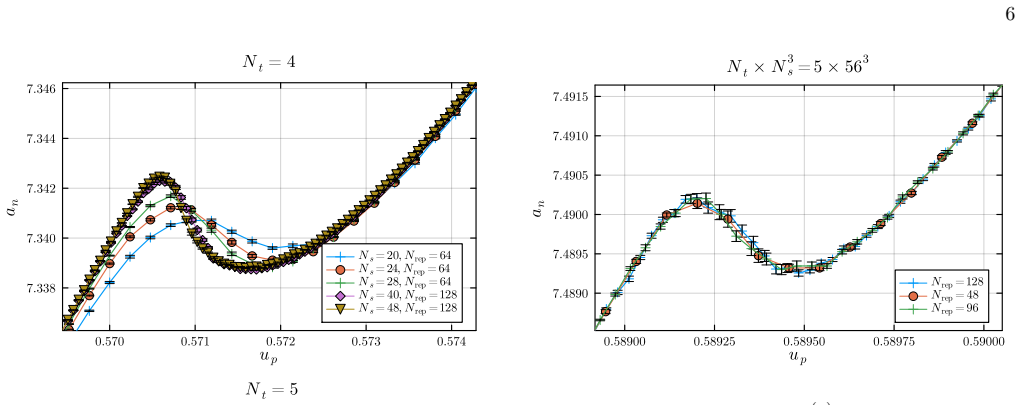
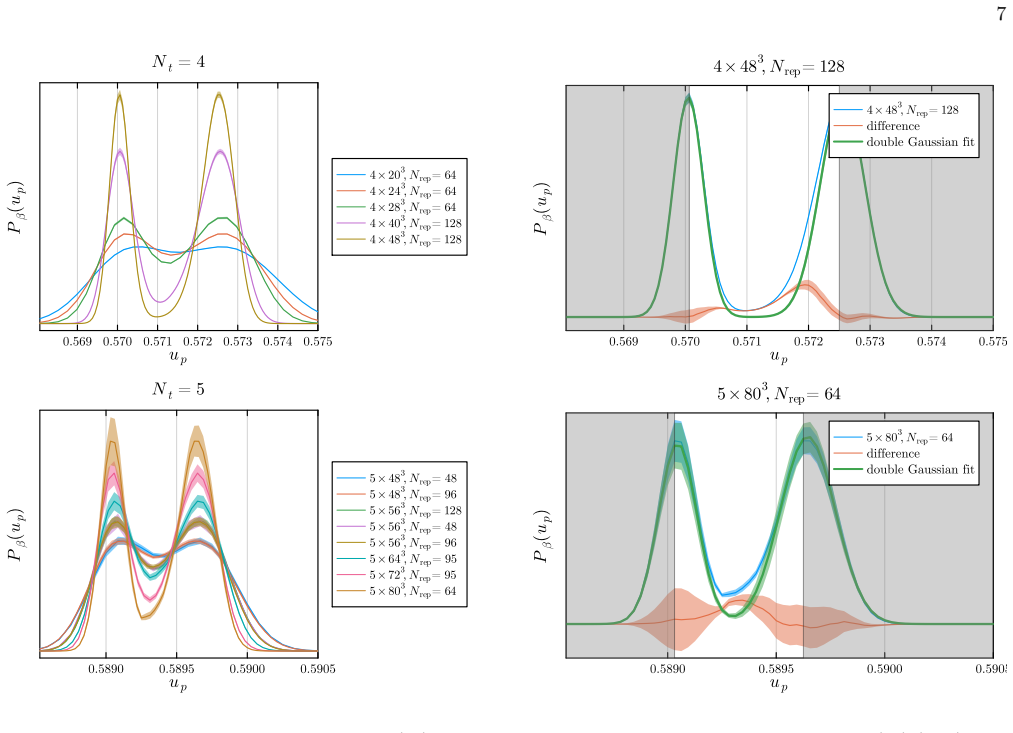
The density of states method successfully maps the first-order phase transition of Sp(4) Yang-Mills theory in the thermodynamic limit for two temporal extents. Coexistence of confined and deconfined states, metastability, latent heat, and surface tension all persist. Multiple strategies for determining the volume-dependent critical coupling produce consistent results, and the minimum spatial-to-temporal ratio required to isolate the surface-tension contribution scales non-trivially with the temporal size.
What carries the argument
The density of states method, which reconstructs the full density of states to compute thermodynamic observables across a first-order transition without relying on importance sampling.
If this is right
- Coexistence, metastability, latent heat and surface tension remain detectable in the infinite-volume limit for both temporal extents examined.
- The critical coupling can be located with small systematic differences across several independent extraction procedures.
- The minimum spatial-to-temporal ratio needed to resolve the surface-tension term grows non-trivially as the temporal extent increases.
- The method supplies the thermodynamic quantities required to estimate the gravitational-wave power spectrum from the transition.
Where Pith is reading between the lines
- Extending the study to additional temporal extents would allow a controlled continuum extrapolation of both the transition strength and the aspect-ratio scaling.
- The same density-of-states workflow could be applied to other gauge groups that appear in beyond-Standard-Model constructions to predict their gravitational-wave signatures.
- The observed consistency across extraction methods suggests the approach is already suitable for precision calculations of early-universe relics once larger volumes and finer lattices are reached.
Load-bearing premise
That the two chosen temporal extents are already close enough to the continuum for the observed non-trivial scaling of the minimum spatial-to-temporal ratio to be extrapolated without further lattice spacings for systematic control.
What would settle it
A third simulation at a significantly larger temporal extent in which the different critical-coupling extraction strategies disagree beyond the reported consistency or in which the surface-tension contribution to the free energy disappears at the expected aspect ratios.
Figures



read the original abstract
A first-order, confinement/deconfinement phase transition appears in the finite temperature behavior of many non-Abelian gauge theories. These theories play an important role in proposals for completion of the Standard Model of particle physics, hence the phase transition might have occurred in the early stages of evolution of our universe, leaving behind a detectable relic stochastic background of gravitational waves. Lattice field theory studies implementing the density of states method have the potential to provide detailed information about the phase transition, and measure the parameters determining the gravitational-wave power spectrum, by overcoming some the challenges faced with importance-sampling methods. We assess this potential for a representative choice of Yang-Mills theory with $Sp(4)$ gauge group. We characterize its finite-temperature, first-order phase transition, in the thermodynamic (infinite volume) limit, for two different choices of number of sites in the compact time direction, hence taking the first steps towards the continuum limit extrapolation. We demonstrate the persistence of non-perturbative phenomena associated to the first-order phase transition: coexistence of states, metastability, latent heat, surface tension. We find consistency between several different strategies for the extraction of the volume-dependent critical coupling, hence assessing the size of systematic effects. We also determine the minimum choice of ratio between spatial and time extent of the lattice that allows to identify the contribution of the surface tension to the free energy. We observe that this ratio scales non-trivially with the time extent of the lattice, and comment on the implications for future high-precision numerical studies.
Editorial analysis
A structured set of objections, weighed in public.
Referee Report
Summary. The manuscript applies the density of states method to Sp(4) Yang-Mills theory at finite temperature. For two values of the temporal extent N_t it characterizes the first-order confinement/deconfinement transition in the thermodynamic limit, demonstrating phase coexistence, metastability, latent heat and surface tension. It reports consistency among several volume-dependent critical-coupling extraction strategies and determines the minimum spatial-to-temporal aspect ratio that isolates the surface-tension contribution to the free energy, observing that this ratio scales non-trivially with N_t and commenting on implications for future continuum studies.
Significance. If the results hold, the work provides a useful demonstration that the density of states approach can access non-perturbative signatures of strong first-order transitions relevant to gravitational-wave production in beyond-Standard-Model scenarios. The internal consistency checks across extraction methods and the explicit recovery of metastability and surface tension are positive features. The limited number of N_t values, however, restricts the strength of any continuum-extrapolation statements.
major comments (1)
- [discussion of minimum aspect ratio and its N_t dependence] The observation that the minimum spatial-to-temporal ratio isolating the surface tension scales non-trivially with N_t is based on only two temporal extents. With two points it is impossible to discriminate between plausible functional forms (e.g., O(1/N_t) versus O(1/N_t^2)) or to quantify residual discretization effects that could alter the extrapolated minimum ratio; this directly affects the robustness of the comments on implications for future high-precision studies.
minor comments (1)
- [critical-coupling extraction] Clarify in the text whether the quoted uncertainties on the critical coupling include all systematic contributions from the chosen fitting windows and volume cuts.
Simulated Author's Rebuttal
We thank the referee for the positive assessment of our work and for the constructive comment on the robustness of our observations regarding the aspect-ratio scaling. We address the point below and will revise the manuscript accordingly.
read point-by-point responses
-
Referee: [discussion of minimum aspect ratio and its N_t dependence] The observation that the minimum spatial-to-temporal ratio isolating the surface tension scales non-trivially with N_t is based on only two temporal extents. With two points it is impossible to discriminate between plausible functional forms (e.g., O(1/N_t) versus O(1/N_t^2)) or to quantify residual discretization effects that could alter the extrapolated minimum ratio; this directly affects the robustness of the comments on implications for future high-precision studies.
Authors: We agree that data at only two values of N_t preclude a reliable fit to any specific functional form or a controlled extrapolation of the minimum aspect ratio to the continuum limit. Our manuscript does not claim such a fit or extrapolation. We report the measured minimum ratios at the two available N_t and observe that the ratio increases, which we characterize as non-trivial scaling. This qualitative observation already indicates that the minimum aspect ratio is not constant with N_t and carries implications for the computational resources required in future high-precision studies. To address the referee's concern, we will revise the manuscript to state explicitly that the limited number of N_t values restricts any quantitative statements about the scaling and to qualify our comments on implications for future work as preliminary. We plan to extend the study to additional N_t in follow-up work. revision: yes
Circularity Check
Direct lattice measurements support central claims with no reduction to fitted inputs
full rationale
The paper's central results are extracted from direct lattice measurements of free-energy differences and probability distributions using the density of states method for Sp(4) Yang-Mills at two N_t values. These do not reduce by the paper's own equations to quantities fitted to the target observables by construction. The observed non-trivial scaling of the minimum spatial-to-temporal ratio is a computed result from explicit simulations rather than a self-definitional or fitted-input prediction. Any self-citations are not load-bearing for the main claims, which remain self-contained against the lattice data.
Axiom & Free-Parameter Ledger
axioms (2)
- standard math The Wilson plaquette action with periodic boundary conditions correctly discretizes the Sp(4) Yang-Mills theory at finite temperature.
- domain assumption The density-of-states method provides an unbiased estimator of the partition function and free-energy differences near a first-order transition.
Reference graph
Works this paper leans on
-
[1]
S. Borsanyi, K. R., Z. Fodor, D.A. Godzieba, P. Parotto and D. Sexty,Precision study of the continuum SU(3) Yang-Mills theory: How to use parallel tempering to improve on supercritical slowing down for first order phase transitions,Phys. Rev. D105(2022) 074513 [2202.05234]
- [2]
-
[3]
B. Svetitsky and L.G. Yaffe,Critical Behavior at Finite Temperature Confinement Transitions,Nucl. Phys. B 210(1982) 423
work page 1982
-
[4]
L.G. Yaffe and B. Svetitsky,First Order Phase Transition in the SU(3) Gauge Theory at Finite Temperature,Phys. Rev. D26(1982) 963
work page 1982
-
[5]
K. Kajantie, C. Montonen and E. Pietarinen,Phase Transition of SU(3) Gauge Theory at Finite Temperature,Z. Phys. C9(1981) 253
work page 1981
- [6]
- [7]
-
[8]
B. Svetitsky and F. Fucito,Latent Heat of the SU(3) Gauge Theory,Phys. Lett. B131(1983) 165
work page 1983
-
[9]
S.A. Gottlieb, J. Kuti, D. Toussaint, A.D. Kennedy, S. Meyer, B.J. Pendleton et al.,The Deconfining Phase Transition and the Continuum Limit of Lattice Quantum Chromodynamics,Phys. Rev. Lett.55(1985) 1958
work page 1985
-
[10]
F.R. Brown, N.H. Christ, Y.F. Deng, M.S. Gao and T.J. Woch,Nature of the Deconfining Phase Transition in SU(3) Lattice Gauge Theory,Phys. Rev. Lett.61 (1988) 2058
work page 1988
-
[11]
M. Fukugita, M. Okawa and A. Ukawa,Order of the Deconfining Phase Transition in SU(3) Lattice Gauge Theory,Phys. Rev. Lett.63(1989) 1768
work page 1989
-
[12]
P. Bacilieri et al.,A New Computation of the Correlation Length Near the Deconfining Transition in SU(3),Phys. Lett. B224(1989) 333
work page 1989
-
[13]
N.A. Alves, B.A. Berg and S. Sanielevici,Binder Energy Cumulant for SU(3) Lattice Gauge Theory, Phys. Lett. B241(1990) 557
work page 1990
-
[14]
G. Boyd, J. Engels, F. Karsch, E. Laermann, C. Legeland, M. Lutgemeier et al.,Equation of state for the SU(3) gauge theory,Phys. Rev. Lett.75(1995) 4169 [hep-lat/9506025]
work page internal anchor Pith review Pith/arXiv arXiv 1995
-
[15]
G. Boyd, J. Engels, F. Karsch, E. Laermann, C. Legeland, M. Lutgemeier et al.,Thermodynamics of SU(3) lattice gauge theory,Nucl. Phys. B469(1996) 419 [hep-lat/9602007]
work page internal anchor Pith review Pith/arXiv arXiv 1996
-
[16]
Precision SU(3) lattice thermodynamics for a large temperature range
S. Borsanyi, G. Endrodi, Z. Fodor, S.D. Katz and K.K. Szabo,Precision SU(3) lattice thermodynamics for a large temperature range,JHEP07(2012) 056 [1204.6184]
work page internal anchor Pith review Pith/arXiv arXiv 2012
-
[17]
Latent heat at the first order phase transition point of SU(3) gauge theory
M. Shirogane, S. Ejiri, R. Iwami, K. Kanaya and M. Kitazawa,Latent heat at the first order phase transition point of SU(3) gauge theory,Phys. Rev. D94 (2016) 014506 [1605.02997]. [18]WHOT-QCDcollaboration,Phase structure of finite temperature QCD in the heavy quark region,Phys. Rev. D84(2011) 054502 [1106.0974]. [19]WHOT-QCDcollaboration,End point of the ...
work page internal anchor Pith review Pith/arXiv arXiv 2016
-
[18]
A. Kiyohara, M. Kitazawa, S. Ejiri and K. Kanaya, Finite-size scaling around the critical point in the heavy quark region of QCD,Phys. Rev. D104(2021) 114509 [2108.00118]
-
[19]
The QCD deconfinement transition for heavy quarks and all baryon chemical potentials
M. Fromm, J. Langelage, S. Lottini and O. Philipsen, The QCD deconfinement transition for heavy quarks and all baryon chemical potentials,JHEP01(2012) 042 [1111.4953]
work page internal anchor Pith review Pith/arXiv arXiv 2012
- [20]
-
[21]
S. Borsanyi, Z. Fodor, J.N. Guenther, R. Kara, P. Parotto, A. Pasztor et al.,The upper right corner of the Columbia plot with staggered fermions,PoS LA TTICE2021(2022) 496 [2112.04192]
-
[22]
The deconfinement transition in SU(N) gauge theories
B. Lucini, M. Teper and U. Wenger,The Deconfinement transition in SU(N) gauge theories,Phys. Lett. B545 (2002) 197 [hep-lat/0206029]
work page internal anchor Pith review Pith/arXiv arXiv 2002
-
[23]
The high temperature phase transition in SU(N) gauge theories
B. Lucini, M. Teper and U. Wenger,The High temperature phase transition in SU(N) gauge theories, JHEP01(2004) 061 [hep-lat/0307017]
work page internal anchor Pith review Pith/arXiv arXiv 2004
-
[24]
The Deconfinement Phase Transition of Sp(2) and Sp(3) Yang-Mills Theories in 2+1 and 3+1 Dimensions
K. Holland, M. Pepe and U.J. Wiese,The Deconfinement phase transition of Sp(2) and Sp(3) Yang-Mills theories in (2+1)-dimensions and (3+1)-dimensions,Nucl. Phys. B694(2004) 35 [hep-lat/0312022]
work page internal anchor Pith review Pith/arXiv arXiv 2004
-
[25]
Properties of the deconfining phase transition in SU(N) gauge theories
B. Lucini, M. Teper and U. Wenger,Properties of the deconfining phase transition in SU(N) gauge theories, JHEP02(2005) 033 [hep-lat/0502003]
work page internal anchor Pith review Pith/arXiv arXiv 2005
-
[26]
Confinement and the center of the gauge group
M. Pepe,Confinement and the center of the gauge group,PoSLA T2005(2006) 017 [hep-lat/0510013]
work page internal anchor Pith review Pith/arXiv arXiv 2006
-
[27]
Exceptional Deconfinement in G(2) Gauge Theory
M. Pepe and U.J. Wiese,Exceptional Deconfinement in G(2) Gauge Theory,Nucl. Phys. B768(2007) 21 [hep-lat/0610076]. 13
work page internal anchor Pith review Pith/arXiv arXiv 2007
-
[28]
G_2 gauge theory at finite temperature
G. Cossu, M. D’Elia, A. Di Giacomo, B. Lucini and C. Pica,G(2) gauge theory at finite temperature,JHEP 10(2007) 100 [0709.0669]
work page internal anchor Pith review Pith/arXiv arXiv 2007
-
[29]
Thermodynamics of the QCD plasma and the large-N limit
M. Panero,Thermodynamics of the QCD plasma and the large-N limit,Phys. Rev. Lett.103(2009) 232001 [0907.3719]
work page internal anchor Pith review Pith/arXiv arXiv 2009
-
[30]
Continuum Thermodynamics of the GluoN_c Plasma
S. Datta and S. Gupta,Continuum Thermodynamics of the GluoN c Plasma,Phys. Rev. D82(2010) 114505 [1006.0938]
work page internal anchor Pith review Pith/arXiv arXiv 2010
-
[31]
SU(N_c) gauge theories at deconfinement
B. Lucini, A. Rago and E. Rinaldi,SU(N c) gauge theories at deconfinement,Phys. Lett. B712(2012) 279 [1202.6684]
work page internal anchor Pith review Pith/arXiv arXiv 2012
-
[32]
Exceptional thermodynamics: The equation of state of G(2) gauge theory
M. Bruno, M. Caselle, M. Panero and R. Pellegrini, Exceptional thermodynamics: the equation of state of G2 gauge theory,JHEP03(2015) 057 [1409.8305]
work page internal anchor Pith review Pith/arXiv arXiv 2015
-
[33]
Stealth Dark Matter: Dark scalar baryons through the Higgs portal
T. Appelquist et al.,Stealth Dark Matter: Dark scalar baryons through the Higgs portal,Phys. Rev. D92 (2015) 075030 [1503.04203]
work page internal anchor Pith review Pith/arXiv arXiv 2015
-
[34]
Direct Detection of Stealth Dark Matter through Electromagnetic Polarizability
T. Appelquist et al.,Detecting Stealth Dark Matter Directly through Electromagnetic Polarizability,Phys. Rev. Lett.115(2015) 171803 [1503.04205]
work page internal anchor Pith review Pith/arXiv arXiv 2015
- [35]
- [36]
-
[37]
Echoes of a Hidden Valley at Hadron Colliders
M.J. Strassler and K.M. Zurek,Echoes of a hidden valley at hadron colliders,Phys. Lett. B651(2007) 374 [hep-ph/0604261]
work page internal anchor Pith review Pith/arXiv arXiv 2007
-
[38]
Hidden fermion as milli-charged dark matter in Stueckelberg Z' model
K. Cheung and T.-C. Yuan,Hidden fermion as milli-charged dark matter in Stueckelberg Z- prime model,JHEP03(2007) 120 [hep-ph/0701107]
work page internal anchor Pith review Pith/arXiv arXiv 2007
-
[39]
T. Hambye,Hidden vector dark matter,JHEP01 (2009) 028 [0811.0172]
work page internal anchor Pith review Pith/arXiv arXiv 2009
-
[40]
J.L. Feng, M. Kaplinghat, H. Tu and H.-B. Yu,Hidden Charged Dark Matter,JCAP07(2009) 004 [0905.3039]
work page internal anchor Pith review Pith/arXiv arXiv 2009
-
[41]
Asymmetric Dark Matter from a GeV Hidden Sector
T. Cohen, D.J. Phalen, A. Pierce and K.M. Zurek, Asymmetric Dark Matter from a GeV Hidden Sector, Phys. Rev. D82(2010) 056001 [1005.1655]
work page internal anchor Pith review Pith/arXiv arXiv 2010
-
[42]
R. Foot and S. Vagnozzi,Dissipative hidden sector dark matter,Phys. Rev. D91(2015) 023512 [1409.7174]
-
[43]
G. Bertone and D. Hooper,History of dark matter,Rev. Mod. Phys.90(2018) 045002 [1605.04909]
work page internal anchor Pith review Pith/arXiv arXiv 2018
-
[44]
Interfering Composite Asymmetric Dark Matter for DAMA and CoGeNT
E. Del Nobile, C. Kouvaris and F. Sannino,Interfering Composite Asymmetric Dark Matter for DAMA and CoGeNT,Phys. Rev. D84(2011) 027301 [1105.5431]
work page internal anchor Pith review Pith/arXiv arXiv 2011
-
[45]
Composite Goldstone Dark Matter: Experimental Predictions from the Lattice
A. Hietanen, R. Lewis, C. Pica and F. Sannino, Composite Goldstone Dark Matter: Experimental Predictions from the Lattice,JHEP12(2014) 130 [1308.4130]
work page internal anchor Pith review Pith/arXiv arXiv 2014
-
[46]
Challenges for models with composite states
J.M. Cline, W. Huang and G.D. Moore,Challenges for models with composite states,Phys. Rev. D94(2016) 055029 [1607.07865]
work page internal anchor Pith review Pith/arXiv arXiv 2016
-
[47]
G. Cacciapaglia, C. Pica and F. Sannino,Fundamental Composite Dynamics: A Review,Phys. Rept.877(2020) 1 [2002.04914]
- [48]
-
[49]
S. Ge, K. Lawson and A. Zhitnitsky,Axion quark nugget dark matter model: Size distribution and survival pattern,Phys. Rev. D99(2019) 116017 [1903.05090]
work page internal anchor Pith review Pith/arXiv arXiv 2019
-
[50]
Hadronic and hadron-like physics of Dark Matter
V. Beylin, M.Y. Khlopov, V. Kuksa and N. Volchanskiy, Hadronic and Hadron-Like Physics of Dark Matter, Symmetry11(2019) 587 [1904.12013]
work page internal anchor Pith review Pith/arXiv arXiv 2019
-
[51]
N. Yamanaka, H. Iida, A. Nakamura and M. Wakayama, Dark matter scattering cross section and dynamics in dark Yang-Mills theory,Phys. Lett. B813(2021) 136056 [1910.01440]
-
[52]
N. Yamanaka, H. Iida, A. Nakamura and M. Wakayama, Glueball scattering cross section in lattice SU(2) Yang-Mills theory,Phys. Rev. D102(2020) 054507 [1910.07756]
- [53]
-
[54]
Y. Hochberg, E. Kuflik, T. Volansky and J.G. Wacker, Mechanism for Thermal Relic Dark Matter of Strongly Interacting Massive Particles,Phys. Rev. Lett.113 (2014) 171301 [1402.5143]
work page internal anchor Pith review Pith/arXiv arXiv 2014
-
[55]
Y. Hochberg, E. Kuflik, H. Murayama, T. Volansky and J.G. Wacker,Model for Thermal Relic Dark Matter of Strongly Interacting Massive Particles,Phys. Rev. Lett. 115(2015) 021301 [1411.3727]
work page internal anchor Pith review Pith/arXiv arXiv 2015
-
[56]
Y. Hochberg, E. Kuflik and H. Murayama,SIMP Spectroscopy,JHEP05(2016) 090 [1512.07917]
work page internal anchor Pith review Pith/arXiv arXiv 2016
-
[57]
N. Bernal, X. Chu and J. Pradler,Simply split strongly interacting massive particles,Phys. Rev. D95(2017) 115023 [1702.04906]
work page internal anchor Pith review Pith/arXiv arXiv 2017
-
[58]
Cosmology and Accelerator Tests of Strongly Interacting Dark Matter
A. Berlin, N. Blinov, S. Gori, P. Schuster and N. Toro, Cosmology and Accelerator Tests of Strongly Interacting Dark Matter,Phys. Rev. D97(2018) 055033 [1801.05805]
work page internal anchor Pith review Pith/arXiv arXiv 2018
- [59]
- [60]
- [61]
- [62]
-
[63]
A. Maas and F. Zierler,Strong isospin breaking in S p(4) gauge theory,PoSLA TTICE2021(2022) 130 [2109.14377]
-
[64]
F. Zierler and A. Maas,Sp(4)SIMP Dark Matter on the Lattice,PoSLHCP2021(2021) 162
work page 2021
-
[65]
S. Kulkarni, A. Maas, S. Mee, M. Nikolic, J. Pradler and F. Zierler,Low-energy effective description of dark Sp(4)theories,SciPost Phys.14(2023) 044 [2202.05191]
-
[66]
J. Pomper and S. Kulkarni,Low energy effective theories of composite dark matter with real representations,2402.04176
-
[67]
G. Cacciapaglia, D.Y. Cheong, A. Deandrea, W. Isnard and S.C. Park,Composite hybrid inflation: dilaton and waterfall pions,JCAP10(2023) 063 [2307.01852]
-
[68]
S. Ferrante, A. Ismail, S.J. Lee and Y. Lee,Forbidden conformal dark matter at a GeV,JHEP11(2023) 186 [2308.16219]
-
[69]
T. Appelquist, J. Ingoldby and M. Piai,Dilaton forbidden dark matter,Phys. Rev. D110(2024) 035013 [2404.07601]. 14
-
[70]
M. Cirelli, A. Strumia and J. Zupan,Dark Matter, 2406.01705
work page internal anchor Pith review Pith/arXiv arXiv
-
[71]
What's new with the electroweak phase transition?
M. Laine and K. Rummukainen,What’s new with the electroweak phase transition?,Nucl. Phys. B Proc. Suppl.73(1999) 180 [hep-lat/9809045]
work page internal anchor Pith review Pith/arXiv arXiv 1999
-
[72]
D.E. Morrissey and M.J. Ramsey-Musolf,Electroweak baryogenesis,New J. Phys.14(2012) 125003 [1206.2942]
work page internal anchor Pith review Pith/arXiv arXiv 2012
-
[73]
Is There a Hot Electroweak Phase Transition at $m_H\gsim m_W$?
K. Kajantie, M. Laine, K. Rummukainen and M.E. Shaposhnikov,Is there a hot electroweak phase transition atm H ≳m W ?,Phys. Rev. Lett.77(1996) 2887 [hep-ph/9605288]
work page internal anchor Pith review Pith/arXiv arXiv 1996
-
[74]
Critical Higgs Mass and Temperature Dependence of Gauge Boson Masses in the SU(2) Gauge-Higgs Model
F. Karsch, T. Neuhaus, A. Patkos and J. Rank,Critical Higgs mass and temperature dependence of gauge boson masses in the SU(2) gauge Higgs model,Nucl. Phys. B Proc. Suppl.53(1997) 623 [hep-lat/9608087]
work page internal anchor Pith review Pith/arXiv arXiv 1997
-
[75]
Where the electroweak phase transition ends
M. Gurtler, E.-M. Ilgenfritz and A. Schiller,Where the electroweak phase transition ends,Phys. Rev. D56 (1997) 3888 [hep-lat/9704013]
work page internal anchor Pith review Pith/arXiv arXiv 1997
-
[76]
The universality class of the electroweak theory
K. Rummukainen, M. Tsypin, K. Kajantie, M. Laine and M.E. Shaposhnikov,The Universality class of the electroweak theory,Nucl. Phys. B532(1998) 283 [hep-lat/9805013]
work page internal anchor Pith review Pith/arXiv arXiv 1998
-
[77]
Endpoint of the hot electroweak phase transition
F. Csikor, Z. Fodor and J. Heitger,Endpoint of the hot electroweak phase transition,Phys. Rev. Lett.82(1999) 21 [hep-ph/9809291]
work page internal anchor Pith review Pith/arXiv arXiv 1999
-
[78]
Y. Aoki, F. Csikor, Z. Fodor and A. Ukawa,The Endpoint of the first order phase transition of the SU(2) gauge Higgs model on a four-dimensional isotropic lattice,Phys. Rev. D60(1999) 013001 [hep-lat/9901021]
work page internal anchor Pith review Pith/arXiv arXiv 1999
-
[79]
The Standard Model cross-over on the lattice
M. D’Onofrio and K. Rummukainen,Standard model cross-over on the lattice,Phys. Rev. D93(2016) 025003 [1508.07161]
work page internal anchor Pith review Pith/arXiv arXiv 2016
- [80]
discussion (0)
Sign in with ORCID, Apple, or X to comment. Anyone can read and Pith papers without signing in.