Expectations for the first supermassive black-hole binary resolved by PTAs II: Milestones for binary characterization
Pith reviewed 2026-05-18 10:16 UTC · model grok-4.3
The pith
Pulsar timing arrays constrain the frequency and strain of the first supermassive black hole binary at the same signal strength, followed by sky location.
A machine-rendered reading of the paper's core claim, the machinery that carries it, and where it could break.
Core claim
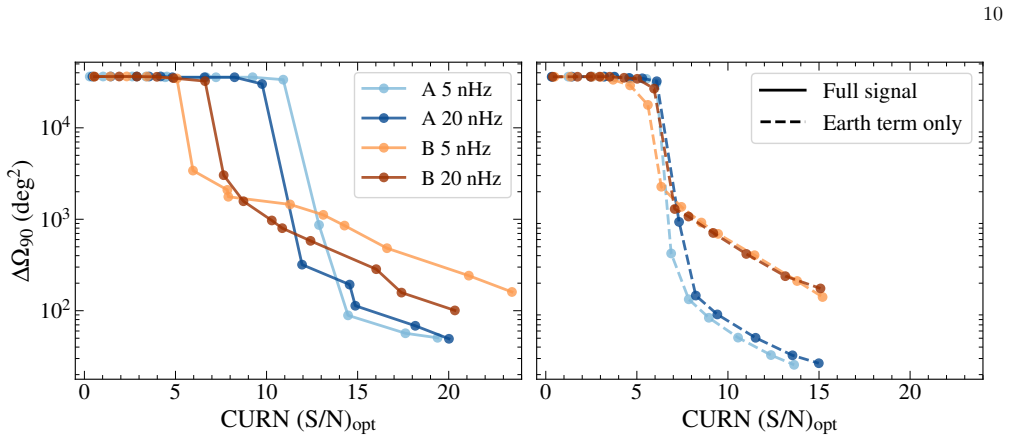
Using only the continuous-wave deterministic template on realistic near-future PTA datasets, the GW frequency and strain amplitude are generally constrained at the same time or S/N, closely followed by sky location, and later the chirp mass (if highly evolving) and inclination angle, with the exact timing depending on source sky location and frequency due to pulsar terms and PTA geometry.
What carries the argument
The continuous-wave (CW) deterministic template model applied to accumulating PTA data, which tracks how parameter uncertainties shrink as signal-to-noise ratio grows.
If this is right
- Higher-frequency sources reach tighter precision on frequency, chirp mass, and sky location at the same overall signal strength.
- Pulsar terms and PTA geometry set the precise S/N threshold at which each parameter becomes useful.
- Sky location becomes available after frequency and strain but before mass and inclination for most sources.
- The sequence of constraints is independent of the absolute S/N scale and depends mainly on source properties.
Where Pith is reading between the lines
- Once frequency is known early, electromagnetic surveys could be triggered to search for periodic optical or radio signatures from the same binary.
- If real data contain extra red-noise components not captured in the simulations, the later parameters such as chirp mass may require higher S/N than predicted.
- The geometry-driven timing differences suggest that arrays with different pulsar distributions will see different characterization orders for the same source.
Load-bearing premise
The continuous-wave search model reaches detection and characterization first, and the simulated noise plus pulsar terms match future real data without extra unmodeled effects.
What would settle it
A real detection in which sky location is constrained before frequency, or in which chirp mass appears at the same S/N as frequency for a non-evolving source, would contradict the predicted order.
Figures





read the original abstract
Following the recent evidence for a gravitational wave (GW) background found by pulsar timing array (PTA) experiments, the next major science milestone is resolving individual supermassive black hole binaries (SMBHBs). The detection of these systems could arise via searches using a power-based GW anisotropy model or a deterministic template model. In Schult et al. 2025, we compared the efficacy of these models in constraining the GW signal from a single SMBHB using realistic, near-future PTA datasets, and found that the full-signal deterministic continuous wave (CW) search may achieve detection and characterization first. Here, we continue our analyses using only the CW model given its better performance, focusing now on characterization milestones. We examine the order in which CW parameters are constrained as PTA data are accumulated and the signal-to-noise ratio (S/N) grows. We also study how these parameter constraints vary across sources of different sky locations and GW frequencies. We find that the GW frequency and strain are generally constrained at the same time (or S/N), closely followed by the sky location, and later the chirp mass (if the source is highly evolving) and inclination angle. At fixed S/N, sources at higher frequencies generally achieve better precision on the GW frequency, chirp mass, and sky location. The time (and S/N) at which the signal becomes constrained is dependent on the sky location and frequency of the source, with the effects of pulsar terms and PTA geometry playing crucial roles in source detection and localization.
Editorial analysis
A structured set of objections, weighed in public.
Referee Report
Summary. The paper uses Monte-Carlo simulations of realistic near-future PTA datasets and the deterministic continuous-wave (CW) template to determine the sequence in which SMBHB parameters (GW frequency and strain amplitude first, followed by sky location, then chirp mass for highly evolving sources and inclination angle) become constrained as S/N increases. It examines how this ordering and the required S/N vary with source sky location and frequency, attributing differences to pulsar-term effects and PTA geometry. The study follows a companion paper that compared search models and concludes that the CW model enables earlier characterization.
Significance. If the simulation assumptions hold, the work supplies concrete, observationally relevant milestones for when individual SMBHB parameters can be measured in PTA data. It credits the use of explicit Monte-Carlo tracking of parameter uncertainties across multiple source realizations and the systematic exploration of sky-location and frequency dependence. These elements make the results directly usable for planning follow-up analyses once a CW candidate is identified.
major comments (1)
- [§3 and §4] §3 (simulation setup) and §4 (results): the reported ordering of constraints (frequency/strain at the same S/N, then sky location) is obtained from the Monte-Carlo runs and is stated to depend on pulsar terms and PTA geometry. However, the manuscript does not present a sensitivity test to plausible additional red-noise processes or timing-model errors that would alter the differential pulsar-term contributions; such systematics would shift the S/N at which sky localization crosses its threshold and therefore directly affect the central claim about the sequence of milestones.
minor comments (2)
- [Abstract and §4.1] Abstract and §4.1: the statement that parameters are 'constrained at the same time (or S/N)' would be clearer if the quantitative threshold (e.g., fractional uncertainty dropping below 50 % or a specific credible-interval criterion) were defined once and applied uniformly across all parameters and figures.
- [Figure captions] Figure captions (e.g., those showing uncertainty vs. S/N curves): adding the number of Monte-Carlo realizations and a brief note on how the median or percentile curves are computed would help readers assess the robustness of the reported ordering.
Simulated Author's Rebuttal
We thank the referee for their positive assessment of our work and for the recommendation of minor revision. We appreciate the careful reading and address the major comment below with a targeted revision to the manuscript.
read point-by-point responses
-
Referee: [§3 and §4] §3 (simulation setup) and §4 (results): the reported ordering of constraints (frequency/strain at the same S/N, then sky location) is obtained from the Monte-Carlo runs and is stated to depend on pulsar terms and PTA geometry. However, the manuscript does not present a sensitivity test to plausible additional red-noise processes or timing-model errors that would alter the differential pulsar-term contributions; such systematics would shift the S/N at which sky localization crosses its threshold and therefore directly affect the central claim about the sequence of milestones.
Authors: We agree that the manuscript would be strengthened by explicitly addressing the potential impact of additional red-noise processes or timing-model errors on the pulsar-term contributions. Our simulations employ noise models drawn from published near-future PTA datasets, which already incorporate substantial red-noise components from the pulsars. We have revised Section 4 to include a new paragraph discussing how unmodeled systematics could quantitatively shift the S/N thresholds at which sky localization is achieved, while noting that the relative ordering (frequency and strain first, followed by sky location) is driven primarily by the geometric structure of the PTA and the Earth-term versus pulsar-term decomposition in the CW template. This ordering is therefore expected to remain robust across a range of plausible noise realizations. The revised text also states that a full Monte-Carlo sensitivity study lies beyond the scope of the present work but would be a natural extension for follow-up analyses once a candidate is identified. revision: partial
Circularity Check
No significant circularity: results from independent Monte Carlo simulations on synthetic data
full rationale
The paper reports the ordering of parameter constraints (frequency/strain first, then sky location, then chirp mass/inclination for evolving sources) directly from Monte Carlo analyses performed on simulated near-future PTA datasets. No derivation reduces a claimed result to a fitted parameter from the same data by construction, nor does any equation or ansatz loop back to its inputs. The citation to Schult et al. 2025 is used only to justify restricting the present analysis to the CW model; the milestone ordering itself is generated by new simulations whose inputs (noise models, PTA geometry, source parameters) are stated separately and do not include the target ordering. The work is therefore self-contained forward-looking simulation output rather than a self-referential chain.
Axiom & Free-Parameter Ledger
axioms (1)
- domain assumption Pulsar timing residuals are dominated by the modeled gravitational wave signal plus stationary Gaussian noise with known power spectral density
Lean theorems connected to this paper
-
IndisputableMonolith/Foundation/RealityFromDistinction.leanreality_from_one_distinction unclear?
unclearRelation between the paper passage and the cited Recognition theorem.
We examine the order in which CW parameters are constrained as PTA data are accumulated and the signal-to-noise ratio (S/N) grows... GW frequency and strain are generally constrained at the same time (or S/N), closely followed by the sky location, and later the chirp mass (if the source is highly evolving) and inclination angle.
-
IndisputableMonolith/Cost/FunctionalEquation.leanwashburn_uniqueness_aczel unclear?
unclearRelation between the paper passage and the cited Recognition theorem.
The pulsar terms can provide constraints on the chirp mass if their frequencies are sufficiently different from the Earth term frequency... higher-frequency binaries... evolve more quickly
What do these tags mean?
- matches
- The paper's claim is directly supported by a theorem in the formal canon.
- supports
- The theorem supports part of the paper's argument, but the paper may add assumptions or extra steps.
- extends
- The paper goes beyond the formal theorem; the theorem is a base layer rather than the whole result.
- uses
- The paper appears to rely on the theorem as machinery.
- contradicts
- The paper's claim conflicts with a theorem or certificate in the canon.
- unclear
- Pith found a possible connection, but the passage is too broad, indirect, or ambiguous to say the theorem truly supports the claim.
Forward citations
Cited by 2 Pith papers
-
Archival Multiband Gravitational-Wave Signals from Massive Black Hole Binary Mergers
Massive black hole binary mergers produce orphaned low-frequency signals in PTA pulsar terms that can be stacked for archival multiband gravitational-wave detection.
-
Expectations for the first supermassive black-hole binary resolved by PTAs I: Model efficacy
Simulations of PTA data show that a full gravitational-wave signal template achieves the highest Bayes factors and most robust parameter estimation for individual supermassive black hole binaries compared to an Earth-...
Reference graph
Works this paper leans on
-
[1]
Pulsar distance and phase parameters Pulsar terms can be better constrained, and in turn the source localization can be improved, if precise pulsar distance measurements are obtained [64, 66, 67]. For a pulsar’s distance to be classified as accurately measured, the precision should generally be smaller than the grav- itational wavelength λGW = c/fGW (typi...
-
[2]
Expectations for the first supermassive black-hole binary resolved by PTAs I: Model efficacy
L. Schult, P. Petrov, S. R. Taylor, N. Pol, N. Laal, M. Charisi, and C.-P. Ma, Expectations for the first supermassive black-hole binary resolved by PTAs I: Model efficacy, arXiv e-prints , arXiv:2510.01317 (2025), arXiv:2510.01317 [astro-ph.IM]
work page internal anchor Pith review Pith/arXiv arXiv 2025
-
[3]
M. V. Sazhin, Opportunities for detecting ultralong grav- itational waves, Soviet Ast. 22, 36 (1978)
work page 1978
-
[4]
Detweiler, Pulsar timing measurements and the search for gravitational waves, ApJ 234, 1100 (1979)
S. Detweiler, Pulsar timing measurements and the search for gravitational waves, ApJ 234, 1100 (1979)
work page 1979
-
[5]
R. S. Foster and D. C. Backer, Constructing a Pulsar Timing Array, ApJ 361, 300 (1990)
work page 1990
-
[6]
The NANOGrav 15-year Data Set: Evidence for a Gravitational-Wave Background
G. Agazie, A. Anumarlapudi, A. M. Archibald, Z. Ar- zoumanian, P. T. Baker, B. B´ ecsy, L. Blecha, A. Brazier, P. R. Brook, S. Burke-Spolaor, R. Burnette, R. Case, M. Charisi, S. Chatterjee, K. Chatziioannou, B. D. Cheeseboro, S. Chen, T. Cohen, J. M. Cordes, N. J. Cornish, F. Crawford, H. T. Cromartie, K. Crowter, C. J. Cutler, M. E. Decesar, D. Degan, P...
work page internal anchor Pith review Pith/arXiv arXiv 2023
-
[7]
EPTA Collaboration, InPTA Collaboration, J. An- toniadis, P. Arumugam, S. Arumugam, S. Babak, M. Bagchi, A. S. Bak Nielsen, C. G. Bassa, A. Bathula, A. Berthereau, M. Bonetti, E. Bortolas, P. R. Brook, M. Burgay, R. N. Caballero, A. Chalumeau, D. J. Cham- pion, S. Chanlaridis, S. Chen, I. Cognard, S. Danda- pat, D. Deb, S. Desai, G. Desvignes, N. Dhanda-B...
work page internal anchor Pith review Pith/arXiv arXiv 2023
-
[8]
D. J. Reardon, A. Zic, R. M. Shannon, G. B. Hobbs, M. Bailes, V. Di Marco, A. Kapur, A. F. Rogers, E. Thrane, J. Askew, N. D. R. Bhat, A. Cameron, M. Cury lo, W. A. Coles, S. Dai, B. Goncharov, M. Kerr, A. Kulkarni, Y. Levin, M. E. Lower, R. N. Manchester, R. Mandow, M. T. Miles, R. S. Nathan, S. Os lowski, C. J. Russell, R. Spiewak, S. Zhang, and X.-J. Z...
work page internal anchor Pith review Pith/arXiv arXiv 2023
-
[9]
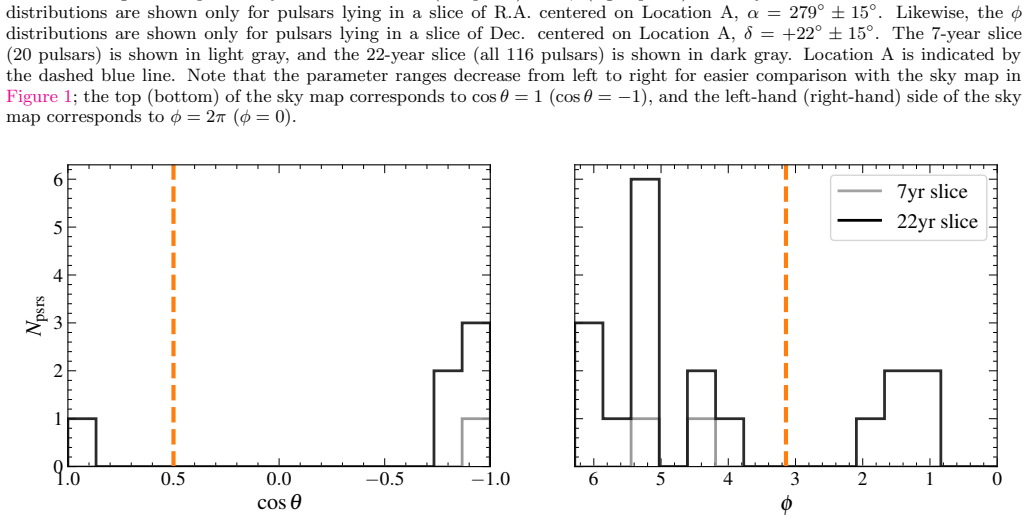
H. Xu, S. Chen, Y. Guo, J. Jiang, B. Wang, J. Xu, Z. Xue, R. N. Caballero, J. Yuan, Y. Xu, J. Wang, L. Hao, J. Luo, K. Lee, J. Han, P. Jiang, Z. Shen, M. Wang, N. Wang, R. Xu, X. Wu, R. Manchester, 17 −1.0−0.50.00.51.0 cosθ 0 2 4 6Npsrs 0123456 φ 7yr slice 22yr slice FIG. 8. Histograms of pulsar sky locations in cos θ (left panel) and ϕ (right panel) for ...
work page internal anchor Pith review Pith/arXiv arXiv 2023
-
[10]
M. T. Miles, R. M. Shannon, D. J. Reardon, M. Bailes, D. J. Champion, M. Geyer, P. Gitika, K. Grunthal, M. J. Keith, M. Kramer, A. D. Kulkarni, R. S. Nathan, A. Parthasarathy, J. Singha, G. Theureau, E. Thrane, F. Abbate, S. Buchner, A. D. Cameron, F. Camilo, B. E. Moreschi, G. Shaifullah, M. Shamohammadi, A. Pos- senti, and V. V. Krishnan, The MeerKAT Pu...
-
[11]
G. Agazie, J. Antoniadis, A. Anumarlapudi, A. M. Archibald, P. Arumugam, S. Arumugam, Z. Arzouma- nian, J. Askew, S. Babak, M. Bagchi, M. Bailes, A. S. Bak Nielsen, P. T. Baker, C. G. Bassa, A. Bathula, B. B´ ecsy, A. Berthereau, N. D. R. Bhat, L. Blecha, M. Bonetti, E. Bortolas, A. Brazier, P. R. Brook, M. Bur- gay, S. Burke-Spolaor, R. Burnette, R. N. C...
-
[12]
B. Larsen, C. M. F. Mingarelli, P. T. Baker, J. S. Hazboun, S. Chen, L. Schult, S. R. Taylor, J. Si- mon, J. Antoniadis, J. Baier, R. Nicolaos Caballero, A. Chalumeau, Z.-C. Chen, I. Cognard, D. Deb, V. Di Marco, T. Dolch, I. O. Eya, E. C. Ferrara, K. A. Gersbach, D. C. Good, H. Hu, A. Kapur, S. Kala, M. Kramer, M. T. Lam, W. G. Lamb, T. J. W. Lazio, K. L...
-
[13]
J. Antoniadis, Z. Arzoumanian, S. Babak, M. Bailes, A. S. Bak Nielsen, P. T. Baker, C. G. Bassa, B. B´ ecsy, A. Berthereau, M. Bonetti, A. Brazier, P. R. Brook, M. Burgay, S. Burke-Spolaor, R. N. Caballero, J. A. Casey-Clyde, A. Chalumeau, D. J. Champion, M. Charisi, S. Chatterjee, S. Chen, I. Cognard, J. M. Cordes, N. J. Cornish, F. Crawford, H. T. Croma...
-
[14]
Ultra-Low Frequency Gravitational Radiation from Massive Black Hole Binaries
M. Rajagopal and R. W. Romani, Ultra–Low-Frequency Gravitational Radiation from Massive Black Hole Bi- naries, ApJ 446, 543 (1995), arXiv:astro-ph/9412038 [astro-ph]
work page internal anchor Pith review Pith/arXiv arXiv 1995
-
[15]
A. H. Jaffe and D. C. Backer, Gravitational Waves Probe the Coalescence Rate of Massive Black Hole Binaries, ApJ 583, 616 (2003), arXiv:astro-ph/0210148 [astro-ph]
work page internal anchor Pith review Pith/arXiv arXiv 2003
-
[16]
A. Sesana, F. Haardt, P. Madau, and M. Volonteri, Low- Frequency Gravitational Radiation from Coalescing Mas- sive Black Hole Binaries in Hierarchical Cosmologies, ApJ 611, 623 (2004), arXiv:astro-ph/0401543 [astro-ph]
work page internal anchor Pith review Pith/arXiv arXiv 2004
-
[17]
The Astrophysics of Nanohertz Gravitational Waves
S. Burke-Spolaor, S. R. Taylor, M. Charisi, T. Dolch, J. S. Hazboun, A. M. Holgado, L. Z. Kelley, T. J. W. Lazio, D. R. Madison, N. McMann, C. M. F. Min- garelli, A. Rasskazov, X. Siemens, J. J. Simon, and T. L. Smith, The astrophysics of nanohertz gravitational waves, A&A Rev. 27, 5 (2019), arXiv:1811.08826 [astro- ph.HE]
work page internal anchor Pith review Pith/arXiv arXiv 2019
-
[18]
G. Agazie, A. Anumarlapudi, A. M. Archibald, P. T. Baker, B. B´ ecsy, L. Blecha, A. Bonilla, A. Brazier, P. R. Brook, S. Burke-Spolaor, R. Burnette, R. Case, J. A. Casey-Clyde, M. Charisi, S. Chatterjee, K. Chatziioan- nou, B. D. Cheeseboro, S. Chen, T. Cohen, J. M. Cordes, N. J. Cornish, F. Crawford, H. T. Cromartie, K. Crowter, C. J. Cutler, D. J. D’Ora...
-
[19]
EPTA Collaboration, InPTA Collaboration, J. An- toniadis, P. Arumugam, S. Arumugam, S. Babak, M. Bagchi, A. S. Bak Nielsen, C. G. Bassa, A. Bathula, A. Berthereau, M. Bonetti, E. Bortolas, P. R. Brook, M. Burgay, R. N. Caballero, A. Chalumeau, D. J. Cham- pion, S. Chanlaridis, S. Chen, I. Cognard, S. Danda- pat, D. Deb, S. Desai, G. Desvignes, N. Dhanda-B...
-
[20]
M. C. Begelman, R. D. Blandford, and M. J. Rees, Mas- sive black hole binaries in active galactic nuclei, Nature 287, 307 (1980)
work page 1980
- [21]
-
[22]
A. Sesana, A. Vecchio, and M. Volonteri, Gravitational waves from resolvable massive black hole binary systems and observations with Pulsar Timing Arrays, MNRAS 394, 2255 (2009), arXiv:0809.3412 [astro-ph]
work page internal anchor Pith review Pith/arXiv arXiv 2009
-
[23]
P. A. Rosado, A. Sesana, and J. Gair, Expected prop- erties of the first gravitational wave signal detected with pulsar timing arrays, MNRAS 451, 2417 (2015), arXiv:1503.04803 [astro-ph.HE]
work page internal anchor Pith review Pith/arXiv arXiv 2015
-
[24]
L. Z. Kelley, L. Blecha, L. Hernquist, A. Sesana, and S. R. Taylor, Single sources in the low-frequency gravitational wave sky: properties and time to detection by pulsar tim- ing arrays, MNRAS 477, 964 (2018), arXiv:1711.00075 [astro-ph.HE]
work page internal anchor Pith review Pith/arXiv arXiv 2018
-
[25]
B. B´ ecsy, N. J. Cornish, and L. Z. Kelley, Exploring Re- alistic Nanohertz Gravitational-wave Backgrounds, ApJ 941, 119 (2022), arXiv:2207.01607 [astro-ph.HE]
- [26]
-
[27]
N. Veronesi, M. Charisi, S. R. Taylor, J. Runnoe, and D. J. D’Orazio, The Host Galaxies of Pulsar Timing Ar- ray Sources: Converting Supermassive Black Hole Binary Parameters into Electromagnetic Observables, ApJ 990, 46 (2025), arXiv:2505.11598 [astro-ph.HE]
-
[28]
G. Agazie, A. Anumarlapudi, A. M. Archibald, Z. Ar- zoumanian, P. T. Baker, B. B´ ecsy, L. Blecha, A. Brazier, P. R. Brook, S. Burke-Spolaor, R. Case, J. A. Casey- Clyde, M. Charisi, S. Chatterjee, T. Cohen, J. M. Cordes, N. J. Cornish, F. Crawford, H. T. Cromartie, K. Crowter, M. E. Decesar, P. B. Demorest, M. C. Digman, T. Dolch, B. Drachler, E. C. Ferr...
-
[29]
EPTA Collaboration, InPTA Collaboration, J. An- toniadis, P. Arumugam, S. Arumugam, S. Babak, M. Bagchi, A. S. Bak Nielsen, C. G. Bassa, A. Bathula, A. Berthereau, M. Bonetti, E. Bortolas, P. R. Brook, M. Burgay, R. N. Caballero, A. Chalumeau, D. J. Cham- pion, S. Chanlaridis, S. Chen, I. Cognard, S. Dan- dapat, D. Deb, S. Desai, G. Desvignes, N. Dhanda- ...
-
[30]
J. Cardinal Tremblay, B. Goncharov, R. van Haasteren, N. D. R. Bhat, Z.-C. Chen, V. Di Marco, S. Iguchi, A. Ka- pur, W. Ling, R. Mandow, S. Mishra, D. J. Reardon, R. M. Shannon, H. Sudou, J. Wang, S.-Y. Zhao, X.-J. Zhu, and A. Zic, A Multi-Messenger Search for the Su- permassive Black Hole Binary in 3C 66B with the Parkes Pulsar Timing Array, arXiv e-prin...
-
[31]
The NANOGrav 15 yr Data Set: Targeted Searches for Supermassive Black Hole Binaries
N. Agarwal, G. Agazie, A. Anumarlapudi, A. M. Archibald, Z. Arzoumanian, J. G. Baier, P. T. Baker, B. Becsy, L. Blecha, A. Brazier, P. R. Brook, S. Burke- Spolaor, R. Burnette, R. Case, J. A. Casey-Clyde, Y.-T. Chang, M. Charisi, S. Chatterjee, T. Cohen, P. Coppi, J. M. Cordes, N. J. Cornish, F. Crawford, H. T. Cromar- tie, K. Crowter, M. E. DeCesar, P. B...
work page internal anchor Pith review Pith/arXiv arXiv 2025
-
[32]
C. M. F. Mingarelli, T. J. W. Lazio, A. Sesana, J. E. Greene, J. A. Ellis, C.-P. Ma, S. Croft, S. Burke-Spolaor, and S. R. Taylor, The local nanohertz gravitational-wave landscape from supermassive black hole binaries, Na- ture Astronomy 1, 886 (2017), arXiv:1708.03491 [astro- ph.GA]
work page internal anchor Pith review Pith/arXiv arXiv 2017
- [33]
- [34]
-
[35]
A. Sesana and A. Vecchio, Measuring the parameters of massive black hole binary systems with pulsar timing ar- ray observations of gravitational waves, Phys. Rev. D81, 104008 (2010), arXiv:1003.0677 [astro-ph.CO]
work page internal anchor Pith review Pith/arXiv arXiv 2010
-
[36]
Pulsar Timing Array Observations of Massive Black Hole Binaries
V. Corbin and N. J. Cornish, Pulsar Timing Array Ob- servations of Massive Black Hole Binaries, arXiv e-prints , arXiv:1008.1782 (2010), arXiv:1008.1782 [astro-ph.HE]
work page internal anchor Pith review Pith/arXiv arXiv 2010
- [37]
-
[38]
J. M. Goldstein, A. Sesana, A. M. Holgado, and J. Veitch, Associating host galaxy candidates to massive black hole binaries resolved by pulsar timing arrays, MNRAS 485, 248 (2019), arXiv:1812.02670 [astro-ph.IM]
work page internal anchor Pith review Pith/arXiv arXiv 2019
- [39]
-
[40]
J. Bardati, J. J. Ruan, D. Haggard, and M. Tremmel, Sig- natures of Massive Black Hole Merger Host Galaxies from Cosmological Simulations. I. Unique Galaxy Morpholo- gies in Imaging, ApJ 961, 34 (2024), arXiv:2308.03828 21 [astro-ph.GA]
-
[41]
J. Bardati, J. J. Ruan, D. Haggard, M. Tremmel, and P. Horlaville, Signatures of Massive Black Hole Merger Host Galaxies from Cosmological Simulations. II. Unique Stellar Kinematics in Integral Field Unit Spectroscopy, ApJ 977, 265 (2024), arXiv:2407.14061 [astro-ph.GA]
-
[42]
P. Horlaville, J. J. Ruan, M. Eracleous, J. Bardati, J. C. Runnoe, and D. Haggard, Predicting Potential Host Galaxies of Supermassive Black Hole Binaries Based on Stellar Kinematics in Archival IFU Surveys, arXiv e-prints , arXiv:2504.21145 (2025), arXiv:2504.21145 [astro-ph.GA]
work page internal anchor Pith review Pith/arXiv arXiv 2025
-
[43]
R. J. Truant, D. Izquierdo-Villalba, A. Sesana, G. Mohi- uddin Shaifullah, M. Bonetti, D. Spinoso, and S. Bonoli, Lighting up the nano-hertz gravitational wave sky: op- portunities and challenges of multimessenger astronomy with PTA experiments, arXiv e-prints , arXiv:2504.01074 (2025), arXiv:2504.01074 [astro-ph.GA]
-
[44]
B. B´ ecsy, N. J. Cornish, and M. C. Digman, Fast Bayesian analysis of individual binaries in pulsar tim- ing array data, Phys. Rev. D 105, 122003 (2022), arXiv:2204.07160 [gr-qc]
- [45]
-
[46]
R. W. Hellings and G. S. Downs, Upper limits on the isotropic gravitational radiation background from pulsar timing analysis., ApJ 265, L39 (1983)
work page 1983
-
[47]
P. C. Peters and J. Mathews, Gravitational radiation from point masses in a keplerian orbit, Phys. Rev. 131, 435 (1963)
work page 1963
-
[48]
P. C. Peters, Gravitational radiation and the motion of two point masses, Phys. Rev. 136, B1224 (1964)
work page 1964
-
[49]
J. A. Ellis, A Bayesian analysis pipeline for continu- ous GW sources in the PTA band, Classical and Quan- tum Gravity 30, 224004 (2013), arXiv:1305.0835 [astro- ph.IM]
work page internal anchor Pith review Pith/arXiv arXiv 2013
-
[50]
N. S. Pol, S. R. Taylor, L. Z. Kelley, S. J. Vigeland, J. Si- mon, S. Chen, Z. Arzoumanian, P. T. Baker, B. B´ ecsy, A. Brazier, P. R. Brook, S. Burke-Spolaor, S. Chatterjee, J. M. Cordes, N. J. Cornish, F. Crawford, H. Thankful Cromartie, M. E. Decesar, P. B. Demorest, T. Dolch, E. C. Ferrara, W. Fiore, E. Fonseca, N. Garver-Daniels, D. C. Good, J. S. Ha...
-
[51]
M. F. Alam, Z. Arzoumanian, P. T. Baker, H. Blumer, K. E. Bohler, A. Brazier, P. R. Brook, S. Burke-Spolaor, K. Caballero, R. S. Camuccio, R. L. Chamberlain, S. Chatterjee, J. M. Cordes, N. J. Cornish, F. Craw- ford, H. T. Cromartie, M. E. Decesar, P. B. Demor- est, T. Dolch, J. A. Ellis, R. D. Ferdman, E. C. Fer- rara, W. Fiore, E. Fonseca, Y. Garcia, N....
-
[52]
G. Agazie, M. F. Alam, A. Anumarlapudi, A. M. Archibald, Z. Arzoumanian, P. T. Baker, L. Blecha, V. Bonidie, A. Brazier, P. R. Brook, S. Burke-Spolaor, B. B´ ecsy, C. Chapman, M. Charisi, S. Chatterjee, T. Co- hen, J. M. Cordes, N. J. Cornish, F. Crawford, H. T. Cromartie, K. Crowter, M. E. Decesar, P. B. Demor- est, T. Dolch, B. Drachler, E. C. Ferrara, ...
-
[53]
A. Zic, D. J. Reardon, A. Kapur, G. Hobbs, R. Mandow, M. Cury lo, R. M. Shannon, J. Askew, M. Bailes, N. D. R. Bhat, A. Cameron, Z.-C. Chen, S. Dai, V. Di Marco, Y. Feng, M. Kerr, A. Kulkarni, M. E. Lower, R. Luo, R. N. Manchester, M. T. Miles, R. S. Nathan, S. Os lowski, A. F. Rogers, C. J. Russell, R. Spiewak, N. Thyagarajan, L. Toomey, S. Wang, L. Zhan...
-
[54]
J. Antoniadis, S. Babak, A. S. Bak Nielsen, C. G. Bassa, A. Berthereau, M. Bonetti, E. Bortolas, P. R. Brook, M. Burgay, R. N. Caballero, A. Chalumeau, D. J. Cham- pion, S. Chanlaridis, S. Chen, I. Cognard, G. Desvi- gnes, M. Falxa, R. D. Ferdman, A. Franchini, J. R. Gair, B. Goncharov, E. Graikou, J. M. Grießmeier, L. Guille- mot, Y. J. Guo, H. Hu, F. Ir...
-
[55]
M. T. Miles, R. M. Shannon, M. Bailes, D. J. Rear- don, M. J. Keith, A. D. Cameron, A. Parthasarathy, M. Shamohammadi, R. Spiewak, W. van Straten, S. Buchner, F. Camilo, M. Geyer, A. Karastergiou, M. Kramer, M. Serylak, G. Theureau, and V. Venka- traman Krishnan, The MeerKAT Pulsar Timing Ar- ray: first data release, MNRAS 519, 3976 (2023), arXiv:2212.046...
-
[56]
P. Jaranowski, A. Kr´ olak, and B. F. Schutz, Data analysis of gravitational-wave signals from spinning neutron stars: The signal and its detection, Phys. Rev. D 58, 063001 (1998), arXiv:gr-qc/9804014 [gr-qc]
work page internal anchor Pith review Pith/arXiv arXiv 1998
-
[57]
T. Di Matteo, A. King, and N. J. Cornish, Black Hole Formation and Growth: Saas-Fee Advanced Course 48. Swiss Society for Astrophysics and Astronomy , Vol. 48 (Springer, 2019)
work page 2019
-
[58]
J. A. Ellis, X. Siemens, and J. D. E. Creighton, Opti- mal Strategies for Continuous Gravitational Wave De- tection in Pulsar Timing Arrays, ApJ 756, 175 (2012), arXiv:1204.4218 [astro-ph.IM]
work page internal anchor Pith review Pith/arXiv arXiv 2012
-
[59]
The search for continuous gravitational waves: metric of the multi-detector F-statistic
R. Prix, Search for continuous gravitational waves: Met- ric of the multidetector F-statistic, Phys. Rev. D 75, 023004 (2007), arXiv:gr-qc/0606088 [gr-qc]
work page internal anchor Pith review Pith/arXiv arXiv 2007
-
[60]
J. A. Ellis, M. Vallisneri, S. R. Taylor, and P. T. Baker, ENTERPRISE: Enhanced Numerical Toolbox Enabling a Robust PulsaR Inference SuitE, Astrophysics Source Code Library, record ascl:1912.015 (2019)
work page 1912
-
[61]
S. R. Taylor, P. T. Baker, J. S. Hazboun, J. Simon, and S. J. Vigeland, enterprise extensions (2021), v2.4.3
work page 2021
-
[62]
S. R. Taylor, E. A. Huerta, J. R. Gair, and S. T. McWilliams, Detecting Eccentric Supermassive Black Hole Binaries with Pulsar Timing Arrays: Resolvable Source Strategies, ApJ 817, 70 (2016), arXiv:1505.06208 [gr-qc]
work page internal anchor Pith review Pith/arXiv arXiv 2016
-
[63]
Parameter estimation for Galactic binaries by LISA
R. Takahashi and N. Seto, Parameter Estimation for Galactic Binaries by the Laser Interferometer Space An- tenna, ApJ 575, 1030 (2002), arXiv:astro-ph/0204487 [astro-ph]
work page internal anchor Pith review Pith/arXiv arXiv 2002
-
[64]
K. J. Lee, N. Wex, M. Kramer, B. W. Stappers, C. G. Bassa, G. H. Janssen, R. Karuppusamy, and R. Smits, Gravitational wave astronomy of single sources with a pulsar timing array, MNRAS 414, 3251 (2011), arXiv:1103.0115 [astro-ph.HE]
work page internal anchor Pith review Pith/arXiv arXiv 2011
-
[65]
L. Boyle and U.-L. Pen, Pulsar timing arrays as imag- ing gravitational wave telescopes: Angular resolution and source (de)confusion, Phys. Rev. D 86, 124028 (2012), arXiv:1010.4337 [astro-ph.HE]
work page internal anchor Pith review Pith/arXiv arXiv 2012
-
[66]
M. Charisi, S. R. Taylor, C. A. Witt, and J. Runnoe, Ef- ficient Large-Scale, Targeted Gravitational-Wave Probes of Supermassive Black-Hole Binaries, Phys. Rev. Lett. 132, 061401 (2024), arXiv:2304.03786 [gr-qc]
-
[67]
R. Kato and K. Takahashi, Precision of localization of single gravitational-wave source with pulsar timing array, Phys. Rev. D 108, 123535 (2023), arXiv:2308.10419 [gr- qc]
-
[68]
R. Kato and K. Takahashi, Realistic assessment of a single gravitational wave source localization taking into account precise pulsar distances with pulsar tim- ing arrays, arXiv e-prints , arXiv:2506.02819 (2025), arXiv:2506.02819 [gr-qc]
-
[69]
J. M. Goldstein, J. Veitch, A. Sesana, and A. Vecchio, Null-stream analysis of Pulsar Timing Array data: local- ization of resolvable gravitational wave sources, MNRAS 477, 5447 (2018), arXiv:1712.03975 [astro-ph.IM]
work page internal anchor Pith review Pith/arXiv arXiv 2018
-
[70]
Exploring short gamma-ray bursts as gravitational-wave standard sirens
S. Nissanke, D. E. Holz, S. A. Hughes, N. Dalal, and J. L. Sievers, Exploring Short Gamma-ray Bursts as Gravitational-wave Standard Sirens, ApJ 725, 496 (2010), arXiv:0904.1017 [astro-ph.CO]
work page internal anchor Pith review Pith/arXiv arXiv 2010
-
[71]
N. J. Cornish, Fast Fisher Matrices and Lazy Likelihoods, arXiv e-prints , arXiv:1007.4820 (2010), arXiv:1007.4820 [gr-qc]
work page internal anchor Pith review Pith/arXiv arXiv 2010
-
[72]
False periodicities in quasar time-domain surveys
S. Vaughan, P. Uttley, A. G. Markowitz, D. Hup- penkothen, M. J. Middleton, W. N. Alston, J. D. Scargle, and W. M. Farr, False periodicities in quasar time-domain surveys, MNRAS 461, 3145 (2016), arXiv:1606.02620 [astro-ph.IM]
work page internal anchor Pith review Pith/arXiv arXiv 2016
-
[73]
S. Kullback and R. A. Leibler, On information and suf- ficiency, The Annals of Mathematical Statistics 22, 79 (1951)
work page 1951
-
[74]
Z. Arzoumanian, A. Brazier, S. Burke-Spolaor, S. J. Chamberlin, S. Chatterjee, J. M. Cordes, P. B. Demorest, X. Deng, T. Dolch, J. A. Ellis, R. D. Ferdman, N. Garver- Daniels, F. Jenet, G. Jones, V. M. Kaspi, M. Koop, M. T. Lam, T. J. W. Lazio, A. N. Lommen, D. R. Lorimer, J. Luo, R. S. Lynch, D. R. Madison, M. A. McLaugh- lin, S. T. McWilliams, D. J. Nic...
work page internal anchor Pith review Pith/arXiv arXiv 2014
-
[75]
Z. Arzoumanian, P. T. Baker, H. Blumer, B. B´ ecsy, A. Brazier, P. R. Brook, S. Burke-Spolaor, S. Chatter- jee, S. Chen, J. M. Cordes, N. J. Cornish, F. Craw- ford, H. T. Cromartie, M. E. Decesar, P. B. Demorest, T. Dolch, J. A. Ellis, E. C. Ferrara, W. Fiore, E. Fon- seca, N. Garver-Daniels, P. A. Gentile, D. C. Good, J. S. Hazboun, A. M. Holgado, K. Isl...
-
[76]
B. B´ ecsy, N. J. Cornish, P. M. Meyers, L. Z. Kelley, G. Agazie, A. Anumarlapudi, A. M. Archibald, Z. Ar- zoumanian, P. T. Baker, L. Blecha, A. Brazier, P. R. Brook, S. Burke-Spolaor, J. A. Casey-Clyde, M. Charisi, S. Chatterjee, K. Chatziioannou, T. Cohen, J. M. Cordes, F. Crawford, H. T. Cromartie, K. Crowter, M. E. DeCe- sar, P. B. Demorest, T. Dolch,...
-
[77]
S. Valtolina, G. Shaifullah, A. Samajdar, and A. Sesana, Testing strengths, limitations, and biases of current pul- sar timing arrays’ detection analyses on realistic data, A&A 683, A201 (2024), arXiv:2309.13117 [astro-ph.HE]
-
[78]
I. Ferranti, G. Shaifullah, A. Chalumeau, and A. Sesana, Separating deterministic and stochastic grav- itational wave signals in realistic pulsar timing ar- ray datasets, arXiv e-prints , arXiv:2407.21105 (2024), arXiv:2407.21105 [astro-ph.HE]
-
[79]
M. Crisostomi, R. van Haasteren, P. M. Meyers, and M. Vallisneri, Beyond diagonal approximations: im- proved covariance modeling for pulsar timing array data analysis, arXiv e-prints , arXiv:2506.13866 (2025), arXiv:2506.13866 [astro-ph.IM]
-
[80]
S. Hourihane, P. Meyers, A. Johnson, K. Chatziioan- nou, and M. Vallisneri, Accurate characterization of the stochastic gravitational-wave background with pul- sar timing arrays by likelihood reweighting, Phys. Rev. D 107, 084045 (2023), arXiv:2212.06276 [gr-qc]
discussion (0)
Sign in with ORCID, Apple, or X to comment. Anyone can read and Pith papers without signing in.