Spectrum of pure R² gravity: full Hamiltonian analysis
Pith reviewed 2026-05-21 21:17 UTC · model grok-4.3
The pith
Pure R² gravity has an empty linearised spectrum around Minkowski spacetime because ten second-class constraints become first-class upon linearisation.
A machine-rendered reading of the paper's core claim, the machinery that carries it, and where it could break.
Core claim
The central claim is that the linearised spectrum of pure R² gravity around Minkowski spacetime is empty, and this property holds for any traceless-Ricci spacetime with vanishing Ricci scalar such as Schwarzschild and Kerr. Upon linearisation at these backgrounds, ten second-class constraints of the full theory become first-class and the three momentum constraints degenerate into a single constraint. Higher-order perturbation theory around the same backgrounds yields no degrees of freedom at any perturbative order. This conflicts with the general nonlinear analysis and indicates that the backgrounds are surfaces of strong coupling where perturbative dynamics becomes nonperturbative. A phase-
What carries the argument
The Hamiltonian constraint analysis that tracks the change in the class of ten second-class constraints and the degeneracy of the momentum constraints upon linearisation at R=0 surfaces.
If this is right
- The full nonlinear theory consistently propagates three degrees of freedom.
- No degrees of freedom appear at any order of perturbation theory around R=0 backgrounds.
- These backgrounds function as surfaces of strong coupling where the general analysis ceases to apply directly.
- The evolving universe can penetrate the singular R=0 surface according to cosmological phase-space evolution.
Where Pith is reading between the lines
- Linearised analyses around black holes in this theory must be supplemented by nonperturbative methods.
- Analogous constraint changes upon linearisation may appear in other higher-curvature models evaluated on Ricci-flat backgrounds.
- Gravitational-wave or black-hole stability calculations in pure R² gravity would need to account for the nonperturbative character of perturbations at R=0.
Load-bearing premise
The linearisation procedure and the classification of constraints remain valid exactly at the R=0 surfaces where the dynamics turns nonperturbative.
What would settle it
A direct count of physical degrees of freedom in the linearised Hamiltonian analysis around the Schwarzschild spacetime that returns a nonzero number would contradict the empty-spectrum claim.
Figures



read the original abstract
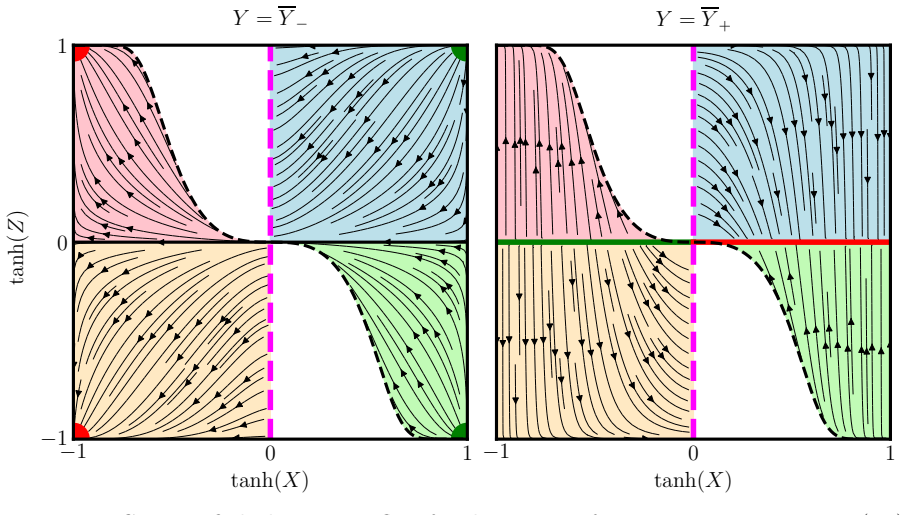
We perform a full Hamiltonian constraint analysis of pure Ricci-scalar-squared ($R^2$) gravity to clarify recent controversies regarding its particle spectrum. While it is well established that the full theory consistently propagates three degrees of freedom, we confirm that its linearised spectrum around Minkowski spacetime is empty. Moreover, we show that this is not a feature unique to Minkowski spacetime, but a generic property of all traceless-Ricci spacetimes that have a vanishing Ricci scalar, such as the Schwarzschild and Kerr black hole spacetimes. The mechanism for this phenomenon is a change in the nature of the constraints upon linearisation: ten second-class constraints of the full theory become first-class, while the three momentum constraints degenerate into a single constraint. Furthermore, we show that higher order perturbation theory around these singular backgrounds reveals no degrees of freedom at any order. This is in conflict with the general analysis and points to the fact that such backgrounds are surfaces of strong coupling in field space, where the dynamics of perturbations becomes nonperturbative. We further show via a cosmological phase-space analysis that the evolving universe is able to penetrate through the singular $R=0$ surface.
Editorial analysis
A structured set of objections, weighed in public.
Referee Report
Summary. The manuscript performs a full Hamiltonian constraint analysis of pure R² gravity. It confirms that the nonlinear theory consistently propagates three degrees of freedom. The linearised spectrum around Minkowski spacetime is empty; this is shown to be a generic feature of all traceless-Ricci spacetimes with vanishing Ricci scalar (e.g., Schwarzschild and Kerr), arising because ten second-class constraints become first-class upon linearisation while the three momentum constraints degenerate to one. Higher-order perturbations around these backgrounds likewise yield no degrees of freedom, indicating that R=0 surfaces are strong-coupling loci where perturbative dynamics becomes nonperturbative. A cosmological phase-space analysis demonstrates that the evolving universe can cross the singular R=0 surface.
Significance. If the central claims hold, the work clarifies ongoing debates on the particle spectrum of R² gravity and identifies important limitations of linearisation around R=0 backgrounds in modified gravity. The explicit constraint reclassification, the demonstration that higher orders remain empty, and the cosmological phase-space result that evolution can penetrate R=0 are substantive contributions. The detailed Hamiltonian analysis provides a concrete basis for understanding strong-coupling regimes in quadratic gravity.
major comments (2)
- [§4] §4 (linearisation around R=0): The reclassification of ten second-class constraints into first-class ones (and the degeneration of momentum constraints) upon linearisation is load-bearing for the empty-spectrum claim. The paper itself states that R=0 surfaces are points where the general nonlinear analysis no longer applies directly and dynamics is nonperturbative; an explicit verification that the linearised Poisson brackets vanish on the constraint surface (without residual second-class structure) is required to confirm the reclassification remains valid precisely in this regime.
- [§5] §5 (higher-order perturbations): The statement that higher-order perturbation theory around these singular backgrounds reveals no degrees of freedom at any order is central to the strong-coupling interpretation. The section should specify the perturbative orders examined and demonstrate that the constraint degeneracy persists without introducing new propagating modes beyond linear order.
minor comments (3)
- The abstract would benefit from a single sentence explicitly contrasting the three DOF of the full theory with the empty linearised spectrum to reduce potential reader confusion.
- [§3] Notation for the constraint classes (first-class vs. second-class) should be introduced once in §2 or §3 and used consistently thereafter.
- Figure captions for the cosmological phase-space plots should explicitly mark the R=0 surface and the direction of cosmic evolution.
Simulated Author's Rebuttal
We thank the referee for their thorough review and constructive feedback on our manuscript. We appreciate the recognition of the significance of our Hamiltonian analysis and the identification of areas where additional clarification would strengthen the presentation. We address each major comment below and will revise the manuscript to incorporate the requested details.
read point-by-point responses
-
Referee: [§4] §4 (linearisation around R=0): The reclassification of ten second-class constraints into first-class ones (and the degeneration of momentum constraints) upon linearisation is load-bearing for the empty-spectrum claim. The paper itself states that R=0 surfaces are points where the general nonlinear analysis no longer applies directly and dynamics is nonperturbative; an explicit verification that the linearised Poisson brackets vanish on the constraint surface (without residual second-class structure) is required to confirm the reclassification remains valid precisely in this regime.
Authors: We agree that an explicit verification of the Poisson brackets in the linearized theory is important for rigor. In the revised manuscript we will add a new subsection (or appendix) that computes the linearized Poisson brackets of the ten constraints on the constraint surface and explicitly demonstrates that they vanish identically, confirming the absence of any residual second-class structure. revision: yes
-
Referee: [§5] §5 (higher-order perturbations): The statement that higher-order perturbation theory around these singular backgrounds reveals no degrees of freedom at any order is central to the strong-coupling interpretation. The section should specify the perturbative orders examined and demonstrate that the constraint degeneracy persists without introducing new propagating modes beyond linear order.
Authors: We acknowledge the need for greater specificity. In the revision we will expand §5 to state the perturbative orders explicitly considered (linear, quadratic, and cubic), provide the relevant constraint expressions at each order, and show that the degeneracy pattern identified at linear order continues to hold, with no additional propagating modes appearing. revision: yes
Circularity Check
No circularity: direct Hamiltonian constraint classification on the R² action
full rationale
The paper applies standard Dirac-Bergmann constraint analysis to the pure R² Lagrangian, deriving the full set of primary and secondary constraints, computing their Poisson brackets, and classifying them as first- or second-class in the nonlinear theory. Linearization around Minkowski (and other R=0, traceless-Ricci backgrounds) is then performed by expanding the constraints and brackets to first order, showing the ten second-class constraints become first-class and the three momentum constraints degenerate. This reduction follows directly from the explicit form of the constraints and their brackets evaluated on the background; it is not obtained by fitting parameters to data, by defining a quantity in terms of the result it is supposed to predict, or by invoking a self-citation whose content is itself unverified. The observation that R=0 surfaces are strong-coupling loci is presented as a limitation of the perturbative expansion rather than a premise used to justify the linearised counting. The derivation is therefore self-contained and independent of the target spectrum result.
Axiom & Free-Parameter Ledger
axioms (2)
- standard math The Dirac-Bergmann procedure correctly classifies constraints and counts degrees of freedom in diffeomorphism-invariant theories.
- domain assumption Linearisation around a background is a valid first step for extracting the perturbative spectrum.
Forward citations
Cited by 3 Pith papers
-
Extrinsic geometry and Hamiltonian analysis of symmetric teleparallel gravity
Symmetric teleparallel gravity has the same number of degrees of freedom as general relativity, confirmed via its Hamiltonian formulation after deriving generalized extrinsic geometry relations.
-
How to deal with conformal and pure scale-invariant theories of gravity in d dimensions?
Conformal and scale-invariant gravity theories in d dimensions have distinct properties from 4D analogues, enabled by a new formulation method.
-
Batalin-Fradkin-Vilkovisky Quantization of Quadratic Gravity
BFV quantization of quadratic gravity produces propagators for fields with negative norms and a mass spectrum matching Stelle's results but distributed differently among the fields.
Reference graph
Works this paper leans on
-
[1]
On the degrees of freedo m of R 2 gravity in flat space- time,
A. Hell, D. Lust and G. Zoupanos, “On the degrees of freedo m of R 2 gravity in flat space- time,” JHEP 02 (2024), 039 [arXiv:2311.08216 [hep-th]]
-
[2]
L. Alvarez-Gaume, A. Kehagias, C. Kounnas, D. L¨ ust and A . Riotto, “Aspects of Quadratic Gravity,” Fortsch. Phys. 64 (2016) no.2-3, 176-189 [arXiv:1505.07657 [hep-th]]
work page internal anchor Pith review Pith/arXiv arXiv 2016
-
[3]
On the Degrees of Freedom Count on Singular Phase Space Submanifolds,
A. Golovnev, “On the Degrees of Freedom Count on Singular Phase Space Submanifolds,” Int. J. Theor. Phys. 63 (2024) no.8, 212 [arXiv:2311.10690 [hep-th]]
-
[4]
Particle content of (scalar curvature )2 gravities revisited,
G. K. Karananas, “Particle content of (scalar curvature )2 gravities revisited,” Phys. Rev. D 111 (2025) no.4, 044068 [arXiv:2407.09598 [hep-th]]
-
[5]
Particle spectrum f or any tensor Lagrangian,
W. Barker, C. Marzo and C. Rigouzzo, “Particle spectrum f or any tensor Lagrangian,” Phys. Rev. D 112 (2025) no.1, 016018 [arXiv:2406.09500 [hep-th]]
-
[6]
Canonical Quanti zation and Local Measure of R**2 Gravity,
I. L. Buchbinder and S. L. Lyakhovich, “Canonical Quanti zation and Local Measure of R**2 Gravity,” Class. Quant. Grav. 4 (1987), 1487-1501
work page 1987
-
[7]
The Classification of spaces defining gravi tational fields,
A. Z. Petrov, “The Classification of spaces defining gravi tational fields,” Gen. Rel. Grav. 32 (2000), 1661-1663
work page 2000
-
[8]
The algebraic Structure of the tensor of matter,
J. F. Pleba´ nski, “The algebraic Structure of the tensor of matter,” Acta Phys. Pol. 26 (1964), 963-1020. 28
work page 1964
-
[9]
C. B. G. McIntosh, J. M. Foyster and A. W.-C. Lun, “The clas sification of the Ricci and Pleba´ nski tensors in general relativity using newman–pen rose formalism,” J. Math. Phys. 22 (1981), 2620–2623
work page 1981
-
[10]
Lectures on quantum Mechanics,
P. A. M. Dirac, “Lectures on quantum Mechanics,” Belfer Graduate School of Sciences, Yeshiva University, New York, 1964
work page 1964
-
[11]
The Dynamics of General Relativity
R. L. Arnowitt, S. Deser and C. W. Misner, “The Dynamics o f general relativity,” Gen. Rel. Grav. 40 (2008), 1997-2027 [arXiv:gr-qc/0405109 [gr-qc]]
work page internal anchor Pith review Pith/arXiv arXiv 2008
-
[12]
Generalized Hamiltonian dynamics,
P. A. M. Dirac, “Generalized Hamiltonian dynamics,” Ca n. J. Math. 2 (1950), 129-148
work page 1950
-
[13]
Constraints in covar iant field theories,
J. L. Anderson and P. G. Bergmann, “Constraints in covar iant field theories,” Phys. Rev. 83 (1951), 1018-1025
work page 1951
-
[14]
A. De Felice and S. Tsujikawa, “f(R) theories,” Living R ev. Rel. 13 (2010), 3 [arXiv:1002.4928 [gr-qc]]
work page internal anchor Pith review Pith/arXiv arXiv 2010
-
[15]
Unified cosmic history in modified gravity: from F(R) theory to Lorentz non-invariant models
S. Nojiri and S. D. Odintsov, “Unified cosmic history in m odified gravity: from F(R) theory to Lorentz non-invariant models,” Phys. Rept. 505 (2011), 59-144 [arXiv:1011.0544 [gr-qc]]
work page internal anchor Pith review Pith/arXiv arXiv 2011
-
[16]
Critical reassessm ent of the restricted Weyl symmetry,
D. Glavan, R. Noris and T. Zlosnik, “Critical reassessm ent of the restricted Weyl symmetry,” Phys. Rev. D 110 (2024) no.12, 12 [arXiv:2408.02763 [hep-th]]
-
[17]
Correspondence of $F(R)$ Gravity Singularities in Jordan and Einstein Frames
S. Bahamonde, S. D. Odintsov, V. K. Oikonomou and M. Wrig ht, “Correspondence of F(R) gravity singularities in Jordan and Einstein frames,” Annals Phys. 373 (2016), 96-114 [arXiv:1603.05113 [gr-qc]]
work page internal anchor Pith review Pith/arXiv arXiv 2016
-
[18]
On dynamical systems approaches and methods in $f(R)$ cosmology
A. Alho, S. Carloni and C. Uggla, “On dynamical systems a pproaches and methods in f (R) cosmology,” JCAP 08 (2016), 064 [arXiv:1607.05715 [gr-qc]]
work page internal anchor Pith review Pith/arXiv arXiv 2016
-
[19]
On the equivalence of Jordan and Einstein frames in scale-invariant gravity
M. Rinaldi, “On the equivalence of Jordan and Einstein f rames in scale-invariant gravity,” Eur. Phys. J. Plus 133 (2018) no.10, 408 [arXiv:1808.08154 [gr-qc]]
work page internal anchor Pith review Pith/arXiv arXiv 2018
-
[20]
3+1 Formalism and Bases of Numerical Relativity
E. Gourgoulhon, “3+1 formalism and bases of numerical r elativity,” [arXiv:gr-qc/0703035 [gr-qc]]
work page internal anchor Pith review Pith/arXiv arXiv
-
[21]
Introduction to Hamiltonian formulation of ge neral relativity and homogeneous cosmologies,
R. Jha, “Introduction to Hamiltonian formulation of ge neral relativity and homogeneous cosmologies,” SciPost Phys. Lect. Notes 73 (2023), 1 [arXiv:2204.03537 [gr-qc]]
-
[22]
Introducing Cadabra: a symbolic computer algebra system for field theory problems
K. Peeters, “Introducing Cadabra: A Symbolic computer algebra system for field theory problems,” [arXiv:hep-th/0701238 [hep-th]]
work page internal anchor Pith review Pith/arXiv arXiv
-
[23]
A field-theory motivated approach to symbolic computer algebra
K. Peeters, “A Field-theory motivated approach to symb olic computer algebra,” Comput. Phys. Commun. 176 (2007), 550-558 [arXiv:cs/0608005 [cs.SC]]
work page internal anchor Pith review Pith/arXiv arXiv 2007
-
[24]
Cadabra2: computer algebra for field theor y revisited,
K. Peeters, “Cadabra2: computer algebra for field theor y revisited,” J. Open Source Softw. 3 (2018) no.32, 1118
work page 2018
-
[25]
Removing spuri ous degrees of freedom from EFT of gravity,
D. Glavan, S. Mukohyama and T. Zlosnik, “Removing spuri ous degrees of freedom from EFT of gravity,” JCAP 01 (2025), 111 [arXiv:2409.15989 [gr-qc]]
-
[26]
Quantization of fields wit h constraints,
D. M. Gitman and I. V. Tyutin, “Quantization of fields wit h constraints,” Springer, Berlin Heidelberg, Germany, 1990
work page 1990
-
[27]
Hamiltonian equations of motion of quadr atic gravity,
J. Bellorin, “Hamiltonian equations of motion of quadr atic gravity,” [arXiv:2506.07305 [gr- qc]]. 29
-
[28]
Canonical s tructure of minimal varying Λ theories,
S. Alexandrov, S. Speziale and T. Zlosnik, “Canonical s tructure of minimal varying Λ theories,” Class. Quant. Grav. 38 (2021) no.17, 175011 [arXiv:2104.03753 [gr-qc]]
-
[29]
New dynamical degrees of freedom from invertible transformations,
P. Jirouˇ sek, K. Shimada, A. Vikman and M. Yamaguchi, “New dynamical degrees of freedom from invertible transformations,” JHEP 07 (2023), 154 [arXiv:2208.05951 [gr-qc]]
-
[30]
Aspects of non-minimally coupled c urvature with power laws,
A. Hell and D. Lust, “Aspects of non-minimally coupled c urvature with power laws,” [arXiv:2509.20217 [hep-th]]
-
[31]
A note on the linear stabil ity of black holes in quadratic gravity,
C. Dioguardi and M. Rinaldi, “A note on the linear stabil ity of black holes in quadratic gravity,” Eur. Phys. J. Plus 135 (2020) no.11, 920 [arXiv:2007.11468 [gr-qc]]
-
[32]
Exact Solutions of the Einstein Field Equations,
H. Stephani, D. Kramer, M. MacCallum, C. Hoenselaers an d E. Herlt, “Exact Solutions of the Einstein Field Equations,” Cambridge University Press , 2. edition, 2003
work page 2003
-
[33]
Exact Space-Times in Ein stein’s General Relativity,
J. B. Griffiths and J. Podolsky, “Exact Space-Times in Ein stein’s General Relativity,” Cam- bridge University Press, 2009
work page 2009
-
[34]
T. Muller and F. Grave, “Catalogue of Spacetimes,” [arX iv:0904.4184 [gr-qc]]
work page internal anchor Pith review Pith/arXiv arXiv
-
[35]
A dynamical system approach to higher order gravity
S. Carloni and P. K. S. Dunsby, “A Dynamical system appro ach to higher order gravity,” J. Phys. A 40 (2007), 6919-6926 [arXiv:gr-qc/0611122 [gr-qc]]
work page internal anchor Pith review Pith/arXiv arXiv 2007
-
[36]
The phase space view of f(R) gravity
J. C. C. de Souza and V. Faraoni, “The Phase space view of f (R) gravity,” Class. Quant. Grav. 24 (2007), 3637-3648 [arXiv:0706.1223 [gr-qc]]
work page internal anchor Pith review Pith/arXiv arXiv 2007
-
[37]
Cosmological dynamics of Scalar--Tensor Gravity
S. Carloni, S. Capozziello, J. A. Leach and P. K. S. Dunsb y, “Cosmological dynamics of scalar-tensor gravity,” Class. Quant. Grav. 25 (2008), 035008 [arXiv:gr-qc/0701009 [gr-qc]]
work page internal anchor Pith review Pith/arXiv arXiv 2008
-
[38]
Some remarks on the dynamical systems approach to fourth order gravity
S. Carloni, A. Troisi and P. K. S. Dunsby, “Some remarks o n the dynamical systems ap- proach to fourth order gravity,” Gen. Rel. Grav. 41 (2009), 1757-1776 [arXiv:0706.0452 [gr-qc]]
work page internal anchor Pith review Pith/arXiv arXiv 2009
-
[39]
Autonomous Dynamical System Approach for $f(R)$ Gravity
S. D. Odintsov and V. K. Oikonomou, “Autonomous dynamic al system approach for f (R) gravity,” Phys. Rev. D 96 (2017) no.10, 104049 [arXiv:1711.02230 [gr-qc]]
work page internal anchor Pith review Pith/arXiv arXiv 2017
-
[40]
A not e on the dynamical system formulations in f(R) gravity,
S. Chakraborty, P. K. S. Dunsby and K. Macdevette, “A not e on the dynamical system formulations in f(R) gravity,” Int. J. Geom. Meth. Mod. Phys . 19 (2022) no.08, 2230003 [arXiv:2112.13094 [gr-qc]]
-
[41]
Cosmological dynamics of R^n gravity
S. Carloni, P. K. S. Dunsby, S. Capozziello and A. Troisi , “Cosmological dynamics of R**n gravity,” Class. Quant. Grav. 22 (2005), 4839-4868 [arXiv:gr-qc/0410046 [gr-qc]]
work page internal anchor Pith review Pith/arXiv arXiv 2005
-
[42]
The Pha se space view of inflation. 2: Fourth order models,
S. Capozziello, F. Occhionero and L. Amendola, “The Pha se space view of inflation. 2: Fourth order models,” Int. J. Mod. Phys. D 1 (1993), 615-639
work page 1993
-
[43]
S. D. Odintsov and V. K. Oikonomou, “Dynamical Systems P erspective of Cosmological Finite-time Singularities in f (R) Gravity and Interacting Multifluid Cosmology,” Phys. Rev. D 98 (2018) no.2, 024013 [arXiv:1806.07295 [gr-qc]]
work page internal anchor Pith review Pith/arXiv arXiv 2018
-
[44]
The particle content of (scalar curva ture)2 metric-affine gravity,
G. K. Karananas, “The particle content of (scalar curva ture)2 metric-affine gravity,” [arXiv:2408.16818 [hep-th]]
-
[45]
Hamiltonian analysis of metric-affine-R 2 theory,
D. Glavan, T. Zlosnik and C. Lin, “Hamiltonian analysis of metric-affine-R 2 theory,” JCAP 04 (2024), 072 [arXiv:2311.17459 [gr-qc]]
-
[46]
Conformal and pure scale-invarian t gravities in d dimensions,
A. Hell and D. Lust, “Conformal and pure scale-invarian t gravities in d dimensions,” [arXiv:2506.18775 [hep-th]]. 30
-
[47]
Hamiltonian analysis of the cuscuton
H. Gomes and D. C. Guariento, Phys. Rev. D 95 (2017) no.10, 104049 [arXiv:1703.08226 [gr-qc]]
work page internal anchor Pith review Pith/arXiv arXiv 2017
-
[48]
On the stro ng coupling of Einsteinian Cubic Gravity and its generalisations,
J. Beltr´ an Jim´ enez and A. Jim´ enez-Cano, “On the stro ng coupling of Einsteinian Cubic Gravity and its generalisations,” JCAP 01 (2021), 069 [arXiv:2009.08197 [gr-qc]]
-
[49]
Propagating degrees of freedom on maximally symmetric backgrounds in f(R) theories of grav ity,
A. Casado-Turri´ on, ´A. de la Cruz-Dombriz and A. Dobado, “Propagating degrees of freedom on maximally symmetric backgrounds in f(R) theories of grav ity,” Phys. Rev. D 111 (2025) no.4, 044030 [arXiv:2412.09366 [gr-qc]]. 31
discussion (0)
Sign in with ORCID, Apple, or X to comment. Anyone can read and Pith papers without signing in.