REVIEW 2 major objections 2 minor 47 references
Adaptive Gradient Calibration for Single-Positive Multi-Label Learning in Remote Sensing Image Scene Classification
T0 review · 2 major / 2 minor · reviewed 2026-05-18 · grok-4.3
Pith's one-line read Adaptive gradient calibration with dual EMA and training-dynamics triggers recovers full labels from single-positive annotations in remote sensing scenes.
desk verdict AdaGC adds a training-dynamics trigger to gradient calibration plus dual EMA for single-positive multi-label learning on remote sensing images, with reported SOTA results on two datasets, but the indicator's reliability under RS-specific imbalance and noise is the least secured part of the robustness claim. read the letter →
The pith
A machine-rendered reading of the paper's core claim, the machinery that carries it, and where it could break.
The reading
What carries the argument
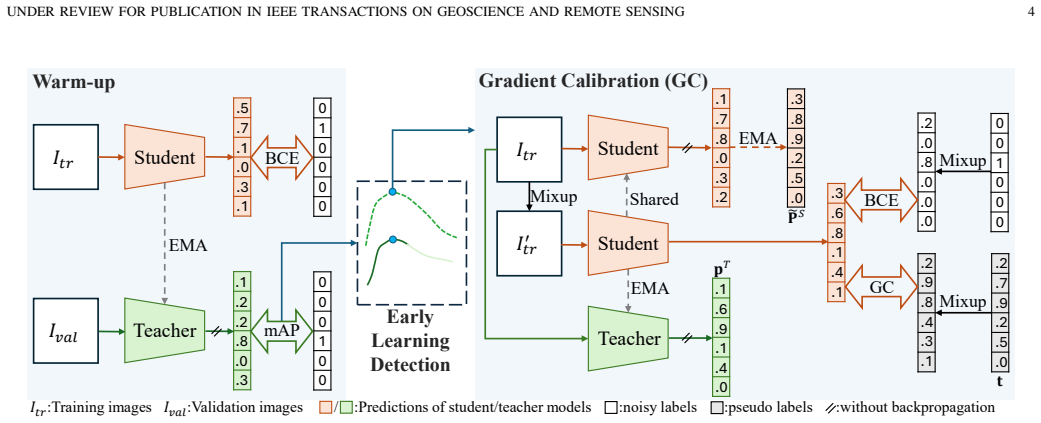
Adaptive Gradient Calibration (AdaGC) driven by a training-dynamics indicator that decides when to apply gradient updates based on pseudo-labels produced by a dual exponential moving average module.
What would settle it
On the same two remote sensing benchmarks and the same two label-noise protocols, a re-implementation of AdaGC that removes the training-dynamics trigger (or replaces it with a fixed schedule) yields lower mean average precision than the full method or than prior SPML baselines.
Extended reading notes
Core claim
AdaGC adopts a gradient calibration mechanism together with a dual EMA module for robust pseudo-label generation and introduces a theoretically grounded, training-dynamics-based indicator that adaptively triggers calibration only when it is likely to be effective, thereby avoiding degradation from underfitting or overfitting to label noise; extensive experiments on two benchmark remote sensing datasets under two distinct label noise types establish that this approach attains state-of-the-art performance while preserving strong robustness.
Load-bearing premise
The training-dynamics indicator can correctly identify moments when gradient calibration will help rather than harm, without being misled by the model's early underfitting or later overfitting to the single-positive noise.
Editorial extensions
If this is right
- Full multi-label recovery becomes feasible from far cheaper single-positive annotations in remote sensing scene classification.
- Gradient calibration steps remain beneficial across both uniform and instance-dependent label noise without manual retuning.
- The dual EMA pseudo-label generator supplies sufficiently stable targets for the calibration step on typical remote sensing imagery.
- The overall pipeline generalizes across the two standard benchmark datasets without dataset-specific hyper-parameter changes.
Reading between the lines
- Similar adaptive triggering could reduce the annotation burden in other image domains that rely on multi-label ground truth.
- The training-dynamics signal might be combined with other semi-supervised regularizers to further stabilize learning from partial labels.
- If the indicator proves reliable, it could be used to schedule other forms of label correction beyond gradient calibration.
Signed reviews
Editorial analysis
A structured set of objections, weighed in public.
Referee Report
Summary. The paper proposes Adaptive Gradient Calibration (AdaGC) as a framework for single-positive multi-label learning (SPML) tailored to remote sensing (RS) image scene classification. It combines a gradient calibration (GC) mechanism with a dual exponential moving average (EMA) module for pseudo-label generation and introduces a training-dynamics-based indicator that adaptively triggers GC to avoid underfitting or overfitting to label noise. Experiments on two benchmark RS datasets under two label noise types report state-of-the-art performance and robustness across settings.
Significance. If the adaptive indicator reliably detects effective calibration points without being misled by RS-specific factors such as class imbalance or multi-scale scenes, the work would advance practical SPML solutions for RS imagery where full annotations are costly. The dual EMA for pseudo-labels and code release are positive elements that could support reproducibility and further adoption in the domain.
major comments (2)
- [§3.2] §3.2 (Adaptive Trigger): The claim that the training-dynamics indicator is 'theoretically grounded' and prevents GC from being affected by underfitting or overfitting to label noise lacks an explicit derivation or proof sketch; the indicator is defined in terms of optimization trajectory quantities that the model itself produces, raising a circularity risk for the robustness claim.
- [§4.2] §4.2 and Table 2: The SOTA and cross-noise-type robustness results rest on the indicator correctly deciding when to apply GC, yet no controlled ablation isolates failure modes under RS-typical conditions (high imbalance, multi-scale scenes); without this, the headline performance does not fully follow from the presented evidence.
minor comments (2)
- [§3.1] Notation for the dual EMA update rules in §3.1 could be clarified with explicit equations for both the label and feature EMAs to avoid ambiguity in implementation.
- [§4] The abstract mentions 'two distinct label noise types' but the experimental section would benefit from a brief table summarizing the exact noise generation procedures for reproducibility.
Simulated Author's Rebuttal
We sincerely thank the referee for the constructive and detailed feedback on our manuscript. The comments highlight important aspects of the theoretical motivation and experimental validation that we will address in the revision. Below we respond point by point to the major comments.
read point-by-point responses
-
Referee: [§3.2] §3.2 (Adaptive Trigger): The claim that the training-dynamics indicator is 'theoretically grounded' and prevents GC from being affected by underfitting or overfitting to label noise lacks an explicit derivation or proof sketch; the indicator is defined in terms of optimization trajectory quantities that the model itself produces, raising a circularity risk for the robustness claim.
Authors: We appreciate the referee's observation on the presentation of the adaptive trigger. The indicator is motivated by monitoring the divergence between the model's evolving predictions on the fixed single-positive labels and the dual-EMA pseudo-labels, which empirically signals the transition out of underfitting before noise overfitting dominates. We acknowledge that the original submission did not include an explicit derivation or proof sketch supporting this choice. In the revised manuscript we will add a dedicated paragraph in §3.2 that provides a step-by-step motivation derived from the expected behavior of gradient descent under partial label noise, together with a short proof sketch showing that the chosen threshold corresponds to a point where the expected gradient bias begins to increase. Regarding potential circularity, the trigger quantities are computed solely from the observed single-positive supervision and the EMA estimates; the gradient-calibration step is applied only after the trigger decision and does not feed back into the indicator. We believe these additions will remove any ambiguity while preserving the original design. revision: yes
-
Referee: [§4.2] §4.2 and Table 2: The SOTA and cross-noise-type robustness results rest on the indicator correctly deciding when to apply GC, yet no controlled ablation isolates failure modes under RS-typical conditions (high imbalance, multi-scale scenes); without this, the headline performance does not fully follow from the presented evidence.
Authors: We thank the referee for underscoring the need for more targeted validation of the indicator under remote-sensing-specific conditions. The reported experiments already cover two standard RS benchmarks that exhibit natural class imbalance and multi-scale scene content, and AdaGC maintains SOTA performance under both symmetric and asymmetric noise. Nevertheless, we agree that controlled ablations that explicitly vary imbalance ratios and scene-scale complexity would strengthen the robustness claim. In the revised version we will insert a new subsection in §4.2 containing two additional ablation tables: one that sweeps class-imbalance ratios while keeping other factors fixed, and another that partitions the test sets according to a multi-scale complexity metric. These will report both the trigger decision accuracy and the final mAP to demonstrate that the indicator remains reliable under the conditions highlighted by the referee. revision: yes
Circularity Check
No significant circularity; derivation remains self-contained
full rationale
The paper introduces AdaGC as a new SPML framework with a training-dynamics-based indicator for adaptively triggering gradient calibration. The abstract describes this indicator as 'theoretically grounded' to prevent underfitting or overfitting to label noise, without any provided equations or sections showing the indicator being defined in terms of the GC outputs it controls, or any fitted parameter being renamed as a prediction. No self-citation chains, uniqueness theorems from prior author work, or ansatz smuggling are referenced in the given text. The SOTA and robustness claims rest on experimental results across datasets rather than reducing to inputs by construction. This is the typical case of an independent methodological proposal.
Assumptions & free parameters
assumptions (1)
- domain assumption Gradient calibration improves pseudo-label quality when triggered at appropriate training stages.
Cite this review
Pith. "Pith review of Adaptive Gradient Calibration for Single-Positive Multi-Label Learning in Remote Sensing Image Scene Classification." pith.science (2026). https://pith.science/paper/2510.08269
@misc{pith2026251008269,
  author       = {Pith},
  title        = {Pith review of: Adaptive Gradient Calibration for Single-Positive Multi-Label Learning in Remote Sensing Image Scene Classification},
  year         = {2026},
  howpublished = {\url{https://pith.science/paper/2510.08269}},
  note         = {Machine review of arXiv:2510.08269}
}
read the original abstract
Multi-label classification (MLC) offers a more comprehensive semantic understanding of Remote Sensing (RS) imagery compared to traditional single-label classification (SLC). However, obtaining complete annotations for MLC is particularly challenging due to the complexity and high cost of the labeling process. As a practical alternative, single-positive multi-label learning (SPML) has emerged, where each image is annotated with only one relevant label, and the model is expected to recover the full set of labels. While scalable, SPML introduces significant supervision ambiguity, demanding specialized solutions for model training. Although various SPML methods have been proposed in the computer vision domain, research in the RS context remains limited. To bridge this gap, we propose Adaptive Gradient Calibration (AdaGC), a novel and generalizable SPML framework tailored to RS imagery. AdaGC adopts a gradient calibration (GC) mechanism with a dual exponential moving average (EMA) module for robust pseudo-label generation. We introduce a theoretically grounded, training-dynamics-based indicator to adaptively trigger GC, which ensures GC's effectiveness by preventing it from being affected by model underfitting or overfitting to label noise. Extensive experiments on two benchmark RS datasets under two distinct label noise types demonstrate that AdaGC achieves state-of-the-art (SOTA) performance while maintaining strong robustness across diverse settings. The codes and data will be released at https://github.com/rslab-unitrento/AdaGC.
Figures


Figures from the paper (5 more)


Lean theorems connected to this paper
-
IndisputableMonolith/Cost/FunctionalEquation.leanwashburn_uniqueness_aczel unclear?
unclearRelation between the paper passage and the cited Recognition theorem.
We introduce a theoretically grounded, training-dynamics-based indicator to adaptively trigger GC, which ensures GC's effectiveness by preventing it from being affected by model underfitting or overfitting to label noise.
-
IndisputableMonolith/Foundation/AlphaCoordinateFixation.leanJ_uniquely_calibrated_via_higher_derivative unclear?
unclearRelation between the paper passage and the cited Recognition theorem.
The final objective is a combination of the binary cross-entropy loss and the GC regularization: L(θ) = L_AN(θ) + λ · R_GC_MLC(θ)
What do these tags mean?
- matches
- The paper's claim is directly supported by a theorem in the formal canon.
- supports
- The theorem supports part of the paper's argument, but the paper may add assumptions or extra steps.
- extends
- The paper goes beyond the formal theorem; the theorem is a base layer rather than the whole result.
- uses
- The paper appears to rely on the theorem as machinery.
- contradicts
- The paper's claim conflicts with a theorem or certificate in the canon.
- unclear
- Pith found a possible connection, but the passage is too broad, indirect, or ambiguous to say the theorem truly supports the claim.
Reference graph
Works this paper leans on
-
[1]
Artificial intelligence for geoscience: Progress, chal- lenges and perspectives,
T. Zhaoet al., “Artificial intelligence for geoscience: Progress, chal- lenges and perspectives,”The Innov., vol. 5, no. 5, Sep. 2024, Art. no. 100691
work page 2024
-
[2]
On the Foundations of Earth and Climate Foundation Models,
X. X. Zhuet al., “On the Foundations of Earth and Climate Foundation Models,” 2024,arXiv:2405.04285
-
[3]
Remote Sensing Image Classification: A Comprehensive Review and Applica- tions,
M. Mehmood, A. Shahzad, B. Zafar, A. Shabbir, and N. Ali, “Remote Sensing Image Classification: A Comprehensive Review and Applica- tions,”Math. Problems Eng., vol. 2022, no. 1, Aug. 2022, Art. no. 5880959
work page 2022
-
[4]
I. Dimitrovski, I. Kitanovski, D. Kocev, and N. Simidjievski, “Current trends in deep learning for Earth Observation: An open-source bench- mark arena for image classification,”ISPRS J. Photogrammetry Remote Sens., vol. 197, pp. 18–35, Mar. 2023
work page 2023
-
[5]
L. He, J. Li, C. Liu, and S. Li, “Recent Advances on Spectral–Spatial Hyperspectral Image Classification: An Overview and New Guidelines,” IEEE Trans. Geosci. Remote Sens., vol. 56, no. 3, pp. 1579–1597, Mar. 2018
work page 2018
-
[6]
Y . Hua, L. Mou, and X. X. Zhu, “Recurrently exploring class-wise attention in a hybrid convolutional and bidirectional LSTM network for multi-label aerial image classification,”ISPRS J. Photogrammetry Remote Sens., vol. 149, pp. 188–199, Mar. 2019
work page 2019
-
[7]
A Deep Multi-Attention Driven Approach for Multi-Label Remote Sensing Image Classification,
G. Sumbul and B. Demir, “A Deep Multi-Attention Driven Approach for Multi-Label Remote Sensing Image Classification,”IEEE Access, vol. 8, pp. 95 934–95 946, May 2020
work page 2020
-
[8]
T. Burgert, M. Ravanbakhsh, and B. Demir, “On the Effects of Different Types of Label Noise in Multi-Label Remote Sensing Image Classifica- tion,”IEEE Trans. Geosci. Remote Sens., vol. 60, Dec. 2022, Art. no. 5413713
work page 2022
Show all 47 references
-
[9]
Deep Learning in Remote Sensing: A Comprehensive Review and List of Resources,
X. X. Zhuet al., “Deep Learning in Remote Sensing: A Comprehensive Review and List of Resources,”IEEE Geosci. Remote Sens. Mag., vol. 5, no. 4, pp. 8–36, Dec. 2017
2017
-
[10]
Multi-Label Learning From Single Positive Labels,
E. Cole, O. Mac Aodha, T. Lorieul, P. Perona, D. Morris, and N. Jojic, “Multi-Label Learning From Single Positive Labels,” inProc. IEEE Conf. Comput. Vis. Pattern Recog., Nashville, TN, USA, Jun. 2021, pp. 933–942
2021
-
[11]
Relation Network for Multilabel Aerial Image Classification,
Y . Hua, L. Mou, and X. X. Zhu, “Relation Network for Multilabel Aerial Image Classification,”IEEE Trans. Geosci. Remote Sens., vol. 58, no. 7, pp. 4558–4572, Jul. 2020
2020
-
[12]
reBEN: Refined BigEarthNet Dataset for Remote Sensing Image Analysis,
K. N. Clasen, L. Hackel, T. Burgert, G. Sumbul, B. Demir, and V . Markl, “reBEN: Refined BigEarthNet Dataset for Remote Sensing Image Analysis,” May 2025,arXiv:2407.03653
2025
-
[13]
mixup: Beyond Empirical Risk Minimization,
H. Zhang, M. Cisse, Y . N. Dauphin, and D. Lopez-Paz, “mixup: Beyond Empirical Risk Minimization,” inProc. Int. Conf. Learn. Representa- tions, Vancouver, Canada, Apr./May 2018
2018
-
[14]
Large Loss Matters in Weakly Supervised Multi-Label Classification,
Y . Kim, J. M. Kim, Z. Akata, and J. Lee, “Large Loss Matters in Weakly Supervised Multi-Label Classification,” inProc. IEEE Conf. Comput. Vis. Pattern Recog., New Orleans, LA, USA, Jun. 2022, pp. 14 156– 14 165
2022
-
[15]
Label-Aware Global Consistency for Multi-Label Learning with Single Positive Labels,
M.-K. Xie, J. Xiao, and S.-J. Huang, “Label-Aware Global Consistency for Multi-Label Learning with Single Positive Labels,” inAdv. Neural Inform. Process. Syst., vol. 35, Louisiana, LA, USA, Nov./Dec. 2022, pp. 18 430–18 441
2022
-
[16]
Boosting single positive multi-label classification with generalized robust loss,
Y . Chenet al., “Boosting single positive multi-label classification with generalized robust loss,” inProc. Int. Joint Conf. Artif. Intell., Jeju, Korea, Aug. 2024, pp. 3825–3833
2024
-
[17]
Bridging the Gap Between Model Explanations in Partially Annotated Multi- Label Classification,
Y . Kim, J. M. Kim, J. Jeong, C. Schmid, Z. Akata, and J. Lee, “Bridging the Gap Between Model Explanations in Partially Annotated Multi- Label Classification,” inProc. IEEE Conf. Comput. Vis. Pattern Recog., Vancouver, Canada, Jun. 2023, pp. 3408–3417
2023
-
[18]
Revisiting Pseudo-Label for Single- UNDER REVIEW FOR PUBLICATION IN IEEE TRANSACTIONS ON GEOSCIENCE AND REMOTE SENSING 14 Positive Multi-Label Learning,
B. Liu, N. Xu, J. Lv, and X. Geng, “Revisiting Pseudo-Label for Single- UNDER REVIEW FOR PUBLICATION IN IEEE TRANSACTIONS ON GEOSCIENCE AND REMOTE SENSING 14 Positive Multi-Label Learning,” inProc. Int. Conf. Mach. Learn., vol. 202, Jul. 2023, pp. 22 249–22 265
2023
-
[19]
Early-Learning Regularization Prevents Memorization of Noisy Labels,
S. Liu, J. Niles-Weed, N. Razavian, and C. Fernandez- Granda, “Early-Learning Regularization Prevents Memorization of Noisy Labels,” inAdvances in Neural Information Processing Systems, vol. 33. Curran Associates, Inc., 2020, pp. 20 331– 20 342. [Online]. Available: https://pr...
2020
-
[20]
A Deep Learning Approach to UA V Image Multilabeling,
A. Zeggada, F. Melgani, and Y . Bazi, “A Deep Learning Approach to UA V Image Multilabeling,”IEEE Geosci. Remote Sens. Lett., vol. 14, no. 5, pp. 694–698, May 2017
2017
-
[21]
Spatial and Structured SVM for Multilabel Image Classification,
S. Koda, A. Zeggada, F. Melgani, and R. Nishii, “Spatial and Structured SVM for Multilabel Image Classification,”IEEE Trans. Geosci. Remote Sens., vol. 56, no. 10, pp. 5948–5960, Oct. 2018
2018
-
[22]
ImageNet Large Scale Visual Recognition Challenge,
O. Russakovskyet al., “ImageNet Large Scale Visual Recognition Challenge,”Int. J. Comput. Vis., vol. 115, no. 3, pp. 211–252, Apr. 2015
2015
-
[23]
Deep Learning for Multilabel Land Cover Scene Categorization Using Data Augmentation,
R. Stivaktakis, G. Tsagkatakis, and P. Tsakalides, “Deep Learning for Multilabel Land Cover Scene Categorization Using Data Augmentation,” IEEE Geosci. Remote Sens. Lett., vol. 16, no. 7, pp. 1031–1035, Jul. 2019
2019
-
[24]
Deep Attention Neural Network for Multi-Label Classification in Unmanned Aerial Vehicle Imagery,
A. Alshehri, Y . Bazi, N. Ammour, H. Almubarak, and N. Alajlan, “Deep Attention Neural Network for Multi-Label Classification in Unmanned Aerial Vehicle Imagery,”IEEE Access, vol. 7, pp. 119 873–119 880, Aug. 2019
2019
-
[25]
CCMN: A General Framework for Learn- ing With Class-Conditional Multi-Label Noise,
M.-K. Xie and S.-J. Huang, “CCMN: A General Framework for Learn- ing With Class-Conditional Multi-Label Noise,”IEEE Trans. Pattern Anal. Mach. Intell., vol. 45, no. 1, pp. 154–166, Jan. 2023
2023
-
[26]
Analysis of Learning from Positive and Unlabeled Data,
M. C. du Plessis, G. Niu, and M. Sugiyama, “Analysis of Learning from Positive and Unlabeled Data,” inAdv. Neural Inform. Process. Syst., vol. 27, Montr ´eal, Canada, Dec. 2014, pp. 703––711
2014
-
[27]
The- oretical Comparisons of Positive-Unlabeled Learning against Positive- Negative Learning,
G. Niu, M. C. du Plessis, T. Sakai, Y . Ma, and M. Sugiyama, “The- oretical Comparisons of Positive-Unlabeled Learning against Positive- Negative Learning,” inAdv. Neural Inform. Process. Syst., vol. 29, Barcelona, Spain, Dec. 2016, pp. 1199–1207
2016
-
[28]
Learning from positive and unlabeled data: A survey,
J. Bekker and J. Davis, “Learning from positive and unlabeled data: A survey,”Mach. Learn., vol. 109, no. 4, pp. 719–760, Apr. 2020
2020
-
[29]
Robust Training of Deep Neural Networks with Weakly Labelled Data,
G. Perantoni and L. Bruzzone, “Robust Training of Deep Neural Networks with Weakly Labelled Data,” inSignal and Image Processing for Remote Sensing, C. H. Chen, Ed. Boca Raton, FL, USA: CRC Press, 2024, ch. 14, pp. 256–279
2024
-
[30]
Robust deep neural networks for road extraction from remote sensing images,
P. Liet al., “Robust deep neural networks for road extraction from remote sensing images,”IEEE Trans. Geosci. Remote Sens., vol. 59, no. 7, pp. 6182–6197, Jul. 2021
2021
-
[31]
Remote Sensing Image Scene Classification with Noisy Label Distillation,
R. Zhanget al., “Remote Sensing Image Scene Classification with Noisy Label Distillation,”Remote Sens., vol. 12, no. 15, Jul. 2020, Art. no. 2376
2020
-
[32]
Early- Learning Regularization Prevents Memorization of Noisy Labels,
S. Liu, J. Niles-Weed, N. Razavian, and C. Fernandez-Granda, “Early- Learning Regularization Prevents Memorization of Noisy Labels,” in Adv. Neural Inform. Process. Syst., vol. 33, Virtual, Dec. 2020, pp. 20 331–20 342
2020
-
[33]
A Novel Approach to the Unsupervised Extraction of Reliable Training Samples From Thematic Products,
C. Paris and L. Bruzzone, “A Novel Approach to the Unsupervised Extraction of Reliable Training Samples From Thematic Products,”IEEE Trans. Geosci. Remote Sens., vol. 59, no. 3, pp. 1930–1948, Mar. 2021
1930
-
[34]
A Consensual Collaborative Learning Method for Remote Sensing Image Classification Under Noisy Multi-Labels,
A. K. Aksoy, M. Ravanbakhsh, T. Kreuziger, and B. Demir, “A Consensual Collaborative Learning Method for Remote Sensing Image Classification Under Noisy Multi-Labels,” inProc. IEEE Int. Conf. Image Process., Anchorage, AK, USA, Sep. 2021, pp. 3842–3846
2021
-
[35]
Multi-Label Noise Ro- bust Collaborative Learning for Remote Sensing Image Classification,
A. K. Aksoy, M. Ravanbakhsh, and B. Demir, “Multi-Label Noise Ro- bust Collaborative Learning for Remote Sensing Image Classification,” IEEE Trans. Neural Netw. Learn. Syst., vol. 35, no. 5, pp. 6438–6451, May 2024
2024
-
[36]
Learning Multi- Label Aerial Image Classification Under Label Noise: A Regularization Approach Using Word Embeddings,
Y . Hua, S. Lobry, L. Mou, D. Tuia, and X. X. Zhu, “Learning Multi- Label Aerial Image Classification Under Label Noise: A Regularization Approach Using Word Embeddings,” inProc. IEEE Int. Geosci. Remote Sens. Symp., Waikoloa, HI, USA, Sep./Oct. 2020, pp. 525–528
2020
-
[37]
Deep Variational Information Bottleneck,
A. A. Alemi, I. Fischer, J. V . Dillon, and K. Murphy, “Deep Variational Information Bottleneck,” inProc. Int. Conf. Learn. Representations, Toulon, France, Apr. 2017
2017
-
[38]
Dist-PU: Positive- Unlabeled Learning From a Label Distribution Perspective,
Y . Zhao, Q. Xu, Y . Jiang, P. Wen, and Q. Huang, “Dist-PU: Positive- Unlabeled Learning From a Label Distribution Perspective,” inProc. IEEE Conf. Comput. Vis. Pattern Recog., New Orleans, LA, USA, Jun. 2022, pp. 14 461–14 470
2022
-
[39]
AIO2: Online Correction of Object Labels for Deep Learning With Incomplete Annotation in Remote Sensing Image Segmentation,
C. Liu, C. M. Albrecht, Y . Wang, Q. Li, and X. X. Zhu, “AIO2: Online Correction of Object Labels for Deep Learning With Incomplete Annotation in Remote Sensing Image Segmentation,”IEEE Trans. Geosci. Remote Sens., vol. 62, Mar. 2024, Art. no. 5613917
2024
-
[40]
A closer look at memorization in deep networks,
D. Arpitet al., “A closer look at memorization in deep networks,” in Proc. Int. Conf. Mach. Learn., Sydney, Australia, Aug. 2017, pp. 233– –242
2017
-
[41]
Understand- ing deep learning (still) requires rethinking generalization,
C. Zhang, S. Bengio, M. Hardt, B. Recht, and O. Vinyals, “Understand- ing deep learning (still) requires rethinking generalization,”Commun. ACM, vol. 64, no. 3, pp. 107––115, Feb. 2021
2021
-
[42]
A Novel Technique for Robust Training of Deep Networks With Multisource Weak Labeled Remote Sensing Data,
G. Perantoni and L. Bruzzone, “A Novel Technique for Robust Training of Deep Networks With Multisource Weak Labeled Remote Sensing Data,”IEEE Trans. Geosci. Remote Sens., vol. 60, 2022, Art. no. 5402915
2022
-
[43]
Mean teachers are better role mod- els: Weight-averaged consistency targets improve semi-supervised deep learning results,
A. Tarvainen and H. Valpola, “Mean teachers are better role mod- els: Weight-averaged consistency targets improve semi-supervised deep learning results,” inAdv. Neural Inform. Process. Syst., vol. 30, Long Beach, CA, USA, Dec. 2017, pp. 1195–1204
2017
-
[44]
Bigearthnet: A Large-Scale Benchmark Archive for Remote Sensing Image Understand- ing,
G. Sumbul, M. Charfuelan, B. Demir, and V . Markl, “Bigearthnet: A Large-Scale Benchmark Archive for Remote Sensing Image Understand- ing,” inProc. IEEE Int. Geosci. Remote Sens. Symp., Yokohama, Japan, 2019, pp. 5901–5904
2019
-
[45]
BigEarthNet-MM: A Large-Scale, Multimodal, Mul- tilabel Benchmark Archive for Remote Sensing Image Classification and Retrieval [Software and Data Sets],
G. Sumbulet al., “BigEarthNet-MM: A Large-Scale, Multimodal, Mul- tilabel Benchmark Archive for Remote Sensing Image Classification and Retrieval [Software and Data Sets],”IEEE Geosci. Remote Sens. Mag., vol. 9, no. 3, pp. 174–180, Sep. 2021
2021
-
[46]
AID: A Benchmark Data Set for Performance Evaluation of Aerial Scene Classification,
G.-S. Xiaet al., “AID: A Benchmark Data Set for Performance Evaluation of Aerial Scene Classification,”IEEE Trans. Geosci. Remote Sens., vol. 55, no. 7, pp. 3965–3981, Jul. 2017
2017
-
[47]
RemoteCLIP: A Vision Language Foundation Model for Remote Sensing,
F. Liuet al., “RemoteCLIP: A Vision Language Foundation Model for Remote Sensing,”IEEE Trans. Geosci. Remote Sens., vol. 62, Apr. 2024, Art. no. 5622216
2024
Reviewed May 18, 2026 · model on record in the stance chip above.
Discussion (0). Continue with ORCID to comment.