REVIEW 2 major objections 5 minor 27 references
A unifying Bayesian framework for adversarial robustness
T0 review · 2 major / 5 minor · reviewed 2026-08-04 · deepseek-v4-flash
Pith's one-line read This paper argues that adversarial robustness is Bayesian inference through a stochastic adversarial channel, uniting adversarial training, adversarial purification, and randomized smoothing as special cases—and extending robustness to full
desk verdict A useful Bayesian unification of AT, purification, and RS with a clean BAL-consistency proof; the proactive defense's Jensen surrogate needs tighter scrutiny before 'fully Bayesian' claims stick. read the letter →
The pith
A machine-rendered reading of the paper's core claim, the machinery that carries it, and where it could break.
The reading
What carries the argument
The central object is the adversarial channel, a conditional probability distribution p(x'|x,θ) that describes how a clean input x becomes an observed corrupted input x' as a random function of the model parameters θ. In the reactive model, the channel is used at test time to infer the latent clean input; in the proactive model, the channel is integrated into the training likelihood, so the robust posterior is proportional to p(θ)∏ E_{x'|x_i,θ}[p(y_i|x'_i,θ)]. The channel's flexibility—fixed noise, probabilistic iterative attacks, mixtures of attacks, and learned neural generators—is what lets the framework interpolate between and subsume existing defenses.
What would settle it
Train the proactive defense on a small regression or classification problem where the true robust posterior can be computed by exhaustive MCMC, then compare the variational posterior from the Jensen-bound objective against the true posterior on predictive NLL under held-out attacks; if the variational posterior diverges materially or loses adversarial robustness relative to the true posterior, the unification claim for the proactive defense fails.
Extended reading notes
Core claim
The central claim is that adversarial robustness is best understood as inference through a stochastic adversarial channel p(x'|x,θ). Modeling the channel explicitly yields two Bayesian strategies: a reactive defense, which infers the latent clean input at test time and marginalizes over the model posterior, and a proactive defense, which integrates the channel into the training likelihood to produce a robust posterior. The paper proves that standard adversarial training is a deterministic, point-estimate limit of the proactive defense (Dirac-delta channel plus MAP estimation), and that randomized smoothing is recovered from the reactive defense under a Gaussian channel, MAP parameters, and a
Load-bearing premise
The load-bearing premise is that maximizing the Jensen lower bound on the robust ELBO produces a variational posterior close enough to the stated robust posterior that the defense is genuinely Bayesian; if that surrogate is loose, the 'fully Bayesian' label for the proactive defense does not follow.
Editorial extensions
If this is right
- Adversarial training becomes a special case of the proactive defense, so stochastic or distributional training is a strict generalization of deterministic minimax training.
- Randomized smoothing becomes a special case of the reactive defense, giving purification and smoothing a shared probabilistic interpretation.
- The proactive method can protect full predictive distributions, not just point predictions, covering both classification and regression under a single variational objective.
- Training against a distribution of attacks (mixture or learned channels) confers robustness against attack types not seen during training, a benefit beyond deterministic adversarial training.
- The reactive defense exposes the oversmoothing and calibration trade-offs of purification, explaining why simplified purification can degrade clean accuracy.
Reading between the lines
- If the unification holds, one could design a continuum of defenses by tuning the channel: a single training procedure could sweep from deterministic adversarial training to randomized smoothing, letting practitioners choose the operating point on the robustness–clean-accuracy curve.
- The use of a Jensen lower bound suggests a practical diagnostic: monitor the gap between the surrogate and an unbiased ELBO estimate during training; if the gap is large, the fitted variational posterior may not reflect the stated robust model, weakening the 'fully Bayesian' interpretation.
- The framework implies a principled way to select the channel via Bayesian model comparison across candidate channel families, treating the adversary's strategy as a model parameter to be inferred rather than assumed.
- Beyond prediction, the robust predictive distributions produced by the proactive defense could be plugged directly into decision-theoretic pipelines, making robust decisions rather than robust point forecasts.
Editorial analysis
A structured set of objections, weighed in public.
Referee Report
Summary. The paper proposes a Bayesian framework for adversarial robustness in which the adversary is modeled by a stochastic channel p(x'|x,θ). Two inference strategies are derived: a reactive defense applied at test time (adversarial purification) and a proactive defense applied during training (adversarial training). The paper proves that adversarial training and randomized smoothing arise as limiting cases, and that a previously proposed Bayesian adversarial learning sampler is probabilistically inconsistent. Empirical validation is carried out on MNIST classification and three regression datasets using Bayesian neural networks, with the proactive defense as the main focus. The central formal derivations are mostly sound, but the proactive defense replaces the stated ELBO with a Jensen lower bound whose tightness is never assessed; this is the key weakness in the paper's 'fully Bayesian' and empirical claims.
Significance. If the framework is taken as stated, it offers a useful conceptual unification of adversarial training, randomized smoothing, and adversarial purification under a single Bayesian formalism, and extends robustness to Bayesian predictive distributions in both classification and regression. The SM proofs—of the inconsistency of BAL, of the distinctness of reactive and proactive predictive distributions, and of the AT/RS limiting cases—are clear and, to my reading, correct. The empirical study is broad and includes both point metrics and proper scoring rules. However, the main load-bearing empirical objective is a Jensen lower bound rather than the actual ELBO; without an assessment of the gap, the empirical success cannot be attributed to the proposed robust posterior. This tempers the strength of the contribution and requires revision.
major comments (2)
- [§3.3, Eq. (7) and following] The paper states that the intractable inner log-expectation in the ELBO (7) is bypassed by Jensen's inequality, yielding a lower bound L̃, and that L̃ is then maximized. This surrogate is exactly the ELBO of a different model in which the adversarial latent x' is integrated out with its prior, i.e. stochastic data augmentation. The gap L − L̃ = E_qΣ_i[log E_{x'}p(y|x',θ) − E_{x'}log p(y|x',θ)] is never quantified. For neural likelihoods under adversarial perturbations this gap can be large. Since all proactive experiments in Tables 1–4 use this surrogate, the headline empirical claims validate the surrogate, not the robust posterior in Eq. (6). The authors should either use the SM F estimator for the true ELBO gradient, provide a bound or empirical estimate of the gap, or explicitly reframe the contribution as an approximate Bayesian method with a separate justification for the surrogate
- [Abstract & §4.2 (NN50) and §5] The abstract and conclusion describe the method as a 'fully Bayesian framework' and Section 4.2 calls NN50 'specification-free'. This overstates what is implemented. The proactive objective actually trained is a Jensen lower bound, not the posterior corresponding to Eq. (6); the reactive defense uses an empirical distribution in place of a learned generative model; and the 'learned adversarial channel' for NN50 is a GAN-style min-max adversary with its own specification and training procedure. The prose should carefully separate the formal framework from the implemented approximations, and avoid claiming that the empirical benefits arise specifically from Bayesian inference over the robust posterior.
minor comments (5)
- [§3.3, Eq. (5)] Equation (5) writes p(y_i|x_i,θ,ϕ) = ∫ p(y_i|x_i,θ)p(x'_i|x_i,θ) dx'_i. The first term in the integrand should be p(y_i|x'_i,θ), since y_i is stated to be conditionally independent of x_i given x'_i and θ. Equation (6) uses the correct form, so this is a typo, but it should be fixed.
- [§3.2] The text refers twice to 'the inner expectation in (12)' and 'inner expectation (12)', but no equation (12) appears in the paper; the intended reference seems to be Eq. (2). Please correct the cross-reference.
- [§4.2] The sentence 'NN50—trained exclusively against a learned NN adversary...' contradicts Section 4.1, where NN50 is described as using a 50/50 mix of adversarial and clean data. Please rephrase to avoid ambiguity.
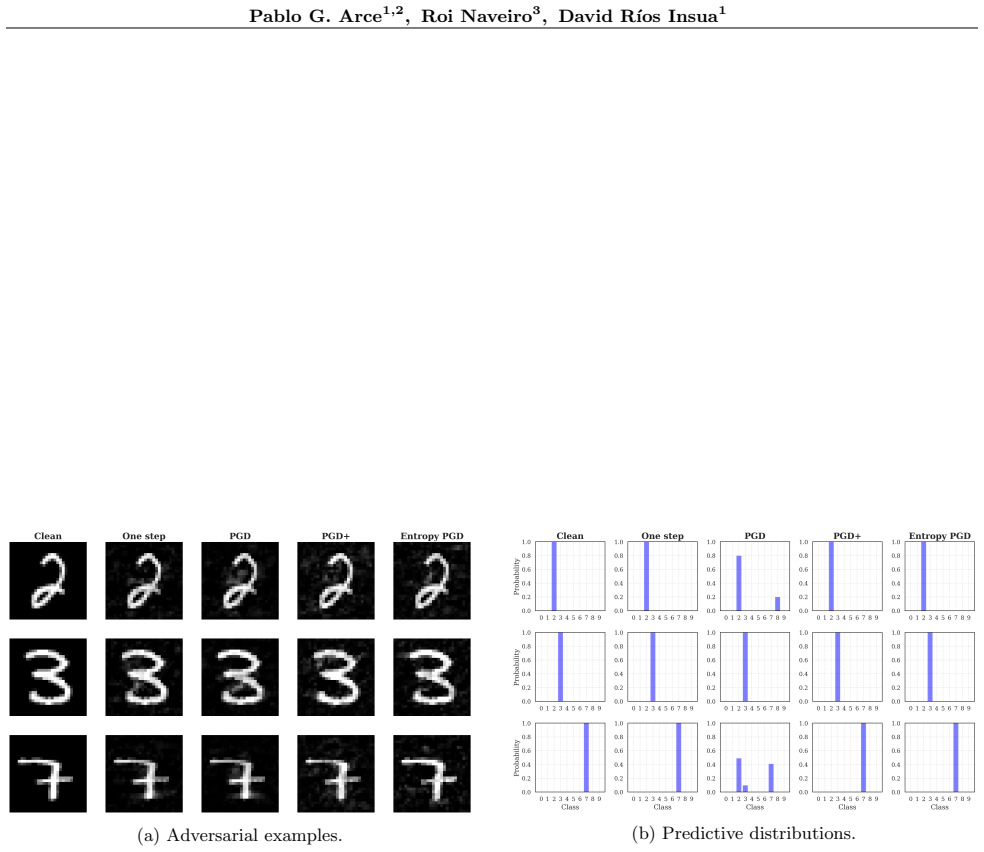
- [§4.1 and Tables 1–4] The 'AT' baseline is implemented as a one-step PGD augmentation with a 50/50 clean/adversarial mix. This is not the standard multi-step adversarial training of Madry et al. (2018), and it performs unusually poorly (e.g., 0.14 accuracy under PGD on MNIST). Please either rename the baseline to 'one-step adversarial training' or use a stronger AT implementation, so the comparison with OS50 is interpreted fairly.
- [§3.1] Typo: 'within within the setting' should be 'within the setting'.
Circularity Check
No circularity: AT/RS recoveries are explicit special cases; the Jensen-bound training is an approximation, not a self-referential fit.
full rationale
The paper's central derivations are self-contained. The proactive defense starts from a model-based robust posterior (Eq. 6) and derives an ELBO (Eq. 7); the Jensen-lower-bound objective in Sec. 3.3 is a genuine (if unquantified) approximation of that ELBO, not a restatement of the target. The AT and RS recovery propositions in SM E and SM C explicitly impose simplifying channel and estimation choices (Dirac worst-case channel plus MAP; isotropic Gaussian channel plus uniform latent prior plus MAP) and then compute the resulting predictor; these are special-case derivations, not definitions chosen to mirror the known methods. The empirical comparisons are against fixed external attacks and baselines, with no fitted parameter relabeled as a prediction. Self-citations (Arce et al., 2025; Gallego et al., 2024; Insua et al., 2023) are contextual and not load-bearing for the framework's validity. The only notable rigor gap—the unexplored Jensen gap between Eq. (7) and the optimized surrogate—is an approximation error concern, not circularity.
Assumptions & free parameters
free parameters (4)
- epsilon (attack radius) =
1 for MIX training; 2 for evaluation
- channel noise standard deviation sigma =
not stated in the main text; stored in the code repository
- MIX mixture weights =
0.4 identity; 0.2 for each of CE, CW, and entropy one-step adversaries
- reactive sample counts S and N =
S=5 posterior samples, N=100 training points
assumptions (7)
- domain assumption Conditional independence: y_j is independent of x'_j given x_j and theta, and x'_j is independent of phi given x_j and theta.
- domain assumption The offline approximation p(theta, phi | x'_j, D) ≈ p(theta, phi | D).
- ad hoc to paper The empirical distribution of training data substitutes for the generative model p(x|phi).
- ad hoc to paper A Jensen lower bound on the ELBO is a valid surrogate objective for the proactive posterior.
- standard math Posterior and adversarial channels are reparameterizable.
- ad hoc to paper AT recovery requires a Dirac-delta worst-case channel and a MAP point estimate.
- ad hoc to paper RS recovery requires MAP estimates, a uniform prior over x, and an isotropic Gaussian channel.
invented entities (1)
-
stochastic adversarial channel p(x'|x, theta)
Cite this review
Pith. "Pith review of A unifying Bayesian framework for adversarial robustness." pith.science (2026). https://pith.science/paper/NE6SSVNS
@misc{pith2026251009288,
  author       = {Pith},
  title        = {Pith review of: A unifying Bayesian framework for adversarial robustness},
  year         = {2026},
  howpublished = {\url{https://pith.science/paper/NE6SSVNS}},
  note         = {Machine review of arXiv:2510.09288}
}
read the original abstract
The vulnerability of machine learning models to adversarial attacks remains a critical societal security challenge. Traditional defenses, such as adversarial training, typically robustify models by minimizing a worst-case loss. These deterministic approaches do not account for uncertainty in the adversary's attack. While stochastic defenses placing a probability distribution on the adversary exist, they often lack statistical rigor and fail to make explicit their underlying assumptions. To resolve these issues, we introduce a formal Bayesian framework that models adversarial uncertainty through a stochastic channel, articulating all probabilistic assumptions. This yields two robustification strategies: a proactive defense enacted during training, aligned with adversarial training, and a reactive defense enacted during operations, aligned with adversarial purification. Several state-of-the-art defenses can be recovered as limiting cases of our model. We empirically validate our methodology, showcasing the benefits of explicitly modeling adversarial uncertainty.
Figures


Figures from the paper (5 more)


Reference graph
Works this paper leans on
-
[1]
G., Naveiro, R., and Insua, D
Arce, P. G., Naveiro, R., and Insua, D. R. (2025). Evasion attacks against bayesian predictive models. In Chiappa, S. and Magliacane, S., editors, Proceedings of the Forty-first Conference on Uncertainty in Artificial Intelligence , volume 286 of Proceedings of Machine Learning Research , pages 184--202. PMLR
2025
-
[2]
Balaji, Y., Goldstein, T., and Hoffman, J. (2019). Instance adaptive adversarial training: Improved accuracy tradeoffs in neural nets. arXiv preprint arXiv:1910.08051
arXiv 2019
-
[3]
M., Kucukelbir, A., and McAuliffe, J
Blei, D. M., Kucukelbir, A., and McAuliffe, J. D. (2017). Variational inference: A review for statisticians. Journal of the American statistical Association , 112(518):859--877
2017
-
[4]
Cai, Q.-Z., Du, M., Liu, C., and Song, D. (2018). Curriculum adversarial training. arXiv preprint arXiv:1805.04807
arXiv 2018
-
[5]
Carreau, M., Naveiro, R., and Caballero, W. N. (2025). Poisoning bayesian inference via data deletion and replication. arXiv preprint arXiv:2503.04480
arXiv 2025
-
[6]
Cohen, J., Rosenfeld, E., and Kolter, Z. (2019). Certified adversarial robustness via randomized smoothing. In international conference on machine learning , pages 1310--1320. PMLR
2019
-
[7]
Cortez, P., Cerdeira, A., Almeida, F., Matos, T., and Reis, J. (2009). Wine Quality . UCI Machine Learning Repository
2009
-
[8]
Dalvi, N., Domingos, P., Mausam, Sumit, S., and Verma, D. (2004). Adversarial classification . In Proceedings of the Tenth ACM SIGKDD International Conference on Knowledge Discovery and Data Mining , KDD '04, pages 99--108
2004
Show all 27 references
-
[9]
De Palma, G., Kiani, B., and Lloyd, S. (2021). Adversarial robustness guarantees for random deep neural networks. In International Conference on Machine Learning , pages 2522--2534. PMLR
2021
-
[10]
J., and Ong, Y.-S
Dong, J., Qu, X., Wang, Z. J., and Ong, Y.-S. (2024). Enhancing adversarial robustness via uncertainty-aware distributional adversarial training. arXiv preprint arXiv:2411.02871
2024 arXiv
-
[11]
G., Tsilivis, N., and Kempe, J
Feng, Y., Rudner, T. G., Tsilivis, N., and Kempe, J. (2024). Attacking bayes: On the adversarial robustness of bayesian neural networks. arXiv preprint arXiv:2404.19640
2024 arXiv
-
[12]
Gallego, V., Naveiro, R., and Insua, D. R. (2019). Reinforcement learning under threats. In Proceedings of the AAAI Conference on Artificial Intelligence , volume 33, pages 9939--9940
2019
-
[13]
Gallego, V., Naveiro, R., Redondo, A., R \' os Insua, D., and Ruggeri, F. (2024). Protecting classifiers from attacks. Statistical Science , 39(3):449--468
2024
-
[14]
J., Shlens, J., and Szegedy, C
Goodfellow, I. J., Shlens, J., and Szegedy, C. (2014). Explaining and harnessing adversarial examples. arXiv preprint arXiv:1412.6572
2014 arXiv
-
[15]
R., Naveiro, R., Gallego, V., and Poulos, J
Insua, D. R., Naveiro, R., Gallego, V., and Poulos, J. (2023). Adversarial machine learning: Bayesian perspectives. Journal of the American Statistical Association , 118(543):2195--2206
2023
-
[16]
Joseph, A., Melson, B., Rubisntein, B., and Tygar, J. (2019). Adversarial Machine Learning . Cambridge University Press
2019
-
[17]
Kannan, H., Kurakin, A., and Goodfellow, I. (2018). Adversarial logit pairing. arXiv preprint arXiv:1803.06373
2018 arXiv
-
[18]
LeCun, Y., Cortes, C., and Burges, C. (1998). THE MNIST DATABASE of handwritten digits . http://yann.lecun.com/exdb/mnist/
1998
-
[19]
Lin, G., Li, C., Zhang, J., Tanaka, T., and Zhao, Q. (2024). Adversarial training on purification (atop): Advancing both robustness and generalization. arXiv preprint arXiv:2401.16352
2024 arXiv
-
[20]
Madry, A., Makelov, A., Schmidt, L., Tsipras, D., and Vladu, A. (2018). Towards deep learning models resistant to adversarial attacks. In International Conference on Learning Representations
2018
-
[21]
Nie, W., Guo, B., Huang, Y., Xiao, C., Vahdat, A., and Anandkumar, A. (2022). Diffusion models for adversarial purification. arXiv preprint arXiv:2205.07460
2022 arXiv
-
[22]
Papamakarios, G., Sterratt, D., and Murray, I. (2019). Sequential neural likelihood: Fast likelihood-free inference with autoregressive flows. In The 22nd international conference on artificial intelligence and statistics , pages 837--848. PMLR
2019
-
[23]
and Xifara, A
Tsanas, A. and Xifara, A. (2012). Energy efficiency. UCI Machine Learning Repository
2012
-
[24]
and Kantarcioglu, M
Vorobeichyk, Y. and Kantarcioglu, M. (2019). Adversarial Machine Learning . Morgan & Claypool
2019
-
[25]
and Zhu, Z
Ye, N. and Zhu, Z. (2018). Bayesian adversarial learning. In Proceedings of the 32nd International Conference on Neural Information Processing Systems , pages 6892--6901. Curran Associates Inc
2018
-
[26]
Zhang, H., Yu, Y., Jiao, J., Xing, E., El Ghaoui, L., and Jordan, M. (2019). Theoretically principled trade-off between robustness and accuracy. In International conference on machine learning , pages 7472--7482. PMLR
2019
-
[27]
X., Zhou, K., Li, J., Tang, T., Wang, X., Hou, Y., Min, Y., Zhang, B., Zhang, J., Dong, Z., et al
Zhao, W. X., Zhou, K., Li, J., Tang, T., Wang, X., Hou, Y., Min, Y., Zhang, B., Zhang, J., Dong, Z., et al. (2023). A survey of large language models. arXiv preprint arXiv:2303.18223 , 1(2)
2023 arXiv
Reviewed August 4, 2026 · model on record in the stance chip above.
Discussion (0). Sign in to comment.