REVIEW 3 major objections 5 minor 1 cited by
Advances in 4D Representation: Geometry, Motion, and Interaction
T0 review · 3 major / 5 minor · reviewed 2026-08-04 · deepseek-v4-flash
Pith's one-line read This survey argues that in 4D content modeling, the choice of representation is the primary design decision, and it supplies a task-oriented framework of geometry, motion, and interaction with explicit trade-offs to guide that choice.
desk verdict A useful representation-centric survey whose practical selection table is weaker than its taxonomy. read the letter →
The pith
A machine-rendered reading of the paper's core claim, the machinery that carries it, and where it could break.
The reading
What carries the argument
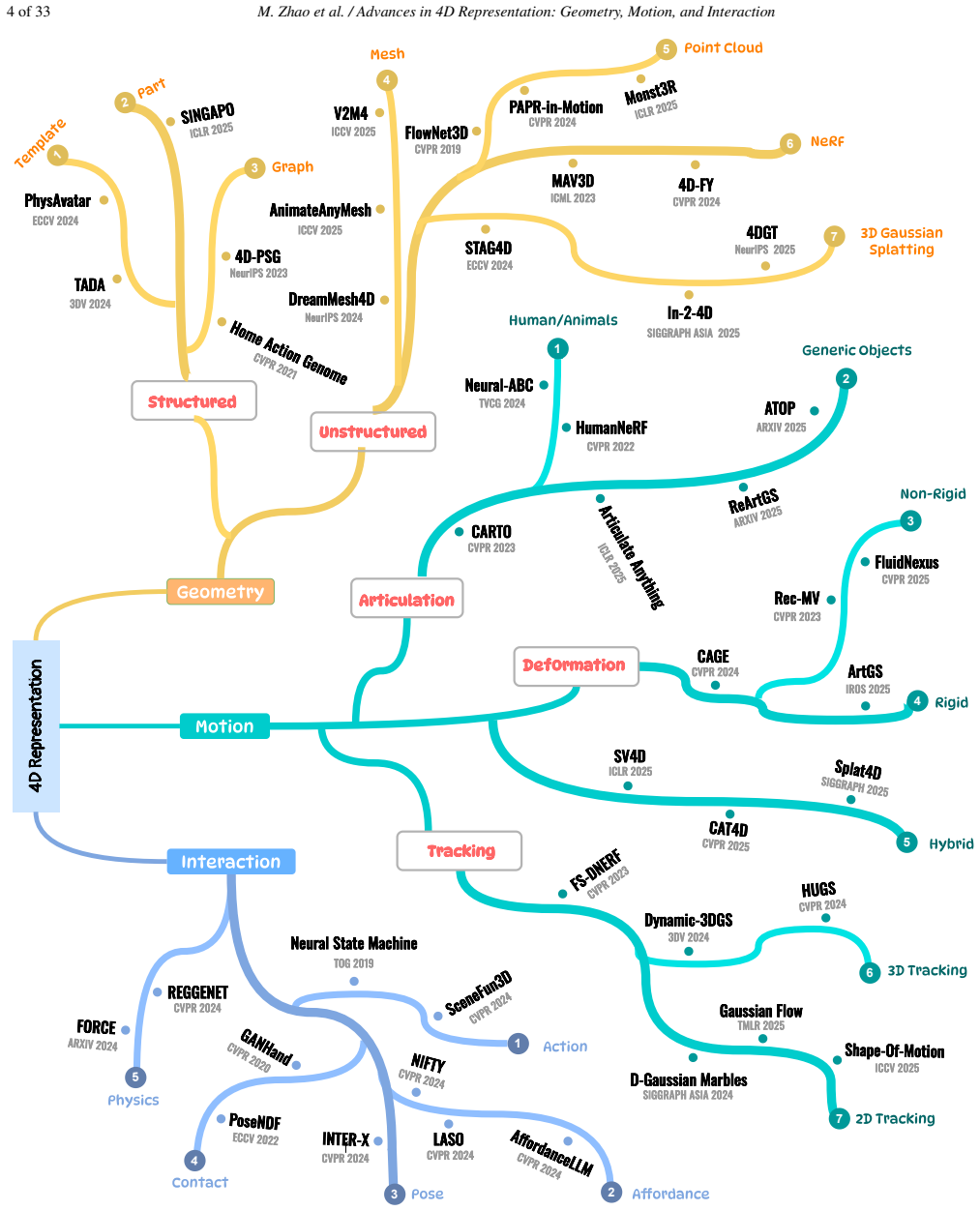
The central object is the taxonomy itself, together with the structured-vs-unstructured distinction and the seven-dimension comparison in Table 2. The taxonomy splits geometry into unstructured representations (mesh, point cloud, NeRF, 3D Gaussian Splatting), whose primitives carry no functional or semantic meaning, and structured representations (template, part, graph), which impose explicit compositional constraints; motion is then divided into articulated, deformation, tracking, and hybrid classes; interaction is organized as pose, contact, action/affordance, and physics. The taxonomy is doing the argumentative work: it is the device that converts a large body of methods into a small set
What would settle it
Run the seven Table 2 dimensions as a quantitative study: take a balanced sample of methods from each of the seven geometry classes, evaluate them on a common set of dynamic scenes with standardized protocols (e.g., fixed compute, identical sparse-input monocular video), and check whether the relative orderings — point clouds highest scalability, templates highest editability, NeRF highest visual fidelity — reproduce. A single class flipping its rank would undercut the paper's central comparative claim.
Extended reading notes
Core claim
On the paper's own terms, the central discovery is a representation-first map of the 4D landscape: a taxonomy built on three pillars — geometry (meshes, point clouds, NeRF, 3DGS, templates, parts, graphs), motion (articulated, deformation, tracking, hybrid), and interaction (pose, contact, action and affordance, physics) — with a structured/unstructured distinction as its backbone. The load-bearing comparison is Table 2, which rates each geometric representation on visual fidelity, scalability, temporal consistency, topology handling, editability, generalization, and efficiency. The paper argues that unstructured representations excel at novel-view synthesis from sparse inputs, while structu
Load-bearing premise
The trade-off ratings in Table 2 assume that the survey's selective, representative sample of methods fairly spans each representation class, so the High/Medium/Low assignments would not hold if the chosen works are unrepresentative of their categories.
Editorial extensions
If this is right
- If the framework is right, a practitioner can use Table 2 to pick a representation by task: point clouds for large-scale sensor capture, templates or parts for category-level editing and animation, NeRF or 3DGS for high-fidelity novel-view synthesis.
- It implies that structured representations — templates, part-based models, scene graphs — will become a focus of 4D research for editing and interaction workloads, since they score highest on editability and temporal consistency.
- It supports the push toward hybrid representations that combine the interpretability of structured models with the flexibility of implicit neural fields.
- It diagnoses the field's dataset bottleneck: existing data lacks the diversity in motion and interaction, and the geometry ground truth, needed to train representation-aware 4D models.
- It predicts continued migration from per-scene optimization to feed-forward and SDS-free training, which changes which representations are practical to deploy.
Reading between the lines
- The taxonomy's trade-off table could be made falsifiable by running a pantheon of representative methods on a shared set of dynamic scenes and measuring the seven dimensions; the paper does not provide that benchmark, so the ratings are testable hypotheses rather than measurements.
- If representation choice is truly primary, then evaluation metrics should become representation-aware — for example, measuring editability and temporal consistency alongside image fidelity — otherwise cross-method comparisons remain confounded by representational differences.
- An implicit consequence of the argument is that the current dominance of NeRF and 3DGS in 4D work may be a historical artifact of their success in static 3D, and that part-aware or template-aware extensions of these representations are the most promising route to combine fidelity with editability.
- The survey's claim about the role of LLMs and video foundation models as data amplifiers implies that the next bottleneck will be 4D evaluation and dataset curation, not generation quality — an area the paper itself flags as underdeveloped.
Editorial analysis
A structured set of objections, weighed in public.
Referee Report
Summary. The paper surveys 4D generation and reconstruction from a representation-centric perspective, organizing content into geometry (unstructured: mesh, point clouds, NeRF, 3DGS; structured: template, part, graph), motion (articulated, deformation, tracking, hybrid), and interaction (pose, contact, action/affordance, physics). It includes method tables, a seven-dimension qualitative comparison of representations, datasets/benchmarks, and training-strategy sections. The stated goal is to help readers select and customize appropriate 4D representations for their tasks.
Significance. The representation-centric organization is a useful contribution: the structured/unstructured distinction is coherent, the motion taxonomy is sensible, and the formal definitions (LBS, deformation fields, scene flow, SDS) are standard and correctly stated. The coverage of datasets, benchmarks, and metrics is a practical strength that will help newcomers. However, the promised decision framework rests on Table 2, whose qualitative ratings currently conflate representation-level and method-level evidence. This is fixable but requires substantive revision of the comparison methodology.
major comments (3)
- [Table 2, §7 (Generalization row)] Generalization is defined as 'Transferability to unseen scenes/objects without per-instance optimization or retraining,' a method-level property, but the row rates representations. Point Cloud is rated High citing DUST3R/VGGT, which are trained feed-forward models; NeRF and 3DGS are rated Medium even though the survey cites feed-forward variants (LRM, 4D-LRM, L4GM) with strong cross-instance generalization; Graph/Part/Template are Very High largely due to category-specific priors. The accompanying prose then discusses deformation-field motion representations and zero-shot tracking, which are not rows in Table 2. Since the abstract and Section 1 promise selection guidance, this conflation is load-bearing. Please split representation-level inductive bias from method-level generalization, or add a method column.
- [Table 2 / §1 (evidence and selection criteria)] Table 2 assigns High/Medium/Low ratings across seven dimensions without an evaluation protocol, benchmark, or quantitative support; Section 1 only says the survey takes a selective approach. Some ratings sit uneasily with the paper's own sections: NeRF is Very High for visual fidelity despite Section 2.1.3 noting persistent flickering and unrealistic deformations, and Mesh is Low for efficiency despite native rasterization and skinning. A reader cannot tell whether a rating reflects the representation or the representative methods. Please specify rating criteria or reframe the table as an informal summary with stated caveats.
- [Figure 3 / Table 1 / Table 2 (representative works)] The selective-example basis for the global comparison is not documented. Several works used as representative examples are from the authors' own groups (In-2-4D, SINGAPO, ATOP, 4D-PSG, SweepNet). This is not inherently problematic, but absent inclusion criteria it creates a risk that the trade-off conclusions in Table 2 are driven by convenience samples. Please state the selection protocol or explicitly bound the claims to the selected methods.
minor comments (5)
- [§7 (opening sentence)] The section opens by saying the comparison is across 'six key metrics,' but seven dimensions are defined and listed in Table 2. Please align the count and definitions.
- [Eq. (3)] The left-hand side is written as Δb→f(pb) but the right-hand side applies Φθ to p_f. The argument should be p_b (or the notation clarified) to match the forward canonical-to-observation mapping.
- [Table 1] The legend lists motion types ART, DF, TRK, ST, and PF, but the 4D-LRM row uses 'TG.' This appears to be a typo (likely ST).
- [Throughout] There are numerous typos and nonstandard reference abbreviations, e.g., 'Gassuain,' 'syncrhonised,' 'disscused,' 'adpot,' and entries such as [Y*23], [L*19], [WW A*25], [YYj*25] where the abbreviated author list obscures the citation. A thorough proofread and reference cleanup is needed.
- [Figure 3] The taxonomy diagram is dense, with small venue labels and numbers overlaid on the tree. The font/contrast should be improved for readability.
Circularity Check
No circularity: the survey's claims are organizational and qualitative, not derived from its inputs or from the cited works' outputs.
full rationale
This is a survey with an organizing thesis, not a derivation chain. The paper states in §1: 'we take a more selective approach by focusing on representative works to highlight both the desirable properties and ensuing challenges of each 4D representation' — this is an editorial framing, not a claim derived from equations. Table 2's qualitative High/Medium/Low ratings are presented as comparative judgments ('Table 2 outlines the fundamental trade-offs'), not as predictions fitted from data or obtained by substitution; no equation in the paper reduces one rating to another by construction. The 'Generalization' row's conflation of representation-level and method-level evidence is a legitimate correctness/selection-bias concern, but it is not circularity: the ratings are not defined in terms of the outputs they purport to explain. Several works from the authors' own group (e.g., In-2-4D [NCOZMA25], SINGAPO [LIC*25], ATOP [VNZ25], 4D-PSG [YCP*23]) appear as representative examples in Figure 3, Table 1, and the text, but they are not invoked as a uniqueness theorem, an exclusive justification for the taxonomy, or a fitted input disguised as a prediction. Self-citation of representative examples may raise representativeness concerns, but the survey's central claim — that 4D representations can be organized by geometry, motion, and interaction and selected via trade-offs — does not logically depend on the specific outputs of those papers. No circular step meeting the quoted-evidence bar was found.
Assumptions & free parameters
assumptions (3)
- domain assumption The selective set of representative works covers the relevant 4D representation space for the conclusions drawn.
- ad hoc to paper Representations can be cleanly categorized as structured vs unstructured by whether primitives carry explicit functional, hierarchical, or semantic meaning.
- domain assumption Qualitative ratings in Table 2 (fidelity, scalability, etc.) can be compared across methods without a standardized benchmark.
Cite this review
Pith. "Pith review of Advances in 4D Representation: Geometry, Motion, and Interaction." pith.science (2026). https://pith.science/paper/3JBT2HE4
@misc{pith2026251019255,
  author       = {Pith},
  title        = {Pith review of: Advances in 4D Representation: Geometry, Motion, and Interaction},
  year         = {2026},
  howpublished = {\url{https://pith.science/paper/3JBT2HE4}},
  note         = {Machine review of arXiv:2510.19255}
}
read the original abstract
We present a survey on 4D generation and reconstruction, a fast-evolving subfield of computer graphics whose developments have been propelled by recent advances in neural fields, geometric and motion deep learning, as well as 3D generative artificial intelligence (GenAI). While our survey is not the first of its kind, we build our coverage of the domain from a unique and distinctive perspective of 4D representations, to model 3D geometry evolving over time while exhibiting motion and interaction. Specifically, instead of offering an exhaustive enumeration of many works, we take a more selective approach by focusing on representative works to highlight both the desirable properties and ensuing challenges of each representation under different computation, application, and data scenarios. The main take-away message we aim to convey to the readers is on how to select and then customize the appropriate 4D representations for their tasks. Organizationally, we separate the 4D representations based on three key pillars: geometry, motion, and interaction. Our discourse will not only encompass the most popular representations of today, such as neural radiance fields (NeRFs) and 3D Gaussian Splatting (3DGS), but also bring attention to relatively under-explored representations in the 4D context, such as structured models and long-range motions. Throughout our survey, we will reprise the role of large language models (LLMs) and video foundational models (VFMs) in a variety of 4D applications, while steering our discussion towards their current limitations and how they can be addressed. We also provide a dedicated coverage on what 4D datasets are currently available, as well as what is lacking, in driving the subfield forward. Project page:https://mingrui-zhao.github.io/4DRep-GMI/
Figures


Figures from the paper (4 more)


Forward citations
Cited by 1 Pith paper
-
One Video, One World: Turning Monocular Video into Physical 4D Scenes
OVOW reconstructs instance-level, simulation-ready 4D mesh scenes from monocular video via a four-stage training-free pipeline and introduces a new benchmark for structured Video-to-4D evaluation.
Reference graph
Works this paper leans on
-
[1]
write newline
" write newline "" before.all 'output.state := FUNCTION fin.entry.original add.period write newline FUNCTION new.block output.state before.all = 'skip after.block 'output.state := if FUNCTION new.sentence output.state after.block = 'skip output.state before.all = 'skip after.sentence 'output.state := if if FUNCTION not #0 #1 if FUNCTION and 'skip pop #0 i...
-
[2]
: Physically embodied gaussian splatting: Embedding physical priors into a visual 3d world model for robotics
Abou-Chakra J., Rana K., Dayoub F., S \"u nderhauf N. : Physically embodied gaussian splatting: Embedding physical priors into a visual 3d world model for robotics. In Conference on Robot Learning (2023), no. 7th
2023
-
[3]
https://www.mixamo.com, 2015
Adobe : Mixamo. https://www.mixamo.com, 2015
2015
-
[4]
: Hyperreel: High-fidelity 6-dof video with ray-conditioned sampling
Attal B., Huang J.-B., Richardt C., Zollhoefer M., Kopf J., O’Toole M., Kim C. : Hyperreel: High-fidelity 6-dof video with ray-conditioned sampling. In Proceedings of the IEEE/CVF Conference on Computer Vision and Pattern Recognition (2023)
2023
-
[5]
: Score distillation sampling with learned manifold corrective
Alldieck T., Kolotouros N., Sminchisescu C. : Score distillation sampling with learned manifold corrective. In European Conference on Computer Vision (2024), Springer, pp. 1--18
2024
-
[6]
Armandpour M., Sadeghian A., Sadeghian A., Wang H., Hu C., Wang Z. : Re-imagine the negative prompt algorithm: Transform 2d diffusion into 3d, alleviate janus problem and beyond. arXiv preprint arXiv:2304.04968 (2023)
arXiv 2023
-
[7]
D., Sminchisescu C
Andriluka M., Tabanpour B., Freeman C. D., Sminchisescu C. : Learned neural physics simulation for articulated 3d human pose reconstruction. In European Conference on Computer Vision (2024), Springer, pp. 320--336
2024
-
[8]
: Learning to generalize kinematic models to novel objects
Abbatematteo B., Tellex S., Konidaris G. : Learning to generalize kinematic models to novel objects. In Proceedings of the 3rd Conference on Robot Learning (2019)
2019
Show all 300 references
-
[9]
: A differentiable extended kalman filter for object tracking
Bauza M., et al. : A differentiable extended kalman filter for object tracking. Frontiers in Robotics and AI (2021). URL: https://www.frontiersin.org/articles/10.3389/frobt.2021.686447
2021
-
[10]
Berlincioni L., Berretti S., Bertini M., Bimbo A. D. : 4dsr-gcn: 4d video point cloud upsampling using graph convolutional networks. In Proceedings of the 1st International Workshop on Multimedia Content Generation and Evaluation: New Methods and Practice (2023), pp. 57--65
2023
-
[11]
: Stable video diffusion: Scaling latent video diffusion models to large datasets
Blattmann A., Dockhorn T., Kulal S., Mendelevitch D., Kilian M., Lorenz D., Levi Y., English Z., Voleti V., Letts A., et al. : Stable video diffusion: Scaling latent video diffusion models to large datasets. arXiv preprint arXiv:2311.15127 (2023)
2023 arXiv
-
[12]
C., Hays J
Brahmbhatt S., Ham C., Kemp C. C., Hays J. : Contactdb: Analyzing and predicting grasp contact via thermal imaging. In Proceedings of the IEEE/CVF conference on computer vision and pattern recognition (2019), pp. 8709--8719
2019
-
[13]
: Per-gaussian embedding-based deformation for deformable 3d gaussian splatting
Bae J., Kim S., Yun Y., Lee H., Bang G., Uh Y. : Per-gaussian embedding-based deformation for deformable 3d gaussian splatting. arXiv preprint arXiv:2404.03613 (2024)
2024 arXiv
-
[14]
: Frozen in time: A joint video and image encoder for end-to-end retrieval
Bain M., Nagrani A., Varol G., Zisserman A. : Frozen in time: A joint video and image encoder for end-to-end retrieval. Proceedings of the IEEE/CVF International Conference on Computer Vision (2021), 1728--1738
2021
-
[15]
: Interaction networks for learning about objects, relations and physics
Battaglia P., Pascanu R., Lai M., Jimenez Rezende D., et al. : Interaction networks for learning about objects, relations and physics. Advances in neural information processing systems 29 (2016)
2016
-
[16]
W., Fidler S., Kreis K
Blattmann A., Rombach R., Ling H., Dockhorn T., Kim S. W., Fidler S., Kreis K. : Align your latents: High-resolution video synthesis with latent diffusion models. In Proceedings of the IEEE/CVF Conference on Computer Vision and Pattern Recognition (2023)
2023
-
[17]
J., Tagliasacchi A., Lindell D
Bahmani S., Skorokhodov I., Rong V., Wetzstein G., Guibas L., Wonka P., Tulyakov S., Park J. J., Tagliasacchi A., Lindell D. B. : 4d-fy: Text-to-4d generation using hybrid score distillation sampling. In Proceedings of the IEEE/CVF Conference on Computer Vision and Pattern Rec...
2024
-
[18]
B., Gojcic Z., Fidler S., et al
Bahmani S., Shen T., Ren J., Huang J., Jiang Y., Turki H., Tagliasacchi A., Lindell D. B., Gojcic Z., Fidler S., et al. : Lyra: Generative 3d scene reconstruction via video diffusion model self-distillation. arXiv preprint arXiv:2509.19296 (2025)
2025
-
[19]
: Learning spatiotemporal graphs of human activities
Brendel W., Todorovic S. : Learning spatiotemporal graphs of human activities. In 2011 International Conference on Computer Vision (2011), IEEE, pp. 778--785
2011
-
[20]
: Lumiere: A space-time diffusion model for video generation
Bar-Tal O., Chefer H., Tov O., Herrmann C., Paiss R., Zada S., Ephrat A., Hur J., Li Y., Michaeli T., et al. : Lumiere: A space-time diffusion model for video generation. arXiv preprint arXiv:2401.12945 (2024)
2024 arXiv
-
[21]
D., Kemp C
Brahmbhatt S., Tang C., Twigg C. D., Kemp C. C., Hays J. : Contactpose: A dataset of grasps with object contact and hand pose. In European Conference on Computer Vision (2020), Springer, pp. 361--378
2020
-
[22]
L., Xie X., Petrov I., Sminchisescu C., Theobalt C., Pons-Moll G
Bhatnagar B. L., Xie X., Petrov I., Sminchisescu C., Theobalt C., Pons-Moll G. : Behave: Dataset and method for tracking human object interactions. In IEEE Conference on Computer Vision and Pattern Recognition (CVPR) (jun 2022), IEEE
2022
-
[23]
: Object-centric reconstruction and tracking of dynamic unknown objects using 3d gaussian splatting
Chen X., et al. : Object-centric reconstruction and tracking of dynamic unknown objects using 3d gaussian splatting. arXiv preprint arXiv:2405.20104 (2024)
2024 arXiv
-
[24]
H., Vora S., Liong V
Caesar H., Bankiti V., Lang A. H., Vora S., Liong V. E., Xu Q., Krishnan A., Pan Y., Baldan G., Beijbom O. : nuscenes: A multimodal dataset for autonomous driving. Proceedings of the IEEE/CVF conference on computer vision and pattern recognition (2020), 11621--11631
2020
-
[25]
: Physx-3d: Physical-grounded 3d asset generation
Cao Z., Chen Z., Pan L., Liu Z. : Physx-3d: Physical-grounded 3d asset generation. arXiv preprint arXiv:2507.12465 (2025)
2025
-
[26]
: Easi3r: Estimating disentangled motion from dust3r without training
Chen X., Chen Y., Xiu Y., Geiger A., Chen A. : Easi3r: Estimating disentangled motion from dust3r without training. arXiv preprint arXiv:2503.24391 (2025)
2025
-
[27]
: Human3r: Everyone everywhere all at once
Chen Y., Chen X., Xue Y., Chen A., Xiu Y., Gerard P.-M. : Human3r: Everyone everywhere all at once. arXiv preprint arXiv:2510.06219 (2025)
2025
-
[28]
: Neural surface reconstruction of dynamic scenes with monocular rgb-d camera
Cai H., Feng W., Feng X., Wang Y., Zhang J. : Neural surface reconstruction of dynamic scenes with monocular rgb-d camera. NeurIPS 35 (2022)
2022
-
[29]
X., Funkhouser T., Guibas L., Hanrahan P., Huang Q., Li Z., Savarese S., Savva M., Song S., Su H., et al
Chang A. X., Funkhouser T., Guibas L., Hanrahan P., Huang Q., Li Z., Savarese S., Savva M., Song S., Su H., et al. : Shapenet: An information-rich 3d model repository. In Proceedings of the IEEE conference on computer vision and pattern recognition (2015), pp. 81--89
2015
-
[30]
F., Dideriksen T., Arora H., Guillaumin M., Malik J
Collins J., Goel S., Deng K., Luthra A., Xu L., Gundogdu E., Zhang X., Yago Vicente T. F., Dideriksen T., Arora H., Guillaumin M., Malik J. : Abo: Dataset and benchmarks for real-world 3d object understanding. CVPR (2022)
2022
-
[31]
: Periodic vibration gaussian: Dynamic urban scene reconstruction and real-time rendering
Chen Y., Gu C., Jiang J., Zhu X., Zhang L. : Periodic vibration gaussian: Dynamic urban scene reconstruction and real-time rendering. ArXiv:2311.18561 (2023)
2023 arXiv
-
[32]
: Ct4d: Consistent text-to-4d generation with animatable meshes
Chen C., Huang S., Chen X., Chen G., Han X., Zhang K., Gong M. : Ct4d: Consistent text-to-4d generation with animatable meshes. arXiv preprint arXiv:2408.08342 (2024)
2024 arXiv
-
[33]
: Occlusion-robust scene flow-based tissue deformation recovery incorporating a mesh optimization model
Chen J., Hara K., Kobayashi E., Sakuma I., Tomii N. : Occlusion-robust scene flow-based tissue deformation recovery incorporating a mesh optimization model. International Journal of Computer Assisted Radiology and Surgery 18, 6 (2023), 1043--1051
2023
-
[34]
R., Xu G., Ma F., Li M., Zhou G
Chen G., He Y., Yu M., Yu F. R., Xu G., Ma F., Li M., Zhou G. : Inter3d: A benchmark and strong baseline for human-interactive 3d object reconstruction. arXiv preprint arXiv:2502.14004 (2025)
2025 arXiv
-
[35]
: Hexplane: A fast representation for dynamic scenes
Cao A., Johnson J. : Hexplane: A fast representation for dynamic scenes. In Proceedings of the IEEE/CVF Conference on Computer Vision and Pattern Recognition (2023)
2023
-
[36]
: D-grasp: Physically plausible dynamic grasp synthesis for hand-object interactions
Christen S., Kocabas M., Aksan E., Hwangbo J., Song J., Hilliges O. : D-grasp: Physically plausible dynamic grasp synthesis for hand-object interactions. In Proceedings of the IEEE/CVF Conference on Computer Vision and Pattern Recognition (2022), pp. 20577--20586
2022
-
[37]
: Reconstructing 4d spatial intelligence: A survey, 2025
Cao Y., Lu J., Huang Z., Shen Z., Zhao C., Hong F., Chen Z., Li X., Wang W., Liu Y., Liu Z. : Reconstructing 4d spatial intelligence: A survey, 2025. URL: https://arxiv.org/abs/2507.21045, http://arxiv.org/abs/2507.21045 arXiv:2507.21045
2025 arXiv
-
[38]
: Motion2vecsets: 4d latent vector set diffusion for non-rigid shape reconstruction and tracking
Cao W., Luo C., Zhang B., Nie ner M., Tang J. : Motion2vecsets: 4d latent vector set diffusion for non-rigid shape reconstruction and tracking. In Proceedings of the IEEE/CVF conference on computer vision and pattern recognition (2024), pp. 20496--20506
2024
-
[39]
: 4dnex: Feed-forward 4d generative modeling made easy
Chen Z., Liu T., Zhuo L., Ren J., Tao Z., Zhu H., Hong F., Pan L., Liu Z. : 4dnex: Feed-forward 4d generative modeling made easy. arXiv preprint arXiv:2508.13154 (2025)
2025 arXiv
-
[40]
Y., Lee K
Choi H., Moon G., Chang J. Y., Lee K. M. : Beyond static features for temporally consistent 3d human pose and shape from a video. In Proceedings of the IEEE/CVF conference on computer vision and pattern recognition (2021), pp. 1964--1973
2021
-
[41]
: Ganhand: Predicting human grasp affordances in multi-object scenes
Corona E., Pumarola A., Alenya G., Moreno-Noguer F., Rogez G. : Ganhand: Predicting human grasp affordances in multi-object scenes. In Proceedings of the IEEE/CVF conference on computer vision and pattern recognition (2020), pp. 5031--5041
2020
-
[42]
K., Liu Z
Cao Y., Pan L., Han K., Wong K.-Y. K., Liu Z. : Avatargo: Zero-shot 4d human-object interaction generation and animation. In The Thirteenth International Conference on Learning Representations (2024)
2024
-
[43]
M., Kim S
Chignoli M., Slotine J.-J., Wensing P. M., Kim S. : Urdf+: An enhanced urdf for robots with kinematic loops. In 2024 IEEE-RAS 23rd International Conference on Humanoid Robots (Humanoids) (2024), IEEE, pp. 197--204
2024
-
[44]
: Urdformer: A pipeline for constructing articulated simulation environments from real-world images
Chen Z., Walsman A., Memmel M., Mo K., Fang A., Vemuri K., Wu A., Fox D., Gupta A. : Urdformer: A pipeline for constructing articulated simulation environments from real-world images. arXiv preprint arXiv:2405.11656 (2024)
2024 arXiv
-
[45]
M., Ivanovic B., Litany O., Gojcic Z., Fidler S., Pavone M., Song L., Wang Y
Chen Z., Yang J., Huang J., de Lutio R., Esturo J. M., Ivanovic B., Litany O., Gojcic Z., Fidler S., Pavone M., Song L., Wang Y. : OmniRe : Omni Urban Scene Reconstruction , 2024. https://doi.org/10.48550/arXiv.2408.16760 doi:10.48550/arXiv.2408.16760
-
[46]
: Neural-abc: neural parametric models for articulated body with clothes
Chen H., Yao Y., Zhang J. : Neural-abc: neural parametric models for articulated body with clothes. IEEE Transactions on Visualization and Computer Graphics 31, 2 (2024), 1478--1495
2024
-
[47]
: Deepverse: 4d autoregressive video generation as a world model
Chen J., Zhu H., He X., Wang Y., Zhou J., Chang W., Zhou Y., Li Z., Fu Z., Pang J., et al. : Deepverse: 4d autoregressive video generation as a world model. arXiv preprint arXiv:2506.01103 (2025)
2025 arXiv
-
[48]
: Physics-driven local-whole elastic deformation modeling for point cloud representation learning
Chen Z., Zhao R., Han X., Guo X., Wang S., Qiao Z. : Physics-driven local-whole elastic deformation modeling for point cloud representation learning. arXiv preprint arXiv:2505.13812 (2025)
2025 arXiv
-
[49]
: Encoder-decoder with atrous separable convolution for semantic image segmentation
Chen L.-C., Zhu Y., Papandreou G., Schroff F., Adam H. : Encoder-decoder with atrous separable convolution for semantic image segmentation. In ECCV (2018)
2018
-
[50]
: V2m4: 4d mesh animation reconstruction from a single monocular video
Chen J., Zhang B., Tang X., Wonka P. : V2m4: 4d mesh animation reconstruction from a single monocular video. arXiv preprint arXiv:2503.09631 (2025)
2025 arXiv
-
[51]
: Imagenet: A large-scale hierarchical image database
Deng J., Dong W., Socher R., Li L.-J., Li K., Fei-Fei L. : Imagenet: A large-scale hierarchical image database. In 2009 IEEE conference on computer vision and pattern recognition (2009), Ieee, pp. 248--255
2009
-
[52]
B., Vanhoucke V
Downs L., Francis A., Koenig N., Kinman B., Hickman R., Reymann K., McHugh T. B., Vanhoucke V. : Google scanned objects: A high-quality dataset of 3d scanned household items. 2022 International Conference on Robotics and Automation (ICRA) (2022), 2553--2560
2022
-
[53]
Y., et al
Deitke M., Liu R., Wallingford M., Ngo H., Michel O., Kusupati A., Fan A., Laforte C., Voleti V., Gadre S. Y., et al. : Objaverse-xl: A universe of 10m+ 3d objects. In Advances in Neural Information Processing Systems (2023), vol. 36, pp. 35799--35813
2023
-
[54]
P., Mandi Z., Yao Y., Liu J.-W., Seidenschwarz J., Shou M
Duisterhof B. P., Mandi Z., Yao Y., Liu J.-W., Seidenschwarz J., Shou M. Z., Ramanan D., Song S., Birchfield S., Wen B., et al. : Deformgs: Scene flow in highly deformable scenes for deformable object manipulation. ArXiv:2312.00583 (2023)
2023 arXiv
-
[55]
P., Mandi Z., Yao Y., Liu J.-W., Shou M
Duisterhof B. P., Mandi Z., Yao Y., Liu J.-W., Shou M. Z., Song S., Ichnowski J. : Md-splatting: Learning metric deformation from 4d gaussians in highly deformable scenes
-
[56]
: Textmesh4d: High-quality text-to-4d mesh generation
Dai S., Su X., Wan B., Hu R., Xu K. : Textmesh4d: High-quality text-to-4d mesh generation. arXiv preprint arXiv:2506.24121 (2025)
2025 arXiv
-
[57]
: Scenefun3d: Fine-grained functionality and affordance understanding in 3d scenes
Delitzas A., Takmaz A., Tombari F., Sumner R., Pollefeys M., Engelmann F. : Scenefun3d: Fine-grained functionality and affordance understanding in 3d scenes. In Proceedings of the IEEE/CVF Conference on Computer Vision and Pattern Recognition (2024), pp. 14531--14542
2024
-
[58]
: 4d-rotor gaussian splatting: towards efficient novel view synthesis for dynamic scenes
Duan Y., Wei F., Dai Q., He Y., Chen W., Chen B. : 4d-rotor gaussian splatting: towards efficient novel view synthesis for dynamic scenes. In ACM SIGGRAPH 2024 Conference Papers (2024), pp. 1--11
2024
-
[59]
: 3d affordancenet: A benchmark for visual object affordance understanding
Deng S., Xu X., Wu C., Chen K., Jia K. : 3d affordancenet: A benchmark for visual object affordance understanding. In proceedings of the IEEE/CVF conference on computer vision and pattern recognition (2021), pp. 1778--1787
2021
-
[60]
: Nsm4d: Neural scene model based online 4d point cloud sequence understanding
Dong Y., Zhang Z., Liu Y., Yi L. : Nsm4d: Neural scene model based online 4d point cloud sequence understanding. arXiv preprint arXiv:2310.08326 (2023)
2023 arXiv
-
[61]
B., Wu J
Du Y., Zhang Y., Yu H.-X., Tenenbaum J. B., Wu J. : Neural radiance flow for 4d view synthesis and video processing. In 2021 IEEE/CVF International Conference on Computer Vision (ICCV) (2021), IEEE Computer Society, pp. 14304--14314
2021
-
[62]
R., Zhou Y., et al
Ettinger S., Cheng S., Caine B., Liu C., Zhao H., Pradhan S., Chai Y., Sapp B., Qi C. R., Zhou Y., et al. : Large scale interactive motion forecasting for autonomous driving: The waymo open motion dataset. In Proceedings of the IEEE/CVF international conference on computer vis...
2021
-
[63]
: Flowbot3d: Learning 3d articulation flow to manipulate articulated objects
Eisner B., Zhang H., Held D. : Flowbot3d: Learning 3d articulation flow to manipulate articulated objects. arXiv preprint arXiv:2205.04382 (2022)
2022 arXiv
-
[64]
: 3d human interaction generation: A survey
Fan S., Huang W., Cai X., Du B. : 3d human interaction generation: A survey. arXiv preprint arXiv:2503.13120 (2025)
2025 arXiv
-
[65]
: 3d-future: 3d furniture shape with texture
Fu H., Jia R., Gao L., Gong M., Zhao B., Maybank S., Tao D. : 3d-future: 3d furniture shape with texture. International Journal of Computer Vision 129, 12 (2021), 3313--3337
2021
-
[66]
R., Porzi L., Pollefeys M., Kontschieder P
Fischer T., Kulhanek J., Bul \`o S. R., Porzi L., Pollefeys M., Kontschieder P. : Dynamic 3d gaussian fields for urban areas. In NeurIPS (2024)
2024
-
[67]
R., Recht B., Kanazawa A
Fridovich-Keil S., Meanti G., Warburg F. R., Recht B., Kanazawa A. : K-planes: Explicit radiance fields in space, time, and appearance. In Proceedings of the IEEE/CVF Conference on Computer Vision and Pattern Recognition (2023)
2023
-
[68]
R., Pollefeys M., Kontschieder P
Fischer T., Porzi L., Bulo S. R., Pollefeys M., Kontschieder P. : Multi-level neural scene graphs for dynamic urban environments. In CVPR (2024)
2024
-
[69]
: Pie-nerf: Physics-based interactive elastodynamics with nerf
Feng Y., Shang Y., Li X., Shao T., Jiang C., Yang Y. : Pie-nerf: Physics-based interactive elastodynamics with nerf. In Proceedings of the IEEE/CVF Conference on Computer Vision and Pattern Recognition (2024), pp. 4450--4461
2024
-
[70]
: Fast dynamic radiance fields with time-aware neural voxels
Fang J., Yi T., Wang X., Xie L., Zhang X., Liu W., Nie ner M., Tian Q. : Fast dynamic radiance fields with time-aware neural voxels. In SIGGRAPH Asia 2022 Conference Papers (2022), pp. 1--9
2022
-
[71]
: Three-dimensional reconstruction of human interactions
Fieraru M., Zanfir M., Oneata E., Popa A.-I., Olaru V., Sminchisescu C. : Three-dimensional reconstruction of human interactions. In Proceedings of the IEEE/CVF Conference on Computer Vision and Pattern Recognition (2020), pp. 7214--7223
2020
-
[72]
J., Darrell T., Kanazawa A
Feng H., Zhang J., Wang Q., Ye Y., Yu P., Black M. J., Darrell T., Kanazawa A. : St4rtrack: Simultaneous 4d reconstruction and tracking in the world. arXiv preprint arXiv:2504.13152 (2025)
2025 arXiv
-
[73]
: Advances in radiance field for dynamic scene: From neural field to gaussian field, 2025
Fan J., Zeng X., Zhang J., Gong M., Yang Y., Tao D. : Advances in radiance field for dynamic scene: From neural field to gaussian field, 2025. URL: https://arxiv.org/abs/2505.10049, http://arxiv.org/abs/2505.10049 arXiv:2505.10049
2025 arXiv
-
[74]
: Neural deformable voxel grid for fast optimization of dynamic view synthesis
Guo X., Chen G., Dai Y., Ye X., Sun J., Tan X., Ding E. : Neural deformable voxel grid for fast optimization of dynamic view synthesis. In ACCV (2022)
2022
-
[75]
K., Gopalan N
Gupta A., Gu W., Patil O., Lee J. K., Gopalan N. : Learning sequential kinematic models from demonstrations for multi-jointed articulated objects. arXiv preprint arXiv:2505.06363 (2025)
2025 arXiv
-
[76]
T., Poole B
Gao R., Holynski A., Henzler P., Brussee A., Martin-Brualla R., Srinivasan P., Barron J. T., Poole B. : Cat3d: Create anything in 3d with multi-view diffusion models. arXiv preprint arXiv:2405.10314 (2024)
2024 arXiv
-
[77]
Gibson J. J. : The theory of affordances. Perceiving, acting, and knowing: toward an ecological psychology (1977), pp--67
1977
-
[78]
: Vid2avatar: 3d avatar reconstruction from videos in the wild via self-supervised scene decomposition
Guo C., Jiang T., Chen X., Song J., Hilliges O. : Vid2avatar: 3d avatar reconstruction from videos in the wild via self-supervised scene decomposition. In Proceedings of the IEEE/CVF Conference on Computer Vision and Pattern Recognition (2023)
2023
-
[79]
: Vision meets robotics: The kitti dataset
Geiger A., Lenz P., Stiller C., Urtasun R. : Vision meets robotics: The kitti dataset. The International Journal of Robotics Research 32, 11 (2013), 1231--1237
2013
-
[80]
D., Kalogerakis E
Goyal P., Petrov D., Andrews S., Ben-Shabat Y., Liu H.-T. D., Kalogerakis E. : Geopard: Geometric pretraining for articulation prediction in 3d shapes. arXiv preprint arXiv:2504.02747 (2025)
2025 arXiv
-
[81]
H., Cohen-Or D
Gat I., Raab S., Tevet G., Reshef Y., Bermano A. H., Cohen-Or D. : Anytop: Character animation diffusion with any topology. arXiv preprint arXiv:2502.17327 (2025)
2025 arXiv
-
[82]
: Dynamic view synthesis from dynamic monocular video
Gao C., Saraf A., Kopf J., Huang J.-B. : Dynamic view synthesis from dynamic monocular video. In Proceedings of the IEEE/CVF International Conference on Computer Vision (2021), pp. 5712--5721
2021
-
[83]
: Meshart: Generating articulated meshes with structure-guided transformers
Gao D., Siddiqui Y., Li L., Dai A. : Meshart: Generating articulated meshes with structure-guided transformers. In Proceedings of the Computer Vision and Pattern Recognition Conference (2025), pp. 618--627
2025
-
[84]
D., Vo M., Brahmbhatt S., Kemp C
Grady P., Tang C., Twigg C. D., Vo M., Brahmbhatt S., Kemp C. C. : Contactopt: Optimizing contact to improve grasps. In Proceedings of the IEEE/CVF Conference on Computer Vision and Pattern Recognition (2021), pp. 1471--1481
2021
-
[85]
: Ego4d: Around the world in 3,000 hours of egocentric video
Grauman K., Westbury A., Byrne E., Chavis Z., Furnari A., Girdhar R., Hamburger J., Jiang H., Liu M., Liu X., et al. : Ego4d: Around the world in 3,000 hours of egocentric video. In Proceedings of the IEEE/CVF conference on computer vision and pattern recognition (2022), pp. 1...
2022
-
[86]
: Ego-exo4d: Understanding skilled human activity from first-and third-person perspectives
Grauman K., Westbury A., Torresani L., Kitani K., Malik J., Afouras T., Ashutosh K., Baiyya V., Bansal S., Boote B., et al. : Ego-exo4d: Understanding skilled human activity from first-and third-person perspectives. In Proceedings of the IEEE/CVF Conference on Computer Vision ...
2024
-
[87]
: Gaussianflow: Splatting gaussian dynamics for 4d content creation
Gao Q., Xu Q., Cao Z., Mildenhall B., Ma W., Chen L., Tang D., Neumann U. : Gaussianflow: Splatting gaussian dynamics for 4d content creation. arXiv preprint arXiv:2403.12365 (2024)
2024 arXiv
-
[88]
: V4d: Voxel for 4d novel view synthesis
Gan W., Xu H., Huang Y., Chen S., Yokoya N. : V4d: Voxel for 4d novel view synthesis. IEEE Transactions on Visualization and Computer Graphics 30, 2 (2023), 1579--1591
2023
-
[89]
: Articulatedgs: Self-supervised digital twin modeling of articulated objects using 3d gaussian splatting
Guo J., Xin Y., Liu G., Xu K., Liu L., Hu R. : Articulatedgs: Self-supervised digital twin modeling of articulated objects using 3d gaussian splatting. In Proceedings of the Computer Vision and Pattern Recognition Conference (2025), pp. 27144--27153
2025
-
[90]
: Gapartnet: Cross-category domain-generalizable object perception and manipulation via generalizable and actionable parts
Geng H., Xu H., Zhao C., Xu C., Yi L., Huang S., Wang H. : Gapartnet: Cross-category domain-generalizable object perception and manipulation via generalizable and actionable parts. In Proceedings of the IEEE/CVF Conference on Computer Vision and Pattern Recognition (2023), pp....
2023
-
[91]
: Animatediff: Animate your personalized text-to-image diffusion models without specific tuning
Guo Y., Yang C., Rao A., Liang Z., Wang Y., Qiao Y., Agrawala M., Lin D., Dai B. : Animatediff: Animate your personalized text-to-image diffusion models without specific tuning. arXiv preprint arXiv:2307.04725 (2023)
2023 arXiv
-
[92]
: Fluidnexus: 3d fluid reconstruction and prediction from a single video
Gao Y., Yu H.-X., Zhu B., Wu J. : Fluidnexus: 3d fluid reconstruction and prediction from a single video. In Proceedings of the Computer Vision and Pattern Recognition Conference (2025), pp. 26091--26101
2025
-
[93]
: Dynamic 3d scene analysis by point cloud accumulation
Huang S., Gojcic Z., Huang J., Wieser A., Schindler K. : Dynamic 3d scene analysis by point cloud accumulation. In European Conference on Computer Vision (2022), Springer, pp. 674--690
2022
-
[94]
Hassan M., Ghosh P., Tesch J., Tzionas D., Black M. J. : Populating 3d scenes by learning human-scene interaction. In Proceedings of the IEEE/CVF Conference on Computer Vision and Pattern Recognition (2021), pp. 14708--14718
2021
-
[95]
Hassan M., Guo Y., Wang T., Black M., Fidler S., Peng X. B. : Synthesizing physical character-scene interactions. In ACM SIGGRAPH 2023 Conference Proceedings (2023), pp. 1--9
2023
-
[96]
: Dynamic point cloud denoising via gradient fields
Hu Q., Hu W. : Dynamic point cloud denoising via gradient fields. ACM Transactions on Multimedia Computing, Communications and Applications 21, 4 (2025), 1--24
2025
-
[97]
: Forge4d: Feed-forward 4d human reconstruction and interpolation from uncalibrated sparse-view videos
Hu Y., He Y., Chen J., Yuan W., Qiu K., Lin Z., Zhu S., Dong Z., Zhang J. : Forge4d: Feed-forward 4d human reconstruction and interpolation from uncalibrated sparse-view videos. arXiv preprint arXiv:2509.24209 (2025)
2025
-
[98]
: Vbench: Comprehensive benchmark suite for video generative models
Huang Z., He Y., Yu J., Zhang F., Si C., Jiang Y., Zhang Y., Wu T., Jin Q., Chanpaisit N., et al. : Vbench: Comprehensive benchmark suite for video generative models. In Proceedings of the IEEE/CVF Conference on Computer Vision and Pattern Recognition (2024)
2024
-
[99]
Z., Zakharov S., Liu K., Ambrus R
Heppert N., Irshad M. Z., Zakharov S., Liu K., Ambrus R. A., Bohg J., Valada A., Kollar T. : Carto: Category and joint agnostic reconstruction of articulated objects. In Proceedings of the IEEE/CVF Conference on Computer Vision and Pattern Recognition (2023), pp. 21201--21210
2023
-
[100]
: Neural Radiance Field in Autonomous Driving : A Survey
He L., Li L., Sun W., Han Z., Liu Y., Zheng S., Wang J., Li K. : Neural Radiance Field in Autonomous Driving : A Survey . ArXiv:240413816 (2024)
2024
-
[101]
: Real-time deep dynamic characters
Habermann M., Liu L., Xu W., Zollhoefer M., Pons-Moll G., Theobalt C. : Real-time deep dynamic characters. ACM Transactions on Graphics (ToG) 40, 4 (2021), 1--16
2021
-
[102]
: Mvtokenflow: High-quality 4d content generation using multiview token flow
Huang H., Liu Y., Zheng G., Wang J., Dou Z., Yang S. : Mvtokenflow: High-quality 4d content generation using multiview token flow. In The Thirteenth International Conference on Learning Representations (2025)
2025
-
[103]
: Sc-gs: Sparse-controlled gaussian splatting for editable dynamic scenes
Huang Y.-H., Sun Y.-T., Yang Z., Lyu X., Cao Y.-P., Qi X. : Sc-gs: Sparse-controlled gaussian splatting for editable dynamic scenes. In Proceedings of the IEEE/CVF conference on computer vision and pattern recognition (2024), pp. 4220--4230
2024
-
[104]
: S^3 gaussian: Self-supervised street gaussians for autonomous driving
Huang N., Wei X., Zheng W., An P., Lu M., Zhan W., Tomizuka M., Keutzer K., Zhang S. : S^3 gaussian: Self-supervised street gaussians for autonomous driving. CoRR (2024)
2024
-
[105]
: Lrm: Large reconstruction model for single image to 3d
Hong Y., Zhang K., Gu J., Bi S., Zhou Y., Liu D., Liu F., Sunkavalli K., Bui T., Tan H. : Lrm: Large reconstruction model for single image to 3d. arXiv preprint arXiv:2311.04400 (2023)
2023 arXiv
-
[106]
Huang T., Zeng Y., Li H., Zuo W., Lau R. W. : Dreamphysics: Learning physical properties of dynamic 3d gaussians with video diffusion priors. arXiv e-prints (2024), arXiv--2406
2024
-
[107]
Iliash D., Jiang H., Zhang Y., Savva M., Chang A. X. : S2O : Static to openable enhancement for articulated 3D objects. arXiv preprint arXiv:2409.18896 (2024)
2024 arXiv
-
[108]
Igarashi T., Moscovich T., Hughes J. F. : As-rigid-as-possible shape manipulation. ACM transactions on Graphics (TOG) 24, 3 (2005), 1134--1141
2005
-
[109]
: Human3
Ionescu C., Papava D., Olaru V., Sminchisescu C. : Human3. 6m: Large scale datasets and predictive methods for 3d human sensing in natural environments. IEEE transactions on pattern analysis and machine intelligence 36, 7 (2013), 1325--1339
2013
-
[110]
: Humanrf: High-fidelity neural radiance fields for humans in motion
I s k M., R \"u nz M., Georgopoulos M., Khakhulin T., Starck J., Agapito L., Nie ner M. : Humanrf: High-fidelity neural radiance fields for humans in motion. ACM Transactions on Graphics (TOG) 42, 4 (2023), 1--12
2023
-
[111]
: Selfrecon: Self reconstruction your digital avatar from monocular video
Jiang B., Hong Y., Bao H., Zhang J. : Selfrecon: Self reconstruction your digital avatar from monocular video. In CVPR (2022)
2022
-
[112]
Ji J., Krishna R., Fei-Fei L., Niebles J. C. : Action genome: Actions as compositions of spatio-temporal scene graphs. In Proceedings of the IEEE/CVF conference on computer vision and pattern recognition (2020), pp. 10236--10247
2020
-
[113]
: Timeformer: Capturing temporal relationships of deformable 3d gaussians for robust reconstruction
Jiang D., Ke Z., Zhou X., Hou Z., Yang X., Hu W., Qiu T., Guo C. : Timeformer: Capturing temporal relationships of deformable 3d gaussians for robust reconstruction. arXiv preprint arXiv:2411.11941 (2024)
2024
-
[114]
: Hand-object contact consistency reasoning for human grasps generation
Jiang H., Liu S., Wang J., Wang X. : Hand-object contact consistency reasoning for human grasps generation. In Proceedings of the IEEE/CVF international conference on computer vision (2021), pp. 11107--11116
2021
-
[115]
Jiang H., Mao Y., Savva M., Chang A. X. : Opd: Single-view 3d openable part detection. In Computer Vision--ECCV 2022: 17th European Conference, Tel Aviv, Israel, October 23--27, 2022, Proceedings, Part XXXIX (2022), Springer, pp. 410--426
2022
-
[116]
: Shap-e: Generating conditional 3d implicit functions
Jun H., Nichol A. : Shap-e: Generating conditional 3d implicit functions. arXiv preprint arXiv:2305.02463 (2023)
2023 arXiv
-
[117]
: A neural-network-based approach for loose-fitting clothing
Jin Y., Omens D., Geng Z., Teran J., Kumar A., Tashiro K., Fedkiw R. : A neural-network-based approach for loose-fitting clothing. arXiv preprint arXiv:2404.16896 (2024)
2024 arXiv
-
[118]
S., Nabbe B., Matthews I., Kanade T., Nobuhara S., Sheikh Y
Joo H., Simon T., Li X., Liu H., Tan L., Gui L., Banerjee S., Godisart T. S., Nabbe B., Matthews I., Kanade T., Nobuhara S., Sheikh Y. : Panoptic studio: A massively multiview system for social interaction capture. IEEE Transactions on Pattern Analysis and Machine Intelligence (2017)
2017
-
[119]
: Stereo4d: Learning how things move in 3d from internet stereo videos
Jin L., Tucker R., Li Z., Fouhey D., Snavely N., Holynski A. : Stereo4d: Learning how things move in 3d from internet stereo videos. arXiv preprint arXiv:2412.09621 (2024)
2024 arXiv
-
[120]
: Segment any 4d gaussians
Ji S., Wu G., Fang J., Cen J., Yi T., Liu W., Tian Q., Wang X. : Segment any 4d gaussians. arXiv preprint arXiv:2407.04504 (2024)
2024 arXiv
-
[121]
: Animate3d: Animating any 3d model with multi-view video diffusion
Jiang Y., Yu C., Cao C., Wang F., Hu W., Gao J. : Animate3d: Animating any 3d model with multi-view video diffusion. Advances in Neural Information Processing Systems 37 (2024), 125879--125906
2024
-
[122]
: Consistent4d: Consistent 360 dynamic object generation from monocular video
Jiang Y., Zhang L., Gao J., Hu W., Yao Y. : Consistent4d: Consistent 360 dynamic object generation from monocular video. In The Twelfth International Conference on Learning Representations (2024)
2024
-
[123]
: Geo4d: Leveraging video generators for geometric 4d scene reconstruction
Jiang Z., Zheng C., Laina I., Larlus D., Vedaldi A. : Geo4d: Leveraging video generators for geometric 4d scene reconstruction. arXiv preprint arXiv:2504.07961 (2025)
2025 arXiv
-
[124]
Kocabas M., Athanasiou N., Black M. J. : Vibe: Video inference for human body pose and shape estimation. In Proceedings of the IEEE/CVF conference on computer vision and pattern recognition (2020), pp. 5253--5263
2020
-
[125]
a stingsch \
K \"a stingsch \"a fer M., Gieruc T., Bernhard S., Campbell D., Insafutdinov E., Najafli E., Brox T. : Seed4d: A synthetic ego-exo dynamic 4d data generator, driving dataset and benchmark. In 2025 IEEE/CVF Winter Conference on Applications of Computer Vision (WACV) (2025), IEE...
2025
-
[126]
: Motion graphs
Kovar L., Gleicher M., Pighin F. : Motion graphs. ACM Transactions on Graphics 21, 3 (2002), 473--482
2002
-
[127]
: Point cloud forecasting as a proxy for 4d occupancy forecasting
Khurana T., Hu P., Held D., Ramanan D. : Point cloud forecasting as a proxy for 4d occupancy forecasting. In IEEE/CVF Conference on Computer Vision and Pattern Recognition (CVPR) (2023)
2023
-
[128]
H., Lee Y., Park F
Kim S., Ha J., Kim Y. H., Lee Y., Park F. C. : Screwsplat: An end-to-end method for articulated object recognition. arXiv preprint arXiv:2508.02146 (2025)
2025 arXiv
-
[129]
: 3d gaussian splatting for real-time radiance field rendering
Kerbl B., Kopanas G., Leimk \"u hler T., Drettakis G. : 3d gaussian splatting for real-time radiance field rendering. ACM TOG 42, 4 (2023). URL: https://repo-sam.inria.fr/fungraph/3d-gaussian-splatting/
2023
-
[130]
: Parahome: Parameterizing everyday home activities towards 3d generative modeling of human-object interactions
Kim J., Kim J., Na J., Joo H. : Parahome: Parameterizing everyday home activities towards 3d generative modeling of human-object interactions. In Proceedings of the Computer Vision and Pattern Recognition Conference (2025), pp. 1816--1828
2025
-
[131]
J., Kim S., Yoo J
Kim P. J., Kim S., Yoo J. : Stream: Spatio-temporal evaluation and analysis metric for video generative models. arXiv preprint arXiv:2403.09669 (2024)
2024 arXiv
-
[132]
X., Savva M
Khanna M., Mao Y., Jiang H., Haresh S., Shacklett B., Batra D., Clegg A., Undersander E., Chang A. X., Savva M. : Habitat synthetic scenes dataset (hssd-200): An analysis of 3d scene scale and realism tradeoffs for objectgoal navigation. In Proceedings of the IEEE/CVF Conferen...
2024
-
[133]
C., Lo W.-Y., et al
Kirillov A., Mintun E., Ravi N., Mao H., Rolland C., Gustafson L., Xiao T., Whitehead S., Berg A. C., Lo W.-Y., et al. : Segment anything. In ICCV (2023)
2023
-
[134]
: Nifty: Neural object interaction fields for guided human motion synthesis
Kulkarni N., Rempe D., Genova K., Kundu A., Johnson J., Fouhey D., Guibas L. : Nifty: Neural object interaction fields for guided human motion synthesis. In Proceedings of the IEEE/CVF Conference on Computer Vision and Pattern Recognition (2024), pp. 947--957
2024
-
[135]
T., Von Herzen B
Kajiya J. T., Von Herzen B. P. : Ray tracing volume densities. ACM SIGGRAPH computer graphics 18, 3 (1984), 165--174
1984
-
[136]
M., Nakayama H
Katsumata K., Vo D. M., Nakayama H. : A compact dynamic 3d gaussian representation for real-time dynamic view synthesis. In European Conference on Computer Vision (2024), Springer, pp. 394--412
2024
-
[137]
M., Nakayama H
Katsumata K., Vo D. M., Nakayama H. : A compact dynamic 3d gaussian representation for real-time dynamic view synthesis. In ECCV (2025)
2025
-
[138]
J., Muandet K., Tang S
Karunratanakul K., Yang J., Zhang Y., Black M. J., Muandet K., Tang S. : Grasping field: Learning implicit representations for human grasps. In 2020 International Conference on 3D Vision (3DV) (2020), IEEE, pp. 333--344
2020
-
[139]
Y., Felsen P., Malik J
Kanazawa A., Zhang J. Y., Felsen P., Malik J. : Learning 3d human dynamics from video. In Proceedings of the IEEE/CVF Conference on Computer Vision and Pattern Recognition (2019)
2019
-
[140]
: Three-dimensional extended object tracking and shape learning using gaussian processes
Lan J., et al. : Three-dimensional extended object tracking and shape learning using gaussian processes. arXiv preprint arXiv:1909.11358 (2019)
1909 arXiv
-
[141]
J., Li H., Romero J
Li T., Bolkart T., Black M. J., Li H., Romero J. : Learning a model of facial shape and expression from 4D scans. ACM Transactions on Graphics, (Proc. SIGGRAPH Asia) 36, 6 (2017), 194:1--194:17. URL: https://doi.org/10.1145/3130800.3130813
2017
-
[142]
: Single-view robot pose and joint angle estimation via render & compare
Labb \'e Y., Carpentier J., Aubry M., Sivic J. : Single-view robot pose and joint angle estimation via render & compare. In Proceedings of the IEEE/CVF Conference on Computer Vision and Pattern Recognition (2021), pp. 1654--1663
2021
-
[143]
: Dreammesh4d: Video-to-4d generation with sparse-controlled gaussian-mesh hybrid representation
Li Z., Chen Y., Liu P. : Dreammesh4d: Video-to-4d generation with sparse-controlled gaussian-mesh hybrid representation. Advances in Neural Information Processing Systems 37 (2024), 21377--21400
2024
-
[144]
: Spacetime gaussian feature splatting for real-time dynamic view synthesis
Li Z., Chen Z., Li Z., Xu Y. : Spacetime gaussian feature splatting for real-time dynamic view synthesis. In Proceedings of the IEEE/CVF Conference on Computer Vision and Pattern Recognition (2024)
2024
-
[145]
J., Keppo J., Shan Y., Qie X., Shou M
Liu J.-W., Cao Y.-P., Mao W., Zhang W., Zhang D. J., Keppo J., Shan Y., Qie X., Shou M. Z. : Devrf: Fast deformable voxel radiance fields for dynamic scenes. NeurIPS 35 (2022)
2022
-
[146]
: Pointinet: Point cloud frame interpolation network
Lu F., Chen G., Qu S., Li Z., Liu Y., Knoll A. : Pointinet: Point cloud frame interpolation network. In Proceedings of the AAAI Conference on Artificial Intelligence (2021), vol. 35, pp. 2251--2259
2021
-
[147]
: Nap: Neural 3d articulation prior
Lei J., Deng C., Shen B., Guibas L., Daniilidis K. : Nap: Neural 3d articulation prior. arXiv preprint arXiv:2305.16315 (2023)
2023 arXiv
-
[148]
: Dn-4dgs: Denoised deformable network with temporal-spatial aggregation for dynamic scene rendering
Lu J., Deng J., Zhu R., Liang Y., Yang W., Zhang T., Zhou X. : Dn-4dgs: Denoised deformable network with temporal-spatial aggregation for dynamic scene rendering. arXiv preprint arXiv:2410.13607 (2024)
2024 arXiv
-
[149]
: Gaussian-flow: 4d reconstruction with dynamic 3d gaussian particle
Lin Y., Dai Z., Zhu S., Yao Y. : Gaussian-flow: 4d reconstruction with dynamic 3d gaussian particle. In Proceedings of the IEEE/CVF Conference on Computer Vision and Pattern Recognition (2024)
2024
-
[150]
: Gaussian-flow: 4d reconstruction with dynamic 3d gaussian particle
Lin Y., Dai Z., Zhu S., Yao Y. : Gaussian-flow: 4d reconstruction with dynamic 3d gaussian particle. In CVPR (2024)
2024
-
[151]
: Wonder3d: Single image to 3d using cross-domain diffusion
Long X., Guo Y.-C., Lin C., Liu Y., Dou Z., Liu L., Ma Y., Zhang S.-H., Habermann M., Theobalt C., et al. : Wonder3d: Single image to 3d using cross-domain diffusion. arXiv preprint arXiv:2310.15008 (2023)
2023 arXiv
-
[152]
: Sadg: Segment any dynamic gaussian without object trackers
Li Y.-J., Gladkova M., Xia Y., Cremers D. : Sadg: Segment any dynamic gaussian without object trackers. arXiv preprint arXiv:2411.19290 (2024)
2024
-
[153]
P., Bhattacharya U., Huang Q., Zhou Y
Lu J., Huang C.-H. P., Bhattacharya U., Huang Q., Zhou Y. : Humoto: A 4d dataset of mocap human object interactions. arXiv preprint arXiv:2504.10414 (2025)
2025
-
[154]
: Free4d: Tuning-free 4d scene generation with spatial-temporal consistency
Liu T., Huang Z., Chen Z., Wang G., Hu S., Shen L., Sun H., Cao Z., Li W., Liu Z. : Free4d: Tuning-free 4d scene generation with spatial-temporal consistency. In Proceedings of the IEEE/CVF International Conference on Computer Vision (2025)
2025
-
[155]
I., Jiang C., Liu Z., Wang H
Liu J., Han J., Liu L., Aviles-Rivero A. I., Jiang C., Liu Z., Wang H. : Mamba4d: Efficient 4d point cloud video understanding with disentangled spatial-temporal state space models. In Proceedings of the Computer Vision and Pattern Recognition Conference (2025), pp. 17626--17636
2025
-
[156]
X., Savva M., Mahdavi-Amiri A
Liu J., Iliash D., Chang A. X., Savva M., Mahdavi-Amiri A. : SINGAPO: Single Image Controlled Generation of Articulated Parts in Objects . In Proceedings of the International Conference on Learning Representations (ICLR) (2025)
2025
-
[157]
: Artgs: Building interactable replicas of complex articulated objects via gaussian splatting
Liu Y., Jia B., Lu R., Ni J., Zhu S.-C., Huang S. : Artgs: Building interactable replicas of complex articulated objects via gaussian splatting. ArXiv:2502.19459 (2025)
2025 arXiv
-
[158]
D., Kanade T
Lucas B. D., Kanade T. : An iterative image registration technique with an application to stereo vision. In IJCAI (1981), vol. 2
1981
-
[159]
M., Jiang C
Li M., Kaufman D. M., Jiang C. : Codimensional incremental potential contact. arXiv preprint arXiv:2012.04457 (2020)
2012 arXiv
-
[160]
: Dynamic 3d gaussians: Tracking by persistent dynamic view synthesis
Luiten J., Kopanas G., Leibe B., Ramanan D. : Dynamic 3d gaussians: Tracking by persistent dynamic view synthesis. In International Conference on 3D Vision (3DV) (2024)
2024
-
[161]
W., Torralba A., Fidler S., Kreis K
Ling H., Kim S. W., Torralba A., Fidler S., Kreis K. : Align your gaussians: Text-to-4d with dynamic 3d gaussians and composed diffusion models. In Proceedings of the IEEE/CVF Conference on Computer Vision and Pattern Recognition (2024)
2024
-
[162]
Li Z., Li T., Farimani A. B. : Tpu-gan: Learning temporal coherence from dynamic point cloud sequences. In International Conference on Learning Representations (2021)
2021
-
[163]
: Capturing, reconstructing, and simulating: the urbanscene3d dataset
Lin L., Liu Y., Hu Y., Yan X., Xie K., Huang H. : Capturing, reconstructing, and simulating: the urbanscene3d dataset. In European Conference on Computer Vision (2022), Springer, pp. 93--109
2022
-
[164]
: Movies: Motion-aware 4d dynamic view synthesis in one second, 2025
Lin C., Lin Y., Pan P., Yu Y., Yan H., Fragkiadaki K., Mu Y. : Movies: Motion-aware 4d dynamic view synthesis in one second, 2025. URL: https://arxiv.org/abs/2507.10065, http://arxiv.org/abs/2507.10065 arXiv:2507.10065
2025
-
[165]
: Dreamart: Generating interactable articulated objects from a single image
Lu R., Liu Y., Tang J., Ni J., Wang Y., Wan D., Zeng G., Chen Y., Huang S. : Dreamart: Generating interactable articulated objects from a single image. arXiv preprint arXiv:2507.05763 (2025)
2025 arXiv
-
[166]
: MoDGS : Dynamic Gaussian Splatting from Causually-captured Monocular Videos
Liu Q., Liu Y., Wang J., Lv X., Wang P., Wang W., Hou J. : MoDGS : Dynamic Gaussian Splatting from Causually-captured Monocular Videos . ArXiv:240600434 (2024)
2024
-
[167]
: Modgs: Dynamic gaussian splatting from casually-captured monocular videos with depth priors
Liu Q., Liu Y., Wang J., Lyv X., Wang P., Wang W., Hou J. : Modgs: Dynamic gaussian splatting from casually-captured monocular videos with depth priors. arXiv preprint arXiv:2406.00434 (2024)
2024 arXiv
-
[168]
: Craftsman3d: High-fidelity mesh generation with 3d native generation and interactive geometry refiner, 2024
Li W., Liu J., Yan H., Chen R., Liang Y., Chen X., Tan P., Long X. : Craftsman3d: High-fidelity mesh generation with 3d native generation and interactive geometry refiner, 2024
2024
-
[169]
: Syncdreamer: Generating multiview-consistent images from a single-view image
Liu Y., Lin C., Zeng Z., Long X., Liu L., Komura T., Wang W. : Syncdreamer: Generating multiview-consistent images from a single-view image. In The Twelfth International Conference on Learning Representations (2023)
2023
-
[170]
H., Unberath M., Liu M.-Y., Lin C.-H
Li Z., M\"uller T., Evans A., Taylor R. H., Unberath M., Liu M.-Y., Lin C.-H. : Neuralangelo: High-fidelity neural surface reconstruction. In Proceedings of the IEEE/CVF Conference on Computer Vision and Pattern Recognition (CVPR) (June 2023), pp. 8456--8465
2023
-
[171]
Loper M., Mahmood N., Romero J., Pons-Moll G., Black M. J. : SMPL : A skinned multi-person linear model. ACM Trans. Graphics (Proc. SIGGRAPH Asia) 34, 6 (Oct. 2015), 248:1--248:16
2015
-
[172]
: Paris: Part-level reconstruction and motion analysis for articulated objects
Liu J., Mahdavi-Amiri A., Savva M. : Paris: Part-level reconstruction and motion analysis for articulated objects. In ICCV (2023)
2023
-
[173]
: Neural scene flow fields for space-time view synthesis of dynamic scenes
Li Z., Niklaus S., Snavely N., Wang O. : Neural scene flow fields for space-time view synthesis of dynamic scenes. In Proceedings of the IEEE/CVF Conference on Computer Vision and Pattern Recognition (2021)
2021
-
[174]
Y., Jatavallabhula K
Li X., Qiao Y.-L., Chen P. Y., Jatavallabhula K. M., Lin M., Jiang C., Gan C. : Pac-nerf: Physics augmented continuum neural radiance fields for geometry-agnostic system identification. arXiv preprint arXiv:2303.05512 (2023)
2023 arXiv
-
[175]
R., Guibas L
Liu X., Qi C. R., Guibas L. J. : Flownet3d: Learning scene flow in 3d point clouds. In Proceedings of the IEEE/CVF conference on computer vision and pattern recognition (2019), pp. 529--537
2019
-
[176]
: Feed-forward bullet-time reconstruction of dynamic scenes from monocular videos
Liang H., Ren J., Mirzaei A., Torralba A., Liu Z., Gilitschenski I., Fidler S., Oztireli C., Ling H., Gojcic Z., et al. : Feed-forward bullet-time reconstruction of dynamic scenes from monocular videos. arXiv preprint arXiv:2412.03526 (2024)
2024
-
[177]
: Im2hands: Learning attentive implicit representation of interacting two-hand shapes
Lee J., Sung M., Choi H., Kim T.-K. : Im2hands: Learning attentive implicit representation of interacting two-hand shapes. In CVPR (2023)
2023
-
[178]
: Interhandgen: Two-hand interaction generation via cascaded reverse diffusion
Lee J., Saito S., Nam G., Sung M., Kim T.-K. : Interhandgen: Two-hand interaction generation via cascaded reverse diffusion. In Proceedings of the IEEE/CVF Conference on Computer Vision and Pattern Recognition (2024), pp. 527--537
2024
-
[179]
: Neural volumes: Learning dynamic renderable volumes from images
Lombardi S., Simon T., Saragih J., Schwartz G., Lehrmann A., Sheikh Y. : Neural volumes: Learning dynamic renderable volumes from images. TOG 38, 4 (2019). https://doi.org/10.1145/3306346.3323020 doi:10.1145/3306346.3323020
2019
-
[180]
: Nvfi: Neural velocity fields for 3d physics learning from dynamic videos
Li J., Song Z., Yang B. : Nvfi: Neural velocity fields for 3d physics learning from dynamic videos. Advances in Neural Information Processing Systems 36 (2023), 34723--34751
2023
-
[181]
: Neural 3d video synthesis from multi-view video
Li T., Slavcheva M., Zollhoefer M., Green S., Lassner C., Kim C., Schmidt T., Lovegrove S., Goesele M., Newcombe R., et al. : Neural 3d video synthesis from multi-view video. In Proceedings of the IEEE/CVF conference on computer vision and pattern recognition (2022), pp. 5521--5531
2022
-
[182]
Liu J., Tam H. I. I., Mahdavi-Amiri A., Savva M. : CAGE: Controllable Articulation GEneration . In Proceedings of the IEEE Conference on Computer Vision and Pattern Recognition (CVPR) (2024)
2024
-
[183]
: 4dcomplete: Non-rigid motion estimation beyond the observable surface
Li Y., Takehara H., Taketomi T., Zheng B., Nie ner M. : 4dcomplete: Non-rigid motion estimation beyond the observable surface. In Proceedings of the IEEE/CVF International Conference on Computer Vision (2021), pp. 12706--12716
2021
-
[184]
: Tava: Template-free animatable volumetric actors
Li R., Tanke J., Vo M., Zollhofer M., Gall J., Kanazawa A., Lassner C. : Tava: Template-free animatable volumetric actors. In ECCV (2022)
2022
-
[185]
: Dynibar: Neural dynamic image-based rendering
Li Z., Wang Q., Cole F., Tucker R., Snavely N. : Dynibar: Neural dynamic image-based rendering. In CVPR (2023)
2023
-
[186]
W., Guibas L
Lei J., Weng Y., Harley A. W., Guibas L. J., Daniilidis K. : Mosca: Dynamic gaussian fusion from casual videos via 4d motion scaffolds. CoRR (2024)
2024
-
[187]
Li J., Wu J., Liu C. K. : Object motion guided human motion synthesis. ACM Transactions on Graphics (TOG) 42, 6 (2023), 1--11
2023
-
[188]
: Zero-1-to-3: Zero-shot one image to 3d object
Liu R., Wu R., Van Hoorick B., Tokmakov P., Zakharov S., Vondrick C. : Zero-1-to-3: Zero-shot one image to 3d object. Proceedings of the IEEE/CVF International Conference on Computer Vision (2023), 9298--9309
2023
-
[189]
: Avatarartist: Open-domain 4d avatarization
Liu H., Wang X., Wan Z., Ma Y., Chen J., Fan Y., Shen Y., Song Y., Chen Q. : Avatarartist: Open-domain 4d avatarization. In Proceedings of the Computer Vision and Pattern Recognition Conference (2025), pp. 10758--10769
2025
-
[190]
J., Abbott A
Li X., Wang H., Yi L., Guibas L. J., Abbott A. L., Song S. : Category-level articulated object pose estimation. In Proceedings of the IEEE/CVF conference on computer vision and pattern recognition (2020), pp. 3706--3715
2020
-
[191]
: Akb-48: A real-world articulated object knowledge base
Liu L., Xu W., Fu H., Qian S., Yu Q., Han Y., Lu C. : Akb-48: A real-world articulated object knowledge base. In Proceedings of the IEEE/CVF Conference on Computer Vision and Pattern Recognition (2022), pp. 14809--14818
2022
-
[192]
J., Vedder K., Krishna A., Jayaraman D., Eaton E
Le L., Xie J., Liang W., Wang H.-J., Yang Y., Ma Y. J., Vedder K., Krishna A., Jayaraman D., Eaton E. : Articulate-anything: Automatic modeling of articulated objects via a vision-language foundation model. arXiv preprint arXiv:2410.13882 (2024)
2024 arXiv
-
[193]
: Riganything: Template-free autoregressive rigging for diverse 3d assets
Liu I., Xu Z., Yifan W., Tan H., Xu Z., Wang X., Su H., Shi Z. : Riganything: Template-free autoregressive rigging for diverse 3d assets. ACM Transactions on Graphics (TOG) 44, 4 (2025), 1--12
2025
-
[194]
LU H., XU T., ZHENG W., ZHAN Y. Z. W., DU D., Tomizuka M., Keutzer K., CHEN Y. : Drivingrecon: Large 4d gaussian reconstruction model for autonomous driving. arXiv preprint arXiv:2412.09043 (2024)
2024 arXiv
-
[195]
: Zerohsi: Zero-shot 4d human-scene interaction by video generation
Li H., Yu H.-X., Li J., Wu J. : Zerohsi: Zero-shot 4d human-scene interaction by video generation. arXiv preprint arXiv:2412.18600 (2024)
2024 arXiv
-
[196]
N., Zhao Y., Wei Y
Liang H., Yin Y., Xu D., Liang H., Wang Z., Plataniotis K. N., Zhao Y., Wei Y. : Diffusion4d: fast spatial-temporal consistent 4d generation via video diffusion models. In Proceedings of the 38th International Conference on Neural Information Processing Systems (2024)
2024
-
[197]
Liao T., Yi H., Xiu Y., Tang J., Huang Y., Thies J., Black M. J. : TADA! Text to Animatable Digital Avatars . In International Conference on 3D Vision (3DV) (2024)
2024
-
[198]
: Intergen: Diffusion-based multi-human motion generation under complex interactions
Liang H., Zhang W., Li W., Yu J., Xu L. : Intergen: Diffusion-based multi-human motion generation under complex interactions. International Journal of Computer Vision 132, 9 (2024), 3463--3483
2024
-
[199]
: Triposg: High-fidelity 3d shape synthesis using large-scale rectified flow models
Li Y., Zou Z.-X., Liu Z., Wang D., Liang Y., Yu Z., Liu X., Guo Y.-C., Liang D., Ouyang W., et al. : Triposg: High-fidelity 3d shape synthesis using large-scale rectified flow models. arXiv preprint arXiv:2502.06608 (2025)
2025 arXiv
-
[200]
: Dragapart: Learning a part-level motion prior for articulated objects
Li R., Zheng C., Rupprecht C., Vedaldi A. : Dragapart: Learning a part-level motion prior for articulated objects. In European Conference on Computer Vision (2024), Springer, pp. 165--183
2024
-
[201]
: Puppet-master: Scaling interactive video generation as a motion prior for part-level dynamics
Li R., Zheng C., Rupprecht C., Vedaldi A. : Puppet-master: Scaling interactive video generation as a motion prior for part-level dynamics. arXiv preprint arXiv:2408.04631 (2024)
2024 arXiv
-
[202]
: Laso: Language-guided affordance segmentation on 3d object
Li Y., Zhao N., Xiao J., Feng C., Wang X., Chua T.-s. : Laso: Language-guided affordance segmentation on 3d object. In Proceedings of the IEEE/CVF Conference on Computer Vision and Pattern Recognition (2024), pp. 14251--14260
2024
-
[203]
: Vivid-zoo: Multi-view video generation with diffusion model
Li B., Zheng C., Zhu W., Mai J., Zhang B., Wonka P., Ghanem B. : Vivid-zoo: Multi-view video generation with diffusion model. Advances in Neural Information Processing Systems 37 (2024), 62189--62222
2024
-
[204]
: On the exact recovery conditions of 3d human motion from 2d landmark motion with sparse articulated motion, 2019
Malti A. : On the exact recovery conditions of 3d human motion from 2d landmark motion with sparse articulated motion, 2019. URL: https://arxiv.org/abs/1907.03967, http://arxiv.org/abs/1907.03967 arXiv:1907.03967
2019 arXiv
-
[205]
: 4d-lrm: Large space-time reconstruction model from and to any view at any time
Ma Z., Chen X., Yu S., Bi S., Zhang K., Ziwen C., Xu S., Yang J., Xu Z., Sunkavalli K., et al. : 4d-lrm: Large space-time reconstruction model from and to any view at any time. arXiv preprint arXiv:2506.18890 (2025)
2025 arXiv
-
[206]
F., Pons-Moll G., Black M
Mahmood N., Ghorbani N., Troje N. F., Pons-Moll G., Black M. J. : Amass: Archive of motion capture as surface shapes. Proceedings of the IEEE/CVF international conference on computer vision (2019), 5442--5451
2019
-
[207]
I., Salzmann M., et al
Mao W., Hartley R. I., Salzmann M., et al. : Contact-aware human motion forecasting. Advances in Neural Information Processing Systems 35 (2022), 7356--7367
2022
- [208]
-
[209]
: 4d temporally coherent multi-person semantic reconstruction and segmentation
Mustafa A., Russell C., Hilton A. : 4d temporally coherent multi-person semantic reconstruction and segmentation. International journal of computer vision 130, 6 (2022), 1583--1606
2022
-
[210]
P., Tancik M., Barron J
Mildenhall B., Srinivasan P. P., Tancik M., Barron J. T., Ramamoorthi R., Ng R. : Nerf: Representing scenes as neural radiance fields for view synthesis. Communications of the ACM 65, 1 (2021), 99--106
2021
-
[211]
Ma Q., Yang J., Ranjan A., Pujades S., Pons-Moll G., Tang S., Black M. J. : Learning to Dress 3D People in Generative Clothing . In Computer Vision and Pattern Recognition (CVPR) (2020)
2020
-
[212]
: Multiscan: Scalable rgbd scanning for 3d environments with articulated objects
Mao Y., Zhang Y., Jiang H., Chang A., Savva M. : Multiscan: Scalable rgbd scanning for 3d environments with articulated objects. Advances in neural information processing systems 35 (2022), 9058--9071
2022
-
[213]
: In-2-4d: Inbetweening from two single-view images to 4d generation
Nag S., Cohen-Or D., Zhang H., Mahdavi-Amiri A. : In-2-4d: Inbetweening from two single-view images to 4d generation. arXiv preprint arXiv:2504.08366 (2025)
2025
-
[214]
: Occupancy flow: 4d reconstruction by learning particle dynamics
Niemeyer M., Mescheder L., Oechsle M., Geiger A. : Occupancy flow: 4d reconstruction by learning particle dynamics. In Proceedings of the IEEE/CVF international conference on computer vision (2019), pp. 5379--5389
2019
-
[215]
: Dinov2: Learning robust visual features without supervision
Oquab M., Darcet T., Moutakanni T., Vo H., Szafraniec M., Khalidov V., Fernandez P., Haziza D., Massa F., El-Nouby A., et al. : Dinov2: Learning robust visual features without supervision. Transactions on Machine Learning Research Journal (2024)
2024
-
[216]
: Bigs: Bimanual category-agnostic interaction reconstruction from monocular videos via 3d gaussian splatting
On J., Gwak K., Kang G., Cha J., Hwang S., Hwang H., Baek S. : Bigs: Bimanual category-agnostic interaction reconstruction from monocular videos via 3d gaussian splatting. In Proceedings of the Computer Vision and Pattern Recognition Conference (2025), pp. 17437--17447
2025
-
[217]
: Neural scene graphs for dynamic scenes
Ost J., Mannan F., Thuerey N., Knodt J., Heide F. : Neural scene graphs for dynamic scenes. In Proceedings of the IEEE/CVF Conference on Computer Vision and Pattern Recognition (2021), pp. 2856--2865
2021
-
[218]
A., Tzionas D., Black M
Pavlakos G., Choutas V., Ghorbani N., Bolkart T., Osman A. A., Tzionas D., Black M. J. : Expressive body capture: 3d hands, face, and body from a single image. In Proceedings of the IEEE/CVF Conference on Computer Vision and Pattern Recognition (2019)
2019
-
[219]
: D-nerf: Neural radiance fields for dynamic scenes
Pumarola A., Corona E., Pons-Moll G., Moreno-Noguer F. : D-nerf: Neural radiance fields for dynamic scenes. Proceedings of the IEEE/CVF Conference on Computer Vision and Pattern Recognition (2021), 10318--10327
2021
-
[220]
T., Mildenhall B
Poole B., Jain A., Barron J. T., Mildenhall B. : Dreamfusion: Text-to-3d using 2d diffusion. arXiv preprint arXiv:2209.14988 (2022)
2022 arXiv
-
[221]
E., Liu S., Cai Z., Yang L., Zhang T., Liu Z
Pang H. E., Liu S., Cai Z., Yang L., Zhang T., Liu Z. : Disco4d: Disentangled 4d human generation and animation from a single image. In Proceedings of the Computer Vision and Pattern Recognition Conference (2025)
2025
-
[222]
T., Bouaziz S., Goldman D
Park K., Sinha U., Barron J. T., Bouaziz S., Goldman D. B., Seitz S. M., Martin-Brualla R. : Nerfies: Deformable neural radiance fields. In Proceedings of the IEEE/CVF International Conference on Computer Vision (2021)
2021
-
[223]
T., Bouaziz S., Goldman D
Park K., Sinha U., Hedman P., Barron J. T., Bouaziz S., Goldman D. B., Martin-Brualla R., Seitz S. M. : Hypernerf: A higher-dimensional representation for topologically varying neural radiance fields. ACM Trans. Graph. 40, 6 (dec 2021)
2021
-
[224]
C., Kim J.-Y., Kang N
Park S., Son M., Jang S., Ahn Y. C., Kim J.-Y., Kang N. : Temporal interpolation is all you need for dynamic neural radiance fields. In Proceedings of the IEEE/CVF conference on computer vision and pattern recognition (2023), pp. 4212--4221
2023
-
[225]
N., Xing A., Li Z., Chen K., Sharma A., Sridhar S
Pokhariya C., Shah I. N., Xing A., Li Z., Chen K., Sharma A., Sridhar S. : Manus: Markerless grasp capture using articulated 3d gaussians. In CVPR (2024)
2024
-
[226]
: Papr in motion: Seamless point-level 3d scene interpolation
Peng S., Zhang Y., Li K. : Papr in motion: Seamless point-level 3d scene interpolation. In IEEE/CVF Conference on Computer Vision and Pattern Recognition (CVPR) (2024)
2024
-
[227]
: Neural body: Implicit neural representations with structured latent codes for novel view synthesis of dynamic humans
Peng S., Zhang Y., Xu Y., Wang Q., Shuai Q., Bao H., Zhou X. : Neural body: Implicit neural representations with structured latent codes for novel view synthesis of dynamic humans. Proceedings of the IEEE/CVF Conference on Computer Vision and Pattern Recognition (2021), 9054--9063
2021
-
[228]
Qian S., Chen W., Bai M., Zhou X., Tu Z., Li L. E. : Affordancellm: Grounding affordance from vision language models. In Proceedings of the IEEE/CVF Conference on Computer Vision and Pattern Recognition (2024), pp. 7587--7597
2024
-
[229]
: Rec-mv: Reconstructing 3d dynamic cloth from monocular videos
Qiu L., Chen G., Zhou J., Xu M., Wang J., Han X. : Rec-mv: Reconstructing 3d dynamic cloth from monocular videos. In CVPR (2023)
2023
-
[230]
: Hogsa: Bimanual hand-object interaction understanding with 3d gaussian splatting based data augmentation
Qu W., Li J., Cheng J., Shi J., Meng C., Ma C., Wang H., Deng X., Zhang Y. : Hogsa: Bimanual hand-object interaction understanding with 3d gaussian splatting based data augmentation. In Proceedings of the AAAI Conference on Artificial Intelligence (2025), vol. 39, pp. 6639--6647
2025
-
[231]
: Articulate anymesh: Open-vocabulary 3d articulated objects modeling
Qiu X., Yang J., Wang Y., Chen Z., Wang Y., Wang T.-H., Xian Z., Gan C. : Articulate anymesh: Open-vocabulary 3d articulated objects modeling. arXiv preprint arXiv:2502.02590 (2025)
2025 arXiv
-
[232]
: Feature splatting: Language-driven physics-based scene synthesis and editing
Qiu R.-Z., Yang G., Zeng W., Wang X. : Feature splatting: Language-driven physics-based scene synthesis and editing. arXiv preprint arXiv:2404.01223 (2024)
2024 arXiv
-
[233]
: High-resolution image synthesis with latent diffusion models
Rombach R., Blattmann A., Lorenz D., Esser P., Ommer B. : High-resolution image synthesis with latent diffusion models. In Proceedings of the IEEE/CVF Conference on Computer Vision and Pattern Recognition (2022)
2022
-
[234]
Rempe D., Birdal T., Zhao Y., Gojcic Z., Sridhar S., Guibas L. J. : Caspr: Learning canonical spatiotemporal point cloud representations. Advances in neural information processing systems 33 (2020), 13688--13701
2020
-
[235]
Rai N., Chen H., Ji J., Desai R., Kozuka K., Ishizaka S., Adeli E., Niebles J. C. : Home action genome: Cooperative compositional action understanding. In Proceedings of the IEEE/CVF Conference on Computer Vision and Pattern Recognition (2021), pp. 11184--11193
2021
-
[236]
: 3d dynamic scene graphs: Actionable spatial perception with places, objects, and humans
Rosinol A., Gupta A., Abate M., Shi J., Carlone L. : 3d dynamic scene graphs: Actionable spatial perception with places, objects, and humans. arXiv preprint arXiv:2002.06289 (2020)
2002 arXiv
-
[237]
W., Hallacy C., Ramesh A., Goh G., Agarwal S., Sastry G., Askell A., Mishkin P., Clark J., et al
Radford A., Kim J. W., Hallacy C., Ramesh A., Goh G., Agarwal S., Sastry G., Askell A., Mishkin P., Clark J., et al. : Learning transferable visual models from natural language supervision. In International conference on machine learning (2021), PMLR, pp. 8748--8763
2021
-
[238]
J., Lin M
Redon S., Kim Y. J., Lin M. C., Manocha D. : Fast continuous collision detection for articulated models. In Proceedings of the Ninth ACM Symposium on Solid Modeling and Applications (Goslar, DEU, 2004), SM '04, Eurographics Association, p. 145–156
2004
-
[239]
: Towards robust monocular depth estimation: Mixing datasets for zero-shot cross-dataset transfer
Ranftl R., Lasinger K., Hafner D., Schindler K., Koltun V. : Towards robust monocular depth estimation: Mixing datasets for zero-shot cross-dataset transfer. TPAMI 44, 3 (2020)
2020
-
[240]
: Dreamgaussian4d: Generative 4d gaussian splatting
Ren J., Pan L., Tang J., Zhang C., Cao A., Zeng G., Liu Z. : Dreamgaussian4d: Generative 4d gaussian splatting. arXiv preprint arXiv:2312.17142 (2023)
2023 arXiv
-
[241]
: Orb: An efficient alternative to sift or surf
Rublee E., Rabaud V., Konolige K., Bradski G. : Orb: An efficient alternative to sift or surf. In ICCV (2011), Ieee
2011
-
[242]
Romero J., Tzionas D., Black M. J. : Embodied hands: Modeling and capturing hands and bodies together. ACM Transactions on Graphics, (Proc. SIGGRAPH Asia) 36, 6 (Nov. 2017)
2017
-
[243]
Rubner Y., Tomasi C., Guibas L. J. : A metric for distributions with applications to image databases. In Sixth international conference on computer vision (IEEE Cat. No. 98CH36271) (1998), IEEE, pp. 59--66
1998
-
[244]
Ron R., Tevet G., Sawdayee H., Bermano A. H. : Hoidini: Human-object interaction through diffusion noise optimization. arXiv preprint arXiv:2506.15625 (2025)
2025
-
[245]
W., Ling H., et al
Ren J., Xie C., Mirzaei A., Kreis K., Liu Z., Torralba A., Fidler S., Kim S. W., Ling H., et al. : L4gm: Large 4d gaussian reconstruction model. In Advances in Neural Information Processing Systems (2024), vol. 37, pp. 56828--56858
2024
-
[246]
: Laion-5b: An open large-scale dataset for training next generation image-text models
Schuhmann C., Beaumont R., Vencu R., Gordon C., Wightman R., Cherti M., Coombes T., Katta A., Mullis C., Wortsman M., et al. : Laion-5b: An open large-scale dataset for training next generation image-text models. In Advances in Neural Information Processing Systems (2022), vol...
2022
-
[247]
X., Hanrahan P., Fisher M., Nie ner M
Savva M., Chang A. X., Hanrahan P., Fisher M., Nie ner M. : Pigraphs: learning interaction snapshots from observations. ACM Transactions On Graphics (TOG) 35, 4 (2016), 1--12
2016
-
[248]
: Nerfplayer: A streamable dynamic scene representation with decomposed neural radiance fields
Song L., Chen A., Li Z., Chen Z., Chen L., Yuan J., Xu Y., Geiger A. : Nerfplayer: A streamable dynamic scene representation with decomposed neural radiance fields. IEEE Transactions on Visualization and Computer Graphics 29, 5 (2023), 2732--2742
2023
-
[249]
: Zero123++: a single image to consistent multi-view diffusion base model
Shi R., Chen H., Zhang Z., Liu M., Xu C., Wei X., Chen L., Zeng C., Su H. : Zero123++: a single image to consistent multi-view diffusion base model. arXiv preprint arXiv:2310.15110 (2023)
2023 arXiv
-
[250]
B., Rodriguez A., Agrawal P., Sitzmann V
Simeonov A., Du Y., Tagliasacchi A., Tenenbaum J. B., Rodriguez A., Agrawal P., Sitzmann V. : Neural descriptor fields: Se (3)-equivariant object representations for manipulation. In 2022 International Conference on Robotics and Automation (ICRA) (2022), IEEE, pp. 6394--6400
2022
-
[251]
C., Black M
Siyao L., Feng Y., Taheri O., Loy C. C., Black M. J. : Half-physics: Enabling kinematic 3d human model with physical interactions. arXiv preprint arXiv:2507.23778 (2025)
2025 arXiv
-
[252]
: A survey on human interaction motion generation
Sui K., Ghosh A., Hwang I., Zhou B., Wang J., Guo C. : A survey on human interaction motion generation. arXiv preprint arXiv:2503.12763 (2025)
2025
-
[253]
A., Casas D
Santesteban I., Garces E., Otaduy M. A., Casas D. : Softsmpl: Data-driven modeling of nonlinear soft-tissue dynamics for parametric humans. In Computer Graphics Forum (2020), vol. 39, Wiley Online Library, pp. 65--75
2020
-
[254]
N., Yin S., Zhou W., Liao J., Li H
Sun Q., Guo Z., Wan Z., Yan J. N., Yin S., Zhou W., Liao J., Li H. : Eg4d: Explicit generation of 4d object without score distillation. In The Thirteenth International Conference on Learning Representations (2024)
2024
-
[255]
: Dynamic gaussian marbles for novel view synthesis of casual monocular videos
Stearns C., Harley A., Uy M., Dubost F., Tombari F., Wetzstein G., Guibas L. : Dynamic gaussian marbles for novel view synthesis of casual monocular videos. In SIGGRAPH Asia (2024)
2024
-
[256]
: Opdmulti: Openable part detection for multiple objects
Sun X., Jiang H., Savva M., Chang A. : Opdmulti: Openable part detection for multiple objects. In 2024 International Conference on 3D Vision (3DV) (2024), IEEE, pp. 169--178
2024
-
[257]
: Scalability in perception for autonomous driving: Waymo open dataset
Sun P., Kretzschmar H., Dotiwalla X., Chouard A., Patnaik V., Tsui P., Guo J., Zhou Y., Chai Y., Caine B., et al. : Scalability in perception for autonomous driving: Waymo open dataset. Proceedings of the IEEE/CVF conference on computer vision and pattern recognition (2020), 2...
2020
-
[258]
: Drive any mesh: 4d latent diffusion for mesh deformation from video
Shi Y., Liu Y., Wu Y., Liu X., Zhao C., Luo J., Zhou B. : Drive any mesh: 4d latent diffusion for mesh deformation from video. arXiv preprint arXiv:2506.07489 (2025)
2025 arXiv
-
[259]
: Puppeteer: Rig and animate your 3d models
Song C., Li X., Yang F., Xu Z., Wei J., Liu F., Feng J., Lin G., Zhang J. : Puppeteer: Rig and animate your 3d models. arXiv preprint arXiv:2508.10898 (2025)
2025 arXiv
-
[260]
: Make-a-video: Text-to-video generation without text-video data
Singer U., Polyak A., Hayes T., Yin X., An J., Zhang S., Hu Q., Yang H., Ashual O., Gafni O., et al. : Make-a-video: Text-to-video generation without text-video data. In The Eleventh International Conference on Learning Representations (2022)
2022
-
[261]
: A probabilistic framework for learning kinematic models of articulated objects
Sturm J., Stachniss C., Burgard W. : A probabilistic framework for learning kinematic models of articulated objects. Journal of Artificial Intelligence Research 41 (Aug. 2011), 477–526. URL: http://dx.doi.org/10.1613/jair.3229, https://doi.org/10.1613/jair.3229 doi:10.1613/jair.3229
2011 doi
-
[262]
: A material point method for snow simulation
Stomakhin A., Schroeder C., Chai L., Teran J., Selle A. : A material point method for snow simulation. ACM Transactions on Graphics (TOG) 32, 4 (2013), 1--10
2013
-
[263]
: Text-to-4d dynamic scene generation
Singer U., Sheynin S., Polyak A., Ashual O., Makarov I., Kokkinos F., Goyal N., Vedaldi A., Parikh D., Johnson J., Taigman Y. : Text-to-4d dynamic scene generation. In Proceedings of the 40th International Conference on Machine Learning (2023)
2023
-
[264]
: Control4d: Efficient 4d portrait editing with text
Shao R., Sun J., Peng C., Zheng Z., Zhou B., Zhang H., Liu Y. : Control4d: Efficient 4d portrait editing with text. In Proceedings of the IEEE/CVF Conference on Computer Vision and Pattern Recognition (2024)
2024
-
[265]
Stojanov S., Thai A., Rehg J. M. : Using shape to categorize: Low-shot learning with an explicit shape bias. In Proceedings of the IEEE/CVF conference on computer vision and pattern recognition (2021), pp. 1798--1808
2021
-
[266]
: MVD ream: Multi-view diffusion for 3d generation
Shi Y., Wang P., Ye J., Mai L., Li K., Yang X. : MVD ream: Multi-view diffusion for 3d generation. In The Twelfth International Conference on Learning Representations (2024)
2024
-
[267]
: Pwc-net: Cnns for optical flow using pyramid, warping, and cost volume
Sun D., Yang X., Liu M.-Y., Kautz J. : Pwc-net: Cnns for optical flow using pyramid, warping, and cost volume. In CVPR (2018)
2018
-
[268]
: Neural state machine for character-scene interactions
Starke S., Zhang H., Komura T., Saito J. : Neural state machine for character-scene interactions. ACM Transactions on Graphics 38, 6 (2019), 178
2019
-
[269]
: Hoianimator: Generating text-prompt human-object animations using novel perceptive diffusion models
Song W., Zhang X., Li S., Gao Y., Hao A., Hou X., Chen C., Li N., Qin H. : Hoianimator: Generating text-prompt human-object animations using novel perceptive diffusion models. In Proceedings of the IEEE/CVF Conference on Computer Vision and Pattern Recognition (2024), pp. 811--820
2024
-
[270]
H., Guo X., Liu F., Feng J., Lin G
Song C., Zhang J., Li X., Yang F., Chen Y., Xu Z., Liew J. H., Guo X., Liu F., Feng J., Lin G. : Magicarticulate: Make your 3d models articulation-ready. In Proceedings of the Computer Vision and Pattern Recognition Conference (CVPR) (June 2025), pp. 15998--16007
2025
-
[271]
: Tensor4d: Efficient neural 4d decomposition for high-fidelity dynamic reconstruction and rendering
Shao R., Zheng Z., Tu H., Liu B., Zhang H., Liu Y. : Tensor4d: Efficient neural 4d decomposition for high-fidelity dynamic reconstruction and rendering. In Proceedings of the IEEE/CVF Conference on Computer Vision and Pattern Recognition (2023)
2023
-
[272]
: Rfnet-4d: Joint object reconstruction and flow estimation from 4d point clouds
Tuan-Anh V., Duc-Thanh N., Binh-Son H., Quang-Hieu P., Sai-Kit Y. : Rfnet-4d: Joint object reconstruction and flow estimation from 4d point clouds. In Proceedings of European Conference on Computer Vision (ECCV) (2022)
2022
-
[273]
E., Sarafianos N., Tung T., Pons-Moll G
Tiwari G., Anti \'c D., Lenssen J. E., Sarafianos N., Tung T., Pons-Moll G. : Pose-ndf: Modeling human pose manifolds with neural distance fields. In European Conference on Computer Vision (2022), Springer, pp. 572--589
2022
-
[274]
J., Tzionas D
Taheri O., Choutas V., Black M. J., Tzionas D. : Goal: Generating 4d whole-body motion for hand-object grasping. In Proceedings of the IEEE/CVF Conference on Computer Vision and Pattern Recognition (2022), pp. 13263--13273
2022
-
[275]
: Lgm: Large multi-view gaussian model for high-resolution 3d content creation
Tang J., Chen Z., Chen X., Wang T., Zeng G., Liu Z. : Lgm: Large multi-view gaussian model for high-resolution 3d content creation. In European Conference on Computer Vision (2024), Springer, pp. 1--18
2024
-
[276]
: Raft: Recurrent all-pairs field transforms for optical flow
Teed Z., Deng J. : Raft: Recurrent all-pairs field transforms for optical flow. In ECCV (2020), Springer
2020
-
[277]
J., Tzionas D
Taheri O., Ghorbani N., Black M. J., Tzionas D. : GRAB : A dataset of whole-body human grasping of objects. In European Conference on Computer Vision (ECCV) (2020). URL: https://grab.is.tue.mpg.de
2020
-
[278]
: Neurad: Neural rendering for autonomous driving
Tonderski A., Lindstr \"o m C., Hess G., Ljungbergh W., Svensson L., Petersson C. : Neurad: Neural rendering for autonomous driving. In CVPR (2024)
2024
-
[279]
URL: https://truebones.gumroad.com/l/skZMC
-
[280]
: Non-rigid neural radiance fields: Reconstruction and novel view synthesis of a dynamic scene from monocular video
Tretschk E., Tewari A., Golyanik V., Zollh \"o fer M., Lassner C., Theobalt C. : Non-rigid neural radiance fields: Reconstruction and novel view synthesis of a dynamic scene from monocular video. In Proceedings of the IEEE/CVF international conference on computer vision (2021)...
2021
-
[281]
: Grasp’d: Differentiable contact-rich grasp synthesis for multi-fingered hands
Turpin D., Wang L., Heiden E., Chen Y.-C., Macklin M., Tsogkas S., Dickinson S., Garg A. : Grasp’d: Differentiable contact-rich grasp synthesis for multi-fingered hands. In European Conference on Computer Vision (2022), Springer, pp. 201--221
2022
-
[282]
Taubner F., Zhang R., Tuli M., Bahmani S., Lindell D. B. : Mvp4d: Multi-view portrait video diffusion for animatable 4d avatars. arXiv preprint arXiv:2510.12785 (2025)
2025
-
[283]
Taubner F., Zhang R., Tuli M., Lindell D. B. : CAP4D : Creating animatable 4D portrait avatars with morphable multi-view diffusion models. In Proceedings of the IEEE/CVF Conference on Computer Vision and Pattern Recognition (CVPR) (June 2025), pp. 5318--5330
2025
-
[284]
: Aether: Geometric-aware unified world modeling
Team A., Zhu H., Wang Y., Zhou J., Chang W., Zhou Y., Li Z., Chen J., Shen C., Pang J., et al. : Aether: Geometric-aware unified world modeling. arXiv preprint arXiv:2503.18945 (2025)
2025 arXiv
-
[285]
: Se (3)-diffusionfields: Learning smooth cost functions for joint grasp and motion optimization through diffusion
Urain J., Funk N., Peters J., Chalvatzaki G. : Se (3)-diffusionfields: Learning smooth cost functions for joint grasp and motion optimization through diffusion. arXiv preprint arXiv:2209.03855 (2022)
2022 arXiv
-
[286]
: Articulate that object part (atop): 3d part articulation via text and motion personalization
Vora A., Nag S., Zhang H. : Articulate that object part (atop): 3d part articulation via text and motion personalization. arXiv preprint arXiv:2502.07278 (2025)
2025 arXiv
-
[287]
: Physcap: Physically plausible monocular 3d motion capture in real time
VLADISLAV G., XU W., CHRISTIAN T. : Physcap: Physically plausible monocular 3d motion capture in real time
-
[288]
: Sv3d: Novel multi-view synthesis and 3d generation from a single image using latent video diffusion
Voleti V., Yao C.-H., Boss M., Letts A., Pankratz D., Tochilkin D., Laforte C., Rombach R., Jampani V. : Sv3d: Novel multi-view synthesis and 3d generation from a single image using latent video diffusion. In European Conference on Computer Vision (2024)
2024
-
[289]
: Tracking everything everywhere all at once
Wang Q., Chang Y.-Y., Cai R., Li Z., Hariharan B., Holynski A., Snavely N. : Tracking everything everywhere all at once. In ICCV (2023)
2023
-
[290]
: Move as you say interact as you can: Language-guided human motion generation with scene affordance
Wang Z., Chen Y., Jia B., Li P., Zhang J., Zhang J., Liu T., Zhu Y., Liang W., Huang S. : Move as you say interact as you can: Language-guided human motion generation with scene affordance. In Proceedings of the IEEE/CVF Conference on Computer Vision and Pattern Recognition (2...
2024
-
[291]
: Vggt: Visual geometry grounded transformer
Wang J., Chen M., Karaev N., Vedaldi A., Rupprecht C., Novotny D. : Vggt: Visual geometry grounded transformer. In Proceedings of the IEEE/CVF Conference on Computer Vision and Pattern Recognition (2025)
2025
-
[292]
P., Barron J
Weng C.-Y., Curless B., Srinivasan P. P., Barron J. T., Kemelmacher-Shlizerman I. : Humannerf: Free-viewpoint rendering of moving people from monocular video. In CVPR (2022)
2022
-
[293]
: Neural trajectory fields for dynamic novel view synthesis
Wang C., Eckart B., Lucey S., Gallo O. : Neural trajectory fields for dynamic novel view synthesis. ArXiv:2105.05994 (2021)
2021 arXiv
-
[294]
: Learning 4d panoptic scene graph generation from rich 2d visual scene
Wu S., Fei H., Yang J., Li X., Li J., Zhang H., Chua T.-s. : Learning 4d panoptic scene graph generation from rich 2d visual scene. In Proceedings of the Computer Vision and Pattern Recognition Conference (2025), pp. 24539--24549
2025
-
[295]
T., Holynski A
Wu R., Gao R., Poole B., Trevithick A., Zheng C., Barron J. T., Holynski A. : Cat4d: Create anything in 4d with multi-view video diffusion models. In Proceedings of the IEEE/CVF Conference on Computer Vision and Pattern Recognition (2025), pp. 26057--26068
2025
-
[296]
: Neural grasp distance fields for robot manipulation
Weng T., Held D., Meier F., Mukadam M. : Neural grasp distance fields for robot manipulation. arXiv preprint arXiv:2211.02647 (2022)
2022 arXiv
-
[297]
: Reconstructing in-the-wild open-vocabulary human-object interactions
Wen B., Huang D., Zhang Z., Zhou J., Deng J., Gong J., Chen Y., Ma L., Li Y.-L. : Reconstructing in-the-wild open-vocabulary human-object interactions. In Proceedings of the Computer Vision and Pattern Recognition Conference (2025), pp. 17426--17436
2025
-
[298]
: Reconstructing in-the-wild open-vocabulary human-object interactions, 2025
Wen B., Huang D., Zhang Z., Zhou J., Deng J., Gong J., Chen Y., Ma L., Li Y.-L. : Reconstructing in-the-wild open-vocabulary human-object interactions, 2025. URL: https://arxiv.org/abs/2503.15898, http://arxiv.org/abs/2503.15898 arXiv:2503.15898
2025 arXiv
-
[299]
Wu Q., Iliash D., Ritchie D., Savva M., Chang A. X. : Diorama: Unleashing zero-shot single-view 3d scene modeling. arXiv preprint arXiv:2411.19492 (2024)
2024 arXiv
-
[300]
: Learning dynamic view synthesis with few rgbd cameras
Wang S., Kwon Y., Shen Y., Zhang Q., State A., Huang J.-B., Fuchs H. : Learning dynamic view synthesis with few rgbd cameras. ArXiv:220410477 (2022)
2022
Reviewed August 4, 2026 · model on record in the stance chip above.
Discussion (0). Sign in to comment.