REVIEW 2 major objections 2 minor 26 references
TRASE-NODEs: Trajectory Sensitivity-aware Neural Ordinary Differential Equations for Efficient Dynamic Modeling
T0 review · 2 major / 2 minor · reviewed 2026-05-18 · grok-4.3
Pith's one-line read TRASE-NODEs generalize better than standard NODEs from limited training data by augmenting the system with trajectory sensitivity.
desk verdict TRASE-NODEs augment standard NODEs with sensitivity dynamics to handle control set-points more efficiently on limited data, but the experiments lack the numbers needed to judge whether the gains are real. read the letter →
The pith
A machine-rendered reading of the paper's core claim, the machinery that carries it, and where it could break.
The reading
What carries the argument
The augmented state-sensitivity system that extends standard NODEs to learn trajectory sensitivities alongside states for control-aware dynamics.
What would settle it
Running the same limited-data experiments on the damped oscillator and inverter-based resources and finding that TRASE-NODEs do not produce lower prediction errors than standard NODEs.
Extended reading notes
Core claim
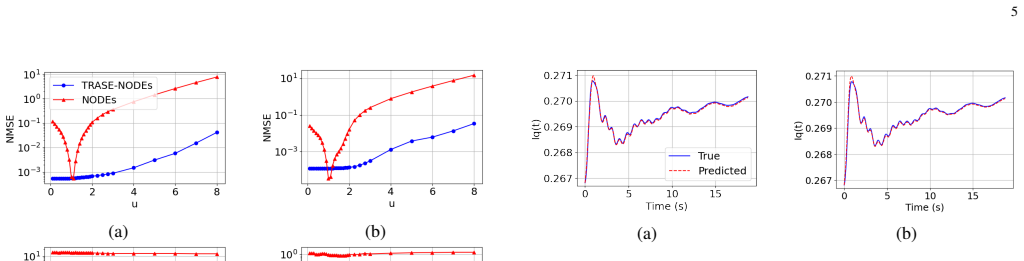
TRASE-NODEs construct an augmented system for both state and sensitivity, enabling simultaneous learning of their dynamics. This formulation allows the adjoint method to update gradients in a memory-efficient manner and ensures that time-invariant control set-point effects are captured in the learned dynamics. The results show that TRASE-NODEs generalize better from the limited training data, yielding lower prediction errors than standard NODEs for both the damped oscillator and inverter-based resources examples.
Load-bearing premise
That adding sensitivity equations to the state system will let the model capture control set-point effects without extra data for different inputs.
Editorial analysis
A structured set of objections, weighed in public.
Referee Report
Summary. The manuscript proposes TRASE-NODEs, which augment standard Neural ODEs with trajectory sensitivity states to form a combined dynamical system. This enables simultaneous learning of state and sensitivity dynamics from limited data, uses the adjoint method for memory-efficient gradient computation, and captures time-invariant control set-point effects. Empirical evaluation on a damped oscillator and inverter-based resources (IBRs) claims improved generalization and lower prediction errors relative to baseline NODEs.
Significance. If the data-efficiency and generalization claims are substantiated with controlled experiments, the approach could offer a practical advance for control-oriented modeling of continuous-time systems where large training datasets are expensive or unsafe to generate. The explicit incorporation of sensitivity equations alongside the learned vector field is a conceptually clean way to embed control-relevant structure into NODE training.
major comments (2)
- §4 (Training and Data Generation): The central claim that TRASE-NODEs generalize better from the same limited training data as standard NODEs requires explicit confirmation that sensitivity trajectories are obtained without additional forward simulations or auxiliary labels. If the augmented ODE is integrated and the loss is computed only on observed states, the sensitivity component must be shown to be constrained by the structure alone; otherwise the reported error reduction may reflect an unequal computational budget rather than the proposed architecture.
- Results section, comparison tables/figures: No quantitative error values, standard deviations, number of training trajectories, or statistical tests are referenced in the abstract or summary of results. Without these, the statement that TRASE-NODEs yield 'lower prediction errors' cannot be evaluated for effect size or robustness, which is load-bearing for the generalization claim.
minor comments (2)
- Abstract: The phrase 'time-invariant control set-point effects' is used without a precise definition or reference to the corresponding term in the augmented dynamics; a short clarifying sentence would improve readability.
- Notation: The distinction between the original NODE vector field f and the augmented field F should be introduced with an equation number at first use to avoid ambiguity when discussing the combined state-sensitivity evolution.
Simulated Author's Rebuttal
We thank the referee for their constructive feedback and positive evaluation of the potential contributions of TRASE-NODEs. We address each major comment below with clarifications and indicate the revisions planned for the next manuscript version.
read point-by-point responses
-
Referee: §4 (Training and Data Generation): The central claim that TRASE-NODEs generalize better from the same limited training data as standard NODEs requires explicit confirmation that sensitivity trajectories are obtained without additional forward simulations or auxiliary labels. If the augmented ODE is integrated and the loss is computed only on observed states, the sensitivity component must be shown to be constrained by the structure alone; otherwise the reported error reduction may reflect an unequal computational budget rather than the proposed architecture.
Authors: We appreciate this request for clarification on the training procedure and comparison fairness. In the TRASE-NODE formulation, a single augmented ODE is integrated that evolves both the original states and the sensitivity states simultaneously. No auxiliary labels or separate forward simulations are used to generate sensitivity trajectories; these states are learned jointly as part of the augmented dynamics. The loss is computed exclusively on the observed state trajectories, while the sensitivity equations are enforced by the structural derivation from the vector field (via differentiation of the learned dynamics). This embeds the control-relevant sensitivity information directly into the model without requiring extra data. We acknowledge that integrating the augmented system incurs additional per-step computational cost compared to a standard NODE of the same state dimension. To address the referee's concern, we will revise §4 to explicitly detail the data-generation and integration process, confirm the absence of auxiliary labels, and discuss the computational implications to demonstrate that performance gains arise from the embedded structure rather than differences in computational budget. We will also emphasize the role of the adjoint method in maintaining memory efficiency during training. revision: yes
-
Referee: Results section, comparison tables/figures: No quantitative error values, standard deviations, number of training trajectories, or statistical tests are referenced in the abstract or summary of results. Without these, the statement that TRASE-NODEs yield 'lower prediction errors' cannot be evaluated for effect size or robustness, which is load-bearing for the generalization claim.
Authors: We agree that the current abstract and results summary lack the specific quantitative details needed to assess effect size and robustness. While the full results section contains comparison tables and figures reporting prediction errors for the damped oscillator and IBR examples, these metrics are not summarized numerically in the abstract or introductory results paragraph, nor are standard deviations, exact numbers of training trajectories, or statistical tests referenced there. We will revise the abstract to include concrete quantitative improvements (such as mean prediction error reductions) and the number of training trajectories. We will also update the results summary to report mean errors with standard deviations across repeated runs and note any statistical tests performed. These changes will allow readers to better evaluate the magnitude and reliability of the reported generalization improvements. revision: yes
Circularity Check
No circularity in TRASE-NODEs augmentation or generalization claim
full rationale
The paper defines TRASE-NODEs as an augmented dynamical system whose state vector is extended to include trajectory sensitivities, with a neural network learning the combined vector field. This construction is presented as a modeling choice that enables simultaneous learning and adjoint-based gradient updates; the reported lower prediction errors on the damped oscillator and IBR examples are obtained by direct numerical comparison against standard NODEs trained on the same state trajectories. No equation is shown that equates the sensitivity component to a reparameterization of the original state data, no fitted parameter is relabeled as a prediction, and no load-bearing uniqueness result is imported via self-citation. The central empirical claim therefore rests on external validation rather than reducing to the inputs by definition.
Assumptions & free parameters
Cite this review
Pith. "Pith review of TRASE-NODEs: Trajectory Sensitivity-aware Neural Ordinary Differential Equations for Efficient Dynamic Modeling." pith.science (2026). https://pith.science/paper/2510.22104
@misc{pith2026251022104,
  author       = {Pith},
  title        = {Pith review of: TRASE-NODEs: Trajectory Sensitivity-aware Neural Ordinary Differential Equations for Efficient Dynamic Modeling},
  year         = {2026},
  howpublished = {\url{https://pith.science/paper/2510.22104}},
  note         = {Machine review of arXiv:2510.22104}
}
read the original abstract
Modeling dynamical systems is crucial across the science and engineering fields for accurate prediction, control, and decision-making. Recently, machine learning (ML) approaches, particularly neural ordinary differential equations (NODEs), have emerged as a powerful tool for data-driven modeling of continuous-time dynamics. Nevertheless, standard NODEs require a large number of data samples to remain consistent under varying control inputs, posing challenges to generate sufficient simulated data and ensure the safety of control design. To address this gap, we propose trajectory-sensitivity-aware (TRASE-)NODEs, which construct an augmented system for both state and sensitivity, enabling simultaneous learning of their dynamics. This formulation allows the adjoint method to update gradients in a memory-efficient manner and ensures that time-invariant control set-point effects are captured in the learned dynamics. We evaluate TRASE-NODEs using damped oscillator and inverter-based resources (IBRs). The results show that TRASE-NODEs generalize better from the limited training data, yielding lower prediction errors than standard NODEs for both examples. The proposed framework offers a data-efficient, control-oriented modeling approach suitable for dynamic systems that require accurate trajectory sensitivity prediction.
Figures


Figures from the paper (3 more)


Reference graph
Works this paper leans on
-
[1]
S. Liu, W. Cai, H. Zhu, and B. Johnson, “A unified approach for learning the dynamics of power system generators and inverter-based resources,” 2024. [Online]. Available: https://arxiv.org/abs/2409.14454
-
[2]
First-order differential equations in chemistry,
G. Scholz and F. Scholz, “First-order differential equations in chemistry,”ChemTexts, vol. 1, no. 1, p. 1, 2015, published online 25 November 2014. [Online]. Available: https://link.springer.com/article/ 10.1007/s40828-014-0001-x
-
[3]
Learning transmission dynamics modelling of covid-19 using comomodels,
S. A. van der Vegt, L. Dai, I. Bouros, H. J. Farm, R. Creswell, O. Dimdore-Miles, I. Cazimoglu, S. Bajaj, L. Hopkins, D. Seiferth, F. Cooper, C. L. Lei, D. Gavaghan, and B. Lambert, “Learning transmission dynamics modelling of covid-19 using comomodels,” Mathematical Biosciences, vol. 349, p. 108824, Jul. 2022. [Online]. Available: https://www.ncbi.nlm.ni...
work page 2022
-
[4]
J. C. Butcher,Numerical Differential Equation Methods. John Wiley & Sons, Ltd, 2016, ch. 2, pp. 55–142. [Online]. Available: https://onlinelibrary.wiley.com/doi/abs/10.1002/9781119121534.ch2
-
[5]
On generalized residual network for deep learning of unknown dynamical systems,
Z. Chen and D. Xiu, “On generalized residual network for deep learning of unknown dynamical systems,”Journal of Computational Physics, vol. 438, p. 110362, 2021. [Online]. Available: https: //www.sciencedirect.com/science/article/pii/S0021999121002576
work page 2021
-
[6]
Neural ordinary differential equations,
R. T. Q. Chen, Y . Rubanova, J. Bettencourt, and D. Duvenaud, “Neural ordinary differential equations,” inProceedings of the 32nd International Conference on Neural Information Processing Systems, ser. NIPS’18. Curran Associates Inc., 2018, p. 6572–6583
work page 2018
-
[7]
Feasibility study of neural ode and dae modules for power system dynamic component modeling,
T. Xiao, Y . Chen, S. Huang, T. He, and H. Guan, “Feasibility study of neural ode and dae modules for power system dynamic component modeling,”IEEE Transactions on Power Systems, vol. 38, no. 3, pp. 2666–2678, 2023
work page 2023
-
[8]
Learning power system dynamics with noisy data using neural ordinary differential equations,
S. Zhang, K. Yamashita, and N. Yu, “Learning power system dynamics with noisy data using neural ordinary differential equations,” in2024 IEEE Power & Energy Society General Meeting (PESGM), 2024, pp. 1–5
work page 2024
Show all 26 references
-
[9]
Financial time series prediction via neural ordinary differential equations approach,
J. Li, W. Zhu, Z. Chen, and C. Pei, “Financial time series prediction via neural ordinary differential equations approach,” in2023 International Annual Conference on Complex Systems and Intelligent Science (CSIS- IAC), 2023, pp. 332–338
2023
-
[10]
Neural odes for data-driven automatic self-design of finite-time output feedback control for unknown nonlinear dynamics,
S. Bachhuber, I. Weygers, and T. Seel, “Neural odes for data-driven automatic self-design of finite-time output feedback control for unknown nonlinear dynamics,”IEEE Control Systems Letters, vol. 7, pp. 3048– 3053, 2023
2023
-
[11]
Modelling chemical reaction networks using neural ordinary differential equations,
A. C. M. Thöni, W. E. Robinson, Y . Bachrach, W. T. S. Huck, and T. Kachman, “Modelling chemical reaction networks using neural ordinary differential equations,” 2025. [Online]. Available: https://arxiv.org/abs/2502.19397
2025
-
[12]
Gradient-enhanced kriging for high-dimensional problems,
M. A. Bouhlel and J. R. R. A. Martins, “Gradient-enhanced kriging for high-dimensional problems,”Engineering with Computers, vol. 35, no. 1, pp. 157–173, February 2019
2019
-
[13]
Learning to solve the ac- opf using sensitivity-informed deep neural networks,
M. K. Singh, V . Kekatos, and G. B. Giannakis, “Learning to solve the ac- opf using sensitivity-informed deep neural networks,”IEEE Transactions on Power Systems, vol. 37, no. 4, pp. 2833–2846, 2022
2022
-
[14]
Learning to optimize power distribution grids using sensitivity- informed deep neural networks,
M. K. Singh, S. Gupta, V . Kekatos, G. Cavraro, and A. Bern- stein, “Learning to optimize power distribution grids using sensitivity- informed deep neural networks,” in2020 IEEE International Conference on Communications, Control, and Computing Technologies for Smart Grids (Sm...
2020
-
[15]
Sensitivity, approximation, and uncer- tainty in power system dynamic simulation,
I. Hiskens and J. Alseddiqui, “Sensitivity, approximation, and uncer- tainty in power system dynamic simulation,”IEEE Transactions on Power Systems, vol. 21, no. 4, pp. 1808–1820, 2006
2006
-
[16]
An annotated timeline of sensitivity analysis,
S. Tarantola, F. Ferretti, S. Lo Piano, M. Kozlova, A. Lachi, R. Rosati, A. Puy, P. Roy, G. Vannucci, M. Kuc-Czarnecka, and A. Saltelli, “An annotated timeline of sensitivity analysis,”Environmental Modelling & Software, vol. 174, p. 105977, 2024. [Online]. Available: https://...
2024
-
[18]
Available: https://arxiv.org/abs/2008.02389
[Online]. Available: https://arxiv.org/abs/2008.02389
2008
-
[19]
Bridging neural ode and resnet: A formal error bound for safety verification,
A. S. Sayed, P.-J. Meyer, and M. Ghazel, “Bridging neural ode and resnet: A formal error bound for safety verification,” 2025. [Online]. Available: https://arxiv.org/abs/2506.03227
2025
-
[20]
L. S. Pontryagin,Mathematical Theory of Optimal Processes, 1st ed. Routledge, 1987. [Online]. Available: https://doi.org/10.1201/ 9780203749319
1987
-
[21]
Second-order trajectory sensitivity analysis of hybrid systems,
S. Geng and I. A. Hiskens, “Second-order trajectory sensitivity analysis of hybrid systems,”IEEE Transactions on Circuits and Systems I: Regular Papers, vol. 66, no. 5, pp. 1922–1934, 2019
1922
-
[22]
Power system applications of trajectory sen- sitivities,
I. Hiskens and M. Pai, “Power system applications of trajectory sen- sitivities,” in2002 IEEE Power Engineering Society Winter Meeting. Conference Proceedings (Cat. No.02CH37309), vol. 2, 2002, pp. 1200– 1205 vol.2
2002
-
[23]
Trajectory sensitivities: Applications in power systems and estimation accuracy refinement,
L. Tang and J. McCalley, “Trajectory sensitivities: Applications in power systems and estimation accuracy refinement,” in2013 IEEE Power & Energy Society General Meeting, 2013, pp. 1–5
2013
-
[24]
A new approach to dynamic security assessment using trajectory sensitivities,
M. Laufenberg and M. Pai, “A new approach to dynamic security assessment using trajectory sensitivities,” inProceedings of the 20th International Conference on Power Industry Computer Applications, 1997, pp. 272–277
1997
-
[25]
Trajectory sensitivity analysis of hybrid systems,
I. Hiskens and A. Pai, “Trajectory sensitivity analysis of hybrid systems,” Circuits and Systems I: Fundamental Theory and Applications, IEEE Transactions on, vol. 47, pp. 204 – 220, 03 2000
2000
-
[26]
Model user guide for generic renewable energy systems,
D. Ramasubramanian, “Model user guide for generic renewable energy systems,” EPRI, Palo Alto, CA, Tech. Rep., 2023
2023
-
[27]
Generator model validation and cal- ibration using synchrophasor data,
S. A. Foroutan and A. Srivastava, “Generator model validation and cal- ibration using synchrophasor data,” in2019 IEEE Industry Applications Society Annual Meeting. IEEE, 2019, pp. 1–6
2019
Reviewed May 18, 2026 · model on record in the stance chip above.
Discussion (0). Continue with ORCID to comment.