REVIEW 2 major objections 4 minor 1 cited by
If dark quarks form a QCD-like sector, a proton beam-dump experiment could catch several long-lived dark mesons decaying in a single collision — a signature no minimal dark photon model can mimic.
Reviewed by Pith at T0; open to challenge. T0 means a machine referee read the full paper against a public rubric. the ladder, T0–T4 →
T0 review · deepseek-v4-flash
2026-08-04 07:50 UTC pith:IO7TWCMB
load-bearing objection Competent and honest dark-shower phenomenology; multi-decay SHiP signature is plausible, but the sub-GeV reach rests on an untested rescaling assumption. the 2 major comments →
Sub-GeV dark matter and multi-decay signatures from dark showers at beam-dump experiments
The pith
A machine-rendered reading of the paper's core claim, the machinery that carries it, and where it could break.
Core claim
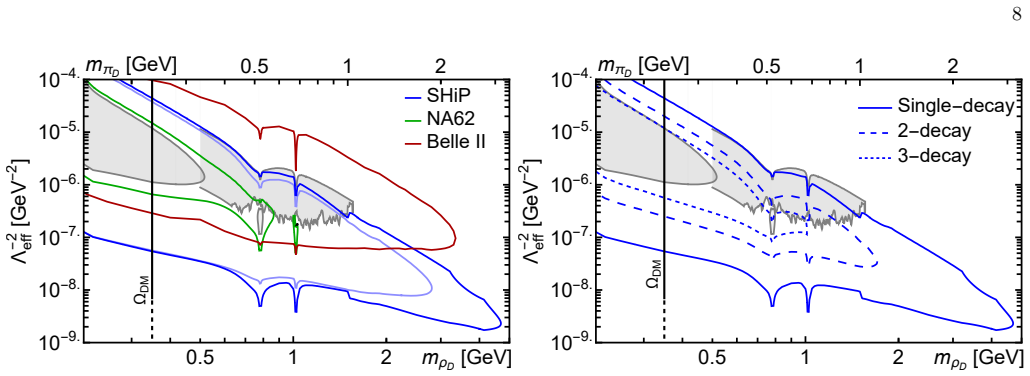
The central discovery is a parameter region where the SHiP beam-dump experiment could observe several displaced vertices from a single collision, an event type that minimal dark photon models cannot produce. In the model studied, two flavors of dark quarks confine into stable dark pions and unstable dark rho mesons; the neutral rho inherits a dark-photon-like coupling through an effective dimension-6 operator, so it can decay visibly with a long lifetime at sub-GeV masses. The paper finds that dark-shower production dominates the rho yield below about 0.8 GeV and contributes significantly up to about 3 GeV, and that SHiP can probe rho masses up to about 5 GeV with single decays, 2 GeV with t
What carries the argument
The dark rho meson—the vector meson of a confining dark SU(3), analogous to QCD's rho—is the load-bearing particle. Its coupling to Standard Model particles is engineered so that it behaves exactly like a dark photon, with an effective mixing angle epsilon = 2 m_rhoD^2 / (Lambda_eff^2 g_pi_rho e), turning every dark-photon production and decay mode into a dark rho mode. The new ingredient is dark-shower production: hadronisation of dark quarks can emit several dark rhos per event, so the multiplicity of displaced vertices per collision becomes the discriminating observable. The calculation chains an effective operator, the KSRF relation, lattice-determined dark-sector parameters, a parton-sh
Load-bearing premise
The sub-GeV reach rests on the untested assumption that dark showers are perfectly scale-invariant, so that simulating heavier dark mesons and rescaling down to 0.3 GeV reproduces the true multiplicities; the paper itself notes the generator is not meant for such small masses and validates the trick only above 1 GeV.
What would settle it
Run the 0.3 GeV benchmark with the newly released generator version that natively handles sub-GeV dark showers and compare the neutral-dark-rho multiplicity distribution to the rescaled one; if they differ beyond Monte-Carlo errors, the two- and three-decay reach is overestimated. Alternatively, if SHiP reaches full design sensitivity and sees no two-decay events while single-decay events are present, the strongly-interacting interpretation would be undercut.
If this is right
- A single multi-decay event would falsify the minimal dark-photon model, in which multiple dark photons per collision are negligible.
- If a two-decay event is observed, the invariant mass distribution of the visible decay products separates dark showers from non-minimal dark-photon pair production, whose mass peaks at the parent particle mass.
- SHiP's reach covers the dark rho masses implied by 3-to-2 freeze-out dark matter for a dark pion mass of about 0.21 GeV, nearly the entire interaction-strength range in which that relic mechanism works.
- Belle II and NA62 with full statistics probe parts of the same parameter space with shorter decay lengths, so a signal at one experiment could be followed up with multi-vertex observations at SHiP.
- Dark-shower production dominates dark rho production below about 0.8 GeV, making the multi-decay signature central rather than peripheral to the low-mass reach.
Where Pith is reading between the lines
- A direct stress test of the paper's central reach is to rerun the 0.3 GeV benchmark with the newly released shower generator that natively handles sub-GeV dark showers; the paper notes its own generator was not intended for such masses, so a clean comparison would settle whether the two- and three-decay reach is overestimated.
- The 'count displaced vertices per event' observable could be applied to long-lived-particle searches at higher-energy colliders, where event rates would be lower but the boost distributions would look different and could further discriminate dark showers from other hidden sectors.
- If dark-pion dark matter is confirmed at a mass near 0.21 GeV, the relic line gives a sharp prior for where SHiP should look first for two- and three-decay events.
- A null observation of multi-vertex events at SHiP in the predicted region would not exclude the model—single-vertex decays and other production channels remain—but it would weaken the case that any single observed displaced vertex originates from a strongly interacting sector.
Editorial analysis
A structured set of objections, weighed in public.
Referee Report
Summary. The paper studies a QCD-like strongly interacting dark sector with an SU(3) dark gauge group, two Dirac dark quarks, and a U(1)' portal integrated out into a dimension-6 effective operator. The dark pions are stable dark-matter candidates, while the dark rho mesons decay into SM particles via kinetic mixing, with m_ρD < 2 m_πD. The authors simulate dark showers with the Pythia Hidden Valley module, using lattice inputs for the dark-sector parameters and a rescaling procedure to reach sub-GeV masses, and they combine dark-shower production with dark-photon-like production modes. Using SensCalc and EventCalc, they derive constraints from BEBC, CHARM, NA62, and BaBar, and forecast sensitivities for SHiP and Belle II. The central claims are that SHiP can probe m_ρD up to about 5 GeV via single displaced decays, will observe multiple displaced vertices in a single event for m_ρD ≲ 2 GeV (2-decay events) and m_ρD ≲ 1 GeV (3-decay events), and that the per-event multiplicity plus invariant-mass spectrum can distinguish dark rho mesons from dark photons.
Significance. If the sub-GeV rescaling assumption is valid, this is a significant and timely phenomenological study. It is, to my knowledge, the first systematic projection of multi-displaced-vertex signatures at SHiP for strongly interacting dark sectors in the sub-GeV regime. The paper has clear strengths: the dark-sector parameters are set using lattice inputs rather than treated as free; the production modes are enumerated systematically; the SensCalc implementation is public and an independent EventCalc Monte Carlo agrees with it to about 10% (Fig. 9); and the impact of shower-parameter variations is explicitly quantified (Fig. 4). The proposed observable — event multiplicity together with the invariant mass of the decaying system (Fig. 8) — is a concrete and valuable way to discriminate strongly interacting dark sectors from single- and pair-produced dark photons. The main caveat is the untested scale-invariance assumption used to reach sub-GeV dark meson masses, which directly affects the multi-decay reach that forms the paper's headline result.
major comments (2)
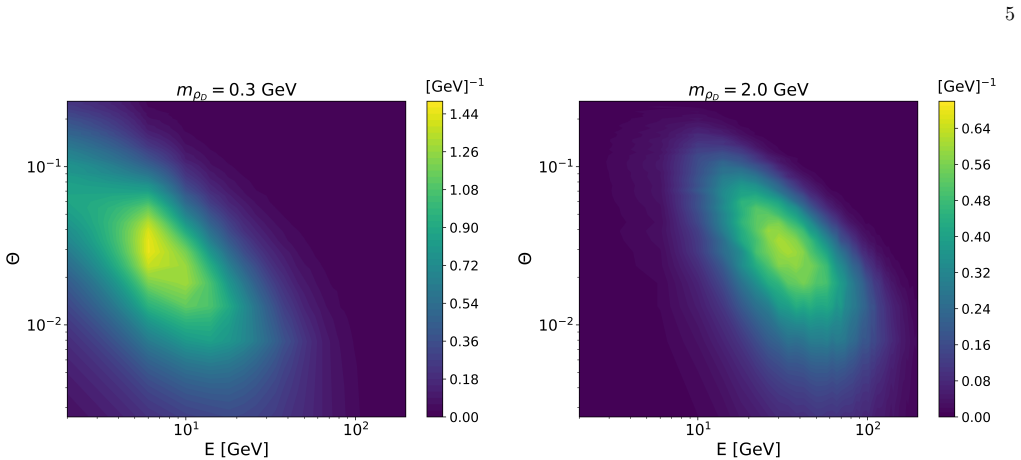
- [§III.A, Figs. 1–4, Eq. (B4)] The sub-GeV results are obtained by rescaling Pythia simulations performed at m_ρD > 1 GeV, yet the validation stated in the text ('confirmed ... for dark meson masses above 1 GeV and rescaling factors 1 < χ < 10') does not cover the 0.3 GeV benchmark, which uses χ ≈ 5 starting from 1.5 GeV. The multiplicity and the two-dimensional (E, θ) distributions that enter Eq. (B4) are exactly the quantities most likely to develop absolute-scale dependence through hadronisation parameters such as probVec or fragmentation thresholds. Fig. 4 already shows more than an order-of-magnitude variation in 2- and 3-decay yields at m_ρD = 1 GeV, so the quoted reach boundaries in Fig. 7 are not robust without a sub-GeV test. The new Pythia sub-GeV capability noted in footnote [52] provides a direct means to check this. I request either a validation at m_ρD = 0.3–1 GeV with the new Pythia version or an explic
- [§V, Figs. 4 and 7] The 2-decay and 3-decay sensitivity contours in Fig. 7 are drawn only for the baseline Pythia settings, despite Fig. 4 showing that, at m_ρD = 1 GeV, the yields of 2- and 3-decay events vary by more than an order of magnitude under the listed probVec and Λ_D variations. Since the statements 'reach for 2-decay events extends up to m_ρD ≈ 2 GeV' and 'for 3-decay events up to m_ρD ≈ 1 GeV' are quantitative claims, the contours should be supplemented by a band or by an explicit statement of how these mass boundaries shift under the quantified shower-parameter uncertainties. Otherwise the reader cannot assess whether the 'sizable parameter region' is an artifact of the baseline choice.
minor comments (4)
- [Figs. 1 and 2] The captions use 'm_D' where the text elsewhere uses m_ρD; please define the notation explicitly in the captions.
- [Footnote 3] The sentence 'It will be very interesting to simulate sub-GeV pion dark matter once the module becomes publicly available' appears outdated given that Ref. [50] is cited as an existing Herwig hidden-valley module. Please clarify whether the module is public or not.
- [Appendix A] The PDF label 'NNPDF23 nlo as 0119' should be formatted as a standard LHAPDF name, e.g. NNPDF23_nlo_as_0119, to avoid ambiguity.
- [§IV.A] The text uses 'SensCalc' and 'EventCalc' inconsistently in a few places (e.g. 'Sens-Calc' in Sec. IV.A before Eq. (5)); please unify the naming.
Circularity Check
No significant circularity: the SHiP multi-decay reach is generated from external lattice inputs, the KSRF relation, and Pythia Hidden Valley simulations; no parameter is fitted to the predicted observables.
full rationale
The derivation chain for the central claim is parameterized by (m_rhoD, Lambda_eff, r), with non-free inputs taken from external lattice results, the KSRF relation, and the Pythia Hidden Valley module. The n-decay rate is computed via Eq. (B4) from simulated multiplicity and kinematic distributions plus the dark-photon-like decay mapping in Eq. (4). No parameter is fitted to the SHiP signal or to the multi-decay claim, and no uniqueness theorem from the authors' prior work is invoked to force the model choice. The only self-citations are Ref. [10] for the context relic-density vertical line and the mass-hierarchy motivation, and Ref. [26] for the Belle II search strategy; these are not used to generate the reach contours. The manuscript itself flags the sub-GeV simulation limitation in Sec. III.A and footnote 4, noting that Pythia 8.313 is not intended for such small masses and that a sub-GeV-capable version now exists but was not used. This is a model-validity and extrapolation uncertainty, and Fig. 4 quantifies the resulting sensitivity to simulation parameters; but it is not circularity, because the sub-GeV multiplicity distributions are assumed outputs of the rescaling procedure, not fitted inputs of the prediction. The central claim therefore does not reduce to its inputs by construction.
Axiom & Free-Parameter Ledger
free parameters (4)
- dark rho mass m_rhoD =
scanned 0.2-5 GeV
- effective operator scale Lambda_eff =
scanned 100 GeV-100 TeV
- mass ratio r = m_rhoD/m_piD =
1.5 or 1.9
- probVec (vector meson production probability) =
0.71 (r=1.5), 0.68 (r=1.9)
axioms (6)
- domain assumption Dark sector is QCD-like and chiral perturbation theory / KSRF applies to dark mesons
- domain assumption One-particle replacement <qbar_D gamma^mu q_D> -> 2 m_rhoD^2 rho_D^mu / g_pi_rho is valid below the confinement scale
- domain assumption Dim-6 EFT with operator Eq. (1) is valid at SHiP energies (m_Z' >> sqrt(s) ~ 27.4 GeV)
- ad hoc to paper Dark shower hadronisation is scale invariant under simultaneous rescaling of all dimensionful parameters
- domain assumption Pythia 8.313 Hidden Valley module reliably simulates dark-sector fragmentation for the chosen parameters
- domain assumption N_fD/N_cD << 3 ensures the chirally-broken confining phase
invented entities (4)
-
dark quarks q_D (N_fD=2, SU(3) fundamental, U(1)' charge +/-1)
no independent evidence
-
dark pions pi_D (stable dark matter candidates)
no independent evidence
-
dark rho meson rho_D^0 (unstable vector meson)
no independent evidence
-
heavy Z' gauge boson (integrated out)
no independent evidence
Cite this review
Pith. "Pith review of Sub-GeV dark matter and multi-decay signatures from dark showers at beam-dump experiments." pith.science (2026). https://pith.science/paper/IO7TWCMB
@misc{pith2026251023696,
  author       = {Pith},
  title        = {Pith review of: Sub-GeV dark matter and multi-decay signatures from dark showers at beam-dump experiments},
  year         = {2026},
  howpublished = {\url{https://pith.science/paper/IO7TWCMB}},
  note         = {Machine review of arXiv:2510.23696}
}
read the original abstract
In models of strongly-interacting dark sectors, the production of dark quarks at accelerators can give rise to dark showers with multiple dark mesons in the final state. If some of these dark mesons are sufficiently light and long-lived, they can be detected with searches for displaced vertices at beam-dump experiments and electron-positron colliders. In this work we focus on the case that dark quark production proceeds via effective operators, while the dark sector analogue of the $\rho^0$ meson can decay via kinetic mixing. We evaluate current constraints from NA62 and BaBar as well as sensitivity projections for SHiP and Belle II. We find that there exists a sizable parameter region where SHiP may detect several displaced vertices in a single event and thus obtain valuable information about the structure of the dark sector.
Figures






Forward citations
Cited by 1 Pith paper
-
Inelastic Scattering Effects on Attenuation of Boosted Dark Matter
Resonant excitation of nucleons into Δ(1232) during Earth passage is a non-negligible attenuation channel for boosted dark matter at E_χ ≈ 1–2 GeV, lowering the PandaX-4T upper bound on σ̄_n in the heavy-mediator regime.
Reference graph
Works this paper leans on
-
[1]
This method takes as input tabu- lated angle-energy distribution d2f /dθdE, treating events withndark rho mesons asnindependent events
A semi-analytic method as implemented inSens- Calc[69]. This method takes as input tabu- lated angle-energy distribution d2f /dθdE, treating events withndark rho mesons asnindependent events. Accordingly, the total production cross- section for dark rho mesons is taken to be σprod =σ× ⟨NρD ⟩,(5) withσbeing the dark shower production cross- section and⟨N ρ...
-
[2]
traditional
On the other hand, the Drell-Yan production dominates form ρD >2 GeV. In the inter- mediate regime, there is a competition between several different modes, including the production in showering. IV. ANAL YSIS METHODOLOGY In this section, we present the experiments that we consider and discuss how we calculate constraints and sensitivity projections. A. SP...
2026
-
[3]
Having simulated the decay products, we calcu- late their acceptanceϵ dec. The event is accepted (ϵdec = 1) if the trajectories of the decay prod- ucts intersect the detector and if the particles sat- isfy various cuts, such as energy cut, mutual spatial separation cut (in the electromagnetic calorimeter), transverse impact parameter cut (for pairs of par...
-
[4]
It uses the same basic set- up asSensCalc, but works directly with theρ D samples, processing them event by event
A Monte-Carlo event generator using importance sampling based onEventCalc, which is an add- on ofSensCalc[37]. It uses the same basic set- up asSensCalc, but works directly with theρ D samples, processing them event by event. Unlike Sens-Calc, it is therefore able to compute also the rate ofn-decay events. Further details on the implementation are summari...
2026
-
[5]
The corresponding geometric weight,ω dec.vol, is 1 in the case of intersection and 0 otherwise
For eachρ D, we sample the decay vertices inside the SHiP decay volume, provided that the trajec- tory of the givenρ D intersects the volume. The corresponding geometric weight,ω dec.vol, is 1 in the case of intersection and 0 otherwise. Thezposition is sampled using the inverse CDF from the differ- ential decay probability dPdecay dz = exp h − z lρD cos(...
-
[6]
For decays into jets, we use the pre-tabulated phase space show- ered and hadronised inPYTHIA8[49]
For each of the decayed dark rho mesons, we sam- ple the phase space of its decay products using the approach adopted inSensCalc: computing their 4-momenta at the dark rho meson’s rest frame and then boosting to the lab frame. For decays into jets, we use the pre-tabulated phase space show- ered and hadronised inPYTHIA8[49]. Only the decay channels visibl...
-
[7]
S.-M. Choi, H. M. Lee, P. Ko, and A. Natale, “Resolving phenomenological problems with strongly-interacting-massive-particle models with dark vector resonances,”Phys. Rev. D98(2018) no. 1, 015034,arXiv:1801.07726 [hep-ph]
Pith/arXiv arXiv 2018
-
[8]
Review of strongly-coupled composite dark matter models and lattice simulations,
G. D. Kribs and E. T. Neil, “Review of strongly-coupled composite dark matter models and lattice simulations,” Int. J. Mod. Phys. A31(2016) no. 22, 1643004, arXiv:1604.04627 [hep-ph]
Pith/arXiv arXiv 2016
-
[9]
Weakly Interacting Stable Pions,
Y. Bai and R. J. Hill, “Weakly Interacting Stable Pions,”Phys. Rev. D82(2010) 111701, arXiv:1005.0008 [hep-ph]
Pith/arXiv arXiv 2010
-
[10]
Thermal Dark Matter from a Confining Sector,
M. R. Buckley and E. T. Neil, “Thermal Dark Matter from a Confining Sector,”Phys. Rev. D87(2013) no. 4, 043510,arXiv:1209.6054 [hep-ph]
Pith/arXiv arXiv 2013
-
[11]
Composite strongly interacting dark matter,
J. M. Cline, Z. Liu, G. D. Moore, and W. Xue, “Composite strongly interacting dark matter,”Phys. Rev. D90(2014) no. 1, 015023,arXiv:1312.3325 [hep-ph]
Pith/arXiv arXiv 2014
-
[12]
Mechanism for Thermal Relic Dark Matter of Strongly Interacting Massive Particles,
Y. Hochberg, E. Kuflik, T. Volansky, and J. G. Wacker, “Mechanism for Thermal Relic Dark Matter of Strongly Interacting Massive Particles,”Phys. Rev. Lett.113 (2014) 171301,arXiv:1402.5143 [hep-ph]
Pith/arXiv arXiv 2014
-
[13]
Model for Thermal Relic Dark Matter of Strongly Interacting Massive Particles,
Y. Hochberg, E. Kuflik, H. Murayama, T. Volansky, and J. G. Wacker, “Model for Thermal Relic Dark Matter of Strongly Interacting Massive Particles,”Phys. Rev. Lett. 115(2015) no. 2, 021301,arXiv:1411.3727 [hep-ph]
Pith/arXiv arXiv 2015
-
[14]
Echoes of a hidden valley at hadron colliders,
M. J. Strassler and K. M. Zurek, “Echoes of a hidden valley at hadron colliders,”Phys. Lett. B651(2007) 374–379,arXiv:hep-ph/0604261
Pith/arXiv arXiv 2007
-
[15]
Dark matter in Hidden Valley models with stable and unstable light dark mesons,
H. Beauchesne, E. Bertuzzo, and G. Grilli Di Cortona, “Dark matter in Hidden Valley models with stable and unstable light dark mesons,”JHEP04(2019) 118, arXiv:1809.10152 [hep-ph]
Pith/arXiv arXiv 2019
-
[16]
Strongly interacting dark sectors in the early Universe and at the LHC through a simplified portal,
E. Bernreuther, F. Kahlhoefer, M. Kr¨ amer, and P. Tunney, “Strongly interacting dark sectors in the early Universe and at the LHC through a simplified portal,”JHEP01(2020) 162,arXiv:1907.04346 [hep-ph]
Pith/arXiv arXiv 2020
-
[17]
Dark matter relic density in strongly interacting dark sectors with light vector mesons,
E. Bernreuther, N. Hemme, F. Kahlhoefer, and S. Kulkarni, “Dark matter relic density in strongly interacting dark sectors with light vector mesons,” Phys. Rev. D110(2024) no. 3, 035009, arXiv:2311.17157 [hep-ph]
Pith/arXiv arXiv 2024
-
[18]
Even SIMP miracles are possible,
X. Chu, M. Nikolic, and J. Pradler, “Even SIMP miracles are possible,”Phys. Rev. Lett.133(2024) no. 2, 2,arXiv:2401.12283 [hep-ph]
Pith/arXiv arXiv 2024
-
[19]
Dilaton forbidden dark matter,
T. Appelquist, J. Ingoldby, and M. Piai, “Dilaton forbidden dark matter,”Phys. Rev. D110(2024) no. 3, 035013,arXiv:2404.07601 [hep-ph]
Pith/arXiv arXiv 2024
-
[20]
Dark matter in QCD-like theories with a theta vacuum: Cosmological and astrophysical implications,
C. Garc ´ ıa-Cely, G. Landini, and´O. Zapata, “Dark matter in QCD-like theories with a theta vacuum: Cosmological and astrophysical implications,”Phys. Rev. D111(2025) no. 6, 063044,arXiv:2405.10367 [hep-ph]
Pith/arXiv arXiv 2025
-
[21]
Dark showers from Z-dark Z’ mixing,
H.-C. Cheng, X.-H. Jiang, L. Li, and E. Salvioni, “Dark showers from Z-dark Z’ mixing,”JHEP04(2024) 081, arXiv:2401.08785 [hep-ph]
Pith/arXiv arXiv 2024
-
[22]
N. Daci, I. De Bruyn, S. Lowette, M. H. G. Tytgat, and B. Zaldivar, “Simplified SIMPs and the LHC,”JHEP 11(2015) 108,arXiv:1503.05505 [hep-ph]
Pith/arXiv arXiv 2015
-
[23]
Searching for confining hidden valleys at LHCb, ATLAS, and CMS,
A. Pierce, B. Shakya, Y. Tsai, and Y. Zhao, “Searching for confining hidden valleys at LHCb, ATLAS, and CMS,”Phys. Rev. D97(2018) no. 9, 095033, arXiv:1708.05389 [hep-ph]
Pith/arXiv arXiv 2018
-
[24]
G. D. Kribs, A. Martin, B. Ostdiek, and T. Tong, “Dark Mesons at the LHC,”JHEP07(2019) 133, arXiv:1809.10184 [hep-ph]
Pith/arXiv arXiv 2019
-
[25]
Light Hidden Mesons through the Z Portal,
H.-C. Cheng, L. Li, E. Salvioni, and C. B. Verhaaren, “Light Hidden Mesons through the Z Portal,”JHEP11 (2019) 031,arXiv:1906.02198 [hep-ph]
Pith/arXiv arXiv 2019
-
[26]
New sensitivity of LHC measurements to composite dark matter models,
J. M. Butterworth, L. Corpe, X. Kong, S. Kulkarni, and M. Thomas, “New sensitivity of LHC measurements to composite dark matter models,”Phys. Rev. D105 (2022) no. 1, 015008,arXiv:2105.08494 [hep-ph]
Pith/arXiv arXiv 2022
-
[27]
Perturbative benchmark models for a dark shower search program,
S. Knapen, J. Shelton, and D. Xu, “Perturbative benchmark models for a dark shower search program,” Phys. Rev. D103(2021) no. 11, 115013, arXiv:2103.01238 [hep-ph]
Pith/arXiv arXiv 2021
-
[29]
Semivisible Jets: Dark Matter Undercover at the LHC,
T. Cohen, M. Lisanti, and H. K. Lou, “Semivisible Jets: Dark Matter Undercover at the LHC,”Phys. Rev. Lett. 115(2015) no. 17, 171804,arXiv:1503.00009 [hep-ph]
Pith/arXiv arXiv 2015
-
[30]
Collider phenomenology of Hidden Valley mediators of spin 0 or 1/2 with semivisible jets,
H. Beauchesne, E. Bertuzzo, G. Grilli Di Cortona, and Z. Tabrizi, “Collider phenomenology of Hidden Valley mediators of spin 0 or 1/2 with semivisible jets,”JHEP 08(2018) 030,arXiv:1712.07160 [hep-ph]
Pith/arXiv arXiv 2018
-
[31]
P. Schwaller, D. Stolarski, and A. Weiler, “Emerging Jets,”JHEP05(2015) 059,arXiv:1502.05409 [hep-ph]
Pith/arXiv arXiv 2015
-
[32]
Cosmology and Accelerator Tests of Strongly Interacting Dark Matter,
A. Berlin, N. Blinov, S. Gori, P. Schuster, and N. Toro, “Cosmology and Accelerator Tests of Strongly Interacting Dark Matter,”Phys. Rev. D97(2018) no. 5, 055033,arXiv:1801.05805 [hep-ph]
Pith/arXiv arXiv 2018
-
[33]
Forecasting dark showers at Belle II,
E. Bernreuther, K. B¨ ose, T. Ferber, C. Hearty, 13 F. Kahlhoefer, A. Morandini, and K. Schmidt-Hoberg, “Forecasting dark showers at Belle II,”JHEP12(2022) 005,arXiv:2203.08824 [hep-ph]
Pith/arXiv arXiv 2022
-
[34]
A facility to Search for Hidden Particles at the CERN SPS: the SHiP physics case,
S. Alekhinet al., “A facility to Search for Hidden Particles at the CERN SPS: the SHiP physics case,” Rept. Prog. Phys.79(2016) no. 12, 124201, arXiv:1504.04855 [hep-ph]. [28]SHiPCollaboration, R. Albaneseet al., “SHiP experiment at the SPS Beam Dump Facility,” arXiv:2504.06692 [hep-ex]
Pith/arXiv arXiv 2016
-
[35]
Two U(1)’s and Epsilon Charge Shifts,
B. Holdom, “Two U(1)’s and Epsilon Charge Shifts,” Phys. Lett. B166(1986) 196–198
1986
-
[36]
Theory, phenomenology, and experimental avenues for dark showers: a Snowmass 2021 report,
G. Albouyet al., “Theory, phenomenology, and experimental avenues for dark showers: a Snowmass 2021 report,”Eur. Phys. J. C82(2022) no. 12, 1132, arXiv:2203.09503 [hep-ph]
Pith/arXiv arXiv 2021
-
[37]
M. Pospelov, A. Ritz, and M. B. Voloshin, “Secluded WIMP Dark Matter,”Phys. Lett. B662(2008) 53–61, arXiv:0711.4866 [hep-ph]
Pith/arXiv arXiv 2008
-
[38]
Serendipity in dark photon searches,
P. Ilten, Y. Soreq, M. Williams, and W. Xue, “Serendipity in dark photon searches,”JHEP06(2018) 004,arXiv:1801.04847 [hep-ph]
Pith/arXiv arXiv 2018
-
[39]
M. Fabbrichesi, E. Gabrielli, and G. Lanfranchi, “The Dark Photon,”arXiv:2005.01515 [hep-ph]
Pith/arXiv arXiv 2005
-
[40]
Searches for long-lived dark photons at proton accelerator experiments,
Y. Kyselov and M. Ovchynnikov, “Searches for long-lived dark photons at proton accelerator experiments,”Phys. Rev. D111(2025) no. 1, 015030, arXiv:2409.11096 [hep-ph]
Pith/arXiv arXiv 2025
-
[41]
Exotic decays of the 125 GeV Higgs boson,
D. Curtinet al., “Exotic decays of the 125 GeV Higgs boson,”Phys. Rev. D90(2014) no. 7, 075004, arXiv:1312.4992 [hep-ph]
Pith/arXiv arXiv 2014
-
[42]
Limits on an exotic Higgs decay from a recast ATLAS four-lepton analysis,
J. Cheng, R. Husain, L. Li, and M. J. Strassler, “Limits on an exotic Higgs decay from a recast ATLAS four-lepton analysis,”JHEP05(2025) 222, arXiv:2412.14452 [hep-ph]
Pith/arXiv arXiv 2025
-
[43]
Di-decay signature of new physics particles at intensity frontier experiments,
G. Dalla Valle Garcia and M. Ovchynnikov, “Di-decay signature of new physics particles at intensity frontier experiments,”arXiv:2503.01760 [hep-ph]
-
[44]
On the simulation of hidden parton showers in the conformal window,
S. Kulkarni, J. Lockyer, and M. J. Strassler, “On the simulation of hidden parton showers in the conformal window,”JHEP09(2025) 150,arXiv:2502.18566 [hep-ph]
Pith/arXiv arXiv 2025
-
[45]
Surveying the theory space of pion dark matter,
A. Alfano, N. Evans, S. Kulkarni, and W. Porod, “Surveying the theory space of pion dark matter,” arXiv:2509.04892 [hep-ph]. [40]BaBarCollaboration, J. P. Leeset al., “Search for Long-Lived Particles ine +e− Collisions,”Phys. Rev. Lett.114(2015) no. 17, 171801,arXiv:1502.02580 [hep-ex]
arXiv 2015
-
[46]
Effective Lagrangian approach to vector mesons, their structure and decays,
F. Klingl, N. Kaiser, and W. Weise, “Effective Lagrangian approach to vector mesons, their structure and decays,”Z. Phys. A356(1996) no. 2, 193–206, arXiv:hep-ph/9607431
Pith/arXiv arXiv 1996
-
[47]
Partially conserved axial vector current and the decays of vector mesons,
K. Kawarabayashi and M. Suzuki, “Partially conserved axial vector current and the decays of vector mesons,” Phys. Rev. Lett.16(1966) 255
1966
-
[48]
3 In addition to the dark sector parameters discussed in section II,Pythiarequires a number of additional input parameters describing the evolution of the dark shower
using a UFO model file created withfeynrulesand simulate the dark parton shower using the Hidden Valley module ofPythia v8.313[49]. 3 In addition to the dark sector parameters discussed in section II,Pythiarequires a number of additional input parameters describing the evolution of the dark shower. The most important of these parameters is the relative pr...
-
[49]
Algebra of current components and decay widths of rho and K* mesons,
Riazuddin and Fayyazuddin, “Algebra of current components and decay widths of rho and K* mesons,” Phys. Rev.147(1966) 1071–1073
1966
-
[50]
Exclusive Processes in Perturbative Quantum Chromodynamics,
G. P. Lepage and S. J. Brodsky, “Exclusive Processes in Perturbative Quantum Chromodynamics,”Phys. Rev. D22(1980) 2157
1980
-
[51]
New physics particles mixing with mesons: production in the fragmentation chain,
Y. Kyselov, S. Mrenna, and M. Ovchynnikov, “New physics particles mixing with mesons: production in the fragmentation chain,”arXiv:2504.06828 [hep-ph]
-
[52]
QCD modeling of hadron physics,
P. Maris and P. C. Tandy, “QCD modeling of hadron physics,”Nucl. Phys. B Proc. Suppl.161(2006) 136–152,arXiv:nucl-th/0511017. [47]Particle Data GroupCollaboration, S. Navaset al., “Review of particle physics,”Phys. Rev. D110(2024) no. 3, 030001
Pith/arXiv arXiv 2006
-
[53]
J. Alwallet al., “The automated computation of tree-level and next-to-leading order differential cross sections, and their matching to parton shower simulations,”JHEP07(2014) 079,arXiv:1405.0301 [hep-ph]
Pith/arXiv arXiv 2014
-
[54]
A comprehensive guide to the physics and usage of PYTHIA 8.3,
C. Bierlichet al., “A comprehensive guide to the physics and usage of PYTHIA 8.3,”SciPost Phys. Codeb.2022(2022) 8,arXiv:2203.11601 [hep-ph]
Pith/arXiv arXiv 2022
-
[55]
Dark sector showers and hadronisation in Herwig 7,
S. Kulkarni, M. R. Masouminia, S. Pl¨ atzer, and D. Stafford, “Dark sector showers and hadronisation in Herwig 7,”Eur. Phys. J. C84(2024) no. 11, 1210, arXiv:2408.10044 [hep-ph]
Pith/arXiv arXiv 2024
-
[56]
Hidden Valleys in the CMS muon endcap detector,
W. Liu, J. Lockyer, and S. Kulkarni, “Hidden Valleys in the CMS muon endcap detector,”arXiv:2505.03058 [hep-ph]
-
[57]
Pythia8 history
“Pythia8 history.”https://pythia.org/history/
-
[58]
Long-lived vectors from electromagnetic cascades at SHiP,
T. Zhou, R. Plestid, K. J. Kelly, N. Blinov, and P. J. Fox, “Long-lived vectors from electromagnetic cascades at SHiP,”JHEP02(2025) 107,arXiv:2412.01880 [hep-ph]
Pith/arXiv arXiv 2025
-
[59]
Theory of strong interactions,
J. J. Sakurai, “Theory of strong interactions,”Annals Phys.11(1960) 1–48
1960
-
[60]
Nonabelian Anomaly and Vector Mesons as Dynamical Gauge Bosons of Hidden Local Symmetries,
T. Fujiwara, T. Kugo, H. Terao, S. Uehara, and K. Yamawaki, “Nonabelian Anomaly and Vector Mesons as Dynamical Gauge Bosons of Hidden Local Symmetries,”Prog. Theor. Phys.73(1985) 926
1985
-
[61]
Asymptotic Freedom in Parton Language,
G. Altarelli and G. Parisi, “Asymptotic Freedom in Parton Language,”Nucl. Phys. B126(1977) 298–318
1977
-
[62]
Phenomenology of GeV-scale scalar portal,
I. Boiarska, K. Bondarenko, A. Boyarsky, V. Gorkavenko, M. Ovchynnikov, and A. Sokolenko, “Phenomenology of GeV-scale scalar portal,”JHEP11 (2019) 162,arXiv:1904.10447 [hep-ph]
Pith/arXiv arXiv 2019
-
[63]
A Closer Look at Dark Vector Splitting Functions in Proton Bremsstrahlung,
S. Foroughi-Abari, P. Reimitz, and A. Ritz, “A Closer Look at Dark Vector Splitting Functions in Proton Bremsstrahlung,”arXiv:2409.09123 [hep-ph]
-
[64]
Feebly-Interacting Particles: FIPs at LHCb — Workshop Report 2025 Edition,
J. Alimenaet al., “Feebly-Interacting Particles: FIPs at LHCb — Workshop Report 2025 Edition,” 10, 2025. arXiv:2510.05257 [hep-ph]. [60]BEBC W A66Collaboration, H. Grassleret al., “Prompt Neutrino Production in 400-GeV Proton Copper Interactions,”Nucl. Phys. B273(1986) 253–274. [61]W A66Collaboration, A. M. Cooper-Sarkaret al., “Search for Heavy Neutrino ...
arXiv 2025
-
[69]
Sensitivities to feebly interacting particles: Public and unified calculations,
M. Ovchynnikov, J.-L. Tastet, O. Mikulenko, and K. Bondarenko, “Sensitivities to feebly interacting particles: Public and unified calculations,”Phys. Rev. D 108(2023) no. 7, 075028,arXiv:2305.13383 [hep-ph]
Pith/arXiv arXiv 2023
-
[70]
M. Ovchynnikov, “Senscalc.” Online at https://doi.org/10.5281/zenodo.7957784, June, 2025.https://doi.org/10.5281/zenodo.7957784
-
[71]
Invisible and displaced dark matter signatures at Belle II,
M. Duerr, T. Ferber, C. Hearty, F. Kahlhoefer, K. Schmidt-Hoberg, and P. Tunney, “Invisible and displaced dark matter signatures at Belle II,”JHEP02 (2020) 039,arXiv:1911.03176 [hep-ph]
Pith/arXiv arXiv 2020
-
[72]
Dark spectroscopy at lepton colliders,
Y. Hochberg, E. Kuflik, and H. Murayama, “Dark spectroscopy at lepton colliders,”Phys. Rev. D97 (2018) no. 5, 055030,arXiv:1706.05008 [hep-ph]
Pith/arXiv arXiv 2018
-
[73]
Topological Portal to the Dark Sector,
J. Davighi, A. Greljo, and N. Selimovic, “Topological Portal to the Dark Sector,”Phys. Rev. Lett.134(2025) no. 11, 111804,arXiv:2401.09528 [hep-ph]
Pith/arXiv arXiv 2025
-
[74]
Topological Freeze-out by Semi-Annihilation,
J. Davighi, S. Moldovsky, H. Murayama, C. Scherb, and N. Selimovic, “Topological Freeze-out by Semi-Annihilation,”arXiv:2506.05468 [hep-ph]. [75]LHCbCollaboration, R. Aaijet al., “Searches for low-mass dimuon resonances,”JHEP10(2020) 156, arXiv:2007.03923 [hep-ex]
Pith/arXiv arXiv 2020
-
[76]
LHCb potential to discover long-lived new physics particles with lifetimes above 100 ps,
V. Gorkavenko, B. K. Jashal, V. Kholoimov, Y. Kyselov, D. Mendoza, M. Ovchynnikov, A. Oyanguren, V. Svintozelskyi, and J. Zhuo, “LHCb potential to discover long-lived new physics particles with lifetimes above 100 ps,”Eur. Phys. J. C84(2024) no. 6, 608,arXiv:2312.14016 [hep-ph]. [77]A TLASCollaboration, M. Aaboudet al., “Search for long-lived particles pr...
Pith/arXiv arXiv 2024
-
[81]
Illuminating Dark Photons with High-Energy Colliders,
D. Curtin, R. Essig, S. Gori, and J. Shelton, “Illuminating Dark Photons with High-Energy Colliders,”JHEP02(2015) 157,arXiv:1412.0018 [hep-ph]
Pith/arXiv arXiv 2015
-
[82]
Phenomenology of hidden valleys at hadron colliders,
T. Han, Z. Si, K. M. Zurek, and M. J. Strassler, “Phenomenology of hidden valleys at hadron colliders,” JHEP07(2008) 008,arXiv:0712.2041 [hep-ph]
Pith/arXiv arXiv 2008
-
[83]
LHAPDF6: parton density access in the LHC precision era,
A. Buckley, J. Ferrando, S. Lloyd, K. Nordstr¨ om, B. Page, M. R¨ ufenacht, M. Sch¨ onherr, and G. Watt, “LHAPDF6: parton density access in the LHC precision era,”Eur. Phys. J. C75(2015) 132, arXiv:1412.7420 [hep-ph]
Pith/arXiv arXiv 2015
discussion (0)
Sign in with ORCID, Apple, or X to comment. Anyone can read and Pith papers without signing in.