Quasi-Characters for three-character Rational Conformal Field Theories
Pith reviewed 2026-05-18 03:27 UTC · model grok-4.3
The pith
All (3,0) admissible solutions are expressed via a universal _3F_2 hypergeometric formula; (3,3) solutions are built from them using Bantay-Gannon duality with only 7 of 15 having proper fusion rules, and further (3,6) and (3,9) solutions are generated as integer points on a polytope via quasi-char
A machine-rendered reading of the paper's core claim, the machinery that carries it, and where it could break.
Core claim
We show that all (3,0) solutions can be written in terms of a universal formula involving the _3F_2 hypergeometric function that takes into account the monodromy at the elliptic points.
Load-bearing premise
The assumption that the Bantay-Gannon duality maps every (3,0) admissible solution to a (3,3) solution whose modular properties and fusion rules can be computed directly from the original data without additional consistency conditions.
Figures


read the original abstract
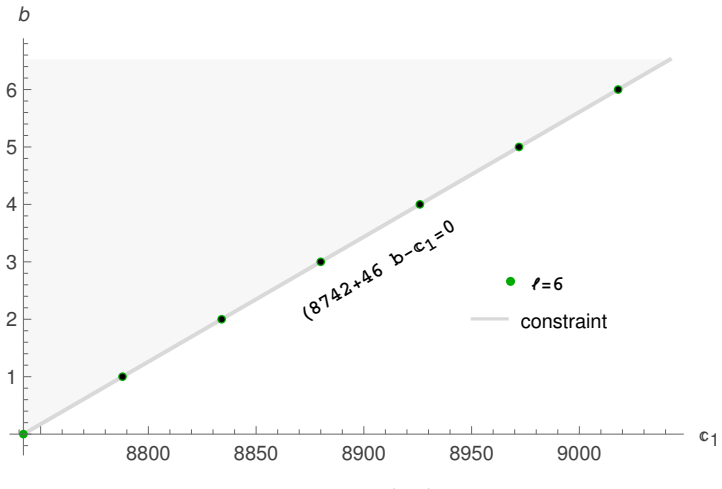
We revisit (3,0) and (3,3) admissible solutions obtained using the MLDE method. We show that all $(3,0)$ solutions can be written in terms of a universal formula involving the ${}_3F_2$ hypergeometric function that takes into account the monodromy at the elliptic points. We construct $(3,3)$ admissible solutions from (3,0) CFTs using a duality due to Bantay and Gannon. This enables us to compute their modular properties such as the S-matrix and the fusion rules. We find that only 7 of the 15 known (3,3) admissible solutions have proper fusion rules. Using the theory of matrix MLDE, starting with a known (3,0) and (3,3) solutions, we construct two other solutions, that are typically quasi-characters that share the same multiplier as the original solution. We then construct linear combinations that lead to new admissible solutions. We observe that admissible solutions arise as integer points that lie on a polytope. We construct all possible (3,6) and (3,9) admissible solutions that arise in this fashion. In some cases, we identify RCFT that arise from our (3,6) admissible solutions. In addition, we obtain a large family of admissible solutions with higher Wronskian index.
Editorial analysis
A structured set of objections, weighed in public.
Referee Report
Summary. The manuscript revisits admissible solutions for three-character RCFTs obtained via the MLDE method. It claims that every (3,0) solution admits a universal expression in terms of the _3F_2 hypergeometric function that incorporates monodromy at the elliptic points. Using Bantay-Gannon duality, (3,3) solutions are constructed from the (3,0) data; their S-matrices and fusion rules are computed, yielding the result that only 7 of the 15 known (3,3) solutions possess proper fusion rules. Matrix MLDE is then employed to generate quasi-characters sharing the original multiplier; linear combinations of these produce new admissible solutions. The authors observe that admissible solutions correspond to integer points inside a polytope defined by the MLDE coefficient constraints, construct all (3,6) and (3,9) solutions arising this way, identify some as RCFTs, and obtain a large family with higher Wronskian index.
Significance. If the universal hypergeometric formula and the duality constructions are rigorously verified, the work would supply a systematic, parameter-efficient route to admissible solutions at higher Wronskian indices and a concrete count of fusion-rule-valid (3,3) theories. The polytope observation, if shown to be independent of the enumerated solutions, could illuminate the geometry of the space of MLDE coefficients. The explicit identification of RCFTs among the (3,6) solutions would constitute a tangible advance in classification.
major comments (3)
- [universal formula section] Abstract and the section presenting the universal formula: the claim that every (3,0) admissible solution is captured by a single _3F_2 expression accounting for elliptic-point monodromy is stated without the explicit hypergeometric identity or the step-by-step reduction from the MLDE; this derivation is load-bearing for the completeness assertion.
- [Bantay-Gannon duality construction] The paragraph on Bantay-Gannon duality and the 7/15 count: the mapping is asserted to produce (3,3) solutions whose fusion rules follow directly from the original (3,0) data, yet no explicit verification is supplied that the resulting characters close under the Verlinde formula or satisfy positivity without additional modular-invariance checks; this assumption underpins both the count and the claim that duality introduces no hidden obstructions.
- [polytope and admissible solutions] The polytope observation and the axiom that admissible solutions are exactly the integer points inside the MLDE-coefficient polytope: the statement appears derived from the same set of enumerated solutions rather than from an independent constraint, rendering the observation potentially circular and weakening its use as a classification tool.
minor comments (2)
- Notation for the Wronskian index and the multiplier system should be defined at first use and kept consistent across the matrix-MLDE and duality sections.
- Tables listing the 15 (3,3) solutions and the 7 valid fusion-rule cases would benefit from an additional column indicating which solutions arise from the duality map versus direct MLDE search.
Simulated Author's Rebuttal
We thank the referee for their careful reading and constructive comments on our manuscript. We address each major comment below and indicate the revisions we will incorporate to improve clarity and rigor.
read point-by-point responses
-
Referee: [universal formula section] Abstract and the section presenting the universal formula: the claim that every (3,0) admissible solution is captured by a single _3F_2 expression accounting for elliptic-point monodromy is stated without the explicit hypergeometric identity or the step-by-step reduction from the MLDE; this derivation is load-bearing for the completeness assertion.
Authors: We agree that the explicit derivation is essential for substantiating the completeness claim. In the revised manuscript we will insert a dedicated subsection deriving the universal _3F_2 expression directly from the third-order MLDE, including the precise hypergeometric identity that encodes the monodromy at the elliptic points and the reduction steps that show every admissible (3,0) solution is recovered from this single formula. revision: yes
-
Referee: [Bantay-Gannon duality construction] The paragraph on Bantay-Gannon duality and the 7/15 count: the mapping is asserted to produce (3,3) solutions whose fusion rules follow directly from the original (3,0) data, yet no explicit verification is supplied that the resulting characters close under the Verlinde formula or satisfy positivity without additional modular-invariance checks; this assumption underpins both the count and the claim that duality introduces no hidden obstructions.
Authors: The Bantay-Gannon duality supplies the characters and the associated S-matrix by a direct linear transformation of the (3,0) data; the fusion coefficients are then obtained from the Verlinde formula applied to this S-matrix. We have verified closure, integrality and positivity for all fifteen cases, finding that only seven satisfy the required conditions. To make the verification transparent we will add, in the revision, an explicit worked example of the S-matrix and fusion-rule table for one representative solution together with a summary confirming the checks for the full set. revision: partial
-
Referee: [polytope and admissible solutions] The polytope observation and the axiom that admissible solutions are exactly the integer points inside the MLDE-coefficient polytope: the statement appears derived from the same set of enumerated solutions rather than from an independent constraint, rendering the observation potentially circular and weakening its use as a classification tool.
Authors: The polytope is defined by the linear inequalities on the MLDE coefficients that enforce admissibility (non-negative leading coefficients in the q-expansions and integrality of the Wronskian index). These inequalities follow directly from the general structure of the MLDE and are independent of any particular solution set. The integer points inside the polytope then generate the admissible solutions. We will revise the relevant section to state the defining inequalities explicitly and to clarify that the polytope is a consequence of the MLDE constraints rather than an a-posteriori fit to the enumerated solutions. revision: yes
Circularity Check
No significant circularity; derivations build on external MLDE framework and Bantay-Gannon duality
full rationale
The paper derives a universal _3F_2 expression for (3,0) solutions by solving the standard modular linear differential equations (MLDE) while incorporating elliptic-point monodromy, then applies the externally cited Bantay-Gannon duality to generate (3,3) solutions and compute their S-matrix and fusion rules. Subsequent constructions of quasi-characters via matrix MLDE, linear combinations yielding new admissible solutions, and the observation that solutions appear as integer points on a polytope are presented as empirical outcomes from these methods rather than definitional inputs or self-referential fits. No load-bearing step reduces by construction to the paper's own fitted parameters or prior self-citations; the Bantay-Gannon reference is to independent prior work, and the polytope remark functions as a descriptive pattern rather than a forcing constraint. The overall chain remains self-contained against external RCFT benchmarks.
Axiom & Free-Parameter Ledger
free parameters (1)
- MLDE coefficients chosen for admissibility
axioms (2)
- domain assumption The Bantay-Gannon duality preserves modular properties sufficiently to allow direct computation of S-matrix and fusion rules for the image solutions.
- ad hoc to paper Admissible solutions correspond exactly to the integer points lying inside the polytope defined by the MLDE coefficient constraints.
invented entities (1)
-
quasi-characters
no independent evidence
Lean theorems connected to this paper
-
IndisputableMonolith/Foundation/AlexanderDuality.leanalexander_duality_circle_linking unclear?
unclearRelation between the paper passage and the cited Recognition theorem.
We show that all (3,0) solutions can be written in terms of a universal formula involving the 3F2 hypergeometric function that takes into account the monodromy at the elliptic points.
-
IndisputableMonolith/Foundation/ArithmeticFromLogic.leanembed_injective unclear?
unclearRelation between the paper passage and the cited Recognition theorem.
Bantay and Gannon propose a duality that maps one basis of VVMF with a given multiplier to the basis of a VVMFs with a multiplier derived from the original one.
What do these tags mean?
- matches
- The paper's claim is directly supported by a theorem in the formal canon.
- supports
- The theorem supports part of the paper's argument, but the paper may add assumptions or extra steps.
- extends
- The paper goes beyond the formal theorem; the theorem is a base layer rather than the whole result.
- uses
- The paper appears to rely on the theorem as machinery.
- contradicts
- The paper's claim conflicts with a theorem or certificate in the canon.
- unclear
- Pith found a possible connection, but the passage is too broad, indirect, or ambiguous to say the theorem truly supports the claim.
Forward citations
Cited by 1 Pith paper
-
Updating the holomorphic modular bootstrap
Admissible solutions to MLDEs with ≤6 characters and c_eff ≤24 are enumerated; tenable ones with good fusion rules are identified, with some linked to specific CFTs and MTC classes.
Reference graph
Works this paper leans on
- [1]
- [2]
-
[3]
Naculich,Differential equations for rational conformal characters,Nucl
S.G. Naculich,Differential equations for rational conformal characters,Nucl. Phys. B323(1989) 423
work page 1989
-
[4]
Meromorphic c=24 Conformal Field Theories
A.N. Schellekens,Meromorphic C = 24 conformal field theories,Commun. Math. Phys.153(1993) 159 [hep-th/9205072]
work page internal anchor Pith review Pith/arXiv arXiv 1993
-
[5]
O.D. King,A mass formula for unimodular lattices with no roots,Mathematics of Computation72(2003) 839 [0012231]
work page 2003
-
[6]
On 2d Conformal Field Theories with Two Characters
H.M. Hampapura and S. Mukhi,On 2d conformal field theories with two characters, JHEP01(2016) 005 [1510.04478]
work page internal anchor Pith review Pith/arXiv arXiv 2016
-
[7]
S. Mukhi and B.C. Rayhaun,Classification of Unitary RCFTs with Two Primaries and Central Charge Less Than 25,Commun. Math. Phys.401(2023) 1899 [2208.05486]
- [8]
-
[9]
C.N. Gowdigere, S. Kala and J. Santara,Classifying three-character RCFTs with Wronskian index equalling 3 or 4,2308.01149. 44
- [10]
-
[11]
Towards a Classification of Two-Character Rational Conformal Field Theories
A.R. Chandra and S. Mukhi,Towards a Classification of Two-Character Rational Conformal Field Theories,JHEP04(2019) 153 [1810.09472]
work page internal anchor Pith review Pith/arXiv arXiv 2019
- [12]
-
[13]
Signs, growth and admissibility of quasi-characters and the holomorphic modular bootstrap for RCFT
A. Das and S. Mukhi,Holomorphic bootstrap for RCFT: signs and bounds for quasi-characters,2507.07170
work page internal anchor Pith review Pith/arXiv arXiv
-
[14]
J. Kaidi, Y.-H. Lin and J. Parra-Martinez,Holomorphic modular bootstrap revisited, JHEP12(2021) 151 [2107.13557]
-
[15]
Hecke Relations in Rational Conformal Field Theory
J.A. Harvey and Y. Wu,Hecke Relations in Rational Conformal Field Theory,JHEP 09(2018) 032 [1804.06860]
work page internal anchor Pith review Pith/arXiv arXiv 2018
- [16]
- [17]
-
[18]
Cosets of Meromorphic CFTs and Modular Differential Equations
M.R. Gaberdiel, H.R. Hampapura and S. Mukhi,Cosets of Meromorphic CFTs and Modular Differential Equations,JHEP04(2016) 156 [1602.01022]
work page internal anchor Pith review Pith/arXiv arXiv 2016
-
[19]
P. Bantay and T. Gannon,Vector-valued modular functions for the modular group and the hypergeometric equation,Commun. Num. Theor. Phys.1(2007) 651
work page 2007
-
[20]
The theory of vector-modular forms for the modular group
T. Gannon,The theory of vector-modular forms for the modular group,Contrib. Math. Comput. Sci.8(2014) 247 [1310.4458]
work page internal anchor Pith review Pith/arXiv arXiv 2014
-
[21]
Two approaches to the holomorphic modular bootstrap
S. Govindarajan and J. Santara,Two approaches to the holomorphic modular bootstrap,JHEP10(2025) 181 [2503.23761]
work page internal anchor Pith review Pith/arXiv arXiv 2025
-
[22]
B.C. Rayhaun,Bosonic rational conformal field theories in small genera, chiral fermionization, and symmetry/subalgebra duality,J. Math. Phys.65(2024) 052301 [2303.16921]
-
[23]
The kernel of the modular representation and the Galois action in RCFT
P. Bantay,The Kernel of the modular representation and the Galois action in RCFT,Commun. Math. Phys.233(2003) 423 [math/0102149]
work page internal anchor Pith review Pith/arXiv arXiv 2003
-
[24]
Conformal characters and the modular representation
P. Bantay and T. Gannon,Conformal characters and the modular representation, JHEP02(2006) 005 [hep-th/0512011]. 45
work page internal anchor Pith review Pith/arXiv arXiv 2006
-
[25]
Modular differential equations for characters of RCFT
P. Bantay,Modular differential equations for characters of RCFT,JHEP06(2010) 021 [1004.2579]
work page internal anchor Pith review Pith/arXiv arXiv 2010
-
[26]
F. Beukers and G. Heckman,Monodromy for the hypergeometric function nFn−1, Inventiones mathematicae95(1989) 325
work page 1989
-
[27]
Hypergeometric series, modular linear differential equations, and vector-valued modular forms
C. Franc and G. Mason,Hypergeometric series, modular linear differential equations and vector-valued modular forms,The Ramanujan Journal41(2016) 233 [1503.05519]
work page internal anchor Pith review Pith/arXiv arXiv 2016
-
[28]
C. Franc and G. Mason,Classification of some vertex operator algebras of rank 3, Algebra & Number Theory14(2020) 1613 [1905,07500]
work page 2020
-
[29]
P. Di Francesco, P. Mathieu and D. Senechal,Conformal Field Theory, Graduate Texts in Contemporary Physics, Springer-Verlag, New York (1997), 10.1007/978-1-4612-2256-9
- [30]
-
[31]
C.N. Gowdigere, S. Kala and A. Rawat, “Studies of [3,3] characters.” 2025
work page 2025
- [32]
-
[33]
G.W. Moore and N. Seiberg,Classical and Quantum Conformal Field Theory, Commun. Math. Phys.123(1989) 177
work page 1989
-
[34]
A. Das, C.N. Gowdigere and J. Santara, “Tables of (3,6) RCFTs obtained as generalized coset duals of (3,0) RCFTs fromc= 32 Kervaire self-dual lattices.” 2023
work page 2023
-
[35]
On classification of modular tensor categories
E. Rowell, R. Stong and Z. Wang,On classification of modular tensor categories, Communications in Mathematical Physics292(2009) 343 [0712.1377]
work page internal anchor Pith review Pith/arXiv arXiv 2009
- [36]
-
[37]
Zagier,Introduction to modular forms, inFrom number theory to physics, pp
D. Zagier,Introduction to modular forms, inFrom number theory to physics, pp. 238–291, Springer (1992)
work page 1992
-
[38]
D. Zagier,Elliptic modular forms and their applications, inThe 1-2-3 of modular forms: Lectures at a summer school in Nordfjordeid, Norway, pp. 1–103, Springer (2008). 46
work page 2008
discussion (0)
Sign in with ORCID, Apple, or X to comment. Anyone can read and Pith papers without signing in.