REVIEW 5 major objections 6 minor 53 references
Physics-Informed Neural Networks for Speech Production
T0 review · 5 major / 6 minor · reviewed 2026-08-04 · deepseek-v4-flash
Pith's one-line read A single physics-informed neural network can solve the coupled vocal-fold/vocal-tract system in the forward direction and, from the speech waveform alone, recover glottal flow, vocal-fold motion, and subglottal pressure in the inverse direc
desk verdict A genuine first: a PINN that solves the coupled two-mass vocal-fold/tract problem forward and inverse, with real technical tricks, but the evidence is a single favorable in-silico run and the period-selection mechanism is unverified. read the letter →
The pith
A machine-rendered reading of the paper's core claim, the machinery that carries it, and where it could break.
The reading
What carries the argument
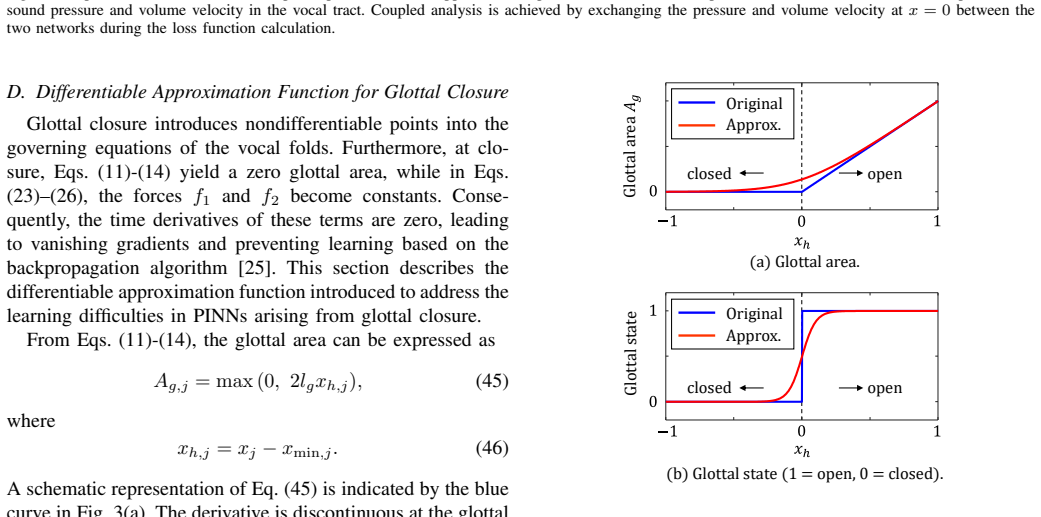
The load-bearing machinery is a two-network PINN: the upper network outputs vocal-fold displacements x1, x2 satisfying the Ishizaka–Flanagan two-mass equations; the lower network outputs pressure and volume velocity in a 1D acoustic tube. Three devices carry the argument: (1) differentiable approximations — softplus for glottal area, sigmoid for collision forces, softplus for the pressure difference — that smooth the nondifferentiable glottal-closure nonlinearity and prevent vanishing gradients; (2) a learnable period T with a time-scaling variable t* = 2t/T − 1, so the unknown self-oscillation period is found during training without repositioning collocation points; (3) a hard constraint th
What would settle it
Train the forward network from a period estimate far outside the 20% initialization band (or with random initial periods) and check whether the learned period and waveforms still converge to the RK4/FDM reference; additionally, take the smoothing coefficients β to infinity and verify that the converged PINN solution approaches the nonsmooth reference solution. If convergence fails or the solution stays on a different orbit, the claim that the method identifies the physical attractor is falsified.
Extended reading notes
Core claim
The paper shows a two-network PINN that solves the coupled Ishizaka–Flanagan two-mass vocal-fold model and a one-dimensional acoustic-tube vocal tract in both forward and inverse directions. In the forward analysis of vowels /a/ and /u/, the PINN reproduces the reference vocal-fold displacement, glottal volume velocity, and intra-tract pressure fields computed by a fourth-order Runge–Kutta/finite-difference solver, with the self-oscillation period learned to within 0.14% (/a/) and 0.18% (/u/) of the reference. In the inverse analysis, the radiated lip-pressure waveform is imposed as a hard boundary constraint and the same network simultaneously estimates the glottal volume velocity, the two
Load-bearing premise
The forward training assumes the self-oscillation is exactly periodic and that gradient descent on the smoothed PDE residuals, starting within 20% of the true period, lands on the physical attractor rather than another periodic orbit of the smoothed equations.
Editorial extensions
If this is right
- Because the same network is used for forward and inverse analysis, no separate inverse solver and no source–filter independence assumption are required.
- The differentiable approximations let a PINN train through vocal-fold collision, meaning PINNs can now be applied to other biomechanical systems with hard contact nonlinearities.
- The learnable-period formulation automatically identifies the self-excited oscillation period during training, so only one steady-state cycle needs to be analyzed, reducing spectral-bias problems.
- Glottis–tract interaction is enforced exactly through the hard constraint, so the method avoids the hyperparameter tuning and extra training cost of soft multi-physics coupling terms.
Reading between the lines
- A natural testable extension is to replace the known vocal-tract shape and fixed vocal-fold parameters with additional trainable parameters, asking whether the same PINN can estimate vocal-fold stiffness or tract geometry from real (not synthetic) speech — a move the paper does not make.
- The smoothing coefficients β for area, force, and pressure are finite; probing the β→∞ limit would show whether the PINN solution approaches the nonsmooth reference and whether training stability degrades, clarifying whether the smoothing is a numerical crutch or a physical regularization.
- The learnable-period trick is a general recipe for PINNs on limit-cycle systems (e.g., other self-oscillators in physiology); it should be tested on simpler systems without a good initial period guess to see whether convergence to the physical orbit is guaranteed or requires the 20% warm start.
- The 5.5-hour training cost and the use of synthetic reference waveforms suggest the method's practical value will hinge on transfer to real voice recordings, where source-filter parameters are unknown and the waveform has noise and higher-order dynamics.
Editorial analysis
A structured set of objections, weighed in public.
Referee Report
Summary. The paper proposes a PINN framework for coupled vocal-fold/vocal-tract speech production analysis. The forward formulation learns one period of the Ishizaka–Flanagan two-mass model coupled to a 1D acoustic tube, with a learnable period and differentiable smoothing (softplus/sigmoid) of glottal closure; glottal–tract coupling is enforced via hard-constraint boundary blending (Eqs. 43–44). The inverse analysis provides the lip pressure waveform as a hard constraint and treats subglottal pressure as a trainable parameter. The authors validate on vowels /a/ and /u/: forward period errors of 0.14–0.18%, inverse subglottal pressure error of 0.13%, and visually matching vocal-fold displacement, glottal flow, and tract pressure fields relative to an RK4/FDM reference.
Significance. If the result holds, this is a useful proof-of-concept: the first PINN for speech production that explicitly models vocal-fold vibration, with a single architecture for forward simulation and inverse state estimation. The hard-constraint coupling and learnable-period trick are reasonable and could be adopted by others. The paper is honest about limitations (5h35m runtime, single runs, in-silico validation). However, the evidence is largely a numerical demonstration against the same model used for training; no error bars, no seed variation, no sensitivity study of the smoothing parameters or initial period, and no comparison to the true nonsmooth model in the β→∞ limit. Thus the strength of the contribution is moderate: it establishes feasibility on one test set, but does not yet establish robustness.
major comments (5)
- [Sec. IV-A / Fig. 5] The forward period-identification claim (“the period is generally unknown” and automatically identified) is tested from a single initialization with a 20% error relative to the reference period. The paper does not sweep initial period guesses, vary random network seeds, or report any statistics over runs. Since the time normalization t*=2t/T−1 in Eq. (41) changes the entire collocation point distribution and the Fourier feature map (42) as T changes, the optimization landscape can differ substantially with T. The reader cannot tell whether the reported convergence is robust or a favorable draw. Please report seed variation and a sweep of initial period errors (e.g., ±5/10/20%) for both vowels.
- [Sec. III-D, Eqs. (47)-(53)] The differentiability fix is central to the method, but β is fixed and never varied; there is no study of the β→∞ limit or a comparison against the original nonsmooth model. Since the reference RK4/FDM solution uses the nonsmooth model, the 0.1% agreement is evidence that the chosen β is small enough for that test case, but it is not evidence that the smoothed model’s periodic orbits converge to the physical ones. Please include a sensitivity analysis over β_Ag, β_f, β_p (e.g., one order of magnitude above and below the chosen values) and an explicit statement of the chosen β values, which appear missing from Table I/text.
- [Sec. IV-C / IV-D] The inverse analysis is a self-consistency benchmark: the “speech signal” is generated by the same equations, parameters, and vocal tract shape used in the PINN training. This validates the estimator under ideal conditions but not for model mismatch or noise. The paper acknowledges the in-silico nature implicitly but does not quantify robustness. Please add, at minimum, a noise-perturbation test (e.g., 1–2% or 20–40 dB SNR on the lip waveform) and a mismatch test of one or two physical parameters (e.g., k1 or l) to show the inverse formulation behaves gracefully under realistic departures from the model.
- [Sec. IV-B / Fig. 7] The convergence evidence is qualitative: “localized discrepancies” are attributed to spectral bias without quantification. Given that the central numerical claim is that “results are in close agreement,” a quantitative error field (e.g., L2 relative pressure error over the (x,t) domain, maximum pointwise error, or the difference colorbar range) should be reported. The difference plots have no colorbar, which obscures whether the discrepancies are 0.1 Pa or 10 Pa.
- [Sec. I (Introduction), Sec. IV-C] The paper states that no PINNs for speech production explicitly including vocal-fold vibration have been reported, and cites only the authors’ previous vocal-tract PINN as the closest prior work. This claim is used to justify the novelty. The reader cannot fully verify the literature scope; nevertheless, the absence of any comparative PINN baseline and the lack of error bars mean the general claim of “high performance” is only weakly supported. Since the contribution is explicitly framed as first-in-kind, the evidence should include more than a single demonstration per vowel.
minor comments (6)
- [Eq. (42)] The notation t* is used both as the normalized time variable and as the output of the Fourier feature map; please use distinct symbols (e.g., τ and φ(τ)) to avoid confusion.
- [Sec. IV-A / Eq. (62)] The learning-rate schedule is given in terms of λAdam, which collides with the loss-weight notation λ_f, λ_t1, etc. Please rename the learning rate (e.g., η) to avoid ambiguity.
- [Table I / Sec. III-D] The exact values of β_Ag, β_f, and β_p are never stated. Since these are the key smoothing hyperparameters, they should be reported in Table I or in the text of Sec. IV-A.
- [Fig. 7 / Fig. 8] The difference plots in Fig. 7 lack colorbars. Please add colorbars or state the maximum absolute difference. Also, the spectrum in Fig. 8(b) would benefit from a comparison with the conventional method’s spectrum rather than only the LPC envelope.
- [Sec. V / conclusion] The conclusion states that “vocal-fold motion, glottal flow, and subglottal pressure were accurately estimated” without caveats. Please add a sentence noting that this was demonstrated for a synthetic, matched-model test signal, with future work needed for real speech data.
- [References [25] and [47]] The same reference (Rumelhart et al., 1986) is listed twice with different entry details. Please merge or cross-reference.
Circularity Check
No significant circularity: forward/inverse validation is an in-silico benchmark, and the learnable period and subglottal pressure are honestly evaluated against reference solutions.
full rationale
The central claim is that a PINN can solve the coupled vocal-fold/vocal-tract equations in both forward and inverse directions. The forward analysis treats the period T as a learnable parameter (Eq. 61: min_{Θ,T} L_all) and initializes it with a stated 20% error relative to the RK4/FDM reference (Sec. IV-A). The reported convergence to 0.14–0.18% error (Fig. 5) is an honest numerical benchmark, not a result forced by construction: the output displacement, glottal flow, and acoustic fields are compared against an independent conventional solver. The inverse analysis supplies the reference lip-pressure waveform as p_data through the hard constraint in Eq. (43), treats T as known, and estimates p_s and the vocal-fold states (Eq. 63). Because the target states are not equal to the training data by construction, this is a genuine (if self-consistent) inverse problem: the network must satisfy PDE residuals while fitting the boundary waveform, and it could fail. The in-silico nature of the speech signal limits claims about real data but is not circularity. Self-citations [23], [37], [52] support component choices (network architecture, activation, loss weights) rather than the core derivation; no load-bearing uniqueness theorem or hidden ansatz is imported. The single 20% initialization and absence of period/seed sweeps are robustness concerns, not circularity.
Assumptions & free parameters
free parameters (6)
- Oscillation period T (forward analysis) =
5.17e-3 s (/a/), 5.44e-3 s (/u/)
- Subglottal pressure ps (inverse analysis) =
783.6 Pa (reference 785 Pa)
- Loss weights λf, λt1, λt2, λr =
3.50e9, 2.72e19, 1.01e7, 1.00e10
- Smoothing coefficients βAg, βf, βp =
not reported
- Fourier feature count m =
not reported
- Initial period guess =
20% error relative to reference
assumptions (6)
- domain assumption The two-mass Ishizaka-Flanagan model with the stated parameters (Table I) has a stable, single-period self-oscillating solution for the /a/ and /u/ vocal-tract shapes.
- domain assumption Quasi-steady Bernoulli flow through the glottis with no backflow (ps > p0) holds.
- domain assumption The one-dimensional vocal-tract acoustics with rigid walls and the loss formulas (31)-(32), including α_R=25 and α_G=1, adequately represent vocal-tract physics.
- standard math Neural networks with universal-approximation capacity and Fourier feature mappings can represent the periodic solution accurately enough for residual minimization.
- ad hoc to paper The softplus/sigmoid approximations (47), (50)-(53) with finite β produce a model whose solution converges to the true nonsmooth model as β increases.
- domain assumption Minimizing PDE residuals over a single period without initial conditions selects the physical periodic orbit for the given subglottal pressure.
Cite this review
Pith. "Pith review of Physics-Informed Neural Networks for Speech Production." pith.science (2026). https://pith.science/paper/SFYCFFUL
@misc{pith2026251100428,
  author       = {Pith},
  title        = {Pith review of: Physics-Informed Neural Networks for Speech Production},
  year         = {2026},
  howpublished = {\url{https://pith.science/paper/SFYCFFUL}},
  note         = {Machine review of arXiv:2511.00428}
}
read the original abstract
The analysis of speech production based on physical models of the vocal folds and vocal tract is essential for studies on vocal-fold behavior and linguistic research. This paper proposes a speech production analysis method using physics-informed neural networks (PINNs). The networks are trained directly on the governing equations of vocal-fold vibration and vocal-tract acoustics. Vocal-fold collisions introduce nondifferentiability and vanishing gradients, challenging phenomena for PINNs. We demonstrate, however, that introducing a differentiable approximation function enables the analysis of vocal-fold vibrations within the PINN framework. The period of self-excited vocal-fold vibration is generally unknown. We show that by treating the period as a learnable network parameter, a periodic solution can be obtained. Furthermore, by implementing the coupling between glottal flow and vocal-tract acoustics as a hard constraint, glottis-tract interaction is achieved without additional loss terms. We confirmed the method's validity through forward and inverse analyses, demonstrating that the glottal flow rate, vocal-fold vibratory state, and subglottal pressure can be simultaneously estimated from speech signals. Notably, the same network architecture can be applied to both forward and inverse analyses, highlighting the versatility of this approach. The proposed method inherits the advantages of PINNs, including mesh-free computation and the natural incorporation of nonlinearities, and thus holds promise for a wide range of applications.
Figures


Figures from the paper (6 more)


Reference graph
Works this paper leans on
-
[1]
Synthesis of voiced sounds from a two- mass model of the vocal cords,
K. Ishizaka and J. L. Flanagan, “Synthesis of voiced sounds from a two- mass model of the vocal cords,”Bell system technical journal, vol. 51, no. 6, pp. 1233–1268, 1972
1972
-
[2]
The physics of small-amplitude oscillation of the vocal folds,
I. R. Titze, “The physics of small-amplitude oscillation of the vocal folds,”The Journal of the Acoustical Society of America, vol. 83, no. 4, pp. 1536–1552, 1988
1988
-
[3]
Laryngopharyngeal reflux and voice disorders: a multifactorial model of etiology and pathophysiology,
J. R. Lechien, S. Saussez, B. Harmegnies, C. Finck, and J. A. Burns, “Laryngopharyngeal reflux and voice disorders: a multifactorial model of etiology and pathophysiology,”Journal of voice, vol. 31, no. 6, pp. 733–752, 2017
2017
-
[4]
Evaluation of voice pathology based on the estimation of vocal fold biomechanical parameters,
P. G ´omez-Vilda, R. Fern´andez-Baillo, A. Nieto, F. D´ıaz, F. J. Fern´andez- Camacho, V . Rodellar, A. ´Alvarez, and R. Mart ´ınez, “Evaluation of voice pathology based on the estimation of vocal fold biomechanical parameters,”Journal of Voice, vol. 21, no. 4, pp. 450–476, 2007
2007
-
[5]
Education system in acoustics of speech production using physical models of the human vocal tract,
T. Arai, “Education system in acoustics of speech production using physical models of the human vocal tract,”Acoustical science and technology, vol. 28, no. 3, pp. 190–201, 2007
2007
-
[6]
Indirect assessment of the contribution of subglottal air pressure and vocal-fold tension to changes of fundamental frequency in english,
R. B. Monsen, A. M. Engebretson, and N. R. Vemula, “Indirect assessment of the contribution of subglottal air pressure and vocal-fold tension to changes of fundamental frequency in english,”The Journal of the Acoustical Society of America, vol. 64, no. 1, pp. 65–80, 1978
1978
-
[7]
Numerical analysis and physical consideration of vocal fold vibration by modal analysis,
K. Yokota, S. Ishikawa, K. Takezaki, Y . Koba, and S. Kijimoto, “Numerical analysis and physical consideration of vocal fold vibration by modal analysis,”Journal of Sound and Vibration, vol. 514, p. 116442, 2021
2021
-
[8]
Toward a simulation-based tool for the treatment of vocal fold paralysis,
R. Mittal, X. Zheng, R. Bhardwaj, J. H. Seo, Q. Xue, and S. Bielam- owicz, “Toward a simulation-based tool for the treatment of vocal fold paralysis,”Frontiers in physiology, vol. 2, p. 19, 2011
2011
Show all 53 references
-
[9]
Simulation of velopha- ryngeal biomechanics identifies differences in sphincter pharyngoplasty outcomes: A matched case–control study,
T. Tran, J. Perry, S. Blemker, and K. Mason, “Simulation of velopha- ryngeal biomechanics identifies differences in sphincter pharyngoplasty outcomes: A matched case–control study,”The Cleft Palate Craniofacial Journal, vol. 61, no. 2, pp. 339–349, 2024
2024
-
[10]
Inverse analysis of vocal sound source using an analytical model of the vocal tract,
K. Yokota, S. Ishikawa, Y . Koba, S. Kijimoto, and S. Sugiki, “Inverse analysis of vocal sound source using an analytical model of the vocal tract,”Applied Acoustics, vol. 150, pp. 89–103, 2019
2019
-
[11]
Techniques for estimating vocal-tract shapes from the speech signal,
J. Schroeter and M. M. Sondhi, “Techniques for estimating vocal-tract shapes from the speech signal,”IEEE Transactions on Speech and Audio Processing, vol. 2, no. 1, pp. 133–150, 1994
1994
-
[12]
Glottal inverse filtering analysis of human voice production—a review of estimation and parameterization methods of the glottal exci- tation and their applications,
P. Alku, “Glottal inverse filtering analysis of human voice production—a review of estimation and parameterization methods of the glottal exci- tation and their applications,”Sadhana, vol. 36, no. 5, pp. 623–650, 2011
2011
-
[13]
Fant,Acoustic theory of speech production: with calculations based on X-ray studies of Russian articulations
G. Fant,Acoustic theory of speech production: with calculations based on X-ray studies of Russian articulations. Walter de Gruyter, 1971, no. 2
1971
-
[14]
Deriving vocal fold oscillation information from recorded voice signals using models of phonation,
W. Zhao and R. Singh, “Deriving vocal fold oscillation information from recorded voice signals using models of phonation,”Entropy, vol. 25, no. 7, p. 1039, 2023
2023
-
[15]
Efficient 3d acoustic simulation of the vocal tract by combining the multimodal method and finite elements,
R. Blandin, M. Arnela, S. F ´elix, J.-B. Doc, and P. Birkholz, “Efficient 3d acoustic simulation of the vocal tract by combining the multimodal method and finite elements,”IEEE Access, vol. 10, pp. 69 922–69 938, 2022
2022
-
[16]
Physics-informed neural networks: A deep learning framework for solving forward and inverse problems involving nonlinear partial differential equations,
M. Raissi, P. Perdikaris, and G. E. Karniadakis, “Physics-informed neural networks: A deep learning framework for solving forward and inverse problems involving nonlinear partial differential equations,” Journal of Computational physics, vol. 378, pp. 686–707, 2019
2019
-
[17]
Scientific machine learning through physics–informed neural networks: Where we are and what’s next,
S. Cuomo, V . S. Di Cola, F. Giampaolo, G. Rozza, M. Raissi, and F. Piccialli, “Scientific machine learning through physics–informed neural networks: Where we are and what’s next,”Journal of Scientific Computing, vol. 92, no. 3, p. 88, 2022
2022
-
[18]
Understanding physics- informed neural networks: Techniques, applications, trends, and chal- lenges,
A. Farea, O. Yli-Harja, and F. Emmert-Streib, “Understanding physics- informed neural networks: Techniques, applications, trends, and chal- lenges,”AI, vol. 5, no. 3, pp. 1534–1557, 2024
2024
-
[19]
Physics- informed neural network for nonlinear dynamics in fiber optics,
X. Jiang, D. Wang, Q. Fan, M. Zhang, C. Lu, and A. P. T. Lau, “Physics- informed neural network for nonlinear dynamics in fiber optics,”Laser & Photonics Reviews, vol. 16, no. 9, p. 2100483, 2022
2022
-
[20]
Physics-informed neural networks for acoustic boundary admittance estimation,
J. D. Schmid, P. Bauerschmidt, C. Gurbuz, M. Eser, and S. Marburg, “Physics-informed neural networks for acoustic boundary admittance estimation,”Mechanical Systems and Signal Processing, vol. 215, p. 111405, 2024
2024
-
[21]
Room impulse response reconstruction with physics-informed deep learning,
X. Karakonstantis, D. Caviedes-Nozal, A. Richard, and E. Fernandez- Grande, “Room impulse response reconstruction with physics-informed deep learning,”The Journal of the Acoustical Society of America, vol. 155, no. 2, pp. 1048–1059, 2024
2024
-
[22]
Sound field estimation around a rigid sphere with physics-informed neural network,
X. Chen, F. Ma, A. Bastine, P. Samarasinghe, and H. Sun, “Sound field estimation around a rigid sphere with physics-informed neural network,” in2023 Asia Pacific Signal and Information Processing Association Annual Summit and Conference (APSIPA ASC). IEEE, 2023, pp. 1984– 1989
2023
-
[23]
Synthesis of voiced sounds using physics-informed neural networks,
K. Yokota, M. Ogura, and M. Abe, “Synthesis of voiced sounds using physics-informed neural networks,”Acoustical Science and Technology, vol. 45, no. 6, pp. 333–336, 2024
2024
-
[24]
Approximation capabilities of multilayer feedforward net- works,
K. Hornik, “Approximation capabilities of multilayer feedforward net- works,”Neural networks, vol. 4, no. 2, pp. 251–257, 1991. IEEE TRANSACTIONS AND JOURNALS TEMPLATE 11
1991
-
[26]
Discontinuity computing using physics-informed neural networks,
L. Liu, S. Liu, H. Xie, F. Xiong, T. Yu, M. Xiao, L. Liu, and H. Yong, “Discontinuity computing using physics-informed neural networks,” Journal of Scientific Computing, vol. 98, no. 1, p. 22, 2024
2024
-
[27]
Improving weak pinns for hyperbolic conservation laws: Dual norm computation, boundary conditions and systems,
A. Chaumet and J. Giesselmann, “Improving weak pinns for hyperbolic conservation laws: Dual norm computation, boundary conditions and systems,”arXiv preprint arXiv:2211.12393, 2022
2022 arXiv
-
[28]
When and why pinns fail to train: A neural tangent kernel perspective,
S. Wang, X. Yu, and P. Perdikaris, “When and why pinns fail to train: A neural tangent kernel perspective,”Journal of Computational Physics, vol. 449, p. 110768, 2022
2022
-
[29]
Hard enforcement of physics-informed neural network solutions of acoustic wave propagation,
H. Sethi, D. Pan, P. Dimitrov, J. Shragge, G. Roth, and K. Hester, “Hard enforcement of physics-informed neural network solutions of acoustic wave propagation,”Computational geosciences, vol. 27, no. 5, pp. 737– 751, 2023
2023
-
[30]
Evolutionary optimization of physics-informed neural networks: Survey and prospects,
J. C. Wong, A. Gupta, C. C. Ooi, P.-H. Chiu, J. Liu, and Y .-S. Ong, “Evolutionary optimization of physics-informed neural networks: Survey and prospects,”arXiv preprint arXiv:2501.06572, 2025
2025
-
[31]
On shooting methods for boundary value problems,
M. R. Osborne, “On shooting methods for boundary value problems,” Journal of mathematical analysis and applications, vol. 27, no. 2, pp. 417–433, 1969
1969
-
[32]
J. L. Flanagan,Speech analysis synthesis and perception. Springer Science & Business Media, 2013, vol. 3
2013
-
[33]
Chaotic vibration induced by turbulent noise in a two-mass model of vocal folds,
J. J. Jiang and Y . Zhang, “Chaotic vibration induced by turbulent noise in a two-mass model of vocal folds,”The Journal of the Acoustical Society of America, vol. 112, no. 5, pp. 2127–2133, 2002
2002
-
[34]
Studying vocal fold vibrations in parkinson’s disease with a nonlinear model,
Y . Zhang, J. Jiang, and D. A. Rahn, “Studying vocal fold vibrations in parkinson’s disease with a nonlinear model,”Chaos: An Interdisciplinary Journal of Nonlinear Science, vol. 15, no. 3, 2005
2005
-
[35]
Vibrational dynamics of vocal folds using nonlinear normal modes,
A. P. Pinheiro and G. Kerschen, “Vibrational dynamics of vocal folds using nonlinear normal modes,”Medical Engineering & Physics, vol. 35, no. 8, pp. 1079–1088, 2013
2013
-
[36]
Dynamics of the two-mass model of the vocal folds: Equilibria, bifurcations, and oscillation region,
J. C. Lucero, “Dynamics of the two-mass model of the vocal folds: Equilibria, bifurcations, and oscillation region,”The Journal of the Acoustical Society of America, vol. 94, no. 6, pp. 3104–3111, 1993
1993
-
[37]
Physics-informed neural network for acoustic resonance analysis in a one-dimensional acoustic tube,
K. Yokota, T. Kurahashi, and M. Abe, “Physics-informed neural network for acoustic resonance analysis in a one-dimensional acoustic tube,”The Journal of the Acoustical Society of America, vol. 156, no. 1, pp. 30–43, 2024
2024
-
[38]
Neural networks fail to learn periodic functions and how to fix it,
L. Ziyin, T. Hartwig, and M. Ueda, “Neural networks fail to learn periodic functions and how to fix it,”Advances in Neural Information Processing Systems, vol. 33, pp. 1583–1594, 2020
2020
-
[39]
Physics-informed neural networks with hard constraints for inverse design,
L. Lu, R. Pestourie, W. Yao, Z. Wang, F. Verdugo, and S. G. Johnson, “Physics-informed neural networks with hard constraints for inverse design,”SIAM Journal on Scientific Computing, vol. 43, no. 6, pp. B1105–B1132, 2021
2021
-
[40]
Simulating seismic multifrequency wavefields with the fourier feature physics-informed neural network,
C. Song and Y . Wang, “Simulating seismic multifrequency wavefields with the fourier feature physics-informed neural network,”Geophysical Journal International, vol. 232, no. 3, pp. 1503–1514, 2023
2023
-
[41]
On the use of fourier features-physics in- formed neural networks (ff-pinn) for forward and inverse fluid mechanics problems,
O. Sallam and M. F ¨urth, “On the use of fourier features-physics in- formed neural networks (ff-pinn) for forward and inverse fluid mechanics problems,”Proceedings of the Institution of Mechanical Engineers, Part M: Journal of Engineering for the Maritime Environment, vol. 23...
2023
-
[42]
Modeling and prediction of lithium-ion battery thermal runaway via multiphysics- informed neural network,
S. W. Kim, E. Kwak, J.-H. Kim, K.-Y . Oh, and S. Lee, “Modeling and prediction of lithium-ion battery thermal runaway via multiphysics- informed neural network,”Journal of Energy Storage, vol. 60, p. 106654, 2023
2023
-
[43]
The application of physics-informed machine learning in multiphysics modeling in chemical engineering,
Z. Wu, H. Wang, C. He, B. Zhang, T. Xu, and Q. Chen, “The application of physics-informed machine learning in multiphysics modeling in chemical engineering,”Industrial & Engineering Chemistry Research, vol. 62, no. 44, pp. 18 178–18 204, 2023
2023
-
[44]
Exact imposition of boundary conditions with distance functions in physics-informed deep neural networks,
N. Sukumar and A. Srivastava, “Exact imposition of boundary conditions with distance functions in physics-informed deep neural networks,” Computer Methods in Applied Mechanics and Engineering, vol. 389, p. 114333, 2022
2022
-
[45]
Enforcing dirichlet boundary conditions in physics-informed neural networks and variational physics-informed neural networks,
S. Berrone, C. Canuto, M. Pintore, and N. Sukumar, “Enforcing dirichlet boundary conditions in physics-informed neural networks and variational physics-informed neural networks,”Heliyon, vol. 9, no. 8, 2023
2023
-
[46]
Incor- porating second-order functional knowledge for better option pricing,
C. Dugas, Y . Bengio, F. B ´elisle, C. Nadeau, and R. Garcia, “Incor- porating second-order functional knowledge for better option pricing,” Advances in neural information processing systems, vol. 13, 2000
2000
-
[47]
Learning repre- sentations by back-propagating errors,
D. E. Rumelhart, G. E. Hinton, and R. J. Williams, “Learning repre- sentations by back-propagating errors,”nature, vol. 323, no. 6088, pp. 533–536, 1986
1986
-
[48]
Unsteady behavior of flow in a scaled- up vocal folds model,
M. Krane, M. Barry, and T. Wei, “Unsteady behavior of flow in a scaled- up vocal folds model,”The Journal of the Acoustical Society of America, vol. 122, no. 6, pp. 3659–3670, 2007
2007
-
[49]
Adam: A method for stochastic optimization,
D. P. Kingma, “Adam: A method for stochastic optimization,”arXiv preprint arXiv:1412.6980, 2014
2014 arXiv
-
[50]
Monotone piecewise cubic interpola- tion,
F. N. Fritsch and R. E. Carlson, “Monotone piecewise cubic interpola- tion,”SIAM Journal on Numerical Analysis, vol. 17, no. 2, pp. 238–246, 1980
1980
-
[51]
A method for constructing local monotone piecewise cubic interpolants,
F. N. Fritsch and J. Butland, “A method for constructing local monotone piecewise cubic interpolants,”SIAM journal on scientific and statistical computing, vol. 5, no. 2, pp. 300–304, 1984
1984
-
[52]
Identification of physical properties in acoustic tubes using physics-informed neural networks,
K. Yokota, M. Ogura, and M. Abe, “Identification of physical properties in acoustic tubes using physics-informed neural networks,”Mechanical Engineering Journal, vol. 11, no. 5, pp. 24–00 228, 2024
2024
-
[53]
A statistical method for estimation of speech spectral density and formant frequencies,
F. Itakura, “A statistical method for estimation of speech spectral density and formant frequencies,”Electro. Comm. Japan, A, vol. 53, no. 1, pp. 36–43, 1970
1970
-
[54]
V owel space characteristics and vowel identification ac- curacy,
A. T. Neel, “V owel space characteristics and vowel identification ac- curacy,”Journal of Speech, Language, and Hearing Research, vol. 51, no. 3, pp. 574–585, 2008
2008
Reviewed August 4, 2026 · model on record in the stance chip above.
Discussion (0). Continue with ORCID to comment.