Spindle solutions, hyperscalars and smooth uplifts
Pith reviewed 2026-05-21 20:24 UTC · model grok-4.3
The pith
Type IIB supergravity admits new AdS3 solutions with smooth S5 bundles over spindles that are dual to 2D N=(0,2) SCFTs.
A machine-rendered reading of the paper's core claim, the machinery that carries it, and where it could break.
Core claim
We construct AdS3×Y7 solutions of type IIB supergravity, where Y7 is a smooth S5 bundle over a spindle Σ(n_N,n_S), which are dual to N=(0,2) SCFTs in d=2. The solutions are constructed using the D=5 STU U(1)^3 gauged supergravity theory coupled to a hyperscalar charged under U(1)_B. We investigate spindle solutions with two new features: first, we allow (n_N,n_S) to be non-coprime integers, including orbifolds of the round S2, which can lead to non-unique, inequivalent uplifts, distinguished by the hyperscalar spectra, for given magnetic flux through the spindle. Second, we also allow the hyperscalar to vanish at the poles leading to solutions carrying non-vanishing U(1)_B flux. The new AdS3
What carries the argument
The five-dimensional STU U(1)^3 gauged supergravity coupled to a hyperscalar charged under U(1)_B, which enables smooth uplifts to type IIB with spindle features including non-coprime parameters and pole-vanishing hyperscalars.
If this is right
- These solutions provide holographic duals for N=(0,2) SCFTs in two dimensions.
- RG flows triggered by relevant hyperscalar deformations can end at these new AdS3 solutions rather than the pure STU ones.
- Non-coprime spindle parameters yield multiple inequivalent type IIB uplifts for the same magnetic flux, distinguished by hyperscalar spectra.
- Solutions with hyperscalar vanishing at the poles carry additional non-vanishing U(1)_B flux through the spindle.
Where Pith is reading between the lines
- The non-unique uplifts for non-coprime cases may correspond to distinct phases or moduli in the dual 2D SCFTs.
- These constructions could be generalized to other gauged supergravity models to produce additional families of spindle solutions in different dimensions.
- Computing quantities such as central charges or correlation functions in these backgrounds would allow direct comparison with expectations from 2D field theory.
- The spindle-plus-hyperscalar setup might connect to known D-brane or geometric realizations of 2D SCFTs for explicit tests of the duality.
Load-bearing premise
The D=5 STU U(1)^3 gauged supergravity theory coupled to a hyperscalar charged under U(1)_B admits consistent smooth uplifts to type IIB supergravity for the chosen spindle parameters, including non-coprime cases and vanishing hyperscalar at poles.
What would settle it
An explicit computation of the ten-dimensional metric and fluxes for a specific non-coprime (n_N, n_S) example or a vanishing-hyperscalar case that reveals a curvature singularity would falsify the smoothness of the uplift.
Figures



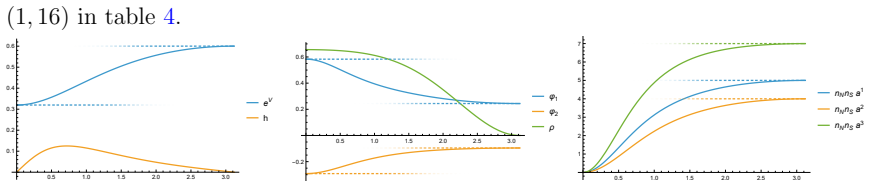
read the original abstract
We construct $AdS_3\times Y_7$ solutions of type IIB supergravity, where $Y_7$ is a smooth $S^5$ bundle over a spindle $\Sigma(n_N,n_S)$, which are dual to $\mathcal{N}=(0,2)$ SCFTs in $d=2$. The solutions are constructed using the $D=5$ STU $U(1)^3$ gauged supergravity theory coupled to a hyperscalar charged under $U(1)_B$. We investigate spindle solutions with two new features: first, we allow $(n_N,n_S)$ to be non-coprime integers, including orbifolds of the round $S^2$, which can lead to non-unique, inequivalent uplifts, distinguished by the hyperscalar spectra, for given magnetic flux through the spindle. Second, we also allow the hyperscalar to vanish at the poles leading to solutions carrying non-vanishing $U(1)_B$ flux. The new hyperscalar $AdS_3$ solutions can naturally arise as the endpoint of RG flows, triggered by relevant hyperscalar deformations of the $AdS_3$ solutions of the STU model.
Editorial analysis
A structured set of objections, weighed in public.
Referee Report
Summary. The manuscript constructs AdS_3 × Y_7 solutions of type IIB supergravity, where Y_7 is a smooth S^5 bundle over a spindle Σ(n_N, n_S). The solutions are obtained from the D=5 STU U(1)^3 gauged supergravity coupled to a hyperscalar charged under U(1)_B. Two new features are explored: non-coprime integers (n_N, n_S), which can yield inequivalent orbifold uplifts distinguished by hyperscalar spectra, and vanishing hyperscalar at the poles, which induces non-vanishing U(1)_B flux. These AdS_3 solutions are proposed to arise as endpoints of RG flows from relevant hyperscalar deformations of prior STU-model solutions, dual to N=(0,2) SCFTs in d=2.
Significance. If the claimed smooth uplifts hold, the work meaningfully extends the known landscape of spindle solutions by incorporating orbifolds and additional baryonic flux, furnishing new holographic duals for 2d SCFTs and concrete examples of RG flows triggered by hyperscalar deformations. The explicit use of the 5D gauged supergravity equations with standard boundary conditions for the spindle parameters provides a reproducible construction route.
major comments (2)
- [Uplift to type IIB supergravity] The central claim of smooth 10D uplifts for vanishing hyperscalar at the poles (inducing nonzero U(1)_B flux) and for non-coprime (n_N, n_S) rests on regularity of the metric, dilaton, and 5-form; explicit near-pole expansions or curvature invariants confirming absence of singularities are not provided in the uplift section, and standard coprime/non-vanishing assumptions do not automatically extend.
- [Spindle solutions with hyperscalars] For non-coprime (n_N, n_S), the paper asserts inequivalent uplifts distinguished by hyperscalar spectra, but the 5D equations of motion and flux quantization conditions must be re-solved and checked for each inequivalent choice to ensure the magnetic fluxes remain consistent with the spindle topology.
minor comments (2)
- [Introduction and setup] The notation for the hyperscalar charge under U(1)_B and its coupling to the STU gauge fields could be cross-referenced to standard conventions in the 5D gauged supergravity literature for clarity.
- [Numerical solutions] Figure captions for the spindle geometry and hyperscalar profiles should explicitly label the pole locations and the values of n_N, n_S used in each plot.
Simulated Author's Rebuttal
We thank the referee for their careful reading of the manuscript and for the constructive comments. We address each major point below and will revise the manuscript to strengthen the explicit verification of regularity in the 10D uplifts and the consistency checks for non-coprime cases.
read point-by-point responses
-
Referee: [Uplift to type IIB supergravity] The central claim of smooth 10D uplifts for vanishing hyperscalar at the poles (inducing nonzero U(1)_B flux) and for non-coprime (n_N, n_S) rests on regularity of the metric, dilaton, and 5-form; explicit near-pole expansions or curvature invariants confirming absence of singularities are not provided in the uplift section, and standard coprime/non-vanishing assumptions do not automatically extend.
Authors: We agree that explicit confirmation of 10D regularity is important for the new cases considered. In the revised manuscript we will add near-pole expansions of the 10D metric, dilaton and five-form flux for both the vanishing-hyperscalar solutions and the non-coprime (n_N, n_S) examples. These expansions show that all fields remain smooth: the hyperscalar vanishes linearly at the poles while the U(1)_B flux is tuned to cancel any potential divergence in the curvature, ensuring the standard regularity conditions continue to hold under the consistent truncation. revision: yes
-
Referee: [Spindle solutions with hyperscalars] For non-coprime (n_N, n_S), the paper asserts inequivalent uplifts distinguished by hyperscalar spectra, but the 5D equations of motion and flux quantization conditions must be re-solved and checked for each inequivalent choice to ensure the magnetic fluxes remain consistent with the spindle topology.
Authors: The 5D equations of motion and the local flux expressions depend only on the spindle parameters and the chosen magnetic fluxes; they are independent of whether n_N and n_S are coprime. Quantization is satisfied by integrating the field strengths over the spindle and fixing the periods of the gauge potentials accordingly. Different hyperscalar profiles for non-coprime integers simply correspond to distinct global orbifold actions in the 10D uplift while satisfying the same local 5D solution. We will include an explicit consistency check for a representative non-coprime pair in the revised version. revision: partial
Circularity Check
No significant circularity; derivation self-contained
full rationale
The paper constructs AdS3×Y7 solutions by solving the standard equations of motion in the D=5 STU U(1)^3 gauged supergravity coupled to a hyperscalar, then performing consistent uplifts to type IIB with explicit regularity checks for the new regimes of non-coprime (n_N,n_S) and vanishing hyperscalars at the poles. No steps reduce by construction to fitted inputs, self-definitions, or load-bearing self-citations; the central results follow directly from integration of the supergravity equations with specified boundary data and are independently verifiable against the 10D metric, dilaton, and flux regularity conditions.
Axiom & Free-Parameter Ledger
free parameters (1)
- n_N and n_S
axioms (1)
- domain assumption The D=5 STU U(1)^3 gauged supergravity is a consistent truncation of type IIB supergravity that admits a hyperscalar extension charged under U(1)_B.
Lean theorems connected to this paper
-
IndisputableMonolith/Foundation/AlexanderDuality.leanalexander_duality_circle_linking unclear?
unclearRelation between the paper passage and the cited Recognition theorem.
We construct AdS3×Y7 solutions of type IIB supergravity, where Y7 is a smooth S5 bundle over a spindle Σ(nN,nS)
-
IndisputableMonolith/Foundation/ArithmeticFromLogic.leanreality_from_one_distinction unclear?
unclearRelation between the paper passage and the cited Recognition theorem.
D=5 STU U(1)3 gauged supergravity theory coupled to a hyperscalar charged under U(1)B
What do these tags mean?
- matches
- The paper's claim is directly supported by a theorem in the formal canon.
- supports
- The theorem supports part of the paper's argument, but the paper may add assumptions or extra steps.
- extends
- The paper goes beyond the formal theorem; the theorem is a base layer rather than the whole result.
- uses
- The paper appears to rely on the theorem as machinery.
- contradicts
- The paper's claim conflicts with a theorem or certificate in the canon.
- unclear
- Pith found a possible connection, but the passage is too broad, indirect, or ambiguous to say the theorem truly supports the claim.
Forward citations
Cited by 2 Pith papers
-
Localisation of $\mathcal{N} = (2,2)$ theories on spindles of both twists
A general formula is derived for the exact partition function of abelian vector and charged chiral multiplets on both twisted and anti-twisted spindles.
-
Spindle solutions with hyperscalars in $D=4$ gauged supergravity
New classes of supersymmetric AdS₂×Σ spindle solutions with hyperscalars are constructed in D=4 STU gauged supergravity and uplifted to smooth AdS₂×Y₉ solutions in D=11 supergravity.
Reference graph
Works this paper leans on
-
[1]
D3-Branes Wrapped on a Spindle,
P. Ferrero, J. P. Gauntlett, J. M. P´ erez Ipi˜ na, D. Martelli, and J. Sparks, “D3-Branes Wrapped on a Spindle,”Phys. Rev. Lett.126no. 11, (2021) 111601,arXiv:2011.10579 [hep-th]. 68 0.5 1.0 1.5 2.0 2.5 3.0 0.1 0.2 0.3 0.4 0.5 0.6 eV h 0.5 1.0 1.5 2.0 2.5 3.0 -0.5 0.5 φ1 φ2 ρ 0.5 1.0 1.5 2.0 2.5 3.0 1 2 3 4 5 6 7 nNnS a1 nNnS a2 nNnSa3 Figure 3: Metric, ...
-
[2]
P. Ferrero, J. P. Gauntlett, and J. Sparks, “Supersymmetric spindles,”JHEP 01(2022) 102,arXiv:2112.01543 [hep-th]
-
[3]
Supergravity description of field theories on curved manifolds and a no go theorem
J. M. Maldacena and C. Nunez, “Supergravity description of field theories on curved manifolds and a no go theorem,”Int. J. Mod. Phys. A16(2001) 822–855,arXiv:hep-th/0007018
work page internal anchor Pith review Pith/arXiv arXiv 2001
-
[4]
P. Benetti Genolini, J. P. Gauntlett, Y. Jiao, A. L¨ uscher, and J. Sparks, “Localization and attraction,”JHEP05(2024) 152,arXiv:2401.10977 [hep-th]
-
[5]
Rotating multi-charge spindles and their microstates,
S. M. Hosseini, K. Hristov, and A. Zaffaroni, “Rotating multi-charge spindles and their microstates,”JHEP07(2021) 182,arXiv:2104.11249 [hep-th]
-
[6]
Twisted D3-brane and M5-brane compactifications from multi-charge spindles,
A. Boido, J. M. P. Ipi˜ na, and J. Sparks, “Twisted D3-brane and M5-brane compactifications from multi-charge spindles,”JHEP07(2021) 222, arXiv:2104.13287 [hep-th]
-
[7]
Multicharge accelerating black holes and spinning spindles,
P. Ferrero, M. Inglese, D. Martelli, and J. Sparks, “Multicharge accelerating black holes and spinning spindles,”Phys. Rev. D105no. 12, (2022) 126001, arXiv:2109.14625 [hep-th]
-
[8]
M2-branes on discs and multi-charged spindles,
C. Couzens, K. Stemerdink, and D. van de Heisteeg, “M2-branes on discs and multi-charged spindles,”JHEP04(2022) 107,arXiv:2110.00571 [hep-th]. 69
-
[9]
Leigh-Strassler compactified on a spindle,
I. Arav, J. P. Gauntlett, M. M. Roberts, and C. Rosen, “Leigh-Strassler compactified on a spindle,”JHEP10(2022) 067,arXiv:2207.06427 [hep-th]
-
[10]
Spindle black holes and mass-deformed ABJM,
M. Suh, “Spindle black holes and mass-deformed ABJM,”JHEP05(2024) 267,arXiv:2211.11782 [hep-th]
-
[11]
Baryonic spindles from conifolds,
M. Suh, “Baryonic spindles from conifolds,”JHEP02(2025) 181, arXiv:2304.03308 [hep-th]
-
[12]
Spindle black holes in AdS 4×SE 7,
K. Hristov and M. Suh, “Spindle black holes in AdS 4×SE 7,”JHEP10(2023) 141,arXiv:2307.10378 [hep-th]
-
[13]
Two-dimensional SCFTs from wrapped branes and c-extremization
F. Benini and N. Bobev, “Two-dimensional SCFTs from wrapped branes and c-extremization,”JHEP06(2013) 005,arXiv:1302.4451 [hep-th]
work page internal anchor Pith review Pith/arXiv arXiv 2013
-
[14]
Renormalization Group Flows from Holography--Supersymmetry and a c-Theorem
D. Z. Freedman, S. S. Gubser, K. Pilch, and N. P. Warner, “Renormalization group flows from holography supersymmetry and a c theorem,”Adv. Theor. Math. Phys.3(1999) 363–417,arXiv:hep-th/9904017 [hep-th]
work page internal anchor Pith review Pith/arXiv arXiv 1999
-
[15]
Accelerating black holes and spinning spindles,
P. Ferrero, J. P. Gauntlett, J. M. P. Ipi˜ na, D. Martelli, and J. Sparks, “Accelerating black holes and spinning spindles,”Phys. Rev. D104no. 4, (2021) 046007,arXiv:2012.08530 [hep-th]
-
[16]
Equivariant Localization in Supergravity,
P. Benetti Genolini, J. P. Gauntlett, and J. Sparks, “Equivariant Localization in Supergravity,”Phys. Rev. Lett.131no. 12, (2023) 121602, arXiv:2306.03868 [hep-th]
-
[17]
(0,2) SCFTs from the Leigh-Strassler Fixed Point
N. Bobev, K. Pilch, and O. Vasilakis, “(0, 2) SCFTs from the Leigh-Strassler fixed point,”JHEP06(2014) 094,arXiv:1403.7131 [hep-th]
work page internal anchor Pith review Pith/arXiv arXiv 2014
-
[18]
A New Supersymmetric Compactification of Chiral IIB Supergravity
K. Pilch and N. P. Warner, “A New supersymmetric compactification of chiral IIB supergravity,”Phys. Lett. B487(2000) 22–29,arXiv:hep-th/0002192
work page internal anchor Pith review Pith/arXiv arXiv 2000
-
[19]
Exactly Marginal Operators and Duality in Four Dimensional N=1 Supersymmetric Gauge Theory
R. G. Leigh and M. J. Strassler, “Exactly marginal operators and duality in four-dimensional N=1 supersymmetric gauge theory,”Nucl. Phys.B447 (1995) 95–136,arXiv:hep-th/9503121 [hep-th]
work page internal anchor Pith review Pith/arXiv arXiv 1995
-
[20]
Superconformal monodromy defects inN=4 SYM and LS theory,
I. Arav, J. P. Gauntlett, Y. Jiao, M. M. Roberts, and C. Rosen, “Superconformal monodromy defects inN=4 SYM and LS theory,”JHEP08 (2024) 177,arXiv:2405.06014 [hep-th]. 70
-
[21]
Supersymmetric AdS_3 solutions of type IIB supergravity
J. P. Gauntlett, O. A. P. Mac Conamhna, T. Mateos, and D. Waldram, “Supersymmetric AdS(3) solutions of type IIB supergravity,”Phys. Rev. Lett. 97(2006) 171601,arXiv:hep-th/0606221
work page internal anchor Pith review Pith/arXiv arXiv 2006
-
[22]
Supersymmetric Charged Clouds in AdS_5
N. Bobev, A. Kundu, K. Pilch, and N. P. Warner, “Supersymmetric Charged Clouds inAdS 5,”JHEP03(2011) 070,arXiv:1005.3552 [hep-th]
work page internal anchor Pith review Pith/arXiv arXiv 2011
-
[23]
AdS(3) Solutions of IIB Supergravity from D3-branes
N. Kim, “AdS(3) solutions of IIB supergravity from D3-branes,”JHEP01 (2006) 094,arXiv:hep-th/0511029
work page internal anchor Pith review Pith/arXiv arXiv 2006
-
[24]
Geometries with Killing Spinors and Supersymmetric AdS Solutions
J. P. Gauntlett and N. Kim, “Geometries with Killing Spinors and Supersymmetric AdS Solutions,”Commun. Math. Phys.284(2008) 897–918, arXiv:0710.2590 [hep-th]
work page internal anchor Pith review Pith/arXiv arXiv 2008
-
[25]
Gravitational Blocks, Spindles and GK Geometry,
A. Boido, J. P. Gauntlett, D. Martelli, and J. Sparks, “Gravitational Blocks, Spindles and GK Geometry,”Commun. Math. Phys.403no. 2, (2023) 917–1003,arXiv:2211.02662 [hep-th]
-
[26]
New Classes of AdS2 spindle solutions,
I. Arav, J. P. Gauntlett, J. Park, M. Roberts, and C. Rosen, “New Classes of AdS2 spindle solutions,”To appear
-
[27]
P. Orlik,Seifert Manifolds, vol. 291. Springer-Verlag, Berlin, 1972
work page 1972
-
[28]
Lectures on Seifert Manifolds,
M. Jankins and D. Neumann, “Lectures on Seifert Manifolds,”Brandeis Lecture Notes2(1983) http://www.math.columbia.edu/department/neumann/preprints/
work page 1983
-
[29]
The Geometries of 3-manifolds,
P. Scott, “The Geometries of 3-manifolds,”Bull. London Math. Soc.15(1983) 401–487
work page 1983
-
[30]
Seifert fibrations of lens spaces
H. Geiges and C. Lange, “Seifert fibrations of lens spaces,” 2017. https://arxiv.org/abs/1608.06844. 71
work page internal anchor Pith review Pith/arXiv arXiv 2017
discussion (0)
Sign in with ORCID, Apple, or X to comment. Anyone can read and Pith papers without signing in.