Post-quench relaxation dynamics of Gross-Neveu lattice fermions
Pith reviewed 2026-05-18 01:04 UTC · model grok-4.3
The pith
In the thermodynamic limit the order parameter of the quenched Gross-Neveu lattice model reaches its post-quench value according to the eigenstate thermalization hypothesis.
A machine-rendered reading of the paper's core claim, the machinery that carries it, and where it could break.
Core claim
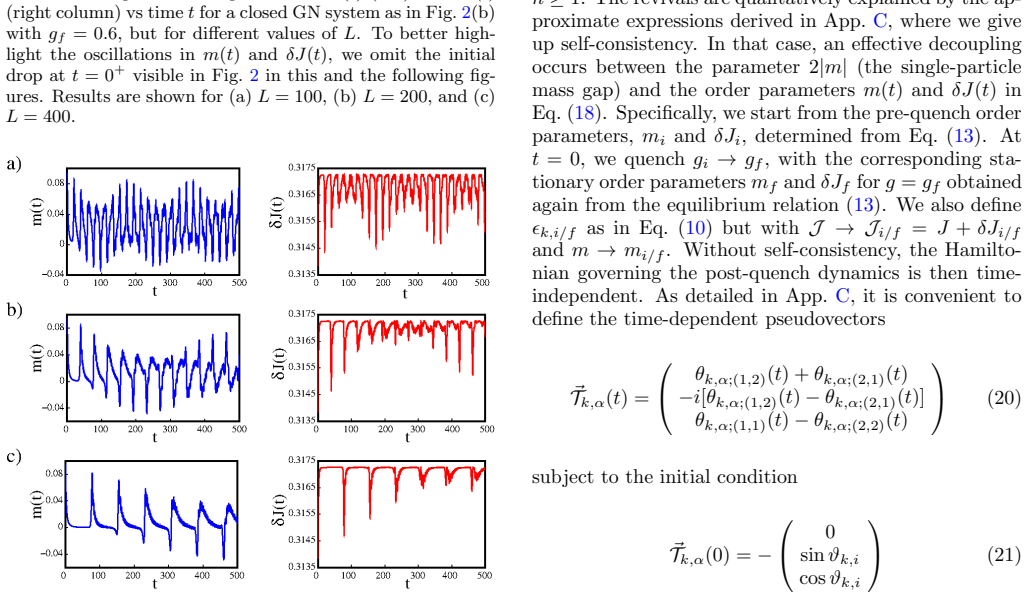
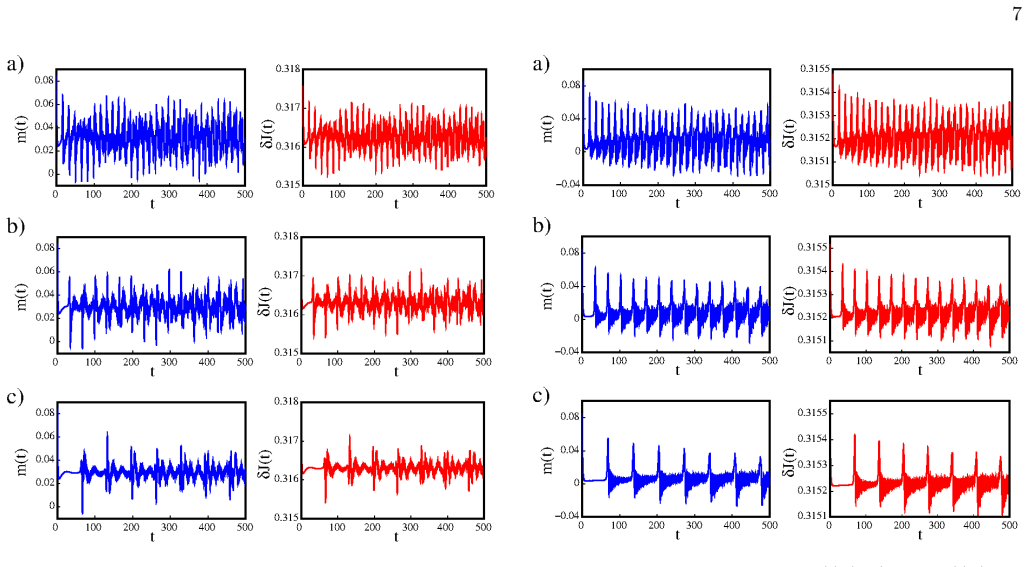
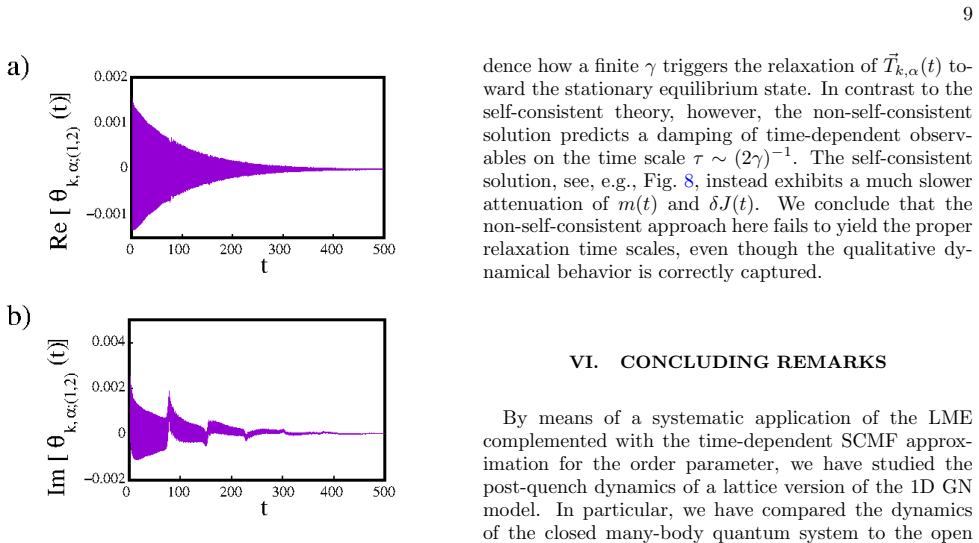
For a closed finite-size system the order parameter dynamics exhibits oscillations and revivals after an interaction parameter quench. In the thermodynamic limit the order parameter reaches its post-quench stationary value in accordance with the eigenstate thermalization hypothesis. Time-dependent finite-momentum correlation matrix elements equilibrate only if the system-reservoir coupling is nonzero. The findings are consistent with a pertinent Generalized Gibbs Ensemble.
What carries the argument
The time-dependent self-consistent Lindblad master equation that incorporates the system-reservoir coupling γ to describe the open-system dynamics of the lattice fermions.
If this is right
- The order parameter equilibrates in the thermodynamic limit even for a closed system.
- Finite-momentum correlations require nonzero reservoir coupling to reach equilibrium.
- The post-quench state is captured by a generalized Gibbs ensemble.
- Oscillations and revivals appear only in finite closed systems and vanish in the thermodynamic limit.
Where Pith is reading between the lines
- Integrable models may routinely relax to a GGE rather than a fully thermal state after quenches.
- Analogous behavior could appear in other lattice field theories subjected to interaction quenches.
- Cold-atom experiments could directly test whether reservoir coupling is required for correlation equilibration.
Load-bearing premise
The time-dependent self-consistent Lindblad master equation accurately captures the open-system dynamics of the lattice fermions without introducing artifacts that alter the observed relaxation and equilibration behavior.
What would settle it
Numerical simulation or experiment on a closed system in the thermodynamic limit that checks whether finite-momentum correlations equilibrate in the absence of any reservoir coupling.
Figures



read the original abstract
We study the quantum relaxation dynamics for a lattice version of the one-dimensional (1D) $N$-flavor Gross-Neveu (GN) model after a Hamiltonian parameter quench. Allowing for a system-reservoir coupling $\gamma$, we numerically describe the system dynamics through a time-dependent self-consistent Lindblad master equation. For a closed ($\gamma=0$) finite-size system subjected to an interaction parameter quench, the order parameter dynamics exhibits oscillations and revivals. In the thermodynamic limit, our results imply that the order parameter reaches its post-quench stationary value in accordance with the eigenstate thermalization hypothesis (ETH). However, time-dependent finite-momentum correlation matrix elements equilibrate only if $\gamma>0$. Our findings are consistent with the system being described by a pertinent Generalized Gibbs Ensemble (GGE) and, accordingly, highlight subtle yet important aspects of the post-quench relaxation dynamics of quantum many-body systems.
Editorial analysis
A structured set of objections, weighed in public.
Referee Report
Summary. The manuscript examines the relaxation dynamics following a parameter quench in a lattice Gross-Neveu model of interacting fermions. Using a time-dependent self-consistent Lindblad master equation with tunable dissipation strength γ, the authors numerically simulate the evolution of the order parameter and correlation functions. They report oscillations and revivals in finite systems for γ=0, infer ETH-compliant equilibration of the order parameter in the thermodynamic limit, and find that finite-momentum correlations equilibrate only in the presence of dissipation (γ>0), consistent with a Generalized Gibbs Ensemble description.
Significance. If the numerical method is free of artifacts, the work provides useful insights into the role of dissipation in distinguishing full thermalization (via ETH) from GGE-like prethermalization in interacting 1D fermionic models. The reported γ dependence and revival behavior could inform broader studies of open quantum many-body systems and the applicability of ETH to order parameters versus correlation functions.
major comments (2)
- The time-dependent self-consistent Lindblad master equation is the sole tool used to generate all dynamical results. For γ=0 this equation must reduce exactly to unitary Schrödinger evolution, yet the self-consistent closure (mean-field factorization of the GN interaction) is not shown to preserve this property without introducing damping or premature stationarity. This directly affects the validity of the ETH claim for the order parameter in the closed-system thermodynamic limit and the GGE interpretation for correlations.
- The thermodynamic-limit statement that the order parameter reaches its post-quench stationary value in accordance with ETH rests on finite-size numerics and standard scaling assumptions. The manuscript does not present a systematic finite-size scaling analysis (e.g., revival amplitude versus system size or explicit extrapolation of the long-time value) that would confirm the absence of persistent oscillations in the infinite-volume limit.
minor comments (2)
- Abstract: the phrasing 'our results imply' for the thermodynamic-limit ETH statement should be softened to 'suggest' or 'are consistent with' to reflect the numerical and approximate nature of the evidence.
- Notation: the definition of the self-consistent closure and the precise form of the Lindblad operators should be stated with an explicit equation number so that readers can verify the γ=0 reduction.
Simulated Author's Rebuttal
We thank the referee for the careful reading of our manuscript and the constructive comments. We address each major comment point by point below, indicating the revisions we will implement.
read point-by-point responses
-
Referee: The time-dependent self-consistent Lindblad master equation is the sole tool used to generate all dynamical results. For γ=0 this equation must reduce exactly to unitary Schrödinger evolution, yet the self-consistent closure (mean-field factorization of the GN interaction) is not shown to preserve this property without introducing damping or premature stationarity. This directly affects the validity of the ETH claim for the order parameter in the closed-system thermodynamic limit and the GGE interpretation for correlations.
Authors: We agree that the self-consistent closure is a mean-field factorization and does not correspond to the exact many-body unitary Schrödinger evolution. For γ=0 the equations reduce to the closed time-dependent Hartree-Fock dynamics of the one-body density matrix. Within this approximation the evolution is trace-preserving and does not introduce extraneous damping or artificial stationarity; any apparent relaxation in the thermodynamic limit arises from dephasing of an increasing number of modes. We will add an explicit derivation of the γ=0 reduction together with numerical checks of energy and norm conservation, and we will qualify the ETH and GGE statements as holding within the mean-field description. These clarifications will be placed in the Methods section and the discussion of the closed-system results. revision: yes
-
Referee: The thermodynamic-limit statement that the order parameter reaches its post-quench stationary value in accordance with ETH rests on finite-size numerics and standard scaling assumptions. The manuscript does not present a systematic finite-size scaling analysis (e.g., revival amplitude versus system size or explicit extrapolation of the long-time value) that would confirm the absence of persistent oscillations in the infinite-volume limit.
Authors: We concur that a systematic finite-size scaling analysis would strengthen the thermodynamic-limit claim. In the revised manuscript we will include additional data showing the revival amplitude versus system size L together with an explicit extrapolation of the long-time order-parameter value to L→∞. These results will be presented in a new figure and accompanying text demonstrating that persistent oscillations vanish in the infinite-volume limit, consistent with ETH expectations within our approach. revision: yes
Circularity Check
No circularity: claims follow from numerical integration of the master equation
full rationale
The paper obtains its results on order-parameter relaxation, ETH compliance in the thermodynamic limit, and GGE consistency by direct numerical integration of the time-dependent self-consistent Lindblad master equation after a parameter quench. No step fits a parameter to a target observable and then presents a closely related quantity as an independent prediction; the self-consistent closure is an explicit dynamical approximation whose output is computed rather than assumed. The distinction between γ=0 (oscillations/revivals) and γ>0 (equilibration of finite-momentum correlations) emerges from the integration itself and is not forced by definition or by a self-citation chain. The central claims therefore remain independent of the inputs.
Axiom & Free-Parameter Ledger
free parameters (1)
- γ
axioms (1)
- domain assumption The self-consistent Lindblad master equation provides a faithful description of the open quantum dynamics for the chosen parameter regime.
Lean theorems connected to this paper
-
IndisputableMonolith/Cost/FunctionalEquation.leanwashburn_uniqueness_aczel unclear?
unclearRelation between the paper passage and the cited Recognition theorem.
we numerically describe the system dynamics through a time-dependent self-consistent Lindblad master equation... switching to a closed set of differential equations for the time-dependent correlation matrix
-
IndisputableMonolith/Foundation/RealityFromDistinction.leanreality_from_one_distinction unclear?
unclearRelation between the paper passage and the cited Recognition theorem.
In the thermodynamic limit... order parameter reaches its post-quench stationary value in accordance with the eigenstate thermalization hypothesis (ETH)
What do these tags mean?
- matches
- The paper's claim is directly supported by a theorem in the formal canon.
- supports
- The theorem supports part of the paper's argument, but the paper may add assumptions or extra steps.
- extends
- The paper goes beyond the formal theorem; the theorem is a base layer rather than the whole result.
- uses
- The paper appears to rely on the theorem as machinery.
- contradicts
- The paper's claim conflicts with a theorem or certificate in the canon.
- unclear
- Pith found a possible connection, but the passage is too broad, indirect, or ambiguous to say the theorem truly supports the claim.
Forward citations
Cited by 1 Pith paper
-
Dissipation Mechanisms and Dissipative Phase Transitions of two coupled Fully Connected Quantum Ising models
Different classes of dissipators in coupled quantum Ising models produce either equilibrium-like relaxation with protocol-dependent dynamics or nonequilibrium steady states featuring reentrant symmetry breaking.
Reference graph
Works this paper leans on
-
[1]
C. Giannetti, F. Cilento, S. D. Conte, G. Coslovich, G. Ferrini, H. Molegraaf, M. Raichle, R. Liang, H. Eisaki, M. Greven, A. Damascelli, D. van der Marel, and F. Parmigiani, Revealing the high-energy electronic exci- tations underlying the onset of high-temperature super- conductivity in cuprates, Nature Communications2, 353 (2011)
work page 2011
-
[2]
J. Graf, C. Jozwiak, C. L. Smallwood, H. Eisaki, R. A. Kaindl, D.-H. Lee, and A. Lanzara, Nodal quasiparti- cle meltdown in ultrahigh-resolution pump–probe angle- resolved photoemission, Nature Physics7, 805 (2011)
work page 2011
-
[3]
C. L. Smallwood, W. Zhang, T. L. Miller, C. Jozwiak, H. Eisaki, D.-H. Lee, and A. Lanzara, Time- and momentum-resolved gap dynamics in Bi2Sr2CaCu2O8+δ, Phys. Rev. B89, 115126 (2014)
work page 2014
-
[4]
F. Peronaci, M. Schir´ o, and M. Capone, Transient dy- namics ofd-Wave superconductors after a sudden exci- tation, Phys. Rev. Lett.115, 257001 (2015)
work page 2015
-
[5]
A. D. Caviglia, R. Scherwitzl, P. Popovich, W. Hu, H. Bromberger, R. Singla, M. Mitrano, M. C. Hoff- mann, S. Kaiser, P. Zubko, S. Gariglio, J.-M. Triscone, M. F¨ orst, and A. Cavalleri, Ultrafast Strain Engineer- ing in Complex Oxide Heterostructures, Phys. Rev. Lett. 108, 136801 (2012)
work page 2012
-
[6]
Cooling quasiparticles in A3C60 fullerides by excitonic mid-infrared absorption, Nature Physics14, 154 (2018)
work page 2018
-
[7]
P. A. Lee, N. Nagaosa, and X.-G. Wen, Doping a Mott in- sulator: Physics of high-temperature superconductivity, Rev. Mod. Phys.78, 17 (2006)
work page 2006
-
[8]
P. Andr´ e, M. Schir´ o, and M. Fabrizio, Lattice and surface 13 effects in the out-of-equilibrium dynamics of the Hubbard model, Phys. Rev. B85, 205118 (2012)
work page 2012
-
[9]
M. Sandri and M. Fabrizio, Nonequilibrium gap collapse near a first-order Mott transition, Phys. Rev. B91, 115102 (2015)
work page 2015
- [10]
-
[11]
A. A. Zvyagin, Dynamical quantum phase transitions (Review Article), Low Temperature Physics42, 971 (2016)
work page 2016
-
[12]
M. Heyl, Dynamical quantum phase transitions: a re- view, Reports on Progress in Physics81, 054001 (2018)
work page 2018
-
[13]
Heyl, Dynamical quantum phase transitions: A brief survey, Europhysics Letters125, 26001 (2019)
M. Heyl, Dynamical quantum phase transitions: A brief survey, Europhysics Letters125, 26001 (2019)
work page 2019
-
[14]
G. Di Meglio, D. Rossini, and E. Vicari, Dissipative dy- namics at first-order quantum transitions, Phys. Rev. B 102, 224302 (2020)
work page 2020
-
[15]
A. Pelissetto, D. Rossini, and E. Vicari, Scaling proper- ties of the dynamics at first-order quantum transitions when boundary conditions favor one of the two phases, Phys. Rev. E102, 012143 (2020)
work page 2020
-
[16]
D. Rossini and E. Vicari, Dynamics after quenches in one-dimensional quantum Ising-like systems, Phys. Rev. B102, 054444 (2020)
work page 2020
-
[17]
A. Nava, C. A. Perroni, R. Egger, L. Lepori, and D. Giu- liano, Lindblad master equation approach to the dissipa- tive quench dynamics of planar superconductors, Phys. Rev. B108, 245129 (2023)
work page 2023
-
[18]
A. Nava, C. A. Perroni, R. Egger, L. Lepori, and D. Giu- liano, Dissipation-driven dynamical topological phase transitions in two-dimensional superconductors, Phys. Rev. B109, L041107 (2024)
work page 2024
-
[19]
A. Nava and R. Egger, Pontus-Mpemba Effects, Phys. Rev. Lett.135, 140404 (2025)
work page 2025
- [20]
-
[21]
L. D’Alessio, Y. Kafri, A. Polkovnikov, and M. Rigol, From quantum chaos and eigenstate thermalization to statistical mechanics and thermodynamics, Advances in Physics65, 239 (2016)
work page 2016
-
[22]
Mazza, From sudden quench to adiabatic dynamics in the attractive Hubbard model, Phys
G. Mazza, From sudden quench to adiabatic dynamics in the attractive Hubbard model, Phys. Rev. B96, 205110 (2017)
work page 2017
-
[23]
T. Cui, X. Yang, C. Vaswani, J. Wang, R. M. Fernandes, and P. P. Orth, Impact of damping on the superconduct- ing gap dynamics induced by intense terahertz pulses, Phys. Rev. B100, 054504 (2019)
work page 2019
-
[24]
A. Nava, M. Rossi, and D. Giuliano, Lindblad equation approach to the determination of the optimal working point in nonequilibrium stationary states of an interact- ing electronic one-dimensional system: Application to the spinless Hubbard chain in the clean and in the weakly disordered limit, Phys. Rev. B103, 115139 (2021)
work page 2021
-
[25]
A. Nava, G. Campagnano, P. Sodano, and D. Giuliano, Lindblad master equation approach to the topological phase transition in the disordered Su-Schrieffer-Heeger model, Phys. Rev. B107, 035113 (2023)
work page 2023
-
[26]
E. G. Cinnirella, A. Nava, G. Campagnano, and D. Giu- liano, Fate of high winding number topological phases in the disordered extended Su-Schrieffer-Heeger model, Phys. Rev. B109, 035114 (2024)
work page 2024
-
[27]
E. G. Cinnirella, A. Nava, G. Campagnano, and D. Giu- liano, Phase diagram of the disordered Kitaev chain with long-range pairing connected to external baths, Phys. Rev. B111, 155149 (2025)
work page 2025
-
[28]
D. J. Gross and A. Neveu, Dynamical symmetry breaking in asymptotically free field theories, Phys. Rev. D10, 3235 (1974)
work page 1974
-
[29]
I. K. Affleck, Phase transition in the lattice gross-neveu model, Physics Letters B109, 307 (1982)
work page 1982
-
[30]
U. Wolff, The phase diagram of the infinite-N Gross- Neveu model at finite temperature and chemical poten- tial, Physics Letters B157, 303 (1985)
work page 1985
- [31]
-
[32]
O. Schnetz, M. Thies, and K. Urlichs, Phase diagram of the Gross–Neveu model: exact results and condensed matter precursors, Annals of Physics314, 425 (2004)
work page 2004
-
[33]
M. Thies, From relativistic quantum fields to condensed matter and back again: updating the Gross–Neveu phase diagram, Journal of Physics A: Mathematical and Gen- eral39, 12707 (2006)
work page 2006
-
[34]
S. A. Brazovskii and N. N. Kirova, Excitons, polarons, and bipolarons in conducting polymers, Zh. Eksp. Teor. Fiz33, 6 (1981)
work page 1981
-
[35]
S. Brazovskii, N. Kirova, and S. Matveenko, Peierls ef- fect in conducting polymers, Zh. Eksp. Teor. Fiz86, 757 (1984)
work page 1984
-
[36]
A. Saxena and J. D. Gunton, Theory of bipolaron lattices in quasi-one-dimensional conducting polymers, Phys. Rev. B35, 3914 (1987)
work page 1987
-
[37]
G. Lindblad, On the generators of quantum dynamical semigroups, Communications in Mathematical Physics 48, 119 (1976)
work page 1976
-
[38]
H.-P. Breuer and F. Petruccione,The theory of open quantum systems(Oxford University Press, 2007)
work page 2007
- [39]
- [40]
-
[41]
Weiss,Quantum Dissipative Systems, World Scientific (2021), 10.1142/12402
U. Weiss,Quantum dissipative sys- tems, 5th ed. (World Scientific, 2021) https://www.worldscientific.com/doi/pdf/10.1142/12402
-
[42]
E. A. Yuzbashyan, V. B. Kuznetsov, and B. L. Altshuler, Integrable dynamics of coupled Fermi-Bose condensates, Phys. Rev. B72, 144524 (2005)
work page 2005
-
[43]
E. A. Yuzbashyan, O. Tsyplyatyev, and B. L. Altshuler, Relaxation and Persistent Oscillations of the Order Pa- rameter in Fermionic Condensates, Phys. Rev. Lett.96, 097005 (2006)
work page 2006
discussion (0)
Sign in with ORCID, Apple, or X to comment. Anyone can read and Pith papers without signing in.