Time-based Selection of Kaonic Atom X-ray Events with Quasi-Hemispherical CZT Detectors at the DAFNE collider
Pith reviewed 2026-05-18 01:23 UTC · model grok-4.3
The pith
An 80-nanosecond timing window around collisions lets a cadmium-zinc-telluride detector isolate X-ray lines from kaonic aluminum atoms for the first time.
A machine-rendered reading of the paper's core claim, the machinery that carries it, and where it could break.
Core claim
By exploiting the precise timing correlation between electron-positron collisions and detector signals, a dedicated event selection strategy within an 80-nanosecond window suppressed background by approximately 95 percent of the triggered data. This enabled the first observation of the 5-4 transition at 50 keV, recording 362 plus or minus 41 statistical plus or minus 20 systematic signal events over 1698 plus or minus 197 statistical plus or minus 25 systematic background events at 5 sigma, with 9.2 percent FWHM resolution, and the 4-3 transition at 106 keV, recording 295 plus or minus 50 statistical plus or minus 20 systematic signal events over 2939 plus or minus 500 statistical plus or 16
What carries the argument
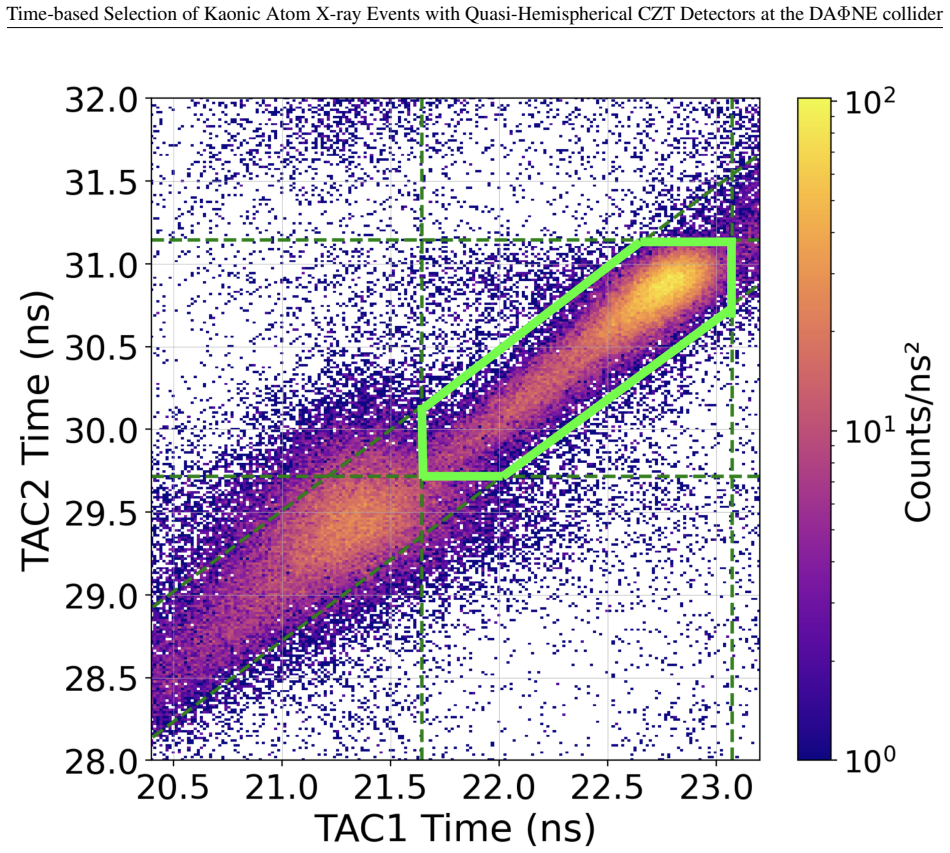
The time-based event selection that uses the timing correlation between collisions and detector signals inside an 80 ns window to isolate true kaonic-atom X-rays from background.
Load-bearing premise
The 80-nanosecond timing window around collisions cleanly isolates true kaonic-atom X-rays without appreciable contamination from prompt or delayed background processes inside the same window.
What would settle it
Reanalyzing the dataset without the 80 ns timing cut and finding no statistically significant peaks at 50 keV or 106 keV would show that the isolation does not work as claimed.
Figures




read the original abstract
This work presents the results of a time-based event selection for searching X-ray signals from kaonic atom X-ray transition using a single quasi-hemispherical Cadmium-Zinc-Telluride (CZT) detector at the DA$\Phi$NE collider. To mitigate the high background level in the measured X-ray spectrum, a dedicated event selection strategy was developed, exploiting the precise timing correlation between e+e- collisions and detector signals. This approach enabled, for the first time, the observation of two characteristic X-ray transitions from kaonic aluminum atoms using a CZT detector: for the 5-4 transition at 50~keV, 362~$\pm$~41~(stat.)~$\pm$~20~(sys.) signal events over 1698~$\pm$~197~(stat.)~$\pm$~25~(sys.) background events in 5$\sigma$ were observed, with a resolution of 9.2\%~FWHM; for the 4-3 transition at 106~keV, 295~$\pm$~50~(stat.)~$\pm$~20~(sys.) signal events over 2939~$\pm$~500~(stat.)~$\pm$~16~(sys.) background events in 5$\sigma$ were measured, with a resolution of 6.6 ~FWHM. A strong background suppression of approximately 95\% of the triggered data was achieved through this time-based selection. The demonstrated timing capability of the CZT detector proved highly effective in isolating time-correlated events within an 80 ns window, setting an important benchmark for the application of these semiconductors in timing-based X-ray spectroscopy. These results highlight the potential of CZT-based detection systems for future precision measurements in high-radiation environments, paving the way for compact, room-temperature X-ray and $\gamma$-ray spectrometers in fundamental physics and beyond.
Editorial analysis
A structured set of objections, weighed in public.
Referee Report
Summary. The manuscript reports the first observation of kaonic aluminum X-ray transitions (5-4 at 50 keV and 4-3 at 106 keV) using a single quasi-hemispherical CZT detector at the DAΦNE collider. A time-based selection within an 80 ns window around e+e- collisions is applied to suppress background, yielding 362 ± 41 (stat.) ± 20 (sys.) signal events over 1698 ± 197 (stat.) ± 25 (sys.) background events at 5σ for the lower-energy line (9.2% FWHM resolution) and 295 ± 50 (stat.) ± 20 (sys.) signal over 2939 ± 500 (stat.) ± 16 (sys.) background at 5σ for the higher-energy line (6.6% FWHM), with an overall ~95% background reduction claimed.
Significance. If the timing selection is shown to isolate true kaonic-atom X-rays with negligible time-correlated contamination, the work establishes a practical benchmark for room-temperature CZT detectors in high-radiation collider environments and demonstrates their timing capability for precision X-ray spectroscopy. The explicit reporting of signal and background yields together with both statistical and systematic uncertainties directly supports the observation claim and provides a concrete starting point for future compact spectrometers in fundamental physics.
major comments (1)
- [Event selection / timing window description] The event-selection section (and associated figures showing the timing distribution): the central 5σ observation claims rest on the premise that the 80 ns window around collisions contains negligible prompt or delayed non-kaonic background. No off-window control spectrum, quantitative breakdown of residual prompt contamination, or Monte Carlo estimate of acceptance for beam-related gammas and random coincidences is provided, leaving the quoted background levels (1698 and 2939 events) and extracted signal significances vulnerable to overestimation.
minor comments (2)
- [Abstract and Results] The abstract and results section should explicitly state the total live time or integrated luminosity corresponding to the reported event counts to allow direct comparison with prior kaonic-atom measurements.
- [Figures] Figure captions for the energy spectra should indicate whether the displayed histograms are before or after the final background-subtraction step and whether the quoted resolutions are obtained from Gaussian fits to the signal peaks.
Simulated Author's Rebuttal
We thank the referee for the careful and constructive review of our manuscript. The comment on the event-selection and timing window is addressed point by point below. We have revised the manuscript to provide additional supporting material where feasible.
read point-by-point responses
-
Referee: The event-selection section (and associated figures showing the timing distribution): the central 5σ observation claims rest on the premise that the 80 ns window around collisions contains negligible prompt or delayed non-kaonic background. No off-window control spectrum, quantitative breakdown of residual prompt contamination, or Monte Carlo estimate of acceptance for beam-related gammas and random coincidences is provided, leaving the quoted background levels (1698 and 2939 events) and extracted signal significances vulnerable to overestimation.
Authors: We agree that the original manuscript would benefit from more explicit validation of the background composition inside the 80 ns window. In the revised version we have expanded the event-selection section with a detailed description of the timing distribution and added a new figure that overlays the selected 80 ns window on the full timing histogram. We also include an off-window control spectrum (events outside the window but within the same data set) that demonstrates a background rate approximately 20 times higher than inside the window, directly supporting the claimed 95 % suppression. A quantitative breakdown of residual prompt contamination is now provided by fitting the timing profile with a prompt peak plus flat random-coincidence component; the fitted prompt fraction inside the window is < 3 %. While a full Monte Carlo simulation of beam-related gammas and acceptance is not included (as it would require a dedicated simulation campaign beyond the scope of this first demonstration), we discuss the dominant background sources and show that the tight time correlation with the DAΦNE collision timing inherently suppresses delayed and random components. These additions leave the reported signal yields, background estimates, and 5σ significances unchanged but place them on firmer ground. revision: yes
Circularity Check
No circularity: pure experimental measurement with direct event counting
full rationale
This is an experimental detector paper reporting observed X-ray signal yields (362 and 295 events) and significances after applying an 80 ns timing window to DAΦNE collision data. No derivations, equations, or fitted parameters are presented as predictions. The timing cut and background subtraction are described as an empirical selection strategy, not derived from or equivalent to the reported counts by construction. No self-citation chains, ansatzes, or uniqueness theorems are invoked to justify the central results. The paper is self-contained against external benchmarks as a measurement report.
Axiom & Free-Parameter Ledger
axioms (1)
- domain assumption Established properties of kaonic atom formation and radiative transitions in light nuclei.
Reference graph
Works this paper leans on
-
[1]
S. Del Sordo, others, Progress in the Development of CdTe and CdZnTe Semiconductor Radiation Detectors for Astrophysical and Medical Applications, Sensors 9 (5) (2009) 3491–3526, number: 5 Publisher: Molecular Diversity Preservation International.doi:10.3390/s90503491. URLhttps://www.mdpi.com/1424-8220/9/5/3491
-
[2]
Iniewski, CZT detector technology for medical imaging 9 (11) C11001
K. Iniewski, CZT detector technology for medical imaging 9 (11) C11001. doi:10.1088/1748-0221/9/11/ C11001. URLhttps://dx.doi.org/10.1088/1748-0221/9/11/C11001
-
[3]
J. Tang, F. Kislat, H. Krawczynski, Cadmium zinc telluride detectors for a next-generation hard x-ray telescope 128 102563.doi:10.1016/j.astropartphys.2021.102563. URLhttps://www.sciencedirect.com/science/article/pii/S0927650521000074
-
[4]
L. Abbene, G. Gerardi, G. Raso, S. Basile, M. Brai, F. Principato, Energy resolution and throughput of a new real time digital pulse processing system for x-ray and gamma ray semiconductor detectors, Journal of Instrumentation 8 (2013) P07019.doi:10.1088/1748-0221/8/07/P07019
-
[5]
L. Abbene, G. Gerardi, G. Raso, F. Principato, N. Zambelli, G. Benassi, M. Bettelli, A. Zappettini, Development of new CdZnTe detectors for room-temperature high-flux radiation measurements, J Synchrotron Rad 24 (2) 429–438, publisher: International Union of Crystallography.doi:10.1107/S1600577517000194. URL//scripts.iucr.org/cgi-bin/paper?pp5097 18 Time-...
-
[6]
L. Abbene, F. Principato, G. Gerardi, A. Buttacavoli, D. Cascio, M. Bettelli, N. S. Amad `e, P. Seller, M. C. Veale, O. Fox, K. Sawhney, S. Zanettini, E. Tomarchio, A. Zappettini, Room-temperature x-ray response of cadmium–zinc–telluride pixel detectors grown by the vertical bridgman technique 27 (2) 319–328, publisher: International Union of Crystallogra...
- [7]
-
[8]
Curceanu, et al., The modern era of light kaonic atom experiments, Rev
C. Curceanu, et al., The modern era of light kaonic atom experiments, Rev. Mod. Phys. 91 (2) (2019) 025006. doi:10.1103/RevModPhys.91.025006
-
[9]
F. Artibani, et al., The Odyssey of Kaonic Atoms Studies at the DAΦNE Collider: From DEAR to SIDDHARTA-2, Acta Phys. Polon. B 55 (5) (2024) 5–A2.doi:10.5506/APhysPolB.55.5-A2
-
[10]
Curceanu, et al., Kaonic atoms at the DA ΦNE collider: a strangeness adventure, Front
C. Curceanu, et al., Kaonic atoms at the DA ΦNE collider: a strangeness adventure, Front. in Phys. 11 (2023) 1240250.doi:10.3389/fphy.2023.1240250
-
[11]
L. Abbene, et al., Potentialities of CdZnTe Quasi-Hemispherical Detectors for Hard X-ray Spectroscopy of Kaonic Atoms at the DAΦNE Collider, Sensors 23 (17) (2023) 7328.doi:10.3390/s23177328
-
[12]
A. Scordo, et al., CdZnTe detectors tested at the DAΦNE collider for future kaonic atoms measurements, Nucl. Instrum. Meth. A 1060 (2024) 169060.arXiv:2310.15062,doi:10.1016/j.nima.2023.169060
-
[13]
F. Artibani, “new opportunities in kaonic atoms spectroscopy with novel czt detector, Frascati Physics Series 76 (2024)
work page 2024
-
[14]
F. Artibani, et al., Tests of New CZT detectors at DA ΦNE collider for Kaonic Atoms Measurements, PoS DISCRETE2024 (2025) 031.doi:10.22323/1.481.0031
-
[15]
Milardi, et al., Present status of the DAFNE upgrade and perspectives, Int
C. Milardi, et al., Present status of the DAFNE upgrade and perspectives, Int. J. Mod. Phys. A 24 (2009) 360–368. doi:10.1142/S0217751X09043687
-
[16]
C. Milardi, et al., Preparation Activity for the Siddharta-2 Run at DAΦNE, in: 9th International Particle Accelerator Conference, IPAC2018, Vancouver BC Canada, 2018.doi:10.18429/JACoW-IPAC2018-MOPMF088
-
[17]
Milardi, et al., DAΦNE Commissioning for SIDDHARTA-2 Experiment, JACoW IPAC2021 (2021) TUPAB001
C. Milardi, et al., DAΦNE Commissioning for SIDDHARTA-2 Experiment, JACoW IPAC2021 (2021) TUPAB001. doi:10.18429/JACoW-IPAC2021-TUPAB001
-
[18]
C. Milardi, et al., DAFNE operation strategy for the observation of the kaonic deuterium, JACoW IPAC2024 (2024) WEPR17.doi:10.18429/JACoW-IPAC2024-WEPR17
-
[19]
Curceanu, et al., Kaonic Atoms to Investigate Global Symmetry Breaking, Symmetry 12 (4) (2020) 547
C. Curceanu, et al., Kaonic Atoms to Investigate Global Symmetry Breaking, Symmetry 12 (4) (2020) 547. doi:10.3390/sym12040547
-
[20]
On the pole content of coupled channels chiral approaches used for the $\bar{K}N$ system
A. Ciepl´y, M. Mai, U.-G. Meißner, J. Smejkal, On the pole content of coupled channels chiral approaches used for the ¯KN system, Nucl. Phys. A 954 (2016) 17–40. arXiv:1603.02531, doi:10.1016/j.nuclphysa.2016. 04.031
work page internal anchor Pith review Pith/arXiv arXiv doi:10.1016/j.nuclphysa.2016 2016
-
[21]
J. ´Obertov´a, E. Friedman, J. Mareˇs, A. Ramos, On K −-nuclear interaction, K −-nuclear quasibound states and K − atoms, EPJ Web Conf. 271 (2022) 07003.doi:10.1051/epjconf/202227107003
-
[22]
Parameter estima- tion of stellar-mass black hole binaries with LISA
M. Merafina, F. G. Saturni, C. Curceanu, R. Del Grande, K. Piscicchia, Self-gravitating strange dark matter halos around galaxies, Phys. Rev. D 102 (8) (2020) 083015. arXiv:2007.03024, doi:10.1103/PhysRevD.102. 083015
-
[23]
L. Tolos, L. Fabbietti, Strangeness in Nuclei and Neutron Stars, Prog. Part. Nucl. Phys. 112 (2020) 103770. arXiv:2002.09223,doi:10.1016/j.ppnp.2020.103770. 19 Time-based Selection of Kaonic Atom X-ray Events with Quasi-Hemispherical CZT Detectors at the DAΦNE collider
-
[24]
F. J. Hartmann, Exotic Atom Cascade Processes in Atoms with Z¿2, Springer US, Boston, MA, 1990, pp. 127–139. doi:10.1007/978-1-4899-3701-8\_12. URLhttps://doi.org/10.1007/978-1-4899-3701-8_12
-
[25]
Gotta, Precision spectroscopy of light exotic atoms, Prog
D. Gotta, Precision spectroscopy of light exotic atoms, Prog. Part. Nucl. Phys. 52 (2004) 133–195. doi: 10.1016/j.ppnp.2003.09.003
-
[26]
Sgaramella, et al., High precision X-ray spectroscopy of kaonic neon, Phys
F. Sgaramella, et al., High precision X-ray spectroscopy of kaonic neon, Phys. Lett. B 865 (2025) 139492. arXiv:2412.16101,doi:10.1016/j.physletb.2025.139492
-
[27]
M. Bassetti, M. Biagini, C. Biscari, S. Guiducci, M. Maria Rosaria, Daϕne main ring optics (01 1998)
work page 1998
-
[28]
M. Boscolo, M. E. Biagini, S. Guiducci, P. Raimondi, Touschek background and beam lifetime studies for the DAFNE upgrade, Conf. Proc. C 070625 (2007) 1454.doi:10.1109/PAC.2007.4440787
-
[29]
M. Miliucci, et al., Silicon drift detectors system for high-precision light kaonic atoms spectroscopy, Measur. Sci. Tech. 32 (9) (2021) 095501.doi:10.1088/1361-6501/abeea9
-
[30]
M. Miliucci, et al., Large area silicon drift detectors system for high precision timed x-ray spectroscopy, Measur. Sci. Tech. 33 (9) (2022) 095502.doi:10.1088/1361-6501/ac777a
-
[31]
A. Khreptak, M. Skurzok, Efficiency analysis and promising applications of silicon drift detectors, Bio Algorithms Med Syst. 19 (2023) 74–79
work page 2023
-
[32]
F. Sirghi, et al., SIDDHARTA-2 apparatus for kaonic atoms research on the DAΦNE collider, JINST 19 (11) (2024) P11006.arXiv:2311.16144,doi:10.1088/1748-0221/19/11/P11006
-
[33]
Skurzok, et al., Characterization of the SIDDHARTA-2 luminosity monitor, JINST 15 (10) (2020) P10010
M. Skurzok, et al., Characterization of the SIDDHARTA-2 luminosity monitor, JINST 15 (10) (2020) P10010. arXiv:2008.05472,doi:10.1088/1748-0221/15/10/P10010
-
[34]
L. Abbene, et al., First Stability Characterization for a CZT Detection System in an e+e− Collider Environment, Sensors 24 (23) (2024) 7562.arXiv:2410.11294,doi:10.3390/s24237562
-
[35]
J. P. Santos, F. Parente, S. Boucard, P. Indelicato, J. P. Desclaux, X-ray energies of circular transitions and electron screening in kaonic atoms, Physical Review A 71 (3) (2005) 032501, publisher: American Physical Society. doi:10.1103/PhysRevA.71.032501. URLhttps://link.aps.org/doi/10.1103/PhysRevA.71.032501
-
[36]
M. Gysel, P. Lemberge, P. Van Espen, Implementation of a spectrum fitting procedure using a robust peak model, X-Ray Spectrometry 32 (2003) 434 – 441.doi:10.1002/xrs.666
-
[37]
A New Measurement of Kaonic Hydrogen X rays
M. Bazzi, et al., A New Measurement of Kaonic Hydrogen X-rays, Phys. Lett. B 704 (2011) 113–117. arXiv: 1105.3090,doi:10.1016/j.physletb.2011.09.011
work page internal anchor Pith review Pith/arXiv arXiv doi:10.1016/j.physletb.2011.09.011 2011
-
[38]
F. Sgaramella, et al., Characterization of the SIDDHARTA-2 Setup via the Kaonic Helium Measurement, Condens. Mat. 9 (1) (2024) 16.doi:10.3390/condmat9010016
-
[39]
Abbene, et al., New opportunities for kaonic atoms measurements from CdZnTe detectors, Eur
L. Abbene, et al., New opportunities for kaonic atoms measurements from CdZnTe detectors, Eur. Phys. J. ST 232 (10) (2023) 1487–1492.arXiv:2301.12253,doi:10.1140/epjs/s11734-023-00881-x. 20
discussion (0)
Sign in with ORCID, Apple, or X to comment. Anyone can read and Pith papers without signing in.