REVIEW 3 major objections 4 minor 5 cited by
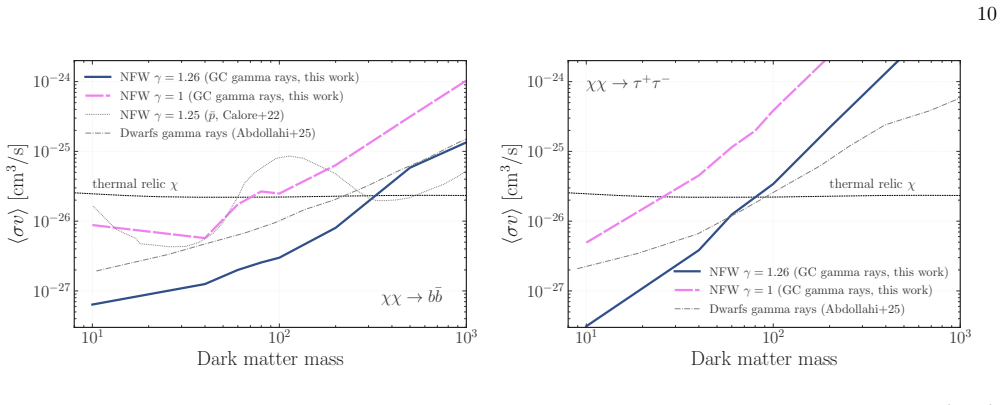
A re-analysis of Fermi-LAT data from the Galactic Center, allowing dark matter and a stellar bulge to coexist, finds no significant dark matter signal and excludes the thermal relic annihilation cross section up to about 300 GeV for hadroni
Reviewed by Pith at T0; open to challenge. T0 means a machine referee read the full paper against a public rubric. the ladder, T0–T4 →
T0 review · deepseek-v4-flash
2026-08-03 23:56 UTC pith:6TBUUEHS
load-bearing objection Careful simultaneous fit yields important new GC dark-matter limits, but the headline 300 GeV exclusion depends on an untested assumption that the stellar-bulge template is exactly correct. the 3 major comments →
Stellar-like Galactic center excess challenges particle dark matter
The pith
A machine-rendered reading of the paper's core claim, the machinery that carries it, and where it could break.
Core claim
The central claim is that the Galactic Center excess is not dark matter: when the gamma-ray data in the inner Galaxy are fitted with a joint model in which a WIMP annihilation template and a stellar-bulge template are both free, the bulge template absorbs the excess and the dark-matter normalization is consistent with zero in essentially all cases. The few nonzero best-fit normalizations, such as for the contracted NFW profile with heavy masses, correspond to cross sections far below the derived upper limits and are reproduced in simulations of a bulge-only excess, so they are treated as not evidence for dark matter. Under the contracted NFW profile, the 95% C.L. upper limit on the annihilat
What carries the argument
The analysis is carried by a two-stage statistical pipeline. First, adaptive template fitting (regularized, bin-by-bin spectral and spatial nuisance parameters) is used to fit the whole 40x40-degree region and produce optimized maps of the diffuse backgrounds; crucially, every fit includes both the dark-matter and the stellar-bulge templates at the same time, so the backgrounds are optimized separately for each dark-matter model. Second, a photon-count probability distribution is fitted in a 20x20-degree inner-Galaxy region with a Galactic-plane mask, using those optimized templates plus a parametrized source-count distribution for sub-threshold point sources. This second stage is what sets
Load-bearing premise
The load-bearing assumption is that the stellar-bulge template used in the fit—a boxy bulge plus nuclear bulge—correctly captures the astrophysical component of the excess; if the true stellar emission has a different shape that the fit absorbs into the dark-matter template, the null result and the derived limits would not stand.
What would settle it
Re-analyze the same Fermi-LAT data with an alternative bulge morphology (e.g., an X-shaped or prolate stellar distribution) using the identical pipeline: if a dark-matter component becomes significant in that fit, the claim that there is no dark matter in the Galactic Center excess is falsified; if the dark-matter normalization remains consistent with zero, the conclusion is robust to bulge-template choice.
If this is right
- For a contracted NFW halo, the thermal-relic annihilation cross section is excluded at 95% C.L. for dark-matter masses up to about 300 GeV (b-bbar) and about 80 GeV (tau+tau-).
- The derived limits vary by roughly two orders of magnitude depending on the assumed Milky Way halo profile, so the dark-matter density in the inner kiloparsecs is the dominant systematic uncertainty.
- With the contracted profile, the Galactic Center limits are about three times stronger than the combined dwarf-spheroidal gamma-ray limits for b-bbar below about 500 GeV, and stronger than antiproton limits below about 200-300 GeV.
- The measured source-count distribution in the inner Galaxy remains compatible with previous bulge/point-source interpretations, so the stellar explanation of the excess is not disturbed by including dark matter in the fit.
- The pipeline recovers injected dark-matter signals down to about 10% of the excess in simulations, indicating the null result is not simply an insensitivity of the method.
Where Pith is reading between the lines
- If the adopted bulge template is wrong in a way that correlates with a dark-matter-like morphology, the limits could be artificially strong; a decisive cross-check would be to re-run the same pipeline with a family of alternative bulge morphologies and watch for a significant dark-matter component.
- The same machinery could be applied to triaxial or non-spherical dark-matter halos suggested by recent simulations; the conclusion 'no dark matter' applies to the spherically symmetric profiles tested here, and asymmetric profiles may leave more room.
- Extending the photon-count analysis to energies above about 10 GeV would sharpen limits on TeV-scale candidates such as Higgsinos; the paper notes its narrow 1.6-5.9 GeV band is why its Higgsino bound is weaker than dedicated line searches.
- If the stellar-bulge explanation is right, the same source-count measurement can be compared against radio and X-ray observations of the bulge pulsar population, turning the excess into a probe of stellar evolution rather than particle physics.
Editorial analysis
A structured set of objections, weighed in public.
Referee Report
Summary. The paper re-evaluates the Fermi-LAT Galactic Center as a target for dark matter (DM) annihilation searches by fitting the gamma-ray data with a mixed model containing both a stellar-bulge component and a DM component. The analysis pipeline combines adaptive template fitting with skyFACT and photon-count statistics with 1pPDF, using optimized diffuse templates from skyFACT as input to 1pPDF. For four DM halo profiles and two annihilation channels (b bbar, tau+tau-), the authors derive 95% C.L. upper limits on the annihilation cross section from the 1.6–5.9 GeV energy bin. They report no significant DM component in any profile/channel combination, and for the contracted NFW (gamma=1.26) profile they claim exclusion of the thermal-relic cross section up to m_DM ≈ 300 GeV for b bbar and ≈ 80 GeV for tau+tau-. The robustness of the pipeline is argued through a suite of injection/recovery simulations and null-hypothesis 1pPDF simulations.
Significance. If the results are correct, they provide some of the strongest gamma-ray limits on light thermal-relic DM from the Galactic Center, competitive with and complementary to dwarf-galaxy and antiproton constraints in the sub-GeV-to-~300 GeV mass range. The simultaneous treatment of DM and stellar-bulge components with unresolved point sources is a methodological step forward relative to previous template fits. The extensive validation effort—injection/recovery tests down to 10% of the GCE flux, null-hypothesis simulations with and without background mismodeling, and careful ROI optimization—is a clear strength and demonstrates that the pipeline behaves well under the modeled assumptions. However, the central no-DM conclusion and the associated limits rest on the assumption that the adopted Coleman stellar-bulge template faithfully represents the astrophysical GCE morphology; this assumption is not tested by the simulation suite.
major comments (3)
- [§II B, §III B, §A 1 b] The injection/recovery tests validate the pipeline only when the stellar-bulge template is exactly correct. In §A 1 b and Fig. 6, mock skies are generated using the same Coleman boxy-bulge + nuclear-bulge template that is later used in the fit. In the 1pPDF step, the DM and bulge components are separated in a single energy bin (1.6–5.9 GeV) almost entirely by morphology, with A_stellar free but the bulge spatial map fixed. A mismatch between the true stellar distribution and the adopted template—e.g., in boxy-bulge axis ratio, nuclear-bulge fraction, or vertical scale—can be partially absorbed by A_DM, biasing the profile likelihood and producing over-strong upper limits. The paper's own Fig. 6 shows a 25% cross-attribution in the 0% bulge/100% DM scenario, demonstrating the DM/bulge degeneracy. A test with a perturbed or alternative bulge template is needed to bound this dominant morpho
- [§A 2 a, Fig. 7] The description of the null-hypothesis simulations is internally inconsistent. The text states that the simulated diffuse emission model is 'the sum of the Galactic diffuse emission and the stellar bulge as found by the best skyFACT fit of the real sky for a benchmark case, where also a DM component ... was included,' but then says the 1pPDF analysis includes a DM model 'which is not included in the simulation.' If a DM component is actually injected, the comparison in Fig. 7 does not validate the A_DM=0 null hypothesis; if it is not injected, the text should be corrected. Since Fig. 7 is the primary evidence that the real-sky upper limits are statistically consistent with the null hypothesis, this ambiguity must be resolved and the correct test reported.
- [§III D, §A 2] The 95% C.L. upper limits are extracted from one-dimensional profile likelihoods built from the MultiNest posterior sample, using the condition 2ΔlnL = 2.71. Because A_DM is sampled with a log-flat prior, the posterior density is not proportional to the likelihood, and a profile likelihood binned from posterior samples can be prior-dependent. The null-hypothesis simulations provide some validation, but the text does not state how the profile likelihood is computed from the posterior sample or demonstrate that the derived limits are insensitive to the prior range/parameterization. This should be clarified and, if necessary, the limits re-derived from a proper profile-likelihood maximization over the nuisance parameters.
minor comments (4)
- [Eq. (3)] The isotropic term is written as x_iso F_iso/F_iso, which cancels to x_iso and omits the expected flux dependence on F_iso. This appears to be a typographical error.
- [Fig. 6 caption] The caption writes 'DRGB' while the text uses 'DGRB' for the isotropic gamma-ray background; please fix the typo.
- [§IV A] The text says the DM component is 'suppressed by more than eight orders of magnitude' while Fig. 1 shows colorbars spanning about five orders of magnitude; the quantitative statement should be reconciled with the map normalization.
- [§IV B] The statement that 'we do not find a single configuration in which the DM component is detected significantly' is slightly in tension with the earlier skyFACT findings of non-zero DM normalizations for some NFW126 cases. The text explains these as sub-threshold, but the wording should be tightened to distinguish 'detected in 1pPDF' from 'non-zero best-fit in skyFACT.'
Circularity Check
No significant circularity: the DM limits come from a genuine multi-component fit with free DM normalization, validated by null-hypothesis simulations that do not contain DM.
full rationale
The paper's central claim—upper limits on the DM annihilation cross section from Fermi-LAT Galactic Center data—is derived from a fit to real data in which the DM normalization is free over many orders of magnitude. The null-hypothesis simulations explicitly set A_DM=0 and produce profile likelihoods compatible with the real-sky result, so the limits are not forced by the analysis inputs or priors. The stellar bulge template is adopted from independent morphological work (Coleman et al. 2020) and is tested through injection/recovery simulations; while the assumption that this template is correct is a genuine systematic limitation, it is not an identification of the output with the input. Self-citations to previous skyFACT-1pPDF works support methodology and template choices, but the load-bearing statistical result is demonstrated in this paper through real-data fits and simulations, so the self-citations are not circular. The paper's explicit limitations (narrow energy range, spherically symmetric profiles, residual mismodeling at the 2-sigma level) are acknowledged and do not amount to circularity.
Axiom & Free-Parameter Ledger
free parameters (5)
- A_DM (DM template normalization in 1pPDF) =
varies per mass/channel/profile; 95% C.L. upper limits in Fig. 3
- A_stellar (stellar bulge normalization) =
best-fit values not individually reported
- A_gal (Galactic diffuse template rescaling) =
sampled in [0.1,1.2]
- F_iso (isotropic diffuse flux) =
sampled as a free parameter
- dN/dS parameters (6 total) =
normalization, 3 indices, 2 breaks
axioms (5)
- standard math DM annihilation flux formula (Eq. 1) applies with self-conjugate particles and standard halo J-factor definition.
- domain assumption The four DM density profiles (NFW126, NFW100, Einasto, Burkert) with scale radius fixed to 20 kpc and local density 0.5 GeV/cm³ span the halo uncertainty.
- domain assumption The stellar-bulge template (Coleman boxy bulge + nuclear bulge) correctly represents the non-DM GCE component.
- domain assumption The 1pPDF model specification (parametric dN/dS, diffuse templates, PSF correction, pixel likelihood) is correct and complete.
- domain assumption Residual background mismodeling after the skyFACT fits is at the ~2σ Poisson level and does not bias the final DM limits.
read the original abstract
The Galactic Center (GC) is potentially hosting the largest indirect signal from particle dark matter (DM), which in many well-motivated models would produce gamma rays as their final states. However, this region has often been dismissed for DM studies because of the evidence for an unexpected gamma-ray component over astrophysical backgrounds at GeV energies, firstly discovered in the data of the \textit{Fermi} Large Area Telescope (LAT), the so-called Galactic Center Excess (GCE). While this was initially considered to hint at GeV thermal relics, recent work supports a GCE interpretation in terms of a stellar population of millisecond pulsar-like sources in the Galactic bulge. Building on this preference, we re-evaluate the GC as a powerful target for indirect DM searches via gamma rays. This is achieved by combining adaptive template fitting and photon-count statistical methods to assess the role of sub-threshold point sources in the observed \textit{Fermi}-LAT gamma-ray counts, while minimizing the mismodeling of Galactic diffuse emission backgrounds. In a fully self-consistent way, the gamma-ray data are fitted with a mixed model comprising a DM signal and a stellar bulge, both potentially contributing to the GCE. The space left for signals from weak-scale DM particle annihilations is quantified by extracting 95\% C.L. upper limits on the annihilation cross section, which, depending on the DM density profile, result in stringent limits for masses $\lesssim 300$ GeV. The robustness of our results is supported by tests on simulated data.
Figures




Forward citations
Cited by 5 Pith papers
-
Galactic Center gamma-ray excess from a generic triaxial halo
Fermi-LAT fits show the Galactic Center gamma-ray excess keeps its spectrum and cuspiness under triaxial/tilted dark matter halo templates, but its morphology prefers a flipped-tilt halo and disfavors a stellar-halo profile.
-
Semi-analytic Inference of Satellite Densities in the Cold Dark Matter Model Part II. Implications for Dark Matter Indirect Detection Constraints
Using SatGen and Jeans analyses, the authors find that J-factor modeling choices move Fermi dwarf-galaxy dark matter annihilation limits by a factor of 2–4 and that the highest-J dwarfs are already known and spatially...
-
A Precise Measurement of the Fermi-LAT Galactic Center Excess Morphology and Spectrum
Refined Fermi-LAT analysis finds the Galactic Center Excess has a centrally concentrated spherical morphology consistent with generalized Navarro-Frenk-White inner slope ~1.15, significant across interstellar emission...
-
A Precise Measurement of the Fermi-LAT Galactic Center Excess Morphology and Spectrum
An optimized Fermi-LAT analysis finds the Galactic Center Excess follows an approximately spherical generalized NFW morphology with inner slope ~1.15, a spectrum peaking at a few GeV, and only upper limits above tens of GeV.
-
Contribution of interstellar objects to local dark matter density
Interstellar objects may contribute enough baryonic mass to reduce the local dark matter halo density to 0.24 GeV/cm³.
Reference graph
Works this paper leans on
-
[1]
Diffuse mismodeling and DM injection and recovery tests a.skyFACTsimulation methods Despite the ability of adaptive template fitting via skyFACTto reduce the fit residuals and redistribute them among the model components, the resulting optimized templates are not entirely free of a certain degree of mis- modeling because,(i), the fit model is not guarante...
-
[2]
This value is not excluded by complementary indirect search results (c.f
90% stellar bulge, 10% DM: This case features a weak DM signal in the data, which corresponds to a cross-section of⟨σv⟩= 5.5×10 −27 cm3 s−1 for the selected DM particle parameters. This value is not excluded by complementary indirect search results (c.f. Fig. 4)
-
[3]
The required anni- hilation cross section amounts to⟨σv⟩= 2.8× 10⁻²⁶ cm3 s−1, roughly the thermal value
50% stellar bulge, 50% DM. The required anni- hilation cross section amounts to⟨σv⟩= 2.8× 10⁻²⁶ cm3 s−1, roughly the thermal value. Such a scenario is within the current reach of indirect DM searches and excluded by the non-observation of gamma rays from the Milky Way’s dwarf spheroidal galaxies [73]
-
[4]
data” refers to the sum of simulated components and “model
0% stellar bulge, 100% DM: Lastly, we consider that 100% of the GCE is comprised of emission from DM annihilation, requiring twice the cross- section mentioned in the previous case. For all scenarios, we generateO(10) Poisson realizations of the simulated data and analyze them withskyFACT. From the results, we will assess the expected significance of the ...
-
[5]
In this setting, we will examine what level of resid- ual diffuse background mismodeling is present in the modulated template
100% stellar bulge, 0% DM: This scenario corre- sponds to the null hypothesis of this study. In this setting, we will examine what level of resid- ual diffuse background mismodeling is present in the modulated template
-
[6]
C. Gordon and O. Macias, Dark Matter and Pulsar Model Constraints from Galactic Center Fermi-LAT Gamma Ray Observations, Phys. Rev.D88, 083521 (2013), [Erratum: Phys. Rev.D89,no.4,049901(2014)], arXiv:1306.5725 [astro-ph.HE]
Pith/arXiv arXiv 2013
-
[7]
B. Zhou, Y.-F. Liang, X. Huang, X. Li, Y.-Z. Fan, L. Feng, and J. Chang, GeV excess in the Milky Way: The role of diffuse galactic gamma-ray emission tem- plates, Phys. Rev. D91, 123010 (2015), arXiv:1406.6948 [astro-ph.HE]
Pith/arXiv arXiv 2015
-
[8]
F. Calore, I. Cholis, and C. Weniger, Background Model Systematics for the Fermi GeV Excess, JCAP03, 038, arXiv:1409.0042 [astro-ph.CO]
-
[9]
Null hypothesis test a. 1pPDF simulation methods The1pPDFsimulations are designed to quantify if the obtained DM upper limits are robust against the null hy- pothesis, as well as the possible role of background sys- tematics in shaping the upper limits. Our goal is to verify that the limits obtained within our methodology on real Fermi-LAT data are consis...
-
[10]
L. Goodenough and D. Hooper, Possible Evidence For Dark Matter Annihilation In The Inner Milky Way From The Fermi Gamma Ray Space Telescope, arXiv preprint (2009), arXiv:0910.2998 [hep-ph]
Pith/arXiv arXiv 2009
-
[11]
V. Vitale and A. Morselli (Fermi-LAT), Indirect Search for Dark Matter from the center of the Milky Way with the Fermi-Large Area Telescope, in2009 Fermi Sympo- sium(2009) arXiv:0912.3828 [astro-ph.HE]
Pith/arXiv arXiv 2009
-
[12]
D. Hooper and L. Goodenough, Dark Matter Annihila- tion in The Galactic Center As Seen by the Fermi Gamma Ray Space Telescope, Phys. Lett. B697, 412 (2011), arXiv:1010.2752 [hep-ph]
Pith/arXiv arXiv 2011
-
[13]
D. Hooper and T. Linden, On The Origin Of The Gamma Rays From The Galactic Center, Phys. Rev. D84, 123005 (2011), arXiv:1110.0006 [astro-ph.HE]
Pith/arXiv arXiv 2011
-
[14]
K. N. Abazajian and M. Kaplinghat, Detection of a Gamma-Ray Source in the Galactic Center Consistent with Extended Emission from Dark Matter Annihilation and Concentrated Astrophysical Emission, Phys. Rev. D86, 083511 (2012), arXiv:1207.6047 [astro-ph.HE]
Pith/arXiv arXiv 2012
-
[15]
O. Macias, C. Gordon, R. M. Crocker, B. Cole- man, D. Paterson, S. Horiuchi, and M. Pohl, Galactic bulge preferred over dark matter for the Galactic cen- tre gamma-ray excess, Nature Astron.2, 387 (2018), arXiv:1611.06644 [astro-ph.HE]
Pith/arXiv arXiv 2018
-
[16]
O. Macias, S. Horiuchi, M. Kaplinghat, C. Gordon, R. M. Crocker, and D. M. Nataf, Strong Evidence that the Galactic Bulge is Shining in Gamma Rays, JCAP09, 042, arXiv:1901.03822 [astro-ph.HE]
Pith/arXiv arXiv 1901
-
[17]
and when studying the GCE high-energy tail at en- ergies larger than 10 GeV [18]. In this work, the photon counts are fitted assuming the following model components: a population of isotropic point sources, as quantified by their dN/dS; a diffuse, isotropic background emission; a Galactic diffuse emis- sion template; a smooth template following the stella...
2020
-
[18]
T. Daylan, D. P. Finkbeiner, D. Hooper, T. Linden, S. K. N. Portillo, N. L. Rodd, and T. R. Slatyer, The characterization of the gamma-ray signal from the central Milky Way: A case for annihilating dark matter, Phys. Dark Univ.12, 1 (2016), arXiv:1402.6703 [astro-ph.HE]
Pith/arXiv arXiv 2016
-
[19]
M. Ajelloet al.(Fermi-LAT), Fermi-LAT Observations of High-Energyγ-Ray Emission Toward the Galactic Center, Astrophys. J.819, 44 (2016), arXiv:1511.02938 [astro-ph.HE]
Pith/arXiv arXiv 2016
-
[20]
M. Di Mauro, Characteristics of the Galactic Center ex- cess measured with 11 years ofF ermi-LAT data, Phys. Rev. D103, 063029 (2021), arXiv:2101.04694 [astro- ph.HE]
Pith/arXiv arXiv 2021
-
[21]
Murgia, The Fermi–LAT Galactic Center Excess: Ev- idence of Annihilating Dark Matter?, Ann
S. Murgia, The Fermi–LAT Galactic Center Excess: Ev- idence of Annihilating Dark Matter?, Ann. Rev. Nucl. Part. Sci.70, 455 (2020)
2020
-
[22]
K. N. Abazajian, The Consistency of Fermi-LAT Ob- servations of the Galactic Center with a Millisecond Pulsar Population in the Central Stellar Cluster, Jour- nal of Cosmology and Astroparticle Physics1103, 010, arXiv:1011.4275 [astro-ph.HE]
-
[23]
R. Bartels, E. Storm, C. Weniger, and F. Calore, The Fermi-LAT GeV excess as a tracer of stellar mass in the Galactic bulge, Nature Astron.2, 819 (2018), arXiv:1711.04778 [astro-ph.HE]
Pith/arXiv arXiv 2018
-
[24]
D. McKeown, Analysis of shape and angular orienta- tion parameters of velocity-dependent dark matter an- nihilation signals in galactic centres for fire simulations, Monthly Notices of the Royal Astronomical Society541, 348 (2025), https://academic.oup.com/mnras/article- pdf/541/1/348/63521170/staf1004.pdf
2025
-
[25]
F. List, N. L. Rodd, and G. F. Lewis, Extracting the Galactic Center excess’ source-count distribution with neural nets, Phys. Rev. D104, 123022 (2021), arXiv:2107.09070 [astro-ph.HE]
Pith/arXiv arXiv 2021
-
[26]
F. Calore, F. Donato, and S. Manconi, Dissecting the Inner Galaxy withγ-Ray Pixel Count Statistics, Phys. Rev. Lett.127, 161102 (2021), arXiv:2102.12497 [astro- ph.HE]
Pith/arXiv arXiv 2021
-
[27]
S. Manconi, F. Calore, and F. Donato, Galactic Center excess at the highest energies: Morphology and photon- count statistics, Phys. Rev. D109, 123042 (2024), arXiv:2402.04733 [astro-ph.HE]
Pith/arXiv arXiv 2024
-
[28]
D. Song, C. Eckner, C. Gordon, F. Calore, O. Ma- cias, K. N. Abazajian, S. Horiuchi, M. Kaplinghat, and M. Pohl, Robust inference of the Galactic Centre gamma- ray excess spatial properties, Mon. Not. Roy. Astron. Soc. 530, 4395 (2024), arXiv:2402.05449 [astro-ph.GA]
Pith/arXiv arXiv 2024
-
[29]
K. N. Abazajian, S. Horiuchi, M. Kaplinghat, R. E. Keeley, and O. Macias, Strong constraints on thermal relic dark matter from Fermi-LAT observations of the Galactic Center, Phys. Rev. D102, 043012 (2020), arXiv:2003.10416 [hep-ph]
Pith/arXiv arXiv 2020
-
[30]
for the details on the mathematical background. In short, the1pPDFextracts the average source-count dis- tribution dN/dSfrom the number ofk-photon sources x(p) k in each pixel within a given region of the sky, and is sensitive to photon fluxes about one order of magnitude lower than the sensitivity threshold of source catalogs using the sameFermi-LAT data...
-
[31]
H. C. Woudenberg and A. Helmi, First measurement of the triaxiality of the inner dark matter halo of the milky way, Astronomy & Astrophysics691, A277 (2024)
2024
-
[32]
A. Hussein, L. Necib, M. Kaplinghat, S. Y. Kim, A. Wet- zel, J. I. Read, M. P. Rey, and O. Agertz, Theoreti- cal Predictions for the Inner Dark Matter Distribution in the Milky Way Informed by Simulations, (2025), arXiv:2501.14868 [hep-ph]
Pith/arXiv arXiv 2025
-
[33]
M. M. Muru, J. Silk, N. I. Libeskind, S. Gottloe- ber, and Y. Hoffman, Fermi-LAT Galactic Center Ex- cess Morphology of Dark Matter in Simulations of the Milky Way Galaxy, Phys. Rev. Lett.135, 161005 (2025), arXiv:2508.06314 [astro-ph.HE]
Pith/arXiv arXiv 2025
-
[34]
J. F. Navarro, C. S. Frenk, and S. D. M. White, A Uni- versal Density Profile from Hierarchical Clustering, As- trophys. J.490, 493 (1997), astro-ph/9611107
Pith/arXiv arXiv 1997
-
[35]
F. List, Y. Park, N. L. Rodd, E. Schoen, and F. Wolf, On the Energy Distribution of the Galactic Center Excess’ Sources, (2025), arXiv:2507.17804 [astro-ph.HE]
arXiv 2025
-
[36]
Ackermannet al., Constraints on the galactic halo dark matter fromfermi-lat diffuse measurements, The As- trophysical Journal761, 91 (2012)
M. Ackermannet al., Constraints on the galactic halo dark matter fromfermi-lat diffuse measurements, The As- trophysical Journal761, 91 (2012)
2012
-
[37]
M. Ackermannet al.(Fermi-LAT), The Fermi Galactic Center GeV Excess and Implications for Dark Matter, 17 Astrophys. J.840, 43 (2017), arXiv:1704.03910 [astro- ph.HE]
Pith/arXiv arXiv 2017
-
[38]
E. Storm, C. Weniger, and F. Calore, SkyF ACT: High- dimensional modeling of gamma-ray emission with adap- tive templates and penalized likelihoods, JCAP08, 022, arXiv:1705.04065 [astro-ph.HE]
-
[39]
H.-S. Zechlin, A. Cuoco, F. Donato, N. Fornengo, and A. Vittino, Unveiling the Gamma-ray Source Count Dis- tribution Below the Fermi Detection Limit with Pho- ton Statistics, Astrophys. J. Suppl.225, 18 (2016), arXiv:1512.07190 [astro-ph.HE]
Pith/arXiv arXiv 2016
-
[40]
F. Calore, I. Cholis, C. McCabe, and C. Weniger, A Tale of Tails: Dark Matter Interpretations of the Fermi GeV Excess in Light of Background Model Systematics, Phys. Rev. D91, 063003 (2015), arXiv:1411.4647 [hep-ph]
Pith/arXiv arXiv 2015
-
[41]
Y. Hu, C. Cesarotti, and T. R. Slatyer, Testing Viabil- ity of Benchmark Dark Matter Models for the Galactic Center Excess, (2025), arXiv:2509.08043 [hep-ph]
Pith/arXiv arXiv 2025
-
[42]
J. Koechler and M. Di Mauro, Leptophilic dark matter in U(1) Li−Lj models: a solution to the Fermi-LAT Galactic Center Excess consistent with cosmological and labora- tory observations, (2025), arXiv:2508.02775 [hep-ph]
arXiv 2025
-
[43]
McCann, A stacked analysis of 115 pulsars ob- served by the Fermi LAT, Astrophys
A. McCann, A stacked analysis of 115 pulsars ob- served by the Fermi LAT, Astrophys. J.804, 86 (2015), arXiv:1412.2422 [astro-ph.HE]
Pith/arXiv arXiv 2015
-
[44]
M. Schalleret al., Dark matter annihilation radi- ation in hydrodynamic simulations of Milky Way haloes, Mon. Not. Roy. Astron. Soc.455, 4442 (2016), arXiv:1509.02166 [astro-ph.CO]
Pith/arXiv arXiv 2016
-
[45]
F. Calore, N. Bozorgnia, M. Lovell, G. Bertone, M. Schaller, C. S. Frenk, R. A. Crain, J. Schaye, T. The- uns, and J. W. Trayford, Simulated Milky Way ana- logues: implications for dark matter indirect searches, JCAP12, 053, arXiv:1509.02164 [astro-ph.GA]
-
[46]
D. McKeown, J. S. Bullock, F. J. Mercado, Z. Hafen, M. Boylan-Kolchin, A. Wetzel, L. Necib, P. F. Hop- kins, and S. Yu, Amplified J-factors in the Galactic Cen- tre for velocity-dependent dark matter annihilation in FIRE simulations, ”Mon. Not. Roy. Astron. Soc.”513, 55 (2022), arXiv:2111.03076 [astro-ph.GA]
Pith/arXiv arXiv 2022
-
[47]
M. Benito, A. Cuoco, and F. Iocco, Handling the Un- certainties in the Galactic Dark Matter Distribution for Particle Dark Matter Searches, JCAP03, 033, arXiv:1901.02460 [astro-ph.GA]
Pith/arXiv arXiv 1901
-
[48]
M. Benito, F. Iocco, and A. Cuoco, Uncertainties in the Galactic Dark Matter distribution: An update, Phys. Dark Univ.32, 100826 (2021), arXiv:2009.13523 [astro- ph.GA]
Pith/arXiv arXiv 2021
-
[49]
J. Einasto, On the Construction of a Composite Model for the Galaxy and on the Determination of the System of Galactic Parameters, Trudy Astrofizicheskogo Instituta Alma-Ata5, 87 (1965)
1965
-
[50]
Burkert, The structure of dark matter halos in dwarf galaxies, The Astrophysical Journal447, L25 (1995)
A. Burkert, The structure of dark matter halos in dwarf galaxies, The Astrophysical Journal447, L25 (1995)
1995
-
[51]
B. Coleman, D. Paterson, C. Gordon, O. Macias, and H. Ploeg, Maximum Entropy Estimation of the Galactic Bulge Morphology via the VVV Red Clump, Mon. Not. Roy. Astron. Soc.495, 3350 (2020), arXiv:1911.04714 [astro-ph.GA]
Pith/arXiv arXiv 2020
-
[52]
C. Eckner, S. Manconi, and F. Calore, No evidence for gamma-ray emission from the Sagittarius dwarf spheroidal galaxy, Phys. Rev. D110, 123006 (2024), arXiv:2410.19909 [astro-ph.HE]
Pith/arXiv arXiv 2024
-
[53]
J. T. Dinsmore and T. R. Slatyer, Luminosity functions consistent with a pulsar-dominated Galactic Center ex- cess, JCAP06(06), 025, arXiv:2112.09699 [astro-ph.HE]
-
[54]
H.-S. Zechlin, S. Manconi, and F. Donato, Constraining Galactic dark matter with gamma-ray pixel counts statis- tics, Phys. Rev. D98, 083022 (2018), arXiv:1710.01506 [astro-ph.HE]
Pith/arXiv arXiv 2018
-
[55]
Maccione, C
L. Maccione, C. Evoli, D. Gaggero, and D. Grasso, DRAGON: Galactic Cosmic Ray Diffusion Code, Astro- physics Source Code Library, record ascl:1106.011 (2011)
2011
-
[56]
T. A. Porter, G. Johannesson, and V. I. Moskalenko, The GALPROP Cosmic-ray Propagation and Nonther- mal Emissions Framework: Release v57, Astrophys. J. Supp.262, 30 (2022), arXiv:2112.12745 [astro-ph.HE]
Pith/arXiv arXiv 2022
-
[57]
M. Ackermannet al., Fermi-LAT Observations of the Dif- fuseγ-Ray Emission: Implications for Cosmic Rays and the Interstellar Medium, Astrophys. J.750, 3 (2012), arXiv:1202.4039 [astro-ph.HE]
Pith/arXiv arXiv 2012
-
[58]
Ackermannet al.(Fermi-LAT), The Spectrum and Morphology of theF ermiBubbles, Astrophys
M. Ackermannet al.(Fermi-LAT), The Spectrum and Morphology of theF ermiBubbles, Astrophys. J.793, 64 (2014), arXiv:1407.7905 [astro-ph.HE]
Pith/arXiv arXiv 2014
-
[59]
Abdollahiet al.(Fermi-LAT),F ermiLarge Area Tele- scope Fourth Source Catalog, Astrophys
S. Abdollahiet al.(Fermi-LAT),F ermiLarge Area Tele- scope Fourth Source Catalog, Astrophys. J. Suppl.247, 33 (2020), arXiv:1902.10045 [astro-ph.HE]
Pith/arXiv arXiv 2020
-
[60]
M. Ackermannet al.(Fermi-LAT), The spectrum of isotropic diffuse gamma-ray emission between 100 MeV and 820 GeV, Astrophys. J.799, 86 (2015), arXiv:1410.3696 [astro-ph.HE]
Pith/arXiv arXiv 2015
-
[61]
S. Mishra-Sharma, N. L. Rodd, and B. R. Safdi, NPTFit: A code package for Non-Poissonian Template Fitting, As- tron. J.153, 253 (2017), arXiv:1612.03173 [astro-ph.HE]
Pith/arXiv arXiv 2017
-
[62]
I. Cholis, Y.-M. Zhong, S. D. McDermott, and J. P. Surdutovich, Return of the templates: Revisiting the Galactic Center excess with multimessenger observations, Phys. Rev. D105, 103023 (2022), arXiv:2112.09706 [astro-ph.HE]
Pith/arXiv arXiv 2022
-
[63]
M. Pohl, O. Macias, P. Coleman, and C. Gordon, As- sessing the Impact of Hydrogen Absorption on the Char- acteristics of the Galactic Center Excess, Astrophys. J. 929, 136 (2022), arXiv:2203.11626 [astro-ph.HE]
Pith/arXiv arXiv 2022
-
[64]
L. J. Chang, S. Mishra-Sharma, M. Lisanti, M. Buschmann, N. L. Rodd, and B. R. Safdi, Character- izing the nature of the unresolved point sources in the Galactic Center: An assessment of systematic uncertain- ties, Phys. Rev. D101, 023014 (2020), arXiv:1908.10874 [astro-ph.CO]
Pith/arXiv arXiv 2020
-
[65]
R. K. Leane and T. R. Slatyer, The enigmatic Galac- tic Center excess: Spurious point sources and sig- nal mismodeling, Phys. Rev. D102, 063019 (2020), arXiv:2002.12371 [astro-ph.HE]
Pith/arXiv arXiv 2020
-
[66]
R. K. Leane and T. R. Slatyer, Spurious Point Source Signals in the Galactic Center Excess, Phys. Rev. Lett. 125, 121105 (2020), arXiv:2002.12370 [astro-ph.HE]
Pith/arXiv arXiv 2020
-
[67]
M. Ackermannet al.(Fermi-LAT), Resolving the Extra- galacticγ-Ray Background above 50 GeV with the Fermi Large Area Telescope, Phys. Rev. Lett.116, 151105 (2016), arXiv:1511.00693 [astro-ph.CO]
Pith/arXiv arXiv 2016
-
[68]
standard
using 14 years ofFermi-LAT data at energies above 10 GeV. Yet, this conclusion does not come as a surprise since our constraints are derived from a narrow energy window where the spectral shape of the DM annihilation signal cannot provide additional constraining power, in contrast to the cited study. V. DISCUSSION AND CONCLUSIONS In this work, we have scr...
2021
-
[69]
M. Di Mauro, S. Manconi, H.-S. Zechlin, M. Ajello, E. Charles, and F. Donato, Deriving the contribution of blazars to the Fermi-LAT Extragalacticγ-ray back- ground atE >10 GeV with efficiency corrections and photon statistics, Astrophys. J.856, 106 (2018), arXiv:1711.03111 [astro-ph.HE]
Pith/arXiv arXiv 2018
-
[70]
D. Malyshev and D. W. Hogg, Statistics of Gamma-Ray Point Sources below the Fermi Detection Limit, Astro- 18 phys. J.738, 181 (2011), arXiv:1104.0010 [astro-ph.CO]
Pith/arXiv arXiv 2011
-
[71]
H.-S. Zechlin, A. Cuoco, F. Donato, N. Fornengo, and M. Regis, Statistical Measurement of the Gamma-ray Source-count Distribution as a Function of Energy, As- trophys. J. Lett.826, L31 (2016), arXiv:1605.04256 [astro-ph.HE]
Pith/arXiv arXiv 2016
-
[72]
M. Lisanti, S. Mishra-Sharma, L. Necib, and B. R. Safdi, Deciphering Contributions to the Extragalactic Gamma- Ray Background from 2 GeV to 2 TeV, Astrophys. J. 832, 117 (2016), arXiv:1606.04101 [astro-ph.HE]
Pith/arXiv arXiv 2016
-
[73]
S. K. Lee, M. Lisanti, B. R. Safdi, T. R. Slatyer, and W. Xue, Evidence for Unresolved Gamma-Ray Point Sources in the Inner Galaxy, Phys. Rev. Lett.116, 051103 (2016), arXiv:1506.05124 [astro-ph.HE]
Pith/arXiv arXiv 2016
-
[74]
F. Feroz, M. P. Hobson, and M. Bridges, MULTINEST: an efficient and robust Bayesian inference tool for cos- mology and particle physics, Mon. Not. Roy. Astron. Soc. 398, 1601 (2009), arXiv:0809.3437
Pith/arXiv arXiv 2009
-
[75]
K. M. G´ orski, E. Hivon, A. J. Banday, B. D. Wandelt, F. K. Hansen, M. Reinecke, and M. Bartelman, HEALPix - A Framework for high resolution discretization, and fast analysis of data distributed on the sphere, Astrophys. J. 622, 759 (2005), arXiv:astro-ph/0409513
Pith/arXiv arXiv 2005
-
[76]
G. Steigman, B. Dasgupta, and J. F. Beacom, Precise Relic WIMP Abundance and its Impact on Searches for Dark Matter Annihilation, Phys. Rev. D86, 023506 (2012), arXiv:1204.3622 [hep-ph]
Pith/arXiv arXiv 2012
-
[77]
C. Dessert, J. W. Foster, Y. Park, B. R. Safdi, and W. L. Xu, Higgsino Dark Matter Confronts 14 Years of Fermiγ-Ray Data, Phys. Rev. Lett.130, 201001 (2023), arXiv:2207.10090 [hep-ph]
Pith/arXiv arXiv 2023
-
[78]
J. Hisano, S. Matsumoto, M. Nagai, O. Saito, and M. Senami, Non-perturbative effect on thermal relic abundance of dark matter, Phys. Lett. B646, 34 (2007), arXiv:hep-ph/0610249
Pith/arXiv arXiv 2007
-
[79]
M. Cirelli, A. Strumia, and M. Tamburini, Cosmology and Astrophysics of Minimal Dark Matter, Nucl. Phys. B787, 152 (2007), arXiv:0706.4071 [hep-ph]
Pith/arXiv arXiv 2007
-
[80]
C. Arina, M. Di Mauro, N. Fornengo, J. Heisig, A. Jueid, and R. R. de Austri, CosmiXs: cosmic messenger spec- tra for indirect dark matter searches, JCAP03, 035, arXiv:2312.01153 [astro-ph.HE]
discussion (0)
Sign in with ORCID, Apple, or X to comment. Anyone can read and Pith papers without signing in.