Quantifying Weighted Morphological Content of Large-Scale Structures via Simulation-Based Inference
Pith reviewed 2026-05-18 01:07 UTC · model grok-4.3
The pith
Weighted morphological statistics from large-scale structures yield up to 45 percent tighter constraints on sigma_8 and Omega_m than the halo power spectrum in mass-selected samples.
A machine-rendered reading of the paper's core claim, the machinery that carries it, and where it could break.
Core claim
The central claim is that at matched effective scales of k_max approximately 0.16 h per Mpc, the combination of Minkowski Functionals and Conditional Moments of Derivatives outperforms the power spectrum multipoles by 45 percent plus or minus 20 percent for sigma_8 and 43 percent plus or minus 10 percent for Omega_m in the mass-selected halo configuration at redshift 0.5, as determined through simulation-based forecasting with neural posterior estimation on Big Sobol Sequence halo catalogs.
What carries the argument
The Conditional Moments of Derivatives (CMD), a class of weighted morphological measures that quantify the moments of derivatives of the smoothed density field conditioned on its value, providing sensitivity to anisotropic and nonlinear features in redshift space.
Load-bearing premise
The neural posterior estimation framework accurately recovers unbiased posteriors for the chosen summary statistics without architecture-dependent biases or insufficient training coverage of the parameter space.
What would settle it
Applying the same neural posterior estimation pipeline to an independent set of mock halo catalogs or to actual survey data and finding that the morphological estimator no longer produces tighter constraints or yields parameter values inconsistent with the power spectrum results.
Figures






read the original abstract
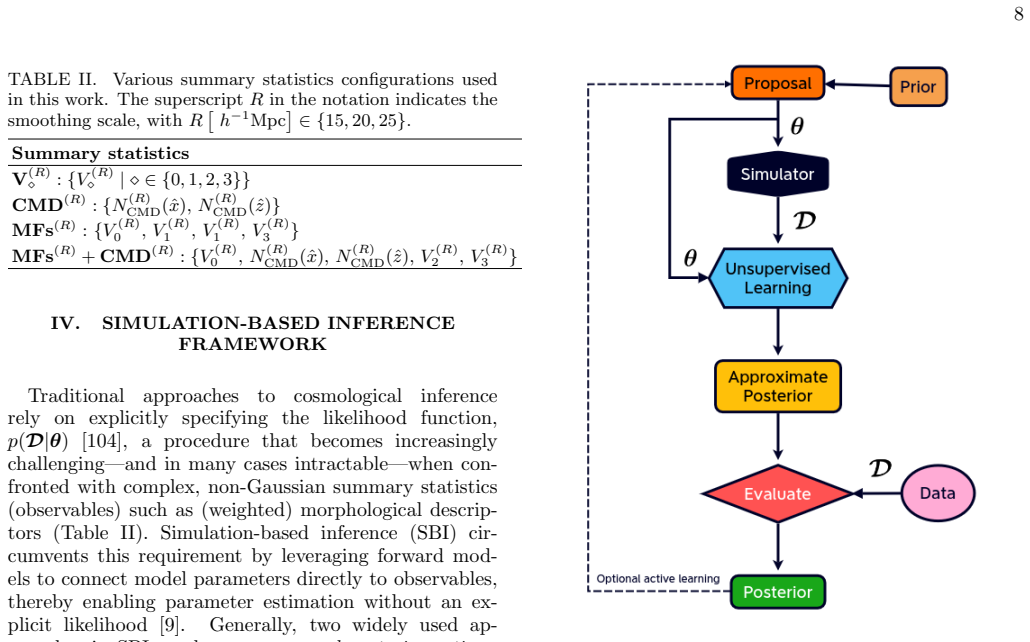
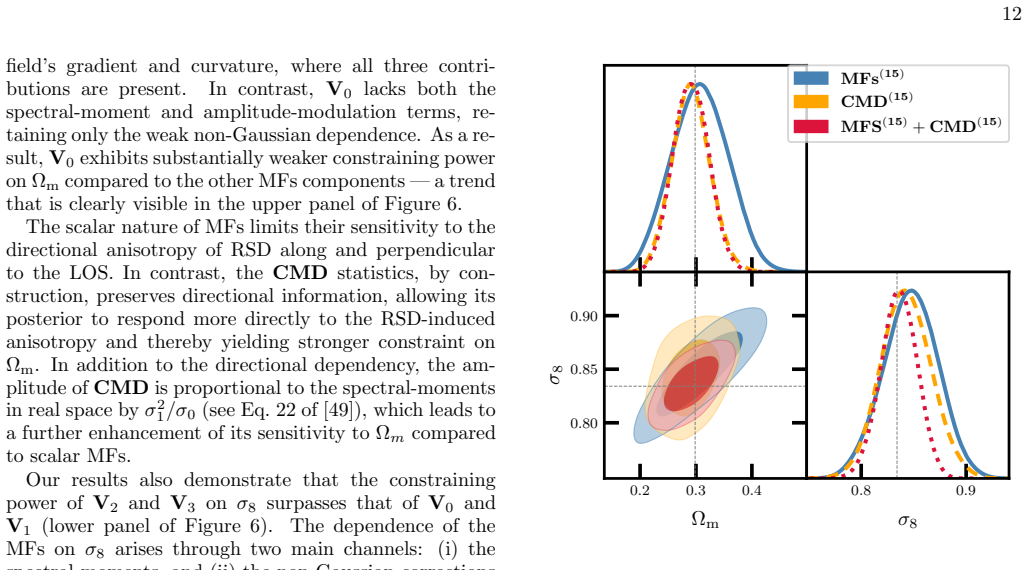
We perform a simulation-based forecasting analysis to compare the cosmological constraining power of higher-order summary statistics of the large-scale structure, the Minkowski Functionals (MFs) and a class weighted morphological measure known as the Conditional Moments of Derivatives (CMD), with that of the redshift-space halo power spectrum multipoles (PS), with a particular focus on their sensitivity to nonlinear and anisotropic features in redshift space. Our analysis relies on halo catalogs from the Big Sobol Sequence simulations at redshift $z=0.5$, employing a likelihood-free inference framework implemented via neural posterior estimation. At the fiducial Quijote cosmology and for a Gaussian smoothing scale of $R=15\,h^{-1}\mathrm{Mpc}$, CMD provide systematically tighter constraints than MFs. Combining MFs and CMD into a joint estimator improves the precision by $27\%^{+9\%}_{-5\%}$ for $\sigma_8$ and $26\%^{+7\%}_{-5\%}$ for $\Omega_{\mathrm{m}}$ relative to MFs alone, highlighting the complementary anisotropy-sensitive information captured by the CMD in contrast to the scalar morphological content encapsulated by the MFs. We compare the combined statistic MFs+CMD with the PS at matched effective scales ($k_{\max}\simeq0.16\,h\,\mathrm{Mpc^{-1}}$) under three halo-selection conditions: all halos, fixed number density, and mass-selected ($M>3\times10^{13}\,h^{-1}M_\odot$). In the mass-selected configuration, the (weighted) morphological estimator outperforms the power spectrum by $45\%^{+20\%}_{-9\%}$ for $\sigma_8$ and $43\%^{+10\%}_{-7\%}$ for $\Omega_{\mathrm{m}}$. We also extend the simulation-based forecast analysis across a continuous range of cosmological parameters and multiple smoothing scales for morphological measures.
Editorial analysis
A structured set of objections, weighed in public.
Referee Report
Summary. The manuscript performs a simulation-based forecasting analysis using neural posterior estimation (NPE) on halo catalogs from the Big Sobol Sequence simulations at z=0.5 to compare the cosmological constraining power of Minkowski Functionals (MFs) and Conditional Moments of Derivatives (CMD) against redshift-space halo power spectrum multipoles (PS). At the fiducial Quijote cosmology and Gaussian smoothing R=15 h^{-1}Mpc, it reports that CMD outperform MFs, that the joint MFs+CMD estimator improves precision by 27% for σ8 and 26% for Ωm over MFs alone, and that in the mass-selected sample (M>3×10^{13} h^{-1}M_⊙) the combined morphological estimator outperforms the PS by 45%^{+20%}_{-9%} for σ8 and 43%^{+10%}_{-7%} for Ωm at matched effective scales k_max ≃ 0.16 h Mpc^{-1}. The analysis is extended across continuous cosmological parameters and multiple smoothing scales.
Significance. If the NPE posteriors are demonstrated to be unbiased and well-calibrated, the results would indicate that weighted morphological statistics capture complementary nonlinear and anisotropic information in redshift space, offering a more informative summary than the power spectrum for mass-selected tracers. The simulation-based approach and extension to continuous parameters provide a useful forecasting framework for future surveys.
major comments (1)
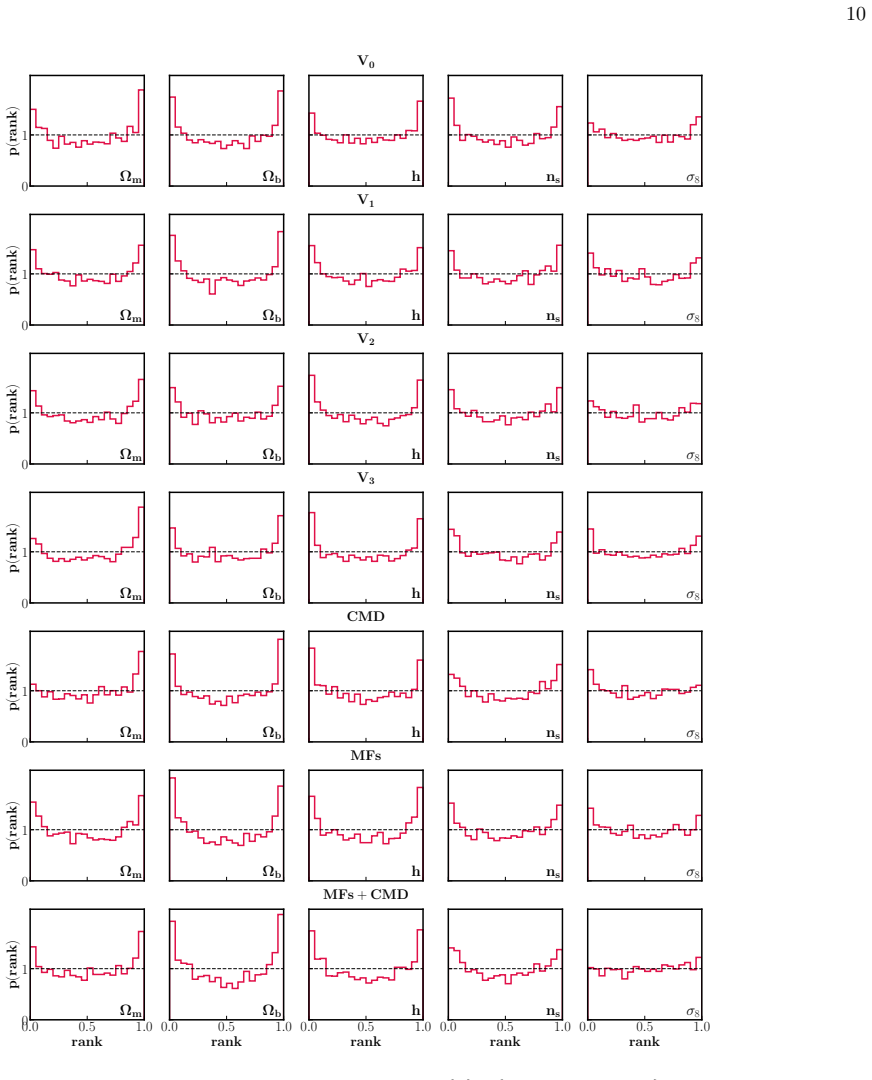
- The central claims of percentage improvements (e.g., 45%^{+20%}_{-9%} tighter σ8 constraints from MFs+CMD versus PS in the mass-selected configuration) rest on the assumption that NPE recovers unbiased, well-calibrated posteriors for both the higher-dimensional morphological summaries and the lower-dimensional PS. No explicit coverage tests, rank statistics on held-out mocks, or architecture/training ablation results are described to rule out differential variance underestimation or calibration failures between the statistics.
minor comments (2)
- Clarify the precise definition of the 'weighted' morphological estimator and how CMD are combined with MFs in the joint analysis.
- Provide additional justification or sensitivity tests for the choice of Gaussian smoothing scale R=15 h^{-1}Mpc and the k_max matching procedure between morphological measures and the power spectrum.
Simulated Author's Rebuttal
We thank the referee for their careful reading and constructive feedback on our manuscript. We appreciate the emphasis placed on rigorously validating the neural posterior estimation (NPE) results, which is essential for supporting the reported improvements in cosmological constraints. We address the major comment below.
read point-by-point responses
-
Referee: The central claims of percentage improvements (e.g., 45%^{+20%}_{-9%} tighter σ8 constraints from MFs+CMD versus PS in the mass-selected configuration) rest on the assumption that NPE recovers unbiased, well-calibrated posteriors for both the higher-dimensional morphological summaries and the lower-dimensional PS. No explicit coverage tests, rank statistics on held-out mocks, or architecture/training ablation results are described to rule out differential variance underestimation or calibration failures between the statistics.
Authors: We agree that explicit demonstration of NPE calibration and lack of bias is necessary to substantiate the percentage improvements in precision. While our analysis uses standard NPE implementations on the Big Sobol Sequence simulations and internal validation was performed during development, these checks were not documented in the original manuscript. In the revised version, we will add coverage probability tests and rank statistics on held-out mock catalogs for both the MFs+CMD and PS estimators. We will also include architecture and training ablation results to confirm that posterior widths are robust and show no differential underestimation between the higher-dimensional morphological summaries and the lower-dimensional PS. These additions will directly address the referee's concern and strengthen the reliability of the comparative results. revision: yes
Circularity Check
No circularity: forward simulation-based forecast derives constraints from external suites
full rationale
The analysis is a pure forecasting exercise that generates mock halo catalogs from the Big Sobol Sequence at fixed fiducial cosmology, computes summary statistics (MFs, CMD, PS multipoles), trains neural posterior estimators on those mocks, and reports posterior-width ratios as measures of relative information content. All quoted percentage improvements (e.g., 45% for σ8 in the mass-selected case) are obtained by direct numerical comparison of the resulting posterior standard deviations on the same simulation ensemble; no parameter is fitted to external data and then re-used as a prediction, no summary statistic is defined in terms of the target cosmological parameters, and no uniqueness theorem or ansatz is imported via self-citation to force the result. The derivation chain therefore remains self-contained against the external simulation benchmarks.
Axiom & Free-Parameter Ledger
free parameters (2)
- Gaussian smoothing scale R
- k_max matching scale
axioms (1)
- domain assumption Big Sobol Sequence halo catalogs at z=0.5 faithfully reproduce nonlinear and redshift-space anisotropic features of the large-scale structure for the Quijote cosmology.
Lean theorems connected to this paper
-
IndisputableMonolith/Foundation/AlexanderDuality.leanalexander_duality_circle_linking unclear?
unclearRelation between the paper passage and the cited Recognition theorem.
Minkowski Functionals (MFs) ... quantify ... volume, surface area, mean curvature, Euler characteristic ... V0(ϑ) = 1/V ∫ Θ(δs−ϑ) d³x ... CMD: N(m)CMD(ϑ,i) = 1/V ∫ δD(δs−ϑ) |∇i δs|^m d³x
-
IndisputableMonolith/Cost/FunctionalEquation.leanwashburn_uniqueness_aczel unclear?
unclearRelation between the paper passage and the cited Recognition theorem.
neural posterior estimation ... NSF ... ensemble of density estimators ... simulation-based calibration via rank statistics
What do these tags mean?
- matches
- The paper's claim is directly supported by a theorem in the formal canon.
- supports
- The theorem supports part of the paper's argument, but the paper may add assumptions or extra steps.
- extends
- The paper goes beyond the formal theorem; the theorem is a base layer rather than the whole result.
- uses
- The paper appears to rely on the theorem as machinery.
- contradicts
- The paper's claim conflicts with a theorem or certificate in the canon.
- unclear
- Pith found a possible connection, but the passage is too broad, indirect, or ambiguous to say the theorem truly supports the claim.
Reference graph
Works this paper leans on
-
[1]
Minkowski Functionals (MFs), which fall under the broader category ofmorphology, and encode both geo- metrical and topological information of excursion sets of matter field
-
[2]
Conditional Moments of Derivative (CMD), a di- rectional, anisotropy-sensitive statistics introduced in 5 https://www.ligo.caltech.edu/ 6 https://www.virgo-gw.eu/ 7 https://www.lisamission.org/ 8 https://www.et-gw.eu/ 9 https://cosmicexplorer.org/ 10 https://quijote-simulations.readthedocs.io/en/latest/ bsq.html [49, 50] as a class ofweighted morphologica...
work page 2000
-
[3]
Tegmark, Physical Review Letters79, 3806 (1997)
M. Tegmark, Physical Review Letters79, 3806 (1997)
work page 1997
-
[4]
P. J. E. Peebles,The Large-Scale Structure of the Uni- verse(Princeton University Press, Princeton, NJ, 1980)
work page 1980
-
[5]
S. Cole, W. J. Percival, J. A. Peacock, P. Nor- berg, C. M. Baugh, C. S. Frenk, I. K. Baldry, J. Bland-Hawthorn, T. Bridges, R. Cannon, M. Colless, C. Collins, W. Couch, N. Cross, G. Dalton, R. De Pro- pris, S. P. Driver, G. Efstathiou, R. S. Ellis, K. Glaze- brook, C. A. Jackson, A. Jenkins, O. Lahav, I. Lewis, S. Lumsden, S. Maddox, D. S. Madgwick, B. A...
work page 2005
-
[6]
S. Alam, M. Aubert, S. Avila, C. Balland, J. E. Bautista, M. A. Bershady, D. Bizyaev, M. R. Blan- ton, A. S. Bolton, J. Bovy, J. Brinkmann, J. R. Brownstein, E. Burtin, S. Chabanier, M. J. Chap- man, P. D. Choi, C.-H. Chuang, J. Comparat, M.-C. Cousinou, A. Cuceu, K. S. Dawson, S. de la Torre, A. de Mattia, V. d. S. Agathe, H. d. M. des Bourboux, S. Escof...
work page 2021
-
[7]
T. M. C. Abbott, M. Aguena, A. Alarcon, S. Allam, O. Alves, A. Amon, F. Andrade-Oliveira, J. Annis, S. Avila, D. Bacon, E. Baxter, K. Bechtol, M. R. Becker, G. M. Bernstein, S. Bhargava, S. Birrer, J. Blazek, A. Brandao-Souza, S. L. Bridle, D. Brooks, E. Buckley-Geer, D. L. Burke, H. Camacho, A. Campos, A. Carnero Rosell, M. Carrasco Kind, J. Carretero, F...
work page 2022
-
[8]
R. Trotta, arXiv e-printsarXiv:1701.01467, 10.48550/arXiv.1701.01467 (2017), arXiv:1701.01467 [astro-ph.IM]
work page internal anchor Pith review Pith/arXiv arXiv doi:10.48550/arxiv.1701.01467 2017
-
[9]
F. Bernardeau, S. Colombi, E. Gazta˜ naga, and R. Scoc- cimarro, Physics Reports367, 1 (2002)
work page 2002
-
[10]
Scoccimarro, The Astrophysical Journal544, 597 (2000)
R. Scoccimarro, The Astrophysical Journal544, 597 (2000)
work page 2000
-
[11]
K. Cranmer, J. Brehmer, and G. Louppe, Proceedings of the National Academy of Sciences117, 30055 (2020)
work page 2020
- [12]
-
[13]
The DESI Experiment Part I: Science,Targeting, and Survey Design
DESI Collaboration, A. Aghamousa,et al., arXiv e-prints , arXiv:1611.00036 (2016), arXiv:1611.00036 [astro-ph.IM]
work page internal anchor Pith review Pith/arXiv arXiv 2016
- [14]
-
[15]
Wide-Field InfrarRed Survey Telescope-Astrophysics Focused Telescope Assets WFIRST-AFTA 2015 Report
D. Spergel, N. Gehrels, C. Baltay, D. Bennett, J. Breckinridge, M. Donahue, A. Dressler, B. S. Gaudi, T. Greene, O. Guyon,et al., arXiv preprint arXiv:1503.03757 (2015)
work page internal anchor Pith review Pith/arXiv arXiv 2015
-
[16]
Y. Wang, Z. Zhai, A. Alavi, E. Massara, A. Pisani, A. Benson, C. M. Hirata, L. Samushia, D. H. Wein- berg, J. Colbert,et al., The Astrophysical Journal928, 1 (2022)
work page 2022
-
[17]
Euclid Definition Study Report
R. Laureijset al., arXiv preprint 10.48550/arXiv.1110.3193 (2011), arXiv:1110.3193 [astro-ph.CO]
work page internal anchor Pith review Pith/arXiv arXiv doi:10.48550/arxiv.1110.3193 2011
-
[18]
E. Sefusatti, M. Crocce, S. Pueblas, and R. Scocci- marro, Phys. Rev. D74, 023522 (2006), arXiv:astro- ph/0604505
-
[19]
H. Gil-Mar´ ın, W. J. Percival, L. Verde, J. R. Brown- stein, C.-H. Chuang, F.-S. Kitaura, S. A. Rodr´ ıguez- Torres, and M. D. Olmstead, Monthly Notices of the Royal Astronomical Society465, 1757 (2016)
work page 2016
-
[20]
Fry, Astrophysical Journal, Part 1 (ISSN 0004-637X), vol
J. Fry, Astrophysical Journal, Part 1 (ISSN 0004-637X), vol. 289, Feb. 1, 1985, p. 10-17. NASA-supported re- search.289, 10 (1985)
work page 1985
-
[21]
F. R. Bouchet, arXiv preprint astro-ph/9305018 (1993)
work page internal anchor Pith review Pith/arXiv arXiv 1993
-
[22]
Skewness and Kurtosis in Large-Scale Cosmic Fields
F. Bernardeau, arXiv preprint astro-ph/9312026 (1993)
work page internal anchor Pith review Pith/arXiv arXiv 1993
-
[23]
D. J. Croton, E. Gaztanaga, C. M. Baugh, P. Norberg, M. Colless, I. K. Baldry, J. Bland-Hawthorn, T. Bridges, R. Cannon, S. Cole,et al., Monthly Notices of the Royal Astronomical Society352, 1232 (2004)
work page 2004
- [24]
-
[25]
C. G. Sabiu, B. Hoyle, J. Kim, and X.-D. Li, The As- trophysical Journal Supplement Series242, 29 (2019)
work page 2019
-
[26]
O. H. Philcox, Physical Review D106, 063501 (2022)
work page 2022
-
[27]
A marked correlation function for constraining modified gravity models
M. White, JCAP11, 057, arXiv:1609.08632 [astro- ph.CO]
work page internal anchor Pith review Pith/arXiv arXiv
-
[28]
E. Massara, F. Villaescusa-Navarro, C. Hahn, M. M. Abidi, M. Eickenberg, S. Ho, P. Lemos, A. M. Dizgah, and B. R.-S. Blancard, The Astrophysical Journal951, 70 (2023)
work page 2023
-
[29]
J. A. Cowell, D. Alonso, and J. Liu, Monthly Notices of the Royal Astronomical Society535, 3129 (2024), https://academic.oup.com/mnras/article- pdf/535/4/3129/60881005/stae2492.pdf
work page 2024
- [30]
-
[31]
M. Eickenberg, E. Allys, A. M. Dizgah, P. Lemos, E. Massara, M. Abidi, C. Hahn, S. Hassan, B. R.-S. Blancard, S. Ho,et al., arXiv preprint arXiv:2204.07646 (2022)
-
[32]
E. Paillas, C. Cuesta-Lazaro, W. J. Percival, S. Na- dathur, Y.-C. Cai, S. Yuan, F. Beutler, A. De Mattia, D. J. Eisenstein, D. Forero-Sanchez,et al., Monthly No- tices of the Royal Astronomical Society531, 898 (2024)
work page 2024
-
[33]
E. Paillas, C. Cuesta-Lazaro, P. Zarrouk, Y.-C. Cai, W. J. Percival, S. Nadathur, M. Pinon, A. de Mattia, and F. Beutler, Monthly Notices of the Royal Astro- nomical Society522, 606 (2023)
work page 2023
-
[34]
C. Cuesta-Lazaro, E. Paillas, S. Yuan, Y.-C. Cai, S. Na- dathur, W. J. Percival, F. Beutler, A. de Mattia, D. J. Eisenstein, D. Forero-Sanchez,et al., Monthly Notices of the Royal Astronomical Society531, 3336 (2024)
work page 2024
- [35]
-
[36]
C. Gay, C. Pichon, and D. Pogosyan, Phys. Rev. D85, 023011 (2012), arXiv:1110.0261 [astro-ph.CO]
work page internal anchor Pith review Pith/arXiv arXiv 2012
-
[37]
Non-Gaussian Minkowski functionals & extrema counts in redshift space
S. Codis, C. Pichon, D. Pogosyan, F. Bernardeau, and T. Matsubara, Monthly Notices of the RAS435, 531 (2013), arXiv:1305.7402
work page internal anchor Pith review Pith/arXiv arXiv 2013
-
[38]
T. Sousbie, C. Pichon, S. Colombi, D. Novikov, and D. Pogosyan, Monthly Notices of the Royal Astronom- ical Society383, 1655 (2008)
work page 2008
-
[39]
T. Sousbie, S. Colombi, and C. Pichon, Monthly Notices of the Royal Astronomical Society393, 457 (2009)
work page 2009
-
[40]
T. Sousbie, C. Pichon, and H. Kawahara, Monthly No- tices of the Royal Astronomical Society414, 384 (2011)
work page 2011
- [41]
-
[42]
J. Schmalzing, T. Buchert, and M. Kerscher, Proc. Int. Sch. Phys. Fermi132, 281 (1995)
work page 1995
-
[43]
Statistics of Isodensity Contours in Redshift Space
T. Matsubara, Astrophys. J.457, 13 (1996), arXiv:astro-ph/9501055 [astro-ph]
work page internal anchor Pith review Pith/arXiv arXiv 1996
-
[44]
T. Matsubara, C. Hikage, and S. Kuriki, Physical Re- view D105, 023527 (2022)
work page 2022
- [45]
- [46]
-
[47]
S. Appleby, P. Chingangbam, C. Park, S. E. Hong, J. Kim, and V. Ganesan, Astrophysical Journal858, 87 (2018), arXiv:1712.07466
work page internal anchor Pith review Pith/arXiv arXiv 2018
-
[48]
S. Appleby, J. P. Kochappan, P. Chingangbam, and C. Park, Astrophysical Journal887, 128 (2019), arXiv:1908.02440
-
[49]
S. Appleby, J. P. Kochappan, P. Chingangbam, and C. Park, Astrophysical Journal942, 110 (2023), 18 arXiv:2208.10164
-
[50]
W. Liu, L. Wu, F. Villaescusa-Navarro, M. Baldi, G. Valogiannis, and W. Fang, Journal of Cosmology and Astroparticle Physics2025(04), 088
-
[51]
M. J. Kanafi and S. Movahed, The Astrophysical Jour- nal963, 31 (2024)
work page 2024
- [52]
- [53]
-
[54]
X. Xu, J. Cisewski-Kehe, S. B. Green, and D. Na- gai, Astronomy and Computing27, 34 (2019), arXiv:1811.08450
work page internal anchor Pith review Pith/arXiv arXiv 2019
-
[55]
G. Wilding, K. Nevenzeel, R. van de Weygaert, G. Veg- ter, P. Pranav, B. J. T. Jones, K. Efstathiou, and J. Feldbrugge, Monthly Notices of the RAS507, 2968 (2021), arXiv:2011.12851
-
[56]
M. Biagetti, J. Calles, L. Castiblanco, A. Cole, and J. Nore˜ na, Journal of Cosmology and Astroparticle Physics2022(10), 002
-
[57]
J. H. Yip, M. Biagetti, A. Cole, K. Viswanathan, and G. Shiu, Journal of Cosmology and Astroparticle Physics2024(09), 034
-
[58]
M. Jalali Kanafi, S. Ansarifard, and S. Movahed, Monthly Notices of the Royal Astronomical Society535, 657 (2024)
work page 2024
- [59]
- [60]
-
[61]
K. Lin, M. von wietersheim Kramsta, B. Joachimi, and S. Feeney, Monthly Notices of the Royal Astronomical Society524, 6167 (2023)
work page 2023
-
[62]
M. von Wietersheim-Kramsta, K. Lin, N. Tessore, B. Joachimi, A. Loureiro, R. Reischke, and A. H. Wright, Astronomy & Astrophysics694, A223 (2025)
work page 2025
-
[63]
C. P. Novaes, L. Thiele, J. Armijo, S. Cheng, J. A. Cow- ell, G. A. Marques, E. G. Ferreira, M. Shirasaki, K. Os- ato, and J. Liu, Physical Review D111, 083510 (2025)
work page 2025
-
[64]
N. Jeffrey, J. Alsing, and F. Lanusse, Monthly Notices of the Royal Astronomical Society501, 954 (2021)
work page 2021
-
[65]
M. Gatti, G. Campailla, N. Jeffrey, L. Whiteway, A. Porredon, J. Prat, J. Williamson, M. Raveri, B. Jain, V. Ajani, G. Giannini, M. Yamamoto, C. Zhou, J. Blazek, D. Anbajagane, S. Samuroff, T. Kacprzak, A. Alarcon, A. Amon, K. Bechtol, M. Becker, G. Bern- stein, A. Campos, C. Chang, R. Chen, A. Choi, C. Davis, J. Derose, H. T. Diehl, S. Dodelson, C. Doux,...
work page 2025
-
[66]
N. Jeffrey, L. Whiteway, M. Gatti, J. Williamson, J. Als- ing, A. Porredon, J. Prat, C. Doux, B. Jain, C. Chang, et al., Monthly Notices of the Royal Astronomical Soci- ety536, 1303 (2025)
work page 2025
-
[67]
D. Lanzieri, J. Zeghal, T. L. Makinen, A. Boucaud, J.- L. Starck, and F. Lanusse, Astronomy & Astrophysics 697, A162 (2025)
work page 2025
- [68]
- [69]
-
[70]
E. Massara, C. Hahn, M. Eickenberg, S. Ho, J. Hou, P. Lemos, C. Modi, A. M. Dizgah, L. Parker, and B. R.- S. Blancard, arXiv preprint arXiv:2404.04228 (2024)
-
[71]
C. Hahn, M. Eickenberg, S. Ho, J. Hou, P. Lemos, E. Massara, C. Modi, A. M. Dizgah, L. Parker, B. R.-S. Blancard,et al., Physical Review D109, 083534 (2024)
work page 2024
-
[72]
J. Hou, A. M. Dizgah, C. Hahn, M. Eickenberg, S. Ho, P. Lemos, E. Massara, C. Modi, L. Parker, and B. R.-S. Blancard, Phys. Rev. D109, 103528 (2024)
work page 2024
- [73]
-
[74]
B. Tucci and F. Schmidt, Journal of Cosmology and Astroparticle Physics2024(05), 063
-
[75]
C. Modi, S. Pandey, M. Ho, C. Hahn, B. R´ egaldo- Saint Blancard, and B. Wandelt, Monthly Notices of the Royal Astronomical Society536, 254 (2025)
work page 2025
- [76]
-
[77]
´I. Zubeldia, B. Bolliet, A. Challinor, and W. Handley, arXiv preprint arXiv:2504.10230 (2025)
- [78]
-
[79]
D. Prelogovi´ c and A. Mesinger, Monthly Notices of the Royal Astronomical Society524, 4239 (2023)
work page 2023
-
[80]
A. Bairagi, B. Wandelt, and F. Villaescusa-Navarro, arXiv preprint arXiv:2503.13755 (2025)
discussion (0)
Sign in with ORCID, Apple, or X to comment. Anyone can read and Pith papers without signing in.