Fermionic Casimir densities for a uniformly accelerating mirror in the Fulling-Rindler vacuum
Pith reviewed 2026-05-18 00:52 UTC · model grok-4.3
The pith
The boundary-induced contributions to the fermion condensate and energy density have opposite signs in the two regions divided by an accelerating mirror in Rindler spacetime.
A machine-rendered reading of the paper's core claim, the machinery that carries it, and where it could break.
Core claim
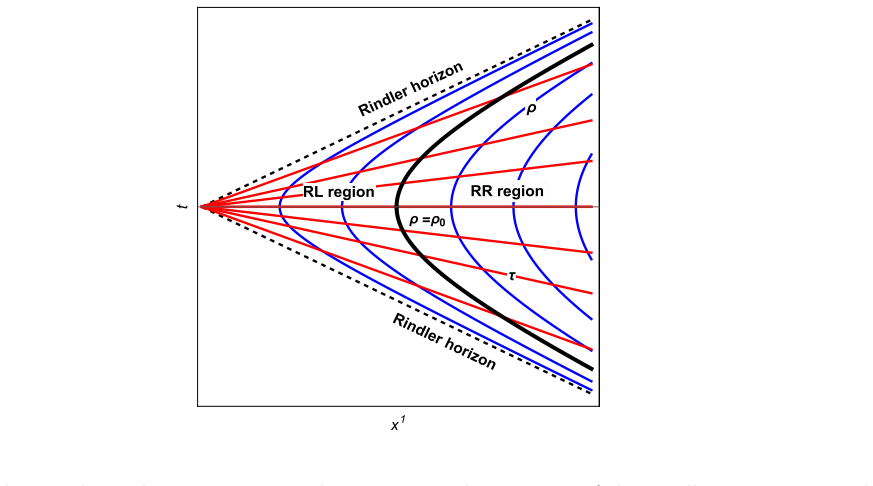
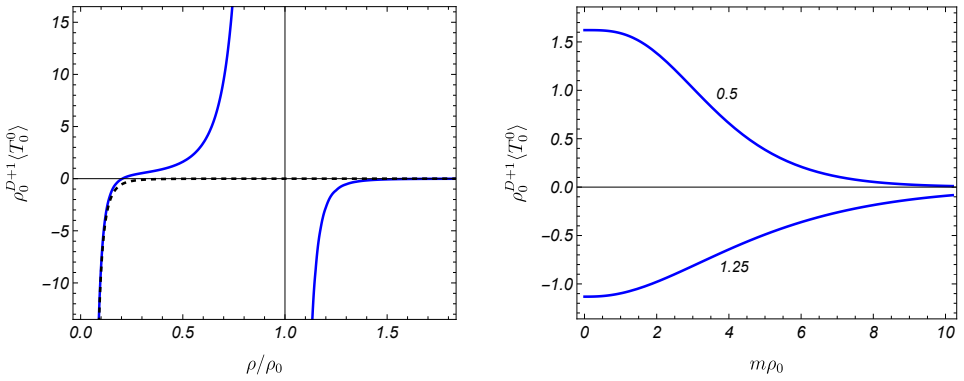
In the presence of a planar boundary moving with constant proper acceleration in (D+1)-dimensional flat spacetime, the Dirac field obeys the bag boundary condition. The boundary divides the right Rindler wedge into RL and RR regions. The fermion condensate and the VEV of the energy-momentum tensor are decomposed into the Fulling-Rindler vacuum contributions without boundary and the boundary-induced contributions. The boundary-free contributions are negative for massive fields. The boundary-induced contributions in the fermion condensate and the energy density are positive in the RL region and negative in the RR region. For a massless field the fermion condensate vanishes in spatial dimension
What carries the argument
Decomposition of the vacuum expectation values into boundary-free Fulling-Rindler parts and boundary-induced parts, with renormalization reducing to the boundary-free case for points away from the mirror.
If this is right
- The total VEVs are dominated by the boundary-free parts near the Rindler horizon and by the boundary-induced parts near the boundary.
- For a massive field the boundary-free contributions in the fermion condensate and the vacuum energy density and effective pressures are negative everywhere.
- For a massless field the fermion condensate vanishes in spatial dimensions D greater than or equal to 2, while the VEV of the energy-momentum tensor is different from zero.
- The results are used to investigate the VEV of the fermionic energy-momentum tensor in weak gravitational fields and background geometries that are conformally related to Rindler spacetime.
Where Pith is reading between the lines
- The contrast with the Minkowski vacuum suggests that acceleration plays a key role in determining whether the condensate or the energy-momentum tensor dominates for massless fields.
- Applications to weak gravitational fields imply possible effects on vacuum structure in slightly curved spacetimes.
- Similar sign differences might appear in other accelerated boundary problems.
Load-bearing premise
The accelerating boundary divides the right Rindler wedge into independent RL and RR regions with the Dirac field obeying the bag boundary condition, allowing separate renormalization that reduces to the boundary-free case away from the mirror.
What would settle it
A calculation of the boundary-induced energy density at a fixed proper distance from the mirror in the RL region that yields a negative value instead of positive would contradict the central result.
Figures


read the original abstract
We investigate the local characteristics of the Fulling-Rindler vacuum for a massive Dirac field induced by a planar boundary moving with constant proper acceleration in $(D+1)$-dimensional flat spacetime. On the boundary, the field operator obeys the bag boundary condition. The boundary divides the right Rindler wedge into two separate regions, called RL and RR regions. In both these regions, the fermion condensate and the vacuum expectation value (VEV) of the energy-momentum tensor are decomposed into two contributions. The first one presents the VEVs in the Fulling-Rindler vacuum when the boundary is absent and the second one is the boundary-induced contribution. For points away from the boundary, the renormalization is reduced to the one for the boundary-free geometry. The total VEVs are dominated by the boundary-free parts near the Rindler horizon and by the boundary-induced parts in the region near the boundary. For a massive field the boundary-free contributions in the fermion condensate and the vacuum energy density and effective pressures are negative everywhere. The boundary-induced contributions in the fermion condensate and the energy density are positive in the RL region and negative in the RR region. For a massless field the fermion condensate vanishes in spatial dimensions $D\geq 2$, while the VEV of the energy-momentum tensor is different from zero. This behavior contrasts with that of the VEVs in the Minkowski vacuum for the geometry of a boundary at rest relative to an inertial observer. In the latter case, the fermion condensate for a massless field is nonzero, while the VEV of the energy-momentum tensor becomes zero. The obtained results are used to investigate the VEV of the fermionic energy-momentum tensor in weak gravitational fields and background geometries that are conformally related to Rindler spacetime.
Editorial analysis
A structured set of objections, weighed in public.
Referee Report
Summary. The paper computes the fermion condensate and the VEV of the energy-momentum tensor for a massive Dirac field in the Fulling-Rindler vacuum in the presence of a planar boundary moving with constant proper acceleration and obeying the bag boundary condition. The boundary divides the right Rindler wedge into RL and RR regions; the VEVs are decomposed into a boundary-free Fulling-Rindler part plus a boundary-induced part. Boundary-free contributions are negative for massive fields; boundary-induced contributions are positive in RL and negative in RR. For massless fields the condensate vanishes in D≥2 while the EMT VEV remains nonzero, in contrast to the Minkowski vacuum case. The results are applied to weak gravitational fields and conformally related geometries.
Significance. If the decomposition and renormalization hold, the work provides explicit analytic expressions for fermionic vacuum polarization in an accelerated frame, with clear sign patterns and a nontrivial massless limit that differs from the inertial case. The reduction of renormalization to the boundary-free geometry away from the mirror and the applications to weak gravity are useful strengths. The absence of free parameters in the final expressions is a positive feature.
major comments (2)
- [Section 3 (mode expansion and two-point function construction)] The central decomposition into independent RL and RR regions with separate renormalization rests on the assumption that the bag boundary condition (1 + i n_μ γ^μ)ψ = 0 completely decouples the two sides. Given the form of the Dirac operator in Rindler coordinates (vierbein plus conformal factor e^{aξ}), an explicit check that the inner product between RL and RR modes vanishes is required; otherwise cross terms would appear in the two-point function and invalidate the reported opposite signs for the boundary-induced contributions in the fermion condensate and energy density.
- [Section 5 (massless limit and comparison with Minkowski case)] The statement that the fermion condensate vanishes for massless fields when D≥2 while the EMT VEV is nonzero (and the contrast with the Minkowski vacuum) is load-bearing for the main claims. This should be shown from the explicit mode sum or integral after the decomposition, rather than asserted from the abstract-level description; the massless limit of the relevant expressions needs to be displayed.
minor comments (2)
- [Introduction] A diagram showing the locations of the RL and RR regions relative to the mirror trajectory and the Rindler horizon would clarify the geometry for readers.
- [Section 2] Notation for the Rindler coordinates (ξ, τ) and the acceleration parameter a should be introduced once and used consistently; a brief reminder of the relation to Minkowski coordinates would help.
Simulated Author's Rebuttal
We thank the referee for the careful reading of the manuscript and the constructive comments. We address each major comment below and have incorporated revisions to strengthen the presentation.
read point-by-point responses
-
Referee: [Section 3 (mode expansion and two-point function construction)] The central decomposition into independent RL and RR regions with separate renormalization rests on the assumption that the bag boundary condition (1 + i n_μ γ^μ)ψ = 0 completely decouples the two sides. Given the form of the Dirac operator in Rindler coordinates (vierbein plus conformal factor e^{aξ}), an explicit check that the inner product between RL and RR modes vanishes is required; otherwise cross terms would appear in the two-point function and invalidate the reported opposite signs for the boundary-induced contributions in the fermion condensate and energy density.
Authors: We agree that an explicit verification of the mode orthogonality is necessary to rigorously justify the decomposition. In the revised manuscript, we have added a detailed calculation in Section 3. The modes in the RL and RR regions are defined with support on their respective sides of the boundary. The bag boundary condition ensures that the Dirac bilinear form in the inner product vanishes when integrating across the boundary, leading to zero overlap between RL and RR modes. This confirms the absence of cross terms in the two-point function and validates the reported sign patterns for the boundary-induced contributions. revision: yes
-
Referee: [Section 5 (massless limit and comparison with Minkowski case)] The statement that the fermion condensate vanishes for massless fields when D≥2 while the EMT VEV is nonzero (and the contrast with the Minkowski vacuum) is load-bearing for the main claims. This should be shown from the explicit mode sum or integral after the decomposition, rather than asserted from the abstract-level description; the massless limit of the relevant expressions needs to be displayed.
Authors: We acknowledge that displaying the explicit limit enhances clarity. We have revised Section 5 to include the massless limit taken directly from the decomposed mode sums. For the fermion condensate, the relevant integral over the Rindler frequency spectrum evaluates to zero for D ≥ 2 because the integrand becomes an odd function or cancels due to the properties of the spinor modes under the bag condition. In contrast, the components of the energy-momentum tensor yield nonzero expressions involving integrals that remain finite. We also explicitly compare these to the corresponding results in the Minkowski vacuum, highlighting the differences arising from the accelerated frame and the boundary motion. revision: yes
Circularity Check
No significant circularity in derivation from standard Rindler modes
full rationale
The paper derives the boundary-induced VEVs for the Dirac field by standard mode expansion in Rindler coordinates subject to the bag boundary condition on the accelerating mirror. The decomposition into Fulling-Rindler (boundary-free) plus boundary-induced parts follows directly from linearity of the field operator and the choice to treat RL and RR as separate regions; renormalization is explicitly reduced to the boundary-free subtraction for points away from the mirror. No quantity is defined in terms of itself, no fitted parameter is relabeled as a prediction, and no load-bearing uniqueness theorem or ansatz is imported via self-citation. The reported sign differences and the vanishing of the massless condensate for D≥2 are obtained from explicit evaluation of the mode sums or integrals in each region, which remain independent of the final numerical results. The contrast with the Minkowski case is likewise shown by direct comparison of the derived expressions rather than by renaming or circular appeal. The derivation is therefore self-contained against external benchmarks.
Axiom & Free-Parameter Ledger
axioms (2)
- standard math Standard mode expansion and vacuum definition for Dirac field in Rindler wedge
- domain assumption Bag boundary condition for the Dirac field on the accelerating mirror
Lean theorems connected to this paper
-
IndisputableMonolith/Foundation/AlexanderDuality.leanalexander_duality_circle_linking unclear?
unclearRelation between the paper passage and the cited Recognition theorem.
The boundary divides the right Rindler wedge into two separate regions, called RL and RR regions... boundary-induced contributions in the fermion condensate and the energy density are positive in the RL region and negative in the RR region.
What do these tags mean?
- matches
- The paper's claim is directly supported by a theorem in the formal canon.
- supports
- The theorem supports part of the paper's argument, but the paper may add assumptions or extra steps.
- extends
- The paper goes beyond the formal theorem; the theorem is a base layer rather than the whole result.
- uses
- The paper appears to rely on the theorem as machinery.
- contradicts
- The paper's claim conflicts with a theorem or certificate in the canon.
- unclear
- Pith found a possible connection, but the passage is too broad, indirect, or ambiguous to say the theorem truly supports the claim.
Reference graph
Works this paper leans on
-
[1]
N. D. Birrell and P. C. W. Davies, Quantum Fields in Curved Space (Cambridge University Press, Cambridge, England, 1982)
work page 1982
-
[2]
L. C. B. Crispino, A. Higuchi, and G. E. A. Matsas, The Unru h effect and its applications, Rev. Mod. Phys. 80, 787 (2008)
work page 2008
-
[3]
P. P. Langlois, Imprints of spacetime topology in the Haw king-Unruh effect, arXiv:gr-qc/0510127
work page internal anchor Pith review Pith/arXiv arXiv
-
[4]
S. A. Fulling, Nonuniqueness of canonical field quantiza tion in Riemannian space-time, Phys. Rev. D 7, 2850 (1973)
work page 1973
-
[5]
P. C. W. Davies, Scalar production in Schwarzschild and R indler metrics, J. Phys. A: Math. Gen. 8, 609 (1975)
work page 1975
-
[6]
W. G. Unruh, Notes on black-hole evaporation, Phys. Rev. D 14, 870 (1976)
work page 1976
-
[7]
I. Fuentes-Schuller and R. B. Mann, Alice falls into a bla ck hole: Entanglement in noninertial frames, Phys. Rev. Lett. 95, 120404 (2005)
work page 2005
-
[8]
P. M. Alsing, I. Fuentes-Schuller, R. B. Mann, and T. E. Te ssier, Entanglement of Dirac fields in noninertial frames, Phys. Rev. A 74, 032326 (2006)
work page 2006
-
[9]
K. Ueda, A. Higuchi, K. Yamamoto, A. Rohim, and Y. Nan, Ent anglement of the vacuum between left, right, future, and past: Dirac spinor in Rindler and Ka sner spaces, Phys. Rev. D 103, 125005 (2021)
work page 2021
- [10]
-
[11]
V. M. Mostepanenko and N. N. Trunov, The Casimir Effect and Its Applications (Clarendon, Oxford, 1997). 24
work page 1997
-
[12]
K. A. Milton, The Casimir Effect: Physical Manifestation of Zero-Point Ener gy (World Scientific, Singapore, 2002)
work page 2002
- [13]
- [14]
-
[15]
P. Candelas and D. Deutsch, Fermion fields in accelerate d states, Proc. R. Soc. Lond. A 362, 251 (1978)
work page 1978
- [16]
-
[17]
Tagaki, On the response of a Rindler particle detecto r
S. Tagaki, On the response of a Rindler particle detecto r. III, Prog. Theor. Phys. 74, 501 (1985)
work page 1985
-
[18]
Tagaki, Vacuum noise and stress induced by uniform ac celeration, Prog
S. Tagaki, Vacuum noise and stress induced by uniform ac celeration, Prog. Theor. Phys. Suppl. 88, 1 (1986)
work page 1986
-
[19]
R. J´ aregui, M. Torres, and S. Hacyan, Dirac vacuum: Acc eleration and external-field effects, Phys. Rev. D 43, 3979 (1991)
work page 1991
-
[20]
Bautista, Acceleration through the Dirac-Pauli vac uum and effects of an external field, Phys
E. Bautista, Acceleration through the Dirac-Pauli vac uum and effects of an external field, Phys. Rev. D 48, 783 (1993)
work page 1993
-
[21]
V. Moretti and L. Vanzo, Thermal Wightman functions and renormalized stress tensors in the Rindler wedge, Phys. Lett. B 375, 54 (1996)
work page 1996
-
[22]
D. Oriti, The spinor field in Rindler spacetime: An analy sis of the Unruh effect, Nuovo Cimento della Societa Italiana di Fisica B 115, 1005 (2000)
work page 2000
-
[23]
D. A. T. Vanzella and G. E. A. Matsas, Decay of accelerate d protons and the existence of the Fulling-Davies-Unruh Effect, Phys. Rev. Lett. 87, 151301 (2001)
work page 2001
-
[24]
P. P. Langlois, Causal particle detectors and topology , Ann. Phys. 321, 2027 (2006)
work page 2027
-
[25]
C. H. G. B´ essa, J. G. Due˜ nas, and N. F. Svaiter, Accelerated detectors in Dirac vacuum: the effects of horizon fluctuations. Class. Quantum Grav. 29, 215011 (2012)
work page 2012
-
[26]
W. Zhou and H. Yu, Spontaneous excitation of a uniformly accelerated atom coupled to vacuum Dirac field fluctuations, Phys. Rev. A 86, 033841 (2012)
work page 2012
-
[27]
J. Louko and V. Toussaint, Unruh-DeWitt detector’s res ponse to fermions in flat spacetimes, Phys. Rev. D 94, 064027 (2016)
work page 2016
-
[28]
D. H¨ ummer, E. Mart ´ ın-Mart ´ ınez, and A. Kempf, Renormalized Unruh-DeWitt particle detector models for boson and fermion fields, Phys. Rev. D 93, 024019 (2016)
work page 2016
-
[29]
Kaushal, Schwinger effect and a uniformly accelerated observer, Eur
S. Kaushal, Schwinger effect and a uniformly accelerated observer, Eur. Phys. J. C 82, 872 (2022)
work page 2022
-
[30]
V. Kh. Kotanjyan, A. A. Saharian, and M. R. Setare, Vacuu m currents in partially compactified Rindler spacetime with an application to cylindrical black holes, Nucl. Phys. B 980, 115838 (2022)
work page 2022
-
[31]
R. Falcone and C. Conti, Minkowski vacuum in Rindler spa cetime and Unruh thermal state for Dirac fields, Phys. Rev. D 107, 105021 (2023). 25
work page 2023
-
[32]
S. Bellucci, V. Kh. Kotanjyan, and A. A. Saharian, Fermi onic condensate and the mean energy- momentum tensor in the Fulling-Rindler vacuum. Phys. Rev. D 108, 085014 (2023)
work page 2023
-
[33]
P. Candelas and D. Deutsch, On the vacuum stress induced by uniform acceleration or supporting the ether, Proc. R. Soc. Lond. A 354, 79 (1977)
work page 1977
-
[34]
A. A. Saharian, Polarization of the Fulling-Rindler va cuum by a uniformly accelerated mirror, Class. Quantum Grav. 19, 5039 (2002)
work page 2002
-
[35]
R. M. Avagyan, A. A. Saharian, and A. H. Yeranyan, Casimi r effect in the Fulling-Rindler vacuum, Phys. Rev. D 66, 085023 (2002)
work page 2002
-
[36]
A. A. Saharian, R. S. Davtyan, and A. H. Yeranyan, Casimi r energy in the Fulling-Rindler vacuum, Phys. Rev. D 69, 085002 (2004)
work page 2004
-
[37]
A. A. Saharian and M. R. Setare, Surface vacuum energy an d stresses on a plate uniformly accelerated through the Fulling-Rindler vacuum, Class. Quantum Gravit y 21, 5261 (2004)
work page 2004
-
[38]
A. A. Saharian, R. M. Avagyan, and R. S. Davtyan, Wightma n function and Casimir densities for Robin plates in the Fulling-Rindler vacuum, Int. J. Mod. Phy s. A 21, 2353 (2006)
work page 2006
-
[39]
G. Bimonte, E. Calloni, G. Esposito, and L. Rosa, Energy -momentum tensor for a Casimir apparatus in a weak gravitational field. Phys. Rev. D 74, 085011 (2006); 77, 109903(E) (2008)
work page 2006
-
[40]
S. A. Fulling, K. A. Milton, P. Parashar, A. Romeo, K. V. S hajesh, and J. Wagner, How does Casimir energy fall? Phys. Rev. D 76, 025004 (2007)
work page 2007
-
[41]
K. A. Milton, P. Parashar, K. V. Shajesh, and J. Wagner, H ow does Casimir energy fall? II. Gravitational acceleration of quantum vacuum energy. J. Ph ys. A 40, 10935 (2007)
work page 2007
-
[42]
K. V. Shajesh, K. A. Milton, P. Parashar, and J. A. Wagner , How does Casimir energy fall? III. Inertial forces on vacuum energy. J. Phys. A 41, 164058 (2008)
work page 2008
-
[43]
K. A. Milton, K. V. Shajesh, S. A. Fulling, P. Parashar, H ow does Casimir energy fall? IV. Gravi- tational interaction of regularized quantum vacuum energy . Phys. Rev. D 89, 064027 (2014)
work page 2014
-
[44]
G. Lambiase, A. Stabile, and An. Stabile, Casimir effect i n extended theories of gravity. Phys. Rev. D 95, 084019 (2017)
work page 2017
-
[45]
F. Sorge and J. H. Wilson, Casimir effect in free-fall towa rds a Schwarzschild black hole, Phys. Rev. D 100, 105007 (2019)
work page 2019
-
[46]
L. Buoninfante, G. Lambiase, L. Petruzziello, A. Stabi le, Casimir effect in quadratic theories of gravity. Eur. Phys. J. C 79, 41 (2019)
work page 2019
-
[47]
A. P. C. M Lima, G. Alencar, C. R. Muniz, and R. R. Landim, N ull second order corrections to Casimir energy in weak gravitational field. JCAP07(2019)01 1
work page 2019
-
[48]
J. H. Wilson, F. Sorge, and S. A. Fulling, Tidal and noneq uilibrium Casimir effects in free fall. Phys. Rev. D 101, 065007 (2020)
work page 2020
-
[49]
Sorge, Quasi-local Casimir energy and vacuum buoyan cy in a weak gravitational field
F. Sorge, Quasi-local Casimir energy and vacuum buoyan cy in a weak gravitational field. Class. Quantum Grav. 38, 025009 (2021)
work page 2021
-
[50]
V. B. Bezerra, H. F. S. Mota, A. P. C. M. Lima, G. Alencar, a nd C. R. Muniz, The Casimir effect in finite-temperature and gravitational scenarios, Physic s 6, 1046 (2024). 26
work page 2024
-
[51]
Shimizu, C, P and T transformations in higher dimensi ons, Prog
K. Shimizu, C, P and T transformations in higher dimensi ons, Prog. Theor. Phys. 74, 610 (1985)
work page 1985
-
[52]
L. Parker and J. D. Toms, Quantum Field Theory in Curved Spacetime: Quantized Fields an d Gravity (Cambridge University Press, Cambridge, England, 2009)
work page 2009
-
[53]
Handbook of Mathematical Functions, edited by M. Abramowitz and I. A. Stegun (Dover, New York, 1972)
work page 1972
-
[54]
E. Elizalde, S. D. Odintsov, and A. A. Saharian, Fermion ic condensate and Casimir densities in the presence of compact dimensions with applications to nanotu bes. Phys. Rev. D 83, 105023 (2011)
work page 2011
-
[55]
S. Bellucci and A. A. Saharian, Fermionic Casimir effect f or parallel plates in the presence of compact dimensions with applications to nanotubes, Phys. Rev. D 80, 105003 (2009)
work page 2009
-
[56]
S. Bellucci and A. A. Saharian, Fermionic current from t opology and boundaries with applications to higher-dimensional models and nanophysics, Phys. Rev. D 87, 025005 (2013)
work page 2013
-
[57]
S. Bellucci, W. Oliveira dos Santos, E. R. Bezerra de Mel lo, and A. A. Saharian, Cosmic string and brane induced effects on the fermionic vacuum in AdS spacetime , J. High Energy Phys. 05 (2022) 021
work page 2022
-
[58]
V. P. Gusynin, S. G. Sharapov, and J. P. Carbotte, AC cond uctivity of graphene: From tight-binding model to 2 + 1-dimensional quantum electrodynamics, Int. J. Mod. Phys. B 21, 4611 (2007)
work page 2007
-
[59]
A. H. Castro Neto, F. Guinea, N. M. R. Peres, K. S. Novosel ov, and A. K. Geim, The electronic properties of graphene, Rev. Mod. Phys. 81, 109 (2009)
work page 2009
-
[60]
O. Vafek and A. Vishwanath, Dirac fermions in solids: Fr om High-Tc cuprates and graphene to topological insulators and Weyl semimetals, Annu. Rev. Con dens. Matter Phys. 5, 83 (2014)
work page 2014
-
[61]
V. V. Dodonov, Dynamical Casimir effect: 55 years later, P hysics 7, 10 (2025)
work page 2025
-
[62]
A. P. Prudnikov, Yu. A. Brychkov, and O. I. Marichev, Integrals and Series (Gordon and Breach, New York, 1986), Vol. 2
work page 1986
-
[63]
A. A. Saharian, The Generalized Abel-Plana Formula with Applications to Bes sel Functions and Casimir Effect (Yerevan State University Publishing House, Yerevan, 2008 ) (arXiv:0708.1187). 27
work page internal anchor Pith review Pith/arXiv arXiv 2008
discussion (0)
Sign in with ORCID, Apple, or X to comment. Anyone can read and Pith papers without signing in.