REVIEW 3 major objections 5 minor 1 cited by
Including spin precession and higher-order multipoles in gravitational-wave models does not improve Hubble-constant inference via the mass-spectrum method at current and near-future catalog sizes.
Reviewed by Pith at T0; open to challenge. T0 means a machine referee read the full paper against a public rubric. the ladder, T0–T4 →
T0 review · deepseek-v4-flash
2026-08-03 23:00 UTC pith:EP6XU2UI
load-bearing objection Useful null result: spectral-siren H0 robust to missing precession/higher modes, but the simulated test's XPHM-as-truth limits the strength of the claim. the 3 major comments →
The impact of precession and higher-order multipoles for gravitational wave cosmological inference
The pith
A machine-rendered reading of the paper's core claim, the machinery that carries it, and where it could break.
Core claim
The central claim is that, for the mass-spectrum method at current and near-future catalog sizes, H0 inference is insensitive to whether the waveform model includes spin precession or higher-order multipoles. For the black-hole mergers in the reference catalog, the H0 posterior obtained with the most complete model and models that omit these effects agree to within a few thousandths of a bit in Jensen-Shannon divergence. For a simulated worst-case population of 80 loud events with about 60 percent showing observable precession and 25 percent showing observable higher-order modes, all models recover the injected H0 within 1-sigma, and the posterior differences stay below the 0.05-bit agreemen
What carries the argument
The central object is a ladder of four phenomenological waveform models—XAS (aligned spins, dominant quadrupole), XP (adds spin precession), XHM (adds higher-order multipoles), and XPHM (adds both)—used for single-event Bayesian inference. These posteriors feed a hierarchical population analysis with the mass-spectrum likelihood, which infers H0 by combining measured detector-frame masses with an assumed source-frame mass distribution and a modeled detection probability. The ladder isolates how much the exact single-event posterior shape contributes to H0 relative to other statistical errors, and the cost difference across rungs quantifies the practical trade-off.
Load-bearing premise
The comparison treats the XPHM waveform as truth when generating simulated signals, so any distance and mass biases it shares with the cheaper models are invisible; if real waveforms differ from XPHM in the same direction the cheaper models do, the apparent H0 agreement could understate the true systematic error.
What would settle it
Inject the simulated high-spin population using numerical-relativity surrogate waveforms rather than XPHM as the truth, recover with XAS and XPHM, and check whether the H0 posteriors separate by more than a Jensen-Shannon divergence of 0.05 bits; such a separation would contradict the paper's conclusion.
If this is right
- For catalogs of tens to hundreds of events, H0 estimates from the spectral-siren method can be obtained with aligned-spin, quadrupole-only waveforms without exceeding current statistical uncertainties.
- A roughly sixfold reduction in per-event computational cost removes a major practical obstacle to hierarchical H0 analyses of the thousand-event catalogs expected in the coming years.
- Waveform choice does alter the inferred mass-ratio distribution—models without precession prefer more equal-mass binaries—so population conclusions about black-hole masses should still use precessing models even though H0 can be obtained cheaply.
- The insensitivity is specific to the no-counterpart mass-spectrum setting; the paper explicitly notes that accurate precession models remain important when electromagnetic counterparts supply the redshift.
- The findings set a benchmark for future systematic checks: if a catalog grows to about 1500 detections with the observed rarity of precession and higher-order modes, comparable waveform systematics may begin to appear.
Where Pith is reading between the lines
- If the conclusion transfers to the dark-siren method—which the paper suggests but does not test—then sky-localization accuracy and galaxy-catalog matching may also be largely waveform-independent for most events.
- The apparent robustness shifts the practical bottleneck in spectral-siren cosmology toward the assumed source-frame mass distribution and selection-function modeling; improvements there may buy more H0 precision than investing in waveform fidelity.
- A natural stress test is to repeat the comparison with numerical-relativity surrogate waveforms as the injection truth; differences smaller than the statistical scatter would confirm the conclusion, while larger shifts would bracket how much of the agreement is due to shared approximations.
Editorial analysis
A structured set of objections, weighed in public.
Referee Report
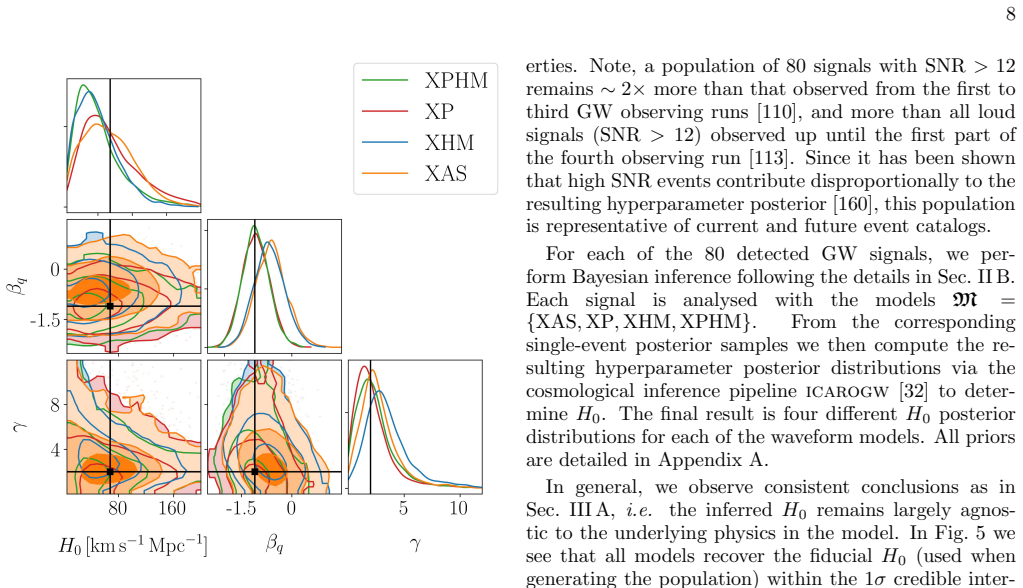
Summary. The paper investigates whether gravitational-wave waveform models that omit spin precession and higher-order multipole moments bias Hubble-constant inference through the spectral siren (mass spectrum) method. The authors reanalyze 42 BBH events from GWTC-3 with XP, XHM, and XPHM, and additionally simulate 80 high-SNR events from a deliberately extreme high-spin, asymmetric-mass population, analyzing each with XAS, XP, XHM, and XPHM. Hierarchical Bayesian inference is used to obtain H0 posteriors, and the results are compared via Jensen-Shannon divergence and computational cost. The central claim is that there is no significant advantage to including precession and higher-order multipoles for current and near-future spectral-siren H0 inference, and that the simpler XAS model gives comparable H0 posteriors at roughly six times lower computational cost.
Significance. If the result holds, it has substantial practical value: it would justify using inexpensive, less accurate waveform models for cosmological inference as catalogs grow to O(1000) events, and it is non-trivial because precession and higher multipoles are known to break the distance-inclination degeneracy. The paper uses standard Bayesian pipelines, clearly stated likelihoods and priors, and a self-contained comparison; the inclusion of a low-spin control population and the explicit JSD and cost metrics are strengths. The main caveat is that the near-future claim rests on injection-recovery with XPHM as the injected 'truth' and on a simplified SNR>12 detection criterion, so the quantitative reach beyond current data is not yet fully established.
major comments (3)
- [Sec. III B, Eq. (6)-(7)] The injection-recovery study simulates every signal with XPHM ('we simulate each GW signal with XPHM') and then compares XAS/XP/XHM against XPHM. XPHM is itself an approximate phenomenological model with residuals relative to numerical relativity, especially for high spins and asymmetric mass ratios. If XPHM's approximation errors are correlated with those of the simpler models, this test will understate the waveform systematics that would appear on real signals. This is the primary support for the near-future 'no advantage' claim. I request either an NR-informed injection check (e.g., a subset of SEOBNR or NR-surrogate injections in the extreme region) or an explicit rescoping of the claim to 'relative to XPHM'.
- [Sec. III A] XAS was not applied to the real GWTC-3 events; the current-catalog claim is supported only by XP/XHM/XPHM. The authors state that 'the inferred H0 from XAS will likely remain comparable', but this is an assertion, not a result. Since the abstract and conclusions claim a current-catalog result and a six-fold cost saving specifically for XAS, either reanalyze the 42 events with XAS (or a representative subset) or restrict the real-data conclusion to the models actually tested.
- [Sec. III B, Eq. (6)] Detection is modeled as a matched-filter SNR>12 threshold in idealized Gaussian noise, with XPHM as the template. Real search pipelines, as the paper's own footnote 5 notes, restrict attention to aligned spins and neglect higher-order multipoles. The selection function enters Eq. (3) through p_det, and a different selection function can change the inferred H0 posterior, particularly for a high-spin/asymmetric population. Please assess the sensitivity to this assumption—for example, by using an injection campaign through a search pipeline or a semianalytic detection probability that accounts for template mismatch—or quantitatively argue why the simplification is conservative for the paper's conclusion.
minor comments (5)
- [Appendix B 2] The sentence 'our ability to constrain cosmological parameters through the mass spectrum method remains larger agnostic' should read 'largely agnostic'.
- [Footnote 5] The fact that real search pipelines neglect precession and higher-order multipoles is important enough to be discussed in the main text, given that the simplified detection model in Eq. (6) does not reflect this pipeline behavior.
- [Sec. III B] The statement 'We estimate that 8% of the binaries drawn from the observed L VK population in GWTC-3 are included in this simulated population' is presented without derivation or reference. Please provide the calculation or a citation.
- [Sec. IV] The extrapolation to '~1500 binaries' is based on rates from Ref. [161], not on a direct hierarchical simulation. It would be helpful to label this explicitly as an estimate rather than a result of the present analysis.
- [Eq. (7)] The symbol M is used both for the waveform model and for the template waveform in the inner-product expression; please clarify the notation, e.g., by writing M(λ_inj) as the model waveform and distinguishing it from the model label.
Circularity Check
No significant circularity; the analysis is self-contained and its conclusions do not reduce to the inputs by construction.
full rationale
The paper's central claim is an empirical null result: H0 posteriors obtained with XAS, XP, XHM and XPHM are compared through the same hierarchical Bayesian likelihood (Eqs. 1-3), with explicit priors and no H0 value fitted into the model. The simulated population is generated from a stated reference population and recovered with stated likelihoods and priors, so the finding that H0 is insensitive to waveform choice is a measured outcome rather than an input. The use of XPHM as the injection waveform ('we simulate each GW signal with XPHM', Sec. III B) is an approximation choice that limits external validity relative to exact GR, but it does not make the comparison true by construction. Self-citations to icarogw and to Ref. [161] (coauthored by the present authors) are uses of published software and externally derived posterior samples/rate estimates; they support parts of the discussion but are not the mechanism by which the main H0 result is derived. The paper also explicitly flags its limitations (no XAS re-analysis of GWTC-3, no expansion to O4a, dark-siren extension untested), which is inconsistent with a hidden circular derivation. The appropriate finding is therefore no significant circularity.
Axiom & Free-Parameter Ledger
free parameters (7)
- Mass-ratio power-law index beta_q for worst-case population =
-1.1
- Spin magnitude distribution (truncated Gaussian mean/std) =
mean 0.7, sigma 0.2
- Primary mass power-law index alpha =
-2.3
- Mass range m_min, m_max =
5 and 80 solar masses
- Redshift evolution index gamma =
2.0
- Gaussian component in primary mass model =
m=34 M_sun, lambda=0.038, sigma_g=5 M_sun
- SNR detection threshold =
12
axioms (8)
- domain assumption XPHM is an adequate representation of true gravitational-wave signals for assessing systematics from simpler models.
- domain assumption A matched-filter SNR>12 detection threshold is representative of real search-pipeline selection effects.
- domain assumption The PowerLaw+Peak mass model plus a power-law mass-ratio distribution is sufficient for the population-level comparison.
- domain assumption Mass and spin distributions are independent of redshift.
- domain assumption Posterior samples from [161] for XHM and XP analyses of GWTC-3 events were produced with settings consistent with the original LVK analyses.
- domain assumption The detection probability's dependence on the waveform model used for recovery is negligible.
- domain assumption The Jensen-Shannon divergence threshold of 5e-2 bits indicates 'good agreement' between posterior distributions.
- standard math Monte Carlo sums in the hierarchical likelihood are numerically accurate at the reported settings.
read the original abstract
Gravitational-wave astronomy presents an exciting opportunity to provide an independent measurement of the expansion rate of the Universe. By combining inferences for the binary component masses and luminosity distances from individual observations, it is possible to infer $H_0$ without direct electromagnetic counterparts or galaxy catalogs. However, this relies on theoretical gravitational-wave models, which are known to be incomplete descriptions of the full predictions of general relativity. Although the accuracy of our models are improving, they are also becoming increasingly expensive as additional phenomena are incorporated. In this work, we demonstrate that there is no significant advantage in including spin-precession and higher-order multipole moments when inferring $H_0$ via the mass spectrum method for current and near-future gravitational-wave event numbers. Even when simulating a population of highly precessing and preferentially asymmetric-mass-ratio binaries, we show that the inferred $H_0$ posterior changes minimally. Using a simpler, less accurate model, achieves comparable $H_0$ estimates with six times less computational cost (on average). Using computationally cheaper models for single event inference may become crucial as thousands of gravitational-wave observations are expected to be detected in the near future.
Figures




Forward citations
Cited by 1 Pith paper
-
Reconsidering the consistent use of precessing, higher order multipole models for gravitational wave analyses
A matched-filter SNR threshold on precession and higher-multipole content can select cheaper waveform models per event while keeping inferred black-hole mass and spin populations consistent, cutting analysis cost by t...
Reference graph
Works this paper leans on
-
[1]
Abbott et al
R. Abbott et al. Constraints on the Cosmic Expansion History from GWTC–3.Astrophys. J., 949(2):76, 2023
2023
-
[2]
GWTC-4.0: Constraints on the Cosmic Expansion Rate and Modified Gravitational-wave Propagation
KAGRA Collaborations LIGO Scientific, VIRGO. GWTC-4.0: Constraints on the Cosmic Expansion Rate and Modified Gravitational-wave Propagation. arXiv:2509.04348, 9 2025
Pith/arXiv arXiv 2025
-
[3]
B. P. Abbott et al. GW170817: Observation of Grav- itational Waves from a Binary Neutron Star Inspiral. Phys. Rev. Lett., 119(16):161101, 2017
2017
-
[4]
B. P. Abbott et al. A gravitational-wave standard siren measurement of the Hubble constant.Nature, 551(7678):85–88, 2017
2017
-
[5]
Aghanim et al
N. Aghanim et al. Planck 2018 results. VI. Cosmologi- cal parameters.Astron. Astrophys., 641:A6, 2020. [Er- ratum: Astron.Astrophys. 652, C4 (2021)]
2018
-
[6]
Riess, Stefano Casertano, Wenlong Yuan, Lu- cas M
Adam G. Riess, Stefano Casertano, Wenlong Yuan, Lu- cas M. Macri, and Dan Scolnic. Large Magellanic Cloud Cepheid Standards Provide a 1% Foundation for the Determination of the Hubble Constant and Stronger Evidence for Physics beyond ΛCDM.Astrophys. J., 876(1):85, 2019
2019
-
[7]
Freedman, Barry F
Wendy L. Freedman, Barry F. Madore, Taylor J. Hoyt, In Sung Jang, Abigail J. Lee, and Kayla A. Owens. Sta- tus Report on the Chicago-Carnegie Hubble Program (CCHP): Measurement of the Hubble Constant Using the Hubble and James Webb Space Telescopes.Astro- phys. J., 985(2):203, 2025
2025
-
[8]
Taylor, Jonathan R
Stephen R. Taylor, Jonathan R. Gair, and Ilya Man- del. Hubble without the Hubble: Cosmology using ad- vanced gravitational-wave detectors alone.Phys. Rev. D, 85:023535, 2012
2012
-
[9]
Taylor and Jonathan R
Stephen R. Taylor and Jonathan R. Gair. Cosmology with the lights off: standard sirens in the Einstein Tele- scope era.Phys. Rev. D, 86:023502, 2012
2012
-
[10]
Farr, Maya Fishbach, Jiani Ye, and Daniel Holz
Will M. Farr, Maya Fishbach, Jiani Ye, and Daniel Holz. A Future Percent-Level Measurement of the Hubble Ex- pansion at Redshift 0.8 With Advanced LIGO.Astro- phys. J. Lett., 883(2):L42, 2019
2019
-
[11]
Mastrogiovanni, K
S. Mastrogiovanni, K. Leyde, C. Karathanasis, E. Chassande-Mottin, D. A. Steer, J. Gair, A. Ghosh, R. Gray, S. Mukherjee, and S. Rinaldi. On the im- portance of source population models for gravitational- wave cosmology.Phys. Rev. D, 104(6):062009, 2021
2021
-
[12]
Cosmology and modified gravita- tional wave propagation from binary black hole pop- ulation models.PhRvD, 105(6):064030, March 2022
Michele Mancarella, Edwin Genoud-Prachex, and Michele Maggiore. Cosmology and modified gravita- tional wave propagation from binary black hole pop- ulation models.PhRvD, 105(6):064030, March 2022
2022
-
[13]
The redshift dependence of black hole mass distribution: is it reliable for standard sirens cosmology?Mon
Suvodip Mukherjee. The redshift dependence of black hole mass distribution: is it reliable for standard sirens cosmology?Mon. Not. Roy. Astron. Soc., 515(4):5495– 5505, 2022
2022
-
[14]
Steer, Eric Chassande-Mottin, and Christos Karathana- sis
Konstantin Leyde, Simone Mastrogiovanni, Dani` ele A. Steer, Eric Chassande-Mottin, and Christos Karathana- sis. Current and future constraints on cosmology and modified gravitational wave friction from binary black holes.JCAP, 09:012, 2022
2022
-
[15]
Binary black holes population and cos- mology in new lights: signature of PISN mass and for- mation channel in GWTC-3.Mon
Christos Karathanasis, Suvodip Mukherjee, and Simone Mastrogiovanni. Binary black holes population and cos- mology in new lights: signature of PISN mass and for- mation channel in GWTC-3.Mon. Not. Roy. Astron. Soc., 523(3):4539–4555, 2023
2023
-
[16]
Jose Mar ´ ıa Ezquiaga and Daniel E. Holz. Spectral Sirens: Cosmology from the Full Mass Distribution of Compact Binaries.Phys. Rev. Lett., 129(6):061102, 2022
2022
-
[17]
Study of systematics on the cosmological inference of the Hubble constant from gravitational wave standard sirens.Phys
Gr´ egoire Pierra, Simone Mastrogiovanni, St´ ephane 11 Perri` es, and Michela Mapelli. Study of systematics on the cosmological inference of the Hubble constant from gravitational wave standard sirens.Phys. Rev. D, 109(8):083504, 2024
2024
-
[18]
Green, Alexandre Toubiana, and Jonathan Gair
Konstantin Leyde, Stephen R. Green, Alexandre Toubiana, and Jonathan Gair. Gravitational wave pop- ulations and cosmology with neural posterior estima- tion.Phys. Rev. D, 109(6):064056, 2024
2024
-
[19]
Cosmology and Astro- physics with Standard Sirens and Galaxy Catalogs in View of Future Gravitational Wave Observations.As- trophys
Nicola Borghi, Michele Mancarella, Michele Moresco, Matteo Tagliazucchi, Francesco Iacovelli, Andrea Cimatti, and Michele Maggiore. Cosmology and Astro- physics with Standard Sirens and Galaxy Catalogs in View of Future Gravitational Wave Observations.As- trophys. J., 964(2):191, 2024
2024
-
[20]
Farah, Thomas A
Amanda M. Farah, Thomas A. Callister, Jose Mar ´ ıa Ezquiaga, Michael Zevin, and Daniel E. Holz. No Need to Know: Toward Astrophysics-free Gravitational-wave Cosmology.Astrophys. J., 978(2):153, 2025
2025
-
[21]
Ignacio Maga˜ na Hernandez and Anarya Ray. Beyond Gaps and Bumps: Spectral Siren Cosmology with Non- Parametric Population Models.arXiv:2404.02522, 4 2024
Pith/arXiv arXiv 2024
-
[22]
Striking a Chord with Spectral Sirens: Multiple Features in the Compact Bi- nary Population Correlate with H 0.Astrophys
Utkarsh Mali and Reed Essick. Striking a Chord with Spectral Sirens: Multiple Features in the Compact Bi- nary Population Correlate with H 0.Astrophys. J., 980(1):85, 2025
2025
-
[23]
Blinded Mock Data Challenge for Gravitational-wave Cosmology
Aman Agarwal et al. Blinded Mock Data Challenge for Gravitational-wave Cosmology. I. Assessing the Robust- ness of Methods Using Binary Black Hole Mass Spec- trum.Astrophys. J., 987(1):47, 2025
2025
-
[24]
Sampling the full hierarchical population posterior distribu- tion in gravitational-wave astronomy.Phys
Michele Mancarella and Davide Gerosa. Sampling the full hierarchical population posterior distribu- tion in gravitational-wave astronomy.Phys. Rev. D, 111(10):103012, 2025
2025
-
[25]
Bernard F. Schutz. Determining the Hubble Con- stant from Gravitational Wave Observations.Nature, 323:310–311, 1986
1986
-
[26]
Inference of the cosmological param- eters from gravitational waves: application to second generation interferometers.Phys
Walter Del Pozzo. Inference of the cosmological param- eters from gravitational waves: application to second generation interferometers.Phys. Rev. D, 86:043011, 2012
2012
-
[27]
Cosmological inference using grav- itational wave standard sirens: A mock data analysis
Rachel Gray et al. Cosmological inference using grav- itational wave standard sirens: A mock data analysis. Phys. Rev. D, 101(12):122001, 2020
2020
-
[28]
A pixe- lated approach to galaxy catalogue incompleteness: im- proving the dark siren measurement of the Hubble con- stant.Mon
Rachel Gray, Chris Messenger, and John Veitch. A pixe- lated approach to galaxy catalogue incompleteness: im- proving the dark siren measurement of the Hubble con- stant.Mon. Not. Roy. Astron. Soc., 512(1):1127–1140, 2022
2022
-
[29]
Cosmol- ogy with LIGO/Virgo dark sirens: Hubble parameter and modified gravitational wave propagation.JCAP, 08:026, 2021
Andreas Finke, Stefano Foffa, Francesco Iacovelli, Michele Maggiore, and Michele Mancarella. Cosmol- ogy with LIGO/Virgo dark sirens: Hubble parameter and modified gravitational wave propagation.JCAP, 08:026, 2021
2021
-
[30]
Wan- delt, and Joseph Silk
Suvodip Mukherjee, Alex Krolewski, Benjamin D. Wan- delt, and Joseph Silk. Cross-correlating dark sirens and galaxies: constraints onH 0 from GWTC-3 of LIGO- Virgo-KAGRA.Astrophys. J., 975(2):189, 2024
2024
-
[31]
Impact of modelling galaxy redshift uncertainties on the gravitational-wave dark standard siren measurement of the Hubble con- stant.Mon
Cezary Turski, Maciej Bilicki, Gergely D´ alya, Rachel Gray, and Archisman Ghosh. Impact of modelling galaxy redshift uncertainties on the gravitational-wave dark standard siren measurement of the Hubble con- stant.Mon. Not. Roy. Astron. Soc., 526(4):6224–6233, 2023
2023
-
[32]
Steer, Stephane Perries, and Gregoire Pierra
Simone Mastrogiovanni, Danny Laghi, Rachel Gray, Giada Caneva Santoro, Archisman Ghosh, Christos Karathanasis, Konstantin Leyde, Daniele A. Steer, Stephane Perries, and Gregoire Pierra. Joint population and cosmological properties inference with gravitational waves standard sirens and galaxy surveys.Phys. Rev. D, 108(4):042002, 2023
2023
-
[33]
Joint cosmological and gravitational- wave population inference using dark sirens and galaxy catalogues.JCAP, 12:023, 2023
Rachel Gray et al. Joint cosmological and gravitational- wave population inference using dark sirens and galaxy catalogues.JCAP, 12:023, 2023
2023
-
[34]
Davis, and Claudia D
Liana Rauf, Cullan Howlett, Tamara M. Davis, and Claudia D. P. Lagos. Exploring binary black hole merg- ers and host galaxies with shark and COMPAS.Mon. Not. Roy. Astron. Soc., 523(4):5719–5737, 2023
2023
-
[35]
Investigating the impact of galaxies’ com- pact binary hosting probability for gravitational wave cosmology.Astron
Gabriele Perna, Simone Mastrogiovanni, and Angelo Ricciardone. Investigating the impact of galaxies’ com- pact binary hosting probability for gravitational wave cosmology.Astron. Astrophys., 698:A128, 2025
2025
-
[36]
Hanselman, Aditya Vijaykumar, Maya Fishbach, and Daniel E
Alexandra G. Hanselman, Aditya Vijaykumar, Maya Fishbach, and Daniel E. Holz. Gravitational-wave Dark Siren Cosmology Systematics from Galaxy Weighting. Astrophys. J., 979(1):9, 2025
2025
-
[37]
Cosmic cartography: Bayesian reconstruction of the galaxy density informed by large-scale structure.JCAP, 12:013, 2024
Konstantin Leyde, Tessa Baker, and Wolfgang Enzi. Cosmic cartography: Bayesian reconstruction of the galaxy density informed by large-scale structure.JCAP, 12:013, 2024
2024
-
[38]
Zhuotao Li, Rachel Gray, and Ik Siong Heng. Using gravitational wave dark sirens to choose between host galaxy weighting models.arXiv:2508.15574, 8 2025
Pith/arXiv arXiv 2025
-
[39]
Dark standard siren cosmology with bright galaxy subsets.arXiv:2505.11268, 5 2025
Khuzaifa Naveed, Cezary Turski, and Archisman Ghosh. Dark standard siren cosmology with bright galaxy subsets.arXiv:2505.11268, 5 2025
Pith/arXiv arXiv 2025
-
[40]
Konstantin Leyde, Tessa Baker, and Wolfgang Enzi. Cosmic Cartography II: completing galaxy catalogs for gravitational-wave cosmology.arXiv:2507.12171, 7 2025
arXiv 2025
-
[41]
A. G. Abac et al. GWTC-4.0: Methods for Identify- ing and Characterizing Gravitational-wave Transients. arXiv:2508.18081, 8 2025
Pith/arXiv arXiv 2025
-
[42]
A. G. Abac et al. GWTC-4.0: An Introduction to Ver- sion 4.0 of the Gravitational-Wave Transient Catalog. arXiv:2508.18080, 8 2025
Pith/arXiv arXiv 2025
-
[43]
A. G. Abac et al. GW231123: A Binary Black Hole Merger with Total Mass 190–265 M ⊙.Astrophys. J. Lett., 993(1):L25, 2025
2025
-
[44]
Nina Kunert, Jonathan Gair, Peter T. H. Pang, and Tim Dietrich. Impact of gravitational waveform model systematics on the measurement of the Hubble constant. Phys. Rev. D, 110(4):043520, 2024
2024
-
[45]
Arnab Dhani, Jonathan Gair, and Alessandra Buo- nanno. The fault in our sirens: Hierarchical diagnosis of waveform systematics in Hubble-Lema ˆ ıtre constant measurements.arXiv:2507.11278, 7 2025
Pith/arXiv arXiv 2025
-
[46]
Kidder, Abdul H
Yi Pan, Alessandra Buonanno, Andrea Taracchini, Lawrence E. Kidder, Abdul H. Mrou´ e, Harald P. Pfeif- fer, Mark A. Scheel, and B´ ela Szil´ agyi. Inspiral-merger- ringdown waveforms of spinning, precessing black-hole binaries in the effective-one-body formalism.Phys. Rev. D, 89(8):084006, 2014
2014
-
[47]
Validating the effective-one-body model of spinning, precessing binary black holes against numeri- cal relativity.Phys
Stanislav Babak, Andrea Taracchini, and Alessandra Buonanno. Validating the effective-one-body model of spinning, precessing binary black holes against numeri- cal relativity.Phys. Rev. D, 95(2):024010, 2017
2017
-
[48]
Improved effective-one-body 12 model of spinning, nonprecessing binary black holes for the era of gravitational-wave astrophysics with ad- vanced detectors.Phys
Alejandro Boh´ e et al. Improved effective-one-body 12 model of spinning, nonprecessing binary black holes for the era of gravitational-wave astrophysics with ad- vanced detectors.Phys. Rev. D, 95(4):044028, 2017
2017
-
[49]
Laying the foundation of the effective-one-body waveform models SEOBNRv5: Im- proved accuracy and efficiency for spinning nonprecess- ing binary black holes.Phys
Lorenzo Pompili et al. Laying the foundation of the effective-one-body waveform models SEOBNRv5: Im- proved accuracy and efficiency for spinning nonprecess- ing binary black holes.Phys. Rev. D, 108(12):124035, 2023
2023
-
[50]
Enriching the Symphony of Gravitational Waves from Binary Black Holes by Tuning Higher Harmonics
Roberto Cotesta, Alessandra Buonanno, Alejandro Boh´ e, Andrea Taracchini, Ian Hinder, and Serguei Os- sokine. Enriching the Symphony of Gravitational Waves from Binary Black Holes by Tuning Higher Harmonics. Phys. Rev. D, 98(8):084028, 2018
2018
-
[51]
Frequency domain reduced order model of aligned-spin effective-one-body waveforms with higher-order modes
Roberto Cotesta, Sylvain Marsat, and Michael P¨ urrer. Frequency domain reduced order model of aligned-spin effective-one-body waveforms with higher-order modes. Phys. Rev. D, 101(12):124040, 2020
2020
-
[52]
Multipolar Effective-One-Body Waveforms for Precessing Binary Black Holes: Con- struction and Validation.Phys
Serguei Ossokine et al. Multipolar Effective-One-Body Waveforms for Precessing Binary Black Holes: Con- struction and Validation.Phys. Rev. D, 102(4):044055, 2020
2020
-
[53]
Mihaylov, Ser- guei Ossokine, Lorenzo Pompili, and Mahlet Shiferaw
Antoni Ramos-Buades, Alessandra Buonanno, H´ ector Estell´ es, Mohammed Khalil, Deyan P. Mihaylov, Ser- guei Ossokine, Lorenzo Pompili, and Mahlet Shiferaw. Next generation of accurate and efficient multipolar precessing-spin effective-one-body waveforms for binary black holes.Phys. Rev. D, 108(12):124037, 2023
2023
-
[54]
Accurate waveforms for eccen- tric, aligned-spin binary black holes: The multipolar effective-one-body model seobnrv5ehm.Phys
Aldo Gamboa et al. Accurate waveforms for eccen- tric, aligned-spin binary black holes: The multipolar effective-one-body model seobnrv5ehm.Phys. Rev. D, 112(4):044038, 2025
2025
-
[55]
Frequency-domain gravitational waves from nonprecessing black-hole binaries
Sascha Husa, Sebastian Khan, Mark Hannam, Michael P¨ urrer, Frank Ohme, Xisco Jim´ enez Forteza, and Ale- jandro Boh´ e. Frequency-domain gravitational waves from nonprecessing black-hole binaries. I. New numer- ical waveforms and anatomy of the signal.Phys. Rev. D, 93(4):044006, 2016
2016
-
[56]
Frequency-domain gravitational waves from nonprecessing black-hole binaries
Sebastian Khan, Sascha Husa, Mark Hannam, Frank Ohme, Michael P¨ urrer, Xisco Jim´ enez Forteza, and Ale- jandro Boh´ e. Frequency-domain gravitational waves from nonprecessing black-hole binaries. II. A phe- nomenological model for the advanced detector era. Phys. Rev. D, 93(4):044007, 2016
2016
-
[57]
Simple Model of Complete Precess- ing Black-Hole-Binary Gravitational Waveforms.Phys
Mark Hannam, Patricia Schmidt, Alejandro Boh´ e, Le ¨ ıla Haegel, Sascha Husa, Frank Ohme, Geraint Pratten, and Michael P¨ urrer. Simple Model of Complete Precess- ing Black-Hole-Binary Gravitational Waveforms.Phys. Rev. Lett., 113(15):151101, 2014
2014
-
[58]
Phenomenological model for the gravitational-wave signal from precessing binary black holes with two-spin effects.Phys
Sebastian Khan, Katerina Chatziioannou, Mark Han- nam, and Frank Ohme. Phenomenological model for the gravitational-wave signal from precessing binary black holes with two-spin effects.Phys. Rev. D, 100(2):024059, 2019
2019
-
[59]
Setting the cornerstone for a family of models for gravitational waves from compact binaries: The dominant harmonic for nonprecessing quasicircular black holes.Phys
Geraint Pratten, Sascha Husa, Cecilio Garcia-Quiros, Marta Colleoni, Antoni Ramos-Buades, Hector Estelles, and Rafel Jaume. Setting the cornerstone for a family of models for gravitational waves from compact binaries: The dominant harmonic for nonprecessing quasicircular black holes.Phys. Rev. D, 102(6):064001, 2020
2020
-
[60]
Phenomenological time domain model for dominant quadrupole gravitational wave sig- nal of coalescing binary black holes.Phys
H´ ector Estell´ es, Antoni Ramos-Buades, Sascha Husa, Cecilio Garc ´ ıa-Quir´ os, Marta Colleoni, Le ¨ ıla Haegel, and Rafel Jaume. Phenomenological time domain model for dominant quadrupole gravitational wave sig- nal of coalescing binary black holes.Phys. Rev. D, 103(12):124060, 2021
2021
-
[61]
New twists in compact binary waveform modeling: A fast time-domain model for precession.Phys
H´ ector Estell´ es, Marta Colleoni, Cecilio Garc ´ ıa-Quir´ os, Sascha Husa, David Keitel, Maite Mateu-Lucena, Maria de Lluc Planas, and Antoni Ramos-Buades. New twists in compact binary waveform modeling: A fast time-domain model for precession.Phys. Rev. D, 105(8):084040, 2022
2022
-
[62]
Thomp- son, Edward Fauchon-Jones, Mark Hannam, Chinmay Kalaghatgi, Sebastian Khan, Francesco Pannarale, and Alex Vano-Vinuales
Eleanor Hamilton, Lionel London, Jonathan E. Thomp- son, Edward Fauchon-Jones, Mark Hannam, Chinmay Kalaghatgi, Sebastian Khan, Francesco Pannarale, and Alex Vano-Vinuales. Model of gravitational waves from precessing black-hole binaries through merger and ring- down.Phys. Rev. D, 104(12):124027, 2021
2021
-
[63]
First higher- multipole model of gravitational waves from spinning and coalescing black-hole binaries.Phys
Lionel London, Sebastian Khan, Edward Fauchon- Jones, Cecilio Garc ´ ıa, Mark Hannam, Sascha Husa, Xisco Jim´ enez-Forteza, Chinmay Kalaghatgi, Frank Ohme, and Francesco Pannarale. First higher- multipole model of gravitational waves from spinning and coalescing black-hole binaries.Phys. Rev. Lett., 120(16):161102, 2018
2018
-
[64]
Mul- timode frequency-domain model for the gravitational wave signal from nonprecessing black-hole binaries
Cecilio Garc ´ ıa-Quir´ os, Marta Colleoni, Sascha Husa, H´ ector Estell´ es, Geraint Pratten, Antoni Ramos- Buades, Maite Mateu-Lucena, and Rafel Jaume. Mul- timode frequency-domain model for the gravitational wave signal from nonprecessing black-hole binaries. Phys. Rev. D, 102(6):064002, 2020
2020
-
[65]
Time- domain phenomenological model of gravitational-wave subdominant harmonics for quasicircular nonprecess- ing binary black hole coalescences.Phys
H´ ector Estell´ es, Sascha Husa, Marta Colleoni, David Keitel, Maite Mateu-Lucena, Cecilio Garc ´ ıa-Quir´ os, Antoni Ramos-Buades, and Angela Borchers. Time- domain phenomenological model of gravitational-wave subdominant harmonics for quasicircular nonprecess- ing binary black hole coalescences.Phys. Rev. D, 105(8):084039, 2022
2022
-
[66]
Including higher order multipoles in gravitational-wave models for precessing binary black holes.Phys
Sebastian Khan, Frank Ohme, Katerina Chatziioannou, and Mark Hannam. Including higher order multipoles in gravitational-wave models for precessing binary black holes.Phys. Rev. D, 101(2):024056, 2020
2020
-
[67]
Computationally efficient mod- els for the dominant and subdominant harmonic modes of precessing binary black holes.Phys
Geraint Pratten et al. Computationally efficient mod- els for the dominant and subdominant harmonic modes of precessing binary black holes.Phys. Rev. D, 103(10):104056, 2021
2021
-
[68]
Thompson, Eleanor Hamilton, Lionel Lon- don, Shrobana Ghosh, Panagiota Kolitsidou, Charlie Hoy, and Mark Hannam
Jonathan E. Thompson, Eleanor Hamilton, Lionel Lon- don, Shrobana Ghosh, Panagiota Kolitsidou, Charlie Hoy, and Mark Hannam. PhenomXO4a: a phenomeno- logical gravitational-wave model for precessing black- hole binaries with higher multipoles and asymmetries. Phys. Rev. D, 109(6):063012, 2024
2024
-
[69]
Ramis Vidal, Cecilio Garc ´ ıa- Quir´ os, Sarp Ak¸ cay, and Sayantani Bera
Marta Colleoni, Felip A. Ramis Vidal, Cecilio Garc ´ ıa- Quir´ os, Sarp Ak¸ cay, and Sayantani Bera. Fast frequency-domain gravitational waveforms for precess- ing binaries with a new twist.Phys. Rev. D, 111(10):104019, 2025
2025
-
[70]
Iyer, Clif- ford M
Luc Blanchet, Thibault Damour, Bala R. Iyer, Clif- ford M. Will, and Alan G. Wiseman. Gravitational ra- diation damping of compact binary systems to second postNewtonian order.Phys. Rev. Lett., 74:3515–3518, 1995
1995
-
[71]
Luc Blanchet, Thibault Damour, Gilles Esposito-Farese, and Bala R. Iyer. Gravitational radiation from inspi- ralling compact binaries completed at the third post- Newtonian order.Phys. Rev. Lett., 93:091101, 2004
2004
-
[72]
Chandra Kant Mishra, Aditya Kela, K. G. Arun, and Guillaume Faye. Ready-to-use post-Newtonian gravita- tional waveforms for binary black holes with nonprecess- 13 ing spins: An update.Phys. Rev. D, 93(8):084054, 2016
2016
-
[73]
Apostolatos, Curt Cutler, Gerald J
Theocharis A. Apostolatos, Curt Cutler, Gerald J. Suss- man, and Kip S. Thorne. Spin induced orbital preces- sion and its modulation of the gravitational wave forms from merging binaries.Phys. Rev. D, 49:6274–6297, 1994
1994
-
[74]
J. N. Goldberg, A. J. MacFarlane, E. T. Newman, F. Rohrlich, and E. C. G. Sudarshan. Spin s spheri- cal harmonics and edth.J. Math. Phys., 8:2155, 1967
1967
-
[75]
Usman, Joseph C
Samantha A. Usman, Joseph C. Mills, and Stephen Fairhurst. Constraining the Inclinations of Binary Merg- ers from Gravitational-wave Observations.Astrophys. J., 877(2):82, 2019
2019
-
[76]
Juan Calder´ on Bustillo, Samson H. W. Leong, Tim Di- etrich, and Paul D. Lasky. Mapping the Universe Ex- pansion: Enabling Percent-level Measurements of the Hubble Constant with a Single Binary Neutron-star Merger Detection.Astrophys. J. Lett., 912(1):L10, 2021
2021
-
[77]
Feeney, Hiranya V
Stephen M. Feeney, Hiranya V. Peiris, Samaya M. Nis- sanke, and Daniel J. Mortlock. Prospects for Measur- ing the Hubble Constant with Neutron-Star–Black-Hole Mergers.Phys. Rev. Lett., 126(17):171102, 2021
2021
-
[78]
Measuring the Hub- ble constant with neutron star black hole mergers.Phys
Salvatore Vitale and Hsin-Yu Chen. Measuring the Hub- ble constant with neutron star black hole mergers.Phys. Rev. Lett., 121(2):021303, 2018
2018
-
[79]
Aasi et al
J. Aasi et al. Advanced LIGO.Class. Quant. Grav., 32:074001, 2015
2015
-
[80]
Acernese et al
F. Acernese et al. Advanced Virgo: a second-generation interferometric gravitational wave detector.Class. Quant. Grav., 32(2):024001, 2015
2015
discussion (0)
Sign in with ORCID, Apple, or X to comment. Anyone can read and Pith papers without signing in.