Optimized tandem catalyst patterning for CO₂ reduction flow reactors
Pith reviewed 2026-05-17 23:26 UTC · model grok-4.3
The pith
Optimizing the pattern of silver and copper catalysts raises ethylene current density by up to 65% at -1.7 V versus SHE in a CO2 flow reactor.
A machine-rendered reading of the paper's core claim, the machinery that carries it, and where it could break.
Core claim
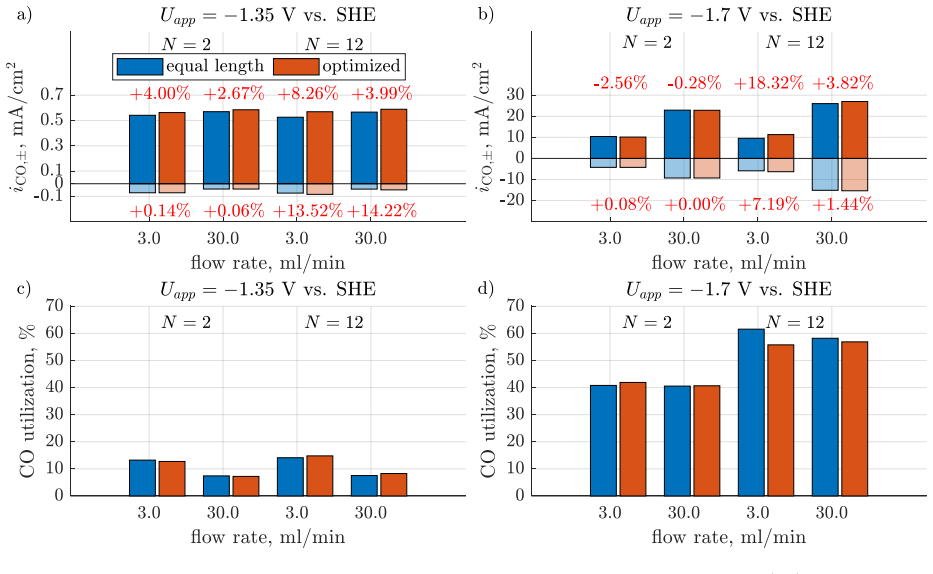
Integration of continuum transport modeling with adjoint optimization modifies the Ag/Cu surface patterning to maximize current density toward ethylene. For an applied voltage of -1.7 V vs. SHE, the 12-section optimized design increases the current density towards ethylene by up to 65% compared to the unoptimized 2-section design. Observed differences in CO production and consumption together with minimized zones of low CO reactant surface concentration on Cu sections account for the improved reactor performance.
What carries the argument
Adjoint-method optimization that varies the spatial arrangement of Ag and Cu catalyst sections inside a two-dimensional flow-reactor transport model to maximize ethylene current density.
If this is right
- Larger performance gains appear at more negative voltages where reaction rates are faster.
- Increasing the number of patterning sections yields further improvements in the optimized designs.
- Better control of local CO concentration on copper surfaces directly raises ethylene production.
- The same modeling approach can be used to target other high-value CO2 reduction products by changing the objective function.
Where Pith is reading between the lines
- If the optimized patterns transfer to three-dimensional or porous electrodes, the same computational route could cut experimental iteration time for reactor scale-up.
- The method may generalize to tandem systems that combine different metals or target different intermediates such as ethanol.
- Running the optimizer at multiple voltages could produce voltage-specific patterns that further increase overall energy efficiency.
Load-bearing premise
The continuum transport model and its reaction rate parameters correctly describe the real physical flow, diffusion, and surface reaction rates inside the reactor.
What would settle it
Build and test a physical flow reactor using the exact 12-section optimized Ag/Cu pattern at -1.7 V vs SHE and measure whether the ethylene partial current density is 65% higher than in a simple 2-section layout.
Figures





read the original abstract
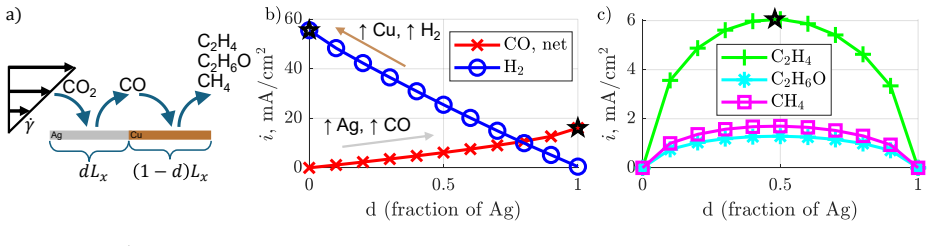
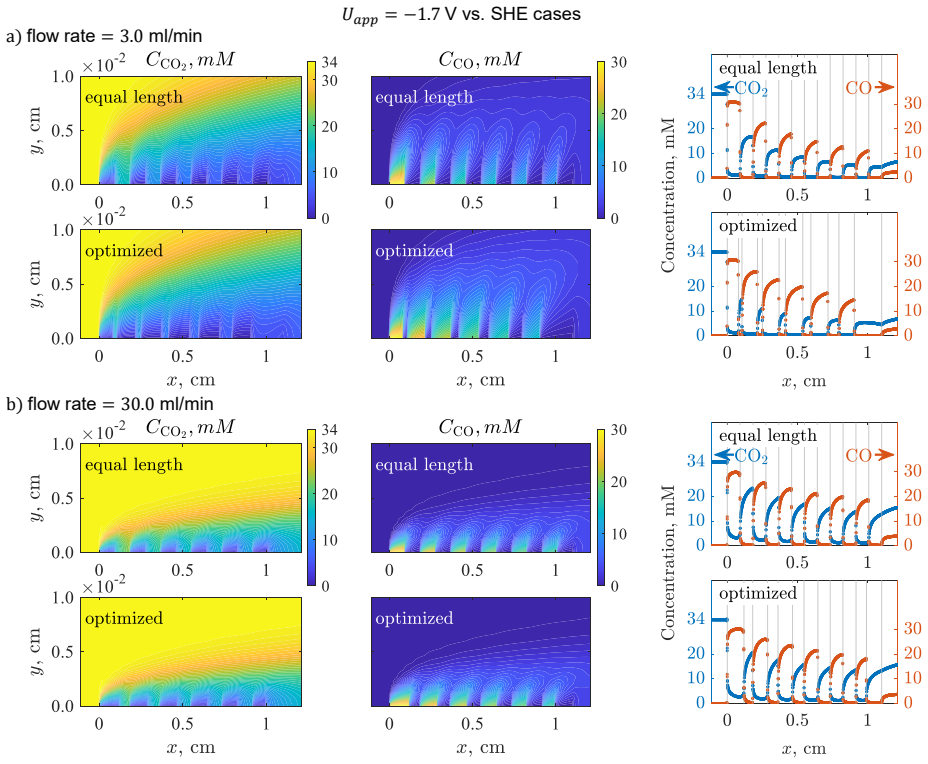
Tandem catalysis involves two or more catalysts arranged in proximity within a single reaction vessel, with the aim of synergistically aligning the catalysts' reaction pathways to maximize overall system performance. This study presents a proof of concept showing the integration of continuum transport modeling with design optimization in a simplified two-dimensional flow reactor setup for electrochemical CO$_2$ reduction. Ag catalysts provide the CO$_2$ $\rightarrow$ CO reaction capability, and Cu catalysts provide the CO $\rightarrow$ high-value products reaction capability. Given a set of input parameters, the optimization algorithm uses adjoint methods to modify the Ag/Cu surface patterning in order to maximize the current density toward high-value products, such as ethylene. The optimized designs yield significant performance enhancement especially at more negative applied voltages (i.e., stronger surface reactions) and for larger numbers of patterning sections. For an applied voltage of $-1.7$ V vs. SHE, the $12$-section optimized design increases the current density towards ethylene by up to $65$% compared to the unoptimized $2$-section design. For the optimized cases, observed differences in the production and consumption of CO (the key intermediate species) and minimized zones of low CO reactant surface concentration on Cu sections explain the improved reactor performance.
Editorial analysis
A structured set of objections, weighed in public.
Referee Report
Summary. The manuscript presents a proof-of-concept for integrating 2D continuum transport modeling with adjoint-based optimization to pattern Ag and Cu catalysts in an electrochemical CO2 reduction flow reactor. Ag sections drive CO2 to CO conversion while Cu sections convert CO to ethylene and other products. The optimization modifies the spatial arrangement of catalyst sections to maximize ethylene current density. The central quantitative result is that, at an applied voltage of -1.7 V vs. SHE, a 12-section optimized patterning increases ethylene current density by up to 65% relative to an unoptimized 2-section baseline, with the gain attributed to improved production/consumption balance of the CO intermediate and reduced low-CO zones on Cu surfaces.
Significance. If the underlying transport and kinetic model is accurate, the work demonstrates a systematic computational route to improve tandem catalyst performance in flow reactors without exhaustive experimental trial-and-error. The adjoint-method optimization and the mechanistic link to CO surface concentration profiles are clear strengths that could guide future reactor designs for CO2-to-ethylene conversion.
major comments (2)
- [Methods (continuum model)] Methods section (continuum model and discretization): the 2D transport equations and boundary conditions are solved to obtain the current densities that enter the optimization objective, yet no mesh-convergence study, grid-refinement test, or discretization-error estimate is reported. Because the 65% gain is a direct numerical output of this PDE solution, lack of demonstrated numerical accuracy is load-bearing for the quantitative claim.
- [Results (optimization at -1.7 V)] Results (optimization at -1.7 V, 12-section case): the reported 65% ethylene current-density increase is obtained with fixed literature kinetic parameters and transport coefficients. No sensitivity analysis to plausible variations in key rates (e.g., CO2-to-CO rate on Ag or CO reduction rates on Cu) or diffusivities is provided. The magnitude of the improvement is therefore tied to the specific parameter set chosen, which directly affects the central performance claim.
minor comments (2)
- [Abstract] Abstract: the phrase 'up to 65%' should be accompanied by the precise configuration (voltage, number of sections, and baseline) in which the maximum occurs so readers can locate the corresponding figure or table without ambiguity.
- [Figures] Figure captions (concentration profiles): units and color-bar scales for CO surface concentration should be stated explicitly to allow quantitative comparison of the 'minimized low-CO zones' cited in the mechanistic explanation.
Simulated Author's Rebuttal
We thank the referee for their constructive review and for recognizing the potential of adjoint-based optimization for tandem catalyst patterning in CO2 reduction reactors. We address each major comment below and have revised the manuscript to strengthen the numerical validation and parameter robustness of our results.
read point-by-point responses
-
Referee: [Methods (continuum model)] Methods section (continuum model and discretization): the 2D transport equations and boundary conditions are solved to obtain the current densities that enter the optimization objective, yet no mesh-convergence study, grid-refinement test, or discretization-error estimate is reported. Because the 65% gain is a direct numerical output of this PDE solution, lack of demonstrated numerical accuracy is load-bearing for the quantitative claim.
Authors: We agree that explicit demonstration of numerical accuracy is essential to support the reported performance gains. In the revised manuscript we have added a mesh-convergence subsection to the Methods. Simulations on successively refined unstructured meshes show that the ethylene current density changes by less than 1% once the element size falls below the resolution used in the optimization runs. This establishes that the 65% improvement is not sensitive to further grid refinement. revision: yes
-
Referee: [Results (optimization at -1.7 V)] Results (optimization at -1.7 V, 12-section case): the reported 65% ethylene current-density increase is obtained with fixed literature kinetic parameters and transport coefficients. No sensitivity analysis to plausible variations in key rates (e.g., CO2-to-CO rate on Ag or CO reduction rates on Cu) or diffusivities is provided. The magnitude of the improvement is therefore tied to the specific parameter set chosen, which directly affects the central performance claim.
Authors: We acknowledge that the absolute magnitude of the gain is parameter-dependent. To address this, the revised manuscript now contains a sensitivity study in which the principal kinetic constants (CO2-to-CO on Ag and CO-to-ethylene on Cu) and diffusivities are varied by ±20% around the literature values. Across this ensemble the optimized 12-section patterning still produces ethylene current-density improvements between 42% and 78%. These results have been added to the Results section together with a brief discussion of robustness. revision: yes
Circularity Check
No circularity: optimization outputs are direct numerical results on the stated model
full rationale
The paper applies adjoint-based optimization to a 2D continuum transport model to pattern Ag and Cu sections for ethylene current density maximization. The 65% improvement at -1.7 V is reported as the computed difference between the optimized 12-section design and the unoptimized 2-section baseline under the model's fixed parameters and equations. No self-definitional relations, fitted inputs renamed as predictions, or load-bearing self-citations appear in the abstract or described derivation; the central claim remains a straightforward simulation output rather than a reduction to its own inputs by construction.
Axiom & Free-Parameter Ledger
free parameters (2)
- applied voltage
- number of patterning sections
axioms (1)
- domain assumption Continuum transport model with given kinetics accurately captures species concentrations and current distributions in the 2D flow reactor.
Lean theorems connected to this paper
-
IndisputableMonolith/Cost/FunctionalEquation.leanwashburn_uniqueness_aczel unclear?
unclearRelation between the paper passage and the cited Recognition theorem.
The optimization algorithm uses adjoint methods to modify the Ag/Cu surface patterning in order to maximize the current density toward high-value products, such as ethylene.
-
IndisputableMonolith/Foundation/AlphaCoordinateFixation.leanJ_uniquely_calibrated_via_higher_derivative unclear?
unclearRelation between the paper passage and the cited Recognition theorem.
The optimized designs yield significant performance enhancement especially at more negative applied voltages... For an applied voltage of -1.7 V vs. SHE, the 12-section optimized design increases the current density towards ethylene by up to 65% compared to the unoptimized 2-section design.
What do these tags mean?
- matches
- The paper's claim is directly supported by a theorem in the formal canon.
- supports
- The theorem supports part of the paper's argument, but the paper may add assumptions or extra steps.
- extends
- The paper goes beyond the formal theorem; the theorem is a base layer rather than the whole result.
- uses
- The paper appears to rely on the theorem as machinery.
- contradicts
- The paper's claim conflicts with a theorem or certificate in the canon.
- unclear
- Pith found a possible connection, but the passage is too broad, indirect, or ambiguous to say the theorem truly supports the claim.
Reference graph
Works this paper leans on
-
[1]
Modeling gas-diffusion electrodes for CO2 reduction
Lien-Chun Weng, Alexis T Bell, and Adam Z Weber. Modeling gas-diffusion electrodes for CO2 reduction. Physical Chemistry Chemical Physics , 20(25):16973–16984, 2018
work page 2018
-
[2]
Diffusion: mass transfer in fluid systems
Edward Lansing Cussler. Diffusion: mass transfer in fluid systems . Cambridge University Press, 2009
work page 2009
-
[3]
Gas treating with chemical reaction
G Astarita, DW Savage, and A Bisio. Gas treating with chemical reaction. Wiley, New York , 213(216):817–822, 1983
work page 1983
-
[4]
Kai G Schulz, Ulf Riebesell, Bjoern Rost, Silke Thoms, and RE Zeebe. Determination of the rate constants for the carbon dioxide to bicarbonate inter-conversion in pH-buffered seawater systems. Marine Chemistry , 100(1-2):53–65, 2006
work page 2006
-
[5]
Joy S Zeng, Nathan Corbin, Kindle Williams, and Karthish Manthiram. Kinetic analysis on the role of bicarbonate in carbon dioxide electroreduction at immobilized cobalt phthalocyanine. ACS Catalysis , 10(7):4326–4336, 2020
work page 2020
-
[6]
Analysis of the reactive CO2 surface flux in electrocatalytic aqueous flow reactors
Tiras Y Lin, Sarah E Baker, Eric B Duoss, and Victor A Beck. Analysis of the reactive CO2 surface flux in electrocatalytic aqueous flow reactors. Industrial & Engineering Chemistry Research, 60(31):11824–11833, 2021
work page 2021
-
[7]
Introduction to fluid dynamics for microfluidic flows
Howard A Stone. Introduction to fluid dynamics for microfluidic flows. In CMOS Biotechnology, pages 5–30. Springer, 2007
work page 2007
-
[8]
Kaitlin Rae M Corpus, Justin C Bui, Aditya M Limaye, Lalit M Pant, Karthish Manthiram, Adam Z Weber, and Alexis T Bell. Coupling covariance matrix adaptation with continuum modeling for determination of kinetic parameters associated with electrochemical CO 2 reduc- tion. Joule, 2023
work page 2023
-
[9]
Ezra L Clark, Stefan Ringe, Michael Tang, Amber Walton, Christopher Hahn, Thomas F Jaramillo, Karen Chan, and Alexis T Bell. Influence of atomic surface structure on the activity of Ag for the electrochemical reduction of CO 2 to CO. ACS Catalysis , 9(5):4006–4014, 2019. 15
work page 2019
-
[10]
David M Koshy, Sneha A Akhade, Adam Shugar, Kabir Abiose, Jingwei Shi, Siwei Liang, James S Oakdale, Stephen E Weitzner, Joel B Varley, Eric B Duoss, Sarah E Baker, Christopher Hahn, Zhenan Bao, and Thomas F Jaramillo. Chemical modifications of Ag catalyst surfaces with imidazolium ionomers modulate H 2 evolution rates during electrochemical CO 2 reduction...
work page 2021
-
[11]
Electrokinetic and in situ spectroscopic investigations of CO electrochemical reduction on copper
Jing Li, Xiaoxia Chang, Haochen Zhang, Arnav S Malkani, Mu-Jeng Cheng, Bingjun Xu, and Qi Lu. Electrokinetic and in situ spectroscopic investigations of CO electrochemical reduction on copper. Nature Communications, 12(1):3264, 2021. 16
work page 2021
discussion (0)
Sign in with ORCID, Apple, or X to comment. Anyone can read and Pith papers without signing in.