Hunting for Neutrino Texture Zeros with Muon and Tau Flavor Violation
Pith reviewed 2026-05-17 23:27 UTC · model grok-4.3
The pith
Two-zero textures in the neutrino mass matrix predict distinctive patterns of charged lepton flavor violation.
A machine-rendered reading of the paper's core claim, the machinery that carries it, and where it could break.
Core claim
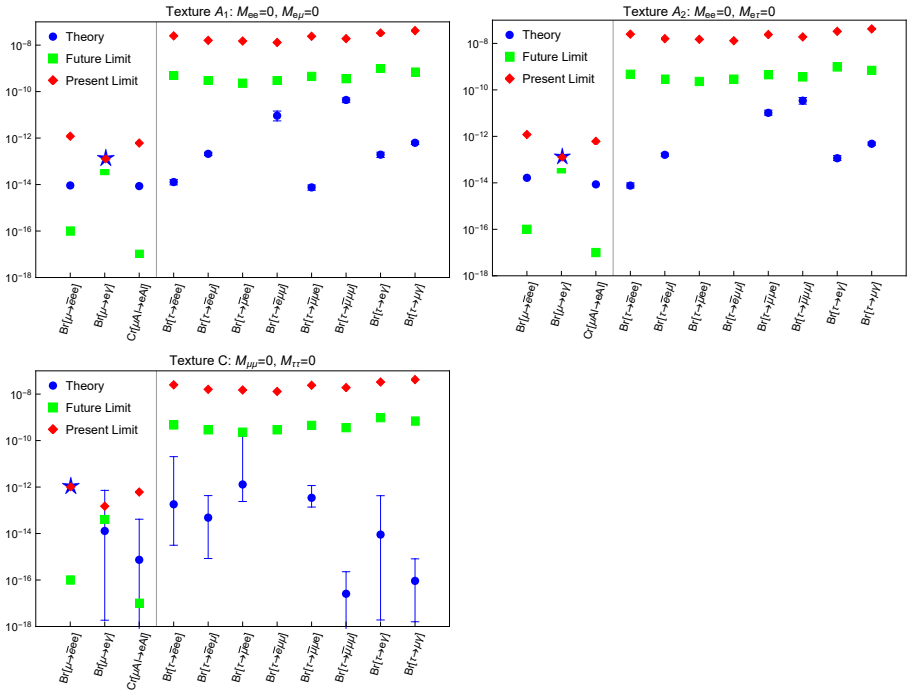
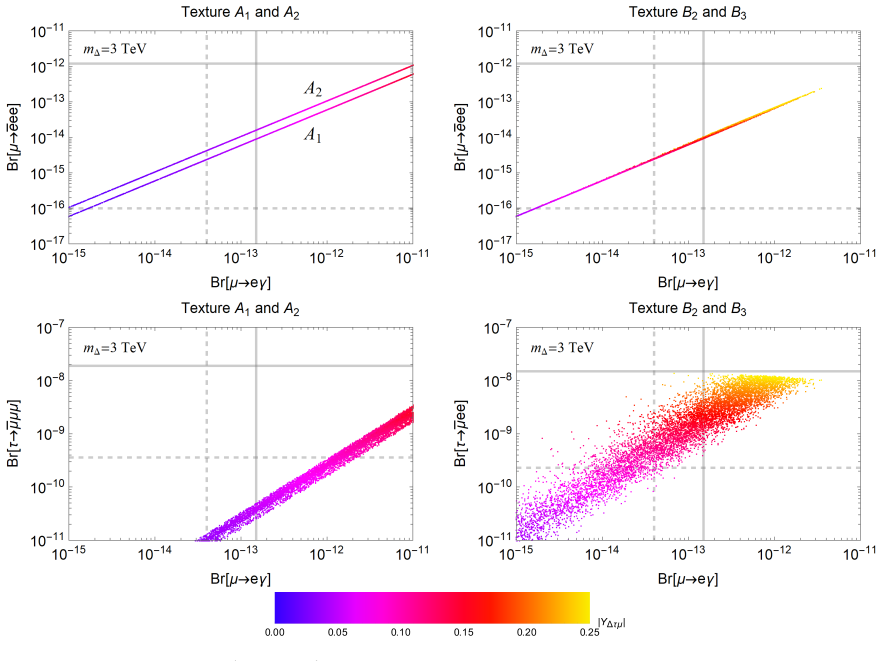
In the minimal type II seesaw mechanism, the assumption of two vanishing entries in the Majorana neutrino mass matrix at a high scale leads to specific correlations among charged lepton flavor violation observables that are fixed by the measured neutrino mixing angles and masses. For the phenomenologically allowed textures, these correlations yield distinctive patterns in processes such as radiative decays and three-body decays involving muons and taus. Certain of these textures suppress μ to e transitions sufficiently to evade current bounds while predicting rates for τ to μ ee that lie within the reach of upcoming experiments like Belle II, even after renormalization group evolution is包括.
What carries the argument
Two-zero textures in the Majorana neutrino mass matrix M^ν of the minimal type II seesaw, which generate correlated predictions for rates of CLFV processes based on neutrino oscillation parameters.
Load-bearing premise
That exactly two entries in the Majorana neutrino mass matrix vanish at some high energy scale, with the minimal type II seesaw being the only mechanism generating neutrino masses and the zeros imposed as a spurion in the low-energy theory.
What would settle it
A measurement of CLFV rates whose correlations do not match those predicted for any of the allowed two-zero textures given the current neutrino oscillation parameters.
Figures



read the original abstract
We revisit the minimal type II seesaw mechanism generating the Majorana neutrino mass matrix $M^{\nu}$, under the assumption that two entries of $M^{\nu}$ vanish. Such flavor structures are known as two-zero textures. Processes with charged lepton flavor violation (CLFV), absent in the Standard Model (SM), can have sizable rates in this framework and are directly linked to the flavor structure of $M^{\nu}$. For each allowed two-zero texture, we quantify the predicted correlations among various CLFV observables using current neutrino oscillation data and show that they lead to distinctive patterns of CLFV processes that could be discriminated between at running and upcoming experiments. In addition, together with information from colliders, the sensitivity of these correlations to renormalization group (RG) effects could shed light on the potentially ultra-high scale where new dynamics (e.g. some underlying flavor symmetry) give rise to the two-zero texture. Furthermore, we find that certain zero textures, although not third-generation specific, can suppress $\mu\to e$ transitions while allowing the rate of the process $\tau\to \bar\mu ee$ to be within the future experimental sensitivity, even when the RG evolution is taken into account. The lowest possible cut-off scale of the effective theory, constructed by treating the two-zero flavor structure of $M^{\nu}$ as a CLFV spurion, can therefore reach $5-6$ TeV. Our results provide further motivation for searches for $\tau$ CLFV at Belle II, as probes of new physics complementary to MEG II and the upcoming Mu3e, COMET, and Mu2e experiments, as well as for collider searches for doubly charged scalar bosons.
Editorial analysis
A structured set of objections, weighed in public.
Referee Report
Summary. The paper revisits the minimal type II seesaw mechanism with the assumption that exactly two entries of the Majorana neutrino mass matrix M^ν vanish at a high scale. For each allowed two-zero texture, it uses current neutrino oscillation parameters together with RG evolution to predict correlations among CLFV observables (such as μ→eγ, τ→μγ, and τ→μ̄ee), identifies distinctive patterns that could be discriminated at future experiments, and argues that certain textures suppress μ→e transitions while keeping τ→μ̄ee within Belle II reach, yielding a lowest effective-theory cutoff of 5-6 TeV when the texture zeros are promoted to CLFV spurions.
Significance. If the central results hold, the work supplies concrete, falsifiable correlations between neutrino mass textures and low-energy CLFV rates that complement direct searches for doubly charged scalars. The inclusion of RG running and the use of existing oscillation data add robustness; the identification of textures that decouple μ→e from τ processes provides a clear experimental target for Belle II, Mu3e, COMET, and Mu2e.
major comments (1)
- [Effective theory and spurion construction] The 5-6 TeV cutoff claim (abstract and the section deriving the spurion effective theory) rests on treating the exact two-zero texture of M^ν as a CLFV spurion whose leading operators are generated without additional same-dimension contributions from the UV dynamics that enforces the texture. The manuscript does not provide an explicit matching or power-counting argument showing that no extra operators lift the μ→e suppression at the same scale that keeps τ→μ̄ee observable; if such operators are present, the quoted cutoff would increase.
minor comments (1)
- [Abstract] The abstract refers to 'the lowest possible cut-off scale' without a cross-reference to the numerical procedure or equation that produces the 5-6 TeV figure; adding such a pointer would improve readability.
Simulated Author's Rebuttal
We thank the referee for the careful reading of our manuscript and the positive assessment of its significance. We address the major comment below and outline the revisions we will make to improve the presentation of the effective theory analysis.
read point-by-point responses
-
Referee: The 5-6 TeV cutoff claim (abstract and the section deriving the spurion effective theory) rests on treating the exact two-zero texture of M^ν as a CLFV spurion whose leading operators are generated without additional same-dimension contributions from the UV dynamics that enforces the texture. The manuscript does not provide an explicit matching or power-counting argument showing that no extra operators lift the μ→e suppression at the same scale that keeps τ→μ̄ee observable; if such operators are present, the quoted cutoff would increase.
Authors: We agree that the manuscript does not contain an explicit UV matching calculation or detailed power-counting analysis for possible additional operators. The spurion construction is presented as a minimal, model-independent way to translate the two-zero texture into an estimate of the scale at which the flavor structure must be generated, under the assumption that the leading CLFV effects arise from the operators obtained by promoting the zeros. This yields the quoted 5-6 TeV lower bound when the μ→e suppression is preserved while τ→μ̄ee remains observable. We will add a short clarifying paragraph in the spurion section that explicitly states the assumptions of this approach, notes that extra same-dimension operators could arise in specific UV completions, and emphasizes that the 5-6 TeV figure is therefore a conservative estimate rather than a model-independent result. The abstract will be updated accordingly to avoid overstatement. The core predictions for CLFV correlations and their RG evolution are unaffected by this clarification. revision: partial
Circularity Check
No significant circularity: CLFV predictions derived from explicit texture assumptions plus external oscillation data
full rationale
The paper starts from the explicit model assumption that exactly two entries of M^ν vanish at a high scale in the minimal type-II seesaw, constrains the remaining parameters with current neutrino oscillation data, evolves the resulting flavor structures via RG equations, and computes the induced CLFV rates in the low-energy effective theory. The spurion construction that generates the leading CLFV operators is introduced as a direct consequence of promoting the texture zeros; the quoted 5-6 TeV cut-off is the lowest scale at which the predicted BR(τ→μ̄ee) enters future sensitivity while BR(μ→e) remains suppressed. None of these steps reduces to a fit of the CLFV observables themselves, nor does any load-bearing step rely on a self-citation whose content is unverified or defined circularly. The derivation is therefore self-contained against external benchmarks and falsifiable at Belle II, MEG II, Mu3e, etc.
Axiom & Free-Parameter Ledger
free parameters (1)
- non-zero entries of M^ν
axioms (2)
- domain assumption Minimal type II seesaw generates M^ν via a scalar triplet
- ad hoc to paper Exactly two entries of M^ν vanish
Lean theorems connected to this paper
-
IndisputableMonolith/Foundation/AbsoluteFloorClosure.leanreality_from_one_distinction unclear?
unclearRelation between the paper passage and the cited Recognition theorem.
We revisit the minimal type II seesaw mechanism generating the Majorana neutrino mass matrix M^ν, under the assumption that two entries of M^ν vanish. Such flavor structures are known as two-zero textures.
-
IndisputableMonolith/Cost/FunctionalEquation.leanwashburn_uniqueness_aczel unclear?
unclearRelation between the paper passage and the cited Recognition theorem.
The lowest possible cut-off scale of the effective theory, constructed by treating the two-zero flavor structure of M^ν as a CLFV spurion, can therefore reach 5-6 TeV.
What do these tags mean?
- matches
- The paper's claim is directly supported by a theorem in the formal canon.
- supports
- The theorem supports part of the paper's argument, but the paper may add assumptions or extra steps.
- extends
- The paper goes beyond the formal theorem; the theorem is a base layer rather than the whole result.
- uses
- The paper appears to rely on the theorem as machinery.
- contradicts
- The paper's claim conflicts with a theorem or certificate in the canon.
- unclear
- Pith found a possible connection, but the passage is too broad, indirect, or ambiguous to say the theorem truly supports the claim.
Reference graph
Works this paper leans on
-
[1]
Charged Lepton Flavour Violation: An Experimental and Theoretical Introduction
L. Calibbi and G. Signorelli,Charged Lepton Flavour Violation: An Experimental and Theoretical Introduction,Riv. Nuovo Cim.41(2018) 71–174, [1709.00294]
work page internal anchor Pith review Pith/arXiv arXiv 2018
-
[2]
F. Feruglio,Pieces of the Flavour Puzzle,Eur. Phys. J. C75(2015) 373, [1503.04071]
work page internal anchor Pith review Pith/arXiv arXiv 2015
-
[3]
Xing,Flavor structures of charged fermions and massive neutrinos,Phys
Z.-z. Xing,Flavor structures of charged fermions and massive neutrinos,Phys. Rept.854 (2020) 1–147, [1909.09610]
-
[4]
Weinberg,The Problem of Mass,Trans
S. Weinberg,The Problem of Mass,Trans. New York Acad. Sci.38(1977) 185–201
work page 1977
-
[5]
A. De Rujula, H. Georgi and S. L. Glashow,A Theory of Flavor Mixing,Annals Phys. 109(1977) 258
work page 1977
-
[6]
F. Wilczek and A. Zee,Discrete Flavor Symmetries and a Formula for the Cabibbo Angle,Phys. Lett. B70(1977) 418
work page 1977
-
[7]
Fritzsch,Calculating the Cabibbo Angle,Phys
H. Fritzsch,Calculating the Cabibbo Angle,Phys. Lett. B70(1977) 436–440
work page 1977
-
[8]
Lepton Mass Hierarchy and Neutrino Oscillations
H. Fritzsch and Z.-Z. Xing,Lepton mass hierarchy and neutrino oscillations,Phys. Lett. B372(1996) 265–270, [hep-ph/9509389]
work page internal anchor Pith review Pith/arXiv arXiv 1996
-
[9]
P. F. Harrison, D. H. Perkins and W. G. Scott,Tri-bimaximal mixing and the neutrino oscillation data,Phys. Lett. B530(2002) 167, [hep-ph/0202074]
work page internal anchor Pith review Pith/arXiv arXiv 2002
-
[10]
Nearly Tri-Bimaximal Neutrino Mixing and CP Violation
Z.-z. Xing,Nearly tri bimaximal neutrino mixing and CP violation,Phys. Lett. B533 (2002) 85–93, [hep-ph/0204049]
work page internal anchor Pith review Pith/arXiv arXiv 2002
-
[11]
P. F. Harrison and W. G. Scott,Symmetries and generalizations of tri-bimaximal neutrino mixing,Phys. Lett. B535(2002) 163–169, [hep-ph/0203209]
work page internal anchor Pith review Pith/arXiv arXiv 2002
-
[12]
X. G. He and A. Zee,Some simple mixing and mass matrices for neutrinos,Phys. Lett. B560(2003) 87–90, [hep-ph/0301092]
work page internal anchor Pith review Pith/arXiv arXiv 2003
-
[13]
Tri-Bimaximal Neutrino Mixing, A4 and the Modular Symmetry
G. Altarelli and F. Feruglio,Tri-bimaximal neutrino mixing,A4 and the modular symmetry,Nucl. Phys. B741(2006) 215–235, [hep-ph/0512103]
work page internal anchor Pith review Pith/arXiv arXiv 2006
-
[14]
P. H. Frampton, S. L. Glashow and D. Marfatia,Zeroes of the neutrino mass matrix, Phys. Lett. B536(2002) 79–82, [hep-ph/0201008]
work page internal anchor Pith review Pith/arXiv arXiv 2002
-
[15]
Texture Zeros and Majorana Phases of the Neutrino Mass Matrix
Z.-z. Xing,Texture zeros and Majorana phases of the neutrino mass matrix,Phys. Lett. B530(2002) 159–166, [hep-ph/0201151]
work page internal anchor Pith review Pith/arXiv arXiv 2002
-
[16]
See-Saw Realization of the Texture Zeros in the Neutrino Mass Matrix
A. Kageyama, S. Kaneko, N. Shimoyama and M. Tanimoto,Seesaw realization of the texture zeros in the neutrino mass matrix,Phys. Lett. B538(2002) 96–106, [hep-ph/0204291]. 24
work page internal anchor Pith review Pith/arXiv arXiv 2002
-
[17]
Z.-z. Xing,A Full determination of the neutrino mass spectrum from two zero textures of the neutrino mass matrix,Phys. Lett. B539(2002) 85–90, [hep-ph/0205032]
work page internal anchor Pith review Pith/arXiv arXiv 2002
-
[18]
Neutrino mass matrix: inverted hierarchy and CP violation
M. Frigerio and A. Y. Smirnov,Neutrino mass matrix: Inverted hierarchy and CP violation,Phys. Rev. D67(2003) 013007, [hep-ph/0207366]
work page internal anchor Pith review Pith/arXiv arXiv 2003
-
[19]
B. R. Desai, D. P. Roy and A. R. Vaucher,Three neutrino mass matrices with two texture zeros,Mod. Phys. Lett. A18(2003) 1355–1366, [hep-ph/0209035]
work page internal anchor Pith review Pith/arXiv arXiv 2003
-
[20]
W.-l. Guo and Z.-z. Xing,Implications of the KamLAND measurement on the lepton flavor mixing matrix and the neutrino mass matrix,Phys. Rev. D67(2003) 053002, [hep-ph/0212142]
work page internal anchor Pith review Pith/arXiv arXiv 2003
-
[21]
Two-zero Textures of the Majorana Neutrino Mass Matrix and Current Experimental Tests
H. Fritzsch, Z.-z. Xing and S. Zhou,Two-zero Textures of the Majorana Neutrino Mass Matrix and Current Experimental Tests,JHEP09(2011) 083, [1108.4534]
work page internal anchor Pith review Pith/arXiv arXiv 2011
-
[22]
Two-zero Majorana textures in the light of the Planck results
D. Meloni, A. Meroni and E. Peinado,Two-zero Majorana textures in the light of the Planck results,Phys. Rev. D89(2014) 053009, [1401.3207]
work page internal anchor Pith review Pith/arXiv arXiv 2014
-
[23]
S. Zhou,Update on two-zero textures of the Majorana neutrino mass matrix in light of recent T2K, Super-Kamiokande and NOνA results,Chin. Phys. C40(2016) 033102, [1509.05300]
work page internal anchor Pith review Pith/arXiv arXiv 2016
-
[24]
Fitting flavour symmetries: the case of two-zero neutrino mass textures
J. Alcaide, J. Salvado and A. Santamaria,Fitting flavour symmetries: the case of two-zero neutrino mass textures,JHEP07(2018) 164, [1806.06785]
work page internal anchor Pith review Pith/arXiv arXiv 2018
-
[25]
M. Singh,Testing texture two-zero neutrino mass matrices under current experimental scenario,EPL129(2020) 1, [1909.01552]
-
[26]
G. Chauhan, P. S. B. Dev, I. Dubovyk, B. Dziewit, W. Flieger, K. Grzanka et al., Phenomenology of lepton masses and mixing with discrete flavor symmetries,Prog. Part. Nucl. Phys.138(2024) 104126, [2310.20681]
-
[27]
W. Treesukrat, N. Supanam and P. Uttayarat,Revisiting the two-zero texture Majorana neutrino mass matrix,Phys. Rev. D111(2025) 075003, [2501.11572]. [28]JUNOcollaboration, F. An et al.,Neutrino Physics with JUNO,J. Phys. G43(2016) 030401, [1507.05613]. [29]DUNEcollaboration, R. Acciarri et al.,Long-Baseline Neutrino Facility (LBNF) and Deep Underground Ne...
-
[28]
R. S. Chivukula and H. Georgi,Composite Technicolor Standard Model,Phys. Lett. B 188(1987) 99–104
work page 1987
-
[29]
Minimal Flavour Violation: an effective field theory approach
G. D’Ambrosio, G. F. Giudice, G. Isidori and A. Strumia,Minimal flavor violation: An Effective field theory approach,Nucl. Phys. B645(2002) 155–187, [hep-ph/0207036]
work page internal anchor Pith review Pith/arXiv arXiv 2002
-
[30]
Minimal Flavor Violation in the Lepton Sector
V. Cirigliano, B. Grinstein, G. Isidori and M. B. Wise,Minimal flavor violation in the lepton sector,Nucl. Phys. B728(2005) 121–134, [hep-ph/0507001]
work page internal anchor Pith review Pith/arXiv arXiv 2005
-
[31]
Various definitions of Minimal Flavour Violation for Leptons
S. Davidson and F. Palorini,Various definitions of Minimal Flavour Violation for Leptons,Phys. Lett. B642(2006) 72–80, [hep-ph/0607329]
work page internal anchor Pith review Pith/arXiv arXiv 2006
-
[32]
Minimal Flavour Violation and Beyond
G. Isidori and D. M. Straub,Minimal Flavour Violation and Beyond,Eur. Phys. J. C 72(2012) 2103, [1202.0464]. 25
work page internal anchor Pith review Pith/arXiv arXiv 2012
-
[33]
U(2) and Minimal Flavour Violation in Supersymmetry
R. Barbieri, G. Isidori, J. Jones-Perez, P. Lodone and D. M. Straub,U(2)and Minimal Flavour Violation in Supersymmetry,Eur. Phys. J. C71(2011) 1725, [1105.2296]
work page internal anchor Pith review Pith/arXiv arXiv 2011
-
[34]
Flavour physics from an approximate U(2)^3 symmetry
R. Barbieri, D. Buttazzo, F. Sala and D. M. Straub,Flavour physics from an approximateU(2) 3 symmetry,JHEP07(2012) 181, [1203.4218]
work page internal anchor Pith review Pith/arXiv arXiv 2012
-
[35]
Neutrino masses and LFV from minimal breaking of U(3)^5 and U(2)^5 flavor symmetries
G. Blankenburg, G. Isidori and J. Jones-Perez,Neutrino Masses and LFV from Minimal Breaking ofU(3) 5 andU(2) 5 flavor Symmetries,Eur. Phys. J. C72(2012) 2126, [1204.0688]
work page internal anchor Pith review Pith/arXiv arXiv 2012
- [36]
-
[37]
L. Allwicher, C. Cornella, G. Isidori and B. A. Stefanek,New physics in the third generation. A comprehensive SMEFT analysis and future prospects,JHEP03(2024) 049, [2311.00020]
-
[38]
L. Allwicher, G. Isidori and M. Pesut,Flavored circular collider: cornering New Physics at FCC-ee via flavor-changing processes,Eur. Phys. J. C85(2025) 631, [2503.17019]
- [39]
-
[40]
Interpretation of Lepton Flavor Violation
J. Heeck,Interpretation of Lepton Flavor Violation,Phys. Rev. D95(2017) 015022, [1610.07623]
work page internal anchor Pith review Pith/arXiv arXiv 2017
-
[41]
Lepton Flavour Violation in Models with A4 Flavour Symmetry
F. Feruglio, C. Hagedorn, Y. Lin and L. Merlo,Lepton Flavour Violation in Models with A(4) Flavour Symmetry,Nucl. Phys. B809(2009) 218–243, [0807.3160]
work page internal anchor Pith review Pith/arXiv arXiv 2009
-
[42]
C. Hagedorn, E. Molinaro and S. T. Petcov,Charged Lepton Flavour Violating Radiative Decaysℓ i →ℓ j +γin See-Saw Models withA 4 Symmetry,JHEP02(2010) 047, [0911.3605]
work page internal anchor Pith review Pith/arXiv arXiv 2010
-
[43]
Lepton Flavour Violation in a Supersymmetric Model with A4 Flavour Symmetry
F. Feruglio, C. Hagedorn, Y. Lin and L. Merlo,Lepton Flavour Violation in a Supersymmetric Model withA4 Flavour Symmetry,Nucl. Phys. B832(2010) 251–288, [0911.3874]
work page internal anchor Pith review Pith/arXiv arXiv 2010
-
[44]
Neutrino Masses from an A4 Symmetry in Holographic Composite Higgs Models
F. del Aguila, A. Carmona and J. Santiago,Neutrino Masses from anA4 Symmetry in Holographic Composite Higgs Models,JHEP08(2010) 127, [1001.5151]
work page internal anchor Pith review Pith/arXiv arXiv 2010
-
[45]
A Model for Tri-bimaximal Mixing from a Completely Broken $A_4$
G.-J. Ding and D. Meloni,A Model for Tri-bimaximal Mixing from a Completely Broken A4,Nucl. Phys. B855(2012) 21–45, [1108.2733]
work page internal anchor Pith review Pith/arXiv arXiv 2012
-
[46]
Discrete Flavour Groups, \theta_13 and Lepton Flavour Violation
G. Altarelli, F. Feruglio, L. Merlo and E. Stamou,Discrete Flavour Groups,θ13 and Lepton Flavour Violation,JHEP08(2012) 021, [1205.4670]
work page internal anchor Pith review Pith/arXiv arXiv 2012
-
[47]
S. Pascoli and Y.-L. Zhou,Flavon-induced connections between lepton flavour mixing and charged lepton flavour violation processes,JHEP10(2016) 145, [1607.05599]
work page internal anchor Pith review Pith/arXiv arXiv 2016
-
[48]
Constraining $A_4$ Leptonic Flavour Model Parameters at Colliders and Beyond
L. Heinrich, H. Schulz, J. Turner and Y.-L. Zhou,Constraining A4 leptonic flavour model parameters at colliders and beyond,JHEP04(2019) 144, [1810.05648]
work page internal anchor Pith review Pith/arXiv arXiv 2019
-
[49]
T. Kobayashi, H. Otsuka, M. Tanimoto and K. Yamamoto,Modular symmetry in the SMEFT,Phys. Rev. D105(2022) 055022, [2112.00493]
-
[50]
T. Kobayashi, H. Otsuka, M. Tanimoto and K. Yamamoto,Lepton flavor violation, lepton (g−2) µ,e and electron EDM in the modular symmetry,JHEP08(2022) 013, [2204.12325]. 26
-
[51]
G.-J. Ding, X.-G. Liu and C.-Y. Yao,A minimal modular invariant neutrino model, JHEP01(2023) 125, [2211.04546]
-
[52]
I. Bigaran, X.-G. He, M. A. Schmidt, G. Valencia and R. Volkas,Lepton-flavor-violating tau decays from triality,Phys. Rev. D107(2023) 055001, [2212.09760]
-
[53]
G. Lichtenstein, M. A. Schmidt, G. Valencia and R. R. Volkas,Complementarity of µTRISTAN and Belle II in searches for charged-lepton flavour violation,Phys. Lett. B 845(2023) 138144, [2307.11369]
-
[54]
G. Lichtenstein, M. A. Schmidt, G. Valencia and R. R. Volkas,Z and Higgs boson decays with doubly-charged scalars at one-loop: Current constraints, future sensitivities, and application to lepton-triality models,Nucl. Phys. B1013(2025) 116850, [2312.09409]
-
[55]
Palavrić,Discrete leptonic flavor symmetries: UV mediators and phenomenology, Phys
A. Palavrić,Discrete leptonic flavor symmetries: UV mediators and phenomenology, Phys. Rev. D110(2024) 115025, [2408.16044]
-
[56]
A. Moreno-Sánchez and A. Palavrić,Leptonic Flavor from ModularA4: UV Mediators and SMEFT Realizations,2505.01535
-
[57]
L. Calibbi, C. Hagedorn, M. A. Schmidt and J. Vandeleur,Selection rules for charged lepton flavour violating processes from residual flavour groups,2505.24350
-
[58]
S. Jangid and H. Okada,A radiative seesaw model in a non-invertible selection rule with the assistance of a non-holomorphic modularA4 symmetry,2510.17292
-
[59]
M. Magg and C. Wetterich,Neutrino Mass Problem and Gauge Hierarchy,Phys. Lett. B 94(1980) 61–64
work page 1980
-
[60]
G. Lazarides, Q. Shafi and C. Wetterich,Proton Lifetime and Fermion Masses in an SO(10) Model,Nucl. Phys. B181(1981) 287–300
work page 1981
-
[61]
J. Schechter and J. W. F. Valle,Neutrino Masses inSU(2)N U(1)Theories,Phys. Rev. D22(1980) 2227
work page 1980
-
[62]
R. N. Mohapatra and G. Senjanovic,Neutrino Masses and Mixings in Gauge Models with Spontaneous Parity Violation,Phys. Rev. D23(1981) 165
work page 1981
-
[63]
G. B. Gelmini and M. Roncadelli,Left-Handed Neutrino Mass Scale and Spontaneously Broken Lepton Number,Phys. Lett. B99(1981) 411–415
work page 1981
-
[64]
Symmetry realization of texture zeros
W. Grimus, A. S. Joshipura, L. Lavoura and M. Tanimoto,Symmetry realization of texture zeros,Eur. Phys. J. C36(2004) 227–232, [hep-ph/0405016]
work page internal anchor Pith review Pith/arXiv arXiv 2004
-
[65]
On a model with two zeros in the neutrino mass matrix
W. Grimus and L. Lavoura,On a model with two zeros in the neutrino mass matrix,J. Phys. G31(2005) 693–702, [hep-ph/0412283]
work page internal anchor Pith review Pith/arXiv arXiv 2005
-
[66]
Predictive flavour symmetries of the neutrino mass matrix
M. Hirsch, A. S. Joshipura, S. Kaneko and J. W. F. Valle,Predictive flavour symmetries of the neutrino mass matrix,Phys. Rev. Lett.99(2007) 151802, [hep-ph/0703046]
work page internal anchor Pith review Pith/arXiv arXiv 2007
-
[67]
S. Dev, S. Gupta and R. R. Gautam,Zero Textures of the Neutrino Mass Matrix from Cyclic Family Symmetry,Phys. Lett. B701(2011) 605–608, [1106.3451]
work page internal anchor Pith review Pith/arXiv arXiv 2011
-
[68]
Vanishing Minors in the Neutrino Mass Matrix from Abelian Gauge Symmetries
T. Araki, J. Heeck and J. Kubo,Vanishing Minors in the Neutrino Mass Matrix from Abelian Gauge Symmetries,JHEP07(2012) 083, [1203.4951]
work page internal anchor Pith review Pith/arXiv arXiv 2012
-
[69]
S. Dev, R. R. Gautam, L. Singh and M. Gupta,Near Maximal Atmospheric Neutrino Mixing in Neutrino Mass Models with Two Texture Zeros,Phys. Rev. D90(2014) 013021, [1405.0566]. 27
work page internal anchor Pith review Pith/arXiv arXiv 2014
-
[70]
Abelian realization of phenomenological two-zero neutrino textures
R. González Felipe and H. Serôdio,Abelian realization of phenomenological two-zero neutrino textures,Nucl. Phys. B886(2014) 75–92, [1405.4263]
work page internal anchor Pith review Pith/arXiv arXiv 2014
-
[71]
J. M. Lamprea and E. Peinado,Seesaw scale discrete dark matter and two-zero texture Majorana neutrino mass matrices,Phys. Rev. D94(2016) 055007, [1603.02190]
work page internal anchor Pith review Pith/arXiv arXiv 2016
-
[72]
A Realistic U(2) Model of Flavor
M. Linster and R. Ziegler,A RealisticU(2)Model of Flavor,JHEP08(2018) 058, [1805.07341]
work page internal anchor Pith review Pith/arXiv arXiv 2018
-
[73]
Phenomenology of two texture zero neutrino mass in left-right symmetric model with $Z_8 \times Z_2$
H. Borgohain and M. K. Das,Phenomenology of two texture zero neutrino mass in left-right symmetric model withZ8 ×Z 2,JHEP02(2019) 129, [1810.04889]
work page internal anchor Pith review Pith/arXiv arXiv 2019
-
[74]
S. Verma, M. Kashav and S. Bhardwaj,Highly predictive and testableA4 flavor model within type-I and II seesaw framework and associated phenomenology,Nucl. Phys. B946 (2019) 114704, [1811.06249]
work page internal anchor Pith review Pith/arXiv arXiv 2019
-
[75]
D. Zhang,A modularA 4 symmetry realization of two-zero textures of the Majorana neutrino mass matrix,Nucl. Phys. B952(2020) 114935, [1910.07869]
-
[76]
F. Björkeroth, L. Di Luzio, F. Mescia and E. Nardi,Covert symmetries in the neutrino mass matrix,JHEP02(2020) 066, [1910.00576]
- [77]
-
[78]
G.-J. Ding and S. F. King,Neutrino mass and mixing with modular symmetry,Rept. Prog. Phys.87(2024) 084201, [2311.09282]
-
[79]
G.-X. Fang and Y.-L. Zhou,Fermion masses and mixing in SO(10) GUT with a universal two-zero texture,Chin. Phys.49(2025) 103107, [2410.18743]
-
[80]
Z. Jiang, B.-Y. Qu and G.-J. Ding,Texture-zeros in minimal seesaw from non-invertible symmetry fusion rules,2510.07236
discussion (0)
Sign in with ORCID, Apple, or X to comment. Anyone can read and Pith papers without signing in.