Recognition: 1 theorem link
· Lean TheoremGalactic foreground residue biases in cosmic-microwave-background lensing-convergence reconstruction and delensing of B-mode maps
Pith reviewed 2026-05-17 22:37 UTC · model grok-4.3
The pith
Galactic foreground residuals after cleaning bias CMB lensing reconstruction mostly through their Gaussian components, which remain comparable to cosmic variance and must be corrected for accurate B-mode delensing.
A machine-rendered reading of the paper's core claim, the machinery that carries it, and where it could break.
Core claim
Using realistic simulations of Galactic foregrounds and multi-frequency component separation, the residual foreground contribution to CMB lensing reconstruction errors is dominated by Gaussian components of the residual maps, with errors from non-Gaussian components around three orders of magnitude smaller even for the most complex models considered. Component separation reduces the overall Galactic contribution to lensing errors by one order of magnitude. The bias from the Gaussian residuals is small but comparable to the cosmic variance limit on the lensing power spectrum, so it is corrected when delensing B-mode maps and constraining the tensor-to-scalar ratio. For a simple quadratic delc
What carries the argument
Separation of Gaussian versus non-Gaussian contributions within the residual foreground maps after component separation, used to quantify their separate impacts on the quadratic estimator for lensing convergence.
If this is right
- Component separation is required to keep Galactic residuals from dominating lensing reconstruction errors.
- Explicit bias correction for the Gaussian residual term is needed to reach cosmic-variance-limited lensing spectra and unbiased tensor-to-scalar ratio constraints.
- With quadratic estimators, foreground residuals after cleaning remain two orders of magnitude below leftover lensing uncertainties in current delensing.
- For experiments achieving 90 percent delensing efficiency, foreground residuals will become one of the dominant error sources in B-mode maps.
Where Pith is reading between the lines
- Improved modeling of Gaussian foreground residuals could further reduce the bias correction step required for future delensing pipelines.
- The results imply that tests of delensing algorithms on real data should separately quantify Gaussian and non-Gaussian residual contributions rather than treating all residuals as a single contaminant.
- Similar Gaussian dominance may appear in other small-scale CMB analyses such as patchy reionization or cluster lensing once foreground cleaning reaches comparable depth.
Load-bearing premise
The simulations of Galactic foreground emission and multi-frequency component separation methods accurately represent the small-scale properties and residuals expected in next-generation CMB experiments.
What would settle it
Direct comparison of the measured power spectrum of small-scale non-Gaussianity in real residual maps from a CMB-S4-like experiment against the three-orders-of-magnitude suppression reported in the simulations.
Figures



read the original abstract
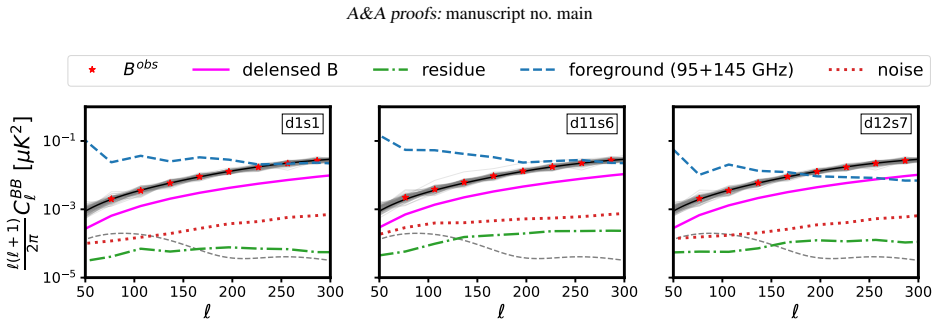
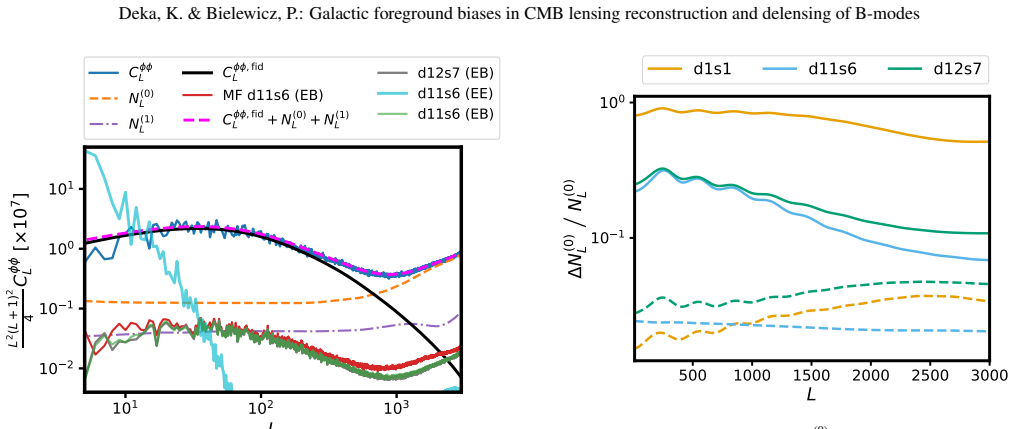
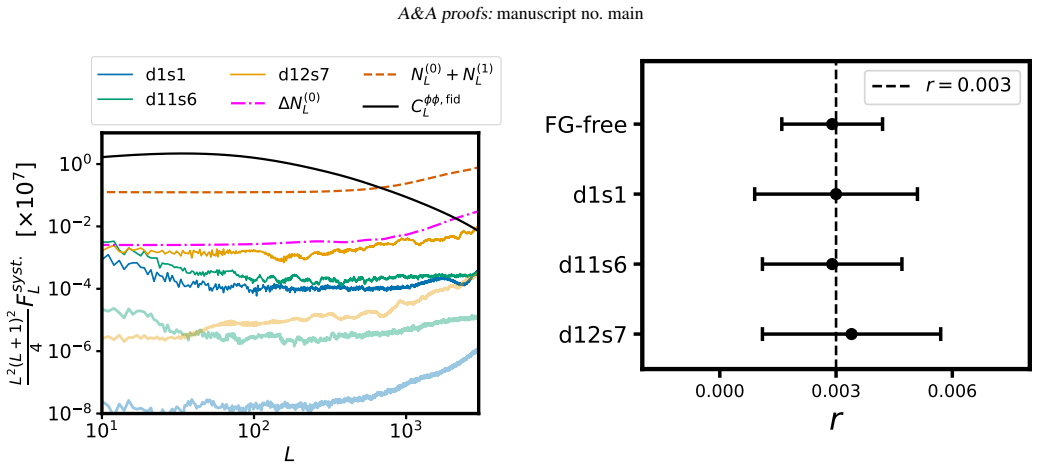
Diffuse contamination from Galactic foreground emission is one of the main concerns for reconstruction of the cosmic microwave background (CMB) lensing potential for next-generation CMB polarisation experiments. Using realistic simulations, we investigated the impact of Galactic foreground residuals from multi-frequency foreground-cleaning methods on CMB lensing reconstruction and the de-lensing of B-mode maps. We also assessed how these residuals affect constraints on the tensor-to-scalar ratio for a CMB-S4--like experiment. We paid special attention to the errors coming from the small scale non-Gaussianity of the foreground residuals. We show that component separation is essential for the lensing reconstruction that reduces Galactic emission contribution to the lensing reconstruction errors by one order of magnitude. The residual foreground contribution is dominated by terms coming from Gaussian components of the residual maps. Errors coming from non-Gaussian components are around three orders of magnitude smaller than the Gaussian one, even for recent and the most complex models of the Galactic emission considered in this work. Although the bias in the reconstruction errors due to the Gaussian component of the residuals being small, it is comparable to the cosmic variance limit for the lensing power spectrum. For this reason, we corrected for this bias in the de-lensing of B-mode maps and constraining the tensor-to-scalar ratio. We also show that for the de-lensed B-mode maps with a simple quadratic estimator, that is, residuals of the Galactic emission after component separation, errors are two orders of magnitude smaller than uncertainties from leftover of the lensing signal. However, for high-sensitivity CMB experiments and more efficient de-lensing algorithms that remove up to 90% of the lensing signal, the foreground residuals will become one of the main sources of errors.
Editorial analysis
A structured set of objections, weighed in public.
Referee Report
Summary. The manuscript uses realistic simulations of Galactic foregrounds (including recent complex models) and multi-frequency component separation to quantify residual biases in CMB lensing-convergence reconstruction and quadratic-estimator delensing of B-mode maps. It reports that component separation reduces foreground contamination to lensing errors by roughly one order of magnitude, that Gaussian components of the residuals dominate the error budget, and that non-Gaussian contributions are suppressed by three orders of magnitude even at small scales. The Gaussian residual bias, though small, is comparable to the cosmic-variance limit on the lensing power spectrum and is therefore corrected before delensing; after correction, foreground residuals remain two orders of magnitude below lensing residuals for a simple quadratic estimator but become a leading systematic for high-sensitivity experiments that achieve ~90 % delensing efficiency. Implications for the tensor-to-scalar ratio constraint in a CMB-S4-like survey are also assessed.
Significance. If the simulation results are robust, the work supplies a concrete, quantitative basis for foreground-mitigation strategies in next-generation CMB polarization surveys. It isolates the Gaussian versus non-Gaussian residual contributions, demonstrates that the latter are negligible, and shows that a straightforward bias correction suffices to keep foregrounds sub-dominant for current delensing algorithms. These findings directly inform survey design and analysis pipelines for CMB-S4 and similar experiments.
major comments (2)
- [§3] §3 (simulation and component-separation pipeline): the central claim that non-Gaussian residual contributions are three orders of magnitude smaller than Gaussian ones rests on the fidelity of the adopted Galactic emission models at ℓ ≳ 1000. No explicit validation against observed small-scale non-Gaussian statistics (e.g., dust or synchrotron bispectrum or kurtosis measurements) is presented; if the simulations under-represent the amplitude or scale dependence of non-Gaussianity, the reported suppression factor would not hold for real data.
- [§4.2] §4.2 (lensing-reconstruction error budget): the statement that the Gaussian residual bias is “comparable to the cosmic variance limit” and therefore requires correction is load-bearing for the subsequent delensing analysis. The precise numerical factor by which the bias exceeds or equals the cosmic-variance floor should be shown explicitly (e.g., via a table or figure comparing the two contributions as a function of multipole) rather than asserted qualitatively.
minor comments (2)
- [Figure 5] Figure 5 (or equivalent): the caption should explicitly state the multipole range over which the power spectra are averaged and whether the plotted curves include the full covariance or only diagonal errors.
- Notation: the symbol for the residual foreground map after component separation is introduced without a clear definition; a single consistent symbol (e.g., f_res) should be used throughout the text and equations.
Simulated Author's Rebuttal
We thank the referee for their careful reading of the manuscript and for the constructive comments, which have helped us improve the clarity and robustness of our presentation. We address each major comment below.
read point-by-point responses
-
Referee: [§3] §3 (simulation and component-separation pipeline): the central claim that non-Gaussian residual contributions are three orders of magnitude smaller than Gaussian ones rests on the fidelity of the adopted Galactic emission models at ℓ ≳ 1000. No explicit validation against observed small-scale non-Gaussian statistics (e.g., dust or synchrotron bispectrum or kurtosis measurements) is presented; if the simulations under-represent the amplitude or scale dependence of non-Gaussianity, the reported suppression factor would not hold for real data.
Authors: We agree that the fidelity of the foreground models at small scales is central to the robustness of the reported suppression of non-Gaussian residuals. The simulations employ the most recent complex Galactic emission models available, which incorporate non-Gaussian features calibrated to existing multi-frequency observations. Direct high-ℓ bispectrum or kurtosis measurements remain limited in the literature, so our results are framed as the impact under current best models. In the revised manuscript we have expanded the discussion in §3 to cite additional validation studies of these models against available small-scale statistics and to explicitly note the reliance on model assumptions. revision: partial
-
Referee: [§4.2] §4.2 (lensing-reconstruction error budget): the statement that the Gaussian residual bias is “comparable to the cosmic variance limit” and therefore requires correction is load-bearing for the subsequent delensing analysis. The precise numerical factor by which the bias exceeds or equals the cosmic-variance floor should be shown explicitly (e.g., via a table or figure comparing the two contributions as a function of multipole) rather than asserted qualitatively.
Authors: We thank the referee for highlighting this point. We have added a new figure (Figure 5 in the revised manuscript) that directly compares the Gaussian residual bias to the cosmic-variance limit on the lensing power spectrum as a function of multipole. The figure shows that the bias lies within a factor of approximately 1–2 of the cosmic-variance floor over the multipole range relevant for delensing, thereby justifying the bias correction applied in the subsequent analysis. revision: yes
Circularity Check
No circularity: results from direct simulation comparisons
full rationale
The paper derives its central claims (Gaussian residuals dominate lensing errors by three orders of magnitude over non-Gaussian terms; bias correction applied to delensing) exclusively from comparisons of simulated foreground residuals against cosmic-variance limits. No equations, fitted parameters, or self-citations are shown to reduce any reported prediction or bias to the input simulations by construction. The analysis remains self-contained against external simulation benchmarks with no self-definitional, fitted-input, or uniqueness-imported steps.
Axiom & Free-Parameter Ledger
axioms (1)
- domain assumption Simulations of Galactic foregrounds and multi-frequency cleaning accurately capture the Gaussian and non-Gaussian properties relevant to lensing reconstruction at small scales.
Lean theorems connected to this paper
-
IndisputableMonolith/Foundation/RealityFromDistinction.leanreality_from_one_distinction unclear?
unclearRelation between the paper passage and the cited Recognition theorem.
We show that component separation is essential for the lensing reconstruction... Errors coming from non-Gaussian components are around three orders of magnitude smaller
What do these tags mean?
- matches
- The paper's claim is directly supported by a theorem in the formal canon.
- supports
- The theorem supports part of the paper's argument, but the paper may add assumptions or extra steps.
- extends
- The paper goes beyond the formal theorem; the theorem is a base layer rather than the whole result.
- uses
- The paper appears to rely on the theorem as machinery.
- contradicts
- The paper's claim conflicts with a theorem or certificate in the canon.
- unclear
- Pith found a possible connection, but the passage is too broad, indirect, or ambiguous to say the theorem truly supports the claim.
Reference graph
Works this paper leans on
-
[1]
CMB-S4 Science Case, Reference Design, and Project Plan
Abazajian, K., Addison, G., et al. 2019 [arXiv:1907.04473]
work page internal anchor Pith review Pith/arXiv arXiv 2019
-
[2]
Abbott, L. F. & Wise, M. B. 1984, Nucl. Phys. B, 244, 541
work page 1984
-
[3]
H., Adachi, S., Ade, P., et al
Abitbol, M. H., Adachi, S., Ade, P., et al. 2019 [arXiv:1907.08284]
-
[4]
Abril-Cabezas, I., Qu, F. J., Sherwin, B. D., et al. 2025, Phys. Rev. D, 112, 023522
work page 2025
-
[5]
Ade, P. A. R., Ahmed, Z., Amiri, M., et al. 2021, Phys. Rev. D, 103, 022004
work page 2021
-
[6]
2025, The Open Journal of Astrophysics, 8 Baleato Lizancos, A., Challinor, A., & Carron, J
Alonso, D. 2025, The Open Journal of Astrophysics, 8 Baleato Lizancos, A., Challinor, A., & Carron, J. 2021a, Journal of Cosmology and Astroparticle Physics, 2021, 016 Baleato Lizancos, A., Challinor, A., & Carron, J. 2021b, Physical Review D, 103 Baleato Lizancos, A., Challinor, A., Sherwin, B. D., & Namikawa, T. 2022, Monthly Notices of the Royal Astron...
work page 2025
-
[7]
2020, Journal of Cosmology and Astroparti- cle Physics, 2020, 030–030
Beck, D., Errard, J., & Stompor, R. 2020, Journal of Cosmology and Astroparti- cle Physics, 2020, 030–030
work page 2020
-
[8]
2024, The Astrophysical Journal, 964, 148
Belkner, S., Carron, J., Legrand, L., et al. 2024, The Astrophysical Journal, 964, 148
work page 2024
-
[9]
Bennett, C. L., Larson, D., Weiland, J. L., et al. 2013, The Astrophysical Journal Supplement Series, 208, 20 Benoit-Lévy, A., Déchelette, T., Benabed, K., et al. 2013, A&A, 555, A37 BICEP/KeckXIII. 2021, Physical Review Letters, 127 BICEP/KeckXII. 2021, Physical Review D, 103
work page 2013
-
[10]
Borrill, J., Clark, S. E., Delabrouille, J., et al. 2025 [arXiv:2502.20452]
-
[11]
F., Zaldarriaga, M., Tegmark, M., & de Oliveira-Costa, A
Bunn, E. F., Zaldarriaga, M., Tegmark, M., & de Oliveira-Costa, A. 2003, Phys- ical Review D, 67
work page 2003
- [12]
-
[13]
2017, Journal of Cosmology and Astropar- ticle Physics, 2017, 035–035
Carron, J., Lewis, A., & Challinor, A. 2017, Journal of Cosmology and Astropar- ticle Physics, 2017, 035–035
work page 2017
-
[14]
2022, Journal of Cosmology and As- troparticle Physics, 2022, 039
Carron, J., Mirmelstein, M., & Lewis, A. 2022, Journal of Cosmology and As- troparticle Physics, 2022, 039
work page 2022
-
[15]
Challinor, A. & Lewis, A. 2005, Physical Review D, 71 DESI Collaboration. 2016, The DESI Experiment Part I: Science,Targeting, and Survey Design
work page 2005
-
[16]
Eriksen, H. K., Banday, A. J., Gorski, K. M., & Lilje, P. B. 2004, The Astrophys- ical Journal, 612, 633–646
work page 2004
- [17]
-
[18]
2012, Journal of Cosmology and Astroparticle Physics, 2012, 017–017
Fantaye, Y ., Baccigalupi, C., Leach, S., & Yadav, A. 2012, Journal of Cosmology and Astroparticle Physics, 2012, 017–017
work page 2012
-
[19]
2012, Astroparticle Physics, 36, 57–63
Fauvet, L., Macías-Pérez, J., & Désert, F. 2012, Astroparticle Physics, 36, 57–63
work page 2012
- [20]
-
[21]
J., Kogut, A., Levin, S., et al
Fixsen, D. J., Kogut, A., Levin, S., et al. 2011, The Astrophysical Journal, 734, 5
work page 2011
- [22]
- [23]
-
[24]
Guth, A. H. & Pi, S. Y . 1982, Phys. Rev. Lett., 49, 1110
work page 1982
- [25]
-
[26]
Han, D., Sehgal, N., MacInnis, A., et al. 2020 [arXiv:2007.14405]
-
[27]
Hanson, D., Challinor, A., Efstathiou, G., & Bielewicz, P. 2011, Physical Review D, 83
work page 2011
- [28]
-
[29]
Hanson, D., Lewis, A., & Challinor, A. 2010, Physical Review D, 81
work page 2010
-
[30]
2009, Monthly Notices of the Royal Astro- nomical Society, 400, 2169–2173
Hanson, D., Rocha, G., & Górski, K. 2009, Monthly Notices of the Royal Astro- nomical Society, 400, 2169–2173
work page 2009
-
[31]
Haslam, C. G. T., Salter, C. J., Stoffel, H., & Wilson, W. E. 1982, A&AS, 47, 1
work page 1982
-
[32]
Hazumi, M., Ade, P. A. R., Akiba, Y ., et al. 2019, Journal of Low Temperature Physics, 194, 443
work page 2019
-
[33]
Hertig, E., Wolz, K., Namikawa, T., et al. 2024, Physical Review D, 110
work page 2024
-
[34]
Hildebrand, R. H. 1988, QJRAS, 29, 327
work page 1988
-
[35]
Hivon, E., Gorski, K. M., Netterfield, C. B., et al. 2002, The Astrophysical Jour- nal, 567, 2–17
work page 2002
- [36]
-
[37]
Kamionkowski, M., Kosowsky, A., & Stebbins, A. 1997, Phys. Rev. D, 55, 7368
work page 1997
-
[38]
2002, Physical Review Letters, 89
Kesden, M., Cooray, A., & Kamionkowski, M. 2002, Physical Review Letters, 89
work page 2002
-
[39]
Kesden, M., Cooray, A., & Kamionkowski, M. 2003, Physical Review D, 67
work page 2003
-
[40]
Kim, J., Naselsky, P., & Christensen, P. R. 2009, Physical Review D, 79
work page 2009
- [41]
-
[42]
2000, The Astrophysical Journal, 538, 473–476
Lewis, A., Challinor, A., & Lasenby, A. 2000, The Astrophysical Journal, 538, 473–476
work page 2000
-
[43]
Lewis, A., Challinor, A., & Turok, N. 2001, Physical Review D, 65
work page 2001
-
[44]
Linde, A. D. 1983, Phys. Lett. B, 129, 177 LSST Science Collaboration. 2009 [arXiv:0912.0201]
work page internal anchor Pith review Pith/arXiv arXiv 1983
- [45]
- [46]
-
[47]
Martire, F., Barreiro, R., & Martínez-González, E. 2022, Journal of Cosmology and Astroparticle Physics, 2022, 003 Martínez-Solaeche, G., Karakci, A., & Delabrouille, J. 2018, Monthly Notices of the Royal Astronomical Society, 476, 1310–1330
work page 2022
- [48]
-
[49]
Namikawa, T., Baleato Lizancos, A., Robertson, N., et al. 2022, Physical Review D, 105
work page 2022
-
[50]
Okamoto, T. & Hu, W. 2003, Physical Review D, 67 Planck Collaboration I. 2020, Astronomy & Astrophysics, 641, A1 Planck Collaboration int. XXII. 2015, Astronomy &; Astrophysics, 576, A107 Planck Collaboration IV. 2020, Astronomy &; Astrophysics, 641, A4 Planck Collaboration V. 2020, Astronomy &; Astrophysics, 641, A5 Planck Collaboration VI. 2020, Astrono...
work page 2003
-
[51]
Polnarev, A. G. 1985, Soviet Ast., 29, 607
work page 1985
-
[52]
2023, Astronomy &; Astrophysics, 678, A165
Reinecke, M., Belkner, S., & Carron, J. 2023, Astronomy &; Astrophysics, 678, A165
work page 2023
-
[53]
An improved source-subtracted and destriped 408 MHz all-sky map
Remazeilles, M., Dickinson, C., Banday, A. J., Bigot-Sazy, M. A., & Ghosh, T. 2015 [arXiv:1411.3628]
work page internal anchor Pith review Pith/arXiv arXiv 2015
-
[54]
Sailer, N., Ferraro, S., & Schaan, E. 2023, Physical Review D, 107
work page 2023
-
[55]
Sailer, N., Schaan, E., Ferraro, S., Darwish, O., & Sherwin, B. 2021, Phys. Rev. D, 104, 123514
work page 2021
-
[56]
Sayre, J. T., Reichardt, C. L., Henning, J. W., et al. 2020, Physical Review D, 101
work page 2020
- [57]
- [58]
-
[59]
Seljak, U. b. u. & Zaldarriaga, M. 1997, Phys. Rev. Lett., 78, 2054
work page 1997
-
[60]
Sherwin, B. D. & Schmittfull, M. 2015, Physical Review D, 92
work page 2015
-
[61]
2015, The Astrophysical Journal, 807, 166
Simard, G., Hanson, D., & Holder, G. 2015, The Astrophysical Journal, 807, 166
work page 2015
-
[62]
M., Hanson, D., LoVerde, M., Hirata, C
Smith, K. M., Hanson, D., LoVerde, M., Hirata, C. M., & Zahn, O. 2012, Journal of Cosmology and Astroparticle Physics, 2012, 014–014
work page 2012
-
[63]
Starobinskii, A. A. 1979, ZhETF Pisma Redaktsiiu, 30, 719
work page 1979
-
[64]
Tegmark, M., de Oliveira-Costa, A., & Hamilton, A. J. S. 2003, Physical Review D, 68
work page 2003
-
[65]
2017, Monthly Notices of the Royal Astronomical Society, 469, 2821–2833
Thorne, B., Dunkley, J., Alonso, D., & Næss, S. 2017, Monthly Notices of the Royal Astronomical Society, 469, 2821–2833
work page 2017
- [66]
- [67]
-
[68]
2021, Journal of Open Source Software, 6, 3783 Article number, page 12 of 15
Zonca, A., Thorne, B., Krachmalnicoff, N., & Borrill, J. 2021, Journal of Open Source Software, 6, 3783 Article number, page 12 of 15
work page 2021
-
[69]
Deka, K. & Bielewicz, P.: Galactic foreground biases in CMB lensing reconstruction and delensing of B-modes Appendix A: HILC method implementation Assuming multi-frequency foreground contaminated CMB ob- servations in theN c frequency bands and frequency maps con- volved with an instrumental beam function, the observed signal for thei th frequency band, w...
work page 2003
discussion (0)
Sign in with ORCID, Apple, or X to comment. Anyone can read and Pith papers without signing in.