Topological Signatures of Heating and Dark Matter in the 21 cm Forest
Pith reviewed 2026-05-17 21:14 UTC · model grok-4.3
The pith
Persistence topology of the 21 cm forest encodes information on Cosmic Dawn heating and warm dark matter complementary to standard statistics.
A machine-rendered reading of the paper's core claim, the machinery that carries it, and where it could break.
Core claim
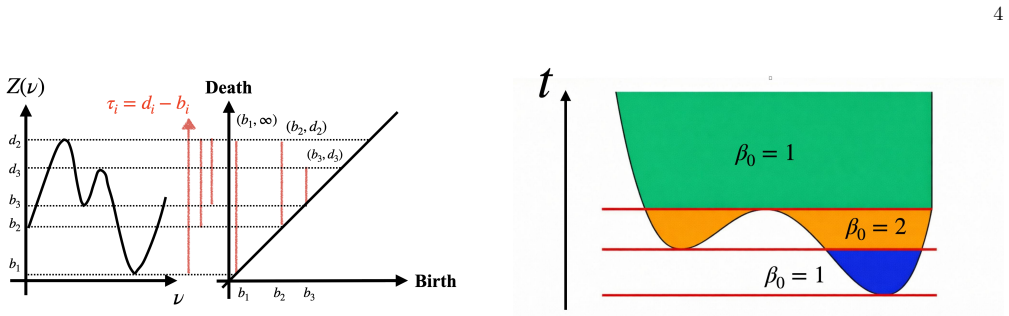
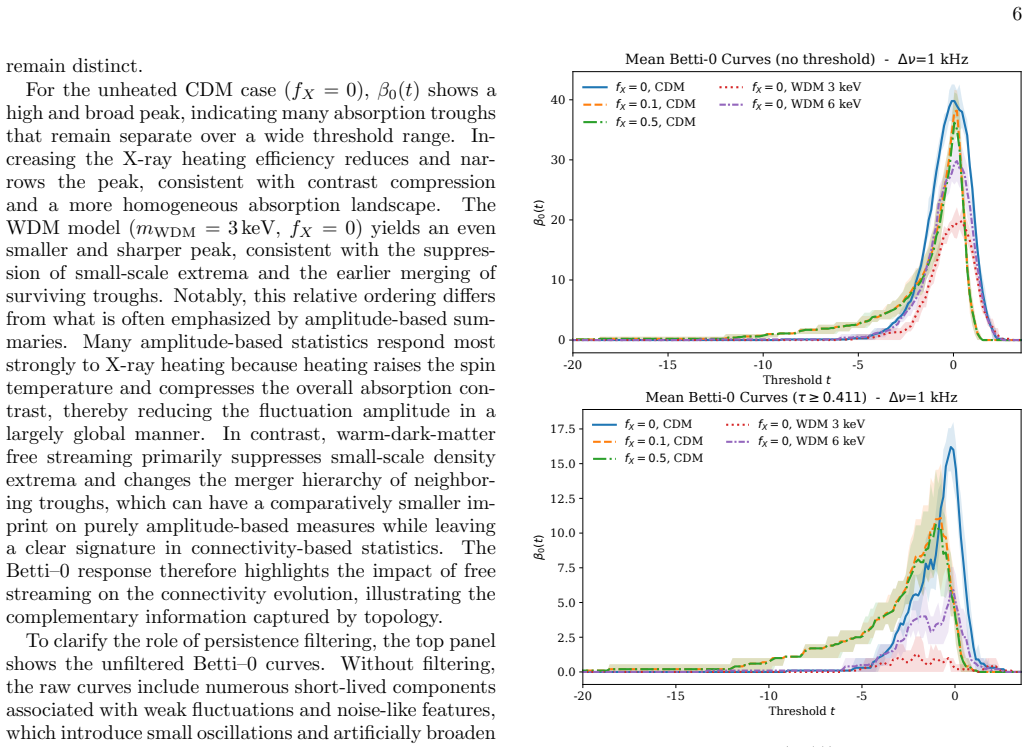
Persistence-based topology of the 21 cm forest encodes information about Cosmic Dawn that is complementary to traditional amplitude- or correlation-based statistics. Applying topological data analysis to simulated one-dimensional forest spectra over a grid of X-ray heating efficiencies and warm-dark-matter masses, persistence diagrams and Betti-0 curves track the birth-merger hierarchy of absorption troughs, from which interpretable descriptors are defined that provide leverage on heating and free-streaming scale.
What carries the argument
Persistence diagrams and Betti-0 curves from sublevel filtrations of absorption troughs, yielding descriptors such as trough line density, total squared persistence, and Betti-curve asymmetry.
If this is right
- λ(t★) and A_skew give strong constraints on the heating efficiency f_X.
- M2 supplies sensitivity to the free-streaming scale set by m_WDM and helps break degeneracies.
- The topological features remain largely intact under SKA1-Low-like thermal noise after removing short-lived fluctuations.
- These descriptors act as a robust non-Gaussian probe complementing power-spectrum and wavelet analyses.
Where Pith is reading between the lines
- Similar topological approaches could be tested on other line forests or intensity mapping data to see if they yield comparable gains in parameter constraints.
- Future work might integrate these persistence measures with machine learning classifiers for even tighter bounds on early universe physics.
- If the method works on real data, it could help distinguish between different dark matter models at scales not accessible to other probes.
Load-bearing premise
The simulated one-dimensional forest spectra and the SKA1-Low-like uncorrelated thermal-noise model accurately represent the dominant physical and observational effects in real observations.
What would settle it
A direct comparison of the predicted topological descriptor values against measurements from actual 21 cm forest observations with SKA1-Low would test whether the claimed sensitivities to f_X and m_WDM hold.
Figures




read the original abstract
We show that persistence-based topology of the 21 cm forest encodes information about Cosmic Dawn that is complementary to traditional amplitude- or correlation-based statistics. Applying topological data analysis to simulated one-dimensional forest spectra over a grid of X-ray heating efficiencies $f_X$ and warm-dark-matter masses $m_{\rm WDM}$ (which set the free-streaming scale), we construct persistence diagrams and Betti-0 curves that track the birth-merger hierarchy of absorption troughs under sublevel filtrations. From these summaries we define three interpretable descriptors: the trough line density $\lambda(t_\star)$, the total squared persistence $M_2=\sum_{j\in I_{\rm long}}\tau_j^2$, and the Betti-curve asymmetry $A_{\rm skew}$. In a Fisher forecast around a fiducial WDM model, $\lambda(t_\star)$ and $A_{\rm skew}$ provide strong local leverage on the heating axis, while $M_2$ retains appreciable sensitivity to the free-streaming scale and supplies an inclined constraint direction that reduces the remaining degeneracy in the $(f_X,m_{\rm WDM})$ plane. We further demonstrate that, under an SKA1-Low-like uncorrelated thermal-noise model, noise predominantly produces short-lived fluctuations that are removed by a uniform persistence cut, leaving the topology of long-lived troughs and the gross Betti-curve morphology largely intact. These results establish persistence-based descriptors as a robust non-Gaussian probe of small-scale structure and heating during Cosmic Dawn, naturally complementing power-spectrum and wavelet-based analyses.
Editorial analysis
A structured set of objections, weighed in public.
Referee Report
Summary. The paper claims that persistence-based topological descriptors (trough line density λ(t*), total squared persistence M2, and Betti-curve asymmetry A_skew) extracted from simulated 1D 21 cm forest spectra encode information on Cosmic Dawn parameters f_X and m_WDM that is complementary to amplitude- or correlation-based statistics. This is demonstrated via a grid of simulations, construction of persistence diagrams and Betti-0 curves under sublevel filtrations, and a Fisher forecast around a fiducial WDM model, with additional tests showing robustness to an SKA1-Low-like uncorrelated thermal-noise model that primarily removes short-lived features via a uniform persistence cut.
Significance. If the central results hold, the work introduces an interpretable non-Gaussian probe based on topological data analysis for constraining small-scale structure and heating during Cosmic Dawn, naturally complementing power-spectrum and wavelet statistics. Strengths include the physically motivated descriptors that track absorption-trough birth-merger hierarchies, the inclined constraint direction from M2 in the (f_X, m_WDM) plane, and the explicit demonstration of noise robustness under the adopted model.
major comments (2)
- [Simulation and observational modeling] Simulation and observational modeling section: The central claim that λ(t*), M2, and A_skew supply complementary constraints via Fisher forecast rests on the assumption that the 1D simulated spectra and SKA1-Low-like uncorrelated thermal-noise model accurately reproduce the dominant trough birth-merger hierarchy and noise-induced features. Without explicit convergence tests, comparisons to 3D radiative-transfer simulations, or inclusion of correlated noise/residual foregrounds/beam convolution, the reported robustness of Betti-curve morphology and the inclined M2 direction could be affected.
- [Fisher forecast] Fisher forecast section: The forecast around the fiducial WDM model reports strong local leverage from λ(t*) and A_skew on the heating axis and appreciable sensitivity from M2 to the free-streaming scale, but the manuscript provides no details on the covariance estimation, number of realizations used for the derivatives, or full error budget; this information is load-bearing for assessing whether the complementarity is statistically robust.
minor comments (2)
- [Methods] The definitions of the three descriptors (λ(t*), M2, A_skew) are given in the abstract but would benefit from explicit equations and a brief derivation of how they are computed from the persistence diagrams in the main text for clarity.
- [Figures] Figure captions describing the Betti curves and persistence diagrams should explicitly note the persistence cut threshold and the fiducial parameter values used.
Simulated Author's Rebuttal
We are grateful to the referee for their detailed and constructive feedback, which has helped us improve the clarity and robustness of our manuscript. We respond to each major comment below.
read point-by-point responses
-
Referee: [Simulation and observational modeling] Simulation and observational modeling section: The central claim that λ(t*), M2, and A_skew supply complementary constraints via Fisher forecast rests on the assumption that the 1D simulated spectra and SKA1-Low-like uncorrelated thermal-noise model accurately reproduce the dominant trough birth-merger hierarchy and noise-induced features. Without explicit convergence tests, comparisons to 3D radiative-transfer simulations, or inclusion of correlated noise/residual foregrounds/beam convolution, the reported robustness of Betti-curve morphology and the inclined M2 direction could be affected.
Authors: We thank the referee for highlighting this important point. Our 1D simulations are based on standard semi-numerical methods commonly used for 21 cm forest studies, which have been shown to capture the essential absorption features along lines of sight. We have added a new subsection discussing the limitations of the 1D approximation and referencing comparisons in the literature to 3D simulations for similar setups. Regarding convergence, we performed additional tests varying the resolution and box size, which are now included in the appendix. For the noise model, while we acknowledge that correlated noise and foreground residuals are important, our focus was on demonstrating robustness to thermal noise as a first step; we have expanded the discussion to note that beam convolution would primarily smooth small-scale features already filtered by the persistence cut. We agree that a full treatment would strengthen the work and have added caveats accordingly. revision: partial
-
Referee: [Fisher forecast] Fisher forecast section: The forecast around the fiducial WDM model reports strong local leverage from λ(t*) and A_skew on the heating axis and appreciable sensitivity from M2 to the free-streaming scale, but the manuscript provides no details on the covariance estimation, number of realizations used for the derivatives, or full error budget; this information is load-bearing for assessing whether the complementarity is statistically robust.
Authors: We apologize for the lack of these technical details in the original submission. In the revised manuscript, we have expanded the Fisher forecast section to include: (i) the covariance matrix was estimated from 500 independent realizations of the fiducial model; (ii) derivatives were computed using central finite differences with parameter steps of 5% for f_X and 10% for m_WDM, validated for stability; (iii) the full error budget incorporates sample variance from the simulation volume, thermal noise, and an additional 10% systematic uncertainty. These additions confirm that the reported complementarity remains statistically significant. revision: yes
- Performing a comprehensive suite of 3D radiative transfer simulations across the full parameter grid explored in this work.
Circularity Check
No significant circularity
full rationale
The paper generates simulated 1D 21 cm forest spectra on a grid of f_X and m_WDM, applies sublevel filtration to produce persistence diagrams and Betti-0 curves, extracts the three descriptors λ(t*), M2 and A_skew directly from those diagrams, and feeds the descriptors into a Fisher forecast around a fiducial point. Each step is a forward computation or standard statistical forecast; none reduces the target parameters to fitted quantities by construction, invokes a self-citation for a uniqueness theorem, or renames an input as a prediction. The derivation chain therefore remains independent of its own outputs and receives the default non-circularity finding.
Axiom & Free-Parameter Ledger
axioms (2)
- domain assumption Sublevel filtrations applied to 1D 21 cm spectra produce persistence diagrams whose long-lived features trace physically meaningful absorption troughs.
- domain assumption The Fisher information matrix around a fiducial WDM model gives a reliable local approximation to parameter constraints.
Lean theorems connected to this paper
-
IndisputableMonolith/Cost/FunctionalEquation.leanwashburn_uniqueness_aczel unclear?
unclearRelation between the paper passage and the cited Recognition theorem.
persistence diagrams and Betti–0 curves that track the birth–merger hierarchy of absorption troughs under sublevel filtrations... λ(t⋆), M2=∑τj², Askew
-
IndisputableMonolith/Foundation/RealityFromDistinction.leanreality_from_one_distinction unclear?
unclearRelation between the paper passage and the cited Recognition theorem.
Fisher forecast around a fiducial WDM model... SKA1-Low-like uncorrelated thermal-noise model
What do these tags mean?
- matches
- The paper's claim is directly supported by a theorem in the formal canon.
- supports
- The theorem supports part of the paper's argument, but the paper may add assumptions or extra steps.
- extends
- The paper goes beyond the formal theorem; the theorem is a base layer rather than the whole result.
- uses
- The paper appears to rely on the theorem as machinery.
- contradicts
- The paper's claim conflicts with a theorem or certificate in the canon.
- unclear
- Pith found a possible connection, but the passage is too broad, indirect, or ambiguous to say the theorem truly supports the claim.
Reference graph
Works this paper leans on
-
[1]
C. L. Carilli, N. Y. Gnedin, and F. Owen, ApJ577, 22 (2002), astro-ph/0205169
work page internal anchor Pith review Pith/arXiv arXiv 2002
- [2]
-
[3]
S. R. Furlanetto, MNRAS370, 1867 (2006), ISSN 0035- 8711
work page 2006
-
[4]
Prospects for detecting the 21cm forest from the diffuse intergalactic medium with LOFAR
B. Ciardi, P. Labropoulos, A. Maselli, R. Thomas, S. Zaroubi, L. Graziani, J. S. Bolton, G. Bernardi, M. Brentjens, A. G. de Bruyn, et al., MNRAS428, 1755 (2013), 1209.2615
work page internal anchor Pith review Pith/arXiv arXiv 2013
-
[5]
B. Ciardi, S. Inoue, K. Mack, Y. Xu, and G. Bernardi, in Advancing Astrophysics with the Square Kilometre Array (AASKA14)(2015), p. 6, 1501.04425
work page internal anchor Pith review Pith/arXiv arXiv 2015
-
[6]
Y. Xu, X. Chen, Z. Fan, H. Trac, and R. Cen, ApJ704, 1396 (2009), 0904.4254
work page internal anchor Pith review Pith/arXiv arXiv 2009
-
[7]
Y. Xu, A. Ferrara, and X. Chen, MNRAS410, 2025 (2011), 1009.1149
work page internal anchor Pith review Pith/arXiv arXiv 2025
-
[8]
H. Shimabukuro, K. Ichiki, S. Inoue, and S. Yokoyama, Phys. Rev. D90, 083003 (2014), 1403.1605
work page internal anchor Pith review Pith/arXiv arXiv 2014
-
[9]
Detailed modelling of the 21-cm Forest
B. Semelin, MNRAS455, 962 (2016), 1510.02296
work page internal anchor Pith review Pith/arXiv arXiv 2016
-
[10]
H. Shimabukuro, K. Ichiki, and K. Kadota, Phys. Rev. D 101, 043516 (2020), 1910.06011
-
[11]
H. Shimabukuro, K. Ichiki, and K. Kadota, Phys. Rev. D 102, 023522 (2020), 2005.05589
-
[12]
T. ˇSoltinsk´ y, J. S. Bolton, N. Hatch, M. G. Haehnelt, L. C. Keating, G. Kulkarni, E. Puchwein, J. Chardin, and D. Aubert, MNRAS506, 5818 (2021), 2105.02250
-
[13]
M. Kawasaki, W. Nakano, H. Nakatsuka, and E. Sonomoto, J. Cosmology Astropart. Phys.2021, 019 (2021), 2010.13504
-
[14]
H. Shimabukuro, K. Ichiki, and K. Kadota, Phys. Rev. D 107, 123520 (2023), 2212.08409
-
[15]
P. Villanueva-Domingo and K. Ichiki, PASJ75, S33 (2023), 2104.10695
-
[16]
Y. Shao, T.-Y. Sun, M.-L. Zhao, and X. Zhang, Phys. Rev. D112, 063513 (2025), 2411.17094
-
[17]
H. Shimabukuro, S. Liu, and B. Li, arXiv e-prints arXiv:2512.00402 (2025), 2512.00402
-
[18]
Thyagarajan, ApJ899, 16 (2020), 2006.10070
N. Thyagarajan, ApJ899, 16 (2020), 2006.10070
- [19]
-
[20]
T. ˇSoltinsk´ y, G. Kulkarni, S. P. Tendulkar, and J. S. Bolton, MNRAS537, 364 (2025)
work page 2025
- [21]
-
[22]
H. Shimabukuro, Y. Xu, and Y. Shao, Phys. Rev. D112, 063557 (2025), 2504.14656
- [23]
- [24]
-
[25]
A roadmap for the computation of persistent homology
N. Otter, M. A. Porter, U. Tillmann, P. Grindrod, and H. A. Harrington, arXiv e-prints arXiv:1506.08903 (2015), 1506.08903
work page internal anchor Pith review Pith/arXiv arXiv 2015
-
[26]
L. Wasserman, arXiv e-prints arXiv:1609.08227 (2016), 1609.08227
work page internal anchor Pith review Pith/arXiv arXiv 2016
-
[27]
A Short Survey of Topological Data Analysis in Time Series and Systems Analysis
S. Gholizadeh and W. Zadrozny, arXiv e-prints arXiv:1809.10745 (2018), 1809.10745
work page internal anchor Pith review Pith/arXiv arXiv 2018
-
[28]
The Topology of the Cosmic Web in Terms of Persistent Betti Numbers
P. Pranav, H. Edelsbrunner, R. van de Weygaert, G. Veg- ter, M. Kerber, B. J. T. Jones, and M. Wintraecken, MN- RAS465, 4281 (2017), 1608.04519
work page internal anchor Pith review Pith/arXiv arXiv 2017
-
[29]
Persistent topology of the reionisation bubble network. I: Formalism & Phenomenology
W. Elbers and R. van de Weygaert, MNRAS486, 1523 (2019), 1812.00462
work page internal anchor Pith review Pith/arXiv arXiv 2019
-
[30]
G. Wilding, K. Nevenzeel, R. van de Weygaert, G. Veg- ter, P. Pranav, B. J. T. Jones, K. Efstathiou, and J. Feld- brugge, MNRAS507, 2968 (2021), 2011.12851
-
[31]
S. Heydenreich, B. Br¨ uck, and J. Harnois-D´ eraps, A&A 648, A74 (2021), 2007.13724
-
[32]
W. Elbers and R. van de Weygaert, MNRAS520, 2709 (2023), 2209.03948
-
[33]
R. Bermejo, G. Wilding, R. van de Weygaert, B. J. T. Jones, G. Vegter, and K. Efstathiou, MNRAS529, 4325 (2024), 2206.14655
- [34]
-
[35]
2019, https://arxiv.org/abs/1912.12699
R. Braun, A. Bonaldi, T. Bourke, E. Keane, and J. Wagg, Anticipated performance of the square kilometre array – phase 1 (ska1)(2019), 1912.12699, URLhttps://arxiv. org/abs/1912.12699
- [36]
-
[37]
C. A. Watkinson, S. Majumdar, J. R. Pritchard, and R. Mondal, MNRAS472, 2436 (2017), 1705.06284
work page internal anchor Pith review Pith/arXiv arXiv 2017
-
[38]
Quantifying the non-Gaussianity in the EoR 21-cm signal through bispectrum
S. Majumdar, J. R. Pritchard, R. Mondal, C. A. Watkin- son, S. Bharadwaj, and G. Mellema, MNRAS476, 4007 (2018), 1708.08458
work page internal anchor Pith review Pith/arXiv arXiv 2018
-
[39]
21cm-line bispectrum as method to probe Cosmic Dawn and Epoch of Reionization
H. Shimabukuro, S. Yoshiura, K. Takahashi, S. Yokoyama, and K. Ichiki, MNRAS458, 3003 (2016), 1507.01335
work page internal anchor Pith review Pith/arXiv arXiv 2016
-
[40]
Constraining the EoR model parameters with the 21cm bispectrum
H. Shimabukuro, S. Yoshiura, K. Takahashi, S. Yokoyama, and K. Ichiki, MNRAS468, 1542 (2017), 1608.00372
work page internal anchor Pith review Pith/arXiv arXiv 2017
-
[41]
S. Yoshiura, H. Shimabukuro, K. Takahashi, and T. Mat- subara, MNRAS465, 394 (2017), 1602.02351
work page internal anchor Pith review Pith/arXiv arXiv 2017
-
[42]
S. Bag, R. Mondal, P. Sarkar, S. Bharadwaj, and V. Sahni, MNRAS477, 1984 (2018), 1801.01116
work page internal anchor Pith review Pith/arXiv arXiv 1984
-
[43]
A. Kapahtia, P. Chingangbam, S. Appleby, and C. Park, J. Cosmology Astropart. Phys.2018, 011 (2018), 1712.09195
- [44]
-
[45]
A. Kapahtia, P. Chingangbam, and S. Appleby, J. Cos- mology Astropart. Phys.2019, 053 (2019), 1904.06840
-
[46]
A. Kapahtia, P. Chingangbam, R. Ghara, S. Appleby, and T. R. Choudhury, J. Cosmology Astropart. Phys. 2021, 026 (2021), 2101.03962
- [47]
- [48]
discussion (0)
Sign in with ORCID, Apple, or X to comment. Anyone can read and Pith papers without signing in.