Probing Dark Sector Particles Coupling to Neutrinos with Double Beta Decay
Pith reviewed 2026-05-17 22:01 UTC · model grok-4.3
The pith
Double beta decay experiments can probe scalar particles coupled to neutrinos with couplings as small as 2×10^{-6}.
A machine-rendered reading of the paper's core claim, the machinery that carries it, and where it could break.
Core claim
On- and off-shell production of a massive Majoron-like scalar coupled to neutrinos produces characteristic distortions in the double beta decay electron spectrum. Future experiments can therefore probe scalar-neutrino couplings of |a_ν| ≈ 2×10^{-6} for sub-MeV scalars and remain sensitive to off-shell production above the Q-value of double beta isotopes.
What carries the argument
Characteristic distortions in the emitted electron energy spectrum from on-shell and off-shell scalar production in the double beta decay process.
If this is right
- Future double beta decay experiments can set limits on scalar-neutrino couplings at |a_ν| ≈ 2×10^{-6} for sub-MeV particles.
- Sensitivity persists for scalar masses above the isotope Q-value via off-shell production.
- The large statistics from 2νββ events collected in neutrinoless double beta decay searches enable this probe without new hardware.
- The resulting bounds can be compared directly to cosmological constraints on the same particles.
Where Pith is reading between the lines
- This approach could link laboratory searches for light scalars to models of neutrino self-interactions or dark matter mediators.
- Similar spectral analyses might be applied to other rare processes involving neutrinos to search for light dark sector states.
- Tighter limits from non-observation would constrain neutrino-dark sector models and affect interpretations of neutrino mass mechanisms.
Load-bearing premise
The spectral distortions from scalar production can be cleanly separated from standard two-neutrino double beta decay backgrounds and detector effects.
What would settle it
A high-statistics measurement of the double beta decay electron spectrum in a future experiment that matches the pure two-neutrino prediction without the predicted distortions at |a_ν| = 2×10^{-6} would falsify the projected sensitivity.
Figures




read the original abstract
Motivated by the observation of non-zero neutrino masses and the potential for discovering physics beyond the Standard Model, numerous experiments are actively searching for neutrinoless double beta $(0\nu\beta\beta)$ decay. In all of these searches, a substantial amount of data on two-neutrino double beta $(2\nu\beta \beta)$ decay has been collected. In this work, we explore the sensitivity of current and future double beta decay experiments to a massive Majoron-like scalar particle coupled to neutrinos and potentially dark sector fermions, and compare their reach to the relevant cosmological constraints. On- and off-shell production of such a scalar leads to characteristic distortions in the emitted electron spectrum. We investigate how these distortions manifest in current and future double beta decay experiments, deriving the sensitivity to such a scenario. We project the reach of future experiments which can probe scalar-neutrino couplings of $|a_\nu| \approx 2\times 10^{-6}$ for sub-MeV scalar particles and remain sensitive to off-shell production above the Q-value of double beta isotopes.
Editorial analysis
A structured set of objections, weighed in public.
Referee Report
Summary. The manuscript explores using spectral distortions in the summed-electron energy spectrum from two-neutrino double beta decay to probe a massive Majoron-like scalar particle coupled to neutrinos (and possibly dark sector fermions). On- and off-shell scalar production modifies the phase-space factor via the scalar propagator and neutrino-scalar vertex; the authors derive sensitivities for current and future 0νββ experiments and project a reach of |a_ν| ≈ 2×10^{-6} for sub-MeV scalars while remaining sensitive to off-shell production above the Q-value, comparing these limits to cosmological constraints.
Significance. If the projected sensitivities hold under realistic conditions, the work would demonstrate a new, data-driven probe of neutrino-dark sector couplings that exploits existing large 2νββ datasets from 0νββ searches. This could complement cosmological bounds on light scalars and provide falsifiable predictions for spectral shapes in multiple isotopes.
major comments (1)
- [Sensitivity derivation and results (abstract and associated sections)] The central projection of |a_ν| ≈ 2×10^{-6} (abstract) rests on the claim that on-shell and off-shell contributions produce identifiable distortions relative to pure 2νββ. The manuscript does not appear to marginalize over 5–10% shape uncertainties in the 2νββ background or 1–2% variations in energy resolution; without this, the quoted reach is an upper bound on ideal sensitivity rather than a realistic experimental projection. This assumption is load-bearing for the main result.
minor comments (2)
- [Theoretical framework] Clarify the precise definition of the coupling |a_ν| and its relation to the scalar propagator in the differential rate formula.
- [Experimental sensitivity] Add explicit discussion of how the analysis would be performed in a real experiment, including background modeling and statistical methods.
Simulated Author's Rebuttal
We thank the referee for their careful reading of the manuscript and for the constructive feedback. We address the major comment below and describe the revisions we intend to implement.
read point-by-point responses
-
Referee: [Sensitivity derivation and results (abstract and associated sections)] The central projection of |a_ν| ≈ 2×10^{-6} (abstract) rests on the claim that on-shell and off-shell contributions produce identifiable distortions relative to pure 2νββ. The manuscript does not appear to marginalize over 5–10% shape uncertainties in the 2νββ background or 1–2% variations in energy resolution; without this, the quoted reach is an upper bound on ideal sensitivity rather than a realistic experimental projection. This assumption is load-bearing for the main result.
Authors: We agree with the referee that a realistic projection must account for systematic uncertainties in the 2νββ background shape and detector energy resolution. The present analysis derives the sensitivity under the assumption of perfect knowledge of the standard 2νββ spectrum and ideal resolution in order to isolate the characteristic distortions produced by the scalar propagator and vertex. We acknowledge that this yields an idealized upper limit on the reach. In the revised manuscript we will incorporate these effects by (i) introducing nuisance parameters that allow 5–10% variations in the 2νββ spectral shape and (ii) convolving all theoretical spectra with a realistic energy-resolution function that includes 1–2% smearing. The resulting likelihood analysis will be used to obtain updated, more conservative sensitivity contours. We will revise the abstract, the sensitivity sections, and the associated figures to reflect the new projections while preserving the comparison to cosmological bounds. revision: yes
Circularity Check
No significant circularity in sensitivity derivation
full rationale
The paper derives projected reach for |a_ν| by computing on-shell and off-shell scalar contributions to the summed-electron spectrum in double beta decay, using modified phase-space factors relative to standard 2νββ. No quoted equations or steps reduce the central projection to a fitted input renamed as prediction, self-definition, or load-bearing self-citation chain. The calculation relies on standard particle-physics modeling of propagators, vertices, and detector response, remaining self-contained against external benchmarks such as known 2νββ spectra and cosmological limits. This matches the default expectation of an honest non-finding.
Axiom & Free-Parameter Ledger
free parameters (2)
- scalar mass m_φ
- coupling strength |a_ν|
axioms (2)
- domain assumption The scalar is a Majoron-like particle with a specific effective coupling to neutrinos
- domain assumption Spectral distortions are distinguishable from standard 2νββ decay and experimental backgrounds
invented entities (1)
-
Massive Majoron-like scalar particle
no independent evidence
Reference graph
Works this paper leans on
-
[1]
(blue), (2.8 MeV,7×10 −2, √
-
[2]
(green) and (3.5 MeV,2×10 −1, √
-
[3]
All other couplings are set to zero and theχare massless
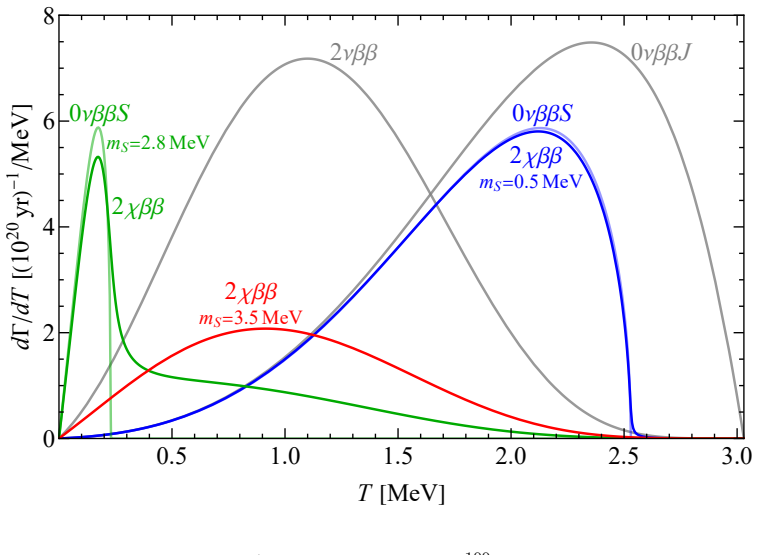
(red). All other couplings are set to zero and theχare massless. For comparison, the scalar emission contributions 0νββSare also shown, for the corresponding values ofm S anda ν. The SM 2νββand ordinary Majoron emission 0νββ(witha ν = 3×10 −3) are shown in grey. The relevant NMEs are given in Table I. masslessχ. The spectra, for 100Mo having the largestQv...
-
[4]
(green) and (2×10 −1, √
-
[5]
Thus, the couplinga χ toχis large and always dominant compared toa ν
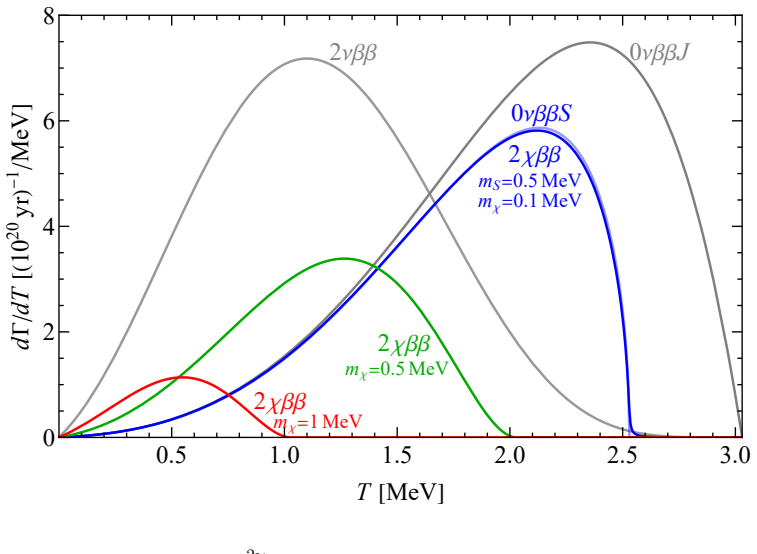
(red). Thus, the couplinga χ toχis large and always dominant compared toa ν. Thus,Salmost exclusively decays toχwith a branching ratio Br(S→χχ)≈1. This can be most easily seen by comparing with the scalar-emission spectrum 0νββSfor mS = 0.5 MeV that is also shown and which almost overlaps with 2χββas we effectively have dΓ2χ S dT ≈ dΓS dT ×Br(S→χχ),(48) 1...
-
[6]
(green) and (3×10 −1, √
-
[7]
coupling toχandSexclusively decays to neutrinos in this case
(red). coupling toχandSexclusively decays to neutrinos in this case. The contributions add as dΓ2ν dT =|M 2ν|2 dΓ2ν SM dT +|a ν|2|M0ν|2 dΓ2ν Son-shell dT +|a ν|4|M0ν|2 dΓ2ν Soff-shell dT + 2 Re a2 νM0νM∗ 2ν dΓ2ν int dT ,(49) where we have extracted the direct scaling ofaν and the NMEs. Here, we have split up the on- and off-shell parts of theS-mediated co...
-
[8]
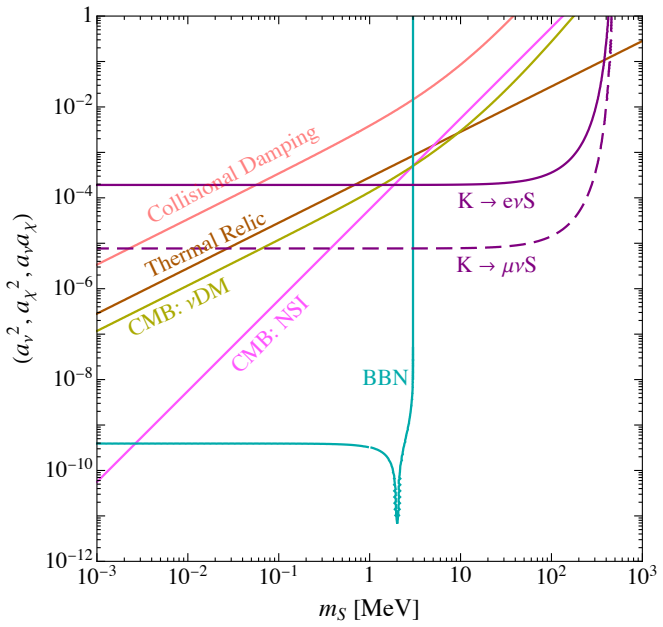
Thermal Relic Considering equal number densities for DM particles and their antiparticles, the thermally averaged annihilation cross section (multiplied by the relative velocity) required to account for the observed DM abundance in present day universe, which can be expressed by a series expansion in relative velocityv r (considering non-relativistic DM s...
-
[9]
Collisional Damping Interactions between neutrinos and DM can significantly affect the distribution of matter and radiation in the Universe, particularly by affecting the CMB spectrum and the forma- tion of large-scale structures (LSS) [38–40]. There are two primary effects to consider in this perspective: the considered DM is no longer collisionless due ...
-
[10]
Neutrino Reheating Bounds DM annihilations into neutrinos after they have decoupled from electrons, at tempera- turesT≲T D ∼1 MeV (whereT D is the decoupling temperature of DM from electrons) [42–50], can reheat the neutrino sector, producing observable effects. This change in neu- trino energy density effectively increases the number of relativistic degr...
-
[11]
CMB-NSI Neutrino non-standard interactions (NSI) influence the epoch of neutrino free streaming and their coupling to the photonbaryon fluid in the early Universe. Such effects manifest as modifications in the phase shift and amplitude of the matter power spectrum, leading to stringent cosmological bounds. These constraints apply not only to neutrino self...
-
[12]
CMB-νDM Additional constraints onν-DM interactions arise from cosmological observables including the Lyman-αforest [55], structure formation [56] and small-scale CMB data [57]. The upper limits on the DM-neutrino scattering cross section can be parameterized as [55] σνχ < σ n mχ GeV Tν T 0 ν n ,(56) withT 0 ν = 6.1 K,σ 0 = 2×10 −28 cm2,σ 2 = 2×10 −39 cm2....
-
[13]
BBN If both the mediator and light particles are at the MeV scale, additional constraints arise from Big Bang Nucleosynthesis observation. For light particles, the annihilation process νν→χχ, vias-channel scalar mediation, keeps the dark fermion in equilibrium with the SM plasma, leading to a significant contribution toN eff. Considering the neutrino ener...
-
[14]
We takeσ f as constant for a given experiment
Systematic experimental errors, assumed proportional to the number of events in a bin,σ (i) sys =σ f N (i) exp, are added in quadrature to the statistical uncertainty. We takeσ f as constant for a given experiment
-
[15]
The main theoretical uncertainty arises from the 2νββand 0νββNMEs that enter the decay rate calculations. The standard 2νββdecay depends onM 2ν whereas the 28 BSM contributions, due to their ordinary Majoron structure, mainly scale withM 0ν (the interference of the scalar-mediated 2ν Sββwith SM 2νββwill also depend on M2ν). Calculations in different nucle...
-
[16]
I and without correlation betweenM 2ν andM 0ν
For the existing experimental searches at GERDA II, NEMO-3 and KamLAND-Zen, we assume the NME values in Tab. I and without correlation betweenM 2ν andM 0ν
-
[17]
consider an optimistic scenario as follows: We keep the best fit values from Tab
For the future searches at LEGEND-1000, CUPID and nEXO, take the same values above as a pessimistic scenario (no future improvement in NME calculations) but also 30 Isotope ExperimentE[kg·yr]T min [keV] ∆T[keV]σ f [%] 76Ge GERDA II [67] 104 500 15 1.9 LEGEND-1000 [68] 7.0×10 3 100 2.5 0.5 100Mo NEMO-3 [10] 34 500 100 1.8 CUPID-1T [69] 1.7×10 3 100 5 0.5 1...
work page 2021
-
[18]
Average and recommended half-life values for two-neutrino double beta decay: upgrade-2019,
A. S. Barabash, “Average and recommended half-life values for two-neutrino double beta decay: upgrade-2019,”AIP Conf. Proc.2165no. 1, (2019) 020002, [1907.06887]
-
[19]
Neutrinoless Double Beta Decay and Physics Beyond the Standard Model
F. F. Deppisch, M. Hirsch, and H. Pas, “Neutrinoless Double Beta Decay and Physics Beyond the Standard Model,”J. Phys. G39(2012) 124007, [1208.0727]
work page internal anchor Pith review Pith/arXiv arXiv 2012
-
[20]
Short-Range Neutrinoless Double Beta Decay Mechanisms
L. Graf, F. F. Deppisch, F. Iachello, and J. Kotila, “Short-Range Neutrinoless Double Beta Decay Mechanisms,”Phys. Rev. D98no. 9, (2018) 095023, [1806.06058]
work page internal anchor Pith review Pith/arXiv arXiv 2018
-
[21]
A neutrinoless double beta decay master formula from effective field theory
V. Cirigliano, W. Dekens, J. de Vries, M. L. Graesser, and E. Mereghetti, “A neutrinoless double beta decay master formula from effective field theory,”JHEP12(2018) 097, [1806.02780]. [5]KamLAND-ZenCollaboration, A. Gandoet al., “Precision measurement of the 136Xe two-neutrinoββspectrum in KamLAND-Zen and its impact on the quenching of nuclear matrix elem...
work page internal anchor Pith review Pith/arXiv arXiv 2018
-
[22]
R. Arnoldet al., “Final results on 82Sedouble beta decay to the ground state of 82Krfrom the NEMO-3 experiment,”Eur. Phys. J. C78no. 10, (2018) 821, [1806.05553]. [10]NEMO-3Collaboration, R. Arnoldet al., “Detailed studies of 100Mo two-neutrino double beta decay in NEMO-3,”Eur. Phys. J. C79no. 5, (2019) 440, [1903.08084]
work page internal anchor Pith review Pith/arXiv arXiv 2018
-
[23]
F. ˇSimkovic, R. Dvornick´ y, D. Stef´ anik, and A. Faessler, “Improved description of the 2νββ -decay and a possibility to determine the effective axial-vector coupling constant,”Phys. Rev. C97no. 3, (2018) 034315, [1804.04227]
work page internal anchor Pith review Pith/arXiv arXiv 2018
-
[24]
Searching for New Physics in Two-Neutrino Double Beta Decay,
F. F. Deppisch, L. Graf, and F. ˇSimkovic, “Searching for New Physics in Two-Neutrino Double Beta Decay,”Phys. Rev. Lett.125no. 17, (2020) 171801, [2003.11836]
-
[25]
Neutrino Self-Interactions and Double Beta Decay,
F. F. Deppisch, L. Graf, W. Rodejohann, and X.-J. Xu, “Neutrino Self-Interactions and Double Beta Decay,”Phys. Rev. D102no. 5, (2020) 051701, [2004.11919]
-
[26]
Two-Neutrino Double Beta Decay with Sterile Neutrinos,
P. D. Bolton, F. F. Deppisch, L. Gr´ af, and F. ˇSimkovic, “Two-Neutrino Double Beta Decay with Sterile Neutrinos,”Phys. Rev. D103no. 5, (2021) 055019, [2011.13387]
-
[27]
Neutrinoless Double-$\beta$ Decay with Nonstandard Majoron Emission
R. Cepedello, F. F. Deppisch, L. Gonz´ alez, C. Hati, and M. Hirsch, “Neutrinoless Double-β Decay with Nonstandard Majoron Emission,”Phys. Rev. Lett.122no. 18, (2019) 181801, [1811.00031]
work page internal anchor Pith review Pith/arXiv arXiv 2019
-
[28]
Are There Real Goldstone Bosons Associated with Broken Lepton Number?,
Y. Chikashige, R. N. Mohapatra, and R. D. Peccei, “Are There Real Goldstone Bosons Associated with Broken Lepton Number?,”Phys. Lett. B98(1981) 265–268
work page 1981
-
[29]
Left-Handed Neutrino Mass Scale and Spontaneously Broken Lepton Number,
G. B. Gelmini and M. Roncadelli, “Left-Handed Neutrino Mass Scale and Spontaneously Broken Lepton Number,”Phys. Lett. B99(1981) 411–415
work page 1981
-
[30]
Double Beta Decay with Vector Majorons
C. D. Carone, “Double beta decay with vector majorons,”Phys. Lett. B308(1993) 85–88, [hep-ph/9302290]
work page internal anchor Pith review Pith/arXiv arXiv 1993
-
[31]
Multi-Majoron Modes for Neutrinoless Double-Beta Decay
P. Bamert, C. P. Burgess, and R. N. Mohapatra, “Multi - Majoron modes for neutrinoless double beta decay,”Nucl. Phys. B449(1995) 25–48, [hep-ph/9412365]
work page internal anchor Pith review Pith/arXiv arXiv 1995
-
[32]
On the observability of Majoron emitting double beta decays
M. Hirsch, H. V. Klapdor-Kleingrothaus, S. G. Kovalenko, and H. Pas, “On the observability of majoron emitting double beta decays,”Phys. Lett. B372(1996) 8–14, [hep-ph/9511227]
work page internal anchor Pith review Pith/arXiv arXiv 1996
-
[33]
Neutrinoless double-beta decay with massive scalar emission
K. Blum, Y. Nir, and M. Shavit, “Neutrinoless double-beta decay with massive scalar emission,”Phys. Lett. B785(2018) 354–361, [1802.08019]. 42
work page internal anchor Pith review Pith/arXiv arXiv 2018
-
[34]
The KeV Majoron as Dark Matter Particle
V. Berezinsky and J. W. F. Valle, “The KeV majoron as a dark matter particle,”Phys. Lett. B318(1993) 360–366, [hep-ph/9309214]
work page internal anchor Pith review Pith/arXiv arXiv 1993
-
[35]
Neutrino Lines from Majoron Dark Matter
C. Garcia-Cely and J. Heeck, “Neutrino Lines from Majoron Dark Matter,”JHEP05(2017) 102, [1701.07209]
work page internal anchor Pith review Pith/arXiv arXiv 2017
-
[36]
Majoron Dark Matter and Constraints on the Majoron-Neutrino Coupling
T. Brune and H. P¨ as, “Massive Majorons and constraints on the Majoron-neutrino coupling,”Phys. Rev. D99no. 9, (2019) 096005, [1808.08158]. [25]KamLAND-ZenCollaboration, A. Gandoet al., “Limits on Majoron-emitting double-beta decays of Xe-136 in the KamLAND-Zen experiment,”Phys. Rev. C86(2012) 021601, [1205.6372]
work page internal anchor Pith review Pith/arXiv arXiv 2019
-
[37]
S. A. Kharusiet al., “Search for Majoron-emitting modes of 136Xe double beta decay with the complete EXO-200 dataset,”Phys. Rev. D104no. 11, (2021) 112002, [2109.01327]. [27]CUPID-0Collaboration, O. Azzoliniet al., “Search for Majoron-like particles with CUPID-0,”Phys. Rev. D107no. 3, (2023) 032006, [2209.09490]
-
[38]
New Constraints on Neutrino-Dark Matter Interactions: A Comprehensive Analysis,
P. S. B. Dev, D. Kim, D. Sathyan, K. Sinha, and Y. Zhang, “New Constraints on Neutrino-Dark Matter Interactions: A Comprehensive Analysis,” [2507.01000]
-
[39]
Sub-GeV dark matter as pseudo-Goldstone from the seesaw scale
M. Frigerio, T. Hambye, and E. Masso, “Sub-GeV dark matter as pseudo-Goldstone from the seesaw scale,”Phys. Rev. X1(2011) 021026, [1107.4564]
work page internal anchor Pith review Pith/arXiv arXiv 2011
-
[40]
Flavour and cosmological probes of Diracon models,
S. Centelles Chuli´ a, T. Herbermann, A. Herrero-Brocal, and A. Vicente, “Flavour and cosmological probes of Diracon models,”JHEP09(2025) 110, [2506.06449]
-
[41]
Double beta Decay and Majorana Neutrino,
M. Doi, T. Kotani, and E. Takasugi, “Double beta Decay and Majorana Neutrino,”Prog. Theor. Phys. Suppl.83(1985) 1
work page 1985
-
[42]
Annihilation Cross Sections for Relic Densities in the Low Velocity Limit
J. D. Wells, “Annihilation cross-sections for relic densities in the low velocity limit,” [hep-ph/9404219]
work page internal anchor Pith review Pith/arXiv arXiv
-
[43]
Dark matter-neutrino interactions through the lens of their cosmological implications
A. Olivares-Del Campo, C. Bœhm, S. Palomares-Ruiz, and S. Pascoli, “Dark matter-neutrino interactions through the lens of their cosmological implications,”Phys. Rev. D97no. 7, (2018) 075039, [1711.05283]. [34]PlanckCollaboration, N. Aghanimet al., “Planck 2018 results. VI. Cosmological parameters,”Astron. Astrophys.641(2020) A6, [1807.06209]. [Erratum: As...
work page internal anchor Pith review Pith/arXiv arXiv 2018
-
[44]
E. W. Kolb and M. S. Turner,The Early Universe, vol. 69. Taylor and Francis, 5, 2019
work page 2019
-
[45]
On the Relic, Cosmic Abundance of Stable Weakly 43 Interacting Massive Particles,
R. J. Scherrer and M. S. Turner, “On the Relic, Cosmic Abundance of Stable Weakly 43 Interacting Massive Particles,”Phys. Rev. D33(1986) 1585. [Erratum: Phys.Rev.D 34, 3263 (1986)]
work page 1986
-
[46]
Scalar Dark Matter Models with Significant Internal Bremsstrahlung
F. Giacchino, L. Lopez-Honorez, and M. H. G. Tytgat, “Scalar Dark Matter Models with Significant Internal Bremsstrahlung,”JCAP10(2013) 025, [1307.6480]
work page internal anchor Pith review Pith/arXiv arXiv 2013
-
[47]
Constraining Dark Matter candidates from structure formation
C. Boehm, P. Fayet, and R. Schaeffer, “Constraining dark matter candidates from structure formation,”Phys. Lett. B518(2001) 8–14, [astro-ph/0012504]
work page internal anchor Pith review Pith/arXiv arXiv 2001
-
[48]
Interacting Dark Matter disguised as Warm Dark Matter
C. Boehm, A. Riazuelo, S. H. Hansen, and R. Schaeffer, “Interacting dark matter disguised as warm dark matter,”Phys. Rev. D66(2002) 083505, [astro-ph/0112522]
work page internal anchor Pith review Pith/arXiv arXiv 2002
-
[49]
Constraints on Dark Matter interactions from structure formation: Damping lengths
C. Boehm and R. Schaeffer, “Constraints on dark matter interactions from structure formation: Damping lengths,”Astron. Astrophys.438(2005) 419–442, [astro-ph/0410591]
work page internal anchor Pith review Pith/arXiv arXiv 2005
-
[50]
K. Akita and S. Ando, “Constraints on dark matter-neutrino scattering from the Milky-Way satellites and subhalo modeling for dark acoustic oscillations,”JCAP11(2023) 037, [2305.01913]
-
[51]
The Effect of Interacting Particles on Primordial Nucleosynthesis,
E. W. Kolb, M. S. Turner, and T. P. Walker, “The Effect of Interacting Particles on Primordial Nucleosynthesis,”Phys. Rev. D34(1986) 2197
work page 1986
-
[52]
MeV-mass dark matter and primordial nucleosynthesis
P. D. Serpico and G. G. Raffelt, “MeV-mass dark matter and primordial nucleosynthesis,” Phys. Rev. D70(2004) 043526, [astro-ph/0403417]
work page internal anchor Pith review Pith/arXiv arXiv 2004
-
[53]
Increasing Neff with particles in thermal equilibrium with neutrinos
C. Boehm, M. J. Dolan, and C. McCabe, “Increasing Neff with particles in thermal equilibrium with neutrinos,”JCAP12(2012) 027, [1207.0497]
work page internal anchor Pith review Pith/arXiv arXiv 2012
-
[54]
Limits on MeV Dark Matter from the Effective Number of Neutrinos
C. M. Ho and R. J. Scherrer, “Limits on MeV Dark Matter from the Effective Number of Neutrinos,”Phys. Rev. D87no. 2, (2013) 023505, [1208.4347]
work page internal anchor Pith review Pith/arXiv arXiv 2013
-
[55]
Equivalent Neutrinos, Light WIMPs, and the Chimera of Dark Radiation
G. Steigman, “Equivalent Neutrinos, Light WIMPs, and the Chimera of Dark Radiation,” Phys. Rev. D87no. 10, (2013) 103517, [1303.0049]
work page internal anchor Pith review Pith/arXiv arXiv 2013
-
[56]
A Lower Bound on the Mass of Cold Thermal Dark Matter from Planck
C. Boehm, M. J. Dolan, and C. McCabe, “A Lower Bound on the Mass of Cold Thermal Dark Matter from Planck,”JCAP08(2013) 041, [1303.6270]
work page internal anchor Pith review Pith/arXiv arXiv 2013
-
[57]
BBN And The CMB Constrain Light, Electromagnetically Coupled WIMPs
K. M. Nollett and G. Steigman, “BBN And The CMB Constrain Light, Electromagnetically Coupled WIMPs,”Phys. Rev. D89no. 8, (2014) 083508, [1312.5725]
work page internal anchor Pith review Pith/arXiv arXiv 2014
-
[58]
Light WIMPs, Equivalent Neutrinos, BBN, and the CMB
G. Steigman and K. M. Nollett, “Light WIMPs, Equivalent Neutrinos, BBN, and the CMB,” Mem. Soc. Ast. It.85(2014) 175, [1401.5488]
work page internal anchor Pith review Pith/arXiv arXiv 2014
-
[59]
BBN And The CMB Constrain Neutrino Coupled Light WIMPs
K. M. Nollett and G. Steigman, “BBN And The CMB Constrain Neutrino Coupled Light WIMPs,”Phys. Rev. D91no. 8, (2015) 083505, [1411.6005]. 44
work page internal anchor Pith review Pith/arXiv arXiv 2015
-
[60]
Ruling out the light WIMP explanation of the galactic 511 keV line
R. J. Wilkinson, A. C. Vincent, C. Bœhm, and C. McCabe, “Ruling out the light weakly interacting massive particle explanation of the Galactic 511 keV line,”Phys. Rev. D94 no. 10, (2016) 103525, [1602.01114]
work page internal anchor Pith review Pith/arXiv arXiv 2016
-
[61]
A precision calculation of the effective number of cosmological neutrinos
G. Mangano, G. Miele, S. Pastor, and M. Peloso, “A Precision calculation of the effective number of cosmological neutrinos,”Phys. Lett. B534(2002) 8–16, [astro-ph/0111408]
work page internal anchor Pith review Pith/arXiv arXiv 2002
-
[62]
Relic neutrino decoupling including flavour oscillations
G. Mangano, G. Miele, S. Pastor, T. Pinto, O. Pisanti, and P. D. Serpico, “Relic neutrino decoupling including flavor oscillations,”Nucl. Phys. B729(2005) 221–234, [hep-ph/0506164]
work page internal anchor Pith review Pith/arXiv arXiv 2005
-
[63]
Strong constraints on a simple self-interacting neutrino cosmology,
D. Camarena and F.-Y. Cyr-Racine, “Strong constraints on a simple self-interacting neutrino cosmology,”Phys. Rev. D111no. 2, (2025) 023504, [2403.05496]
-
[64]
Constraining Dark Matter-Neutrino Interactions using the CMB and Large-Scale Structure
R. J. Wilkinson, C. Boehm, and J. Lesgourgues, “Constraining Dark Matter-Neutrino Interactions using the CMB and Large-Scale Structure,”JCAP05(2014) 011, [1401.7597]
work page internal anchor Pith review Pith/arXiv arXiv 2014
-
[65]
W. Crumrine, E. O. Nadler, R. An, and V. Gluscevic, “Dark matter coupled to radiation: Limits from the Milky Way satellites,”Phys. Rev. D111no. 2, (2025) 023530, [2406.19458]
-
[66]
W. Giar` e, A. G´ omez-Valent, E. Di Valentino, and C. van de Bruck, “Hints of neutrino dark matter scattering in the CMB? Constraints from the marginalized and profile distributions,” Phys. Rev. D109no. 6, (2024) 063516, [2311.09116]
-
[67]
Bounds on Neutrino-Scalar Yukawa Coupling
P. S. Pasquini and O. L. G. Peres, “Bounds on Neutrino-Scalar Yukawa Coupling,”Phys. Rev. D93no. 5, (2016) 053007, [1511.01811]. [Erratum: Phys.Rev.D 93, 079902 (2016)]. [59]Particle Data GroupCollaboration, S. Navaset al., “Review of particle physics,”Phys. Rev. D110no. 3, (2024) 030001
work page internal anchor Pith review Pith/arXiv arXiv 2016
-
[68]
Lepton-Number-Charged Scalars and Neutrino Beamstrahlung
J. M. Berryman, A. De Gouvˆ ea, K. J. Kelly, and Y. Zhang, “Lepton-Number-Charged Scalars and Neutrino Beamstrahlung,”Phys. Rev. D97no. 7, (2018) 075030, [1802.00009]. [61]Particle Data GroupCollaboration, M. Tanabashiet al., “Review of Particle Physics,” Phys. Rev.D98no. 3, (2018) 030001
work page internal anchor Pith review Pith/arXiv arXiv 2018
-
[69]
The Large-Sample Distribution of the Likelihood Ratio for Testing Composite Hypotheses,
S. Wilks, “The Large-Sample Distribution of the Likelihood Ratio for Testing Composite Hypotheses,”Annals Math. Statist.9no. 1, (1938) 60–62
work page 1938
-
[70]
E. Burns and W. Fisher, “Testing the approximations described in ’Asymptotic formulae for likelihood-based tests of new physics’,” [1110.5002]
work page internal anchor Pith review Pith/arXiv arXiv
-
[71]
Asymptotic formulae for likelihood-based tests of new physics
G. Cowan, K. Cranmer, E. Gross, and O. Vitells, “Asymptotic formulae for likelihood-based tests of new physics,”Eur. Phys. J. C71(2011) 1554, [1007.1727]. [Erratum: Eur.Phys.J.C 45 73, 2501 (2013)]
work page internal anchor Pith review Pith/arXiv arXiv 2011
-
[72]
M. Agostini, G. Benato, J. A. Detwiler, J. Men´ endez, and F. Vissani, “Toward the discovery of matter creation with neutrinolessββdecay,”Rev. Mod. Phys.95no. 2, (2023) 025002, [2202.01787]
-
[73]
Neutrinolessββ-decay nuclear matrix elements from two-neutrinoββ-decay data,
L. Jokiniemi, B. Romeo, P. Soriano, and J. Men´ endez, “Neutrinolessββ-decay nuclear matrix elements from two-neutrinoββ-decay data,”Phys. Rev. C107no. 4, (2023) 044305, [2207.05108]. [67]GERDACollaboration, M. Agostiniet al., “Final Results of GERDA on the Search for Neutrinoless Double-βDecay,” [2009.06079]. [68]LEGENDCollaboration, A. J. Zsigmond, “LEG...
-
[74]
PandaX Collaboration, to appear (2025) . 46
work page 2025
discussion (0)
Sign in with ORCID, Apple, or X to comment. Anyone can read and Pith papers without signing in.