Link prediction with swarms of chiral quantum walks
Pith reviewed 2026-05-17 20:55 UTC · model grok-4.3
The pith
Chiral quantum walks in swarms predict links more robustly than non-chiral versions by depending less on precise evolution time.
A machine-rendered reading of the paper's core claim, the machinery that carries it, and where it could break.
Core claim
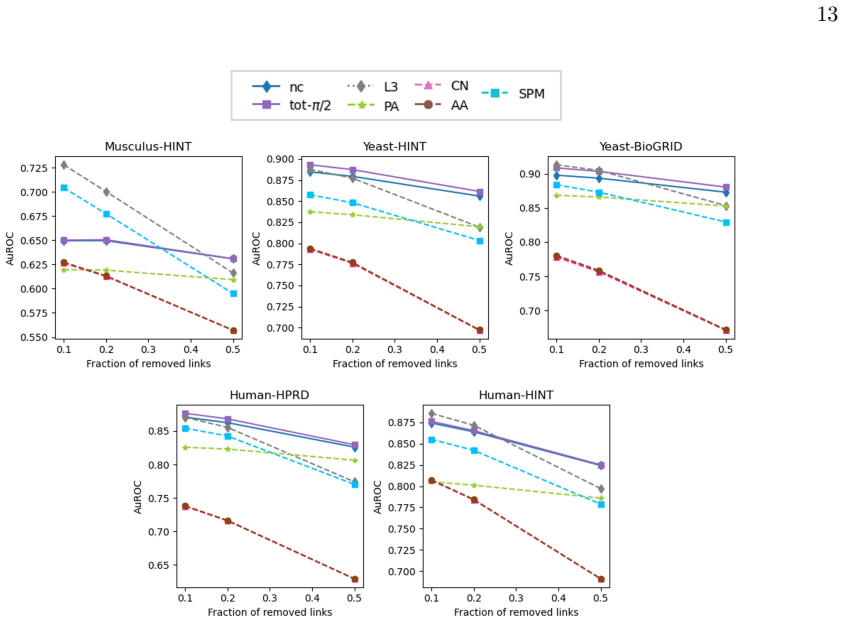
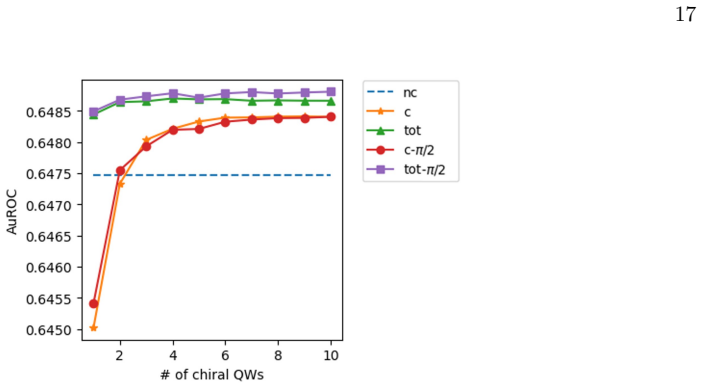
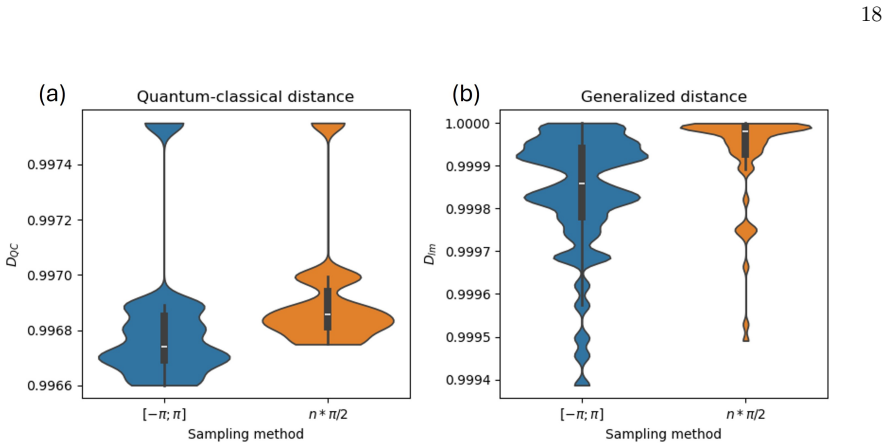
By adding random phases to the Hamiltonian generators we create chiral quantum walks and employ swarms of them to enhance predictive power on complex networks. Compared to a non-chiral algorithm, the chiral version exhibits greater robustness, making its performance less dependent on the optimal evolution time, a critical hyperparameter of the non-chiral model. This improvement arises from complementary dynamics introduced by chirality within the swarm. By analyzing multiple phase-sampling strategies we identify configurations that achieve a practical trade-off: retaining the high predictive accuracy of the non-chiral algorithm at its optimal time while gaining the robustness typical of chir
What carries the argument
Swarms of chiral quantum walks generated by adding random phases to the Hamiltonian generators, supplying complementary dynamics that reduce dependence on exact evolution time for link prediction.
If this is right
- The chiral swarm retains high predictive accuracy of the tuned non-chiral case while adding robustness.
- The method supports comparisons between successive versions of evolving databases.
- Certain phase-sampling strategies produce a practical trade-off between accuracy and reduced timing sensitivity.
- The approach has potential to outperform classical and non-chiral quantum methods in realistic network scenarios.
Where Pith is reading between the lines
- The same random-phase chirality trick could reduce timing sensitivity in other quantum algorithms on graphs.
- Testing the swarm on social or technological networks would show whether the robustness gain generalizes beyond biology.
- Lowered need for precise timing might allow shorter runs or simple averaging to cut computational cost in practice.
Load-bearing premise
The complementary dynamics from different random-phase samplings genuinely improve predictive power on realistic networks without requiring post-hoc selection of the best swarm configuration or introducing hidden fitting to the test data.
What would settle it
Apply both the non-chiral quantum walk and the chiral swarm to a protein-protein interaction network, vary the evolution time around the known optimum, and check whether the chiral swarm's accuracy remains high while the non-chiral accuracy drops sharply.
Figures
read the original abstract
Reconstructing protein-protein interaction networks is a central challenge in network medicine, often addressed using link prediction algorithms. Recent studies suggest that quantum walk-based approaches hold promise for this task. In this paper, we build on these algorithms by introducing chirality through the addition of random phases in the Hamiltonian generators. The resulting additional degrees of freedom enable a more diverse exploration of the network, which we exploit by employing a swarm of chiral quantum walks. Thus, we enhance the predictive power of quantum walks on complex networks. Indeed, compared to a non-chiral algorithm, the chiral version exhibits greater robustness, making its performance less dependent on the optimal evolution time--a critical hyperparameter of the non-chiral model. This improvement arises from complementary dynamics introduced by chirality within the swarm. By analyzing multiple phase-sampling strategies, we identify configurations that achieve a practical trade-off: retaining the high predictive accuracy of the non-chiral algorithm at its optimal time while gaining the robustness typical of chirality. Our findings highlight the versatility of chiral quantum walks and their potential to outperform both classical and non-chiral quantum methods in realistic scenarios, including comparisons between successive versions of evolving databases.
Editorial analysis
A structured set of objections, weighed in public.
Referee Report
Summary. The paper introduces chirality to quantum walks for link prediction on protein-protein interaction networks by adding random phases to the Hamiltonian generators. It employs swarms of such chiral walks to exploit complementary dynamics, claiming greater robustness to the evolution-time hyperparameter than non-chiral quantum walks while retaining high predictive accuracy through the identification of suitable phase-sampling strategies. The work includes comparisons on evolving databases and positions the method as potentially outperforming both classical and non-chiral quantum approaches.
Significance. If the robustness to evolution time holds without data-dependent selection of swarm configurations, the approach would address a key practical limitation of quantum-walk link prediction, reducing sensitivity to a critical hyperparameter and improving applicability to realistic, time-varying networks.
major comments (2)
- [Abstract] Abstract: The central robustness claim rests on the statement that 'by analyzing multiple phase-sampling strategies, we identify configurations that achieve a practical trade-off.' This post-hoc identification process is not shown to be independent of test-set performance; if the selection of favorable strategies or swarm sizes was informed by predictive scores on the target networks or held-out edges, the reported reduction in dependence on optimal t could be an artifact of selection rather than an intrinsic property of the chiral swarm's complementary dynamics.
- [Abstract] Abstract and results sections: The abstract reports qualitative gains in robustness and accuracy but supplies no quantitative metrics, error bars, or explicit definition of how link-prediction performance is scored (e.g., AUC, precision@K, or ranking metrics). Without these, it is impossible to evaluate whether the claimed trade-off is statistically meaningful or merely descriptive.
minor comments (2)
- [Methods] Clarify the precise definition of 'phase sampling strategy' and the range of random phases used; notation for the modified Hamiltonian should be introduced explicitly in the methods.
- [Figures] Figure captions and legends should state the number of independent runs and any error-bar conventions so that robustness claims can be visually assessed.
Simulated Author's Rebuttal
We thank the referee for their detailed and constructive comments on our manuscript. We address each of the major comments below and outline the revisions we plan to make.
read point-by-point responses
-
Referee: [Abstract] Abstract: The central robustness claim rests on the statement that 'by analyzing multiple phase-sampling strategies, we identify configurations that achieve a practical trade-off.' This post-hoc identification process is not shown to be independent of test-set performance; if the selection of favorable strategies or swarm sizes was informed by predictive scores on the target networks or held-out edges, the reported reduction in dependence on optimal t could be an artifact of selection rather than an intrinsic property of the chiral swarm's complementary dynamics.
Authors: We appreciate the referee raising this critical issue regarding potential data-dependent selection. Upon re-examination, the phase-sampling strategies were chosen based on theoretical considerations of introducing complementary dynamics through random phases, drawing from general properties of chiral walks rather than optimizing for specific test-set performances on the protein-protein interaction networks. To strengthen this, we will add a dedicated section or subsection detailing the strategy selection process, including results from cross-validation or independent validation sets to demonstrate that the robustness is not an artifact. This will clarify that the identified configurations generalize across different network instances. revision: yes
-
Referee: [Abstract] Abstract and results sections: The abstract reports qualitative gains in robustness and accuracy but supplies no quantitative metrics, error bars, or explicit definition of how link-prediction performance is scored (e.g., AUC, precision@K, or ranking metrics). Without these, it is impossible to evaluate whether the claimed trade-off is statistically meaningful or merely descriptive.
Authors: We agree with the referee that including quantitative metrics would improve the clarity and impact of the abstract. In the revised manuscript, we will incorporate specific quantitative results, such as average AUC improvements with standard deviations across multiple runs, and explicitly state the evaluation metric used (AUC-ROC for link prediction). We will also ensure the results section provides error bars and statistical significance where appropriate. revision: yes
Circularity Check
No significant circularity; empirical comparisons are self-contained
full rationale
The paper introduces chirality via random phases in quantum walk Hamiltonians and evaluates swarms of such walks for link prediction on networks, claiming improved robustness to evolution time through complementary dynamics. No derivation chain exists that reduces a claimed prediction or first-principles result to its own inputs by construction. The identification of phase-sampling configurations is presented as an experimental analysis step to locate practical trade-offs, not as a fitted parameter renamed as a prediction or a self-referential definition. Claims rest on direct performance metrics across strategies and networks rather than any load-bearing self-citation or ansatz smuggling. This is the common case of an algorithmic paper whose central results are externally falsifiable via replication on the same datasets.
Axiom & Free-Parameter Ledger
free parameters (2)
- phase sampling strategy
- number of walks in swarm
axioms (1)
- standard math Quantum walks on graphs are defined by a Hamiltonian whose off-diagonal elements encode network adjacency.
Reference graph
Works this paper leans on
-
[1]
We considertas a hyperparameter of our problem, on which the performance can be optimized
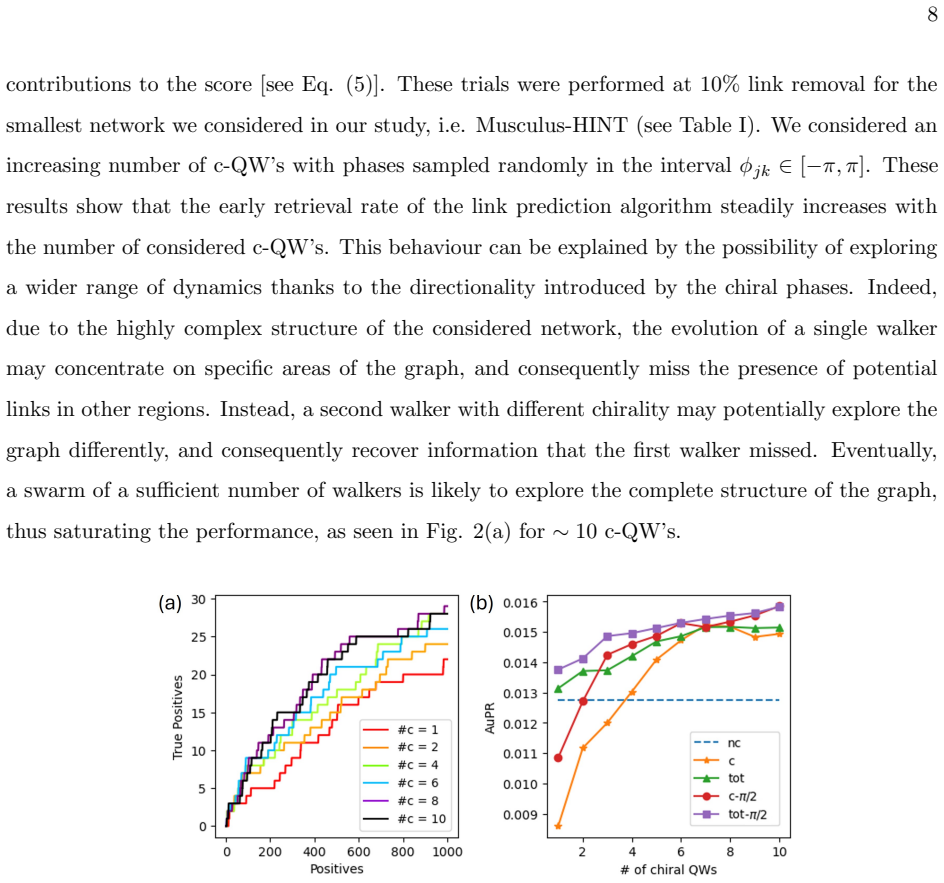
Making the most of chiral complementarity We start our analysis by considering the effects of the contribution of multiple c-QW’s to our algorithm, which we refer to as aswarmof chiral walkers. We considertas a hyperparameter of our problem, on which the performance can be optimized. However, understanding the optimal value oftrequiresa prioriknowledge on...
-
[2]
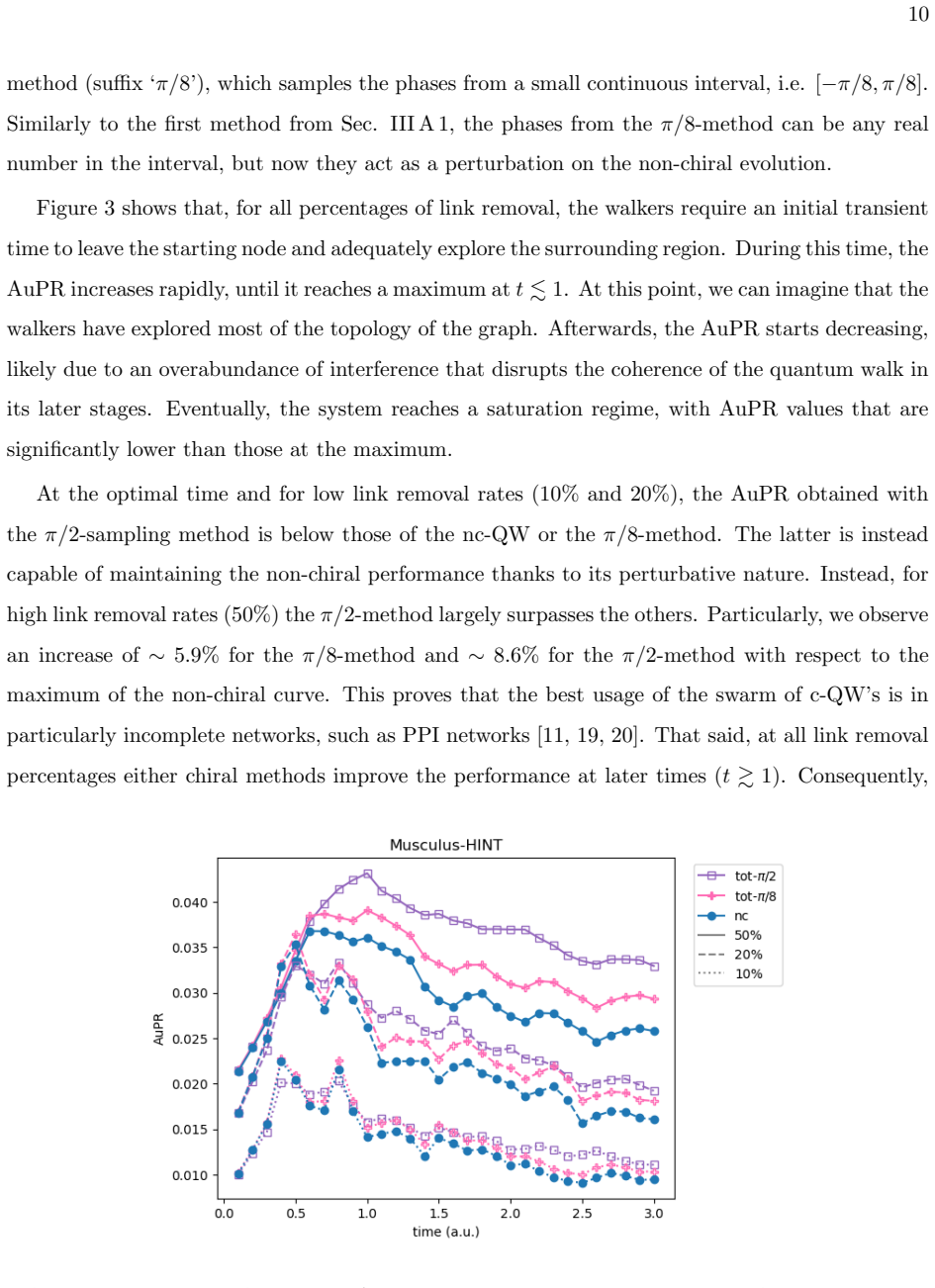
Dependence on time As mentioned above, the problem of maximizing the AuPR requires an optimization on the hyperparametert, which defines the evolution time of the walkers. In Fig. 3 we show the depen- dency of the AuPR on time for Musculus-HINT at various link removal rates. For this analysis, we consider the second sampling method from Sec. III A 1 (suff...
-
[3]
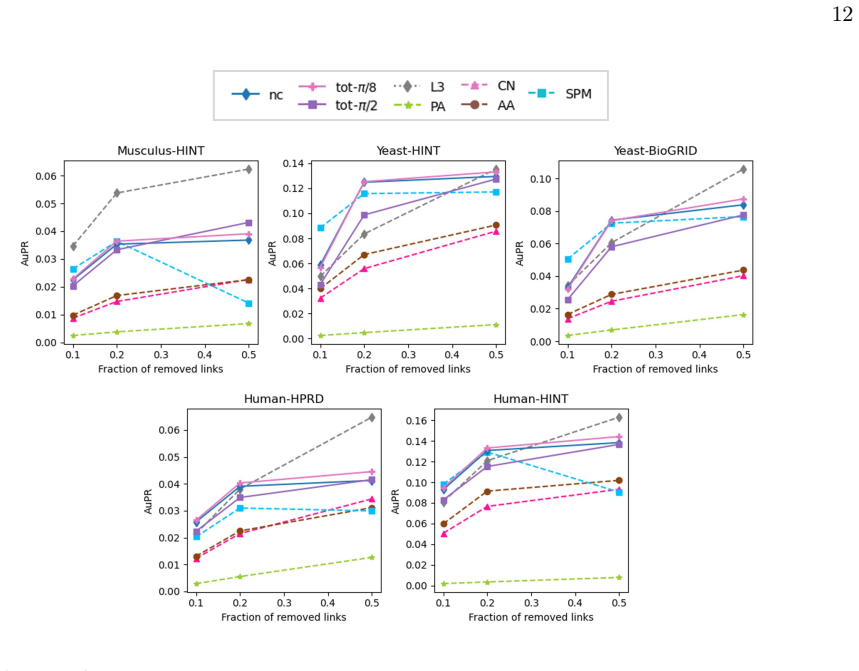
Version comparison Up to now, we have evaluated the link prediction performance throughk-fold cross-validation on specific versions of network databases. That said, an additional benchmark consists of comparing different versions of the same databases, by applying link prediction to earlier versions of the networks studied in this paper. In order to do th...
-
[4]
Lada A. Adamic and Eytan Adar. Friends and neighbors on the web.Social Networks, 25(3):211–230, 2003
work page 2003
-
[5]
Nur Nasuha Daud, Siti Hafizah Ab Hamid, Muntadher Saadoon, Firdaus Sahran, and Nor Badrul Anuar. Applications of link prediction in social networks: A review.Journal of Network and Computer Applications, 166:102716, 2020. 19
work page 2020
-
[6]
Anisha Kumari, Ranjan Kumar Behera, Kshira Sagar Sahoo, Anand Nayyar, Ashish Kumar Luhach, and Satya Prakash Sahoo. Supervised link prediction using structured-based feature extraction in social network.Concurrency and Computation: Practice and Experience, 34(13):e5839, 2022
work page 2022
-
[7]
Istv´ an A. Kov´ acs, Katja Luck, Kerstin Spirohn, Yang Wang, Carl Pollis, Sadie Schlabach, Wenting Bian, Dae-Kyum Kim, Nishka Kishore, Tong Hao, Michael A. Calderwood, Marc Vidal, and Albert- L´ aszl´ o Barab´ asi. Network-based prediction of protein interactions.Nature Communications, 10(1):1240, Mar 2019
work page 2019
-
[8]
Application of network link prediction in drug discovery.BMC Bioinformatics, 22(1):187, Apr 2021
Khushnood Abbas, Alireza Abbasi, Shi Dong, Ling Niu, Laihang Yu, Bolun Chen, Shi-Min Cai, and Qambar Hasan. Application of network link prediction in drug discovery.BMC Bioinformatics, 22(1):187, Apr 2021
work page 2021
-
[9]
Ho Yin Yuen and Jesper Jansson. Normalized l3-based link prediction in protein–protein interaction networks.BMC Bioinformatics, 24(1):59, Feb 2023
work page 2023
-
[10]
Al Musawi, Satyaki Roy, and Preetam Ghosh
Ahmad F. Al Musawi, Satyaki Roy, and Preetam Ghosh. A review of link prediction applications in network biology.IEEE Access, 13:54997–55016, 2025
work page 2025
-
[11]
Renu Goel, HC Harsha, Akhilesh Pandey, and TS Keshava Prasad. Human protein reference database and human proteinpedia as resources for phosphoproteome analysis.Molecular BioSystems, 8(2):453– 463, 2012
work page 2012
-
[12]
Jishnu Das and Haiyuan Yu. Hint: High-quality protein interactomes and their applications in under- standing human disease.BMC Systems Biology, 6(1):92, Jul 2012
work page 2012
-
[13]
Diego Alonso-L´ opez, Francisco J Campos-Laborie, Miguel A Guti´ errez, Luke Lambourne, Michael A Calderwood, Marc Vidal, and Javier De Las Rivas. Apid database: redefining protein–protein interac- tion experimental evidences and binary interactomes.Database, 2019:baz005, 01 2019
work page 2019
-
[14]
Begg, Wenting Bian, Ruth Brignall, Tiziana Cafarelli, Francisco J
Katja Luck, Dae-Kyum Kim, Luke Lambourne, Kerstin Spirohn, Bridget E. Begg, Wenting Bian, Ruth Brignall, Tiziana Cafarelli, Francisco J. Campos-Laborie, Benoit Charloteaux, Dongsic Choi, Atina G. Cot´ e, Meaghan Daley, Steven Deimling, Alice Desbuleux, Am´ elie Dricot, Marinella Geb- bia, Madeleine F. Hardy, Nishka Kishore, Jennifer J. Knapp, Istv´ an A. ...
work page 2020
-
[15]
Rose Oughtred, Jennifer Rust, Christie Chang, Bobby-Joe Breitkreutz, Chris Stark, Andrew Willems, Lorrie Boucher, Genie Leung, Nadine Kolas, Frederick Zhang, Sonam Dolma, Jasmin Coulombe- Huntington, Andrew Chatr-aryamontri, Kara Dolinski, and Mike Tyers. The biogrid database: A comprehensive biomedical resource of curated protein, genetic, and chemical i...
work page 2021
-
[16]
Alicia L Richards, Manon Eckhardt, and Nevan J Krogan. Mass spectrometry-based protein–protein interaction networks for the study of human diseases.Molecular Systems Biology, 17(1):e8792, 2021
work page 2021
-
[17]
Steven Wang, Runxin Wu, Jiaqi Lu, Yijia Jiang, Tao Huang, and Yu-Dong Cai. Protein-protein interaction networks as miners of biological discovery.PROTEOMICS, 22(15-16):2100190, 2022
work page 2022
-
[18]
Vinay Kumar and Kunal Roy. Chapter twelve - protein-protein interaction network analysis for the identification of novel multi-target inhibitors and target mirnas against alzheimer’s disease. In Vijay Ku- mar Prajapati, editor,Translational Bioinformatics, volume 139 ofAdvances in Protein Chemistry and Structural Biology, pages 405–467. Academic Press, 2024
work page 2024
-
[19]
Joseph Loscalzo. Molecular interaction networks and drug development: Novel approach to drug target identification and drug repositioning.The FASEB Journal, 37(1):e22660, 2023. e22660 202201683R
work page 2023
-
[20]
Jia-Xin Liu, Xiao Zhang, Yuan-Qin Huang, Ge-Fei Hao, and Guang-Fu Yang. Multi-level bioinfor- matics resources support drug target discovery of protein–protein interactions.Drug Discovery Today, 29(5):103979, 2024
work page 2024
-
[21]
Cristina Camps-Fajol, Debora Cavero, Jordi Minguill´ on, and Jordi Surrall´ es. Targeting protein-protein interactions in drug discovery: Modulators approved or in clinical trials for cancer treatment.Phar- macological Research, 211:107544, 2025
work page 2025
-
[22]
Georgios N. Dimitrakopoulos, Maria I. Klapa, and Nicholas K. Moschonas. How far are we from the completion of the human protein interactome reconstruction?Biomolecules, 12(1), 2022
work page 2022
-
[23]
Structural coverage of the human interactome.Briefings in Bioinformatics, 25(1):bbad496, 01 2024
Kayra Kosoglu, Zeynep Aydin, Nurcan Tuncbag, Attila Gursoy, and Ozlem Keskin. Structural coverage of the human interactome.Briefings in Bioinformatics, 25(1):bbad496, 01 2024
work page 2024
-
[24]
Elahe Nasiri, Kamal Berahmand, Mehrdad Rostami, and Mohammad Dabiri. A novel link predic- tion algorithm for protein-protein interaction networks by attributed graph embedding.Computers in Biology and Medicine, 137:104772, 2021
work page 2021
-
[25]
Kanchan Jha, Sriparna Saha, and Hiteshi Singh. Prediction of protein–protein interaction using graph neural networks.Scientific Reports, 12(1):8360, May 2022
work page 2022
-
[26]
Jun Hu, Zhe Li, Bing Rao, Maha A. Thafar, and Muhammad Arif. Improving protein-protein inter- action prediction using protein language model and protein network features.Analytical Biochemistry, 693:115550, 2024
work page 2024
-
[27]
Link prediction based on local random walk.Europhysics Letters, 89(5):58007, 2010
Weiping Liu and Linyuan L¨ u. Link prediction based on local random walk.Europhysics Letters, 89(5):58007, 2010. 21
work page 2010
-
[28]
Return random walks for link prediction.Information Sciences, 510:99–107, 2020
Manuel Curado. Return random walks for link prediction.Information Sciences, 510:99–107, 2020
work page 2020
-
[29]
Feng Xia, Jiaying Liu, Hansong Nie, Yonghao Fu, Liangtian Wan, and Xiangjie Kong. Random walks: A review of algorithms and applications.IEEE Transactions on Emerging Topics in Computational Intelligence, 4(2):95–107, 2020
work page 2020
-
[30]
Comparing random walks in graph embedding and link prediction.PloS one, 19(11):e0312863, 2024
Adilson Vital Jr, Filipi Nascimento Silva, and Diego Raphael Amancio. Comparing random walks in graph embedding and link prediction.PloS one, 19(11):e0312863, 2024
work page 2024
-
[31]
Wen Liang, Fei Yan, Abdullah M. Iliyasu, Ahmed S. Salama, and Kaoru Hirota. A simplified quantum walk model for predicting missing links of complex networks.Entropy, 24(11), 2022
work page 2022
-
[32]
Mark Goldsmith, Harto Saarinen, Guillermo Garc´ ıa-P´ erez, Joonas Malmi, Matteo A. C. Rossi, and Sabrina Maniscalco. Link prediction with continuous-time classical and quantum walks.Entropy, 25(5), 2023
work page 2023
-
[33]
Moutinho, Andr´ e Melo, Bruno Coutinho, Istv´ an A
Jo˜ ao P. Moutinho, Andr´ e Melo, Bruno Coutinho, Istv´ an A. Kov´ acs, and Yasser Omar. Quantum link prediction in complex networks.Phys. Rev. A, 107:032605, Mar 2023
work page 2023
-
[34]
Y. Aharonov, L. Davidovich, and N. Zagury. Quantum random walks.Phys. Rev. A, 48:1687–1690, Aug 1993
work page 1993
-
[35]
Oliver M¨ ulken and Alexander Blumen. Continuous-time quantum walks: Models for coherent transport on complex networks.Physics Reports, 502(2):37–87, 2011
work page 2011
-
[36]
Kunkun Wang, Yuhao Shi, Lei Xiao, Jingbo Wang, Yogesh N. Joglekar, and Peng Xue. Experimental realization of continuous-time quantum walks on directed graphs and their application in pagerank. Optica, 7(11):1524–1530, Nov 2020
work page 2020
-
[37]
Karuna Kadian, Sunita Garhwal, and Ajay Kumar. Quantum walk and its application domains: A systematic review.Computer Science Review, 41:100419, 2021
work page 2021
-
[38]
Quantum walk computing: Theory, implementation, and application.Intelligent Computing, 3:0097, 2024
Xiaogang Qiang, Shixin Ma, and Haijing Song. Quantum walk computing: Theory, implementation, and application.Intelligent Computing, 3:0097, 2024
work page 2024
-
[39]
Disease gene prioritization with quantum walks.Bioinformatics, 40(8):btae513, 08 2024
Harto Saarinen, Mark Goldsmith, Rui-Sheng Wang, Joseph Loscalzo, and Sabrina Maniscalco. Disease gene prioritization with quantum walks.Bioinformatics, 40(8):btae513, 08 2024
work page 2024
-
[40]
On quantum random walks in biomolecular networks, 2025
Viacheslav Dubovitskii, Aritra Bose, Filippo Utro, and Laxmi Pardia. On quantum random walks in biomolecular networks, 2025
work page 2025
-
[41]
Biamonte, Jun Li, Hang Li, Tomi H
Dawei Lu, Jacob D. Biamonte, Jun Li, Hang Li, Tomi H. Johnson, Ville Bergholm, Mauro Faccin, Zolt´ an Zimbor´ as, Raymond Laflamme, Jonathan Baugh, and Seth Lloyd. Chiral quantum walks.Phys. Rev. A, 93:042302, Apr 2016
work page 2016
-
[42]
Massimo Frigerio, Claudia Benedetti, Stefano Olivares, and Matteo G. A. Paris. Generalized quantum- classical correspondence for random walks on graphs.Phys. Rev. A, 104:L030201, Sep 2021
work page 2021
-
[43]
Massimo Frigerio, Claudia Benedetti, Stefano Olivares, and Matteo G. A. Paris. Quantum-classical distance as a tool to design optimal chiral quantum walks.Phys. Rev. A, 105:032425, Mar 2022
work page 2022
-
[44]
Quadratic speedup for spatial search by continuous-time quantum walk.Phys
Simon Apers, Shantanav Chakraborty, Leonardo Novo, and J´ er´ emie Roland. Quadratic speedup for spatial search by continuous-time quantum walk.Phys. Rev. Lett., 129:160502, Oct 2022. 22
work page 2022
-
[45]
Simone Cavazzoni, Luca Razzoli, Paolo Bordone, and Matteo G. A. Paris. Perturbed graphs achieve unit transport efficiency without environmental noise.Phys. Rev. E, 106:024118, Aug 2022
work page 2022
-
[46]
Massimo Frigerio and Matteo G.A. Paris. Swift chiral quantum walks.Linear Algebra and its Applica- tions, 673:28–45, 2023
work page 2023
-
[47]
Emilio Annoni, Massimo Frigerio, and Matteo G. A. Paris. Enhanced quantum transport in chiral quantum walks.Quantum Information Processing, 23(4):117, Mar 2024
work page 2024
-
[48]
Luilli, Giuliano Benenti, Matteo G
Sara Finocchiaro, Giovanni O. Luilli, Giuliano Benenti, Matteo G. A. Paris, and Luca Razzoli. Optimal quantum transport on a ring via locally monitored chiral quantum walks.Phys. Rev. E, in press, 2025
work page 2025
-
[49]
A Khalique, A Sett, J B Wang, and J Twamley. Controlled information transfer in continuous-time chiral quantum walks.New Journal of Physics, 23(8):083005, aug 2021
work page 2021
-
[50]
Alberto Bottarelli, Massimo Frigerio, and Matteo G. A. Paris. Quantum routing of information using chiral quantum walks.AVS Quantum Science, 5(2):025001, 04 2023
work page 2023
-
[51]
Giovanni Ragazzi, Simone Cavazzoni, Claudia Benedetti, Paolo Bordone, and Matteo G. A. Paris. Scalable structure for chiral quantum routing.Entropy, 27(5), 2025
work page 2025
-
[52]
Simone Cavazzoni, Giovanni Ragazzi, Paolo Bordone, and Matteo G. A. Paris. Perfect chiral quantum routing.Phys. Rev. A, 111:032439, Mar 2025
work page 2025
-
[53]
Quantum walks in synthetic gauge fields with three-dimensional integrated photonics.Phys
Octavi Boada, Leonardo Novo, Fabio Sciarrino, and Yasser Omar. Quantum walks in synthetic gauge fields with three-dimensional integrated photonics.Phys. Rev. A, 95:013830, Jan 2017
work page 2017
-
[54]
C. Cedzich, T. Geib, A. H. Werner, and R. F. Werner. Quantum walks in external gauge fields.Journal of Mathematical Physics, 60(1):012107, 01 2019
work page 2019
-
[55]
Luca Razzoli, Luca Ghirardi, Ilaria Siloi, Paolo Bordone, and Matteo G. A. Paris. Lattice quantum magnetometry.Phys. Rev. A, 99:062330, Jun 2019
work page 2019
-
[56]
Progresses and challenges in link prediction.iScience, 24(11), Nov 2021
Tao Zhou. Progresses and challenges in link prediction.iScience, 24(11), Nov 2021
work page 2021
-
[57]
Takaya Saito and Marc Rehmsmeier. The precision-recall plot is more informative than the roc plot when evaluating binary classifiers on imbalanced datasets.PloS one, 10(3):e0118432, 2015
work page 2015
-
[58]
Chris Stark, Bobby-Joe Breitkreutz, Teresa Reguly, Lorrie Boucher, Ashton Breitkreutz, and Mike Tyers. Biogrid: a general repository for interaction datasets.Nucleic Acids Research, 34(suppl 1):D535– D539, 01 2006
work page 2006
-
[59]
Human protein reference database—2009 update.Nucleic acids research, 37(suppl 1):D767–D772, 2009
TS Keshava Prasad, Renu Goel, Kumaran Kandasamy, Shivakumar Keerthikumar, Sameer Kumar, Suresh Mathivanan, Deepthi Telikicherla, Rajesh Raju, Beema Shafreen, Abhilash Venugopal, et al. Human protein reference database—2009 update.Nucleic acids research, 37(suppl 1):D767–D772, 2009
work page 2009
-
[60]
M. E. J. Newman. Clustering and preferential attachment in growing networks.Phys. Rev. E, 64:025102, Jul 2001
work page 2001
-
[61]
Lin Yao, Luning Wang, Lv Pan, and Kai Yao. Link prediction based on common-neighbors for dynamic social network.Procedia Computer Science, 83:82–89, 2016. The 7th International Conference on Ambient Systems, Networks and Technologies (ANT 2016) / The 6th International Conference on Sustainable Energy Information Technology (SEIT-2016) / Affiliated Workshops. 23
work page 2016
-
[62]
Linyuan L¨ u, Liming Pan, Tao Zhou, Yi-Cheng Zhang, and H. Eugene Stanley. Toward link predictability of complex networks.Proceedings of the National Academy of Sciences, 112(8):2325–2330, 2015
work page 2015
discussion (0)
Sign in with ORCID, Apple, or X to comment. Anyone can read and Pith papers without signing in.