The effects of dark energy on the matter-gravity coupling
Pith reviewed 2026-05-21 18:30 UTC · model grok-4.3
The pith
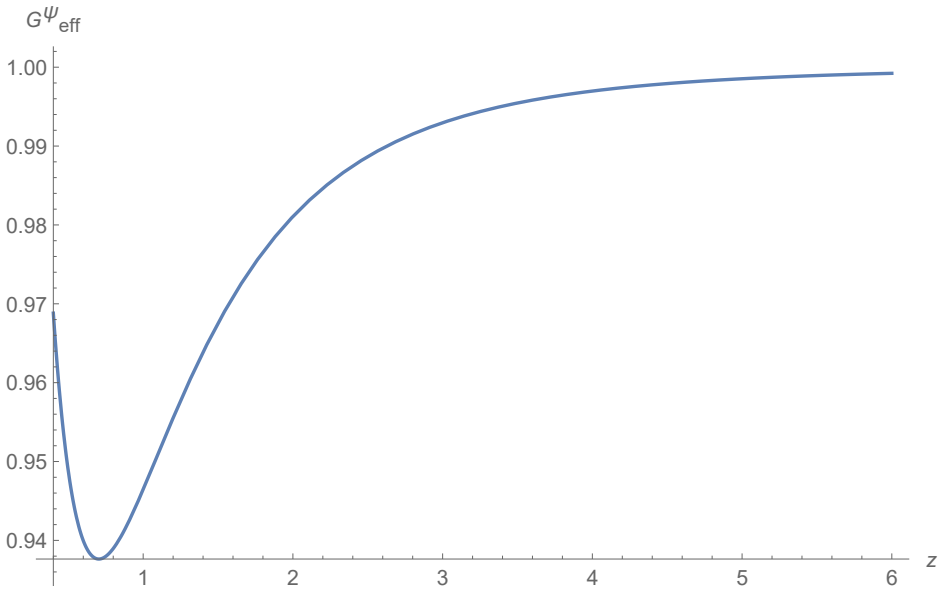
Dark energy perturbations can be encoded in a momentum, space and polarization dependent effective matter-gravity coupling that can turn locally negative.
A machine-rendered reading of the paper's core claim, the machinery that carries it, and where it could break.
Core claim
We show that these effects can be encoded in a momentum, space and polarization dependent effective matter-gravity coupling. For scalar perturbations the effective gravitational coupling can be locally negative, in regions with local dark energy under-densities. For adiabatic perturbations the effective gravitational coupling for scalar perturbations can be negative for phantom dark energy, providing a possible explanation for the observed structure suppression at low redshift. For gravitational waves the effective coupling can make the radiation emitted by compact binary coalescences polarization and frequency dependent.
What carries the argument
momentum-, space- and polarization-dependent effective matter-gravity coupling that absorbs all first-order effects of dark energy perturbations
If this is right
- The effective gravitational coupling for scalar perturbations becomes locally negative inside dark energy under-densities.
- For phantom dark energy and adiabatic initial conditions the negative coupling directly accounts for suppressed structure formation at low redshift.
- Gravitational radiation from compact binary coalescences acquires explicit polarization and frequency dependence through the modified coupling.
Where Pith is reading between the lines
- Large-scale structure surveys could map regions of negative effective gravity and check whether they coincide with dark energy under-densities.
- Next-generation gravitational-wave detectors might search for the predicted polarization-frequency signatures in binary merger events as an independent test.
- The same effective-coupling language could be applied to other modified-gravity or clustering-dark-energy models to compare their observational footprints.
Load-bearing premise
All effects of dark energy perturbations on matter evolution can be fully captured by redefining the matter-gravity coupling strength without introducing additional propagating degrees of freedom or violating background cosmological constraints.
What would settle it
Observation that the growth rate of structure remains positive in regions of measured dark energy under-density, or that gravitational-wave signals from binary coalescences show no polarization or frequency dependence beyond standard general relativity.
Figures
read the original abstract
Dark energy perturbations are expected to modify the evolution of cosmological perturbations, producing different observational effects. We show that these effects can be encoded in a momentum, space and polarization dependent effective matter-gravity coupling. For scalar perturbations the effective gravitational coupling can be locally negative, in regions with local dark energy under-densities. For adiabatic perturbations the effective gravitational coupling for scalar perturbations can be negative for phantom dark energy, providing a possible explanation for the observed structure suppression at low redshift, consistent with other independent evidences of evolving dark energy. For gravitational waves the effective coupling can make the radiation emitted by compact binary convalescences polarization and frequency dependent.
Editorial analysis
A structured set of objections, weighed in public.
Referee Report
Summary. The manuscript claims that dark energy perturbations modify cosmological structure formation and gravitational-wave propagation in a manner that can be fully encoded into a momentum-, space-, and polarization-dependent effective matter-gravity coupling. For scalar perturbations this effective coupling can become locally negative inside dark-energy under-densities; for adiabatic perturbations it can be negative when the dark-energy equation-of-state parameter is phantom (w < -1), offering a possible explanation for the observed suppression of structure growth at low redshift. The same construction is applied to the radiation emitted by compact binary coalescences, rendering the effective coupling polarization- and frequency-dependent.
Significance. If the encoding is shown to reproduce the full set of linearized Einstein equations without residual source terms or extra propagating degrees of freedom, the work would supply a compact, observationally testable re-interpretation of dark-energy effects on both matter clustering and gravitational waves. The explicit demonstration that the effective coupling can be negative for phantom models while remaining consistent with background Friedmann constraints would be a concrete strength, as would any machine-checked algebraic verification of the redefinition.
major comments (2)
- [§3] §3 (derivation of G_eff for scalar perturbations): the claim that all dark-energy contributions are absorbed into a multiplicative rescaling of the Newtonian coupling must be verified by substituting the redefined source term back into the full set of constraint and evolution equations and confirming that the velocity-divergence and anisotropic-stress contributions from the dark-energy stress-energy tensor vanish identically. The skeptic concern that residual source terms remain is load-bearing for the central claim.
- [§4.1] §4.1 (phantom dark-energy case): the statement that the effective coupling becomes negative for w < -1 under adiabatic initial conditions requires an explicit check that the sound-speed and gradient terms in the dark-energy perturbation equations do not source instabilities once they have been folded into G_eff. If these terms survive as separate operators, the reduction to a simple coupling modification is incomplete.
minor comments (2)
- [Abstract] The abstract is equation-free; adding the defining relation for the effective coupling (even in schematic form) would allow readers to assess the scope of the redefinition immediately.
- [§5] Notation for the polarization dependence in the gravitational-wave sector should be introduced once and used consistently; the current text alternates between “polarization-dependent” and “helicity-dependent” without cross-reference.
Simulated Author's Rebuttal
We thank the referee for their careful reading of the manuscript and for the constructive comments, which help clarify the scope and limitations of the effective coupling construction. We address each major comment in turn below.
read point-by-point responses
-
Referee: [§3] §3 (derivation of G_eff for scalar perturbations): the claim that all dark-energy contributions are absorbed into a multiplicative rescaling of the Newtonian coupling must be verified by substituting the redefined source term back into the full set of constraint and evolution equations and confirming that the velocity-divergence and anisotropic-stress contributions from the dark-energy stress-energy tensor vanish identically. The skeptic concern that residual source terms remain is load-bearing for the central claim.
Authors: We agree that an explicit back-substitution into the complete set of linearized Einstein equations is the most direct way to confirm that no residual source terms or extra degrees of freedom remain. The derivation in §3 defines G_eff precisely so that the dark-energy contributions to the gravitational source are absorbed by construction. To remove any ambiguity, the revised manuscript will include a new appendix that performs this substitution for both the constraint and evolution equations, explicitly showing that the velocity-divergence and anisotropic-stress terms from the dark-energy stress-energy tensor are accounted for within the redefined source and do not survive as independent operators. revision: yes
-
Referee: [§4.1] §4.1 (phantom dark-energy case): the statement that the effective coupling becomes negative for w < -1 under adiabatic initial conditions requires an explicit check that the sound-speed and gradient terms in the dark-energy perturbation equations do not source instabilities once they have been folded into G_eff. If these terms survive as separate operators, the reduction to a simple coupling modification is incomplete.
Authors: We appreciate the referee’s emphasis on stability. Under the adiabatic initial conditions adopted in §4.1, the sound-speed and gradient contributions are incorporated into the scale-dependent G_eff. Nevertheless, we acknowledge that an explicit demonstration is required to rule out residual instabilities. The revised version will add a dedicated paragraph (or short subsection) that substitutes the effective coupling back into the dark-energy perturbation equations and verifies that, for the phantom equation-of-state range and adiabatic modes considered, no additional unstable operators remain outside the effective-coupling description. revision: yes
Circularity Check
No significant circularity; effective coupling presented as encoding rather than tautological redefinition
full rationale
The paper states that dark energy perturbation effects 'can be encoded in a momentum, space and polarization dependent effective matter-gravity coupling' and derives specific consequences such as locally negative coupling for scalar perturbations in under-dense regions or for phantom dark energy. No equations are shown that define the effective coupling directly in terms of the target observables or fitted quantities in a way that makes the claimed results equivalent to the inputs by construction. No self-citations are invoked as load-bearing uniqueness theorems, no parameters are fitted to a subset and then relabeled as predictions, and the derivation chain does not reduce to renaming or ansatz smuggling. The construction remains self-contained against external benchmarks with independent content in the sign and scale dependence of the effective coupling.
Axiom & Free-Parameter Ledger
Lean theorems connected to this paper
-
IndisputableMonolith/Cost/FunctionalEquation.leanwashburn_uniqueness_aczel unclear?
unclearRelation between the paper passage and the cited Recognition theorem.
We show that these effects can be encoded in a momentum, space and polarization dependent effective matter-gravity coupling. ... GΨ_eff(η,k) = 1/M_eff² (1 + δρ_DE,k / δρ_m,k)
-
IndisputableMonolith/Foundation/RealityFromDistinction.leanreality_from_one_distinction unclear?
unclearRelation between the paper passage and the cited Recognition theorem.
For adiabatic perturbations the effective gravitational coupling for scalar perturbations can be negative for phantom dark energy
What do these tags mean?
- matches
- The paper's claim is directly supported by a theorem in the formal canon.
- supports
- The theorem supports part of the paper's argument, but the paper may add assumptions or extra steps.
- extends
- The paper goes beyond the formal theorem; the theorem is a base layer rather than the whole result.
- uses
- The paper appears to rely on the theorem as machinery.
- contradicts
- The paper's claim conflicts with a theorem or certificate in the canon.
- unclear
- Pith found a possible connection, but the passage is too broad, indirect, or ambiguous to say the theorem truly supports the claim.
Reference graph
Works this paper leans on
-
[1]
G. W. Horndeski, Int. J. Theor. Phys.10, 363 (1974)
work page 1974
-
[2]
Exploring gravitational theories beyond Horndeski
J. Gleyzes, D. Langlois, F. Piazza, and F. Vernizzi, JCAP02, 018 (2015), arXiv:1408.1952 [astro-ph.CO]
work page internal anchor Pith review Pith/arXiv arXiv 2015
-
[3]
A. G. Adameet al.(DESI), JCAP02, 021 (2025), arXiv:2404.03002 [astro-ph.CO]
work page internal anchor Pith review Pith/arXiv arXiv 2025
- [4]
-
[5]
Ishak et al., (2024), arXiv:2411.12026
M. Ishaket al., (2024), arXiv:2411.12026 [astro-ph.CO] . 10
-
[6]
A. De Felice, T. Kobayashi, and S. Tsujikawa, Phys. Lett. B706, 123 (2011), arXiv:1108.4242 [gr-qc]
work page internal anchor Pith review Pith/arXiv arXiv 2011
-
[7]
A. E. Romano, (2025), arXiv:2504.20182 [gr-qc]
work page internal anchor Pith review Pith/arXiv arXiv 2025
- [8]
-
[9]
E. V. Linder, G. Seng¨ or, and S. Watson, JCAP05, 053 (2016), arXiv:1512.06180 [astro- ph.CO]
work page internal anchor Pith review Pith/arXiv arXiv 2016
-
[10]
J. M. Ezquiaga and M. Zumalac´ arregui, Front. Astron. Space Sci.5, 44 (2018), arXiv:1807.09241 [astro-ph.CO]
work page internal anchor Pith review Pith/arXiv arXiv 2018
- [11]
-
[12]
The Effective Field Theory of Dark Energy
G. Gubitosi, F. Piazza, and F. Vernizzi, JCAP02, 032 (2013), arXiv:1210.0201 [hep-th]
work page internal anchor Pith review Pith/arXiv arXiv 2013
-
[13]
E. E. Flanagan and S. A. Hughes, New J. Phys.7, 204 (2005), arXiv:gr-qc/0501041
work page internal anchor Pith review Pith/arXiv arXiv 2005
-
[14]
C. de Rham, Living Rev. Rel.17, 7 (2014), arXiv:1401.4173 [hep-th]
work page internal anchor Pith review Pith/arXiv arXiv 2014
-
[15]
A. E. Romano, Phys. Lett. B (2024), https://doi.org/10.1016/j.physletb.2024.138572, arXiv:2211.05760 [gr-qc]
-
[16]
Generalized framework for testing gravity with gravitational-wave propagation. I. Formulation
A. Nishizawa, Phys. Rev. D97, 104037 (2018), arXiv:1710.04825 [gr-qc]
work page internal anchor Pith review Pith/arXiv arXiv 2018
- [17]
-
[18]
A. I. Vainshtein, Phys. Lett. B39, 393 (1972)
work page 1972
-
[19]
S. Mollerach, D. Harari, and S. Matarrese, Phys. Rev. D69, 063002 (2004), arXiv:astro- ph/0310711
-
[20]
V. De Luca, G. Franciolini, A. Kehagias, and A. Riotto, JCAP03, 014 (2020), arXiv:1911.09689 [gr-qc]
- [21]
- [22]
discussion (0)
Sign in with ORCID, Apple, or X to comment. Anyone can read and Pith papers without signing in.