Recognition: 2 theorem links
· Lean TheoremRadiative neutrino mass generation and dark matter through vectorlike leptons
Pith reviewed 2026-05-17 20:13 UTC · model grok-4.3
The pith
A single generation of vectorlike leptons produces two nonzero neutrino masses via asymmetric Yukawa couplings in a three-loop radiative model that also accounts for dark matter.
A machine-rendered reading of the paper's core claim, the machinery that carries it, and where it could break.
Core claim
A single generation of vectorlike leptons yields two nonzero neutrino masses as a consequence of the asymmetric Yukawa combinations entering the neutrino mass matrix. The model employs a three-loop radiative mechanism with two scalar doublets whose neutral components split to provide a dark matter candidate while the charged scalars mix to complete the mass-generation diagrams.
What carries the argument
Asymmetric Yukawa coupling between two scalar SU(2)_L doublets and vectorlike lepton doublets that populates the three-loop neutrino mass matrix and induces the required scalar mixing for both mass generation and dark matter.
If this is right
- The model reproduces observed neutrino masses and mixing angles while remaining compatible with current dark matter bounds.
- The predicted rate for μ → eγ lies within reach of forthcoming experiments.
- Singly charged scalars from the two doublets mix and participate directly in the mass-generation loops.
- One scalar doublet supplies a viable dark matter candidate through the mass splitting of its neutral components.
Where Pith is reading between the lines
- If correct, the vectorlike leptons could be produced at the LHC or future colliders through their couplings to the new scalars.
- The three-loop suppression may connect this mechanism to other radiative phenomena in extended gauge theories.
- Precision measurements of the neutrino mixing angles could distinguish the specific texture arising from the asymmetric Yukawa structure.
Load-bearing premise
The three-loop diagrams driven by the asymmetric Yukawa couplings and scalar mixing dominate neutrino mass generation while satisfying all phenomenological constraints without extra fine-tuning or cancellations.
What would settle it
A measured branching ratio for μ → eγ that lies above the model's predicted range, or a direct-detection result that excludes the scalar mass splitting required for the dark matter relic density, would rule out the scenario.
Figures



read the original abstract
This study presents a radiative three-loop model for neutrino mass generation, employing an asymmetric Yukawa coupling between two new scalar $SU(2)_L$ doublets and vectorlike lepton doublets. Dark matter candidates arise from one of the scalar doublets and contribute to neutrino mass generation through the mass splitting between its neutral components. The singly charged scalars are also essential for neutrino mass, with the charged states of the two doublets mixing with one another. A single generation of vectorlike leptons yields two nonzero neutrino masses as a consequence of the asymmetric Yukawa combinations entering the neutrino mass matrix. The model is tested against dark matter phenomenology, neutrino mass and mixing data, and the charged lepton flavor-violating process $\mu \rightarrow e \gamma$, showing compatibility with current bounds and leading to experimentally accessible predictions.
Editorial analysis
A structured set of objections, weighed in public.
Referee Report
Summary. The manuscript presents a three-loop radiative neutrino mass model employing vectorlike lepton doublets coupled asymmetrically to two SU(2)_L scalar doublets. The neutral components of one scalar doublet act as dark matter candidates, with their mass splitting contributing to the loop-induced neutrino masses. A single generation of vectorlike leptons produces a 3×3 neutrino mass matrix with exactly two nonzero eigenvalues. The model is checked for consistency with neutrino oscillation data, dark matter relic density, and the μ → eγ branching ratio, claiming compatibility and experimentally accessible predictions.
Significance. If the central construction holds, the model offers a concrete realization linking radiative neutrino mass generation at three loops to a viable dark matter candidate through scalar mass splitting and mixing. The distinctive feature that asymmetric Yukawa combinations yield precisely two nonzero neutrino masses from one vectorlike generation provides a falsifiable relation to oscillation parameters. Explicit numerical compatibility checks with relic density and LFV bounds, if robust, would strengthen the case for this class of models.
major comments (3)
- [§3.2, Eq. (18)] §3.2, Eq. (18): The three-loop neutrino mass matrix is stated to arise solely from the asymmetric Yukawa terms and scalar mixing, yet the manuscript does not explicitly demonstrate the vanishing of one- and two-loop contributions. A diagram-by-diagram cancellation argument or symmetry reason must be supplied, as any residual lower-order term would dominate and invalidate the three-loop suppression needed to reach the 0.05 eV scale.
- [§5.1 and Table 2] §5.1 and Table 2: The parameter choices that reproduce the observed neutrino mass scale via the three-loop integral simultaneously satisfy the DM relic density only for a narrow range of mass splittings (∼ few GeV). The manuscript must quantify the degree of tuning required between the Yukawa couplings, scalar masses, and the DM annihilation cross section; without this, the claim of natural compatibility remains unverified.
- [§4.3, Eq. (32)] §4.3, Eq. (32): The μ → eγ amplitude is computed at one loop and used to bound the same scalar and Yukawa parameters that enter the three-loop neutrino mass. The paper should show the correlation plot or allowed region where both constraints are satisfied without additional cancellations, as the three-loop suppression for m_ν does not automatically protect the LFV rate.
minor comments (3)
- [§2] The definition of the two scalar doublets Φ1 and Φ2 in §2 should include their hypercharge assignments explicitly to avoid ambiguity with standard notation.
- [Figure 3] Figure 3 (neutrino mass vs. DM mass) lacks error bands from the oscillation parameter uncertainties; adding them would improve clarity.
- [Introduction] A brief comparison to existing three-loop neutrino mass models (e.g., those with colored scalars) is missing from the introduction.
Simulated Author's Rebuttal
We thank the referee for the careful reading of our manuscript and the constructive comments. We address each major comment below and indicate the revisions we will make to strengthen the presentation.
read point-by-point responses
-
Referee: [§3.2, Eq. (18)] §3.2, Eq. (18): The three-loop neutrino mass matrix is stated to arise solely from the asymmetric Yukawa terms and scalar mixing, yet the manuscript does not explicitly demonstrate the vanishing of one- and two-loop contributions. A diagram-by-diagram cancellation argument or symmetry reason must be supplied, as any residual lower-order term would dominate and invalidate the three-loop suppression needed to reach the 0.05 eV scale.
Authors: We agree that an explicit demonstration is necessary. The asymmetric Yukawa structure, in which the vectorlike lepton doublets couple to only one combination of the two scalar doublets, forbids the vertices required for one- and two-loop neutrino mass diagrams through a combination of SU(2)_L charge conservation and the absence of certain scalar mixing terms at lower orders. We will add a new subsection in §3.2 that lists the possible lower-order diagrams and shows their vanishing by explicit inspection of the relevant Feynman rules. revision: yes
-
Referee: [§5.1 and Table 2] §5.1 and Table 2: The parameter choices that reproduce the observed neutrino mass scale via the three-loop integral simultaneously satisfy the DM relic density only for a narrow range of mass splittings (∼ few GeV). The manuscript must quantify the degree of tuning required between the Yukawa couplings, scalar masses, and the DM annihilation cross section; without this, the claim of natural compatibility remains unverified.
Authors: The narrow mass splitting is a direct consequence of the scalar potential parameters needed to generate the correct three-loop neutrino mass scale while keeping the DM candidate stable. In the viable benchmark points the Yukawa couplings remain O(0.1–1) and the scalar masses lie in the few-TeV range; the splitting itself is set by the soft-breaking term in the potential rather than by an independent fine-tuning. We will add a short discussion in §5.1 that quantifies the sensitivity of the relic density to variations in the mass-splitting parameter, confirming that the required tuning is mild (at the level of a few percent) within the regions that also satisfy neutrino data. revision: yes
-
Referee: [§4.3, Eq. (32)] §4.3, Eq. (32): The μ → eγ amplitude is computed at one loop and used to bound the same scalar and Yukawa parameters that enter the three-loop neutrino mass. The paper should show the correlation plot or allowed region where both constraints are satisfied without additional cancellations, as the three-loop suppression for m_ν does not automatically protect the LFV rate.
Authors: We have performed a joint scan over the shared parameters and find viable regions in which the one-loop LFV rate lies below the experimental bound while the three-loop neutrino masses reproduce the observed values. To make this explicit we will add a new figure (or panel in an existing figure) in §4.3 or §5 that displays the allowed parameter space in the plane of the dominant Yukawa coupling versus the relevant scalar mass, with contours indicating the regions satisfying all three constraints simultaneously. revision: yes
Circularity Check
No circularity: neutrino mass matrix structure derived from explicit loop diagrams
full rationale
The paper introduces vectorlike leptons and two scalar doublets, then computes the 3x3 neutrino mass matrix from three-loop diagrams with asymmetric Yukawa couplings. The result of exactly two nonzero eigenvalues follows directly from the matrix rank induced by the model's Feynman rules and field content, without reducing to a fitted input or self-citation. Parameters are later scanned to match data and bounds, but this is standard phenomenology and does not make the structural claim circular. No load-bearing self-citations, ansatze, or fitted predictions renamed as derivations are present.
Axiom & Free-Parameter Ledger
free parameters (2)
- Scalar masses and mass splitting
- Asymmetric Yukawa couplings
axioms (1)
- domain assumption Three-loop diagrams dominate over lower-order contributions to neutrino mass
invented entities (2)
-
Two SU(2)_L scalar doublets
no independent evidence
-
Vectorlike lepton doublets
no independent evidence
Lean theorems connected to this paper
-
IndisputableMonolith/Cost/FunctionalEquation.leanwashburn_uniqueness_aczel unclear?
unclearRelation between the paper passage and the cited Recognition theorem.
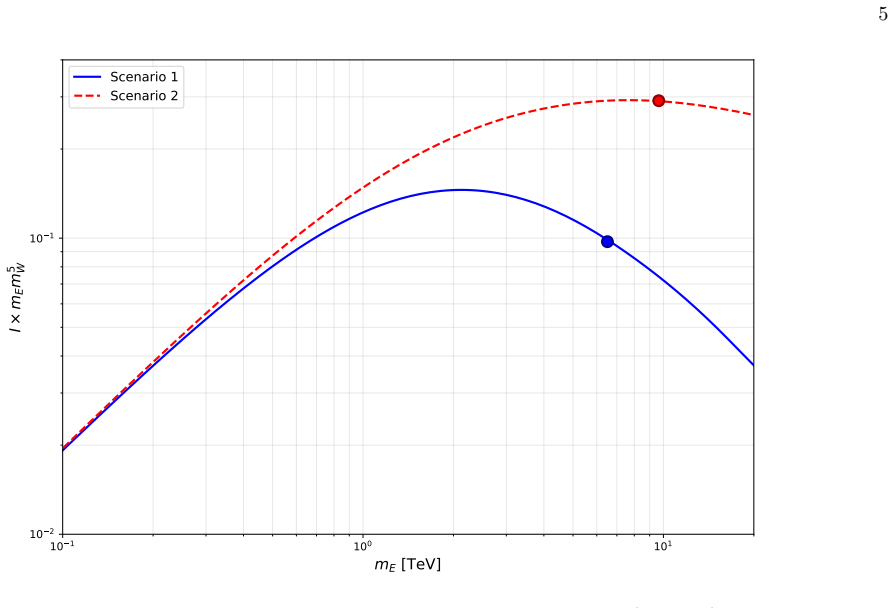
mν_ab = λ7 λ5 / (16π²)³ × (ga ˜gb + ˜ga gb) m_a m_b / m_W × I3L
-
IndisputableMonolith/Foundation/RealityFromDistinction.leanreality_from_one_distinction unclear?
unclearRelation between the paper passage and the cited Recognition theorem.
three-loop topologies … scalar mixing … DM relic density and μ→eγ bounds
What do these tags mean?
- matches
- The paper's claim is directly supported by a theorem in the formal canon.
- supports
- The theorem supports part of the paper's argument, but the paper may add assumptions or extra steps.
- extends
- The paper goes beyond the formal theorem; the theorem is a base layer rather than the whole result.
- uses
- The paper appears to rely on the theorem as machinery.
- contradicts
- The paper's claim conflicts with a theorem or certificate in the canon.
- unclear
- Pith found a possible connection, but the passage is too broad, indirect, or ambiguous to say the theorem truly supports the claim.
Reference graph
Works this paper leans on
-
[1]
Particle Dark Matter: Evidence, Candidates and Constraints
G. Bertone, D. Hooper and J. Silk,Particle dark matter: Evidence, candidates and constraints,Phys. Rept.405(2005) 279–390, [hep-ph/0404175]
work page internal anchor Pith review Pith/arXiv arXiv 2005
-
[2]
R. N. Mohapatra et al.,Theory of Neutrinos: A White Paper,Rept. Prog. Phys.70(2007) 1757–1867, [hep-ph/0510213]
work page internal anchor Pith review Pith/arXiv arXiv 2007
-
[3]
Verifiable Radiative Seesaw Mechanism of Neutrino Mass and Dark Matter
E. Ma,Verifiable radiative seesaw mechanism of neutrino mass and dark matter,Phys. Rev. D73(2006) 077301, [hep-ph/0601225]
work page internal anchor Pith review Pith/arXiv arXiv 2006
-
[4]
K. S. Babu and C. N. Leung,Classification of effective neutrino mass operators,Nucl. Phys.B619(2001) 667–689, [hep-ph/0106054]
work page internal anchor Pith review Pith/arXiv arXiv 2001
-
[5]
A Survey of Lepton Number Violation Via Effective Operators
A. de Gouvea and J. Jenkins,A Survey of Lepton Number Violation Via Effective Operators,Phys. Rev.D77(2008) 013008, [0708.1344]
work page internal anchor Pith review Pith/arXiv arXiv 2008
-
[6]
Y. Cai, J. Herrero-Garc´ ıa, M. A. Schmidt, A. Vicente and R. R. Volkas,From the trees to the forest: a review of radiative neutrino mass models,Front. in Phys.5(2017) 63, [1706.08524]
work page internal anchor Pith review Pith/arXiv arXiv 2017
-
[7]
L. M. Krauss, S. Nasri and M. Trodden,A Model for neutrino masses and dark matter,Phys. Rev.D67(2003) 085002, [hep-ph/0210389]
work page internal anchor Pith review Pith/arXiv arXiv 2003
-
[8]
M. Aoki, S. Kanemura and O. Seto,Neutrino mass, Dark Matter and Baryon Asymmetry via TeV-Scale Physics without Fine-Tuning,Phys. Rev. Lett.102(2009) 051805, [0807.0361]
work page internal anchor Pith review Pith/arXiv arXiv 2009
-
[9]
A Three-loop Neutrino Model with Leptoquark Triplet Scalars
K. Cheung, T. Nomura and H. Okada,A Three-loop Neutrino Model with Leptoquark Triplet Scalars,Phys. Lett. B768 (2017) 359–364, [1701.01080]
work page internal anchor Pith review Pith/arXiv arXiv 2017
-
[10]
$T_7$ Flavor Model in Three Loop Seesaw and Higgs Phenomenology
Y. Kajiyama, H. Okada and K. Yagyu,T 7 Flavor Model in Three Loop Seesaw and Higgs Phenomenology,JHEP10 (2013) 196, [1307.0480]
work page internal anchor Pith review Pith/arXiv arXiv 2013
-
[11]
A Three-Loop Model of Neutrino Mass with Dark Matter
A. Ahriche, C.-S. Chen, K. L. McDonald and S. Nasri,Three-loop model of neutrino mass with dark matter,Phys. Rev. D 90(2014) 015024, [1404.2696]
work page internal anchor Pith review Pith/arXiv arXiv 2014
-
[12]
A Model of Radiative Neutrino Mass: with or without Dark Matter
A. Ahriche, K. L. McDonald and S. Nasri,A Model of Radiative Neutrino Mass: with or without Dark Matter,JHEP10 (2014) 167, [1404.5917]
work page internal anchor Pith review Pith/arXiv arXiv 2014
-
[13]
A Three-Loop Neutrino Model with Global $U(1)$ Symmetry
H. Hatanaka, K. Nishiwaki, H. Okada and Y. Orikasa,A Three-Loop Neutrino Model with GlobalU(1)Symmetry,Nucl. Phys. B894(2015) 268–283, [1412.8664]
work page internal anchor Pith review Pith/arXiv arXiv 2015
-
[14]
Three Loop Neutrino Model with Isolated $k^{\pm\pm}$
K. Nishiwaki, H. Okada and Y. Orikasa,Three loop neutrino model with isolatedk ±±,Phys. Rev. D92(2015) 093013, [1507.02412]
work page internal anchor Pith review Pith/arXiv arXiv 2015
-
[15]
Three-loop Neutrino Mass Model with Doubly Charged Particles from Iso-Doublets
H. Okada and K. Yagyu,Three-loop neutrino mass model with doubly charged particles from isodoublets,Phys. Rev. D93 (2016) 013004, [1508.01046]
work page internal anchor Pith review Pith/arXiv arXiv 2016
-
[16]
A Model of Neutrino Mass and Dark Matter with an Accidental Symmetry
A. Ahriche, K. L. McDonald, S. Nasri and T. Toma,A Model of Neutrino Mass and Dark Matter with an Accidental Symmetry,Phys. Lett. B746(2015) 430–435, [1504.05755]
work page internal anchor Pith review Pith/arXiv arXiv 2015
-
[17]
R. Cepedello, M. Hirsch, P. Rocha-Mor´ an and A. Vicente,Minimal 3-loop neutrino mass models and charged lepton flavor violation,JHEP08(2020) 067, [2005.00015]
-
[18]
C.-S. Chen, C. Q. Geng and J. N. Ng,Unconventional Neutrino Mass Generation, Neutrinoless Double Beta Decays, and Collider Phenomenology,Phys. Rev.D75(2007) 053004, [hep-ph/0610118]
work page internal anchor Pith review Pith/arXiv arXiv 2007
-
[19]
A realistic model of neutrino masses with a large neutrinoless double beta decay rate
F. del Aguila, A. Aparici, S. Bhattacharya, A. Santamaria and J. Wudka,A realistic model of neutrino masses with a large neutrinoless double beta decay rate,JHEP05(2012) 133, [1111.6960]
work page internal anchor Pith review Pith/arXiv arXiv 2012
-
[20]
Predictive Model for Radiatively Induced Neutrino Masses and Mixings with Dark Matter
M. Gustafsson, J. M. No and M. A. Rivera,Predictive Model for Radiatively Induced Neutrino Masses and Mixings with Dark Matter,Phys. Rev. Lett.110(2013) 211802, [1212.4806]
work page internal anchor Pith review Pith/arXiv arXiv 2013
-
[21]
A model of neutrino mass and dark matter with large neutrinoless double beta decay
J. Alcaide, D. Das and A. Santamaria,A model of neutrino mass and dark matter with large neutrinoless double beta decay,JHEP04(2017) 049, [1701.01402]
work page internal anchor Pith review Pith/arXiv arXiv 2017
-
[22]
L.-G. Jin, R. Tang and F. Zhang,A three-loop radiative neutrino mass model with dark matter,Phys. Lett. B741(2015) 163–167, [1501.02020]
work page internal anchor Pith review Pith/arXiv arXiv 2015
-
[23]
Radiative neutrino mass generation linked to neutrino mixing and $0\nu\beta\beta$-decay predictions
M. Gustafsson, J. M. No and M. A. Rivera,Radiative neutrino mass generation linked to neutrino mixing and 0νββ-decay predictions,Phys. Rev. D90(2014) 013012, [1402.0515]
work page internal anchor Pith review Pith/arXiv arXiv 2014
-
[24]
M. Gustafsson, J. M. No and M. A. Rivera,Lepton number violating operators with standard model gauge fields: A survey of neutrino masses from 3-loops and their link to dark matter,JHEP11(2020) 070, [2006.13564]
-
[25]
C.-S. Chen, K. L. McDonald and S. Nasri,A Class of Three-Loop Models with Neutrino Mass and Dark Matter,Phys. Lett. B734(2014) 388–393, [1404.6033]
work page internal anchor Pith review Pith/arXiv arXiv 2014
-
[26]
Vacuum Stability Conditions From Copositivity Criteria
K. Kannike,Vacuum Stability Conditions From Copositivity Criteria,Eur. Phys. J. C72(2012) 2093, [1205.3781]. 15
work page internal anchor Pith review Pith/arXiv arXiv 2012
-
[27]
pySecDec: a toolbox for the numerical evaluation of multi-scale integrals
S. Borowka, G. Heinrich, S. Jahn, S. Jones, M. Kerner, J. Schlenk et al.,pySecDec: a toolbox for the numerical evaluation of multi-scale integrals,Comput. Phys. Commun.222(2018) 313–326, [1703.09692]
work page internal anchor Pith review Pith/arXiv arXiv 2018
- [28]
-
[29]
M. Cirelli, N. Fornengo and A. Strumia,Minimal dark matter,Nucl. Phys. B753(2006) 178–194, [hep-ph/0512090]. [32]XENONcollaboration, E. Aprile et al.,First Dark Matter Search with Nuclear Recoils from the XENONnT Experiment, Phys. Rev. Lett.131(2023) 041003, [2303.14729]. [33]LZcollaboration, J. Aalbers et al.,Dark Matter Search Results from 4.2 Tonne-Yea...
work page internal anchor Pith review Pith/arXiv arXiv 2006
-
[30]
A Mini-review on Vector-like Leptonic Dark Matter, Neutrino Mass and Collider Signatures
S. Bhattacharya, P. Ghosh, N. Sahoo and N. Sahu,Mini Review on Vector-Like Leptonic Dark Matter, Neutrino Mass, and Collider Signatures,Front. in Phys.7(2019) 80, [1812.06505]. [35]Planckcollaboration, N. Aghanim et al.,Planck 2018 results. VI. Cosmological parameters,Astron. Astrophys.641 (2020) A6, [1807.06209]. [36]Particle Data Groupcollaboration, S. ...
work page internal anchor Pith review Pith/arXiv arXiv 2019
-
[31]
NuFit-6.0: Updated global analysis of three-flavor neutrino oscillations
I. Esteban, M. C. Gonzalez-Garcia, M. Maltoni, I. Martinez-Soler, J. a. P. Pinheiro and T. Schwetz,NuFit-6.0: updated global analysis of three-flavor neutrino oscillations,JHEP12(2024) 216, [2410.05380]
work page internal anchor Pith review Pith/arXiv arXiv 2024
-
[32]
Z.-z. Xing, H. Zhang and S. Zhou,Updated Values of Running Quark and Lepton Masses,Phys. Rev. D77(2008) 113016, [0712.1419]
work page internal anchor Pith review Pith/arXiv arXiv 2008
-
[33]
General formulae for f1 --> f2 gamma
L. Lavoura,General formulae for f(1) —>f(2) gamma,Eur. Phys. J. C29(2003) 191–195, [hep-ph/0302221]
work page internal anchor Pith review Pith/arXiv arXiv 2003
-
[34]
FeynRules 2.0 - A complete toolbox for tree-level phenomenology
A. Alloul, N. D. Christensen, C. Degrande, C. Duhr and B. Fuks,FeynRules 2.0 - A complete toolbox for tree-level phenomenology,Comput. Phys. Commun.185(2014) 2250–2300, [1310.1921]
work page internal anchor Pith review Pith/arXiv arXiv 2014
-
[35]
CalcHEP 3.4 for collider physics within and beyond the Standard Model
A. Belyaev, N. D. Christensen and A. Pukhov,CalcHEP 3.4 for collider physics within and beyond the Standard Model, Comput. Phys. Commun.184(2013) 1729–1769, [1207.6082]
work page internal anchor Pith review Pith/arXiv arXiv 2013
-
[36]
micrOMEGAs3.1 : a program for calculating dark matter observables
G. Belanger, F. Boudjema, A. Pukhov and A. Semenov,micrOMEGAs 3: A program for calculating dark matter observables,Comput. Phys. Commun.185(2014) 960–985, [1305.0237]
work page internal anchor Pith review Pith/arXiv arXiv 2014
-
[37]
G. Alguero, G. Belanger, F. Boudjema, S. Chakraborti, A. Goudelis, S. Kraml et al.,micrOMEGAs 6.0: N-component dark matter,Comput. Phys. Commun.299(2024) 109133, [2312.14894]. [44]ATLAScollaboration, G. Aad et al.,Observation of a new particle in the search for the Standard Model Higgs boson with the ATLAS detector at the LHC,Phys. Lett. B716(2012) 1–29, ...
-
[38]
Higgs searches and singlet scalar dark matter: Combined constraints from XENON 100 and the LHC
Y. Mambrini,Higgs searches and singlet scalar dark matter: Combined constraints from XENON 100 and the LHC,Phys. Rev. D84(2011) 115017, [1108.0671]
work page internal anchor Pith review Pith/arXiv arXiv 2011
-
[39]
Can WIMP Dark Matter overcome the Nightmare Scenario?
S. Kanemura, S. Matsumoto, T. Nabeshima and N. Okada,Can WIMP Dark Matter overcome the Nightmare Scenario?, Phys. Rev. D82(2010) 055026, [1005.5651]
work page internal anchor Pith review Pith/arXiv arXiv 2010
-
[40]
J. M. Alarcon, J. Martin Camalich and J. A. Oller,The chiral representation of theπNscattering amplitude and the pion-nucleon sigma term,Phys. Rev. D85(2012) 051503, [1110.3797]
work page internal anchor Pith review Pith/arXiv arXiv 2012
-
[41]
J. M. Alarcon, L. S. Geng, J. Martin Camalich and J. A. Oller,The strangeness content of the nucleon from effective field theory and phenomenology,Phys. Lett. B730(2014) 342–346, [1209.2870]
work page internal anchor Pith review Pith/arXiv arXiv 2014
-
[42]
N. G. Deshpande and E. Ma,Pattern of Symmetry Breaking with Two Higgs Doublets,Phys. Rev. D18(1978) 2574
work page 1978
-
[43]
Improved Naturalness with a Heavy Higgs: An Alternative Road to LHC Physics
R. Barbieri, L. J. Hall and V. S. Rychkov,Improved naturalness with a heavy Higgs: An Alternative road to LHC physics, Phys. Rev. D74(2006) 015007, [hep-ph/0603188]
work page internal anchor Pith review Pith/arXiv arXiv 2006
- [44]
-
[45]
A. Baur,FlavorPy, 2024. 10.5281/zenodo.11060597
-
[46]
Abe and KamLAND-Zen Collaboration et al., arXiv:2406.11438 13
M. Newville, T. Stensitzki, D. B. Allen, M. Rawlik, A. Ingargiola and A. Nelson,LMFIT: Non-linear least-square minimization and curve-fitting for Python, 2016. [55]KamLAND-Zencollaboration, S. Abe et al.,Search for Majorana Neutrinos with the Complete KamLAND-Zen Dataset, 2406.11438. [56]LEGENDcollaboration, N. Abgrall et al.,The Large Enriched Germanium ...
discussion (0)
Sign in with ORCID, Apple, or X to comment. Anyone can read and Pith papers without signing in.