Gravitational Waves from the Big Bang
Pith reviewed 2026-05-17 20:07 UTC · model grok-4.3
The pith
Gravitational waves from cosmic inflation could explain the NANOGrav signal
A machine-rendered reading of the paper's core claim, the machinery that carries it, and where it could break.
Core claim
The dissertation argues that the gravitational-wave signal targeted by NANOGrav could have originated from tensor perturbations generated during cosmic inflation, providing a primordial explanation for the observed stochastic background.
What carries the argument
Tensor perturbations from quantum fluctuations during inflation that evolve into a stochastic gravitational wave background at nanohertz frequencies
If this is right
- NANOGrav data could then constrain the energy scale of inflation.
- Detection would provide indirect evidence for the inflationary paradigm.
- It would enable a direct probe of physics at energy scales inaccessible to particle colliders.
Where Pith is reading between the lines
- Future pulsar timing improvements could separate inflationary signals from astrophysical ones via precise spectral measurements.
- Cross-correlating with cosmic microwave background polarization data might test consistency of the inflationary origin.
- The same mechanism could apply to stochastic backgrounds sought by other gravitational wave experiments at different frequencies.
Load-bearing premise
The assumption that the stochastic gravitational wave background targeted by NANOGrav originates from primordial inflation rather than from astrophysical sources such as supermassive black hole binaries.
What would settle it
Observation of a spectral shape or frequency dependence in the NANOGrav data that matches supermassive black hole binary predictions but deviates from the nearly scale-invariant spectrum expected from inflation.
Figures




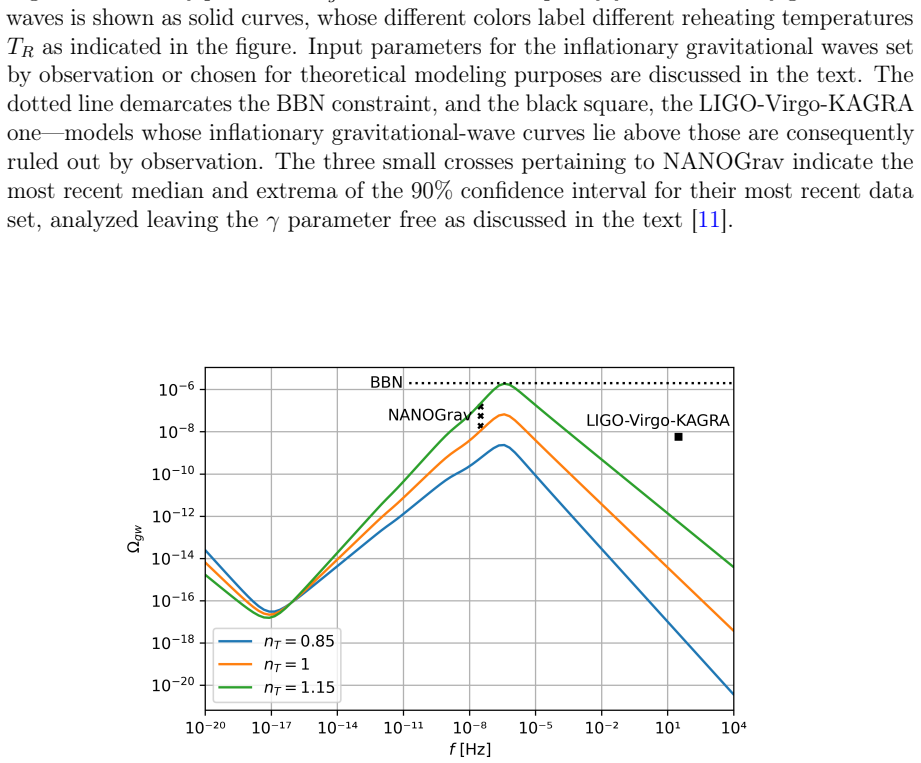
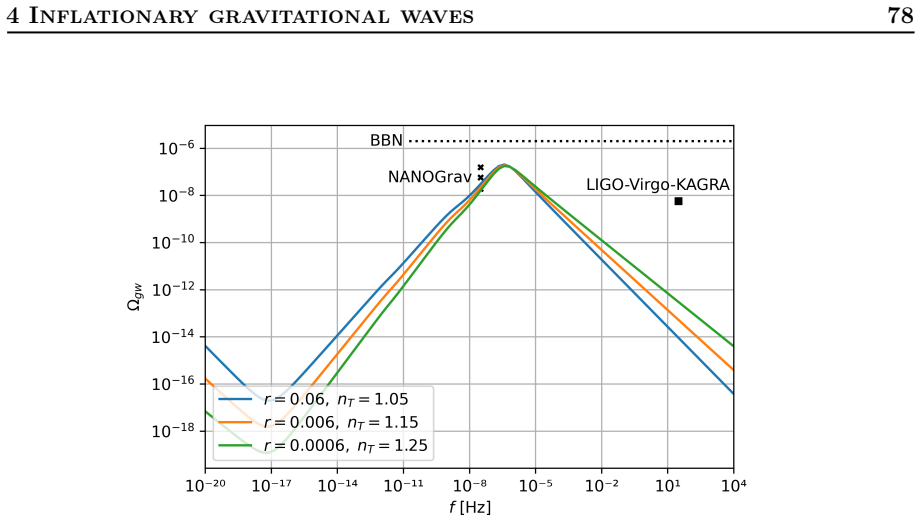
read the original abstract
For millennia, humanity has relied exclusively on light$\unicode{x2014}$initially visible light and, later, broader and broader portions of the electromagnetic spectrum$\unicode{x2014}$to observe the universe. In the past decade, a remarkable chapter in extending astronomy beyond electromagnetic antennas has been concretized: the dawn of gravitational-wave astronomy has opened a new observational window into the cosmos. Among the many new astronomical sources we may now look for and study through their gravitational-wave signals, the Big Bang is surely among the most fascinating. Gravitational waves give us concrete hope of directly observing the primordial universe, whose light, emitted more than 13.7 billion years ago, is blocked from reaching our telescopes. This dissertation is aimed at the study of gravitational waves from cosmic inflation, the main scientific paradigm for the very early universe. Therefore, the text is divided into chapters on gravitational waves, inflationary cosmology, and inflationary gravitational waves. More specifically, our discussion will be steered by the endeavor to explain how the gravitational-wave signal sought by the NANOGrav observatory could have originated in the primordial universe.
Editorial analysis
A structured set of objections, weighed in public.
Referee Report
Summary. The manuscript is a dissertation reviewing gravitational waves, inflationary cosmology, and the generation of primordial gravitational waves during inflation. Its central aim is to explore whether the stochastic gravitational-wave background signal targeted by the NANOGrav pulsar timing array can be attributed to tensor modes produced in the very early universe rather than to later astrophysical sources.
Significance. A successful demonstration that a concrete inflationary model can reproduce the NANOGrav amplitude and spectral tilt at nanohertz frequencies while remaining consistent with the CMB bound r < 0.036 would constitute a notable connection between early-universe theory and current observational efforts. The work's value is currently constrained by the absence of an explicit derivation showing how the required blue tilt or non-standard reheating can be realized without violating slow-roll conditions or existing limits.
major comments (2)
- [Chapter on inflationary gravitational waves] Chapter on inflationary gravitational waves: the discussion of the tensor power spectrum and its transfer to the present-day Omega_GW(f) does not contain an explicit calculation demonstrating that a spectrum consistent with r < 0.036 can reach the amplitude ~10^{-9} at f ~ 10^{-8} Hz reported by NANOGrav; without a concrete potential or modified reheating scenario that produces the necessary blue tilt while preserving slow-roll, the central explanatory claim remains unsupported.
- [Discussion of NANOGrav] Section addressing NANOGrav observations: the assumption that the common-spectrum process is primordial is adopted without quantitative comparison to the expected astrophysical background from supermassive black-hole binaries, leaving the interpretation vulnerable to the standard alternative explanation.
minor comments (2)
- [Abstract] Abstract: the em-dash characters are rendered with unicode escapes that may reduce readability in some formats; replace with standard dashes for clarity.
- [Overall structure] Overall structure: as a dissertation compiled into chapters, the manuscript would benefit from a dedicated conclusions section that explicitly states which new results (if any) go beyond existing literature on inflationary GW spectra.
Simulated Author's Rebuttal
We thank the referee for the careful reading and constructive comments on our dissertation. We address each major comment below and describe the revisions that will be incorporated.
read point-by-point responses
-
Referee: [Chapter on inflationary gravitational waves] Chapter on inflationary gravitational waves: the discussion of the tensor power spectrum and its transfer to the present-day Omega_GW(f) does not contain an explicit calculation demonstrating that a spectrum consistent with r < 0.036 can reach the amplitude ~10^{-9} at f ~ 10^{-8} Hz reported by NANOGrav; without a concrete potential or modified reheating scenario that produces the necessary blue tilt while preserving slow-roll, the central explanatory claim remains unsupported.
Authors: We agree that the current chapter presents the general derivation of the tensor power spectrum and its transfer function to Omega_GW(f) but stops short of a concrete numerical example that simultaneously satisfies r < 0.036 and the NANOGrav amplitude. In the revised version we will insert a new subsection that performs an illustrative calculation: we adopt a power-law tensor spectrum with a blue tilt n_T > 0, evolve it through a non-standard reheating epoch with equation-of-state parameter w > 1/3, and show that the resulting Omega_GW at 10^{-8} Hz can reach ~10^{-9} while the corresponding r remains below the CMB bound. The calculation will be kept within the slow-roll regime during inflation and will cite existing literature models that realize such blue tilts. revision: yes
-
Referee: [Discussion of NANOGrav] Section addressing NANOGrav observations: the assumption that the common-spectrum process is primordial is adopted without quantitative comparison to the expected astrophysical background from supermassive black-hole binaries, leaving the interpretation vulnerable to the standard alternative explanation.
Authors: We acknowledge that the manuscript focuses on the primordial interpretation without a side-by-side quantitative comparison to the supermassive black-hole binary foreground. We will add a concise paragraph that summarizes the expected amplitude and spectral index of the SMBHB background from the literature (typically Omega_GW ~ 10^{-9}–10^{-8} with a steeper slope) and explicitly notes the current degeneracy. This addition will present both possibilities in a balanced manner and highlight how future PTA data could discriminate between them. revision: yes
Circularity Check
No circularity identified; derivation chain not inspectable in provided text
full rationale
The accessible manuscript content consists of an abstract and high-level introductory discussion framing the study of inflationary gravitational waves and their possible link to NANOGrav. No equations, parameter choices, transfer functions, or explicit derivation steps are quoted or described that could be walked for self-definition, fitted inputs renamed as predictions, or load-bearing self-citations. The central endeavor is presented as explanatory rather than a closed-form derivation that reduces to its own inputs by construction. Absent any load-bearing mathematical steps in the given sections, the analysis finds the work self-contained at the level of available text.
Axiom & Free-Parameter Ledger
Lean theorems connected to this paper
-
IndisputableMonolith/Foundation/AlexanderDuality.leanalexander_duality_circle_linking unclear?
unclearRelation between the paper passage and the cited Recognition theorem.
Tensorial metric perturbations during inflation... Gravitational-wave dynamics in the expanding universe... Energy of primordial gravitational waves and the transfer function
-
IndisputableMonolith/Cost/FunctionalEquation.leanwashburn_uniqueness_aczel unclear?
unclearRelation between the paper passage and the cited Recognition theorem.
Blue-tilted tensor spectrum and observations... A model of the early universe with a blue-tilted tensor spectrum
What do these tags mean?
- matches
- The paper's claim is directly supported by a theorem in the formal canon.
- supports
- The theorem supports part of the paper's argument, but the paper may add assumptions or extra steps.
- extends
- The paper goes beyond the formal theorem; the theorem is a base layer rather than the whole result.
- uses
- The paper appears to rely on the theorem as machinery.
- contradicts
- The paper's claim conflicts with a theorem or certificate in the canon.
- unclear
- Pith found a possible connection, but the passage is too broad, indirect, or ambiguous to say the theorem truly supports the claim.
discussion (0)
Sign in with ORCID, Apple, or X to comment. Anyone can read and Pith papers without signing in.