Phases of Giant Magnetic Vortex Strings
Pith reviewed 2026-05-17 04:59 UTC · model grok-4.3
The pith
Giant vortex strings in Abelian Higgs models admit exact solutions in the large-flux limit that organize into distinct phases set by the Higgs potential.
A machine-rendered reading of the paper's core claim, the machinery that carries it, and where it could break.
Core claim
The non-linear equations governing giant vortices can essentially be solved exactly. The solutions fall into different universality classes, reflecting the properties of the Higgs potential, that become sharply distinct phases in the large-n limit. This understanding is used to shed light on the binding energies and stability of vortex strings in each universality class.
What carries the argument
Exact solvability of the transverse profile equations for giant vortices with large magnetic flux n, which classifies solutions into universality classes according to the Higgs potential.
If this is right
- Different forms of the Higgs potential produce qualitatively different large-n behaviors for the vortex strings.
- Binding energies become exactly calculable once the universality class is identified.
- Stability of the strings is fixed by membership in a given phase.
- The transverse spreading remains finite and controlled even as the magnetic flux grows arbitrarily large.
Where Pith is reading between the lines
- The same reduction to exact solvability may apply to other extended objects carrying large topological charge in gauge theories.
- Numerical simulations at large but finite n could directly test how rapidly the phase distinctions appear.
- Analogous large-charge limits in condensed-matter realizations of the Abelian Higgs model might display the same phase structure.
Load-bearing premise
The large-n limit must be taken while keeping the transverse profile finite; otherwise sub-leading corrections in 1/n may prevent the clean emergence of distinct phases for quantities like binding energy.
What would settle it
A numerical computation of the binding energy for a giant vortex at successively larger but finite n that fails to approach the exact large-n prediction would show that the claimed solvability and phase separation do not hold.
Figures


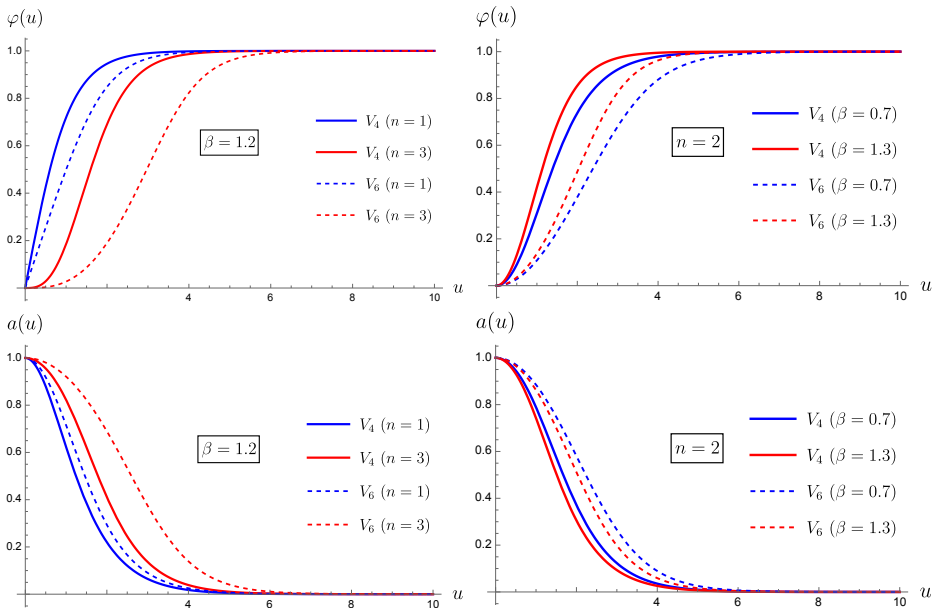


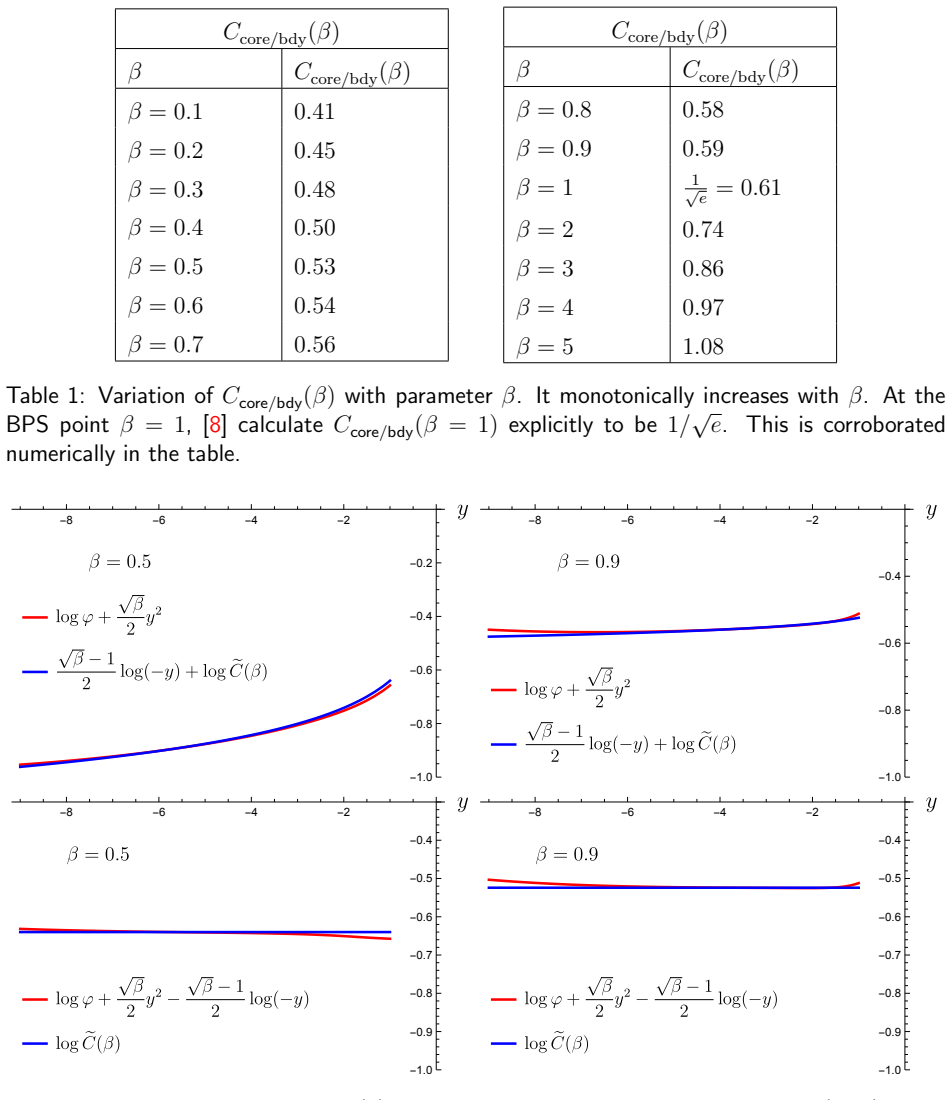


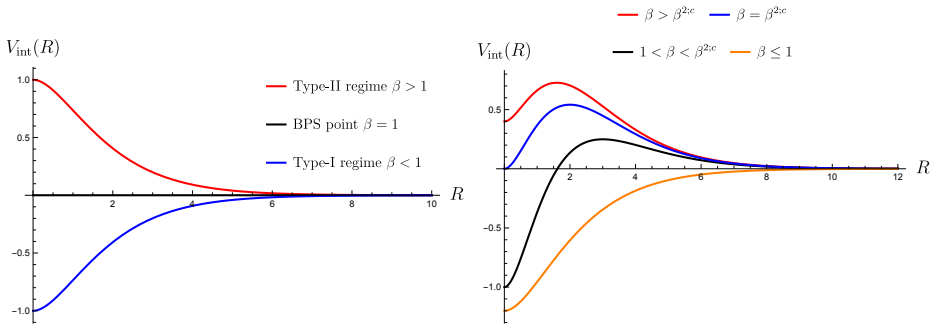


read the original abstract
We consider Abrikosov-Nielsen-Olesen magnetic vortex strings in 3+1 dimensional Abelian Higgs models. We systematically analyze the giant vortex regime using a combination of analytic and numerical methods. In this regime the strings are infinitely long, axially symmetric, and support a large magnetic flux n along the symmetry axis in their core that causes them to spread out in the transverse directions. Extending previous observations, we show that the non-linear equations governing giant vortices can essentially be solved exactly. The solutions fall into different universality classes, reflecting the properties of the Higgs potential, that become sharply distinct phases in the large-n limit. We use this understanding to shed light on the binding energies and stability of vortex strings in each universality class.
Editorial analysis
A structured set of objections, weighed in public.
Referee Report
Summary. The paper analyzes Abrikosov-Nielsen-Olesen magnetic vortex strings in 3+1D Abelian Higgs models in the giant vortex regime, where the strings are infinitely long, axially symmetric, and carry large magnetic flux n. It claims that the non-linear equations can be solved essentially exactly in this regime, with the solutions falling into universality classes determined by the properties of the Higgs potential; these become sharply distinct phases in the large-n limit while keeping the transverse profile finite. The classification is then used to analyze binding energies and stability of the vortex strings, supported by analytic reduction combined with numerical verification for finite n.
Significance. If the central claims hold, the work provides a valuable classification of giant vortex phases and insights into their energetics and stability, building on the standard Abelian Higgs Lagrangian with no free parameters or ad-hoc assumptions. The analytic reduction plus numerical checks for finite n is a strength, offering a potential framework for understanding vortex binding in different Higgs potential regimes. This could impact studies of vortices in field theory and condensed matter contexts.
major comments (1)
- [Large-n limit and binding energy analysis] The central claim that the solutions organize into sharply distinct universality classes in the large-n limit (with finite transverse profile) and that this controls binding energies and stability depends on sub-leading O(1/n) corrections to the profile and integrated energy being parametrically small. The manuscript provides analytic reduction and numerical verification for finite n but does not include a rigorous error estimate or scaling bound on these corrections for the binding energy. If the corrections remain O(1) or decay slower than 1/n for physically relevant quantities, the claimed sharp phase distinctions would be formal rather than realized at accessible n. A concrete analysis of the 1/n expansion for the binding energy (e.g., in the section on universality classes or energy calculations) is needed to support the load-bearing claim.
minor comments (1)
- [Abstract] The abstract refers to 'extending previous observations' without citing the specific prior vortex work; adding a brief reference would improve context.
Simulated Author's Rebuttal
We thank the referee for the careful reading and constructive comments on our manuscript. We appreciate the positive assessment of the work's potential impact and address the major comment below.
read point-by-point responses
-
Referee: [Large-n limit and binding energy analysis] The central claim that the solutions organize into sharply distinct universality classes in the large-n limit (with finite transverse profile) and that this controls binding energies and stability depends on sub-leading O(1/n) corrections to the profile and integrated energy being parametrically small. The manuscript provides analytic reduction and numerical verification for finite n but does not include a rigorous error estimate or scaling bound on these corrections for the binding energy. If the corrections remain O(1) or decay slower than 1/n for physically relevant quantities, the claimed sharp phase distinctions would be formal rather than realized at accessible n. A concrete analysis of the 1/n expansion for the binding energy (e.g., in the section on universality classes or energy calculations) is needed to support the load-bearing claim
Authors: We agree that a more explicit treatment of the sub-leading corrections would strengthen the presentation. The analytic reduction proceeds by rescaling the transverse radial coordinate as r → r/√n (or equivalent, depending on the potential), which renders the profile functions n-independent at leading order while the equations become effectively two-dimensional. The integrated energy (and thus binding energy per unit length) then receives a leading contribution fixed by this limiting profile, with corrections arising from the O(1/√n) deviations of the actual finite-n solution from the limit. Our numerical solutions for n up to several hundred already demonstrate rapid convergence of both the rescaled profiles and the scaled binding energies to their limiting values, with the phase distinctions (e.g., different signs or magnitudes of the binding energy) remaining robust. Nevertheless, we acknowledge that an explicit perturbative expansion or a priori bound on the remainder term for the binding energy is not supplied. In the revised manuscript we will add a dedicated paragraph (or short subsection) deriving the expected O(1/n) scaling of the correction to the binding energy from the linearized perturbation around the large-n solution and confirming consistency with the existing numerics. This will make the parametric smallness of the corrections fully explicit without altering the central claims. revision: yes
Circularity Check
No significant circularity; derivation self-contained from Lagrangian
full rationale
The paper begins from the standard Abelian Higgs Lagrangian in 3+1 dimensions and reduces the vortex equations in the giant regime via the large-n limit with finite transverse profile. The claimed exact solvability and emergence of distinct universality classes follow directly from this controlled approximation and the form of the Higgs potential, without any fitted parameters or self-referential definitions that force the target result. Minor self-citations to prior vortex literature are not load-bearing for the new large-n classification, and the central claims remain independently verifiable against the equations of motion. This is the most common honest finding for a paper whose derivation chain is self-contained against external benchmarks.
Axiom & Free-Parameter Ledger
axioms (2)
- standard math The Abelian Higgs model in 3+1 dimensions admits axially symmetric vortex solutions with integer winding n.
- domain assumption The large-n limit can be taken while keeping the transverse energy density finite.
Lean theorems connected to this paper
-
IndisputableMonolith/Cost/FunctionalEquation.leanwashburn_uniqueness_aczel unclear?
unclearRelation between the paper passage and the cited Recognition theorem.
The solutions fall into different universality classes, reflecting the properties of the Higgs potential, that become sharply distinct phases in the large-n limit.
-
IndisputableMonolith/Foundation/DimensionForcing.leanalexander_duality_circle_linking unclear?
unclearRelation between the paper passage and the cited Recognition theorem.
We use the method of matched asymptotic expansions... core solution via the WKB approximation
What do these tags mean?
- matches
- The paper's claim is directly supported by a theorem in the formal canon.
- supports
- The theorem supports part of the paper's argument, but the paper may add assumptions or extra steps.
- extends
- The paper goes beyond the formal theorem; the theorem is a base layer rather than the whole result.
- uses
- The paper appears to rely on the theorem as machinery.
- contradicts
- The paper's claim conflicts with a theorem or certificate in the canon.
- unclear
- Pith found a possible connection, but the passage is too broad, indirect, or ambiguous to say the theorem truly supports the claim.
Reference graph
Works this paper leans on
-
[1]
On the Magnetic properties of superconductors of the second group,
A. A. Abrikosov, “On the Magnetic properties of superconductors of the second group,”Sov. Phys. JETP5(1957) 1174–1182
work page 1957
-
[2]
Vortex Line Models for Dual Strings,
H. B. Nielsen and P. Olesen, “Vortex Line Models for Dual Strings,”Nucl. Phys. B61 (1973) 45–61
work page 1973
- [3]
-
[4]
N. S. Manton and P. Sutcliffe,Topological solitons. Cambridge Monographs on Mathematical Physics. Cambridge University Press, 2004
work page 2004
-
[5]
Shifman,Advanced topics in quantum field theory.: A lecture course
M. Shifman,Advanced topics in quantum field theory.: A lecture course. Cambridge Univ. Press, Cambridge, UK, 2, 2012
work page 2012
-
[6]
E. J. Weinberg,Classical solutions in quantum field theory: Solitons and Instantons in High Energy Physics. Cambridge Monographs on Mathematical Physics. Cambridge University Press, 9, 2012
work page 2012
-
[7]
What becomes of giant vortices in the abelian higgs model,
A. A. Penin and Q. Weller, “What becomes of giant vortices in the abelian higgs model,”Phys. Rev. Lett.125(Dec, 2020) 251601. https://link.aps.org/doi/10.1103/PhysRevLett.125.251601
-
[8]
A. A. Penin and Q. Weller, “A theory of giant vortices,”Journal of High Energy Physics2021no. 8, (Aug, 2021) .https://arxiv.org/pdf/2105.12137.pdf
-
[9]
Giant Vortices and the Regge Limit,
G. Cuomo and Z. Komargodski, “Giant Vortices and the Regge Limit,”JHEP01 (2023) 006,arXiv:2210.15694 [hep-th]
-
[10]
Chiral modes of giant superfluid vortices,
G. Cuomo, Z. Komargodski, and S. Zhong, “Chiral modes of giant superfluid vortices,” Phys. Rev. B110no. 14, (2024) 144514,arXiv:2312.06095 [cond-mat.quant-gas]
- [11]
-
[12]
Mandelstam ’t Hooft Duality in Abelian Lattice Models,
M. E. Peskin, “Mandelstam ’t Hooft Duality in Abelian Lattice Models,”Annals Phys. 113(1978) 122
work page 1978
-
[13]
Phase Transition in a Lattice Model of Superconductivity,
C. Dasgupta and B. I. Halperin, “Phase Transition in a Lattice Model of Superconductivity,”Phys. Rev. Lett.47(1981) 1556–1560. 71
work page 1981
-
[14]
S. Bolognesi, “Domain walls and flux tubes,”Nuclear Physics B730no. 1–2, (Dec.,
-
[15]
127–149.http://dx.doi.org/10.1016/j.nuclphysb.2005.09.032
-
[16]
Multi-vortices are wall vortices: A numerical proof,
S. Bolognesi and S. B. Gudnason, “Multi-vortices are wall vortices: A numerical proof,”Nuclear Physics B741no. 1–2, (May, 2006) 1–16. http://dx.doi.org/10.1016/j.nuclphysb.2006.01.038
-
[17]
D. Gaiotto, A. Kapustin, N. Seiberg, and B. Willett, “Generalized Global Symmetries,”JHEP02(2015) 172,arXiv:1412.5148 [hep-th]
work page internal anchor Pith review Pith/arXiv arXiv 2015
-
[18]
McGreevy, Generalized Symmetries in Condensed Matter, arXiv:2204.03045
J. McGreevy, “Generalized Symmetries in Condensed Matter,”Ann. Rev. Condensed Matter Phys.14(2023) 57–82,arXiv:2204.03045 [cond-mat.str-el]
-
[19]
Snowmass White Paper: Generalized Symmetries in Quantum Field Theory and Beyond,
C. Cordova, T. T. Dumitrescu, K. Intriligator, and S.-H. Shao, “Snowmass White Paper: Generalized Symmetries in Quantum Field Theory and Beyond,” inSnowmass
-
[20]
5, 2022.arXiv:2205.09545 [hep-th]
work page internal anchor Pith review arXiv 2022
-
[21]
Supercurrents and Brane Currents in Diverse Dimensions,
T. T. Dumitrescu and N. Seiberg, “Supercurrents and Brane Currents in Diverse Dimensions,”JHEP07(2011) 095,arXiv:1106.0031 [hep-th]
-
[22]
Dynamical Symmetry Restoration and Constraints on Masses and Coupling Constants in Gauge Theories,
A. D. Linde, “Dynamical Symmetry Restoration and Constraints on Masses and Coupling Constants in Gauge Theories,”JETP Lett.23(1976) 64–67
work page 1976
-
[23]
S. Weinberg, “Mass of the Higgs Boson,”Phys. Rev. Lett.36(1976) 294–296
work page 1976
-
[24]
Supersymmetry and Selfdual Chern-Simons Systems,
C.-k. Lee, K.-M. Lee, and E. J. Weinberg, “Supersymmetry and Selfdual Chern-Simons Systems,”Phys. Lett. B243(1990) 105–108
work page 1990
-
[25]
Selfdual Chern-Simons solitons,
R. Jackiw, K.-M. Lee, and E. J. Weinberg, “Selfdual Chern-Simons solitons,”Phys. Rev. D42(1990) 3488–3499
work page 1990
-
[26]
A. M. Jaffe and C. H. Taubes,VORTICES AND MONOPOLES. STRUCTURE OF STATIC GAUGE THEORIES. 1980
work page 1980
-
[27]
Interaction Energy of Superconducting Vortices,
L. Jacobs and C. Rebbi, “Interaction Energy of Superconducting Vortices,”Phys. Rev. B19(1979) 4486–4494
work page 1979
-
[28]
The Behavior at Infinity of Isotropic Vortices and Monopoles,
B. Plohr, “The Behavior at Infinity of Isotropic Vortices and Monopoles,”J. Math. Phys.22(1981) 2184–2190
work page 1981
-
[29]
Asymptotics of nielsen-olesen vortices,
L. Perivolaropoulos, “Asymptotics of nielsen-olesen vortices,”Physical Review D48 no. 12, (Dec., 1993) 5961–5962.http://dx.doi.org/10.1103/PhysRevD.48.5961. 72
-
[30]
On the Equivalence of the First and Second Order Equations for Gauge Theories,
C. H. Taubes, “On the Equivalence of the First and Second Order Equations for Gauge Theories,”Commun. Math. Phys.75(1980) 207
work page 1980
-
[31]
Semiclassical approximations in wave mechanics,
M. V. Berry and K. E. Mount, “Semiclassical approximations in wave mechanics,” Rept. Prog. Phys.35(1972) 315
work page 1972
-
[32]
Multivortex Solutions of the Ginzburg-landau Equations,
E. J. Weinberg, “Multivortex Solutions of the Ginzburg-landau Equations,”Phys. Rev. D19(1979) 3008
work page 1979
-
[33]
Arbitrary N: Vortex Solutions to the First Order Landau-Ginzburg Equations,
C. H. Taubes, “Arbitrary N: Vortex Solutions to the First Order Landau-Ginzburg Equations,”Commun. Math. Phys.72(1980) 277–292
work page 1980
-
[34]
J. M. Speight, “Static intervortex forces,”Physical Review D55no. 6, (Mar, 1997) 3830–3835.https://doi.org/10.1103%2Fphysrevd.55.3830
work page 1997
-
[35]
Interactions between u(1) cosmic strings: An analytical study,
L. M. A. Bettencourt and R. J. Rivers, “Interactions between u(1) cosmic strings: An analytical study,”Physical Review D51no. 4, (Feb, 1995) 1842–1853. https://doi.org/10.1103%2Fphysrevd.51.1842
work page 1995
-
[36]
Delta function potentials in two-dimensional and three-dimensional quantum mechanics,
R. Jackiw, “Delta function potentials in two-dimensional and three-dimensional quantum mechanics,”
-
[37]
NS5-Branes, T-Duality and Worldsheet Instantons
D. Tong, “NS5-branes, T duality and world sheet instantons,”JHEP07(2002) 013, arXiv:hep-th/0204186
work page internal anchor Pith review Pith/arXiv arXiv 2002
-
[38]
The Stability of Magnetic Vortices
S. Gustafson and I. M. Sigal, “The stability of magnetic vortices,” 1999. https://arxiv.org/abs/math/9904158
work page internal anchor Pith review Pith/arXiv arXiv 1999
-
[39]
Stability of Classical Solutions,
E. B. Bogomolny, “Stability of Classical Solutions,”Sov. J. Nucl. Phys.24(1976) 449
work page 1976
- [40]
-
[41]
Giant vortices, rings of vortices, and reentrant behavior in type-1.5 superconductors,
V. H. Dao, L. F. Chibotaru, T. Nishio, and V. V. Moshchalkov, “Giant vortices, rings of vortices, and reentrant behavior in type-1.5 superconductors,”Phys. Rev. B83 (Jan, 2011) 020503.https://link.aps.org/doi/10.1103/PhysRevB.83.020503
-
[42]
Type-1.5 superconductivity in multicomponent systems,
E. Babaev, J. Carlstr¨ om, M. Silaev, and J. Speight, “Type-1.5 superconductivity in multicomponent systems,”Physica C: Superconductivity and its Applications533 (Feb., 2017) 20–35.http://dx.doi.org/10.1016/j.physc.2016.08.003
-
[43]
Intervortex forces in competing-order superconductors,
M. Speight and T. Winyard, “Intervortex forces in competing-order superconductors,” Physical Review B103no. 1, (Jan., 2021) . http://dx.doi.org/10.1103/PhysRevB.103.014514. 73
-
[44]
E. Babaev, J. Carlstr¨ om, J. Garaud, M. Silaev, and J. Speight, “Type-1.5 superconductivity in multiband systems: Magnetic response, broken symmetries and microscopic theory – a brief overview,”Physica C: Superconductivity479(Sept., 2012) 2–14.http://dx.doi.org/10.1016/j.physc.2012.01.002
-
[45]
Type-1.5 superconductivity in multiband systems: Effects of interband couplings,
J. Carlstr¨ om, E. Babaev, and M. Speight, “Type-1.5 superconductivity in multiband systems: Effects of interband couplings,”Physical Review B83no. 17, (May, 2011) . http://dx.doi.org/10.1103/PhysRevB.83.174509
-
[46]
E. Babaev and M. Speight, “Semi-meissner state and neither type-i nor type-ii superconductivity in multicomponent superconductors,”Physical Review B72no. 18, (Nov., 2005) .http://dx.doi.org/10.1103/PhysRevB.72.180502
-
[47]
Microscopic solutions for vortex clustering in two-band type-1.5 superconductors,
I. Timoshuk and E. Babaev, “Microscopic solutions for vortex clustering in two-band type-1.5 superconductors,”Physical Review B110no. 6, (Aug., 2024) . http://dx.doi.org/10.1103/PhysRevB.110.064509. 74
discussion (0)
Sign in with ORCID, Apple, or X to comment. Anyone can read and Pith papers without signing in.