Gravitational collapse in the vicinity of the extremal black hole critical point
Pith reviewed 2026-05-17 04:55 UTC · model grok-4.3
The pith
Beyond a critical point, the threshold for black hole formation becomes an extremal black hole rather than a horizonless shell.
A machine-rendered reading of the paper's core claim, the machinery that carries it, and where it could break.
Core claim
The solutions at the threshold of black hole formation are stationary, horizonless shells that terminate at a critical point with their charge-to-mass ratio approaching unity from below and the instability timescale diverging. Beyond the critical point, the threshold solution is an extremal black hole. The scaling of the dynamical time period of the near threshold solutions connects the two regimes.
What carries the argument
The critical point in parameter space, at which threshold solutions transition from stationary horizonless shells to extremal black holes while the charge-to-mass ratio approaches one from below.
If this is right
- The instability timescale of threshold solutions diverges as the critical point is approached from one side.
- The dynamical time periods of near-threshold solutions scale in a manner that links the horizonless shell regime to the extremal black hole regime.
- If analogous behavior holds for rotating matter approaching extremal Kerr spacetimes, it offers a pathway to forming extremal spinning black holes through collapse.
Where Pith is reading between the lines
- This structure could extend to non-spherical or more complex matter models, making extremal black holes accessible exactly at the collapse threshold.
- Understanding this transition might help predict outcomes in astrophysical scenarios involving charged collapse or accretion.
- Further simulations could check if small deviations from spherical symmetry preserve the extremal black hole as the threshold solution.
Load-bearing premise
The numerical solutions accurately capture the true threshold behavior, including the precise location of the critical point and the identification of the threshold solution as an extremal black hole in the new regime, without significant discretization or truncation artifacts.
What would settle it
A numerical simulation with increased resolution or different discretization showing that beyond the critical point the threshold solution forms a non-extremal black hole or disperses instead of being extremal.
Figures


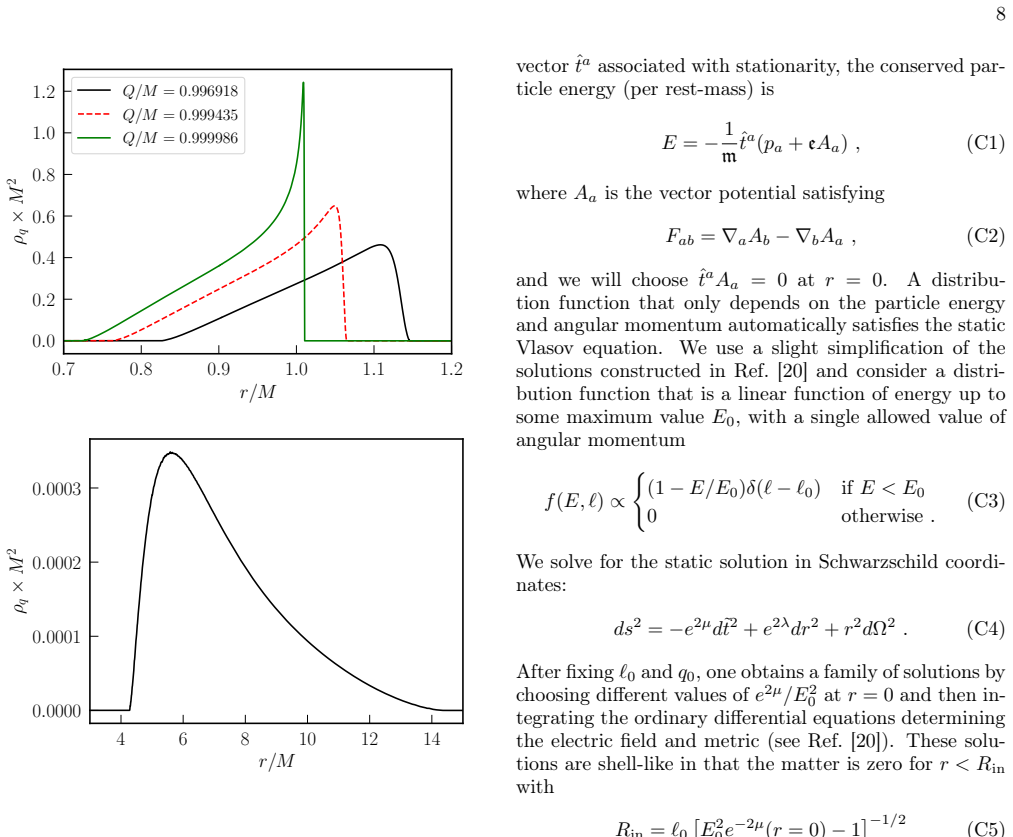

read the original abstract
We study the threshold of gravitational collapse in spherically symmetric spacetimes governed by the Einstein-Maxwell-Vlasov equations. We numerically construct solutions describing a collapsing distribution of charged matter that either forms a charged black hole or eventually disperses. We first consider a region of parameter space where the solutions at the threshold of black hole formation are stationary, horizonless shells. These solutions terminate at a critical point, with their charge-to-mass ratio approaching unity from below, and the instability timescale diverging. Beyond the critical point, we find a new region of parameter space where the threshold solution is an extremal black hole. We measure the scaling of the dynamical time period of the near threshold solutions and discuss how they are connected in the two regimes. If a similar picture to the one found here holds for known families of stationary solutions of rotating matter that approach the exterior of an extremal Kerr spacetime, they could provide a route to forming an extremal spinning black hole.
Editorial analysis
A structured set of objections, weighed in public.
Referee Report
Summary. The manuscript numerically investigates the threshold of gravitational collapse for charged matter distributions in spherically symmetric Einstein-Maxwell-Vlasov spacetimes. It identifies a critical point in parameter space below which threshold solutions are stationary horizonless shells whose charge-to-mass ratio approaches unity from below with diverging instability timescales; beyond this point a new regime appears in which the threshold solution is an extremal black hole. The work also reports measurements of the scaling of dynamical timescales across the two regimes and speculates on possible implications for extremal Kerr black-hole formation.
Significance. If the reported numerical transition and extremal character are robust, the results delineate a concrete mechanism by which extremal black holes can arise as threshold solutions in charged collapse, extending the known picture of critical phenomena. The explicit construction of the post-critical extremal regime and the measured timescale scalings constitute concrete, falsifiable outputs that could guide analytic work on near-extremal dynamics and rotating analogs.
major comments (2)
- [Numerical construction and results sections (critical-point identification)] The separation into two regimes and the identification of extremal black-hole thresholds beyond the critical point rest on numerical evolutions that must accurately capture diverging instability timescales and the precise location where Q/M approaches 1. The manuscript does not report convergence tests, resolution studies, or error estimates for families of initial data straddling the critical point; without these, it remains possible that the apparent transition is influenced by phase-space discretization or artificial viscosity rather than a feature of the continuum equations.
- [Results (post-critical regime)] The claim that the post-critical threshold solutions are extremal black holes (rather than near-extremal horizonless configurations) requires explicit verification that an apparent horizon forms with surface gravity approaching zero while the charge-to-mass ratio reaches unity. The current presentation leaves unclear how horizon detection and the extremality diagnostic are implemented and tested near the critical point.
minor comments (2)
- [Abstract] The abstract states that the instability timescale diverges at the critical point but does not quote the measured scaling exponent or the functional form used to extract it; adding this quantitative detail would make the summary self-contained.
- [Introduction] Notation for the charge-to-mass ratio and the definition of the critical point should be introduced with a single equation reference early in the text to avoid ambiguity when comparing the two regimes.
Simulated Author's Rebuttal
We thank the referee for their thorough review and insightful comments on our work. We address each of the major comments below, providing clarifications and indicating the changes incorporated into the revised manuscript.
read point-by-point responses
-
Referee: [Numerical construction and results sections (critical-point identification)] The separation into two regimes and the identification of extremal black-hole thresholds beyond the critical point rest on numerical evolutions that must accurately capture diverging instability timescales and the precise location where Q/M approaches 1. The manuscript does not report convergence tests, resolution studies, or error estimates for families of initial data straddling the critical point; without these, it remains possible that the apparent transition is influenced by phase-space discretization or artificial viscosity rather than a feature of the continuum equations.
Authors: We agree that explicit convergence tests and error estimates strengthen the robustness of the reported transition. In the revised manuscript we have added a dedicated subsection presenting resolution studies for representative initial-data families that straddle the critical point. These studies show that both the location of the critical charge-to-mass ratio and the divergence of the instability timescale converge under phase-space refinement. We also include truncation-error estimates and confirm that the numerical scheme introduces no artificial viscosity capable of altering the continuum behavior. revision: yes
-
Referee: [Results (post-critical regime)] The claim that the post-critical threshold solutions are extremal black holes (rather than near-extremal horizonless configurations) requires explicit verification that an apparent horizon forms with surface gravity approaching zero while the charge-to-mass ratio reaches unity. The current presentation leaves unclear how horizon detection and the extremality diagnostic are implemented and tested near the critical point.
Authors: We have expanded the numerical-methods section to describe the horizon-detection algorithm, which monitors the expansion of outgoing null geodesics, and the extremality diagnostic, which computes the surface gravity associated with the approximate Killing vector. In the revised manuscript we include additional figures and tables that track both the surface gravity and the charge-to-mass ratio for post-critical threshold solutions; these quantities approach zero and unity, respectively, as the critical point is approached from above, confirming the extremal character. revision: yes
Circularity Check
No circularity: results emerge from direct numerical integration of the field equations
full rationale
The paper reports numerical constructions of solutions to the Einstein-Maxwell-Vlasov system for the threshold of gravitational collapse. The identification of stationary horizonless shells, the critical point where Q/M approaches unity, the divergence of instability timescales, and the post-critical regime with extremal black hole thresholds are all outputs of the simulations rather than quantities fitted to data or defined in terms of themselves. No load-bearing self-citations, ansatzes, or uniqueness theorems imported from prior work by the same authors are invoked to force the central claims. The derivation chain is therefore self-contained: the field equations are solved numerically, and the reported behaviors follow from those solutions without reduction to the inputs by construction.
Axiom & Free-Parameter Ledger
axioms (2)
- domain assumption The Einstein-Maxwell-Vlasov equations accurately describe the coupled gravitational, electromagnetic, and collisionless charged matter dynamics.
- domain assumption Spherical symmetry is sufficient to capture the essential threshold behavior.
Lean theorems connected to this paper
-
IndisputableMonolith/Cost/FunctionalEquation.leanwashburn_uniqueness_aczel unclear?
unclearRelation between the paper passage and the cited Recognition theorem.
threshold solution is an extremal black hole... Q/M approaching unity from below and the instability timescale diverging
-
IndisputableMonolith/Foundation/RealityFromDistinction.leanreality_from_one_distinction unclear?
unclearRelation between the paper passage and the cited Recognition theorem.
scaling T∼M(Q/M−1)^{−1/2} ... Lyapunov timescale λRN≈κ
What do these tags mean?
- matches
- The paper's claim is directly supported by a theorem in the formal canon.
- supports
- The theorem supports part of the paper's argument, but the paper may add assumptions or extra steps.
- extends
- The paper goes beyond the formal theorem; the theorem is a base layer rather than the whole result.
- uses
- The paper appears to rely on the theorem as machinery.
- contradicts
- The paper's claim conflicts with a theorem or certificate in the canon.
- unclear
- Pith found a possible connection, but the passage is too broad, indirect, or ambiguous to say the theorem truly supports the claim.
Reference graph
Works this paper leans on
-
[1]
M. W. Choptuik, Phys. Rev. Lett.70, 9 (1993)
work page 1993
-
[2]
Scaling of curvature in sub-critical gravitational collapse
D. Garfinkle and G. C. Duncan, Phys. Rev. D58, 064024 (1998), arXiv:gr-qc/9802061
work page internal anchor Pith review Pith/arXiv arXiv 1998
-
[3]
C. Gundlach, D. Hilditch, and J. M. Martín-García, (2025), arXiv:2507.07636 [gr-qc]
-
[4]
G. Rein, A. D. Rendall, and J. Schaeffer, Phys. Rev. D 58, 044007 (1998), arXiv:gr-qc/9804040
work page internal anchor Pith review Pith/arXiv arXiv 1998
-
[5]
I. Olabarrieta and M. W. Choptuik, Phys. Rev. D65, 024007 (2002), arXiv:gr-qc/0107076
work page internal anchor Pith review Pith/arXiv arXiv 2002
-
[6]
J. M. Martin-Garcia and C. Gundlach, Phys. Rev. D65, 084026 (2002), arXiv:gr-qc/0112009
work page internal anchor Pith review Pith/arXiv arXiv 2002
-
[7]
Critical collapse in the spherically-symmetric Einstein-Vlasov model
A. Akbarian and M. W. Choptuik, Phys. Rev. D90, 104023 (2014), arXiv:1409.5176 [gr-qc]
work page internal anchor Pith review Pith/arXiv arXiv 2014
-
[8]
A. M. Abrahams and C. R. Evans, Phys. Rev. Lett.70, 2980 (1993)
work page 1993
- [9]
- [10]
- [11]
-
[12]
K. Marouda, D. Cors, H. R. Rüter, A. Vaño-Viñuales, and D. Hilditch, (2025), arXiv:2511.04649 [gr-qc]
-
[13]
M. W. Choptuik, T. Chmaj, and P. Bizon, Phys. Rev. Lett.77, 424 (1996), arXiv:gr-qc/9603051
work page internal anchor Pith review Pith/arXiv arXiv 1996
- [14]
- [15]
-
[16]
Proszynski, General Relativity and Gravitation15, 403 (1983)
M. Proszynski, General Relativity and Gravitation15, 403 (1983)
work page 1983
-
[17]
Ori, Classical and Quantum Gravity8, 1559 (1991)
A. Ori, Classical and Quantum Gravity8, 1559 (1991)
work page 1991
- [18]
- [19]
-
[20]
H. Andreasson, M. Eklund, and G. Rein, Class. Quant. Grav.26, 145003 (2009), arXiv:0903.4092 [gr-qc]
work page internal anchor Pith review Pith/arXiv arXiv 2009
- [21]
- [22]
-
[23]
J. M. Bardeen and R. V. Wagoner, Astrophys. J.167, 359 (1971)
work page 1971
-
[24]
G. Neugebauer and R. Meinel, Phys. Rev. Lett.75, 3046 (1995), arXiv:gr-qc/0302060
work page internal anchor Pith review Pith/arXiv arXiv 1995
-
[25]
Relativistic Dyson Rings and Their Black Hole Limit
M. Ansorg, A. Kleinwachter, and R. Meinel, Astrophys. J. Lett.582, L87 (2003), arXiv:gr-qc/0211040
work page internal anchor Pith review Pith/arXiv arXiv 2003
-
[26]
Uniformly Rotating Rings in General Relativity
T. Fischer, S. Horatschek, and M. Ansorg, Mon. Not. Roy. Astron. Soc.364, 943 (2005), arXiv:gr-qc/0506105
work page internal anchor Pith review Pith/arXiv arXiv 2005
-
[27]
Black Hole Mergers and Unstable Circular Orbits
F. Pretorius and D. Khurana, Class. Quant. Grav.24, S83 (2007), arXiv:gr-qc/0702084
work page internal anchor Pith review Pith/arXiv arXiv 2007
-
[28]
J. L. Friedman, Commun. Math. Phys.63, 243 (1978)
work page 1978
-
[29]
H. Yang and L. Zou, Phys. Rev. D109, 104034 (2024), arXiv:2207.04373 [gr-qc]
-
[30]
Formation of trapped surfaces for the spherically symmetric Einstein-Vlasov system
H. Andreasson and G. Rein, J. Hyperbol. Diff. Equat.7, 707 (2010), arXiv:0910.1254 [gr-qc]. Appendix A: Evolution Equations We evolve the Einstein-Maxwell-Vlasov equations gov- erning a distribution of electrically charged and self- gravitating particles with chargeeand rest massm. The Vlasov equation describing the evolution of the distribu- tion functio...
work page internal anchor Pith review Pith/arXiv arXiv 2010
discussion (0)
Sign in with ORCID, Apple, or X to comment. Anyone can read and Pith papers without signing in.