REVIEW 4 major objections 5 minor 1 cited by
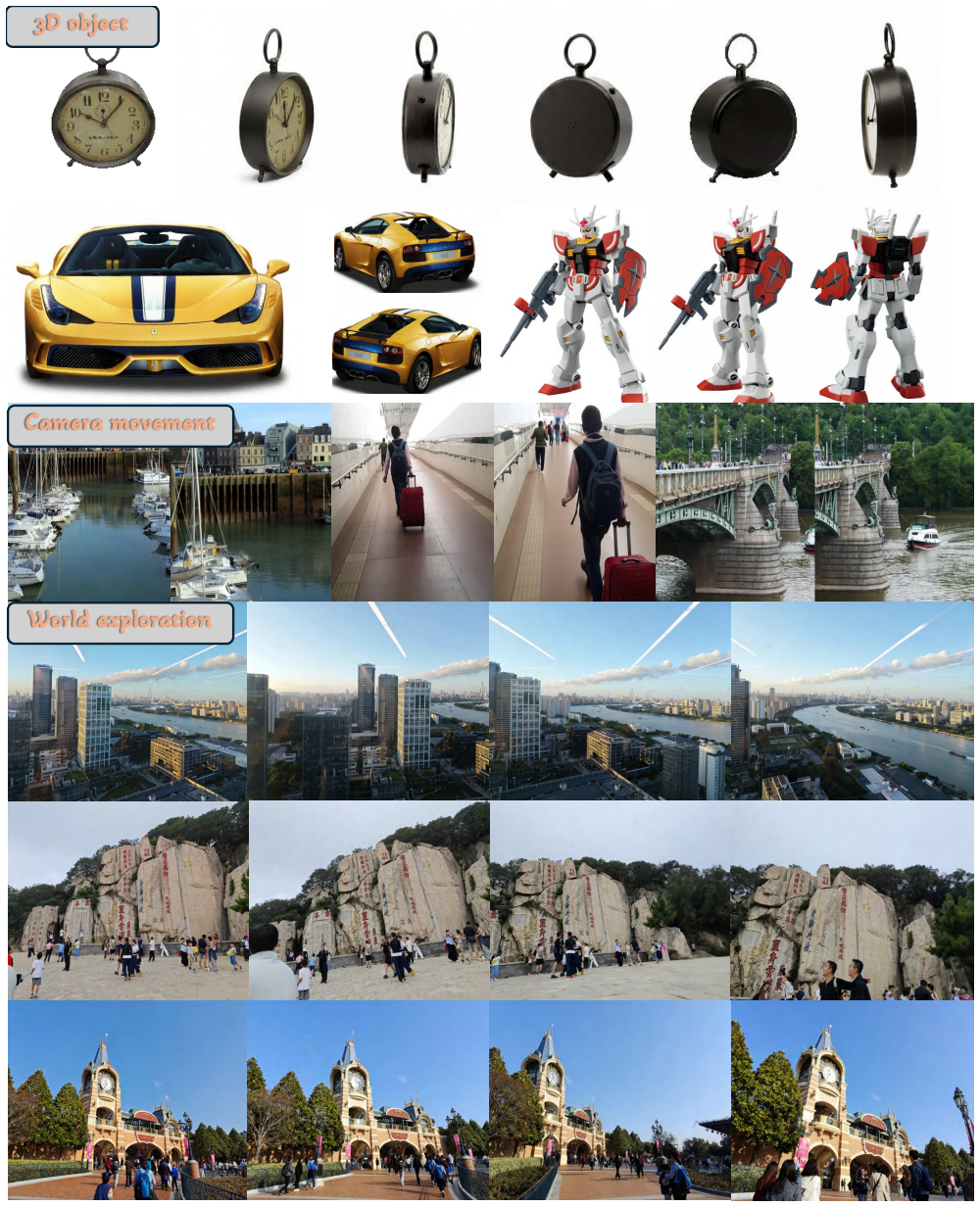
iMontage claims one pretrained video model, re-indexed with head–tail temporal slots, can do one-to-one, many-to-one, and many-to-many image generation in a single inference.
Reviewed by Pith at T0; open to challenge. T0 means a machine referee read the full paper against a public rubric. the ladder, T0–T4 →
T0 review · deepseek-v4-flash
2026-08-04 06:43 UTC pith:V33J7XQY
load-bearing objection A well-engineered system that probably does what it claims, but the signature mechanism—head-tail RoPE—is supported mostly by qualitative evidence, so I'd want a strong referee to push on that before believing the mechanism story. the 4 major comments →
iMontage: Unified, Versatile, Highly Dynamic Many-to-many Image Generation
The pith
A machine-rendered reading of the paper's core claim, the machinery that carries it, and where it could break.
Core claim
The central claim: a pretrained video diffusion transformer can become a many-to-many image generator without losing its temporal priors by treating every input and output image as a pseudo-frame in a head–tail layout, inputs early, outputs late, with a wide empty margin. This 'Marginal RoPE' keeps spatial and temporal-coherence geometry intact while marking image sets as discrete, not continuous video. With a motion-diverse frame-pair dataset and difficulty-ordered curriculum, the outputs stay identity-consistent yet show unusual dynamic range: the paper's stated goal of 'natural transitions and a far more expansive dynamic range.'
What carries the argument
Marginal RoPE: a rotary positional-embedding layout that assigns each input and output image a unique time index inside a fixed 32-slot temporal range, inputs at slots 0–7, outputs at slots 24–31, leaving a 16-slot gap, while preserving the pretrained spatial RoPE. It supplies cross-image ordering cues and separates discrete image sets from continuous video; the paper credits it with keeping motion priors intact while allowing dynamic, non-contiguous outputs. A second mechanism is CocktailMix, the difficulty-ordered curriculum that progressively mixes tasks and shifts sampling weights; the paper reports it outperforms task-grouped training by 12.6% on the multi-reference benchmark.
Load-bearing premise
The load-bearing premise is that the hand-chosen head–tail positional layout, inputs at temporal slots 0–7, outputs at slots 24–31, with the large gap between, is what preserves the video model's motion priors and enables dynamic outputs; the paper's direct evidence is a qualitative ablation against a uniform layout, with no quantitative measurement of gap size or layout sensitivity.
What would settle it
Retrain the full system with a uniform (Even) RoPE layout, or with several different gap widths, using the same data, curriculum, and compute, then compare quantitative consistency and diversity on storyboard and editing benchmarks. If outputs do not degrade when the gap is shrunk or removed, or if the Even layout catches up with more steps, the positional layout is not the mechanism behind the reported gains.
If this is right
- One model, one inference pass, can cover single-image editing, multiple-reference composition, style transfer, multi-view generation, multi-turn edits, and storyboards.
- Because the base is a video model, outputs inherit temporal coherence and world-motion knowledge, so consistency and dynamic motion no longer require a separate image pipeline plus post-hoc normalization.
- Practitioners could replace several fine-tuned specialist models with one checkpoint; the recipe (frozen VAE and text encoder, full diffusion-transformer fine-tune, three-stage data curriculum) is described in enough detail to reproduce.
- The practical envelope is currently about four input and four output images; longer many-to-many generation is called out by the authors as future work.
- Leading scores on public editing, in-context, and storyboard benchmarks suggest the approach is competitive with closed commercial systems, according to the reported evaluations.
Where Pith is reading between the lines
- If the positional gap is the real mechanism, gap width becomes a tunable dial between output diversity and cross-image consistency; a natural test is sweeping gap sizes while holding data fixed and measuring the identity-preservation versus diversity trade-off.
- The same head–tail layout could make pretrained video models handle hard cuts and discontinuous shot lists directly in video generation, not just image sets, by treating a storyboard as sparse video.
- A fixed 32-slot index budget may cap sequence length; scaling to longer stories likely needs hierarchical or continuous positional encodings, so the four-input/four-output ceiling is not purely a data constraint.
- Because the outputs share one latent denoising context, the model may be a plausible substrate for interactive editing where a user constrains a whole image set at once, such as multi-character scenes with explicit relationships between references.
Editorial analysis
A structured set of objections, weighed in public.
Referee Report
Summary. iMontage proposes a unified image-generation framework built on HunyuanVideo, treating image inputs and outputs as pseudo-frames in a video-diffusion backbone. The model consumes variable-length reference images and produces variable-length outputs, covering one-to-one editing, many-to-one reference fusion, and many-to-many storyboarding/multi-view/multi-turn editing. The main technical claims are: (i) a Marginal RoPE temporal layout (inputs at slots 0–7, outputs at 24–31, with a 16-slot gap) that avoids positional interference while preserving the pretrained video model's motion priors; (ii) a data curation pipeline mixing image-edit pairs, video frame pairs, distilled storyboards, and multi-view data; and (iii) a difficulty-ordered CocktailMix curriculum. Extensive experiments report strong quantitative results on GEdit, ImgEdit, OmniContext, and storyboard benchmarks, plus a user study, with claims of state-of-the-art open-source performance and the first one-shot unified many-to-many model.
Significance. If the claims hold, iMontage would be a valuable contribution: it demonstrates that a pretrained video diffusion model can be adapted to flexible many-to-many image generation with a relatively minimal architectural change, and it includes a substantial engineering effort in data curation and multi-task training. The paper provides extensive qualitative results, multiple benchmark comparisons, and a user study. However, the central methodological claim about Marginal RoPE is not quantitatively validated, and the evaluation has statistical and circularity weaknesses. The empirical gains are real but the 'state-of-the-art' and 'first' claims need careful scoping. The reproducibility is limited by reliance on internal and distilled data, though the promise of code/weights is a positive.
major comments (4)
- [Sec. 3.1 / 4.4, Fig. 2, Fig. 5] The load-bearing claim that the Marginal RoPE layout (inputs 0–7, outputs 24–31, 16-slot gap) reduces positional interference and preserves motion priors is not convincingly supported. The only ablation (Sec. 4.4, Fig. 5) is qualitative, on a small pretraining subset, and reports only 'late convergence' for Even RoPE with no quantitative metric, no gap-size/layout sweep, and no measurement of motion-prior retention. The training recipe includes 15M curated video frame pairs, cross-transition re-clipping, Seedream4.0-distilled storyboards, and CocktailMix; any of these could plausibly produce the observed dynamics even if the RoPE layout were irrelevant. Please provide quantitative ablations (e.g., convergence curves and downstream task metrics for at least Even RoPE, current Marginal RoPE, and one intermediate gap size) and, if possible, a control that varies the layout while holding dat
- [Tables 1–4] All quantitative tables report point estimates without error bars, confidence intervals, or significance tests. Several reported differences are small: e.g., Table 1, Motion Change G SC: iMontage 5.25 vs HiDream-E1.1 5.55; Edit overall G O: iMontage 6.94 vs Step1X-Edit 6.97. The storyboard VLM ratings (Table 3) and user study (Table 4, 20 samples, 50 participants) also lack variance information. Without measures of uncertainty, it is impossible to assess whether the claimed advantages are statistically meaningful. Please report bootstrap CIs or standard errors, and state how many independent generations were used per sample.
- [Sec. 3.2.2 / Sec. 8.1] The storyboard evaluation is vulnerable to circularity. The training data for storyboarding are distilled from Seedream4.0, and captions and VLM ratings use GPT-4o; both Seedream4.0 and GPT-4o also appear as comparison baselines (Table 1, and GPT-4o is a baseline in OmniContext). Using GPT-4o as the judge in Sec. 8.1 to rate methods including models trained on GPT-4o-captioned data and Seedream4.0 outputs creates a potential bias. Please add an independent human evaluation (or at least a judge model not involved in the data-generation pipeline) and report the correlation between VLM scores and human ratings.
- [Sec. 4.3 / Contributions bullet / Sec. 9.1] The claims of 'state-of-the-art' and 'first model to unify these tasks' are not fully supported. In Table 1, HiDream-E1.1 outperforms iMontage on Motion Change G SC (5.55 vs 5.25) and OmniGen2 outperforms iMontage on ImgEdit Action (4.68 vs 4.48). The 'first' claim in Sec. 4.3 sits uneasily with Sec. 9.1's acknowledgment of UniReal, ChronoEdit, UniVid, and with the commercial Seedream4.0 that already performs many-to-many generation. Please scope the claims precisely (e.g., 'first open-source one-shot many-to-many system' with a clear definition of the task set) and avoid overclaiming.
minor comments (5)
- [Throughout] Typographical errors: 'Archtecture' (Sec. 3.1), 'seperately' (Sec. 3.1), 'iMontage, a unified' spacing issues, and inconsistent use of 'SOTA' vs 'state-of-the-art'. Please proofread.
- [Fig. 2] The notation '×13N' and '×23N' is unclear; it likely means the number of DualStream/SingleStream blocks, but it should be explained or re-labeled. Also, the figure could better indicate that the 16-slot gap is empty.
- [Sec. 6 / Table 5] Training details are given, but inference resolution per task is not specified consistently (e.g., 'default CFG 6.0' vs 'CFG=5.0' in Sec. 8.2 for the user study). Please reconcile these values and specify inference settings for each benchmark.
- [Sec. 8.2] The user study says '50 professional participants' but the text and Table 4 do not report inter-rater agreement or per-sample variance. Also, the 'same seed' statement for baselines is ambiguous; please clarify how randomness was handled.
- [Sec. 9.2 / Fig. 11] The acknowledged limitations are welcome but should be integrated into the main paper's headline claims. For instance, 'best quality with up to four inputs and four outputs' and the Chinese-character rendering failure weaken the 'unified' and 'versatile' descriptions.
Circularity Check
No construction-level circularity: the paper's claims are empirical system results, not derivations that reduce to their inputs.
full rationale
iMontage is an empirical system paper rather than a formal derivation: it adapts HunyuanVideo with a chosen RoPE layout, curated datasets, and a three-stage training scheme. The central methodological claim about Marginal RoPE (inputs at temporal slots 0-7, outputs at 24-31, with a 16-slot gap) is a design choice, not a fitted parameter or a result derived from a self-citation; the only ablation (Sec. 4.4) is qualitative and compares against Even RoPE, which underdetermines causality but does not make the claim circular. No equation in the paper defines the claimed many-to-many capability in terms of the training data or the evaluation metric, so no 'prediction' reduces to its inputs by construction. The use of GPT-4o and Seedream4.0 to generate training data, and GPT-4o as a judge in storyboard evaluation, raises benchmark-independence concerns, but the evaluation scores are not logically entailed by the training targets, so this is not construction-level circularity. References to the authors' own Step1X-Edit [33] are limited to benchmark reuse and evaluation-template conventions and are not load-bearing for the central claim. The strongest defensible critique is that the causal role of the RoPE layout is under-supported, but underdetermination is not circularity.
Axiom & Free-Parameter Ledger
free parameters (4)
- Marginal RoPE temporal index layout =
inputs {0..7}, outputs {24..31}, 32 total, 16 unused slots
- Inference CFG and steps =
CFG=6.0, 50 steps
- Data mixture ratios in training stages =
video frames 0.75→0.25, image edit 0.25→0.75 in pretraining; SFT 0.9 multi-task/0.1 image edit; HQ 0.5/0.5
- CocktailMix sampling weights =
0.8 for the newly added task, 0.2 evenly split among former tasks
axioms (4)
- domain assumption HunyuanVideo's pretrained motion priors transfer to pseudo-frame image-set generation and remain useful after adaptation
- domain assumption The frozen 3D VAE and text encoder generalize to arbitrary numbers of reference images and to the variable-length attention maps
- domain assumption The evaluation benchmarks and metrics measure the claimed 'highly dynamic' and 'consistent' generation capabilities
- domain assumption Using GPT-4o as a VLM judge gives fair, unbiased quality ratings across all compared models
read the original abstract
Pre-trained video models learn powerful priors for generating high-quality, temporally coherent content. While these models excel at temporal coherence, their dynamics are often constrained by the continuous nature of their training data. We hypothesize that by injecting the rich and unconstrained content diversity from image data into this coherent temporal framework, we can generate image sets that feature both natural transitions and a far more expansive dynamic range. To this end, we introduce iMontage, a unified framework designed to repurpose a powerful video model into an all-in-one image generator. The framework consumes and produces variable-length image sets, unifying a wide array of image generation and editing tasks. To achieve this, we propose an elegant and minimally invasive adaptation strategy, complemented by a tailored data curation process and training paradigm. This approach allows the model to acquire broad image manipulation capabilities without corrupting its invaluable original motion priors. iMontage excels across several mainstream many-in-many-out tasks, not only maintaining strong cross-image contextual consistency but also generating scenes with extraordinary dynamics that surpass conventional scopes. Find our homepage at: https://kr1sjfu.github.io/iMontage-web/.
Figures




Forward citations
Cited by 1 Pith paper
-
FreeStyle: Free Control of Style-Content Dual-Reference Generation from Community LoRA Mining
FreeStyle proposes community LoRA mining plus attention and frequency disentanglement to enable scalable style-content dual-reference generation with reduced leakage.
Reference graph
Works this paper leans on
-
[1]
Shuai Bai, Keqin Chen, Xuejing Liu, Jialin Wang, Wenbin Ge, Sibo Song, Kai Dang, Peng Wang, Shijie Wang, Jun Tang, et al. Qwen2. 5-vl technical report.arXiv preprint arXiv:2502.13923, 2025. 5
Pith/arXiv arXiv 2025
-
[2]
Lumiere: A space-time diffu- sion model for video generation
Omer Bar-Tal, Hila Chefer, Omer Tov, Charles Her- rmann, Roni Paiss, Shiran Zada, Ariel Ephrat, Junhwa Hur, Guanghui Liu, Amit Raj, et al. Lumiere: A space-time diffu- sion model for video generation. InSIGGRAPH Asia 2024 Conference Papers, pages 1–11, 2024. 3
2024
-
[3]
Seedream4.0, 2025.https : / / seed
Bytedance. Seedream4.0, 2025.https : / / seed . bytedance.com/en/seedream4_0. 2, 5
2025
-
[4]
Hidream-i1: A high-efficient image gen- erative foundation model with sparse diffusion transformer
Qi Cai, Jingwen Chen, Yang Chen, Yehao Li, Fuchen Long, Yingwei Pan, Zhaofan Qiu, Yiheng Zhang, Fengbin Gao, Peihan Xu, et al. Hidream-i1: A high-efficient image gen- erative foundation model with sparse diffusion transformer. arXiv preprint arXiv:2505.22705, 2025. 5
Pith/arXiv arXiv 2025
-
[5]
Openpose: Realtime multi-person 2d pose estimation using part affinity fields.IEEE transactions on pattern analysis and machine intelligence, 43(1):172–186,
Zhe Cao, Gines Hidalgo, Tomas Simon, Shih-En Wei, and Yaser Sheikh. Openpose: Realtime multi-person 2d pose estimation using part affinity fields.IEEE transactions on pattern analysis and machine intelligence, 43(1):172–186,
-
[6]
Emerg- ing properties in self-supervised vision transformers
Mathilde Caron, Hugo Touvron, Ishan Misra, Herv ´e J´egou, Julien Mairal, Piotr Bojanowski, and Armand Joulin. Emerg- ing properties in self-supervised vision transformers. InPro- ceedings of the IEEE/CVF international conference on com- puter vision, pages 9650–9660, 2021. 8, 1
2021
-
[7]
Junsong Chen, Jincheng Yu, Chongjian Ge, Lewei Yao, Enze Xie, Yue Wu, Zhongdao Wang, James Kwok, Ping Luo, Huchuan Lu, et al. Pixart: Fast training of diffusion transformer for photorealistic text-to-image synthesis.arXiv preprint arXiv:2310.00426, 2023. 6
Pith/arXiv arXiv 2023
-
[8]
Junyi Chen, Haoyi Zhu, Xianglong He, Yifan Wang, Jian- jun Zhou, Wenzheng Chang, Yang Zhou, Zizun Li, Zhou- jie Fu, Jiangmiao Pang, et al. Deepverse: 4d autoregres- sive video generation as a world model.arXiv preprint arXiv:2506.01103, 2025. 3
Pith/arXiv arXiv 2025
-
[9]
Lan Chen, Yuchao Gu, and Qi Mao. Univid: Unifying vi- sion tasks with pre-trained video generation models.arXiv preprint arXiv:2509.21760, 2025. 3
arXiv 2025
-
[10]
Unireal: Universal image generation and editing via learning real-world dynamics
Xi Chen, Zhifei Zhang, He Zhang, Yuqian Zhou, Soo Ye Kim, Qing Liu, Yijun Li, Jianming Zhang, Nanxuan Zhao, Yilin Wang, et al. Unireal: Universal image generation and editing via learning real-world dynamics. InProceedings of the Computer Vision and Pattern Recognition Conference, pages 12501–12511, 2025. 2, 3
2025
-
[11]
Yufeng Cheng, Wenxu Wu, Shaojin Wu, Mengqi Huang, Fei Ding, and Qian He. Umo: Scaling multi-identity consistency for image customization via matching reward.arXiv preprint arXiv:2509.06818, 2025. 8
Pith/arXiv arXiv 2025
-
[12]
Gemini2.5, 2025.https : / / deepmind.google/models/gemini/pro/
Google Deepmind. Gemini2.5, 2025.https : / / deepmind.google/models/gemini/pro/. 2, 5, 6
2025
-
[13]
Veo3, 2025.https://deepmind
Google Deepmind. Veo3, 2025.https://deepmind. google/models/veo/. 3
2025
-
[14]
Emerging properties in unified multimodal pretraining.arXiv preprint arXiv:2505.14683, 2025
Chaorui Deng, Deyao Zhu, Kunchang Li, Chenhui Gou, Feng Li, Zeyu Wang, Shu Zhong, Weihao Yu, Xiaonan Nie, Ziang Song, et al. Emerging properties in unified multimodal pretraining.arXiv preprint arXiv:2505.14683, 2025. 2, 3, 5, 6, 7
Pith/arXiv arXiv 2025
-
[15]
Yolov8-face-detection, 2024.https : //huggingface.co/arnabdhar/YOLOv8- Face- Detection
Arnab Dhar. Yolov8-face-detection, 2024.https : //huggingface.co/arnabdhar/YOLOv8- Face- Detection. 5
2024
-
[16]
Scaling recti- fied flow transformers for high-resolution image synthesis
Patrick Esser, Sumith Kulal, Andreas Blattmann, Rahim Entezari, Jonas M ¨uller, Harry Saini, Yam Levi, Dominik Lorenz, Axel Sauer, Frederic Boesel, et al. Scaling recti- fied flow transformers for high-resolution image synthesis. InForty-first international conference on machine learning,
-
[17]
Tsu-Jui Fu, Yusu Qian, Chen Chen, Wenze Hu, Zhe Gan, and Yinfei Yang. Univg: A generalist diffusion model for unified image generation and editing.arXiv preprint arXiv:2503.12652, 2025. 3
Pith/arXiv arXiv 2025
-
[18]
Peng Gao, Le Zhuo, Dongyang Liu, Ruoyi Du, Xu Luo, Longtian Qiu, Yuhang Zhang, Chen Lin, Rongjie Huang, Shijie Geng, et al. Lumina-t2x: Transforming text into any modality, resolution, and duration via flow-based large diffu- sion transformers.arXiv preprint arXiv:2405.05945, 2024. 6
Pith/arXiv arXiv 2024
-
[19]
Xiaoguang Han, Yushuang Wu, Luyue Shi, Haolin Liu, Hongjie Liao, Lingteng Qiu, Weihao Yuan, Xiaodong Gu, Zilong Dong, and Shuguang Cui. Mvimgnet2. 0: A larger-scale dataset of multi-view images.arXiv preprint arXiv:2412.01430, 2024. 5
Pith/arXiv arXiv 2024
-
[20]
Hidream-e1-1, 2025.https : / / huggingface.co/HiDream-ai/HiDream-E1-1
HiDream-ai. Hidream-e1-1, 2025.https : / / huggingface.co/HiDream-ai/HiDream-E1-1. 5
2025
-
[21]
Vbench: Comprehensive bench- mark suite for video generative models
Ziqi Huang, Yinan He, Jiashuo Yu, Fan Zhang, Chenyang Si, Yuming Jiang, Yuanhan Zhang, Tianxing Wu, Qingyang Jin, Nattapol Chanpaisit, et al. Vbench: Comprehensive bench- mark suite for video generative models. InProceedings of the IEEE/CVF Conference on Computer Vision and Pattern Recognition, pages 21807–21818, 2024. 8, 1
2024
-
[22]
Controlnet auxiliary models.https : //github.com/huggingface/controlnet_aux? tab=readme-ov-file, 2023
Huggingface. Controlnet auxiliary models.https : //github.com/huggingface/controlnet_aux? tab=readme-ov-file, 2023. 5
2023
-
[23]
Liming Jiang, Qing Yan, Yumin Jia, Zichuan Liu, Hao Kang, and Xin Lu. Infiniteyou: Flexible photo recrafting while preserving your identity.arXiv preprint arXiv:2503.16418,
-
[24]
Weijie Kong, Qi Tian, Zijian Zhang, Rox Min, Zuozhuo Dai, Jin Zhou, Jiangfeng Xiong, Xin Li, Bo Wu, Jianwei Zhang, et al. Hunyuanvideo: A systematic framework for large video generative models.arXiv preprint arXiv:2412.03603, 2024. 4, 3
Pith/arXiv arXiv 2024
-
[25]
Zhe Kong, Feng Gao, Yong Zhang, Zhuoliang Kang, Xi- aoming Wei, Xunliang Cai, Guanying Chen, and Wenhan Luo. Let them talk: Audio-driven multi-person conversa- tional video generation.arXiv preprint arXiv:2505.22647,
-
[26]
Flux.1 [dev], 2024.https : / / huggingface
Black Forest Labs. Flux.1 [dev], 2024.https : / / huggingface . co / black - forest - labs / FLUX . 1-dev. 2, 5
2024
-
[27]
Clip-based nsfw detector, 2021.https : //github.com/LAION- AI/CLIP- based- NSFW- Detector
LAION. Clip-based nsfw detector, 2021.https : //github.com/LAION- AI/CLIP- based- NSFW- Detector. 5 9
2021
-
[28]
Wei Li, Xue Xu, Jiachen Liu, and Xinyan Xiao. Unimo- g: Unified image generation through multimodal conditional diffusion.arXiv preprint arXiv:2401.13388, 2024. 3
Pith/arXiv arXiv 2024
-
[29]
Bin Lin, Zongjian Li, Xinhua Cheng, Yuwei Niu, Yang Ye, Xianyi He, Shenghai Yuan, Wangbo Yu, Shaodong Wang, Yunyang Ge, et al. Uniworld: High-resolution semantic en- coders for unified visual understanding and generation.arXiv preprint arXiv:2506.03147, 2025. 5
Pith/arXiv arXiv 2025
-
[30]
Yijing Lin, Mengqi Huang, Shuhan Zhuang, and Zhendong Mao. Realgeneral: Unifying visual generation via tempo- ral in-context learning with video models.arXiv preprint arXiv:2503.10406, 2025. 2, 3
Pith/arXiv arXiv 2025
-
[31]
Flow matching for generative mod- eling.arXiv preprint arXiv:2210.02747, 2022
Yaron Lipman, Ricky TQ Chen, Heli Ben-Hamu, Maximil- ian Nickel, and Matt Le. Flow matching for generative mod- eling.arXiv preprint arXiv:2210.02747, 2022. 6
Pith/arXiv arXiv 2022
-
[32]
Audioldm 2: Learning holistic audio gen- eration with self-supervised pretraining.IEEE/ACM Trans- actions on Audio, Speech, and Language Processing, 32: 2871–2883, 2024
Haohe Liu, Yi Yuan, Xubo Liu, Xinhao Mei, Qiuqiang Kong, Qiao Tian, Yuping Wang, Wenwu Wang, Yuxuan Wang, and Mark D Plumbley. Audioldm 2: Learning holistic audio gen- eration with self-supervised pretraining.IEEE/ACM Trans- actions on Audio, Speech, and Language Processing, 32: 2871–2883, 2024. 3
2024
-
[33]
Step1x-edit: A practical framework for general image editing.arXiv preprint arXiv:2504.17761, 2025
Shiyu Liu, Yucheng Han, Peng Xing, Fukun Yin, Rui Wang, Wei Cheng, Jiaqi Liao, Yingming Wang, Honghao Fu, Chun- rui Han, et al. Step1x-edit: A practical framework for general image editing.arXiv preprint arXiv:2504.17761, 2025. 2, 3, 5, 6, 1
Pith/arXiv arXiv 2025
-
[34]
Univid: The open-source unified video model.arXiv preprint arXiv:2509.24200, 2025
Jiabin Luo, Junhui Lin, Zeyu Zhang, Biao Wu, Meng Fang, Ling Chen, and Hao Tang. Univid: The open-source unified video model.arXiv preprint arXiv:2509.24200, 2025. 3
arXiv 2025
-
[35]
Chaojie Mao, Jingfeng Zhang, Yulin Pan, Zeyinzi Jiang, Zhen Han, Yu Liu, and Jingren Zhou. Ace++: Instruction- based image creation and editing via context-aware content filling.arXiv preprint arXiv:2501.02487, 2025. 2, 3
Pith/arXiv arXiv 2025
-
[36]
Gpt4o, 2024.https://www.openai.com/
OpenAI. Gpt4o, 2024.https://www.openai.com/. 2, 5, 6, 1
2024
-
[37]
Sora2, 2025.https://openai.com/index/ sora-2/
OpenAI. Sora2, 2025.https://openai.com/index/ sora-2/. 3
2025
-
[38]
Scalable diffusion models with transformers
William Peebles and Saining Xie. Scalable diffusion models with transformers. InProceedings of the IEEE/CVF inter- national conference on computer vision, pages 4195–4205,
-
[39]
Dustin Podell, Zion English, Kyle Lacey, Andreas Blattmann, Tim Dockhorn, Jonas M ¨uller, Joe Penna, and Robin Rombach. Sdxl: Improving latent diffusion mod- els for high-resolution image synthesis.arXiv preprint arXiv:2307.01952, 2023. 2, 6
Pith/arXiv arXiv 2023
-
[40]
Qi Qin, Le Zhuo, Yi Xin, Ruoyi Du, Zhen Li, Bin Fu, Yiting Lu, Jiakang Yuan, Xinyue Li, Dongyang Liu, et al. Lumina- image 2.0: A unified and efficient image generative frame- work.arXiv preprint arXiv:2503.21758, 2025. 2
Pith/arXiv arXiv 2025
-
[41]
Learning transferable visual models from natural language supervi- sion
Alec Radford, Jong Wook Kim, Chris Hallacy, Aditya Ramesh, Gabriel Goh, Sandhini Agarwal, Girish Sastry, Amanda Askell, Pamela Mishkin, Jack Clark, et al. Learning transferable visual models from natural language supervi- sion. InInternational conference on machine learning, pages 8748–8763. PmLR, 2021. 8, 1
2021
-
[42]
Make-a-story: Visual memory conditioned consistent story generation
Tanzila Rahman, Hsin-Ying Lee, Jian Ren, Sergey Tulyakov, Shweta Mahajan, and Leonid Sigal. Make-a-story: Visual memory conditioned consistent story generation. InPro- ceedings of the IEEE/CVF conference on computer vision and pattern recognition, pages 2493–2502, 2023. 5
2023
-
[43]
Grounded sam: Assembling open-world models for diverse visual tasks.arXiv preprint arXiv:2401.14159,
Tianhe Ren, Shilong Liu, Ailing Zeng, Jing Lin, Kunchang Li, He Cao, Jiayu Chen, Xinyu Huang, Yukang Chen, Feng Yan, et al. Grounded sam: Assembling open-world models for diverse visual tasks.arXiv preprint arXiv:2401.14159,
-
[44]
High-resolution image synthesis with latent diffusion models
Robin Rombach, Andreas Blattmann, Dominik Lorenz, Patrick Esser, and Bj ¨orn Ommer. High-resolution image synthesis with latent diffusion models. InProceedings of the IEEE/CVF conference on computer vision and pattern recognition, pages 10684–10695, 2022. 2
2022
-
[45]
Pathways on the image manifold: Image editing via video generation
Noam Rotstein, Gal Yona, Daniel Silver, Roy Velich, David Bensaid, and Ron Kimmel. Pathways on the image manifold: Image editing via video generation. InProceedings of the Computer Vision and Pattern Recognition Conference, pages 7857–7866, 2025. 3
2025
-
[46]
Photorealistic text-to-image diffusion models with deep language understanding.Advances in neural information processing systems, 35:36479–36494, 2022
Chitwan Saharia, William Chan, Saurabh Saxena, Lala Li, Jay Whang, Emily L Denton, Kamyar Ghasemipour, Raphael Gontijo Lopes, Burcu Karagol Ayan, Tim Salimans, et al. Photorealistic text-to-image diffusion models with deep language understanding.Advances in neural information processing systems, 35:36479–36494, 2022. 2
2022
-
[47]
Sizhe Shan, Qiulin Li, Yutao Cui, Miles Yang, Yuehai Wang, Qun Yang, Jin Zhou, and Zhao Zhong. Hunyuanvideo- foley: Multimodal diffusion with representation alignment for high-fidelity foley audio generation.arXiv preprint arXiv:2508.16930, 2025. 3
Pith/arXiv arXiv 2025
-
[48]
Aether: Geometric-aware unified world modeling.arXiv preprint arXiv:2503.18945,
Aether Team, Haoyi Zhu, Yifan Wang, Jianjun Zhou, Wen- zheng Chang, Yang Zhou, Zizun Li, Junyi Chen, Chun- hua Shen, Jiangmiao Pang, et al. Aether: Geometric-aware unified world modeling.arXiv preprint arXiv:2503.18945,
-
[49]
Raft: Recurrent all-pairs field transforms for optical flow
Zachary Teed and Jia Deng. Raft: Recurrent all-pairs field transforms for optical flow. InEuropean conference on com- puter vision, pages 402–419. Springer, 2020. 5
2020
-
[50]
Apoorv Vyas, Bowen Shi, Matthew Le, Andros Tjandra, Yi-Chiao Wu, Baishan Guo, Jiemin Zhang, Xinyue Zhang, Robert Adkins, William Ngan, et al. Audiobox: Unified au- dio generation with natural language prompts.arXiv preprint arXiv:2312.15821, 2023. 3
Pith/arXiv arXiv 2023
-
[51]
Instantid: Zero-shot identity-preserving generation in seconds.arXiv preprint arXiv:2401.07519, 2024
Qixun Wang, Xu Bai, Haofan Wang, Zekui Qin, Anthony Chen, Huaxia Li, Xu Tang, and Yao Hu. Instantid: Zero-shot identity-preserving generation in seconds.arXiv preprint arXiv:2401.07519, 2024. 3
Pith/arXiv arXiv 2024
-
[52]
Autostory: Generating diverse storytelling images with minimal human efforts.Interna- tional Journal of Computer Vision, pages 1–22, 2024
Wen Wang, Canyu Zhao, Hao Chen, Zhekai Chen, Kecheng Zheng, and Chunhua Shen. Autostory: Generating diverse storytelling images with minimal human efforts.Interna- tional Journal of Computer Vision, pages 1–22, 2024. 5
2024
-
[53]
Univideo: Unified understanding, generation, and editing for videos
Cong Wei, Quande Liu, Zixuan Ye, Qiulin Wang, Xintao Wang, Pengfei Wan, Kun Gai, and Wenhu Chen. Univideo: Unified understanding, generation, and editing for videos. arXiv preprint arXiv:2510.08377, 2025. 3
Pith/arXiv arXiv 2025
-
[54]
Omnigen2: Exploration to advanced multimodal 10 generation.arXiv preprint arXiv:2506.18871, 2025
Chenyuan Wu, Pengfei Zheng, Ruiran Yan, Shitao Xiao, Xin Luo, Yueze Wang, Wanli Li, Xiyan Jiang, Yexin Liu, Junjie Zhou, et al. Omnigen2: Exploration to advanced multimodal 10 generation.arXiv preprint arXiv:2506.18871, 2025. 5, 6, 7, 1, 3
Pith/arXiv arXiv 2025
-
[55]
Jay Zhangjie Wu, Xuanchi Ren, Tianchang Shen, Tianshi Cao, Kai He, Yifan Lu, Ruiyuan Gao, Enze Xie, Shiyi Lan, Jose M Alvarez, et al. Chronoedit: Towards temporal reason- ing for image editing and world simulation.arXiv preprint arXiv:2510.04290, 2025. 3
arXiv 2025
-
[56]
Shaojin Wu, Mengqi Huang, Yufeng Cheng, Wenxu Wu, Ji- ahe Tian, Yiming Luo, Fei Ding, and Qian He. Uso: Unified style and subject-driven generation via disentangled and re- ward learning.arXiv preprint arXiv:2508.18966, 2025. 5, 3
Pith/arXiv arXiv 2025
-
[57]
Shaojin Wu, Mengqi Huang, Wenxu Wu, Yufeng Cheng, Fei Ding, and Qian He. Less-to-more generalization: Unlocking more controllability by in-context generation.arXiv preprint arXiv:2504.02160, 2025. 6
Pith/arXiv arXiv 2025
-
[58]
Dreamomni: Unified image generation and editing
Bin Xia, Yuechen Zhang, Jingyao Li, Chengyao Wang, Yitong Wang, Xinglong Wu, Bei Yu, and Jiaya Jia. Dreamomni: Unified image generation and editing. InPro- ceedings of the Computer Vision and Pattern Recognition Conference, pages 28533–28543, 2025. 3
2025
-
[59]
Omnigen: Unified image genera- tion
Shitao Xiao, Yueze Wang, Junjie Zhou, Huaying Yuan, Xin- grun Xing, Ruiran Yan, Chaofan Li, Shuting Wang, Tiejun Huang, and Zheng Liu. Omnigen: Unified image genera- tion. InProceedings of the Computer Vision and Pattern Recognition Conference, pages 13294–13304, 2025. 2, 3, 5, 6
2025
-
[60]
Jinheng Xie, Weijia Mao, Zechen Bai, David Junhao Zhang, Weihao Wang, Kevin Qinghong Lin, Yuchao Gu, Zhijie Chen, Zhenheng Yang, and Mike Zheng Shou. Show-o: One single transformer to unify multimodal understanding and generation.arXiv preprint arXiv:2408.12528, 2024. 2, 3
Pith/arXiv arXiv 2024
-
[61]
Csgo: Content-style composition in text-to-image genera- tion.arXiv preprint arXiv:2408.16766, 2024
Peng Xing, Haofan Wang, Yanpeng Sun, Qixun Wang, Xu Bai, Hao Ai, Renyuan Huang, and Zechao Li. Csgo: Content-style composition in text-to-image genera- tion.arXiv preprint arXiv:2408.16766, 2024. 5, 3
Pith/arXiv arXiv 2024
-
[62]
Hengyuan Xu, Wei Cheng, Peng Xing, Yixiao Fang, Shuhan Wu, Rui Wang, Xianfang Zeng, Daxin Jiang, Gang Yu, Xingjun Ma, et al. Withanyone: Towards control- lable and id consistent image generation.arXiv preprint arXiv:2510.14975, 2025. 3
arXiv 2025
-
[63]
Dongchao Yang, Jinchuan Tian, Xu Tan, Rongjie Huang, Songxiang Liu, Xuankai Chang, Jiatong Shi, Sheng Zhao, Jiang Bian, Xixin Wu, et al. Uniaudio: An audio founda- tion model toward universal audio generation.arXiv preprint arXiv:2310.00704, 2023. 3
Pith/arXiv arXiv 2023
-
[64]
Depth any- thing v2.Advances in Neural Information Processing Sys- tems, 37:21875–21911, 2024
Lihe Yang, Bingyi Kang, Zilong Huang, Zhen Zhao, Xiao- gang Xu, Jiashi Feng, and Hengshuang Zhao. Depth any- thing v2.Advances in Neural Information Processing Sys- tems, 37:21875–21911, 2024. 5
2024
-
[65]
Zhuoyi Yang, Jiayan Teng, Wendi Zheng, Ming Ding, Shiyu Huang, Jiazheng Xu, Yuanming Yang, Wenyi Hong, Xiao- han Zhang, Guanyu Feng, et al. Cogvideox: Text-to-video diffusion models with an expert transformer.arXiv preprint arXiv:2408.06072, 2024. 6
Pith/arXiv arXiv 2024
-
[66]
Hu Ye, Jun Zhang, Sibo Liu, Xiao Han, and Wei Yang. Ip- adapter: Text compatible image prompt adapter for text-to- image diffusion models.arXiv preprint arXiv:2308.06721,
-
[67]
Junyan Ye, Dongzhi Jiang, Zihao Wang, Leqi Zhu, Zheng- hao Hu, Zilong Huang, Jun He, Zhiyuan Yan, Jinghua Yu, Hongsheng Li, et al. Echo-4o: Harnessing the power of gpt- 4o synthetic images for improved image generation.arXiv preprint arXiv:2508.09987, 2025. 5
Pith/arXiv arXiv 2025
-
[68]
Imgedit: A uni- fied image editing dataset and benchmark.arXiv preprint arXiv:2505.20275, 2025
Yang Ye, Xianyi He, Zongjian Li, Bin Lin, Shenghai Yuan, Zhiyuan Yan, Bohan Hou, and Li Yuan. Imgedit: A uni- fied image editing dataset and benchmark.arXiv preprint arXiv:2505.20275, 2025. 6
Pith/arXiv arXiv 2025
-
[69]
Adding conditional control to text-to-image diffusion models
Lvmin Zhang, Anyi Rao, and Maneesh Agrawala. Adding conditional control to text-to-image diffusion models. In Proceedings of the IEEE/CVF international conference on computer vision, pages 3836–3847, 2023. 5
2023
-
[70]
Zechuan Zhang, Ji Xie, Yu Lu, Zongxin Yang, and Yi Yang. In-context edit: Enabling instructional image editing with in- context generation in large scale diffusion transformer.arXiv preprint arXiv:2504.20690, 2025. 5
Pith/arXiv arXiv 2025
-
[71]
Dian Zheng, Ziqi Huang, Hongbo Liu, Kai Zou, Yinan He, Fan Zhang, Lulu Gu, Yuanhan Zhang, Jingwen He, Wei- Shi Zheng, et al. Vbench-2.0: Advancing video generation benchmark suite for intrinsic faithfulness.arXiv preprint arXiv:2503.21755, 2025. 8, 1
Pith/arXiv arXiv 2025
-
[72]
Open-sora: Democratizing efficient video production for all.arXiv preprint arXiv:2412.20404, 2024
Zangwei Zheng, Xiangyu Peng, Tianji Yang, Chenhui Shen, Shenggui Li, Hongxin Liu, Yukun Zhou, Tianyi Li, and Yang You. Open-sora: Democratizing efficient video production for all.arXiv preprint arXiv:2412.20404, 2024. 6
Pith/arXiv arXiv 2024
-
[73]
Storydiffusion: Consistent self- attention for long-range image and video generation.Ad- vances in Neural Information Processing Systems, 37: 110315–110340, 2024
Yupeng Zhou, Daquan Zhou, Ming-Ming Cheng, Jiashi Feng, and Qibin Hou. Storydiffusion: Consistent self- attention for long-range image and video generation.Ad- vances in Neural Information Processing Systems, 37: 110315–110340, 2024. 8 11 iMontage: Unified, Versatile, Highly Dynamic Many-to-many Image Generation Supplementary Material
2024
-
[74]
In pre- training stage, we start with more video clip data and less image editing data, then gradually counting more image editing data for better instruction following capability
Implementation Details For training, we treat all DiT blocks as trainable compo- nents in all stages, frozen V AE and text encoders. In pre- training stage, we start with more video clip data and less image editing data, then gradually counting more image editing data for better instruction following capability. The ratio is a linear increase of 25% to 75...
-
[75]
Please find our image editing results in Fig
More Qualitative Results We present more visualization results to reveal the power- ful capability of our model. Please find our image editing results in Fig. 6 and Fig. 7, multi cref results in Fig. 8 and multi view results in Fig. 10
-
[76]
Storyboard Generation Evaluation For a comprehensive evaluation on our many-to-many set- ting, we choose storyboard generation to report numerical metrics
Detailed Experimental Details 8.1. Storyboard Generation Evaluation For a comprehensive evaluation on our many-to-many set- ting, we choose storyboard generation to report numerical metrics. We follow common video-evaluation practice[21, 71] and compute DINO[6] and CLIP[41] feature similar- ity on the foreground subject(s) as the primary signal. This choi...
-
[77]
vi- sual sentences,
More Discussion 9.1. Concurrent Works Though we are not the first unified image generation model developed upon video models[10, 30], we consider iMontage as the first practical many-to-many system for open-source community. Likewise, two very recent ef- forts build image capabilities on top of video backbones. ChronoEdit[55] treats the input and edited o...
discussion (0)
Sign in with ORCID, Apple, or X to comment. Anyone can read and Pith papers without signing in.