REVIEW 2 major objections 2 minor 3 cited by
The Euclid telescope's temperature-induced optical deformations stay well below the limits needed for weak lensing cosmology.
Reviewed by Pith at T0; open to challenge. T0 means a machine referee read the full paper against a public rubric. the ladder, T0–T4 →
T0 review · grok-4.3
2026-05-17 02:28 UTC
load-bearing objection Euclid's STOP analysis confirms the telescope meets WL PSF limits with small in-orbit surprises noted. the 2 major comments →
Euclid Structural-Thermal-Optical Performance
The pith
A machine-rendered reading of the paper's core claim, the machinery that carries it, and where it could break.
Core claim
The results of the prelaunch STOP analysis demonstrated that temperature-induced optical perturbations will be well below the allowable limits for all permitted observing conditions, confirming the excellent overall performance of the telescope for the Euclid mission's weak lensing science.
What carries the argument
The structural-thermal-optical performance (STOP) analysis that integrates a detailed finite-element mathematical model of the spacecraft with worst-case steady-state and transient thermal boundary conditions to evaluate optical train deformations.
Load-bearing premise
The finite-element model and the defined worst-case boundary conditions accurately represent the real thermal and structural behavior of the spacecraft and its optical components in orbit.
What would settle it
If actual in-orbit measurements of image quality metrics as a function of temperature show deviations larger than predicted by the STOP analysis, that would indicate the model does not fully capture the interactions.
If this is right
- The telescope maintains the required PSF stability across all allowed observing conditions.
- In-orbit temperature variations under 300 mK produce detectable but small effects on image quality metrics.
- The STOP model aids in interpreting measured performance variations with environmental changes.
- Overall, the built telescope satisfies the error budget allocations for weak lensing observations.
Where Pith is reading between the lines
- This approach could inform thermal management strategies for other precision space telescopes targeting cosmological measurements.
- Detecting unpredicted disturbances in orbit points to the value of combining models with real-time monitoring for PSF stability.
- Refining the model with in-orbit data might allow tighter error budgets or improved data processing for future observations.
Editorial analysis
A structured set of objections, weighed in public.
Referee Report
Summary. The manuscript presents a structural-thermal-optical performance (STOP) analysis for the Euclid telescope using a detailed finite-element model. It defines a standard set of steady-state and transient test cases with worst-case boundary conditions, verifies that temperature-induced optical perturbations remain below allowable limits for weak-lensing PSF stability requirements, and uses the prelaunch predictions to interpret first-year in-orbit data that show temperature variations <300 mK together with some unpredicted disturbances.
Significance. If the finite-element model and chosen boundary conditions correctly capture the relevant couplings, the work supplies a rare end-to-end pre- and post-launch validation of STOP predictions against actual flight data for a cosmology mission. The demonstration that perturbations stay within the global error budget, even after accounting for observed in-orbit sensitivities, strengthens in the telescope’s PSF stability for weak-lensing science and provides a useful benchmark for future high-precision space telescopes.
major comments (2)
- [Abstract / Results] Abstract and Results: The central claim that 'temperature-induced optical perturbations will be well below the allowable limits for all permitted observing conditions' is load-bearing, yet the same paragraph reports that 'unpredicted disturbances were discovered and unexpected sensitivities were revealed' despite temperature variations remaining <300 mK. A quantitative comparison (e.g., predicted versus measured contributions to the PSF stability budget) is needed to show that these disturbances do not erode the claimed margin.
- [Methods] Methods: The manuscript states that 'a detailed finite-element mathematical model was set up' and 'a standard set of test cases … comprising combinations of worst-case boundary conditions' was defined. Without explicit description of mesh convergence, material-property validation against test data, or the precise envelope of the boundary conditions relative to the observed in-orbit disturbances, it is not possible to assess whether the model fully captured the structural-thermal-optical interactions that later appeared in flight.
minor comments (2)
- [Abstract] The abstract would be clearer if it reported the numerical margins (e.g., predicted perturbation versus allowable limit) rather than the qualitative statement 'well below'.
- Figure captions and axis labels should explicitly state the units and reference frames used for the reported image-quality metrics so that readers can directly compare prelaunch predictions with the in-orbit time histories.
Simulated Author's Rebuttal
We thank the referee for their constructive feedback and positive overall assessment of our manuscript. We address each of the major comments in detail below and propose revisions to improve clarity and completeness.
read point-by-point responses
-
Referee: [Abstract / Results] Abstract and Results: The central claim that 'temperature-induced optical perturbations will be well below the allowable limits for all permitted observing conditions' is load-bearing, yet the same paragraph reports that 'unpredicted disturbances were discovered and unexpected sensitivities were revealed' despite temperature variations remaining <300 mK. A quantitative comparison (e.g., predicted versus measured contributions to the PSF stability budget) is needed to show that these disturbances do not erode the claimed margin.
Authors: The central claim refers specifically to the pre-launch STOP analysis performed with worst-case boundary conditions, which demonstrated that temperature-induced optical perturbations remain well below allowable limits. The unpredicted disturbances and unexpected sensitivities observed in the first year of flight data are additional factors not directly tied to the <300 mK temperature variations; the manuscript already notes that these temperature effects, while detectable, remain non-negligible but manageable within the overall PSF stability budget. We agree that an explicit quantitative comparison of predicted versus measured contributions would strengthen the presentation. We will add this comparison (including supporting figures or tables) to the revised manuscript. revision: yes
-
Referee: [Methods] Methods: The manuscript states that 'a detailed finite-element mathematical model was set up' and 'a standard set of test cases … comprising combinations of worst-case boundary conditions' was defined. Without explicit description of mesh convergence, material-property validation against test data, or the precise envelope of the boundary conditions relative to the observed in-orbit disturbances, it is not possible to assess whether the model fully captured the structural-thermal-optical interactions that later appeared in flight.
Authors: We acknowledge that additional methodological detail would aid assessment of model fidelity. The finite-element model was developed and exercised during spacecraft development, with internal checks including mesh convergence and material-property validation against test data. To address the referee's point directly, we will expand the Methods section in the revision to describe the mesh convergence criteria employed, the material-property validation process, and the relationship of the worst-case boundary-condition envelope to the observed in-orbit temperature variations and disturbances. revision: yes
Circularity Check
No significant circularity in the Euclid STOP performance derivation
full rationale
The paper's derivation consists of constructing a detailed finite-element mathematical model of the spacecraft, applying a defined set of worst-case steady-state and transient boundary conditions, and computing the resulting optical train deformations to verify that temperature-induced perturbations fall below the WL error budget allocations. This is a standard forward physical simulation whose outputs are compared to independent external requirements rather than being defined in terms of those outputs. The in-orbit section uses the prelaunch model predictions only as an interpretive aid for measured data and does not feed measured performance back into the original verification claim. No self-definitional equations, fitted inputs renamed as predictions, load-bearing self-citations, or imported uniqueness theorems appear in the provided text. The chain is therefore self-contained against external benchmarks.
Axiom & Free-Parameter Ledger
axioms (1)
- domain assumption The finite-element mathematical model accurately captures the structural, thermal, and optical interactions of the spacecraft under the defined boundary conditions.
Cite this review
Pith. "Pith review of Euclid Structural-Thermal-Optical Performance." pith.science (2026). https://pith.science/paper/2512.01075
@misc{pith2026251201075,
  author       = {Pith},
  title        = {Pith review of: Euclid Structural-Thermal-Optical Performance},
  year         = {2026},
  howpublished = {\url{https://pith.science/paper/2512.01075}},
  note         = {Machine review of arXiv:2512.01075}
}
read the original abstract
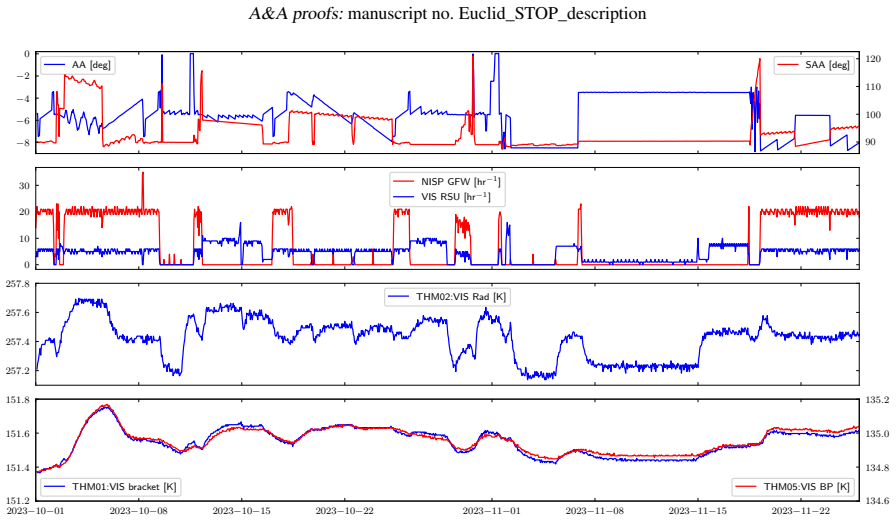
The Euclid system performance is defined in terms of image quality metrics tuned to the weak gravitational lensing (WL) cosmological probe. WL induces stringent requirements on the shape and stability of the VIS instrument system point spread function (PSF). The PSF is affected by error contributions from the telescope, the focal plane and image motion, and is controlled by a global error budget with error allocations to each contributor. Aims. During spacecraft development, we verified through a structural-thermal-optical performance (STOP) analysis that the built and verified telescope with its spacecraft interface meets the in-orbit steady-state and transient image quality requirements. Methods. For the purposes of the STOP analysis, a detailed finite-element mathematical model was set up and a standard set of test cases, both steady-state and transient, was defined, comprising combinations of worst-case boundary conditions. Results. The STOP analysis addressed the interaction of all spacecraft components in transmitting temperature-induced loads that lead to optical train deformation. The results of the prelaunch analysis demonstrated that temperature-induced optical perturbations will be well below the allowable limits for all permitted observing conditions. During the first year in orbit, we used the STOP analysis predictions to help interpret the measured performance as a function of environmental variables. Unpredicted disturbances were discovered and unexpected sensitivities were revealed. In-orbit temperature variations are small (<300 mK) and so are their effects on the telescope structure, but they are detected in the time histories of the image quality metrics and are a non-negligible factor in the PSF stability budget demanded by the WL science. Taking everything into account, our analysis confirms the excellent overall performance of the telescope.
Figures




Lean theorems connected to this paper
-
IndisputableMonolith/Foundation/RealityFromDistinction.leanreality_from_one_distinction unclear?
unclearRelation between the paper passage and the cited Recognition theorem.
a detailed finite-element mathematical model was set up and a standard set of test cases, both steady-state and transient, was defined, comprising combinations of worst-case boundary conditions... The STOP analysis addressed the interaction of all spacecraft components in transmitting temperature-induced loads that lead to optical train deformation.
-
IndisputableMonolith/Cost/FunctionalEquation.leanwashburn_uniqueness_aczel unclear?
unclearRelation between the paper passage and the cited Recognition theorem.
The results of the prelaunch analysis demonstrated that temperature-induced optical perturbations will be well below the allowable limits for all permitted observing conditions.
What do these tags mean?
- matches
- The paper's claim is directly supported by a theorem in the formal canon.
- supports
- The theorem supports part of the paper's argument, but the paper may add assumptions or extra steps.
- extends
- The paper goes beyond the formal theorem; the theorem is a base layer rather than the whole result.
- uses
- The paper appears to rely on the theorem as machinery.
- contradicts
- The paper's claim conflicts with a theorem or certificate in the canon.
- unclear
- Pith found a possible connection, but the passage is too broad, indirect, or ambiguous to say the theorem truly supports the claim.
Forward citations
Cited by 3 Pith papers
-
KiDS-Legacy: Joint analysis of second- and third-order cosmic shear
Joint 2nd- and 3rd-order cosmic shear analysis on KiDS-Legacy data produces Ω_m = 0.297^{+0.056}_{-0.040} and S_8 = 0.806^{+0.025}_{-0.023}, consistent with Planck and prior KiDS results while improving Ω_m precision.
-
\textit{Euclid} preparation. Baryon acoustic oscillations extraction techniques: comparison and optimisation
End-to-end validation on Euclid-like mocks shows RecSym and RecIso reconstruction yield unbiased BAO measurements, improving figure of merit for Omega_m and H0 rs by factor of ~3 across 0.9<z<1.8.
-
Euclid preparation. Three-dimensional galaxy clustering in configuration space: Three-point correlation function estimation
Euclid collaboration develops and validates direct and spherical-harmonic estimators plus a random-split optimization for measuring the three-point galaxy correlation function at the scale of the full Euclid survey.
Reference graph
Works this paper leans on
-
[1]
Amara, A. & Refregier, A. 2008, MNRAS, 391, 228 Bougoin, M., Castel, D., & Levallois, F. 2012, in SPIE Conference Series, V ol. 10564, International Conference on Space Optics (ICSO) 2012, ed. B. Cugny, E. Armadillo, & N. Karafolas, 1056410–1 Bougoin, M., Mallet, F., Levenac, J., et al. 2018, in SPIE Conference Series, V ol. 11180, International Conferenc...
work page 2008
-
[2]
The tests were adapted for the correlation with the mathematical models
The STM underwent more extreme and risky thermal and structural testing conditions, which could not be applied to the flight model. The tests were adapted for the correlation with the mathematical models. The PLM flight model was assembled in Airbus Defence and Space (ADS) in Toulouse and tested in the Centre Spatial de Liège (CSL) 2021, where it was plac...
work page 2021
-
[3]
These milestones are accompanied by reviews where the requirements, implemented design, and expected performance are evaluated by independent panel members. After the launch ofEuclidon 1 July 2023, the plan was to de- vote the first month to the spacecraft commissioning phase fol- lowed by a 2-month performance verification phase before the start of the s...
work page 2023
-
[4]
The IQ values we derived were still sensitive to envi- ronmental changes, so we can use them as diagnostic for changes in IQ. In our analysis, we removed VIS frames that were affected by strong solar flares using a merit function derived frome 1,e 2, andR 2 covariances. However, we found that some areas in the FPA are more affected by solar X-rays than ot...
work page 2024
discussion (0)
Sign in with ORCID, Apple, or X to comment. Anyone can read and Pith papers without signing in.