Recognition: unknown
textit{Euclid} preparation. Baryon acoustic oscillations extraction techniques: comparison and optimisation
Pith reviewed 2026-05-07 13:49 UTC · model grok-4.3
The pith
Density-field reconstruction triples the figure of merit for baryon acoustic oscillation parameters in Euclid-like mocks.
A machine-rendered reading of the paper's core claim, the machinery that carries it, and where it could break.
Core claim
Both reconstruction schemes yield unbiased BAO measurements across all redshifts and analysis choices, including smoothing scale and fiducial cosmology. In each snapshot, reconstruction enhances the figure of merit for {Ω_m, H_0 r_s} by ∼3, equivalent to tripling the effective survey volume. Combining the four redshift bins, the improvement remains substantial, with BAO-only constraints reaching ∼10% precision on Ω_m and ∼3% on H_0 r_s.
What carries the argument
Zel'dovich-approximation density-field reconstruction implemented as RecSym and RecIso, combined with an emulator-based evaluator and semi-analytical covariance estimator.
If this is right
- Results from RecSym and RecIso remain consistent within uncertainties across all tested settings.
- BAO-only constraints reach approximately 10 percent precision on Ω_m and 3 percent on H_0 r_s when all four redshift bins are combined.
- The pipeline delivers more than a 500-fold speed-up in sampling while remaining stable under fiducial-cosmology variations.
- Unbiased BAO measurements hold independent of smoothing scale and choice of fiducial cosmology.
Where Pith is reading between the lines
- The demonstrated robustness suggests the pipeline can be applied to real Euclid data with minimal further tuning.
- Similar reconstruction gains could be tested in other large-scale structure surveys measuring the expansion history.
- The speed-up tools open the possibility of including additional nuisance parameters or cross-correlations without prohibitive cost.
- Extending the validation to mocks that include extra systematics beyond those modeled here would strengthen readiness for later data releases.
Load-bearing premise
The eight Euclid-like mock catalogues from each of four Flagship I snapshots accurately reproduce the expected statistical properties of the first Euclid data release, including all relevant systematics and selection effects.
What would settle it
Running the validated pipeline on actual Euclid DR1 data and obtaining biased BAO scale measurements or no improvement in the figure of merit for Ω_m and H_0 r_s would falsify the claims.
Figures


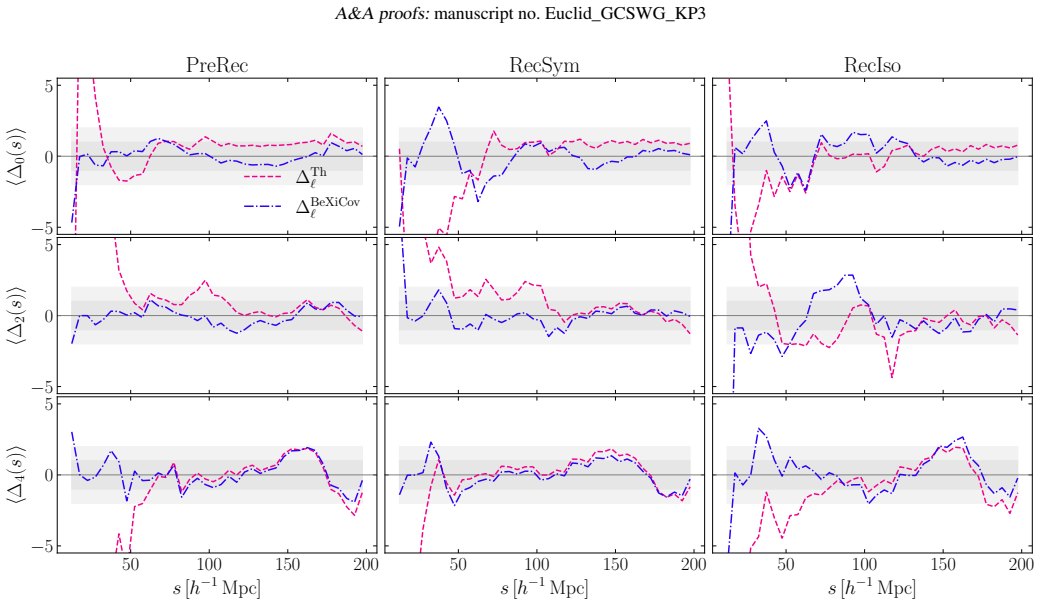
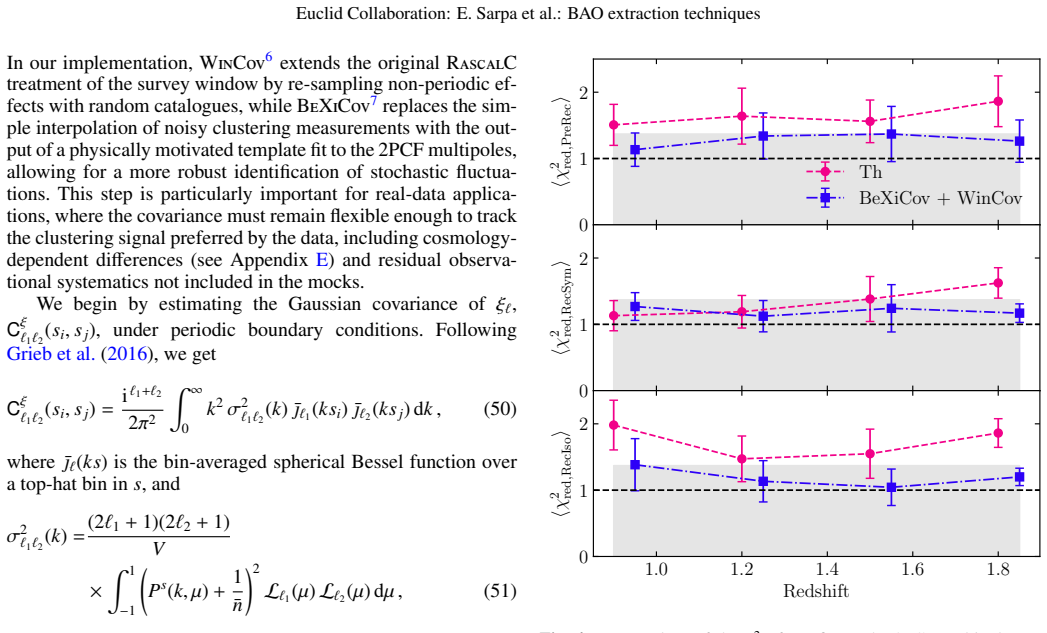
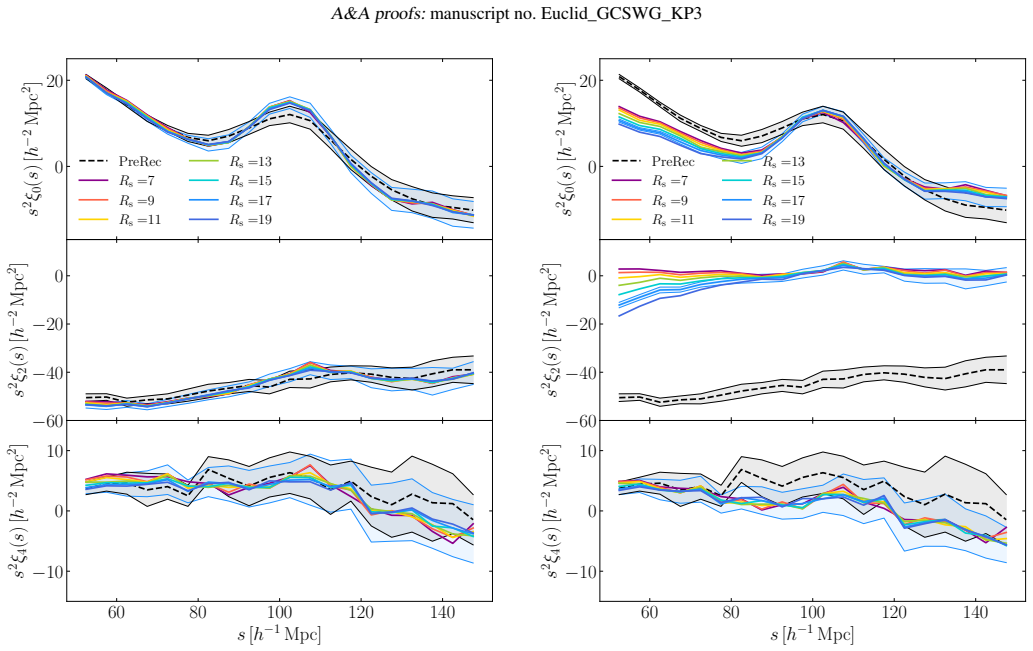
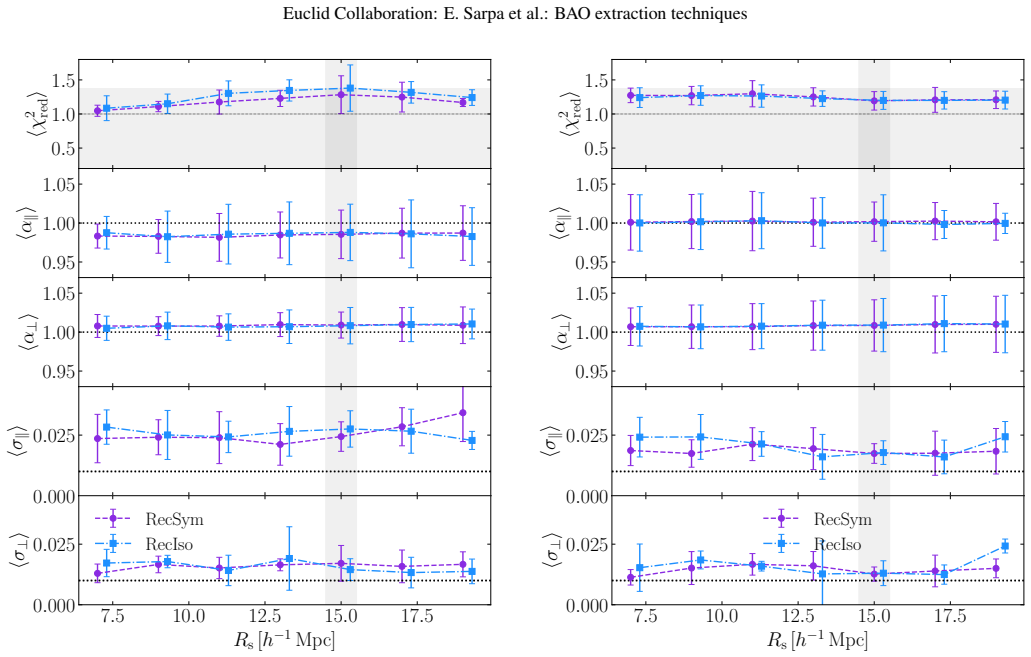


read the original abstract
We present the first end-to-end validation of the Euclid baryon acoustic oscillation (BAO) analysis pipeline, encompassing density-field reconstruction, two-point correlation function measurement, and cosmological-parameter inference. Using eight Euclid-like mock catalogues from each of four Flagship I snapshots, designed to reproduce the expected statistical properties of the first Euclid data release (DR1), we assess the two standard BAO reconstruction methods based on the Zel'dovich approximation, RecSym and RecIso, across $0.9 \leq z \leq 1.8$. The pipeline introduces several methodological advances: an emulator-based model evaluator (Bora.jl) combined with a Hamiltonian Monte Carlo sampler (NUTS), achieving more than a 500-fold speed-up relative to standard Markov chain Monte Carlo, and a semi-analytical covariance estimator (BeXiCov+WinCov) that enables robust error estimates from only eight mock realisations while remaining stable under fiducial-cosmology variations. These components ensure computational efficiency while reducing the risk of underestimating parameter uncertainties. Both reconstruction schemes yield unbiased BAO measurements across all redshifts and analysis choices, including smoothing scale and fiducial cosmology. In each snapshot, reconstruction enhances the figure of merit for $\{\Omega_m, H_0 r_s\}$ by $\sim3$, equivalent to tripling the effective survey volume. Combining the four redshift bins, the improvement remains substantial, with BAO-only constraints reaching $\sim10\%$ precision on $\Omega_m$ and $\sim3\%$ on $H_0 r_s$. Results from RecSym and RecIso are consistent within uncertainties, though we recommend RecSym during testing due to its lower sensitivity to covariance variations. These findings establish the accuracy, robustness, and scalability of the Euclid BAO pipeline for DR1, providing a solid foundation for future cosmological analyses.
Editorial analysis
A structured set of objections, weighed in public.
Referee Report
Summary. The manuscript presents the first end-to-end validation of the Euclid BAO analysis pipeline, including density-field reconstruction (RecSym and RecIso), two-point correlation function measurement, and cosmological parameter inference. Using eight Euclid-like mock catalogs from each of four Flagship I snapshots designed to match DR1 statistical properties, it demonstrates unbiased BAO scale recovery across redshifts 0.9 ≤ z ≤ 1.8, smoothing scales, and fiducial cosmologies. Methodological advances include the Bora.jl emulator with NUTS HMC sampler (>500× speedup) and the BeXiCov+WinCov semi-analytical covariance estimator stable with only eight realizations. Reconstruction improves the FoM for {Ω_m, H_0 r_s} by a factor of ~3 per snapshot (equivalent to tripling effective volume), with combined bins yielding ~10% precision on Ω_m and ~3% on H_0 r_s; RecSym is recommended for lower covariance sensitivity.
Significance. If the central claims hold, this work provides a critical foundation for Euclid DR1 BAO analyses by establishing pipeline accuracy, robustness to analysis choices, and substantial efficiency gains from the emulator and covariance tools. The reported FoM improvement quantifies the value of reconstruction for maximizing cosmological return from the survey volume. The methodological contributions (Bora.jl and BeXiCov+WinCov) are reusable beyond Euclid and address practical challenges of limited mocks and computational cost in large-scale structure analyses.
major comments (2)
- [Abstract and mock validation sections] The central claims of unbiased BAO recovery and ~3× FoM gain rest on the assumption that the eight Flagship I mocks per snapshot fully capture DR1 systematics (photometric redshift scatter, survey mask, selection function, scale-dependent bias). The abstract states the mocks are 'designed to reproduce the expected statistical properties,' but no quantitative fidelity tests or residual mismatch assessments appear in the validation sections; this is load-bearing because any unmodeled systematics would invalidate the lack-of-bias conclusion when applied to real data.
- [Covariance estimator description] The stability of the BeXiCov+WinCov estimator under fiducial-cosmology variations is asserted to enable robust errors from only eight realizations, yet the manuscript provides no explicit equations or tabulated tests quantifying how the semi-analytical terms respond to cosmology shifts or how they compare to direct mock covariances beyond the reported parameter uncertainties.
minor comments (3)
- [Figures] Figure captions and axis labels for the FoM and BAO scale plots could be expanded to explicitly state the smoothing scales and fiducial cosmologies used in each panel for easier cross-reference with the text.
- [Methods] The speed-up factor of >500 for Bora.jl + NUTS is stated in the abstract; a brief comparison table in the methods section showing wall-clock times versus standard MCMC on the same hardware would strengthen the claim.
- [Discussion] A short discussion of how the pipeline would adapt to the full Euclid survey mask and photometric redshift uncertainties (beyond the mocks) would help readers assess readiness for DR1.
Simulated Author's Rebuttal
We thank the referee for their careful reading and constructive comments, which have helped us improve the clarity and completeness of the manuscript. We provide point-by-point responses to the major comments below.
read point-by-point responses
-
Referee: [Abstract and mock validation sections] The central claims of unbiased BAO recovery and ~3× FoM gain rest on the assumption that the eight Flagship I mocks per snapshot fully capture DR1 systematics (photometric redshift scatter, survey mask, selection function, scale-dependent bias). The abstract states the mocks are 'designed to reproduce the expected statistical properties,' but no quantitative fidelity tests or residual mismatch assessments appear in the validation sections; this is load-bearing because any unmodeled systematics would invalidate the lack-of-bias conclusion when applied to real data.
Authors: We agree that explicit demonstration of mock fidelity is important for linking the pipeline validation to real DR1 data. The mocks incorporate the main DR1-like systematics (photometric redshift scatter, survey mask, selection function, and scale-dependent bias) by construction from the Flagship I simulation, as described in the mock generation section. The primary focus of this work is end-to-end validation of the BAO pipeline within this controlled mock framework, where we demonstrate unbiased recovery and FoM gains. To address the referee's concern, we will add a new subsection summarizing quantitative fidelity metrics (e.g., comparisons of redshift distributions, clustering amplitude, and mask effects) and any noted residuals, with references to the mock construction details. We will also clarify that the lack-of-bias result holds for these mocks and that real-data validation will include additional checks. This is a partial revision that strengthens the manuscript without changing the core results. revision: partial
-
Referee: [Covariance estimator description] The stability of the BeXiCov+WinCov estimator under fiducial-cosmology variations is asserted to enable robust errors from only eight realizations, yet the manuscript provides no explicit equations or tabulated tests quantifying how the semi-analytical terms respond to cosmology shifts or how they compare to direct mock covariances beyond the reported parameter uncertainties.
Authors: We thank the referee for noting the need for greater transparency on the covariance estimator. In the revised manuscript we will insert the explicit equations defining the BeXiCov and WinCov terms, including how the semi-analytical contributions are combined with the window-function corrections. We will also add a table (or supplementary figure) that directly compares the semi-analytical covariance to the sample covariance computed from the eight mocks, evaluated at both the fiducial cosmology and at shifted cosmological parameters. This will quantify the response to cosmology variations and confirm stability with limited realizations. These additions make the methodological contribution more self-contained and reproducible. revision: yes
Circularity Check
No significant circularity in BAO validation or pipeline claims
full rationale
The paper validates its reconstruction methods (RecSym, RecIso) and inference pipeline by applying them to external Flagship I mock catalogs and comparing recovered BAO scales and FoM directly to the mocks' known input cosmology. No derivation steps, equations, or self-citations reduce the reported unbiased measurements or ~3x FoM gain to quantities fitted from the same data or to prior self-referential results. The methodological additions (Bora.jl emulator, NUTS sampler, BeXiCov+WinCov covariance) are presented as independent computational tools. Reliance on mocks reproducing DR1 properties is an external modeling assumption rather than an internal definitional loop or fitted-input prediction. The derivation chain remains self-contained against the provided benchmarks.
Axiom & Free-Parameter Ledger
free parameters (2)
- smoothing scale
- fiducial cosmology
axioms (1)
- domain assumption Zel'dovich approximation accurately captures large-scale displacement field for BAO reconstruction
Reference graph
Works this paper leans on
-
[1]
A&A, in press (Euclid Q1 SI),
Euclid: Quick Data Release (Q1) -- The connection between galaxy close encounters and radio activity. A&A, in press (Euclid Q1 SI),
-
[2]
A&A, in press (Euclid Q1 SI),
Euclid: Quick Data Release (Q1) – Secondary nuclei in early-type galaxies. A&A, in press (Euclid Q1 SI),
-
[3]
Euclid Quick Data Release (Q1). XXXVII. Searching for giant gravitational arcs in galaxy clusters with mask region-based convolutional neural networks. A&A, in press,
-
[4]
Quenching precedes bulge formation in dense environments but follows it in the field
Euclid Quick Data Release (Q1). Quenching precedes bulge formation in dense environments but follows it in the field. A&A, in press (Euclid Q1 SI),
-
[5]
The average far-infrared properties of Euclid-selected star-forming galaxies
Euclid Quick Data Release (Q1). The average far-infrared properties of Euclid-selected star-forming galaxies. A&A, in press (Euclid Q1 SI),
-
[6]
Spectroscopic unveiling of highly ionised lines at z = 2.48--3.88
Euclid Quick Data Release (Q1). Spectroscopic unveiling of highly ionised lines at z = 2.48--3.88. A&A, submitted (Euclid Q1 SI) , keywords =
-
[7]
Hunting for luminous z > 6 galaxies in the Euclid Deep Fields – forecasts and first bright detections
Euclid Quick Data Release (Q1). Hunting for luminous z > 6 galaxies in the Euclid Deep Fields – forecasts and first bright detections. A&A, in press (Euclid Q1 SI),
-
[8]
A&A, accepted (Euclid Q1 SI) , keywords =
Euclid Quick Data Release (Q1) - Data release overview. A&A, accepted (Euclid Q1 SI) , keywords =
-
[9]
A&A, in press (Euclid Q1 SI),
Euclid Quick Data Release (Q1): VIS processing and data products. A&A, in press (Euclid Q1 SI),
-
[10]
NIR processing and data products
Euclid Quick Data Release (Q1). NIR processing and data products. A&A, in press (Euclid Q1 SI),
-
[11]
From images to multiwavelength catalogues: the Euclid MERge Processing Function
Euclid Quick Data Release (Q1). From images to multiwavelength catalogues: the Euclid MERge Processing Function. A&A, in press (Euclid Q1 SI),
-
[12]
Photometric redshifts and physical properties of galaxies through the PHZ processing function
Euclid Quick Data Release (Q1). Photometric redshifts and physical properties of galaxies through the PHZ processing function. A&A, in press (Euclid Q1 SI),
-
[13]
A&A, in press (Euclid Q1 SI),
Euclid Quick Data Release (Q1): From spectrograms to spectra: the SIR spectroscopic Processing Function. A&A, in press (Euclid Q1 SI),
-
[14]
A&A, in press (Euclid Q1 SI),
Euclid Quick Data Release (Q1) - Characteristics and limitations of the spectroscopic measurements. A&A, in press (Euclid Q1 SI),
-
[15]
Exploring galaxy morphology across cosmic time through Sersic fits
Euclid Quick Data Release (Q1). Exploring galaxy morphology across cosmic time through Sersic fits. A&A, in press (Euclid Q1 SI),
-
[16]
A&A, accepted (Euclid Q1 SI) , keywords =
Euclid Quick Data Release (Q1): First visual morphology catalogue. A&A, accepted (Euclid Q1 SI) , keywords =
-
[17]
A&A, in press (Euclid Q1 SI),
Euclid Quick Data Release (Q1), A first look at the fraction of bars in massive galaxies at z<1. A&A, in press (Euclid Q1 SI),
-
[18]
A&A, in press (Euclid Q1 SI),
Euclid Quick Data Release (Q1) Exploring galaxy properties with a multi-modal foundation model. A&A, in press (Euclid Q1 SI),
-
[19]
A&A, accepted , keywords =
Euclid Quick Data Release (Q1): The evolution of the passive-density and morphology-density relations between z=0.25 and z=1. A&A, accepted , keywords =
-
[20]
A first view of the star-forming main sequence in the Euclid Deep Fields
Euclid Quick Data Release (Q1). A first view of the star-forming main sequence in the Euclid Deep Fields. A&A, in press (Euclid Q1 SI),
-
[21]
A probabilistic classification of quenched galaxies
Euclid Quick Data Release (Q1). A probabilistic classification of quenched galaxies. A&A, in press (Euclid Q1 SI),
-
[22]
Optical and near-infrared identification and classification of point-like X-ray selected sources
Euclid Quick Data Release (Q1). Optical and near-infrared identification and classification of point-like X-ray selected sources. A&A, in press (Euclid Q1 SI),
-
[23]
A&A, in press (Euclid Q1 SI),
Euclid Quick Data Release (Q1) -- First Euclid statistical study of galaxy mergers and their connection to active galactic nuclei. A&A, in press (Euclid Q1 SI),
-
[24]
First Euclid statistical study of the active galactic nuclei contribution fraction
Euclid Quick Data Release (Q1). First Euclid statistical study of the active galactic nuclei contribution fraction. A&A, in press (Euclid Q1 SI),
-
[25]
A&A, in press (Euclid Q1 SI),
Euclid Quick Data Release (Q1) First study of red quasars selection. A&A, in press (Euclid Q1 SI),
-
[26]
The active galaxies of Euclid
Euclid Quick Data Release (Q1). The active galaxies of Euclid. A&A, in press (Euclid Q1 SI),
-
[27]
Euclid Quick Data Release (Q1): Euclid spectroscopy of QSOs. 1. Identification and redshift determination of 3500 bright QSOs. A&A, in press,. doi:10.48550/arXiv.2512.08803 , archivePrefix =. 2512.08803 , primaryClass =
-
[28]
Active galactic nuclei identification using diffusion-based inpainting of Euclid VIS images
Euclid Quick Data Release (Q1). Active galactic nuclei identification using diffusion-based inpainting of Euclid VIS images. A&A, in press (Euclid Q1 SI),
-
[29]
An investigation of optically faint, red objects in the Euclid Deep Fields
Euclid Quick Data Release (Q1). An investigation of optically faint, red objects in the Euclid Deep Fields. A&A, in press (Euclid Q1 SI),
-
[30]
Extending the quest for little red dots to z<4
Euclid Quick Data Release (Q1). Extending the quest for little red dots to z<4. A&A, in press (Euclid Q1 SI),
-
[31]
Euclid Quick Data Release (Q1): Identification of massive galaxy candidates at the end of the Epoch of Reionisation. A&A, submitted (Euclid Q1 SI) , keywords =. doi:10.48550/arXiv.2511.11943 , archivePrefix =. 2511.11943 , primaryClass =
-
[32]
A&A, accepted (Euclid Q1 SI) , keywords =
Euclid Quick Data Release (Q1): The Strong Lensing Discovery Engine A -- System overview and lens catalogue. A&A, accepted (Euclid Q1 SI) , keywords =
-
[33]
A&A, in press (Euclid Q1 SI),
Euclid Quick Data Release (Q1) The Strong Lensing Discovery Engine B -- Early strong lens candidates from visual inspection of high velocity dispersion galaxies. A&A, in press (Euclid Q1 SI),
-
[34]
The Strong Lensing Discovery Engine C -- Finding lenses with machine learning
Euclid Quick Data Release (Q1). The Strong Lensing Discovery Engine C -- Finding lenses with machine learning. A&A, in press (Euclid Q1 SI),
-
[35]
The Strong Lensing Discovery Engine D -- Double-source-plane lens candidates
Euclid Quick Data Release (Q1). The Strong Lensing Discovery Engine D -- Double-source-plane lens candidates. A&A, in press (Euclid Q1 SI),
-
[36]
The Strong Lensing Discovery Engine E - Ensemble classification of strong gravitational lenses: lessons for Data Release 1
Euclid Quick Data Release (Q1). The Strong Lensing Discovery Engine E - Ensemble classification of strong gravitational lenses: lessons for Data Release 1. A&A, accepted (Euclid Q1 SI) , keywords =
-
[37]
LEMON -- Lens Modelling with Neural networks
Euclid Quick Data Release (Q1). LEMON -- Lens Modelling with Neural networks. Automated and fast modelling of Euclid gravitational lenses with a singular isothermal ellipsoid mass profile. A&A, in press (Euclid Q1 SI),
-
[38]
From simulations to sky: Advancing machine-learning lens detection with real Euclid data
Euclid Quick Data Release (Q1). From simulations to sky: Advancing machine-learning lens detection with real Euclid data. A&A, in press (Euclid Q1 SI),. doi:10.48550/arXiv.2512.05899 , archivePrefix =. 2512.05899 , primaryClass =
-
[39]
The first catalogue of strong-lensing galaxy clusters
Euclid Quick Data Release (Q1). The first catalogue of strong-lensing galaxy clusters. A&A, in press (Euclid Q1 SI),
-
[40]
Combined and galaxy density catalogues at z> 1.3 and detection of significant passive galaxy overdensities in overdense regions
Euclid Quick Data Release (Q1). Combined and galaxy density catalogues at z> 1.3 and detection of significant passive galaxy overdensities in overdense regions. A&A, submitted (Euclid Q1 SI) , keywords =
-
[41]
Euclid Quick Data Release (Q1). The Euclid view on Planck galaxy protocluster candidates: towards a probe of the highest sites of star formation at cosmic noon. A&A, submitted (Euclid Q1 SI) , keywords =. doi:10.48550/arXiv.2503.21304 , archivePrefix =. 2503.21304 , primaryClass =
-
[42]
First detections from the galaxy cluster workflow
Euclid Quick Data Release (Q1). First detections from the galaxy cluster workflow. A&A, in press (Euclid Q1 SI),. doi:10.48550/arXiv.2503.19196 , archivePrefix =. 2503.19196 , primaryClass =
-
[43]
A&A, submittted (Euclid Q1 SI) , keywords =
EMU and Euclid: Detection of a radio-optical galaxy clustering cross-correlation signal between the Evolutionary Map of the Universe and Euclid. A&A, submittted (Euclid Q1 SI) , keywords =. doi:10.48550/arXiv.2511.22732 , archivePrefix =. 2511.22732 , primaryClass =
-
[44]
The role of cosmic connectivity in shaping galaxy clusters
Euclid Quick Data Release (Q1). The role of cosmic connectivity in shaping galaxy clusters. A&A, in press (Euclid Q1 SI),
-
[45]
Galaxy shapes and alignments in the cosmic web
Euclid Quick Data Release (Q1). Galaxy shapes and alignments in the cosmic web. A&A, in press (Euclid Q1 SI),
-
[46]
A&A, in press (Euclid Q1 SI),
Euclid Quick Data Release (Q1): A photometric search for ultracool dwarfs in the Euclid Deep Fields. A&A, in press (Euclid Q1 SI),
-
[47]
A&A, submitted (Euclid Q1 SI) , keywords =
Euclid Quick Data Release (Q1) -- Spectroscopic search, classification and analysis of ultracool dwarfs in the Deep Fields. A&A, submitted (Euclid Q1 SI) , keywords =
-
[48]
A&A, submitted (Euclid Q1 SI) , keywords =
Euclid Quick Data Release (Q1) Ultracool dwarfs in the Euclid Deep Field North. A&A, submitted (Euclid Q1 SI) , keywords =
-
[49]
A&A, in press (Euclid Q1 SI),
Euclid: Quick Data Release (Q1) - Photometric studies of known transients. A&A, in press (Euclid Q1 SI),
-
[50]
A census of dwarf galaxies across a range of distances and environments
Euclid Quick Data Release (Q1). A census of dwarf galaxies across a range of distances and environments. A&A, in press (Euclid Q1 SI),
-
[51]
Euclid Quick Data Release (Q1). AgileLens: A scalable CNN-based pipeline for strong gravitational lens identification. arXiv e-prints , keywords =. doi:10.48550/arXiv.2604.06648 , archivePrefix =. 2604.06648 , primaryClass =
work page internal anchor Pith review Pith/arXiv arXiv doi:10.48550/arxiv.2604.06648
-
[52]
The Strong Lensing Discovery Engine F -- Bright and low-redshift strong lenses
Euclid Quick Data Release (Q1). The Strong Lensing Discovery Engine F -- Bright and low-redshift strong lenses. A&A, submitted , keywords =. doi:10.48550/arXiv.2603.28580 , archivePrefix =. 2603.28580 , primaryClass =
-
[53]
Euclid - I. Overview of the Euclid mission , DOI= "10.1051/0004-6361/202450810", url= "https://doi.org/10.1051/0004-6361/202450810", journal =
-
[55]
Euclid - III. The NISP Instrument , DOI= "10.1051/0004-6361/202450786", url= "https://doi.org/10.1051/0004-6361/202450786", journal =
-
[56]
Euclid - IV. The NISP Calibration Unit , DOI= "10.1051/0004-6361/202450345", url= "https://doi.org/10.1051/0004-6361/202450345", journal =
-
[57]
Astronomy & Astrophysics , author =
Euclid - V. The Flagship galaxy mock catalogue: A comprehensive simulation for the Euclid , DOI= "10.1051/0004-6361/202450853", url= "https://doi.org/10.1051/0004-6361/202450853", journal =
-
[58]
Euclid: Early Release Observations – Programme overview and pipeline for compact- and diffuse-emission photometry , DOI= "10.1051/0004-6361/202450803", url= "https://doi.org/10.1051/0004-6361/202450803", journal =
-
[59]
Euclid: Early Release Observations – A glance at free-floating newborn planets in the σ Orionis cluster , DOI= "10.1051/0004-6361/202450793", url= "https://doi.org/10.1051/0004-6361/202450793", journal =
-
[60]
Euclid: Early Release Observations – Unveiling the morphology of two Milky Way globular clusters out to their periphery , DOI= "10.1051/0004-6361/202449696", url= "https://doi.org/10.1051/0004-6361/202449696", journal =
-
[61]
Euclid: Early Release Observations – Deep anatomy of nearby galaxies , DOI= "10.1051/0004-6361/202450781", url= "https://doi.org/10.1051/0004-6361/202450781", journal =
-
[62]
Euclid: Early Release Observations – Globular clusters in the Fornax galaxy cluster, from dwarf galaxies to the intracluster field , DOI= "10.1051/0004-6361/202450784", url= "https://doi.org/10.1051/0004-6361/202450784", journal =
-
[63]
Euclid: Early Release Observations – Overview of the Perseus cluster and analysis of its luminosity and stellar mass functions , DOI= "10.1051/0004-6361/202450996", url= "https://doi.org/10.1051/0004-6361/202450996", journal =
-
[64]
Euclid: Early Release Observations – Dwarf galaxies in the Perseus galaxy cluster , DOI= "10.1051/0004-6361/202450799", url= "https://doi.org/10.1051/0004-6361/202450799", journal =
-
[65]
arXiv , author =:2405.13503 , journal =
Euclid: Early Release Observations – The intracluster light and intracluster globular clusters of the Perseus cluster , DOI= "10.1051/0004-6361/202450772", url= "https://doi.org/10.1051/0004-6361/202450772", journal =
-
[66]
Euclid: The Early Release Observations Lens Search Experiment , DOI= "10.1051/0004-6361/202451868", url= "https://doi.org/10.1051/0004-6361/202451868", journal =
-
[67]
Euclid: Early Release Observations – A preview of the Euclid era through a galaxy cluster magnifying lens , DOI= "10.1051/0004-6361/202450776", url= "https://doi.org/10.1051/0004-6361/202450776", journal =
-
[68]
Euclid: Early Release Observations – NISP-only sources and the search for luminous z = 6–8 galaxies , DOI= "10.1051/0004-6361/202450794", url= "https://doi.org/10.1051/0004-6361/202450794", journal =
-
[69]
Euclid Early Release Observations
-
[70]
Euclid Quick Release Q1
-
[71]
Euclid Quick Release Q2
-
[72]
Euclid Data Release 1
-
[73]
ESA Datalabs: Digital Innovation in Space Science. Space Data Management. Studies in Big Data , year = 2024, volume =. doi:10.1007/978-981-97-0041-7_1 , adsurl =
-
[74]
Properties and performance of the NISP signal estimator
Euclid. Properties and performance of the NISP signal estimator. A&A, submitted , keywords =. doi:10.48550/arXiv.2602.03574 , archivePrefix =. 2602.03574 , primaryClass =
-
[75]
A&A, submitted , keywords =
Euclid: Galaxy SED reconstruction in the PHZ processing function: impact on the PSF and the role of medium-band filters. A&A, submitted , keywords =
-
[76]
Euclid: VI. NISP-P optical ghosts. , keywords =. doi:10.1051/0004-6361/202555106 , archivePrefix =. 2507.11072 , primaryClass =
-
[77]
Euclid preparation. Non-Gaussianity of 2-pt statistics likelihood: Parameter inference with a non-Gaussian likelihood in Fourier and configuration space. A&A, submitted , keywords =. doi:10.48550/arXiv.2604.01309 , archivePrefix =. 2604.01309 , primaryClass =
-
[78]
Euclid preparation. Impact of redshift distribution uncertainties on the joint analysis of photometric galaxy clustering and weak gravitational lensing. A&A, submitted , keywords =. doi:10.48550/arXiv.2604.00805 , archivePrefix =. 2604.00805 , primaryClass =
-
[79]
Euclid preparation. Galaxy power spectrum and bispectrum modelling
Euclid preparation. Galaxy power spectrum and bispectrum modelling. A&A, submitted , keywords =. doi:10.48550/arXiv.2603.27966 , archivePrefix =. 2603.27966 , primaryClass =
work page internal anchor Pith review Pith/arXiv arXiv doi:10.48550/arxiv.2603.27966
-
[80]
Far-infrared predictions for Euclid galaxy catalogues: cluster, protocluster, and field
Euclid preparation. Far-infrared predictions for Euclid galaxy catalogues: cluster, protocluster, and field. A&A, submitted , keywords =. doi:10.48550/arXiv.2603.13195 , archivePrefix =. 2603.13195 , primaryClass =
-
[81]
Simulated galaxy catalogues for non-standard cosmological models
Euclid preparation. Simulated galaxy catalogues for non-standard cosmological models. A&A, submitted , keywords =. doi:10.48550/arXiv.2603.13148 , archivePrefix =. 2603.13148 , primaryClass =
discussion (0)
Sign in with ORCID, Apple, or X to comment. Anyone can read and Pith papers without signing in.