Recognition: 2 theorem links
· Lean TheoremEFT of Dark Energy with Cosmic Chronometers: Reconstructing Background EFT Functions
Pith reviewed 2026-05-17 01:43 UTC · model grok-4.3
The pith
Cosmic chronometer measurements of the Hubble parameter can be used to reconstruct the background functions of the effective field theory of dark energy without assuming any specific cosmological model.
A machine-rendered reading of the paper's core claim, the machinery that carries it, and where it could break.
Core claim
The background EFT functions can be obtained directly by solving for the time derivatives and combinations of the Hubble parameter H(z) measured by cosmic chronometers; once obtained, these functions serve as a model-independent bridge that lets any scalar-tensor theory be compared with the observed expansion history, including tests of the Lambda CDM limit and explicit quintessence potentials.
What carries the argument
The reconstruction mapping that expresses the EFT background functions in terms of the measured Hubble parameter and its redshift derivatives, without inserting a parametric form for the dark-energy equation of state.
If this is right
- Any scalar-tensor theory whose background solution can be written in EFT form can be confronted with chronometer data without first choosing a parametric dark-energy model.
- The Lambda CDM model becomes a special case that can be tested by checking whether the reconstructed functions remain constant or take their expected values.
- Quintessence models can be constrained by feeding the reconstructed functions into the Klein-Gordon equation and comparing with the same chronometer points.
- The method supplies a consistency check: if two different theories predict different EFT functions for the same expansion history, the data can discriminate between them at the background level.
Where Pith is reading between the lines
- Combining the reconstructed functions with perturbation-level EFT constraints from large-scale structure could test whether a single set of functions works at both background and perturbation orders.
- Future chronometer samples at higher redshift would extend the reconstruction into the matter-dominated era and tighten limits on early dark energy.
- The same mapping could be applied to simulated data from next-generation surveys to forecast how well the EFT functions will be determined once systematics are reduced.
Load-bearing premise
The Hubble parameter values reported by cosmic chronometers are free of large systematic offsets and faithfully trace the true background expansion history.
What would settle it
A statistically significant mismatch between the expansion history predicted by the reconstructed EFT functions (when inserted into a specific model such as quintessence) and an independent measurement of the same history from baryon acoustic oscillations or type Ia supernovae.
Figures




read the original abstract
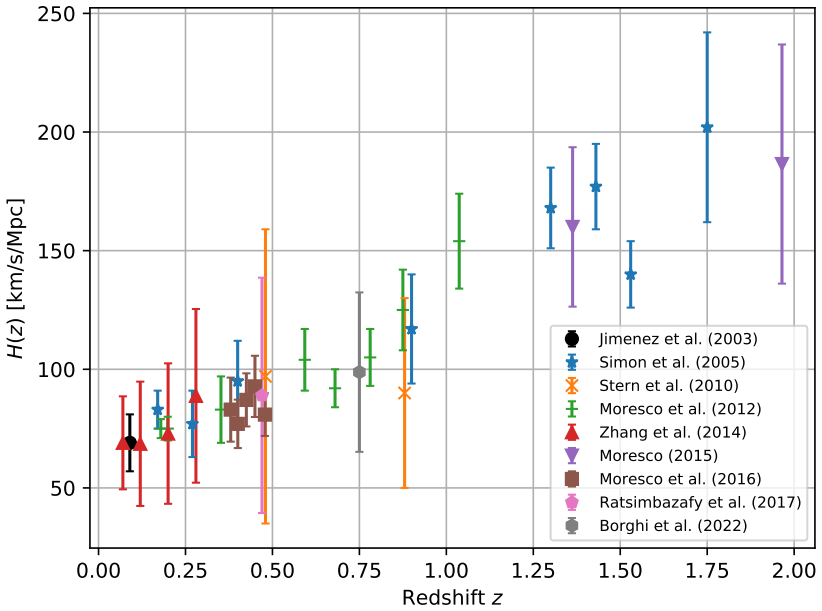
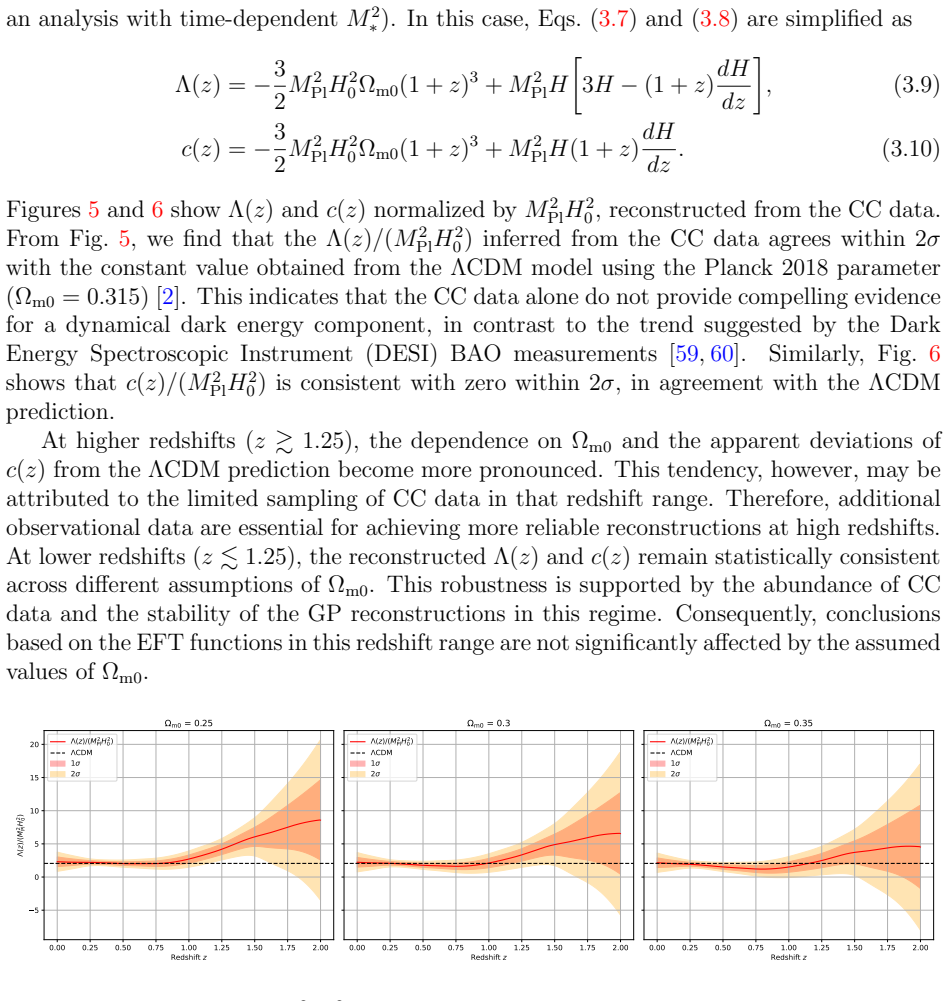
The effective field theory (EFT) of dark energy provides a model-independent framework for studying cosmology within scalar-tensor theories. In this work, we explore how the time evolution of the cosmological background, inferred from cosmic chronometer measurements of the Hubble parameter, can be used to reconstruct the relevant EFT functions. Our approach enables the direct determination of these EFT functions from observational data without assuming any specific cosmological model. This makes it possible to test the background evolution of a wide range of dark energy models, including the $\Lambda$CDM model. We further demonstrate how the reconstructed EFT functions can be applied to constrain concrete theories, such as the quintessence model.
Editorial analysis
A structured set of objections, weighed in public.
Referee Report
Summary. The manuscript proposes reconstructing the time-dependent background EFT functions in the effective field theory of dark energy directly from cosmic chronometer H(z) measurements. It claims this procedure enables model-independent determination of the EFT functions from observational data, allowing tests of the background evolution for a range of dark energy models including ΛCDM and constraints on specific theories such as quintessence.
Significance. If the reconstruction is robust against data systematics and properly validated, the approach could provide a useful data-driven tool for probing scalar-tensor dark energy models at the background level, complementing perturbation-based EFT analyses. The significance is currently limited by the absence of detailed error propagation and mock validation, which are needed to establish that the method yields reliable constraints rather than being dominated by chronometer uncertainties.
major comments (2)
- [Reconstruction procedure] Reconstruction procedure (main text, likely §3): The central claim of 'direct determination of these EFT functions from observational data without assuming any specific cosmological model' requires explicit demonstration that residual systematics in cosmic chronometer H(z) (typically 5-10% from stellar population synthesis and selection effects) do not propagate into biased EFT functions. No quantitative propagation or bias assessment is provided, undermining the model-independence assertion.
- [Validation and error analysis] Validation and error analysis (likely §4): The manuscript lacks mock-data validation of the reconstruction pipeline and detailed error propagation from H(z) uncertainties to the EFT functions. Without these, it is unclear whether the reconstructed functions can meaningfully constrain models or distinguish them from systematics.
minor comments (2)
- [Abstract] The abstract would benefit from specifying the redshift range and number of chronometer data points used in the reconstruction.
- [Introduction] Notation for the EFT functions (e.g., time-dependent coefficients) should be defined more explicitly at first use to improve readability for readers unfamiliar with the EFT framework.
Simulated Author's Rebuttal
We thank the referee for the constructive comments on our manuscript. The points raised regarding robustness to systematics and the need for validation are well taken, and we will strengthen the paper accordingly. We address each major comment below.
read point-by-point responses
-
Referee: Reconstruction procedure (main text, likely §3): The central claim of 'direct determination of these EFT functions from observational data without assuming any specific cosmological model' requires explicit demonstration that residual systematics in cosmic chronometer H(z) (typically 5-10% from stellar population synthesis and selection effects) do not propagate into biased EFT functions. No quantitative propagation or bias assessment is provided, undermining the model-independence assertion.
Authors: We agree that a quantitative assessment of systematics propagation is required to fully substantiate the model-independence of the reconstruction. The method derives the background EFT functions directly from the measured H(z) without presupposing any particular dark energy model or parametrization; the model independence refers to the absence of an assumed functional form for the dark energy sector rather than a claim of immunity to data errors. In the revised manuscript we will add an explicit propagation analysis, including sensitivity tests that inject 5-10% systematic shifts into the H(z) data and quantify the resulting bias and uncertainty in the reconstructed EFT functions. revision: yes
-
Referee: Validation and error analysis (likely §4): The manuscript lacks mock-data validation of the reconstruction pipeline and detailed error propagation from H(z) uncertainties to the EFT functions. Without these, it is unclear whether the reconstructed functions can meaningfully constrain models or distinguish them from systematics.
Authors: We acknowledge that the current version does not contain mock-data validation or a full error-propagation study. To address this, the revised manuscript will include a dedicated validation section that generates synthetic H(z) catalogs from fiducial EFT models (including ΛCDM and quintessence), applies the reconstruction pipeline, and demonstrates recovery of the input functions within the expected uncertainties. Detailed error propagation from the chronometer covariance matrix to the EFT functions will be provided, using both analytic differentiation and Monte Carlo sampling to produce error bands on the reconstructed quantities. revision: yes
Circularity Check
Reconstruction from external chronometer data is independent of fitted EFT outputs
full rationale
The paper derives relations between the EFT background functions and the Hubble parameter H(z) from the standard EFT action for dark energy, then inverts those relations using measured H(z) values from cosmic chronometers as external input. No step reduces a claimed prediction or first-principles result to a fitted parameter by construction, nor does any load-bearing premise rest on self-citation chains or ansatzes imported from prior author work. The output EFT functions are determined directly by the data via the EFT equations rather than being equivalent to the inputs; the method is therefore self-contained against external benchmarks.
Axiom & Free-Parameter Ledger
axioms (1)
- domain assumption The EFT of dark energy provides a model-independent description of scalar-tensor theories at the background level.
Lean theorems connected to this paper
-
IndisputableMonolith/Cost/FunctionalEquation.leanwashburn_uniqueness_aczel unclear?
unclearRelation between the paper passage and the cited Recognition theorem.
Our approach enables the direct determination of these EFT functions from observational data without assuming any specific cosmological model.
-
IndisputableMonolith/Foundation/RealityFromDistinction.leanreality_from_one_distinction unclear?
unclearRelation between the paper passage and the cited Recognition theorem.
reconstruct the relevant EFT functions... using the Hubble parameter H(z)... inferred from cosmic chronometer observations via the Gaussian process regression technique
What do these tags mean?
- matches
- The paper's claim is directly supported by a theorem in the formal canon.
- supports
- The theorem supports part of the paper's argument, but the paper may add assumptions or extra steps.
- extends
- The paper goes beyond the formal theorem; the theorem is a base layer rather than the whole result.
- uses
- The paper appears to rely on the theorem as machinery.
- contradicts
- The paper's claim conflicts with a theorem or certificate in the canon.
- unclear
- Pith found a possible connection, but the passage is too broad, indirect, or ambiguous to say the theorem truly supports the claim.
Reference graph
Works this paper leans on
-
[1]
A. G. Riess et al.,A Comprehensive Measurement of the Local Value of the Hubble Constant with 1 km s −1 Mpc−1 Uncertainty from the Hubble Space Telescope and the SH0ES Team,Astrophys. J. Lett.934(2022) L7, [arXiv:2112.04510]. #7A brief comment on this parametrization is in order. In the EFT of cosmological perturbations de- scribed by the action (3.3), on...
work page internal anchor Pith review Pith/arXiv arXiv 2022
-
[2]
Tensions between the Early and the Late Universe
L. Verde, T. Treu, and A. G. Riess,Tensions between the Early and the Late Universe, Nature Astron.3(2019) 891, [arXiv:1907.10625]
work page internal anchor Pith review Pith/arXiv arXiv 2019
-
[3]
J. Renk, M. Zumalac´ arregui, F. Montanari, and A. Barreira,Galileon gravity in light of ISW, CMB, BAO and H 0 data,JCAP10(2017) 020, [arXiv:1707.02263]
work page internal anchor Pith review Pith/arXiv arXiv 2017
- [4]
-
[5]
M. Braglia, M. Ballardini, F. Finelli, and K. Koyama,Early modified gravity in light of theH 0 tension and LSS data,Phys. Rev. D103(2021) 043528, [arXiv:2011.12934]
-
[6]
Cosmological Tests of Modified Gravity
K. Koyama,Cosmological Tests of Modified Gravity,Rept. Prog. Phys.79(2016) 046902, [arXiv:1504.04623]
work page internal anchor Pith review Pith/arXiv arXiv 2016
- [7]
-
[8]
S. Arai et al.,Cosmological gravity probes: connecting recent theoretical developments to forthcoming observations,PTEP2023(2023) 072E01, [arXiv:2212.09094]
-
[9]
G. W. Horndeski,Second-order scalar-tensor field equations in a four-dimensional space,Int. J. Theor. Phys.10(1974) 363–384
work page 1974
-
[10]
From k-essence to generalised Galileons
C. Deffayet, X. Gao, D. A. Steer, and G. Zahariade,From k-essence to generalised Galileons,Phys. Rev. D84(2011) 064039, [arXiv:1103.3260]
work page internal anchor Pith review Pith/arXiv arXiv 2011
-
[11]
Generalized G-inflation: Inflation with the most general second-order field equations
T. Kobayashi, M. Yamaguchi, and J. Yokoyama,Generalized G-inflation: Inflation with the most general second-order field equations,Prog. Theor. Phys.126(2011) 511–529, [arXiv:1105.5723]
work page internal anchor Pith review Pith/arXiv arXiv 2011
-
[12]
Degenerate higher derivative theories beyond Horndeski: evading the Ostrogradski instability
D. Langlois and K. Noui,Degenerate higher derivative theories beyond Horndeski: evading the Ostrogradski instability,JCAP02(2016) 034, [arXiv:1510.06930]
work page internal anchor Pith review Pith/arXiv arXiv 2016
-
[13]
Extended Scalar-Tensor Theories of Gravity
M. Crisostomi, K. Koyama, and G. Tasinato,Extended Scalar-Tensor Theories of Gravity,JCAP04(2016) 044, [arXiv:1602.03119]
work page internal anchor Pith review Pith/arXiv arXiv 2016
-
[14]
Degenerate higher order scalar-tensor theories beyond Horndeski up to cubic order
J. Ben Achour, M. Crisostomi, K. Koyama, D. Langlois, K. Noui, and G. Tasinato, Degenerate higher order scalar-tensor theories beyond Horndeski up to cubic order, JHEP12(2016) 100, [arXiv:1608.08135]. 17
work page internal anchor Pith review Pith/arXiv arXiv 2016
-
[15]
"Shadowy" modes in Higher-Order Scalar-Tensor theories
A. De Felice, D. Langlois, S. Mukohyama, K. Noui, and A. Wang,Generalized instantaneous modes in higher-order scalar-tensor theories,Phys. Rev. D98(2018) 084024, [arXiv:1803.06241]
work page internal anchor Pith review Pith/arXiv arXiv 2018
-
[16]
A. De Felice, S. Mukohyama, and K. Takahashi,Nonlinear definition of the shadowy mode in higher-order scalar-tensor theories,JCAP12(2021) 020, [arXiv:2110.03194]
-
[17]
K. Takahashi, H. Motohashi, and M. Minamitsuji,Invertible disformal transformations with higher derivatives,Phys. Rev. D105(2022) 024015, [arXiv:2111.11634]
-
[18]
K. Takahashi, M. Minamitsuji, and H. Motohashi,Generalized disformal Horndeski theories: cosmological perturbations and consistent matter coupling,PTEP2023 (2023) 013E01, [arXiv:2209.02176]
-
[19]
K. Takahashi, M. Minamitsuji, and H. Motohashi,Effective description of generalized disformal theories,JCAP07(2023) 009, [arXiv:2304.08624]
-
[20]
Takahashi,Invertible disformal transformations with arbitrary higher-order derivatives,Phys
K. Takahashi,Invertible disformal transformations with arbitrary higher-order derivatives,Phys. Rev. D108(2023) 084031, [arXiv:2307.08814]
-
[21]
Dark Energy and Modified Gravity in Degenerate Higher-Order Scalar-Tensor (DHOST) theories: a review
D. Langlois,Dark energy and modified gravity in degenerate higher-order scalar–tensor (DHOST) theories: A review,Int. J. Mod. Phys. D28(2019) 1942006, [arXiv:1811.06271]
work page internal anchor Pith review Pith/arXiv arXiv 2019
-
[22]
Horndeski theory and beyond: a review
T. Kobayashi,Horndeski theory and beyond: a review,Rept. Prog. Phys.82(2019) 086901, [arXiv:1901.07183]
work page internal anchor Pith review Pith/arXiv arXiv 2019
-
[23]
Starting the Universe: Stable Violation of the Null Energy Condition and Non-standard Cosmologies
P. Creminelli, M. A. Luty, A. Nicolis, and L. Senatore,Starting the Universe: Stable Violation of the Null Energy Condition and Non-standard Cosmologies,JHEP12 (2006) 080, [hep-th/0606090]
work page internal anchor Pith review Pith/arXiv arXiv 2006
-
[24]
The Effective Field Theory of Inflation
C. Cheung, P. Creminelli, A. L. Fitzpatrick, J. Kaplan, and L. Senatore,The Effective Field Theory of Inflation,JHEP03(2008) 014, [arXiv:0709.0293]
work page internal anchor Pith review Pith/arXiv arXiv 2008
-
[25]
The Effective Field Theory of Dark Energy
G. Gubitosi, F. Piazza, and F. Vernizzi,The Effective Field Theory of Dark Energy, JCAP02(2013) 032, [arXiv:1210.0201]. [27]PlanckCollaboration, P. A. R. Ade et al.,Planck 2015 results. XIV. Dark energy and modified gravity,Astron. Astrophys.594(2016) A14, [arXiv:1502.01590]
work page internal anchor Pith review Pith/arXiv arXiv 2013
-
[26]
A. Durakovic, P. Hunt, S. P. Patil, and S. Sarkar,Reconstructing the EFT of Inflation from Cosmological Data,SciPost Phys.7(2019) 049, [arXiv:1904.00991]
-
[27]
Constraining Cosmological Parameters Based on Relative Galaxy Ages
R. Jimenez and A. Loeb,Constraining cosmological parameters based on relative galaxy ages,Astrophys. J.573(2002) 37–42, [astro-ph/0106145]. 18
work page internal anchor Pith review Pith/arXiv arXiv 2002
-
[28]
M. Moresco, R. Jimenez, L. Verde, A. Cimatti, and L. Pozzetti,Setting the Stage for Cosmic Chronometers. II. Impact of Stellar Population Synthesis Models Systematics and Full Covariance Matrix,Astrophys. J.898(2020) 82, [arXiv:2003.07362]
-
[29]
F. Jalilvand and A. Mehrabi,Model independent estimation of the cosmography parameters using cosmic chronometers,Eur. Phys. J. Plus137(2022) 1341, [arXiv:2209.05782]
-
[30]
Model-independent determination on $H_0$ using the latest $H(z)$ data
D. Wang and X.-H. Meng,Model-independent determination on H 0 using the latest cosmic chronometer data,Sci. China Phys. Mech. Astron.60(2017) 110411, [arXiv:1610.01202]
work page internal anchor Pith review Pith/arXiv arXiv 2017
-
[31]
R. Jimenez, L. Verde, T. Treu, and D. Stern,Constraints on the equation of state of dark energy and the Hubble constant from stellar ages and the CMB,Astrophys. J. 593(2003) 622–629, [astro-ph/0302560]
work page internal anchor Pith review Pith/arXiv arXiv 2003
-
[32]
Constraints on the redshift dependence of the dark energy potential
J. Simon, L. Verde, and R. Jimenez,Constraints on the redshift dependence of the dark energy potential,Phys. Rev. D71(2005) 123001, [astro-ph/0412269]
work page internal anchor Pith review Pith/arXiv arXiv 2005
-
[33]
Cosmic Chronometers: Constraining the Equation of State of Dark Energy. I: H(z) Measurements
D. Stern, R. Jimenez, L. Verde, M. Kamionkowski, and S. A. Stanford,Cosmic Chronometers: Constraining the Equation of State of Dark Energy. I: H(z) Measurements,JCAP02(2010) 008, [arXiv:0907.3149]
work page internal anchor Pith review Pith/arXiv arXiv 2010
-
[34]
M. Moresco et al.,Improved constraints on the expansion rate of the Universe up to z∼1.1from the spectroscopic evolution of cosmic chronometers,JCAP08(2012) 006, [arXiv:1201.3609]
work page internal anchor Pith review Pith/arXiv arXiv 2012
-
[35]
C. Zhang, H. Zhang, S. Yuan, S. Liu, T.-J. Zhang, and Y.-C. Sun,Four new observational H(z) data from luminous red galaxies in the Sloan Digital Sky Survey data release seven,Research in Astronomy and Astrophysics14(Oct., 2014) 1221–1233, [arXiv:1207.4541]
work page internal anchor Pith review Pith/arXiv arXiv 2014
-
[36]
Raising the bar: new constraints on the Hubble parameter with cosmic chronometers at z$\sim$2
M. Moresco,Raising the bar: new constraints on the Hubble parameter with cosmic chronometers at z∼2,Mon. Not. Roy. Astron. Soc.450(2015) L16–L20, [arXiv:1503.01116]
work page internal anchor Pith review Pith/arXiv arXiv 2015
-
[37]
M. Moresco, L. Pozzetti, A. Cimatti, R. Jimenez, C. Maraston, L. Verde, D. Thomas, A. Citro, R. Tojeiro, and D. Wilkinson,A 6% measurement of the Hubble parameter at z∼0.45: direct evidence of the epoch of cosmic re-acceleration,JCAP05(2016) 014, [arXiv:1601.01701]
work page internal anchor Pith review Pith/arXiv arXiv 2016
-
[38]
A. L. Ratsimbazafy, S. I. Loubser, S. M. Crawford, C. M. Cress, B. A. Bassett, R. C. Nichol, and P. V¨ ais¨ anen,Age-dating Luminous Red Galaxies observed with the Southern African Large Telescope,Mon. Not. Roy. Astron. Soc.467(2017) 3239–3254, [arXiv:1702.00418]. 19
work page internal anchor Pith review Pith/arXiv arXiv 2017
- [39]
-
[40]
Beckers,An Introduction to Gaussian Process Models,arXiv:2102.05497
T. Beckers,An Introduction to Gaussian Process Models,arXiv:2102.05497
-
[41]
V. C. Busti, C. Clarkson, and M. Seikel,Evidence for a Lower Value forH 0 from Cosmic Chronometers Data?,Mon. Not. Roy. Astron. Soc.441(2014) 11, [arXiv:1402.5429]
work page internal anchor Pith review Pith/arXiv arXiv 2014
-
[42]
A. G´ omez-Valent and L. Amendola,H0 from cosmic chronometers and Type Ia supernovae, with Gaussian Processes and the novel Weighted Polynomial Regression method,JCAP04(2018) 051, [arXiv:1802.01505]
work page internal anchor Pith review Pith/arXiv arXiv 2018
-
[43]
A. Shafieloo, A. G. Kim, and E. V. Linder,Gaussian Process Cosmography,Phys. Rev. D85(2012) 123530, [arXiv:1204.2272]
work page internal anchor Pith review Pith/arXiv arXiv 2012
- [44]
-
[45]
A. M. Pinho, S. Casas, and L. Amendola,Model-independent reconstruction of the linear anisotropic stressη,JCAP11(2018) 027, [arXiv:1805.00027]
work page internal anchor Pith review Pith/arXiv arXiv 2018
-
[46]
A. Mehrabi and S. Basilakos,DoesΛCDM really be in tension with the Hubble diagram data?,Eur. Phys. J. C80(2020) 632, [arXiv:2002.12577]
-
[47]
Smoothing Supernova Data to Reconstruct the Expansion History of the Universe and its Age
A. Shafieloo, U. Alam, V. Sahni, and A. A. Starobinsky,Smoothing Supernova Data to Reconstruct the Expansion History of the Universe and its Age,Mon. Not. Roy. Astron. Soc.366(2006) 1081–1095, [astro-ph/0505329]
work page internal anchor Pith review Pith/arXiv arXiv 2006
-
[48]
A. Shafieloo,Model Independent Reconstruction of the Expansion History of the Universe and the Properties of Dark Energy,Mon. Not. Roy. Astron. Soc.380(2007) 1573–1580, [astro-ph/0703034]
work page internal anchor Pith review Pith/arXiv arXiv 2007
-
[49]
Model independent tests of the standard cosmological model
A. Shafieloo and C. Clarkson,Model independent tests of the standard cosmological model,Phys. Rev. D81(2010) 083537, [arXiv:0911.4858]
work page internal anchor Pith review Pith/arXiv arXiv 2010
- [50]
- [51]
- [52]
- [53]
-
[54]
J. K. Bloomfield, ´E. ´E. Flanagan, M. Park, and S. Watson,Dark energy or modified gravity? An effective field theory approach,JCAP08(2013) 010, [arXiv:1211.7054]
work page internal anchor Pith review Pith/arXiv arXiv 2013
-
[55]
Essential Building Blocks of Dark Energy
J. Gleyzes, D. Langlois, F. Piazza, and F. Vernizzi,Essential Building Blocks of Dark Energy,JCAP08(2013) 025, [arXiv:1304.4840]
work page internal anchor Pith review Pith/arXiv arXiv 2013
-
[56]
The effective field theory of inflation/dark energy and the Horndeski theory
S. Tsujikawa,The effective field theory of inflation/dark energy and the Horndeski theory,Lect. Notes Phys.892(2015) 97–136, [arXiv:1404.2684]. [59]DESICollaboration, A. G. Adame et al.,DESI 2024 IV: Baryon Acoustic Oscillations from the Lyman alpha forest,JCAP01(2025) 124, [arXiv:2404.03001]. [60]DESICollaboration, A. G. Adame et al.,DESI 2024 VI: cosmol...
work page internal anchor Pith review Pith/arXiv arXiv 2015
-
[57]
A. A. Starobinsky,How to determine an effective potential for a variable cosmological term,JETP Lett.68(1998) 757–763, [astro-ph/9810431]
work page internal anchor Pith review Pith/arXiv arXiv 1998
-
[58]
Determining the Equation of State of the Expanding Universe: Inverse Problem in Cosmology
T. Nakamura and T. Chiba,Determining the equation of state of the expanding universe: Inverse problem in cosmology,Mon. Not. Roy. Astron. Soc.306(1999) 696–700, [astro-ph/9810447]
work page internal anchor Pith review Pith/arXiv arXiv 1999
-
[59]
Feasibility of Reconstructing the Quintessential Potential Using SNIa Data
T. Chiba and T. Nakamura,Feasibility of reconstructing the quintessential potential using SNIa data,Phys. Rev. D62(2000) 121301, [astro-ph/0008175]
work page internal anchor Pith review Pith/arXiv arXiv 2000
-
[60]
Y. Fujii,Origin of the Gravitational Constant and Particle Masses in Scale Invariant Scalar - Tensor Theory,Phys. Rev. D26(1982) 2580
work page 1982
-
[61]
B. Ratra and P. J. E. Peebles,Cosmological Consequences of a Rolling Homogeneous Scalar Field,Phys. Rev. D37(1988) 3406
work page 1988
-
[62]
T. Chiba, N. Sugiyama, and T. Nakamura,Cosmology with x matter,Mon. Not. Roy. Astron. Soc.289(1997) L5–L9, [astro-ph/9704199]
work page internal anchor Pith review Pith/arXiv arXiv 1997
-
[63]
E. J. Copeland, A. R. Liddle, and D. Wands,Exponential potentials and cosmological scaling solutions,Phys. Rev. D57(1998) 4686–4690, [gr-qc/9711068]. 21
work page internal anchor Pith review Pith/arXiv arXiv 1998
-
[64]
P. G. Ferreira and M. Joyce,Cosmology with a primordial scaling field,Phys. Rev. D 58(1998) 023503, [astro-ph/9711102]
work page internal anchor Pith review Pith/arXiv arXiv 1998
-
[65]
R. R. Caldwell, R. Dave, and P. J. Steinhardt,Cosmological imprint of an energy component with general equation of state,Phys. Rev. Lett.80(1998) 1582–1585, [astro-ph/9708069]
work page internal anchor Pith review Pith/arXiv arXiv 1998
-
[66]
Quintessence, Cosmic Coincidence, and the Cosmological Constant
I. Zlatev, L.-M. Wang, and P. J. Steinhardt,Quintessence, cosmic coincidence, and the cosmological constant,Phys. Rev. Lett.82(1999) 896–899, [astro-ph/9807002]
work page internal anchor Pith review Pith/arXiv arXiv 1999
-
[67]
Effective Field Theory of Cosmic Acceleration: constraining dark energy with CMB data
M. Raveri, B. Hu, N. Frusciante, and A. Silvestri,Effective Field Theory of Cosmic Acceleration: constraining dark energy with CMB data,Phys. Rev. D90(2014) 043513, [arXiv:1405.1022]
work page internal anchor Pith review Pith/arXiv arXiv 2014
-
[68]
Hiramatsu,CMB constraints on DHOST theories,JCAP10(2022) 035, [arXiv:2205.11559]
T. Hiramatsu,CMB constraints on DHOST theories,JCAP10(2022) 035, [arXiv:2205.11559]. [73]LIGO Scientific, VirgoCollaboration, B. P. Abbott et al.,GW170817: Observation of Gravitational Waves from a Binary Neutron Star Inspiral,Phys. Rev. Lett.119 (2017) 161101, [arXiv:1710.05832]. [74]LIGO Scientific, Virgo, Fermi GBM, INTEGRAL, IceCube, AstroSat Cadmium ...
discussion (0)
Sign in with ORCID, Apple, or X to comment. Anyone can read and Pith papers without signing in.